The Eastern Buddhist 43/1&2: 133–152
©2012 The Eastern Buddhist Society
of Japanese Buddhism
H
ayasHiM
akotot
Hestartingpoint for modernization in East Asia, in my view, occurred after the middle of the nineteenth century when the Western great powers began to interact with China and Japan. The Opium War of 1840 to 1842 is one example: it was a historic event which gave rise to the opening of China and its condition of partial colonization. As for Japan, the American naval commander Perry came to Uraga 浦賀 in 1853 and demanded the opening of the country, an incident known to virtually every Japanese person. While such examples involved China and Japan, in various other non-Western countries too, the Western powers hammered on their doors and demanded open access or colonization; these were shocking incidents which are quite memorable.The starting point, and even the definition, of modernization in Europe is a matter of debate which goes beyond my inquiry here and is not an issue absolutely necessary to my argument. This paper only requires the starting point of modernization in East Asia. There, the Western great powers shook the East Asian world by means of military threat, and through coercion accelerated the shift from traditional society to modern society. Or, in terms of a more generalized argument: by spreading into the non-Western regions of the world, the influence of the Western great powers rolled those regions into the capitalist system, which became an important condition that forced the people in these areas to become conscious of “modernity.” In West-ern history itself, there is no comparable event that can be pointed to as a shocking encounter with “the Western,” and even if Westerners were to seek the starting place of modernity inside their own history, it would be impos-sible to point to a single answer, for there are so many posimpos-sible candidates.
However, for the Japanese, the start of modernity is quite clear; it is either the arrival of Perry in 1853, or the Meiji Restoration in 1868. Thus the Japa-nese encounter with the shock of modernity occurred from the latter half of the nineteenth century to the opening of the twentieth: the so-called Age of Imperialism.1
International Laws and the Unequal Treaties
Amidst the warfare and confusion within nineteenth-century Europe, some kind of consensus became necessary among the great powers, and thus inter-national law came into being. In the case of East Asia, in 1864 the work
Ele-ments of International Law by Henry Wheaton (1785–1848), an American
scholar of international law, was translated by the American missionary Wil-liam Martin (1827–1916) and published in China;2 in Japan it was published in 1865. Elements of International Law continued to be issued afterwards in Japan and also Korea and became widely read for generations. The construc-tion of relaconstruc-tionships with the Western great powers was a matter of pressing concern for the various countries of East Asia. According to international law, among the Western countries equalities were guaranteed, but in coun-tries without such sovereignty, it was written that their fate would be coloni-zation.3 However, certain regions existed which were neither sovereign nor colonized. These included the independent countries of Asia with which the great powers formed unequal treaty relationships, specifically Iran (Persia), Egypt, China, Turkey, and Japan.
According to international law, three types of regions were presumed to exist: the civilized, the half-civilized, and the savage. These were common assumptions in the West in the latter half of the nineteenth century. The international law jurist James Lorimer (1818–1890) divided human beings into three groups according to their level of civilization, using the English terms “civilized humanity,” “barbarous humanity” and “savage humanity.”4 For the second category of barbarous (half-civilized), considering that such people could only give “partial political consent,” an unequal relationship
1 Nakayama 1961.
2 Satō 1977. Additionally, on the reception of international law in Japan at the end of the
early modern regime and the beginning of the Meiji, see Yoshino 1927, Sumiyoshi 1973, and the “Kaisetsu” 解説 (Commentary) section in Murata and Modeki 2010.
3 Since they received the diplomatic protection of the great powers, subordinated
“protec-torates” or “dependencies” were not considered to have the qualifications of nations (Ishikawa 1890, pp. 75–76).
was legitimate. Japan, being identified as a half-civilized country, along the lines of Iran and Egypt, was thus the object of similar unequal treaties. The conditions given by the Western great powers for national sovereignty were four: (1) having the political regime of a nation state; (2) having the conti-nuity of a nation state; (3) having security of territorial control; and (4) hav-ing the quality of independence.5
Even among Western scholars there was a breadth of views, ranging from the opinion that national sovereignty only existed in the sphere of Western Christianity, to the opinion that in the non-Western, savage countries too there was the possibility for the birth of sovereignty. Japanese politicians and international legal scholars maintained the latter position, considering that the Western great powers had to revise the unequal treaties with Japan and recognize it as an equal sovereign state.
The countries which aimed at the establishment of an East Asian sover-eign state in the latter half of the nineteenth century and attempted modern-ization were China and Japan. The competition of these two rivals gradually escalated to the point of the outbreak of the Sino-Japanese War. Japan, endeavoring at treaty reform, intended to be a sovereign state recognized by the Western great powers and ultimately, by its victory in the Russo-Japanese War, acquired recognition as a civilized nation.
The traditional East Asian view of civilization was linked to a Sinophi-lism with China located at the center. Here existed a dichotomy of the Han-Sinitic versus the non-Han ethnicities; the non-Han nations were supposed to offer tribute to the Chinese emperor. Chinese civilization consisted of tra-ditions for cultivating education and ceremony which were maintained by a literate bureaucratic mandarin class; this Chinese-transmitted civilization
5 See the appendix on case precedents (hanketsurei 判決例) in Fujita 1891, p. 19.
Year Country Subject to Treaty Country Making Treaty Name of Treaty
1828 Iran Russia Treaty of Turkmenchay
1840 Egypt England, Russia, Prussia,
Austria London Four-nation Treaty
1842 China England Treaty of Nanjing
1856 Turkey Russia Treaty of Paris
1858 Japan America, Holland, Russia,
England, France Ansei Five-nation Treaty Figure 1. Unequal treaties between Western great powers and other countries
of Confucianism, Buddhism, and the ancient Chinese historical chronicles were received and embedded in Korea, Japan, and Vietnam. Of course, after the Opium War of 1840–1842, the formerly tribute-paying countries separated from China, and their traditional Sino-centric view of culture withered; instead, at that point the signpost of civilization became Western-type elements—institutions and cultural patterns including modern political regimes, modern law, armies, science and technology, and educational sys-tems—which had been created by modern sovereign nation states.
So to review the argument to this point: following from the events of Per-ry’s arrival and the first, unequal treaties between Japan and America, Japan was drawn up into the modern world led by the Western great powers but initially received recognition as (only) semi-civilized or barbarous. How-ever, Japan afterwards rushed to quickly establish a foundation as a modern state; it fought and defeated its rival China; it was subsequently victorious in the Russo-Japanese War; and it was able to achieve recognition from the Western great powers as a “civilized nation.” How the defeat of Russia in particular secured the image of Japan as a civilized nation in foreign coun-tries can be seen from the following citation:
There now exists an image of Russia as an autocratic state, and of a civilized Japan as a constitutional monarchy with freedom of religion. England and the States had hopes that Japan might be the one to throw open the doors of Manchuria. The newspaper
The Times (of London 6 February 1904) reported: “it is part of the
irony of the situation that in this controversy the Asiatic Power represents the forces of civilizing progress, and the European Power those of mechanical repression.”6
Through the course of the Sino-Japanese War, the treaty revisions, and the Russo-Japanese War, Japan succeeded in improving its status from a bar-barous to a civilized country, and ultimately even succeeded in becoming “the West” in Asia. Simultaneously, it became the emblematic representa-tive of Asia for the West. In other words, having satisfied the conditions for becoming a civilized country, Japan stood in the position of a “Western-ized nation” from which it claimed the right to serve as the leading power in Asia. This duality—towards Asia Japan showed its “Western card,” while towards the West Japan showed its “Asian card”—became Japan’s representation on the world stage. Yet in the hearts and minds of Japanese
politicians and intellectuals, it also implanted the dual emotions of superiority and inferiority.
The Era of Modern Buddhism
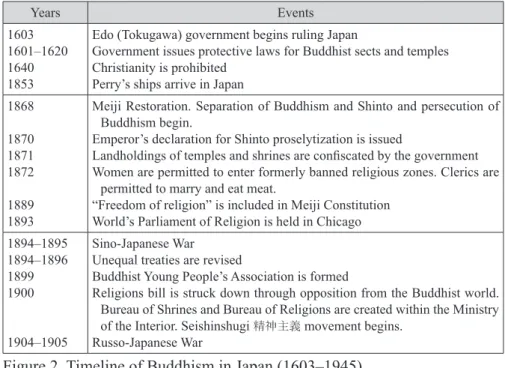
My article deals with three time periods. The first is the early modern period (the Tokugawa 徳川, or Edo 江戸, period); the second is the initial part of the modern period; and the third extends from the Sino-Japanese and Russo-Japanese Wars up to the Second World War. I will not touch on the period after 1945.
The early modern period extended from 1603 to 1868. Its regime, called the Tokugawa bakufu or shogunate, managed and protected Buddhism by relationships with each sectarian organization separately. The regime granted estate land to the large temples, thus providing them with economic patron-age. The Tendai 天台, Pure Land, and Shingon 真言 lineages were regarded favorably, but the True Pure Land and Nichiren 日蓮 groups, which had caused political disturbances in the sixteenth century, were treated more coldly in this process. The Edo bakufu regime was largely a state centered on
Years Events
1603 1601–1620 1640 1853
Edo (Tokugawa) government begins ruling Japan
Government issues protective laws for Buddhist sects and temples Christianity is prohibited
Perry’s ships arrive in Japan 1868 1870 1871 1872 1889 1893
Meiji Restoration. Separation of Buddhism and Shinto and persecution of Buddhism begin.
Emperor’s declaration for Shinto proselytization is issued
Landholdings of temples and shrines are confiscated by the government Women are permitted to enter formerly banned religious zones. Clerics are
permitted to marry and eat meat.
“Freedom of religion” is included in Meiji Constitution World’s Parliament of Religion is held in Chicago 1894–1895 1894–1896 1899 1900 1904–1905 Sino-Japanese War Unequal treaties are revised
Buddhist Young People’s Association is formed
Religions bill is struck down through opposition from the Buddhist world. Bureau of Shrines and Bureau of Religions are created within the Ministry of the Interior. Seishinshugi 精神主義 movement begins.
Russo-Japanese War
Confucian teaching, but also not lost was the character of a Buddhist mon-archy which donated to and protected the Buddhist monastic institution.
The second period, when modern Buddhism was formed, extended from the Meiji Restoration (1868) to the Russo-Japanese War (1904–1905). Dur-ing this period Japan became a sovereign nation state. In 1868 the new government issued a decree which attempted the separation of Shinto and Buddhism. Instigated by this decree, a period of destructiveness towards Buddhist institutions called haibutsu kishaku 廃仏毀釈 (abolish Buddhism and destroy Śākyamuni) ensued throughout Japan. Also, the new Meiji gov-ernment, which had overthrown the earlier Edo bakufu regime, abandoned all economic assistance to the Buddhist organizations, causing many of the lineages to fall into serious financial straits.
Because the Meiji government did not regard Buddhist clerics as spe-cially privileged and instead treated them as ordinary citizens, in 1872 it issued a directive recognizing clerical marriage. The True Pure Land School, which had originally never had rules of celibacy at all, had an advantage in the new era. Meanwhile Christian missionaries were prodigiously active, and the numbers of followers of Christianity grew year by year. The Bud-dhist organizations were concerned about the expansion of Christianity and displayed a posture of antagonism towards the missionaries.7 In 1889 the new Meiji Constitution was promulgated, which contained an article guar-anteeing freedom of religion. Christians understood that by the constitution, freedom of Christian faith was now permitted.
The third period, when modern Buddhism evolved, extended from the Russo-Japanese War to the end of the Second World War. Through its victo-ries in the Sino-Japanese and Russo-Japanese Wars and the treaty revisions, Japan became recognized as a civilized nation by Europe and the United States and thereafter as the “Westernized country” in Asia. It was Japan in particular among other Asian countries that learned Western technologies, arts, and sciences, thereby becoming a site that could offer training in these areas. After the Russo-Japanese War, many Chinese students were sent to study in Japan, but their purpose was not to study Japanese culture, but rather to acquire Western-style education and science. Figure 3 illustrates the increase in numbers of these Chinese students.
Such rapid growth was due to the policy of the Qing government in China, which instead of sending its students to the West, resorted to a policy of hav-ing them do foreign study in Japan. One reason was that there were a great
number of Japanese translations of Western books in Japan, which enabled Chinese foreign students to acquire Western education and culture relatively easily, while another was that compared to a study period in the West the requirements in cost and time were much less.9 Thus through international education Japan accomplished its role as “another West” within Asia.
On the other hand, vis-à-vis the West, Japan regarded itself as the repre-sentative emblem of Asian culture. For example, against Western material-ism it promoted the idea of the superior spirituality of Asian philosophy and religion. The writer Nitobe Inazō 新渡戸稲造 (1862–1933) published his book Bushido: The Soul of Japan (1900) in English. He expressed the view, which came from both inside and outside Japan, that the Japanese achieved their victory in the Russo-Japanese War through a patriotism informed by the samurai path. Other books which were widely read in the English-speaking world included The Ideals of the East (1903) and The Book of Tea (1906) by Okakura (Tenshin) Kakuzō 岡倉(天心)覚三 (1862–1913), and the works on Zen by Suzuki Daisetsu 鈴木大拙 (1870–1966). These works all preached a message about the sophistication of Japanese and Asian spirituality aimed at English-reading audiences. The field of Oriental studies which flourished around this time had the same tendency.10 Thinking they were in a position to play the part, Japanese people more than other East Asians turned to the West and explained the value of Oriental tradition, history, and culture.
At the beginning of this third period, several epochal events occurred, including (1) the various Buddhist organizations’ movements for the official recognition of Buddhism; (2) the emergence of groups attempting to reform Buddhism; (3) overseas proselytization by Japanese Buddhism; (4) the institutionalization of academic Buddhist studies.
8 Qian and Jin 1996, p. 60. 9 Qian and Jin 1996, pp. 61–62.
10 On the development of Oriental studies, see Tanaka 1995.
Year Number of Students
1896 13
1902 500
1903 1,300
1905–1906 10,000
First, let us consider the movements for official recognition led by the various Buddhist organizations. These movements reached their peak as all of the Buddhist denominations (with the exception of Nishi Honganji 西本願 寺, the “Western” branch of True Pure Land) stood in opposition to the estab-lishment of a Christian-adapted law governing religious institutions, while seeking an official recognition of Buddhism from the government. The Bud-dhist organizations thought the religions law should be tossed out, because if implemented it would treat Buddhism and Christianity as equals in legal terms. They emphasized that the government should favor and protect Bud-dhism by official recognition. As a result of this activism, the bill was voted down in February of 1900. In April of that year, a Bureau of Religions was established in the Ministry of the Interior, but its area of jurisdiction was restricted to Buddhism and Sect Shinto (kyōha shintō 教派神道), while Christianity was excluded. Still, because of these events, the idea became widespread in the Buddhist world that Buddhism had been recognized as an official religion in Japan.
Regarding the second major change, we can point to two major reform movements that emerged at this time: the Bukkyō Seito Dōshikai 仏教清徒 同志会 (Buddhist Puritan Association) in 1899, and Seishinshugi 精神主義 in 1900. Since my colleague Yoshinaga Shin’ichi’s paper above touches on this subject11 and much research has been presented in recent years on the topic, I will not discuss it in detail here.
The third change followed when overseas proselytization became very active after the Sino-Japanese and Russo-Japanese Wars. The Buddhist organizations of Japan displayed an arrogant attitude about leading Bud-dhism and assisting Buddhist revivals in Taiwan, Korea, and China. In the case of Taiwan, many of the Japanese sects made both Taiwanese and resident Japanese the objects of their proselytization and even exerted an influence on the indigenous Taiwanese Buddhist world. In the Korean case, in contrast, the Japanese colonial regime itself set out to supervise and control the Korean Buddhists, while the Japanese Buddhist organizations themselves did not form direct links with the Korean Buddhists. The paper by Je Jum-suk, below, discusses how the Japanese Buddhist organizations functioned under the colonial administration there.12 Another destination of overseas proselytization was America. The activities of True Pure Land
11 See “After Olcott Left: Theosophy and ‘New Buddhists’ at the Turn of the Century,” pp.
103–32 of this issue.
12 See “The Modernity of Japanese Buddhism and Colonial Korea: The Jōdoshū Wakō
Buddhism and Suzuki Daisetsu were important there. The papers in this issue by Thomas Tweed13 and Judith Snodgrass14 touch on certain aspects of this process. According to Amstutz, unfortunately Suzuki’s was “an active orientalism which induced misunderstandings.”15 Yet the reception of Suzuki’s descriptions of Zen among Americans was warm because pre-viously he had learned the manner of writing and publishing for American audiences. It seems to me that we can see in these overseas proselytization efforts two types of “Eastern Buddhism”—one in East Asia and the other in the States—which correspond with the dual nature of Japan’s position in international relations discussed above.
Finally I want to mention the fourth major shift, the institutionalization of academic Buddhist studies. In the university system, the process of setting up and developing Buddhist studies did not go smoothly. As the new edu-cational system was being established, the government was afraid that reli-gion would exert an influence on public education and it attempted to avert such an outcome. For this reason, in the university system Buddhist studies was taught under the label of “philosophy” instead of “religion.” Programs were titled “Indian Studies” or “Indian Philosophy,” and the phrase “Bud-dhist Studies” was not used.
The Max Müller Shock: The Claim That “Mahayana Buddhism Is Not the Teaching of Śākyamuni”
When Japanese researchers returned to Japan after periods of foreign study in Europe, they brought with them a new way of studying Buddhism. Nanjō Bun’yū 南条文雄 (1849–1927), who studied under Max Müller (1823–1900), began to teach at Tokyo University after his return home; similarly Takakusu Junjirō 高楠順次郎 (1866–1945) became professor in the chair of Sanskrit at Tokyo University. Both of them faithfully employed Müller’s methods for textual studies. Nanjō translated into English an index to the Ming edition of the Chinese Buddhist canon entitled Daming sanzang sheng jiao mulu 大明三 蔵聖教目録16 and produced edited texts of Buddhist sutras including the
Wu-liangshoujing 無量寿経 and the Amituojing 阿弥陀経. Takakusu was active as the central figure in the editing of the so-called Taishō edition of the Chinese
13 See “Tracing Modernity’s Flows: Buddhist Currents in the Pacific World,” pp. 35–56,
above.
14 See “Japan’s Contribution to Modern Global Buddhism: The World’s Parliament of
Reli-gions Revisited,” pp. 81–102, above.
15 Amstutz 2011. 16 Nanjio 1883.
Buddhist canon. However, it can easily be imagined how complications and discontinuities arose between Müller and his Japanese students. Nanjō was a True Pure Land Buddhist cleric and Takakusu also a non-clerical follower in the same tradition. Both of them must have heard Müller’s view that “Mahayana is not the real teaching of Śākyamuni” many times, but they did not go along with it. What they diligently learned from Müller instead was his philological methodology for dealing with Buddhist literature.
Müller had an interest in the Sanskrit version of the Amituojing that had survived in Japan. With Nanjō’s help, he obtained a copy and wrote a com-mentary on it, in which he urged the Japanese to discard the Pure Land tra-dition right away and go back to the fundamental teaching of Śākyamuni, on the grounds that the Pure Land teaching was not Śākyamuni’s teaching. Müller stated:
This Sûtra sounds to us, no doubt, very different from the origi-nal teaching of Buddha. And so it is. Nevertheless it is the most popular and most widely read Sûtra in Japan, and the whole reli-gion of the great mass of the people may be said to be founded on it. ‘Repeat the name of the Amitâbha as often as you can, repeat it particularly in the hour of death, and you will go straight to Sukhavatî and be happy for ever;’ this is what Japanese Buddhists are asked to believe: this is what they are told was the teaching of Buddha. There is one passage in our Sûtra which seems even to be pointedly directed against the original teaching of Buddha. . . . There is a great future in store, I believe, for those Eastern Islands, which have been called prophetically “the England of the East” and to purify and reform their religion—that is, to bring it back to its original forms—is a work that must be done before anything else can be attempted.17
The Protestant missionary M. L. Gordon (1843–1900) who came to Japan from the United States utilized the above statement from Müller in a con-troversy with a True Pure Land Buddhist cleric, arguing that “Japanese Pure Land teaching is different from Śākyamuni’s teaching,” and criti-cized Japanese Buddhism, in particular True Pure Land.18 In an era when Christian missionaries and Buddhist clerics disputed fiercely with each
17 Müller 1881, vol. 2, pp. 363–66. 18 Gordon 1882.
other, Müller’s doctrine, which can be abbreviated as “the Mahayana is not Śākyamuni’s teaching” worked to the advantage of the missionaries.19 Since this doctrine was voiced by European Buddhologists who possessed authority, it made waves that could not be ignored in the Japanese Buddhist world, which was trying to appropriate European Buddhology. In particular, intellectual clerics could not ignore Müller’s claim.
Inoue Enryō 井上円了 (1858–1919), founder of Toyo University, pro-moted the idea that the reason for believing in Buddhism was not that it had been preached by Śākyamuni three thousand years ago, but rather because it excelled as a philosophy conceived in Western terms.20 Compared to Chris-tianity or Confucianism, Buddhism was superior in its correspondence to Western philosophy. According to Inoue’s manner of posing the question, the problem of whether Mahayana was Śākyamuni’s teaching or not became inconsequential. Inoue deplored the fact that among European Buddholo-gists only information about Hinayana Buddhism had been transmitted and the more essential Buddhism was not known. Per Inoue’s conclusion, since Mahayana was the Buddhism which was superior in its correspondence to Western philosophy, there was no problem in ignoring the claims of Euro-pean Buddhologists about “the Mahayana is not Śākyamuni’s teaching.” However, this stance did not negate the threat from European Buddhology.
The Japanese scholar who really engaged critically with the idea that the Mahayana is not Śākyamuni’s teaching proposed by Western Buddhologists was Murakami Senshō 村上専精 (1851–1929), professor of Buddhist Studies at Tokyo University.21 Murakami did not have the experience of studying in Europe and did not read Sanskrit or Pali, but he had considerable knowl-edge about Chinese Buddhist texts. Murakami’s book Bukkyō tōitsu ron 仏 教統一論 (On the Unification of Buddhism), published in 1901, aimed at unifying the diverse, separated schools of Buddhism in order to construct a Buddhism which could resist Christianity and Western philosophy. In doing so he enunciated his position that “the Mahayana is not Śākyamuni’s teaching.” He took the stance that if one were to see Śākyamuni as a human being from a historical perspective, then he did not preach the Mahayana sutras. Murakami said,
19 Sashikata 2008.
20 See “Furon: Daijōbussetsu hibussetsu no dan’an” 付論:大乗仏説非仏説の断案 (Appendix on Deciding about Whether Mahayana Is Śākyamuni’s Teaching) in Inoue 1990.
I assert that the Mahayana was not preached by the Buddha; but even though I have come to that conclusion, I believe [the Maha-yana] is a developed form of Buddhism.22
This claim that “the Mahayana is not Śākyamuni’s teaching” quickly became a problem within the Ōtani 大谷 branch of the True Pure Land School to which Murakami belonged. Criticism against him arose, and he lost his institutionally-recognized clerical status. In 1903 Murakami pub-lished his book Daijō bussetsu hihan 大乗仏説批判 (Critique of the Idea that Mahayana is Śākyamuni’s Teaching) where he reinforced his posi-tion that “the Mahayana is not Śākyamuni’s teaching.”23 However, in that work he clarified that the problem—whether or not the Mahayana was Śākyamuni’s teaching—was a historical issue, not a problem of religious doctrine or of faith. As a historical matter, there was no question that “the Mahayana is not Śākyamuni’s teaching”; but from the standpoint of reli-gious doctrine and faith it was indicated that “the Mahayana is Śākyamuni’s teaching.” Such compartmentalization into two dimensions was intended to resolve the issue. Murakami supported the stance that “the Mahayana is not Śākyamuni’s teaching,” but his choice can also be seen as an attempt to overcome the threat posed by that claim. At first glance it looks like he was saying the same thing as Müller, but Murakami, viewing things from the problematic of religious doctrine and faith, also boldly affirmed the position that “the Mahayana is Śākyamuni’s teaching.” His creation of a dual explanatory position—claiming both that the Mahayana is and is not Śākyamuni’s teaching—was the epoch-making aspect of Murakami’s stance on this issue. Though he was a scholar of Buddhism, he was at the same time a cleric; this two-layered quality, typical of the Japanese Buddhist scholar, was the foundation that gave birth to and supported his explana-tions. Through his assertion that the Mahayana was “a developed form of Buddhism,” and an entity of far more value than the Hinayana, Murakami tried to overcome the prejudices of European Buddhologists who looked down on the Mahayana.
Murakami’s scholarly contributions were also of significance in pioneer-ing a new field called “History of Buddhism” which was different from European Buddhology. Together with Sakaino Kōyō 境野黄洋 (1871–1933) and Washio Junkyō 鷲尾順敬 (1868–1941), he published the journal Bukkyō
shirin 仏教史林 and presented studies in the field “History of Buddhism”
22 Murakami 1997, p. 175. 23 Murakami 1903.
which marked itself off from both European Buddhology and traditional sectarian studies while also taking the internal doctrines per se of Bud-dhist schools as its object of focus. This new discipline would impartially survey the doctrines of each different line of Buddhism by utilizing his-torical methods, and by obtaining a comprehensive synthesis, scholarly significance could be attributed to the sectarian studies of each different lineage. The method advanced by these three scholars also led to the mode of describing Buddhism in terms of individual countries, that is, “Indian Buddhism,” “Chinese Buddhism,” and “Japanese Buddhism.” Thus their description of the long history of Buddhism was not divided into Mahayana and Theravada, or Northern and Southern traditions, but rather the national units of India, China, and Japan. Japanese Buddhist history was designated as one area among these historical studies and there were hopes that this discipline would serve to cultivate loyalty to the state. One of Murakami and his colleagues’ aims was to describe the history of how Buddhism and the imperial house had maintained an intimate relationship over time.
These scholars held that it was a natural result of the differing national histories and intrinsic national characteristics of these three nations that “Japanese Buddhism” differed from “Indian Buddhism” and “Chinese Bud-dhism,” and therefore it was meaningless to compare them in terms of supe-riority and infesupe-riority. Yet it was thought that “Japanese Buddhism” was at a more historically developed level than “Indian Buddhism” or “Chinese Buddhism.” In sum, without denying the European Buddhologists’ idea that the Mahayana was not preached by Śākyamuni, Murakami incorporated that position into a stance that held that the Mahayana is indeed the teach-ing of the Buddha, which ultimately had great influence on followteach-ing gen-erations.
Let me take a moment here to introduce some recent research about the effect that the idea that “the Mahayana is not Śākyamuni’s teaching” had in Japan. Kōmoto Yasuko’s work has clarified that the purpose of explorations by the scholar Nōmi Yutaka 能海寛 (1869–1903), who traveled in Tibet (and disappeared there), was to obtain Buddhist texts in Tibetan in order to dis-prove that theory.24 Reading Kōmoto’s work, we can understand how much that doctrine brought forward by European Buddhologists shocked young Japanese Buddhists, churning up in them a desire to prove the continuity between the teachings of Śākyamuni and the Mahayana.
The Development of Buddhist Studies
The chronological table in figure 4 shows the formation and development of Buddhist studies in the Japanese university system.25 For much of the
25 See “Kindai Nihon ni okeru bukkyōgaku to shūkyōgaku: Daigaku seido no mondai to
shite” 近代日本における仏教学と宗教学:大学制度の問題として (Hayashi 2002), “Shūkyōkei
Years Events 1879 1881 1882 1885 1889 1890 1891 1898 1899 1901 1905 1906 1907 1910 1917 1918 1921 1922 1923 1924 1925 1926 1928
Hara Tanzan 原坦山 (1819–1892) begins study of Buddhist texts in the Japanese and Chinese Studies Department of Tokyo University
Courses in Indian and Chinese philosophy are established in the Philosophy Department of Tokyo University
Inoue Tetsujirō 井上哲次郎 (1856–1944) teaches Oriental philosophy at Tokyo University
Nanjō Bun’yū teaches Sanskrit at Tokyo University
Inoue Tetsujirō teaches comparative religion and Oriental philosophy Murakami Senshō becomes lecturer at Tokyo University
Inoue Tetsujirō teaches history of Indian philosophy
Anesaki Masaharu 姉崎正治 (1873–1949) takes over comparative religion and Oriental philosophy from Inoue at Tokyo University
Ministry of Education issues Directive 12 banning religious education Sanskrit program is established at Tokyo University
Religious studies program is established at Tokyo University
History of Indian philosophy program is established at Kyoto University Religious studies program is established at Kyoto University
Sanskrit program is established at Kyoto University
Chair in Indian philosophy is established at Tokyo University through contribution by Yasuda business conglomerate
University directive officially recognizes private universities
Second chair in Indian philosophy is founded at Tokyo University with bequest of Zen priest Shaku Sōen 釈宗演 (1860–1919)
Ryukoku and Otani Universities are founded (True Pure Land Buddhism) Indian philosophy program is established at Tohoku University
Rissho University is founded (Nichiren Buddhism); Publication of Taishō edition of Chinese Buddhist canon begins.
Komazawa University is founded (Sōtō Zen 曹洞禅)
Third chair in Indian philosophy is founded at Tokyo University; third chair in religious studies (Buddhist studies) is founded at Kyoto University; program in history of Indian philosophy is founded at Kyushu University; Taisho University (Tendai) and Koyasan University (Shingon) are founded.
Japan Buddhist Studies Association is organized
daigaku to shūkyōgaku” 宗教系大学と宗教学 (Hayashi 2008), and “Gakumonshi to shite no bukkyōshi gakkai” 学問史としての仏教史学会 (Hayashi 2010).
modern period in Japan, the term university referred to the imperial universi-ties founded by the government. Before the founding of Kyoto University in 1897, Tokyo University, founded in 1877, was the sole university in Japan. After Kyoto came the imperial institutions Tohoku University (1907) and Kyushu University (1910). After that came Osaka University, Hokkaido Uni-versity, and Nagoya UniUni-versity, but these did not have departments for the study of the humanities. Buddhist studies programs were established in the imperial universities of Tokyo, Kyoto, Tohoku, and Kyushu. In these loca-tions, instruction in European-style Buddhology was introduced, along with the study of Pali and Sanskrit.
In 1918 a university directive was issued in which for the first time the government officially recognized the establishment of private universities. The Buddhist organizations of True Pure Land, Sōtō Zen, Nichiren, and Shingon then undertook fund-raising in order to create individual sectar-ian universities, and were successful in their foundings. Yet each institution was required to contribute a great deal of money to government trust funds, so weaker sects without financial resources were not able to establish such schools. Buddhist studies inside these sectarian institutions inherited the position of the sectarian and other Buddhist studies performed in the semi-naries of the early modern period. Therefore the purpose of the academic discipline in these private religious universities was really to interpret the works of their respective sectarian founders and the related Chinese- language scriptures in order to create bodies of sectarian doctrine.
At the imperial universities, the instruction was in European Buddhology. European Buddhology was received into the sectarian schools too but their concentration was on their traditional Chinese texts and the works of the sectarian founders. While the distinction between sectarian studies, or shūjō 宗乗, and “other” Buddhist studies, or yojō 余乗, was held over in these insti-tutions from the curriculum of the early modern seminaries, it seems safe to say that European-style Buddhology was incorporated into the place that the traditional yojō once held.
As for the discipline “History of Buddhism,” it was begun by scholars like Murakami Senshō, Washio Junkyō, Sakaino Kōyō and carried on by histo-rians like Tsuji Zennosuke 辻善之助 (1877–1955). Murakami, the pioneer in the field, broadly surveyed the doctrines of all the lines of Buddhism with the intention of making a contribution to the unification of Buddhism, but
of course there was no real actualization of his “dream” to unify Buddhism. However, although the discipline called “History of Buddhism” could not unify Buddhism, the new concept of “Japanese Buddhism” which these scholars invented played the role of a binding agent between European Buddhology and the sectarian studies of each school. The work of sectarian scholars was one part of this “Japanese Buddhism,” for it was thought that if such scholars from all the various organizations could cooperate, they could contribute to a kind of integrated image called “Japanese Buddhism.” Such “Japanese Buddhism” could have equal standing with the “Indian Buddhism” which was the object of study for European Buddhology.
These three streams, European Buddhology, the sectarian studies of each school, and the history of Buddhism, were formed as the fields of research that took Buddhism as their object of study. However, how could it be that they could coexist without any serious conflicts and complications, even though for each of them the methodologies, research goals, and textual lit-eratures were different in nature? The coexistence of three heterogeneous types of research on Buddhism was possible because the researchers who were conveying it all were mainly at the same time Buddhist clerics, and as clerics belonging to Buddhist organizations, they had no room to doubt that each one’s own sectarian organization was really Buddhism.
Sons of clerics
In the modern period the various countries of Asia suffered the fate of on the one hand either receiving the shock of Europe and submitting to the con-trol of colonial governments, or on the other by their own powers aiming at the establishment of a sovereign nation state. In either case, a government formed in the modern period did not play the role of a Buddhist monarchy which protected a monastic saṃgha. The exception was Thailand, where the royal family led the reform of Buddhism; but as for Buddhism in the other regions of Asia, Buddhist monarchies serving as external protectors had mostly been lost. The saṃghas and clerics became impoverished and they were forced into circumstances that required them to be independent. That was their first crisis. A second crisis was brought by the Christian missionar-ies from Europe and America. As Christianity spread, the possibility arose that Buddhist followers might even become a minority of society. These two crises determined how, from the end of the nineteenth century into the twentieth, Buddhists in the various countries of Asia groped for reform. The movement for official government recognition of Buddhism which took place in Japan in 1900 was a movement where a Buddhist world which had
become cut off from government was now again seeking special recogni-tion and protecrecogni-tion from the state. Does it not seem that a longing after the old Buddhist monarchy was concealed here? Did not Nichirenism, which had considerable power in modern Japan and aimed at uniting government and Buddhism, achieve a movement and a rhetoric which sought after a Buddhist monarchy?26 I believe that the fact that the reform movement in modern Buddhism became deeply colored by nationalism had to do with overcoming these two crises.
In Theravada Buddhist countries, regulation by the vinaya was strict and it was difficult for the monks to leave the saṃgha. In East Asia, in place of monastics restricted inside such a saṃgha, lay Buddhist followers were active and made attempts to reform the Buddhism which was surviving in modern society. For example, Yang Wenhui 楊文会 (1837–1911), an official of the late Qing dynasty in China, inherited the traditions of Chinese lay Buddhism. Yang’s disciple Taixu 太虚 (1890–1947) became the founder of modern Chinese Buddhism.27 Olcott and Dharmapāla, who were active in reform in Sri Lanka, were also lay followers of Buddhism. Olcott was seen as a representative of the Buddhist world by the English government and went to England where he served as a negotiator for the colonial govern-ment.28 In Japan the activity of True Pure Land Buddhist clerics became prominent. Although these latter men were born in Buddhist temples, they received general school educations, and by acquiring Western training and knowledge became highly advanced intellectuals. In some cases they became Buddhist scholars, in other cases leaders of Buddhist reform factions. True Pure Land was the school which had neutralized vinaya rules of celibacy since the time of Shinran 親鸞 (1173–1262), and had possessed the character of “lay” Buddhism from the beginning.
In 1872 the government issued permission for the suspension of vinaya rules concerning meat-eating and celibacy, but except for True Pure Land, among the other sects there was hesitancy about embarking on that path. Richard Jaffe’s research has shown that it took a considerable length of time for clerical marriage to become generally established among the latter.29 Other progressive features of True Pure Land included how it was the first to incorporate general school education into the training of its clerics. By
26 The paper just below, “A Comparative Analysis of Buddhist Nationalism in Asia” by
Ōtani Eiichi, touches on this movement. See pp. 153–79.
27 See Chen 2010 and Liang 2011. 28 Prothero 1996, pp. 111–15. 29 See Jaffe 2001.
receiving such education, more of the sons of clerical families could go to university and achieve high academic qualifications. In general, after the establishment of various sectarian universities in Japan, clerical training was done inside them, and large numbers of clerics with university degrees came on the scene in a way without precedent. Through such participation in general education, and marriage, all kinds of Japanese clerics came to be treated as ordinary people. That is to say, they were able to acquire the kinds of knowledge and wisdom that had currency in secular society.
Among those who have been most competent in the modern period, the True Pure Land clerics and members of their networks have been predomi-nantly large in number. Even as these clerics received general educations, they did not have to suspend their clerical roles: in this respect their context was different from that of other Buddhist countries in Asia. The sons of True Pure Land clerics were also numerous in assuming responsibility for the appropriation of European Buddhology and for Buddhist reform movements. The special characteristic of modern Buddhism in Asia and the United States has been thought to be the great expansion of the place of activity of lay Buddhists. In Japan the situation has been much the same, but what was dis-tinctive there was that the sons of clerics made the greatest contribution.
(Translated by Galen Amstutz) REFERENCES
Amstutz, Galen. 2011. “Jūkyū seiki no eibeijin wa bukkyō o dō kangaeta ka” 十九世紀の英米 人は仏教をどう考えたか. Shunjū 春秋 525, pp. 10–13.
Chen Jidong 陳継東. 2010. “Chūgoku bukkyō no genzai” 中国仏教の現在. In Chūgoku bunka to shite no bukkyō 中国文化としての仏教, vol. 8 of Shin Ajia bukkyō shi 新アジア仏教史, ed. Okimoto Katsumi 沖本克己 and Kanno Hiroshi 菅野博史. Tokyo: Kōsei Shuppansha. Fujita Ryūzaburō 藤田隆三郎. 1891. Bankoku kōhō 万国公法. Osaka: Okajima Hōbunkan. Gordon, M. L. 1882. “Hakushi Makusu Myūroru shi amidakyō no setsu” 博士マクス・ミュー
ロル氏阿弥陀教之説. Rikugō zasshi 六合雑誌 2, no. 21, pp. 280–82.
Hayashi Makoto 林淳. 2002. “Kindai Nihon ni okeru bukkyōgaku to shūkyōgaku: Daigaku seido no mondai to shite” 近代日本における仏教学と宗教学:大学制度の問題として. Shūkyō kenkyū 宗教研究 333, pp. 29–53.
———. 2008. “Shūkyōkei daigaku to shūkyōgaku” 宗教系大学と宗教学. Kikan Nihon shisōshi 季刊日本思想史 72, pp. 71–88.
———. 2010. “Gakumonshi kara mita bukkyōshi gakkai” 学問史から見た仏教史学会. Bukkyō shigaku kenkyū 佛教史學研究 53, no. 1, pp. 103–14.
Hirama Yōichi 平間洋一. 2010. Nichi-Ro sensō o sekai wa dō hōjita ka 日露戦争を世界はど う報じたか. Tokyo: Fuyō Shobō.
Inoue Enryō 井上円了. 1990. “Furon: Daijōbussetsu hibussetsu no dan’an” 付論:大乗仏 説非仏説の断案. In vol. 5 of Inoue Enryō senshū 井上円了選集, ed. Inoue Enryō Senshū Henshūtō Iinkai 井上円了選集編集等委員会. Tokyo: Tōyō Daigaku.
Ishikawa Kin’ichirō 石川錦一郎. 1890. Kokusai kōhō 国際公法. Tokyo: Hakubunkan. Jaffe, Richard. 2001. Neither Monk nor Layman: Clerical Marriage in Modern Japanese
Buddhism. Princeton: Princeton University Press.
Klautau, Orion. 2010. “‘Nihon bukkyō’ no tanjō: Murakami Senshō to sono gakumonteki eii o chūshin ni” <日本仏教>の誕生:村上専精とその学問的営為を中心に. Nihon shisōshi kenkyū 日本思想史研究 42, pp. 80–104.
Kōmoto Yasuko 高本康子. 2010a. Kindai Nihon ni okeru Chibetto zō no keisei to tenkai 近 代日本におけるチベット像の形成と展開. Tokyo: Fuyō Shobō.
———. 2010b. “Meiji bukkyō to Chibetto: Nōmi Yutaka ‘Sekai ni okeru bukkyōto’ o chūshin ni” 明治仏教とチベット:能海寛『世界に於ける仏教徒』を中心に. Kindai bukkyō 近代仏 教 17, pp. 18–38.
Liang Mingxia 梁明霞. 2011. “Kindai Chūgoku bukkyōsha kara mita Nihon kindai bukkyō: Senkyūhyaku nijū nendai kara sanjū nendai o chūshin ni” 近代中国仏教者からみた日本近 代仏教:一九二〇年代~三〇年代を中心に. Kindai bukkyō 近代仏教 18, pp. 109–28. Lorimer, James. 1883–84. The Institutes of the Law of Nations: A Treatise of the Jural
Relations of Separate Political Communities. 2 vols. Edinburg and London: William
Blackwood and Sons.
Müller, Max. 1881. Selected Essays on Language, Mythology and Religion. 2 vols. London: Longmans, Green, and Co.
Murakami Senshō 村上専精. 1903. Daijō bussetsu hihan 大乘仏説論批判. Tokyo: Kōyūkan. ———. 1997. Shinpen bukkyō tōitsuron: Taikōron, genriron, butsudaron 新編仏教統一論:
大綱論 原理論 仏陀論. Tokyo: Gunsho. Orig. pub. in 3 vols. by Kinkōdō Shoseki (Tokyo) between 1901 and 1905.
Murata Yūjirō 村田雄二郎 and Modeki Toshio 茂木敏夫, eds. 2010. Bankoku kōhō no jidai: Yōmu, henpō undō 万国公法の時代: 洋務・変法運動. Tokyo: Iwanami Shoten.
Nakayama Jiichi 中山治一, ed. 1961. Teikoku shugi no jidai 帝国主義の時代. Vol. 13 of Sekai no rekishi 世界の歴史. Tokyo: Chūō Kōronsha.
Nanjio, Bunyiu (南条文雄). 1883. A Catalogue of the Chinese Translation of the Buddhist Tripiṭaka: The Sacred Canon of the Buddhists in China and Japan. Oxford: Clarendon
Press.
Prothero, Stephen. 1996. The White Buddhist: The Asian Odyssey of Henry Steel Olcott. Bloomington: Indiana University Press.
Qian Manqian 曼倩 and Jin Linxiang 金林祥, eds. 1996. Zhongguo jindai xuezhi bijiao yanjiu 中国近代学制比 研究. Canton: Guangdong Jiaoyu Chubanshe.
Sashikata Iori 指方伊織. 2008. “M. L. Gōdon no daijōhibussetsu: Senkyōshi ga motarashita kindai bukkyōgaku” M. L. ゴードンの大乗非仏説:宣教師がもたらした近代仏教学. Kindai bukkyō 15, pp. 99–132.
Satō Shin’ichi 佐藤慎一. 1977. “‘Bunmei’ to ‘Bankoku kōhō’: Kindai Chūgoku ni okeru kokusaihō juyō no ichisokumen” 「文明」と「万国公法」:近代中国における国際法受容の 一側面. In Kokusai seiji shisō to taigai ishiki 国際政治思想と対外意識, ed. Sokawa Takeo 祖川武夫. Tokyo: Sōbunsha.
Sumiyoshi Yoshio 住吉良夫. 1973. “Meiji shoki ni okeru kokusaihō no dōnyū” 明治初期にお ける国際法の導入. Kokusaihō gaikō zasshi 国際法外交雑誌 71, nos. 5/6, pp. 32–58.
Tanaka, Stefan. 1995. Japan’s Orient: Rendering Pasts into History. Berkeley: University of California Press.
Thelle, Notto R. 1987. Buddhism and Christianity in Japan: From Conflict to Dialogue 1854–
1899. Honolulu: University of Hawai‘i Press.
Yoshino Sakuzō 吉野作造. 1927. “Waga kuni kindaishi ni okeru seiji ishiki no hassei” 我国 近代史に於ける政治意識の発生. In vol. 2 of Seijigaku kenkyū: Onozuka kyōju zaishoku nijūgo nen kinen 政治学研究:小野塚教授在職廿五年記念, ed. Yoshino Sakuzō. Tokyo: Iwanami Shoten. Reprinted in Yoshino Sakuzō 吉野作造, vol. 48 of Nihon no meicho 日 本の名著, ed. Mitani Taichirō 三谷太一郎. Tokyo: Chūō Kōronsha, 1972.