Direct Reprogramming of Fibroblasts into
Diverse Lineage Cells by Epigenetic
Modification
著者
YANG DONG WOOK
学位授与機関
Tohoku University
学位授与番号
11301甲第18890号
Doctoral Dissertation
Direct Reprogramming of Fibroblasts into
Diverse Lineage Cells by Epigenetic Modification
Department of Dental Science, Graduate School,
Chonnam National University
Yang, Dong-Wook
i
Contents
(Abstract) ···ii
1. INTRODUCTION ··· 1
2. MATERIALS AND METHODS ··· 3
3. RESULTS ··· 10
4. DISCUSSION ··· 16
5. REFERENCES ··· 18
ii
Direct Reprogramming of Fibroblasts into Diverse Lineage Cells
by Epigenetic Modification
Yang, Dong-Wook
Department of Dental Science, Graduate School Chonnam National University
(Supervised by Professor Kim, Sun-Hun)
(Abstract)
Direct reprogramming, also known as a trans-differentiation, is a technique to allow mature cells to be converted into other types of cells without inducing a pluripotent stage. It has been suggested as a major strategy to acquire the desired type of cells in cell-based therapies to repair damaged tissues. Studies related to switching the fate of cells through epigenetic modification have been progressing and they can bypass safety issues raised by the virus-based transfection methods. In this study, a protocol was established to directly convert fully differentiated fibroblasts into diverse mesenchymal-lineage cells, such as osteoblasts, adipocytes, chondrocytes, and ectodermal cells, including neurons, by means of DNA demethylation, immediately followed by culturing in various differentiating media. First, 24 hr exposure of 5-azacytidine (5-aza-CN), a well-characterized DNA methyl transferase inhibitor, to NIH-3T3 murine fibroblast cells induced the expression of stem-cell markers, that is, increasing cell plasticity. Next, 5-aza-CN treated fibroblasts were cultured in osteogenic, adipogenic, chondrogenic, and neurogenic media with or without BMP2 for a designated period. Differentiation of each desired type of cell was verified by quantitative RT-PCR/western blot
iii
assays for appropriate marker expression and by various staining methods, such as ALP/Alizarin red S/Oil Red O/Alcian blue. These proposed procedures allowed easier acquisition of the desired cells without any transgenic modification, using direct reprogramming technology, and thus may help make it more available in the clinical fields of regenerative medicine.
- 1 -
1. INTRODUCTION
In the fields of regenerative medicine, the advent of induced pluripotent stem cells (iPSCs) has provided a great advance in overcoming the ethical difficulties of using embryonic stem cells, as well as the tissue-rejection problems in tissue replantation, by generating pluripotent cells from patients’ own cells [1]. However, retroviral vectors, which are used for iPS derivation, are randomly integrated into the host genome, thus significantly increasing the risk of cancer by insertional mutagenesis [2–4]. Although several virus-free iPS induction protocols have been suggested, they are still less efficient and more technically demanding than viral transduction [5,6]. Considering these limitations of conventional stem cells sources, a more practical alternative approach has been required.
As an up-and-coming strategy, direct reprogramming, also known as direct conversion or trans-differentiation, has received much attention. It can be defined as converting mature somatic cells into other, distinct types of cells directly, bypassing pluripotent stem-cell intermediates [7]; it is based on the principles of cell-fate specification, which can be changed by elimination of pre-existing transcriptional schemes, followed by re-establishment of a new gene regulatory network [8]. Since the first attempt at this method, in which fibroblasts were converted into myoblasts by single transfected cDNA [9], enforced insertion of specific transcription factors or pluripotency-related genes has been widely used as the major tool for cardiomyocytes, neurons, and pancreatic β cells [10,11]. However, this strategy has a very narrow range of applications, because it can be used only if the master regulatory transcription factor for cell-fate specification is already known [12,13]. Also, it has the same safety issues that iPSCs have.
As inferred from the famous Waddington's epigenetic landscape model [14], the differentiation status and fates of cells can be shifted by epigenetic modification, which can regulate gene expressions and functions by modifying chromatin structure conformation,
- 2 -
temporarily and reversibly, without any permanent genomic changes [15,16]. Among epigenetic modifications that are orchestrated by DNA methylation, histone modification, micro RNAs, and cytosine methylation have been relatively intensively studied [17]. Recently, it has been reported that differentiated cells can be converted into some somatic specialized cells, such as insulin-secreting pancreatic β cells and functional osteoblasts, by using a reversible chemical modifier [18,19], which prevents the action of the DNA methyltransferase enzyme that is mostly involved in the CpG site of DNA [20]. However, whether previous protocols suggested can be applicable more extensively to intra- or inter-lineage cell-fate conversion is not clear.
This study investigated whether fully differentiated somatic cells could be directly converted into several specialized types of cell via epigenetic modification, especially by DNA demethylation, without any permanent genetic alterations. This study proposes the possibility of applying patient-specific cell therapy to restore the damaged tissues by using easily obtainable cells, such as fibroblasts. The protocol established by this study will provide a new insight in the field of regenerative medicine.
- 3 -
2. MATERIALS AND METHODS
A. Cell culture and chemical treatment for epigenetic modification
NIH/3T3 fibroblast cells were grown in Dulbecco’s modified Eagle’s medium (DMEM, Gibco BRL, Gaithersburg, MD, USA) supplemented with 10% fetal bovine serum (FBS, Gibco BRL) and 1% penicillin-streptomycin (Gibco BRL). When the cell confluency reached about 50%, cells were treated with various concentrations of 5-aza-CN (Sigma-Aldrich Co., St. Louis, MO, USA) for 24 h.
B. Cell viability assays
The cell counting Kit-8 (CCK-8, Dojindo Lab, Kumamoto, Japan) was used to provide an indirect measurement of cellular viability. Cells were plated onto 6-well plates (8 × 10⁴cells/well) and treated with 2.5, 5, and 10 μM of 5-aza-CN at 24 h after cell plating to
avoid any effect on cellular adhesion. After 24 h the CCK-8 solution was added to the culture medium and incubated at 37°C for 30 min. The optical density was spectrophotometrically measured at 450 nm. Assays were performed in triplicate for each sample.
C. Quantification of global DNA methylation
Global DNA-methylation analysis was conducted using a MethylFlash Methylated DNA Quantification kit (Epigentek, Farming-dale, NY, USA), according to the manufacturer’s instructions. Briefly, genomic DNA was isolated from cells treated with 5-aza-CN for 24 h by a genomic DNA isolation kit (Qiagen, Valencia, CA, USA); 100–200 ng of genomic DNA was used to quantify methylated DNA colorimetrically. The relative percentage of methylated DNA
- 4 -
was quantified using a formula provided by the manufacturer.
D. Cellular differentiation
For cellular differentiation, cells were treated with or without 5-aza-CN for 24 h, then washed with growth media and replaced in a proper differentiation medium. For osteoblastic induction, the medium was replaced into Dulbecco’s Modified Eagle Medium (DMEM) supplemented 2% Fetal Bivine Serum (FBS) containing 170 μM ascorbic acid 2-phosphate, 5 mM β-Glycerophosphate (Sigma-Aldrich) and 200 ng/ml BMP2 (R&D Systems, Minneapolis, MN, USA). For adipogenic differentiation, the medium was changed to DMEM supplemented 2% FBS with 0.5 mM Isobutylmethylxanthine (IBMX), 1 μM Dexamethasone (DEX), 100 μM Indomethacin, and 10 μg/ml Insulin. For chondrogenic differentiation, the medium was changed to chondrogenic differentiation medium (Gibco BRL). For neurogenic differentiation, the cells were cultured in DMEM supplemented 2% FBS, 2% dimethyl sulfoxide, 100 μM butylated hydroxyanisole. All cell differentiation media were changed every other day.
E. Conventional reverse transcription (RT) PCR and quantitative real-time PCR (qRT-PCR)
The total RNA was extracted using Trizol® Reagent (Gibco BRL). RT was conducted with a RT system containing Moloney Murine Leukemia Virus reverse transcriptase (Promega, Madison, WI). Conventional PCR was performed on a Palm Cycler thermocycler (Corbett Life Science, Sydney, Australia) and products were resolved on a 1.5% agarose gel. qRT-PCR was run on a Rotor-Gene RG-3000 (Corbett Life Science) using the SYBR Green PCR Master Mix Reagent kit (Qiagen, Valencia, CA, USA). Ratios of the intensities of the target genes and β-actin, an internal control, were used as a relative expression of the target gene. The mean fold change of expression in the experimental group compared with the control group was calculated
- 5 -
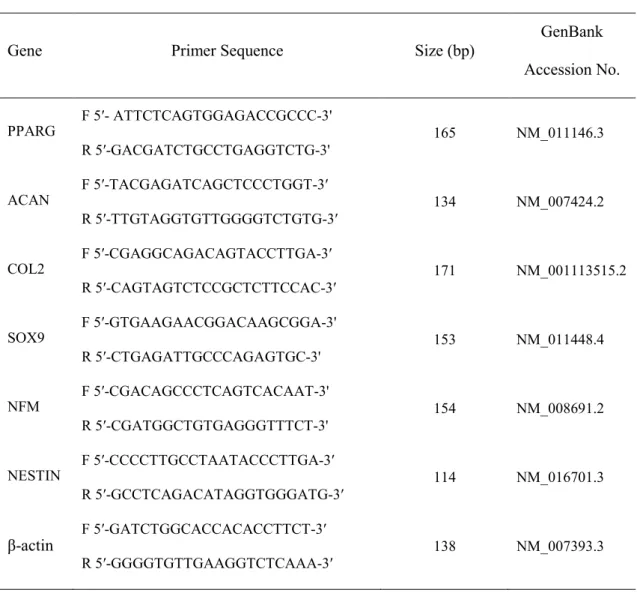
using the 2-△△ct method, and the range of the fold changes was calculated from the standard error of the values. To ensure experimental accuracy, qRT-PCR assays were conducted in triplicate for each sample. Primer sequences and product sizes are defined in Table 1.
F. Western blot analysis
Proteins were extracted with a lysis buffer (Cell Signaling Technology) and quantified using the BCA protein-assay reagent (Bio-Rad Laboratories, Hercules, CA, USA). Proteins were resolved by 8% sodium dodecyl sulfate polyacrylamide gel electrophoresis (SDS-PAGE) and transferred to a PVDF membrane. After blocking in Tris-buffered saline with 5% milk and 0.1% Tween-20, the membrane was incubated with the NFM antibody (Biolegend, San Diego, CA) or nestin antibody (Abcam, Beverly, MA, USA). The mouse monoclonal primary antibody to β-actin (Sigma-Aldrich) was used as the reference. Signals were visualized using an enhanced chemiluminescence reagent (ECL, Santa Cruz Biotechnology) in Image Reader LAS-4000 software (Fujifilm, Minato-ku, Tokyo, Japan).
G. Flow cytometry analysis
Cells were split by 0.2% EDTA in PBS. For intracellular markers, cells were fixed and permeabilized with 90% ice-cold methanol for 30 min and treated with Fc block (anti-FcgRII/III) to prevent nonspecific binding for 15 min. Indirect staining was done with primary and secondary antibodies on each step. Stained cells were analyzed on FACScan (BD Biosciences, Mountain View, CA, USA). The following antibodies and their corresponding isotype controls were used; Antibody against CD146 and OCT4 was purchase from Santa Cruz Biotechnology (Santa Cruz, CA, USA) and antibodies against mouse IgG1 and IgG2b for κ isotype control from Biolegend.
- 6 -
H. Immunofluorescence staining
After 14 days of neuronal differentiation, cells were fixed with 10% neutral formalin for 24 h and immunofluorescence staining was done using the TSATMKit (Invitrogen). Briefly, after
blocking endogenous peroxidase, cells were reacted with the NFM antibody (Biolegend) overnight and subsequently with the HRP-conjugated secondary antibody (Cell Signaling). Cells were incubated in Alexa Fluor 488 tyramide solution and then counterstained with propidium iodide. Cells were photographed using an LSM confocal microscope (Carl Zeiss, Standort Gȍttingen-Vertrieb, Germany).
I. Cell Staining
For alkaline phosphatase (ALP) enzyme staining, cells were fixed with 4% formaldehyde, rinsed three times with deionized water, and treated with a BCIP/NBT solution (Sigma-Aldrich) for 15 min. The reaction was stopped by the addition of water, and the stains were photographed and quantified by Scion Image software. To evaluate mineralization, alizarin red staining was applied. Briefly, cells were fixed with 70% ethanol and then stained with 40 mM alizarin red (pH 4.2) solution for 10 min. After extraction with 10% cetylpyridinium chloride, the stain was quantified by measuring the absorbance at 570 nm.
Oil red O staining is performed to evaluate adipogenic differentiation. Cells were fixed with 10% formalin for 30 min and washed with PBS, then were stained with 0.5% oil red O solution for 30 min, washed with deionized water, and photographed. The images of stained cells were acquired using an inverted contrast-phase microscope (Olympus Corporation, Tokyo, Japan).
To evaluate chondrogenic differentiation, alcian blue staining was used. Briefly, cells were fixed with 4% formaldehyde, washed with deionized water, and stained with a 1% Alcian blue (pH2.5) solution for 30 min. Stained cells were washed with deionized water and photographed.
- 7 -
J. Statistical analysis
Data are expressed as means ± standard errors. Statistical analysis was carried out using the ANOVA. Results were considered significant at a probability level of p < 0.05. For all experiments, at least three independent trials were performed.
- 8 -
Table 1. Oligonucleotide sequences of primers
Gene Primer Sequence Size (bp)
GenBank Accession No. SOX2 KLF4 NANOG OCT4 ALP BSP OCN OPN RUNX2 OSX AP2 C/EBP F 5'-TTTGTCCGAGACCGAGAAGC-3' R 5'-CTCCGGGAAGCGTGTACTTA-3' F 5'-GCCACCCACACTTGTGACTA-3' R 5′-TGGTAAGGTTTCTCGCCTGT-3' F 5'-TACCTCAGCCTCCAGCAGAT-3' R 5′-CTGGTGCTGAGCCCTGAATC-3' F 5'-TGTGGACCTCAGGTTGGACT-3' R 5′-TTTCATGTCCTGGGACTCCTC-3' F 5′-TATGGTAACGGGCCTGGCTAC-3' R 5′-TGCTCATGGACGCCGTGAAGCA-3 F 5'- GGAGGCAGAGAACTCCACAC-3' R 5′-TGCATCTCCAGCCTTCTTGG-3' F 5′-TGAACAGACTCCGGCGCTAC-3′ R 5′-AGGGCAGCACAGGTCCTAA-3′ F 5′-GCCGAGGTGATAGCTTGGCT-3′ R 5′-TGATCAGAGGGCATGCTCAG-3′ F 5′-CCAGGCAGGTGCTTCAGAACTG-3' R 5′-ACATGCCGAGGGACATGCCTG-3' F 5′-CCTCGCTCTCTCCTATTGCAT-3' R 5′-GTTGAGGAGGTCGGAGCATA-3' F 5′-AAATCACCGCAGACGACAGG-3′ R 5′-CATAACACATTCCACCACCAGC-3′ F 5′-TTCGGGTCGCTGGATCTCTA-3' R 5′-TCA AGG AGA AACCACCACGG-3'
146 101 160 189 187 127 172 177 157 163 143 164 NM_011443.3 NM_010637.3 NM_028016.3 NM_013633.3 NM_007431.2 NM_008318.3 NM_007541.2 NM_001204201.1 NM_009820.5 NM_130458.3 NM_024406.2 NM_007678.3
- 9 -
Table 1. Oligonucleotide sequences of primers (Continued)
Gene Primer Sequence Size (bp)
GenBank Accession No. PPARG ACAN COL2 SOX9 NFM NESTIN β-actin F 5′- ATTCTCAGTGGAGACCGCCC-3' R 5′-GACGATCTGCCTGAGGTCTG-3' F 5′-TACGAGATCAGCTCCCTGGT-3′ R 5′-TTGTAGGTGTTGGGGTCTGTG-3′ F 5′-CGAGGCAGACAGTACCTTGA-3′ R 5′-CAGTAGTCTCCGCTCTTCCAC-3′ F 5′-GTGAAGAACGGACAAGCGGA-3' R 5′-CTGAGATTGCCCAGAGTGC-3' F 5′-CGACAGCCCTCAGTCACAAT-3' R 5′-CGATGGCTGTGAGGGTTTCT-3' F 5′-CCCCTTGCCTAATACCCTTGA-3′ R 5′-GCCTCAGACATAGGTGGGATG-3′ F 5′-GATCTGGCACCACACCTTCT-3′ R 5′-GGGGTGTTGAAGGTCTCAAA-3′ 165 134 171 153 154 114 138 NM_011146.3 NM_007424.2 NM_001113515.2 NM_011448.4 NM_008691.2 NM_016701.3 NM_007393.3
- 10 -
3. RESULTS
A. Transient DNA demethylation by 5-aza-CN induced epigenetic modification in NIH/3T3 fibroblasts
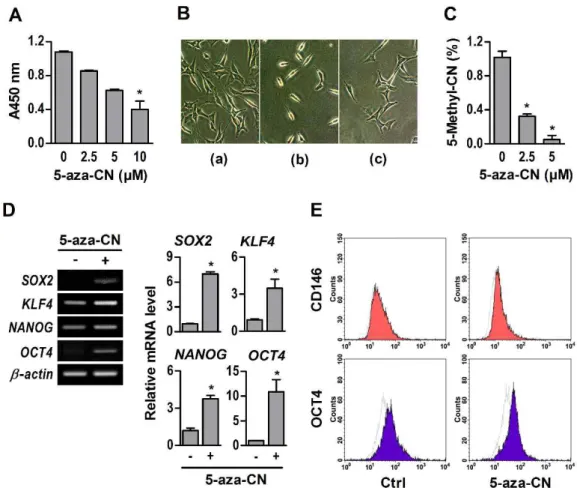
Epigenetic changes in DNA methylation affects cell growth as well as the differentiation potential. To induce epigenetic modification in NIH/3T3 fibroblasts, one of DNA methyltransferase inhibitor, 5-aza-CN was used, which is well known to cause DNA demethylation. First, the effect of 5-aza-CN on proliferation was examined and DNA demethylation of NIH/3T3 fibroblasts, which were treated at the indicated concentrations of 5-aza-CN for 24 h and then cell viability and global DNA methylation status were assessed. As shown in Fig. 1A and B, 2.5 and 5 μM but not 10 μM 5-aza-CN showed no toxicity on cell proliferation, and methylated DNA was significantly decreased in a dose-dependent manner. In order to evaluate the capacity of 5-aza-CN to transform cell phenotypes, morphological changes of NIH/3T3 fibroblasts were examined under an inverted microscope. Exposure to 5 μM 5-aza-CN for 24 h led standard elongated fibroblasts to display shortening and shrinking phenotypes, which were restored efficiently to their initial shape by an additional 24 h culture in fresh medium without 5-aza-CN (Fig. 1C). Next, the differentiation potential of 5-aza-CN-treated NIH/3T3 fibroblasts was assessed by evaluating the relative gene expression levels of the pluripotency markers, such as SOX2, KLF4, NANOG, and OCT4. Expression of these markers was increased clearly, and flow cytometry analysis also showed a significant increase of CD146 and OCT4, stem cell marker proteins, in 5-aza-CN-treated NIH/3T3 fibroblasts (Fig. 1D and E).
B. Transient DNA demethylation by 5-aza-CN allowed the conversion of NIH/3T3 fibroblasts into mesenchymal lineage cells
- 11 -
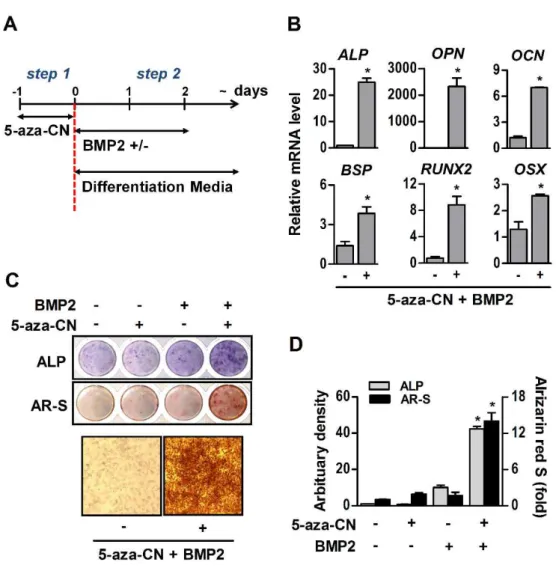
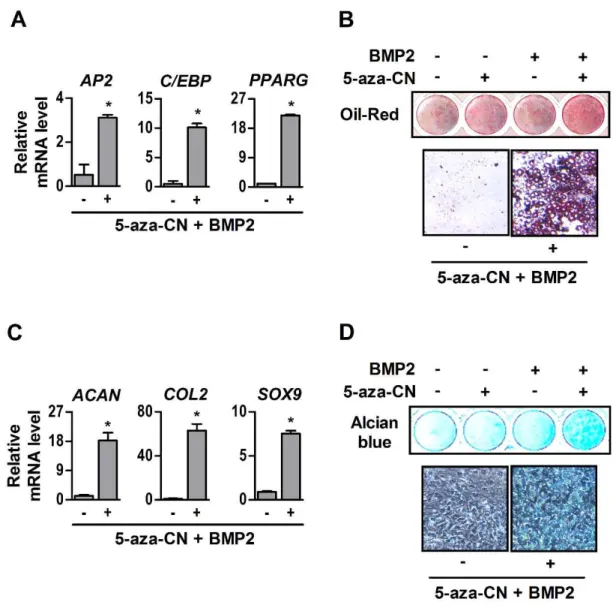
In order to evaluate the differentiation potential, brief exposure of NIH/3T3 fibroblasts to 5-aza-CN was followed by the procedure illustrated in Fig. 2A. For conversion into mesenchymal lineage cells, 5-aza-CN-treated NIH/3T3 fibroblasts were incubated with specific defined differentiation media containing 200 ng/ml BMP2. As shown in Fig. 2B, BMP2 markedly increased the mRNA of osteogenic key molecules, such as ALP, OPN, OCN, BSP, RUNX2, and OSX, in 5-aza-CN-treated NIH/3T3 fibroblasts cultured with osteogenic medium. Furthermore, ALP activities and mineralization nodules were significantly increased (Fig. 2C and D). The 5-aza-CN-treated NIH/3T3 fibroblasts expressed effectively adipogenic marker genes, such as AP2, C/EBP, and PPARG, and vigorously formed oil drops in a specific adipogenic medium containing BMP2 (Fig. 3A and B). In chondrogenic media, BMP2 induced chondrogenic differentiation of 5-aza-CN-treated NIH/3T3 fibroblasts, which significantly increased the expression of ACAN, COL2, and SOX9, chondrogenic markers, as well as proteoglycan stained by Alcian blue (Fig. 3C and D).
C. Transient DNA demethylation by 5-aza-CN allowed the conversion of NIH/3T3 fibroblasts into neuronal cells
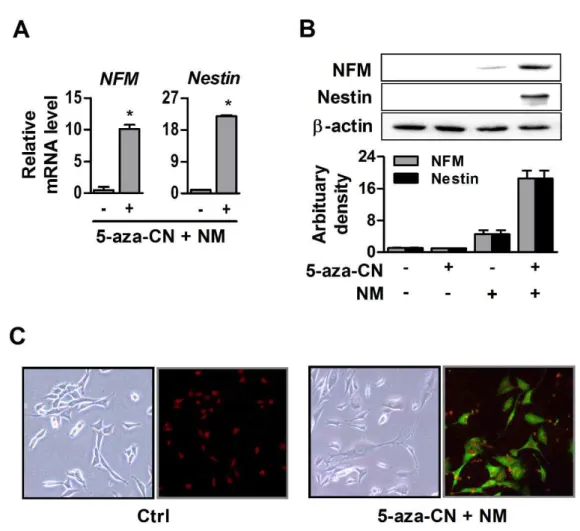
After epigenetic modification, NIH/3T3 fibroblasts were incubated with a defined neurogenic medium to evaluate the neurogenic potential. As shown in Fig. 4A and B, mRNA and protein of Nestin and NFM, neurogenic markers, were clearly increased in 5-aza-CN-treated NIH/3T3 fibroblasts. Fig. 4C shows the morphologic changes of neurogenic differentiated NIH/3T3 fibroblasts, which have an expanded cytoplasm and elongated axon-like pod as well as an increase of NFM protein in the cell cytoplasm. In contrast, control cells showed no morphological changes or NFM protein expression.
- 12 -
Fig. 1. Epigenetic modification in aza-CN-treated NIH/3T3 cells. (A, B) After 24 h of
5-aza-CN treatment, cell viability was estimated by using a cell counting kit, and morphologic changes were observed under an inverted microscope. (a) none-treated; (b) 5-aza-CN-treated (5μM); (c) incubated in fresh media without 5-aza-CN for an additional 24 h after treatment with 5-aza-CN. (C) The global DNA methylation patterns determined by using a methylated DNA quantification kit. (D) The expression of stem-cell marker genes was examined by conventional (left) and qRT-PCR (right). (E) Expression of CD146 and OCT4, stem cell marker proteins, was analyzed by flow cytometry. Ctrl means none-treated. These data represent three independent experiments. The values shown represent means ± standard errors. *, p < 0.05.
- 13 -
Fig. 2. Osteogenic differentiation of 5-aza-CN-treated NIH/3T3 cells. (A) The schematic
diagram of this study is based on direct reprogramming principles. After seven days of osteogenic differentiation medium culture, expression of osteogenic marker genes in CN-treated NIH/3T3 cells was quantified by qRT-PCR (B), and osteogenic differentiation of 5-aza-CN-treated NIH/3T3 was verified by ALP and AR-S staining on days 7 and 14, respectively (C). High magnification images of AR-S staining are shown in the lower panel. (D) Densities of alkaline phosphatase stains were quantified by Scion Image software. Alizarin red S stain was extracted with 10% cetylpyridinium chloride and quantified by measuring the absorbance at 570 nm using an spectrophotometry. These data represent three independent experiments. The values shown represent means ± standard errors. *, p < 0.05.
- 14 -
Fig. 3. Adipogenic and chondrogenic differentiation of 5-aza-CN-treated NIH/3T3 cells.
(A) After seven days of adipogenic differentiation medium culture, expression of adipogenic marker genes in 5-aza-CN-treated NIH/3T3 cells was quantified by qRT-PCR. (B) Adipogenic differentiation was verified by oil-Red O staining on day 14 and high magnification images of oil-Red O staining are shown in the lower panel. (C) After seven days of chondrogenic differentiation medium culture, expression of chondrogenic marker genes in 5-aza-CN-treated NIH/3T3 cells quantified by qRT-PCR. (D) The chondrogenic differentiation was verified by alcian blue staining on day 14 and high magnification images of alcian blue staining are shown in the lower panel. These data represent three independent experiments. The values shown represent means ± standard errors. *, p < 0.05.
- 15 -
Fig. 4. Neurogenic differentiation of 5-aza-CN-treated NIH/3T3 cells. (A, B) After 5 and 14
days of neurogenic differentiation medium culture, expression of neurogenic marker genes in 5-aza-CN-treated NIH/3T3 cells was quantified by qRT-PCR and Western blot analysis, respectively. Arbitrary densities of proteins were quantified by Scion Image software, as shown in the graph below. (C) After 14 days of neurogenic differentiation medium culture, morphologic changes in 5-aza-CN-treated NIH/3T3 cells were observed under an inverted microscope, and NFM expression was visualized by immunofluorescence staining. Ctrl means none-treated. These data represent three independent experiments. The values shown represent means ± standard errors. *, p < 0.05.
- 16 -
4. DISCUSSION
The observation that genetically identical cells can exhibit diverse phenotypes raises the possibility there is a novel mechanism that can modulate expressions of cell-type determinant genes. Epigenetic modification has been considered to be a promising mechanism to perform this function without genetic alteration [15,16]. Based on much evidence that epigenetic modification can affect cell-fate determination by changing gene transcription through a conformational change of chromatin, it has been used as a useful strategy to achieve lineage specification and cellular reprogramming [8].
Along with histone modification, DNA methylation, that repress the transcription, is a well-marked example of epigenetic modification extensively researched in recent years [17]. A chemical analog of cytidine, 5-aza-CN temporarily inhibits the function of DNA methyltransferase, that maintain the methylation pattern of the parent cell by recognizing hemi-methylated DNA, to form arbitrary dehemi-methylated sites in DNA, which cause changes of the cell's genetic imprinting map and ultimately activates repressed genes in heterochromated DNA [21,22]. Inspired from distinctive observations that spontaneous differentiation of mesenchymal cell lines and changes of cell phenotype appeared after exposure of 5-aza-CN [23], Pennarossa and his colleagues developed the protocol that adult fibroblasts could be transformed into endodermal pancreatic cells by brief demethylation using these chemicals [18]. Recently, it was also reported that non-osteogenic cells could be trans-differentiated into osteoblasts by epigenetic modifications followed by a specific induction step [19]. Our results revealed that if reversal of differentiation status by a temporary exposure of 5-aza-CN to mature fibroblast is immediately applied induction step for several desired cell-type-specific differentiation conditions, fibroblasts can be directly converted into diverse mesenchymal-lineage cells, such as osteogenic, chondrogenic, and adipogenic cells first. This two-step protocol enables inter-lineage conversion of fibroblast into ectodermal neuronal cells. So, if an effect of 5-aza-CN that
- 17 -
can increase cell plasticity and coax more inducible states, assumed by expression changes of several pluripotency-related genes such as Sox2, Oct3/4, and Nanog, sequentially combined appropriate cell type determinant induction, it would be possible to allow intra- and/or inter-lineage conversions of differentiated mesenchymal-inter-lineage fibroblasts into all three germline originated cells.
An achievement of neuronal cell fate and identity by direct lineage reprogramming was a research subject of most attention in the field of regenerative medicine in company with cardiomyocyte due to clinical significance [11,24]. A majority of studies to produce functional neurons have been undertaken by transcription factor-mediated cellular reprogramming along the lines of iPSC production [24]. Although some epigenetic-based neuronal conversion approaches using chemical compound targeting chromatin-remodelling proteins have been studied, they used mostly histone modifier as adjuvants to accelerate conversion efficiency by overexpression of Pax6 and Bf1 transcription factors [25] or as only constituents of chemical cocktail including BMP and TGF-b signalling inhibitor [26]. So, suggested protocol using demethylating agent in this study may be used as a simple alternative strategy to earn functional neuronal cells.
This study raised a possible acquisition of desired multi-lineage cell populations from mature fibroblasts by direct lineage reprogramming. If suggested protocol can be fine-tuned by efforts to eliminate cellular toxicity of 5-aza-CN drug and discover a precise signaling molecule to determine induced cellular fate, that substitutes for BMP-2, its efficiency to earn desired patient-specific cells from easily acquired cell source may significantly improve. It will be expected to expand its availabilities such as application in conversions into hardly-obtaining cells due to loss in the developmental process such as enamel-secreting ameloblast in the fields of regenerative medicine.
- 18 -
5. REFERENCES
[1] K. Takahashi, S. Yamanaka : Induction of Pluripotent Stem Cells from Mouse Embryonic and Adult Fibroblast Cultures by Defined Factors, Cell. 126:4, 2006.
[2] A.R.W. Schröder, P. Shinn, H. Chen, C. Berry, J.R. Ecker, F. Bushman : HIV-1 integration in the human genome favors active genes and local hotspots, Cell. 110:4, 2002.
[3] X. Wu, Y. Li, B. Crise, S.M. Burgess : Transcription start regions in the human genome are favored targets for MLV integration, Science. 300:5626, 2003.
[4] F. Bushman, M. Lewinski, A. Ciuffi, S. Barr, J. Leipzig, S. Hannenhalli, C. Hoffmann : Genome-wide analysis of retroviral DNA integration, Nat. Rev. Microbiol. 3:11, 2005.
[5] K. Okita, M. Nakagawa, H. Hyenjong, T. Ichisaka, S. Yamanaka : Generation of mouse induced pluripotent stem cells without viral vectors, Science. 322:5903, 2008.
[6] D.E. Cohen, D. Melton : Turning straw into gold: directing cell fate for regenerative medicine, Nat. Rev. Genet. 12:4, 2011.
[7] T. Graf, T. Enver : Forcing cells to change lineages, Nature. 462:7273, 2009.
[8] C. Guo, S.A. Morris : Engineering cell identity: establishing new gene regulatory and chromatin landscapes, Curr. Opin. Genet. Dev. 46, 2017.
- 19 -
[9] R.L. Davis, H. Weintraub, A.B. Lassar : Expression of a single transfected cDNA converts fibroblasts to myoblasts, Cell. 51:6, 1987.
[10] I. Maza, I. Caspi, A. Zviran, E. Chomsky, Y. Rais, S. Viukov, S. Geula, J.D. Buenrostro, L. Weinberger, V. Krupalnik, S. Hanna, M. Zerbib, J.R. Dutton, W.J. Greenleaf, R. Massarwa, N. Novershtern, J.H. Hanna : Transient acquisition of pluripotency during somatic cell transdifferentiation with iPSC reprogramming factors, Nat. Biotechnol. 33:7, 2015.
[11] J. Xu, Y. Du, H. Deng : Direct lineage reprogramming: strategies, mechanisms, and applications, Cell Stem Cell. 16:2, 2015.
[12] K. Song, Y.-J. Nam, X. Luo, X. Qi, W. Tan, G.N. Huang, A. Acharya, C.L. Smith, M.D. Tallquist, E.G. Neilson, J.A. Hill, R. Bassel-Duby, E.N. Olson : Heart repair by reprogramming non-myocytes with cardiac transcription factors, Nature. 485:7400, 2012.
[13] S. Chanda, C.E. Ang, J. Davila, C. Pak, M. Mall, Q.Y. Lee, H. Ahlenius, S.W. Jung, T.C. Sudhof, M. Wernig : Generation of induced neuronal cells by the single reprogramming factor ASCL1, Stem Cell Reports. 3:2, 2014.
[14] C.H. WADDINGTON : The strategy of the genes. A discussion of some aspects of theoretical biology. With an appendix by H. Kacser., London: George Allen & Unwin, Ltd., 1957.
- 20 -
[15] A.D. Goldberg, C.D. Allis, E. Bernstein : Epigenetics: a landscape takes shape, Cell. 128:4, 2007.
[16] A. Avgustinova, S.A. Benitah : Epigenetic control of adult stem cell function, Nat. Rev. Mol. Cell Biol. 17:10, 2016.
[17] T. Baubec, D.F. Colombo, C. Wirbelauer, J. Schmidt, L. Burger, A.R. Krebs, A. Akalin, D. Schubeler : Genomic profiling of DNA methyltransferases reveals a role for DNMT3B in genic methylation, Nature. 520:7546, 2015.
[18] G. Pennarossa, S. Maffei, M. Campagnol, L. Tarantini, F. Gandolfi, T.A.L. Brevini : Brief demethylation step allows the conversion of adult human skin fibroblasts into insulin-secreting cells, Proc. Natl. Acad. Sci. U. S. A. 110:22, 2013.
[19] Y.D. Cho, W.J. Yoon, W.J. Kim, K.M. Woo, J.H. Baek, G. Lee, Y. Ku, A.J. Van Wijnen, H.M. Ryoo : Epigenetic modifications and canonical wingless/int-1 class (WNT) signaling enable trans-differentiation of nonosteogenic cells into osteoblasts, J. Biol. Chem. 289:29, 2014.
[20] C. Stresemann, F. Lyko : Modes of action of the DNA methyltransferase inhibitors azacytidine and decitabine, Int. J. Cancer. 123:1, 2008.
[21] E. Whitelaw, H. Sutherland, M. Kearns, H. Morgan, L. Weaving, D. Garrick : Epigenetic effects on transgene expression, Methods Mol. Biol. 158, 2001.
- 21 -
Carell, G. Längst, H. Leonhardt : DNMT1 but not its interaction with the replication machinery is required for maintenance of DNA methylation in human cells, J. Cell Biol. 176:5, 2007.
[23] M. Darmon, J.F. Nicolas, D. Lamblin : 5-Azacytidine is able to induce the conversion of teratocarcinoma-derived mesenchymal cells into epithelia cells, EMBO J. 3:5, 1984.
[24] R.J.M. Riemens, D.L.A. van den Hove, M. Esteller, R. Delgado-Morales : Directing neuronal cell fate in vitro: Achievements and challenges, Prog. Neurobiol. 168, 2018.
[25] M. Raciti, M. Granzotto, M. Do Duc, C. Fimiani, G. Cellot, E. Cherubini, A. Mallamaci : Reprogramming fibroblasts to neural-precursor-like cells by structured overexpression of pallial patterning genes, Mol. Cell. Neurosci. 57, 2013.
[26] L. Cheng, W. Hu, B. Qiu, J. Zhao, Y. Yu, W. Guan, M. Wang, W. Yang, G. Pei : Generation of neural progenitor cells by chemical cocktails and hypoxia, Cell Res. 25:5, 2015.
- 22 -
섬유모세포에서 후성유전학적 변형에 의한
직접교차분화
양 동 욱
전남대학교대학원 치의학과 (지도교수 : 김선헌) (국문초록) 전환분화로도 불리는 직접교차분화는 전분화능 단계를 거치지 않고 성숙 세포 를 다른 특정유형의 세포로 직접 분화 유도하는 방법이며, 세포기반 치료의 하나로 서 손상된 조직을 치유하는 과정에 필요한 원하는 세포를 얻을 수 있는 주요한 방 법으로 여겨진다. 최근 후성유전학적변형에 의한 세포운명 변경에 관한 연구가 활 발하게 진행 중이며, 이 방법은 바이러스에 의한 세포내 형질도입이 갖는 위험성을 초래하지 않는다. 본 연구에서 DNA 탈메틸화 후 다양한 분화배지에 배양하여 분화 된 섬유모세포를 골세포, 지방세포, 연골세포 등의 중간엽세포나 신경세포와 같은 외배엽세포로 분화시키는 실험적 방법을 확립하였다. 생쥐 섬유모세포주에 DNA 메 틸전이효소억제제인 5-azacytidine(5-aza-CN)을 24시간 동안 처치하여 줄기세포 특이 유전자의 발현을 통한 세포 가소성 증가를 확인하였다. 이후, 5-aza-CN 처리 된 섬유모세포를 골세포, 지방세포, 연골세포 및 신경세포 분화 유도 배지에서 일- 23 -
정 기간 동안 배양하여 각 유형의 세포로의 분화를 유도하였다. 특정 세포로의 분
화는 ALP, alizarin red S, oil red O, alcian blue와 같은 세포화학적 염색법과 각각 의 세포 표지자에 대한 정량적 역전사중합효소 연쇄반응, 웨스턴블롯 분석, 면역세
포염색과 같은 분자생물학적 방법을 사용하여 검증하였다. 본 연구에서 제시한 직
접교차분화는 유전자 변형 없이 원하는 세포를 보다 쉽게 획득할 수 있도록 함으로