Corporate Social Responsibility and
Environmental Security in Indonesian Mining
Area: A Case Study of PT Timah Tbk in West
Bangka District
著者
Asti Amelia Novita
学位授与機関
Tohoku University
学位授与番号
11301甲第17627号
Corporate Social Responsibility and Environmental Security in
Indonesian Mining Area:
A Case Study of PT Timah Tbk in West Bangka District
(インドネシアの鉱山地域における企業の社会的責任と環境保全
―⻄バンカ地区ティマ社のケーススタディ―)
ASTI AMELIA NOVITA
2016
i LIST OF CONTENT LIST OF CONTENT ………. LIST OF TABLES……… LIST OF FIGURES……… ABREVATIONS………. Chapter I - Introduction……… 1.1. Research Background………... 1.2. Research Purpose and Objectives of the Study………. 1.3. Scope of the Study……… 1.4. Previous Studies………... 1.5. Research Significance………... 1.6. Limitation……….. 1.7. Contributions………. 1.8. Research Methodology ………...
1.8.1. A Qualitative Research and Case Study Approach……… 1.8.2. Research Site………...………. 1.8.3. Research Procedure………... Chapter II - Environmental Security and CSR In Mining Sector……… 2.1. Introduction……… 2.2. CSR and Environmental Security: A Conceptual Framework………... 2.3. Mining Industry and Environmental Insecurity: Experience
in Several Countries………. 2.4. How to Deal with Environmental Problems? Best Practices
of CSR Implementation from Mining Industry………. 2.5. Optimizing CSR Practices through Environmental Governance………. Chapter III - Mining and CSR Policy in Indonesia………. 3.1. Introduction……… 3.2. Indonesian Mining Regulation and Environmental Security ……… 3.3. Indonesian CSR Policy: Does it Strengthen Environmentally
Responsible Mining……….. 3.4. Progress and Challenge of CSR Implementation in Indonesia ……… Chapter IV - Environmental Security in Indonesian Tin Mining………. 4.1. Introduction……….…….. 4.2. An Overview of PT Timah and Its Environmental Impact ……… 4.3. Environmental Problems in West Bangka District: A Case Study ……… 4.3.1. Environmental Security Impact of Offshore Mining ……… 4.3.2. Environmental Security Impact of Onshore Mining ……… 4.3.3. Environmental Security Impact of Metallurgic Unit ………. 4.4. Environmental Compensation and Community Protection ……… i iii iv vi 1 1 5 6 6 8 9 9 10 10 11 12 16 16 17 24 30 31 35 35 35 38 44 47 47 49 52 52 58 61 62
ii
Chapter V - Environmental Security and CSR Practices o PT. Timah
in West Bangka District……… 5.1. Introduction……… 5.2. Environmental Management System of PT Timah……… 5.3. Environmental Performance of PT Timah………...…. 5.4. CSR Implementation Challenges………... Chapter VI – CSR Governance of PT Timah in West Bangka District………. 6.1. Introduction……….... 6.2. The Accountability and Transparency……… 6.3. Law Compliance………. 6.4. The Reporting Practices………. 6.5. Stakeholder Engagement………. Chapter VII – Strengthening Stakeholder Collaboration for Responsible
Mining………... 7.1. Introduction………. 7.2. The Weaknesses of Current CSR Practices………. 7.3. Meeting the Expectation: Finding from Field Study………... 7.4. Collaborative Action for Environmentally Responsibility Mining………. Chapter VIII – Conclusion………. 8.1. Environmental Security Issues in Indonesian Tin Mining………. 8.2. CSR Practices to Reduce the Environmental Impact………. 8.3. Environmental Governance Practices……… 8.4. Ensuring Environmental Security through Stakeholder Collaboration……… 8.5. Policy Implication……….. References………. 64 64 64 72 81 83 83 83 85 86 88 96 96 96 98 101 106 106 107 107 108 109 110
iii LIST OF TABLES Table 1.1. Table 2.1. Table 2.2. Table 2.3. Table 2.4. Table 3.1. Table 3.2. Table 3.3. Table 4.1. Table 4.2. Table 4.3. Table 5.1. Table 5.2. Table 6.1. Table 6.2. Table 6.3. Table 6.4. Table 6.5. Table 6.6. Table 7.1. Table 7.2.
Type of Data and Collecting Method ……… The content of environmental security concept ……… Some of International Cases of Environmental Insecurity……… Some of Environmental Security Issues in Indonesian Mining Areas…………. Top Ten Mining Companies with Best CSR Practices ……… Mining Company Obligation based on Indonesian Law………... CSR Definition Based on Indonesian Law as Company Obligation……... CSR Definition Based on Indonesian Law in term of Natural
Resources Management………... Number and Size of Pit Mine in Bangka Island……… Tin Mining Activities of PT. Timah in Conservation Forest……… Coral Reefs Condition in West Bangka District………. Comparison of Environmental Policy Indicator of Best Practices and
PT.Timah Policy………. Sequence of Illegal Tin Mining Events……….. Dimension and Indicator of Accountability……… Government Engagement Framework by PT.Timah………. Local Government Roles Based on Indonesian Regulation……… Community Engagment Framework by PT.Timah……… Community Rights Based on Indonesian Regulation………. Other Related Stakeholder Engagement Framework by PT.Timah……… Collaboration Continuum Stages……….. Human Security Approach for Environmental Security………..
13 21 26 28 30 37 40 41 55 55 59 65 84 82 89 89 90 91 93 97 105
iv LIST OF FIGURES Figure 1.1. Figure 1.2. Figure 1.3. Figure 2.1. Figure 2.2. Figure 2.3. Figure 2.4. Figure 2.5. Figure 3.1. Figure 4.1. Figure 4.2. Figure 4.3. Figure 4.4. Figure 4.5. Figure 4.6. Figure 4.7. Figure 4.8. Figure 4.9. Figure 4.10. Figure 4.11. Figure 4.12. Figure 4.13. Figure 4.14. Figure 4.15. Figure 5.1. Figure 5.2. Figure 5.3. Figure 5.4. Figure 5.5.
West Bangka District Map……….. Research Procedure……… Data Analysis Procedure……… Mining Activity and Threat to Human Security……….. Mining Processes, Risk and Environmental Security Impacts……… Failure Distribution by Cause………. Schematic Overview of ISO 26000……… Research Framework……….. Number of company with environmental performance reporting practices…… World Tin Reserves by Country (in percentage)………. Tin bearing areas in South East Asia……….. Economic Structure of Bangka Belitung Province (in percentage)………. Tin Mining Flow………. Environmental Impact of Tin Mining Activities………. Indonesian Environmental Index……… Land Mining Area Growths (open pit) in Bangka Barat District……… Tin Mining Sites in West Bangka District………... The Development of Mining Area (red dot) and River Flow (yellow colour)…. Malaria cases in West Bangka District……… Sea Mining Activity……… Interview with Mr Darwin (left) and Mr.Azmi (right)……… Number of catch fish before and after the KIP/PIP operation………. Economic condition of fisherman after KIP/PIP operation………. Location of Metallurgic Unit that Close to Residential Area………. Interview with Mr.Sain and Mr.Ahmad, the representatives of
PT.Timah, Muntok ………. Environmental Policy of PT. Timah……... CSR fund allocation and distribution of PT.Timah for
environmental management (in million rupiahs)……… Close Loop System……… Land Reclamation Processes by PT Timah………
12 12 15 23 25 29 33 34 45 47 47 48 50 51 52 53 54 56 58 59 60 61 61 62 67 67 70 74 76
v Figure 5.6.
Figure 6.1. Figure 6.2. Figure 7.1.
The Reclamation area of PT.Timah (in hectares)……… Discussion (left) and Interview with Mr.Effendi (right)………. NGOs activity in distributing social assistance from PT.Timah………. Stakeholder Relation (a) without and (b) with Collaborative Model………..
.
77 91 93 103
vi
ABREVATIONS
AMDAL
Analisis Dampak Lingkungan / Environmental Impact Assessment
BAPETEN Badan Pengawas Tenaga Nuklir / Nuclear Energy Regulatory
Body
Bappepam-LK Badan Pengawas Pasar Modal dan Lembaga Keuangan/ Capital
Market and Financial Institution Supervisory Agency
BNPB Badan Nasional Penanggulangan Bencana/ National Agency for
Disaster Management
BUMD Badan Usaha Milik Daerah/ Local Owned Company
BUMN Badan Usaha Milik Negara/ State Owned Company
CSR Corporate Social Responsibility
IPPKH
Ijin Pinjam Pakai Kawasan Hutan/ Forest Land Use Permit
JATAM Jaringan Advokasi Tambang/ Mining Advocacy Network
K3-LH Keselamatan Kerja, Kesehatan dan Lingkungan Hidup/
Occupational, Health and Environmental Safety policy
KPA Konsorsium Pembaruan Agraria/ Consortium for Agrarian Reform
KPK Komisi Pemberantasan Korupsi/ Commission of Corruption Eradication
KP Kuasa Penambangan/ Mining Authority
PROPER Program Penilaian Peringkat Kinerja Perusahaan/ Company
Performance Ranking Program
UKL Upaya Pengelolaan Lingkungan Hidup/ Environmental Management Plan
UPL Upaya Pemantauan Lingkungan Hidup/ Environmental Monitoring Plan
1 CHAPTER I
Introduction
1.1.Research Background
Indonesia is one of the largest mineral producers in the world. Data from World Mineral Production 2009 to 2013 shows that Indonesia ranked as the 1st largest nickel producer, 2nd
largest bauxite producer, 2nd largest tin producer, 4th largest coal producer and 5th largest gold
producer. The Indonesian mineral industry has a longstanding history. Gold and silver mining has been excavated since a thousand years ago, while tin and diamond mining started in the 18th century (Leeuwen, 1994). In 2016, 93.36 million hectares of Indonesia's land has been handed over to the mining corporation through 11,142 mining licenses1. Undoubtedly, mining
industry has significantly contributed to the regional and national income. Data from 2014, shows that about 59.78 % of non-tax revenue and 18.39% of tax revenue are still relying on mining activity (Indonesian Ministry of Finance, 2014). The mining industry has multiplier effects that triggered the other sector's growth, as well as provide employment opportunities for approximately 34 thousand direct laborers.2
However, the presence of mining companies in Indonesia has always been a controversial issue. Resentment and rejection from the local community over mining companies are a common situation. Data from KPA (Consortium for Agrarian Reform) shows that the largest number of agrarian conflicts throughout 2014 is between company and community. Eleven conflicts between community and company, both private and state owned company (SOC), has been recorded in the Indonesian mining sector. It is generally caused by the
1 This data informed by JATAM (Jaringan Advocacy Tambang) through Bisnis Indonesia website.
JATAM is a NGO which concern on the issue of human rights, gender, environmental problem, and social justice in Indonesian mining industry.
2
The data obtained from Indonesian Ministry of Energy and Mineral Resources website. The data obtained is from 2015.
2 unfulfilled expectation of the local community toward mining companies, mainly related to the local economy and environmental issues. Specifically, the factors behind community rejection are mostly associated with mining license processes3 , lack of communication with affected
communities, ignoring the rights of local and indigenous communities, and lack of company’s responsiveness toward community losses both in economic and environmental support (Sabini & Ganiem, 2015).
The entire mining methods affect air quality. The particulates which generated from mining activities when the soil layer taken from the land, will pollute the atmosphere. In general, the particulates affect human health and contributes to illnesses related to the respiratory tract. Besides, the particulates could be swallowed or absorbed by the skin which lead to other kind of diseases. Mining activities will also cause disturbance of the ground or landscape and formed as a pile of stones excavated, numerous open pit mine, and declining of wildlife and plants around mining area. The problem relates to the water pollution which caused by mining activities are acid water as a result of mining waste, heavy metal contamination and increasing of sediment levels in the rivers, reservoirs, sea, etc. (BPS, 2015)
As any other resources-rich country is concerned, environmental security is one of the biggest problems associated with mining activities. Environmental security relates to the threat caused by an environmental event which impacted on the sustainability of the life support. In 2012, Indonesian mining activities have caused 70% of deforestation and other environmental issues such as damaging watersheds, and sea ecosystem damage4. Based on Indonesian the
Ministry of Environmental data, the companies with a bad record in term of environmental management is increasing every year. The companies which ranked with poor environmental management are mostly engaged in mining, energy, oil and agroindustry5.
Environmental cases related to mining activities, such as Freeport, Buyat Bay and Sidoarjo Mudflow incidence have become a national and international concern. Those three cases have
3 The granting of a mining license is often associated with corruption practices involving companies and
local governments who have authority in awarding mining license. This made environmental impact assessment (EIA or AMDAL in Indonesia) just become a formality in the issuance of mining permits.
4
Data is provided by Indonesian Ministry of Forestry in 2012 and has been adapted by several online media such as Republika and Kompas.
5
3 contributed immense environmental damage and they have impacted to the community’s life. PT Freeport mining activities have caused deforestation and violate customary rights which resulted in a prolonged conflict between the company and community affected. The Buyat Bay contamination by PT Newmont Minahasa Raya (NMR), which disposed tailing material into the sea, has jeopardized environmental security and threatened community health and economic prospects as well. Similarly, conflict and violence that occurs in Riau Province is triggered by environmental pollution and social issues related to operation of PT Caltex Pacific Indonesia (CPI). Citizens are demanding compensation and asking for CPI prosecution to the national parliament related to the negative impact of the company's operations which deteriorated the economic, health and environment. The contribution of mining activities to a national disaster is also demonstrated by the mud flow incidence that inundated several districts in Sidoarjo City. Similar cases were encountered in various resources rich regions in Indonesia.
If we reflect on the cases that have taken place, the environmental problem caused by improper mining activities could become a big threat of social and economic sustainability. Therefore, environmental management and responsible mining are an urgent call for all mining activities. Environmental management cannot be marginalized, as a curative option or be seen as trivial in the company’s operation. Hence, the implementation of environmental and social responsibility is beyond moral obligation for all types of companies. While a company as a new member of society, has intervened in the life of the local community through their activities, a good company’s attitude becomes a liability. The company needs to adapt, spread a positive effect, and increase the environmental and social condition in an area where they operated. This action is well known as corporate social responsibility (CSR).
The establishment of Indonesian Law No 40 Year 2007 on Corporation and Government Regulation No 47 Year 2012 on Corporate Social Responsibility (CSR) has brought a new twist to the role of companies. CSR becomes mandatory, rather than voluntary, especially for the
4 companies engaged in natural resources.
Corporate social responsibility is a liability of the company, which runs its business activities in the field and are related to the natural resources. The obligations should be implemented both within and outside the company. (Government Regulation No 47 Year 2012)
Mining companies are expected to be more active in providing a positive contribution both socially and environmentally through CSR practices. However, the CSR contribution is mainly related to the environmental security which remains questionable. Many Indonesian resources rich areas still facing environmental security issues. In 2014, based on the Corporate Performance Assessment or PROPER from the Ministry of Environment, coal and mineral mining companies were lacking in their environmental management system’s, including water efficiency, energy efficiency, emission reduction, hazardous waste and their contribution to the ecosystem damage (Ministry of Environment, 2014). In 2016, around 6.3 million hectares of mining licenses violated the rules. About 1.37 million hectares have operated in conservation areas and 4.93 million hectares operated in a protected area. Data from the Commission of Corruption Eradication (or KPK in Indonesian) showed that 874 mining licenses were revoked, 1087 mining licenses did not have a tax identification number (NPWP), furthermore 75% of mining licenses did not pay reclamation and post-mining bail or assurance. These cases are considered as one of the triggers for high environmental damage and the number of occupational accidents.
Indonesian Tin Mining and Its Environmental Problems
As one of the biggest tin producers in the world, Indonesian tin mining has created a new economic zone, which increased economic development through employment opportunities and local income from levies and taxes. On behalf of economic purposes, through Government Regulation No 27 Year 1980, tin has become a strategic sector and monopolized by the government under PT. Timah operation. Along with its mining activities, the existence of PT.
5 Timah has been regarded as a major source of environmental damage in Bangka Belitung Province as a main producer in the area of tin. Environmental degradation in Bangka Belitung Province has continuously threatened other aspects of the life support system, such as the local economy and health. In line with the enactment of the corporate social responsibility regulation, PT. Timah has started their corporate social responsibility program. However, after nine years of the CSR implementation, environmental issues still remain as the biggest problem of tin mining. This condition applies to the emergence of community tension through community rejection of PT. Timah mining activities in Bangka Belitung Province.
1.2. Research Purposes and Objectives of the Study
The emerging of the needs for environmental security, especially in the mining societies, has made corporate social responsibility an important part of a company’s role in ensuring sustainable development. However, CSR practices are still questionable in their contribution to environmental security, particularly in developing countries. Therefore, the purpose of this study is to analyze CSR practices in ensuring environmental security in the Indonesian mining area. Following the research purpose, the objectives of this study are:
1. Understanding the contribution of CSR practices in ensuring environmental security in the mining sector (Chapter II);
2. Reviewing CSR policy in Indonesia related to the environmental security (Chapter III); 3. Understanding the environmental security problems in Indonesian tin mining, particularly
in West Bangka District (Chapter IV);
4. Investigating CSR management and performance of PT. Timah on environmental security in West Bangka District (Chapter V);
5. Analyzing the CSR governance practices in ensuring environmental security in West Bangka District (Chapter VI); and
6 6. Proposing a CSR policy recommendation to optimize CSR practices (Chapter VII).
1.3.Scope of the Study
This study focuses on CSR practices of a tin mining company in Indonesia related to environmental security. CSR practices include CSR management, and CSR performance and CSR governance. Environmental management is a process of planning, organizing and controlling an environmental impact factor caused by mining processes. CSR governance is related to the company’s activity in optimizing CSR practices through law compliance, transparency, accountability, reporting practices, and stakeholder involvement. Environmental performance is defined as a tangible result and contribution of environmental management practices which are shown by positive change on the environmental condition in a mining area. The evidence of this study is gathered specifically from the West Bangka District related to the CSR practices of PT. Timah, the biggest and only tin mining company in West Bangka District. Nonetheless, this study will begin with reviewing the environmental problems caused by mining activities, its impact to the community, and how the mining company actualizes their environmental responsibility. This study will illustrate the environmental responsibility practices which carried out so far.
1.4.Previous Studies
The role of the business world towards sustainable development through CSR practices has long been a concern of many groups around the world, both academicians, government, NGO or citizens. Therefore, much research on CSR has been done along with high public criticism over the environmental negligence and violation of human rights by the company. Specifically, the research related to the CSR practices of a mining company mostly emphasized on CSR assessment (Raufflet, Cruz, & Brez, 2014),social performance (Owen & Kemp, 2014), social
7 license (Gifford, Kestler, & Anand, 2010), CSR implementation (Andrews, 2016; Cash, 2012), the limits of CSR in adding public value (Crowson, 2009), corporate-community involvement (Idemudia, 2009; McAllister, Fitzpatrick, & Fonseca, 2014), stakeholders perspective on CSR practices (Pozas, Lindsay,& Monceau, 2015; Mzembe &Downs, 2014; Mutti et.al, 2012), and cross-sector partnership (Campbell, 2012; Yakovleva & Alabaster, 2003). Meanwhile, CSR practices specifically focused on environmental management or performance are still carried out in the area of transparency (Wirth et.al, 2016), environmental responsibility assessment (Shvarts, Pakhlov & Knizhnikov, 2016) and cross-sector collaboration (McDonald & Young, 2012). Shvarts, Pakhalov, & Knizhnikov (2016) conducted an assessment of environmental responsibility of oil and gas companies, both private and state owned companies in Russia, and found that not all the companies have a good motivation to provide a public access of the detail information related to the environmental performance and its impact. One of the reasons is that the company does not perform proper environmental management. Mutti, et. al (2012) find out that in community perspective, mining industry brings broken promises about local employment, economic development and improved quality of life. Related to CSR, the local community perceived CSR as lip service; a manipulative tool used by the companies toward the local community. Wirth et al (2016), in his study entitled “Corporate Social Responsibility: Communication about Social and Environmental Disclosure by Large and Small Copper Mining Company” revealed that the effectiveness and activeness of government policy will be needed more to force good CSR practices. Furthermore, McDonald & Young, 2012 in his study found that the company could not be a single actor in ensuring environmental protection. Therefore, a partnership between a company and environmental group is needed. The study also revealed that leadership, effective communication and trust are the key success of 30 years of cooperation between mining the company Alcoa of Australia with Greening Australia (NGO) in ensuring sustainable environment.
8 In Indonesia, specifically, the research related to the mining company activity is mostly done in its relation to the mining impact to the environment (Sari & Rosalina, 2016; Oktavia, Setiadi & Hilwan, 2015), social conflict (Erb, 2016), community or local economy and health effect (O’Reilly et.al, 2016; Nakazawa, et.al, 2016). Regarding CSR practices, most of the study emphasized on its contribution to the economic development and community development (Suhadi, Febrian & Turatmiyah, 2014; Prima, 2014), and CSR communication (Rusmawati, 2013; Sabini & Ganiem,2015). Suhadi, Febrian & Turatmiyah stated that the corporate social responsibility program in Indonesia has not brought a significant impact toward community welfare. It is even triggering conflict between company and community. Furthermore, Suhadi, Febrian & Turatmiyah suggested to improve CSR management through intensive communication affecting the community as well as government. A similar result has been drawn by Rusmiwati and Sabini.
1.5. Research Significance
Studies on CSR in Indonesia mostly describe the role of CSR in terms of community empowerment and its impact on the community. The studies also do not provide a comprehensive policy recommendation or model that can be used as a reference to optimize the role of CSR in addressing the issues, while the research on CSR practices of mining companies related to environmental management has not been carried out so far. Especially for the studies related to the CSR governance practices in handling environmental issues. Therefore, this study will fill the gap by specifically examining the implementation of CSR practices in addressing environmental issues as a major criticism of the Indonesian mining companies.
The significance of this research can be viewed through three dimensions: (1) This research provides deepened understanding of factors behind the lack of CSR practices in ensuring environmental security, particularly in case of Indonesian tin mining area; (2) It provides an
9 understanding on how the business sector can contribute in addressing the environmental security issue through the implementation of CSR; and (3) It proposes a CSR policy recommendation based on the human security approach optimizing the role of CSR in addressing environmental security issues.
1.6.Limitation
The problems arising as an impact of mining activities is very diverse. Not only is it related to the environmental problem, but it also occurs in the form of economic and social disruption. However, the most crucial issue of mining activities, are also affected to the other security issues, such as is environmental insecurity. These issues are similar for both developing and developed countries. Environmental security is an important issue to be examined because of the huge subsequent impact to the sustainability of the community. Therefore, this research will focus on the environmental security. Other human security issues are not discussed in this study. Hence, the limitation of this study is related to three aspects: (1) The proposed policy recommendation only focused on environmental security in the mining area; (2) In assessing CSR practices, this study will be more focused on management, governance and its performance, so that other CSR issue such as technical evaluation will not be discussed; (3) the nature of this research is a qualitative study by using a case study approach, this implies that the policy recommendation that could not be applied for all cases in the same way. It would need some adaptation with the culture, problems and condition of an area concerned.
1.7. Contribution
The result of this research will give a new discourse on the role of a company in reducing human security issues through CSR practices, particularly in terms of environmental security. This study will give a contribution in two domains, namely the academic domain and the
10 practical domain. This research could help an academician in understanding the relation between the human security concept and CSR practices. For practitioners, particularly the businessman, this research could become a reference in improving CSR practices of the company. Specifically, it helps the Indonesian practitioners in understanding how CSR operates in Indonesian mining companies and what is the challenge, so that the practitioners could come to the solution in their area. Exclusively for the case of West Bangka District, this research is providing an input or recommendations on how the government should react through government policy. While for the community, this research provides information of CSR practices of PT. Timah related to environmental security in more detail and more comprehensive. Furthermore, the community could understand what are the main problems of CSR practices, and what is the actual role of each stakeholder that must be carried out in ensuring the sustainability of CSR practices.
1.8. Research Methodology
1.8.1. A Qualitative Research and Case Study Approach
The aim of this research is providing a comprehensive understanding on CSR practices in ensuring environmental security that could be used as a reference in the formulation of a policy recommendation. It is intended to make a policy recommendation that is more suitable with the factual condition. For this reason, this study uses qualitative research with a case study approach. Qualitative research is a holistic approach which highlights the bigger picture of “why” and “how” a condition occurs. The qualitative research allows researchers to get in-depth and comprehensive information regarding the causal relationship of the problem.
A case study was chosen with consideration such that the nature of this research requires a deep understanding of the complexity of the issue. The complexity refers to the
11 comprehensive CSR practices which include policy, managerial processes, implementation, monitoring and evaluation until managing stakeholder interests. The high complexity of CSR practices is reinforced by the differences condition between one area to another. A case study approach allows the researcher to maintain the holistic and meaningful characteristics of real-life events such a person’s life, organisational and managerial processes, environmental changes, international relations and industry maturity, (Yin, 2009).
1.8.2. Research Site
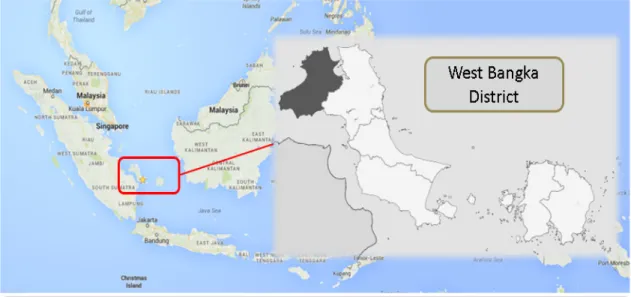
This study is conducted in West Bangka District, Bangka Belitung Province, Indonesia. West Bangka District was established through Law No 5 in 2003 about The Establishment of South Bangka District, Central Bangka District, West Bangka District and East Belitung District in Bangka Belitung Province Territory in February 2003. The establishment of West Bangka District is a result of the Indonesian district expansion program under Law No 32 in 2004 in regards to Local Government. The district expansion program is the formation of a new administrative region in the provincial, city or district level to help the central government in managing the region. The West Bangka District is divided into six sub-districts with a total area of 2,884.15 km2 67. The geographical position and large number of
tin reserves are counted as the biggest factors in increasing the economic development of West Bangka District. Almost 48 percent of West Bangka District regional revenue is contributed by the tin mining sector, followed by agriculture (pepper and palm oil) and fisheries.
6 Statistic of West Bangka District, 2014
7 West Bangka District is divided into six sub-districts which is Kelapa Sub-District with total area 573.8
km2, Tempilang Sub-District with total area 461.02 km2, Muntok Sub-District with total area 505.94 km2, Simpang Teritip Sub-District with total area 637.35 km2, Jebus Sub-District with total area 351.93 km2 and Parittiga Sub-District with total area 354.11 km2.
12 Figure 1.1. West Bangka District Map
Source: Modification from Google Map
1.8.3. Research Procedure
This research is conducted through four steps which include: (1) problem identification; (2) data collection; (3) analysis; (4) conclusion and recommendation (as below).
Figure 1.2. Research Procedure
1.8.3.1. Problem Identification: Grasping the Main Issue
Problem identification was conducted through two steps which consist of a literature review and a field study. In the first step, the researcher reviewed the journals and information existing in the verified website related to the environmental problems caused by mining activity, both national and international. The review includes how the companies or other actors are dealing with the environmental issues. To get real and detailed information
Problem Identification Data Collection Data Analysis Conclusion and Recommendation
13 about the main cause of the environmental problem which was triggered by mining activities, the researcher conducted a field study in February 2016.
1.8.3.2. Data Collection
Data collection is carried out to find out (1) the root cause of environmental insecurity in Indonesian tin mining area; (2) the current CSR practices in addressing the environmental security issue; (3) the role of the local government, company, NGO and community related to the CSR activities to overcome the environmental problem; and (4) threats and challenges of CSR practices. As well as other qualitative research, this study uses two types of data, namely primary data and secondary data. Primary data is data obtained directly by researchers from the respondents through interviews. While secondary data, is a data obtained by the researcher from existing sources. In this research, the data is obtained through documents, field studies and interviews (Table 1.1).
Table 1.1. Type of Data and Collecting Method Type 1 Documents Type 2 Field Study Type 3 Interview • Government regulation regarding CSR • CSR Annual Report of PT. Timah • Website • Pictures • Other related documents
Researcher is directly going to the field and took some evidence (such as picture, video) related to the focus of the study. • Health Agency • Environmental Agency • Development Planning Agency • NGO’s • PT. Timah • Academician • Local community • Mass Media
Data collection is performed twice, in February 2016 and September 2016. Semi structured interview were carried out to get proper information. Semi-structured interviews
14 were conducted to 40 respondents which consist of local government, PT.Timah as a tin mining company, NGOs which are concerned with environmental problems, local owned company (BUMD), community, academicians, and mass media. Respondents were selected through a snowball approach where respondents recommend another potential respondent who is considered to be able to provide more precise and profound information as needed. In addition to the interviews, the researcher also used secondary data collected through documents from various stakeholders (government, mining company and NGOs) and previous studies (such as article in journal and report) and other related documents.
Interview questions focused mainly on the interviewee experience of the environmental impact from PT.Timah mining activities, CSR practices related to environmental management, stakeholder engagement and interviewee expectations toward CSR practices of PT.Timah. To facilitate free interaction with respondents, the researcher provided a brief description of the purpose of the study. It was later followed by a series of open-ended questions to allow respondents to articulate their experiences in more detail.
1.8.3.3. Data Analysis
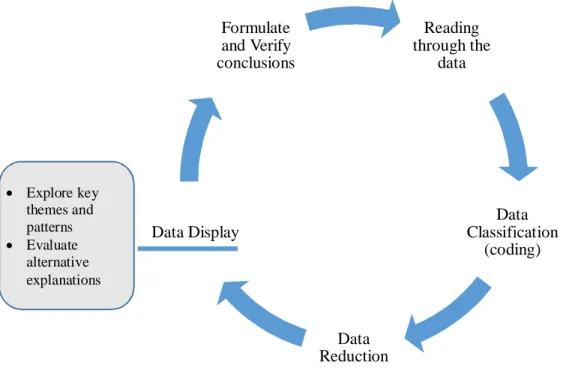
The purpose of qualitative data analysis is so the researcher could understand the meaning of the dimension relations in finding the answer of the problems outlined in this research. Understanding the relations of the dimensions which shaped the occurrence problems or conditions is very important for a qualitative study. The researcher did not use a statistical method as in the quantitative approach. The basic principle of qualitative data analysis is processing and analysing data collected from the field study and documentation into systematic, organized, structured, and meaningful information (Yin, 2002). Qualitative research emphasizes more on the utilization of inductive logic where categorization is created along with a field study or interview process. Logically, the results of a qualitative
15 research have a main characteristic of providing a contextual relationship for the information which explains social phenomenon comprehensively. Data obtained was processed systematically starting from classifying, reducing, doing data analysis, formulating and verifying a conclusion. Therefore, data analysis which is carried out in this research is a cyclical and simultaneous processes (Chart 1.2). To avoid bias, the data collection, categorization and classification in this research is based on the main principles of ISO 2600:2010 on CSR, Indonesian Law on CSR and environmental protection, as well as best practices. The indicators are also used to find out the main challenges in performing a good environmental governance. ISO 26000:2010 is used as an indicator to analyse environmental governance, while it is also used for best practices as an indicator for environmental management and performance.
Figure 1.3. Data Analysis Procedure
Reading through the data Data Classification (coding) Data Reduction Data Display Formulate and Verify conclusions Explore key themes and patterns Evaluate alternative explanations
16 CHAPTER II
Environmental Security and CSR in the Mining Sector
2.1. Introduction
The mining industry has been recognized as one of the biggest contributors for economic development, particularly for the resources-rich country, both local and the national level. However, the exploitation of natural resources frequently caused a serious environmental degradation. The common characteristics of large scale corporations are operated in an enclave or separately from other economic activity, which spawned a dual society where one area could have two different economic characters (Tanudjadja, 2012). On the one hand, the economy is growing rapidly which is mostly shown in the annual government revenue. It could also be caused by the modernization of the infrastructure. On the other hand, the local community economy is running very slow along with environmental degradation.
This condition is often associated with the resource curse. The Resources Curse, referred as Paradox of Plenty, is a condition where the natural resources wealth cannot guarantee the prosperity of a country. It is even a tendency in inducing slow economic growth and the low level of democracy than countries with less or have no natural resources. The Resources Curse could also be formed as a result of an internal or international conflict, corruption, environmental degradation or violation of human rights. Some studies show that the resources curse does not necessarily happen if the company or related stakeholders are able to manage the mining activities in a proper way (Komarulzaman et.al,2006; Holden,2013). It is suggested that the resources curse could also be avoided through the implementation of CSR, especially for the company which runs their business by extracting natural resources. The main reason is that the most tangible impact from a company’s activities is economic and environmental conditions. In this sense, the company has a moral obligation in ensuring and protecting the
17 community and environment from the negative impact of a company’s operations. This scheme is well-known as CSR.
There are two government approaches in the CSR implementation around the world, which is mandatory and voluntary. Those approaches have their weaknesses. When the government tried to suppress companies through CSR practices, the companies will tend to perform CSR as mandated, mostly done without improvisation. On the other hand, when the government exempted the company from CSR practices, there will be two different reaction, which is seriously develop their CSR performance or do not perform CSR at all. Therefore, there is no excellence approach of CSR practices for all conditions. Both of them can have a negative impact on sustainable development efforts as long as they focus exclusively on the role of corporations than the way of company’s investment to create and support the government role in ensuring community prosperity (Genasci & Pray, 2008). This chapter will specifically discuss about the conceptual framework of CSR and the relation with human security issues, particularly environmental security. Furthermore, it also discusses international as well as Indonesian experiences in tackling the environmental security problems caused by mining activity. Another sub-chapter will examine the implementation of the best CSR practices of a mining company in addressing environmental issues. In the final chapter, it will examine how the governance concept could become a great help in ensuring the effectiveness and sustainability of CSR practices.
2.2. CSR and Environmental Security: A Conceptual Framework 2.2.1. The Conceptual Framework of CSR
The concept of CSR underpinned by the idea that corporations could not act as isolated economic entities operating anymore, particularly in detachment from broader society around company. The CSR concept popularly used after the emergence of the "triple bottom
18 line" by John Elkington consists of economic growth, environmental protection, and social equity. The latter is called by 3P (profit, planet, and people). According to Elkington, a good company is not merely looking for an economic benefit (profit), but also concerned about the environment (planet) and social welfare (people) at the same time.
Until now, the notion of CSR is interpreted differently by each interest group. Therefore, there is no consensus on the definition of CSR. According to Kotler & Nancy (2005), CSR is defined as the commitment of corporation to improve the community prosperity through policy related to the business activity and the provision of company contributions. The World Business Council for Sustainable Development (WBCSD)8
defines CSR as the commitment of the business sector to contribute to the sustainable economic development. Whilst, ISO 26000:2010 defined CSR as:
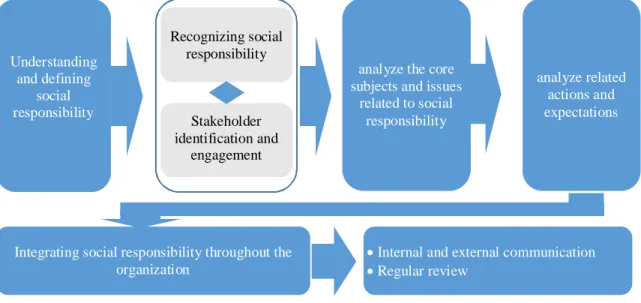
“CSR is a responsibility of an organization for the impacts of its decisions and activities on society and the environment, through transparent and ethical behaviour that contributes to sustainable development, including health and the welfare of society; takes into account the expectations of stakeholders; is in compliance with applicable law and consistent with international norms of behaviour; and is integrated throughout the organization and practised in its relationships”
From three definitions above, CSR can be simply interpreted as a way in which the company tries to achieve a balance between the economic, social and environmental objectives, while still respecting the expectation of the shareholders and stakeholders. In a broader development perspective, CSR refers to the company’s contribution toward the sustainable development concept, which is ‘development that meets the needs of the present without compromising the ability of future generations to meet their needs”9 . In this sense, the
business sector plays a key role in a job creation and community welfare without ignoring the environmental aspect. Hence, the CSR implementation is closely related to three
8
http://www.wbcsd.org/Overview/Global-Network/
9
Cited from Brief for GSDR 2015
<https://sustainabledevelopment.un.org/content/documents/5839GSDR%202015_SD_concept_defin iton_rev.pdf>
19 activities which consist of social responsibility, financial responsibility and environmental responsibility. Social responsibility is associated with the company’s contribution toward social and economic development of the community, particularly the most affected community. Financial responsibility is related to the financial or asset management by ensuring that the company profits are intended to create long term value for stakeholders and contribute to the local and national economy as well as sustainability. Meanwhile environmental responsibility is an effort in managing the environment to ensure that the company activity does not damage the environment and adversely affect the community sustainability.
The corporate social responsibility commitments and activities are principally referring to the firm’s behaviour, including company policy and program concerning the implementation of good corporate governance and good corporate responsibility10. Good
corporate governance is related to business ethics, a company’s policy and management related to the human resources management and company operations11 . Good corporate
responsibility is associated with environmental conservation and protection, community development, human right protection, consumer protection, supplier relation, and respecting the stakeholder interest. In this sense, corporate social responsibility is a part of good corporate responsibility. There are at least five reasons which prompted many companies to implement CSR which is increased customer interest, demands for greater disclosure, growing investor pressure, supplier relations, and the competitive labour market12 .
Globalisation has an increasing market demand for a great disclosure of a company’s activities, particularly related to social and environmental issues. The market demand is a form of public awareness on the impact of a company’s operation following many incidents
10 http://www.wbcsd.org/Overview/Global-Network/ 11 https://id.wikipedia.org/wiki/Tata_kelola_perusahaan 12 https://www.iisd.org/business/issues/sr.aspx
20 that happened around the company. Continuously, its affected to investor pressure which concerns on the company credibility. Therefore, CSR is no longer merely a company tradition. Furthermore, CSR is a company necessity to maintain its existence in the community.
The urgency of CSR practices has now become a public sector concern, especially in the developing countries. The weakening trend of government effectiveness shown by the deficiency of human resources and decreasing of public trust on the government policy and activities has raised the public expectation of greater company’s contribution to the economic and environment sustainability. In this decade, CSR implementation followed by the effort in strengthening the company responsibility through regulation, has already been implemented by India and Indonesia. Indonesia is one of a few countries that have taken an obligatory approach in the CSR implementation, showing positive move and progress for the existence and urgency of CSR.
2.2.2. Environmental Security
The emergence of environmental security is a result of the world concern on the environmental impact caused by the cold war. The war has been regarded as one of the primary sources of environmental degradation that resulting in the cessation of human life support. Although the concept has appeared in the 1960s, the big attention on the urgency of environmental security began in the mid-1980s when the Brundtland Commission was inserting in an environmental issue as one of the security concerns in the final report. In the Brundtland Commission Report 1987, it stated that real security would not be obtained by lifting up the weapon as a form of defense. More than the weapon, the security could be achieved by providing the basic need for non-military issues that threaten human life. Furthermore, the report revealed that the viability of human beings is not only based on
21 military action, but also needs for a global corporation in ensuring environmental sustainability. The environment is a part of the earth that contributed significantly to the existence of a community (Weintraub, 1995). This concept has slowly become a point of attention in security studies always opposed by traditionalists (Martinovsky, 2011). The existence of environmental security become more powerful since UNDP includes environmental security as one of the seven components of human security.
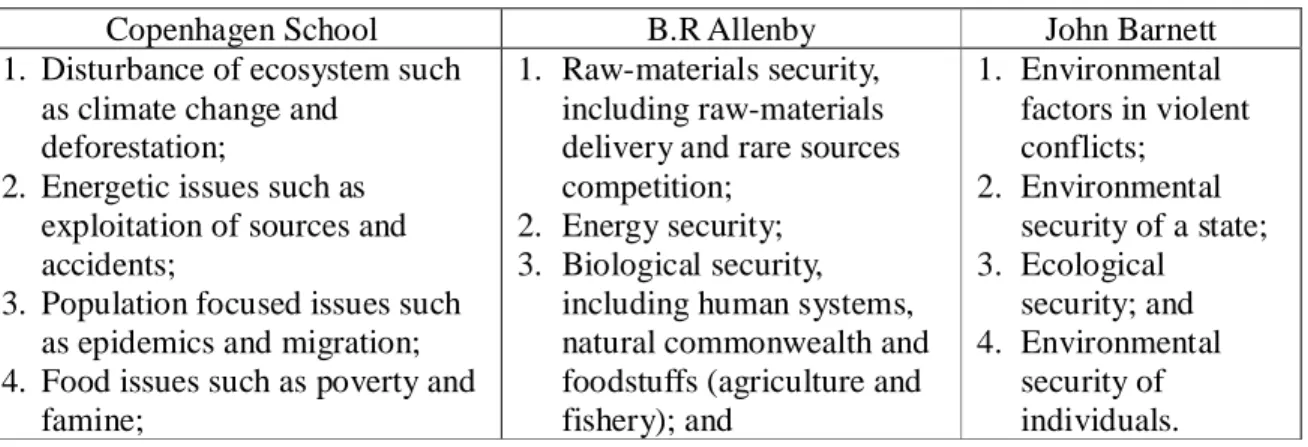
Up till now, there is no consensus on the definition of environmental security as a human security concept. One of the major criticisms on the emergence of the environmental security concept is an attempt to merge two different concepts which have different approaches, namely environmental and security. For the environmentalist, the integration of the security concept mostly associated with military action, and the environment concept will lead to a new social conflict. Environmental security is predicted to become a tool of a powerful fraction, mostly governments and companies, to legalize an action of a powerful group to suppressing the marginal group in the name of environmental protection. In recent years, environmental security has also been widely understood as including its relation with the human, physical, social and environmental prosperity, which made environmental security become hardest to interpret. Hence, the environmental security concept is still conceived as an umbrella concept which encompasses many issues (Table 2.1).
Table 2.1. The content of Environmental Security Concept
Copenhagen School B.R Allenby John Barnett
1. Disturbance of ecosystem such as climate change and
deforestation;
2. Energetic issues such as exploitation of sources and accidents;
3. Population focused issues such as epidemics and migration; 4. Food issues such as poverty and
famine;
1. Raw-materials security, including raw-materials delivery and rare sources competition;
2. Energy security; 3. Biological security,
including human systems, natural commonwealth and foodstuffs (agriculture and fishery); and 1. Environmental factors in violent conflicts; 2. Environmental security of a state; 3. Ecological security; and 4. Environmental security of individuals.
22 Table 2.1. The content of Environmental Security Concept (continued)
5. Economic issues such as not sustainable growth or
asymmetry wealth division; and 6. Civil disputes such as
eco-terrorism and degradation of the country during wars.
4. Dimensions of traditional security.
Source: Arranged from Martinovsky, 2011
Beyond the occurrence conditions, the understanding of the environmental security concept is still needs to classify a state as “secure” or “insecure”. In this study, environmental security is defined following the UNU definition as below:
Environmental security is relative public safety from environmental dangers caused by natural or human processes due to ignorance, accident, mismanagement or design and originating within or across national borders (UNU Milenium Project, 2015)
The environmental security threat could be in the form as deforestation, declining water availability, water pollution, air pollution, natural disaster, or decreasing arable land. Based on this understanding, this is the main source of environmental security related to natural conditions and human activity. The natural condition is related to the nature of environments such as disaster potency or resources scarcity. Meanwhile, sources of environmental security are related to human processes caused by military or economic activity. Glenn, Gordon, & Perelet (1998) highlight five key elements in environmental security, which are: (1) public safety from environmental dangers; (2) amelioration of natural resources scarcity; (3) maintenance of a healthy environment; (4) amelioration of environmental degradation; and (5) prevention of social disorder and conflict.
2.2.3. The Linkage of CSR and Environmental Security
Environmental security has become one of the areas of human security focus due to its dynamic characteristic and the interconnection between natural resources, social structure in
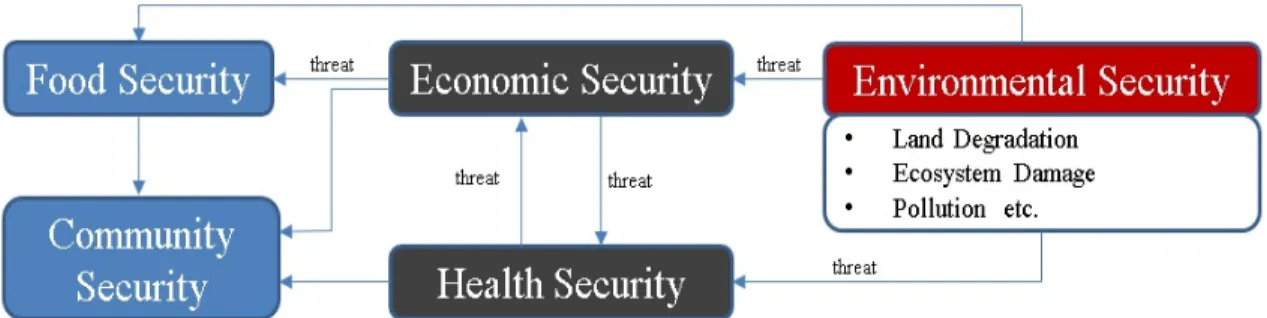
23 a country and economic engine that affect local and regional stability. Social and material impact of environmental degradation have mostly emerged as a threat to the health and economy which continuously affect food security and increase social conflicts (Figure 2.1). Therefore, for the country that relies on their natural resources for the economic purposes, environmental security is imperative to ensure the sustainability of the development efforts. In the sense that environmental security is not caused by a single factor it involves many actors, environmental governance has become an urgent call. Associated with economic purposes of a country, there are two main actors that have a great responsibility in ensuring environmental security, government and company. The government has a responsibility in ensuring environmental security through policy, while the company must do so through environmental management.
Public attention over the business contribution in addressing human security issues is shown in some studies, reports and conferences in the recent years. In 2015, the 5th annual
conference of JAHSS, a conference which focused on human security issues, there was has made a special session on human security and business entitled “Visualization of CSR in the Context of Sustainable Development”. In one of the conference sessions, it informed that the company shall take part in achieving sustainable development objectives and contribute to addressing human security issues. The company contribution is followed through by implementation of CSR, both in term of social, economic or environmental responsibility.
Figure 2.1. Mining Activity and Threat to Human Security Source:Author analysis
24 In line with the 3P (People, Profit and Planet) concept and numerous of company’s contribution toward poor environmental quality, which impacts on the human life and activities, CSR has seen as a solution in ensuring and creating a good environmental condition as well as a healthy community. CSR practices prevent over-exploitation of natural resources and maintain environmental quality by reducing the level of pollution. The advantage of CSR implementation is increasing the promotion of greater material recyclability, increasing better product durability and functionality and increasing of renewable resources used. It will continuously bring to the integration of environmental management into business plans, including life-cycle assessment and costing, environmental management standards, and eco-labelling.
2.3. Mining Industry and Environmental Insecurity: Experience in Several Countries Natural resources exploitation in the sense of the economic development of a country has disrupted the environment through mining processes. The previous studies show that environmental degradation caused by mining activities has ended up in a bigger disaster such as unsustainability of local economy and health insecurity (Laurentiue, Cristine & Loreta, 2016; Rawashdeh, Campbell & Titi, 2016). It is often followed by prolonged social conflict between a company and community. In this sense, environmental security becomes a major factor in ensuring peacefulness and national security as well as human rights13.
Mining activities consists of offshore and onshore activities. Inland mining (onshore) is executed by using open pit and underground mining methods, while sea mining (offshore) is conducted by using dredges or suction dredges. All types of mining processes have a high risk for community and environment sustainability (Figure 2.2).
13
25 Figure 2.2. Mining Processes, Risk and Environmental Security Impacts
Source: Author Analysis
2.3.1. International Experiences
The world has witnessed numerous ecological disasters as a result of mining activities. Several international cases are recorded from long ago. From 1940 to1975, the Hudson River, located in New York, became a dumping ground for a toxic waste by General Electric (GE) economic activity. The river pollution was considered as one of the biggest environmental cases in its time. Hudson River pollution was a compilation of various hazardous wastes, including PCBs14 and mercury. This case has caused an adverse impact on
flora and fauna as well as the community who consumed the fish or drinking the water from the river. Although ultimately the company was willing to accept the responsibility for dredging the Hudson River at a high cost., the environment is still unstable.
14 PCBs is considered as a source of several diseases including Parkinson, heart diseases, lower IQ and
26 Table 2.2. Some of the International Cases of Environmental Insecurity
No Case -
Location Information
1 Red Dog
-Alaska
Red Dog is the world’s largest zinc mines, as well as the largest pollutants contributor in Alaska. This mining site produces 196,000 ton of toxic waste per year.
2
Carlin Trend-Nevada
Carlin Trend Mining is the second largest gold reserves and the third largest gold producer in the world. The mining activities of Carlin Trend are considered the main cause of degradation of Indian Western Shohone land.
3 San
Martin-Honduras
The open-pit mining of Canada’s Glamis Gold destroyed the forest and eliminated local plantations. The mining process also consumed 1.5 million litres of water per day, which was considered as a destructive activity.
4
Yanacocha-Peru
Choropampa, a town located close to Newmont Yanacocha, a gold mining company which operated in Peru, was suffered losses caused by the mercury spilt from Newmont’s contractor truck in 2000. This incident caused health insecurity. Until now, Choropampa people still have to survive from the remaining mercury in their land.
5
Zortman- Landusky-Montana
The mining activity has destroyed Spirit Mountains, a holy place for Assiniboine and Gros Ventre. This mining area was abandoned by the Pegasus Gold company in 1998 due to bankruptcy. The environmental damage is remaining until now.
6 Los Frailes -
Spanish
In 1998, there was an incident where tin and zinc mining processes disposed hazardous waste into the Guadiamar River which partly contaminated Donana National Park.
7
Omal-Guyana
In 1995, the gold mining in Omal – Guyana disposed of 3 million litres of tailing which contaminating the Essequibo River.
8 Syama-Mali
Syama gold mine is the first large scale mining company in Mali. It is owned by Resolute Mining Limited, a gold mining company headquartered in Australia. This mining activity is responsible for the groundwater contamination in their mining areas.
9
Copperbelt-Zambia
The air pollution produced by Anglo-American company mining activities and other mining companies has made the local people acquire asthma, lung and other health problems.
10 Baia
Mare-Romania
In 2000, there was a waste disposal activity in Baia Mare Romania which disposed of 100,000 metric tonnes hazardous liquid waste which poisoned the drinking water for 2.5 million people and killed the fish.
11 Kumtor-
Kyrgyzstan
Cyanide disposal, work accidents, and deaths have become a major concern of the World Bank as an investor of mining activities in Kumtor, Kyrgyzstan.
12 Sepon-Laos Gold and copper mining have contaminated Mekong River, and threaten the forest sustainability and rural community’s life.
27 Table 2.2. Some of the International Cases of Environmental Insecurity (continued)
13
Ok Tedi-
Papua New Guinea
The gold and copper mining activities of Ok Tedi Mining Limited has contaminated Ok Tedi River by disposed 200,000 litres of hazardous waste every day.
14
Marcopper-Marinduque, Philippines
The copper mining has disposed 200 million tonnes solid waste directly to the sea for 16 years in one period.
Source: Author review
A recent big mining disaster was caused by improper environmental protection and management that occurred in Brazil in 2015. This accident is considered as the worst environmental disaster in Brazil. Toxic sludge flooded several areas of South Eastern Minas Gerais – Brazil, due to the breakdown of two waste dams from iron ore mining activities that belonged to Samarco Mineracao SA. This incident resulted in the death of at least 17 people and dozens were wounded. It contaminated the Southern Atlantic Ocean, destroyed one village, and caused economic losses. In October 2016, Brazilian prosecutors filed for the death penalty of 21 people, including Vale and BHP Billiton executives.
2.3.2. Indonesian Case
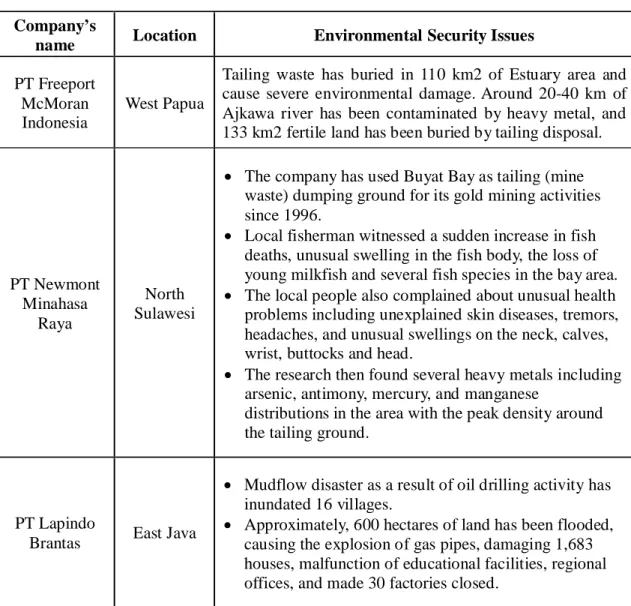
Based on Consortium for Agrarian Reform, Indonesia has to face 11 mining conflicts within a total area of 6,953 hectares in 2014. It has been proven that the mining company, both private and state-owned mining companies cause various effects to the environmental degradation. The following section will highlight some environmental cases as a consequence of mining company negligence. Oil and gas are one of the main sources of the Indonesian economy. Along with the economic contribution, oil and gas extraction has caused several problems in Indonesia. Oil and gas exploration in Aceh by Exxon Mobil, for example, resulted in 33 hectares of land subsidence in Lubuk Pusaka. There is no responsibility from Exxon Mobil accepted for this cases both in remedial action or preventive action or for similar situations following that. The community is abandoned and suffered from the economic loss
28 and environmental damage. A similar incident has appeared in Papua. Under Freeport Indonesia, a mining company headquartered in United States caused environmental destruction through gold mining activities witnessed by Papuans. Grasberg and Esberg as a mega project in Papua have changed a mountainous area into a giant hollow that is impossible to recover from.
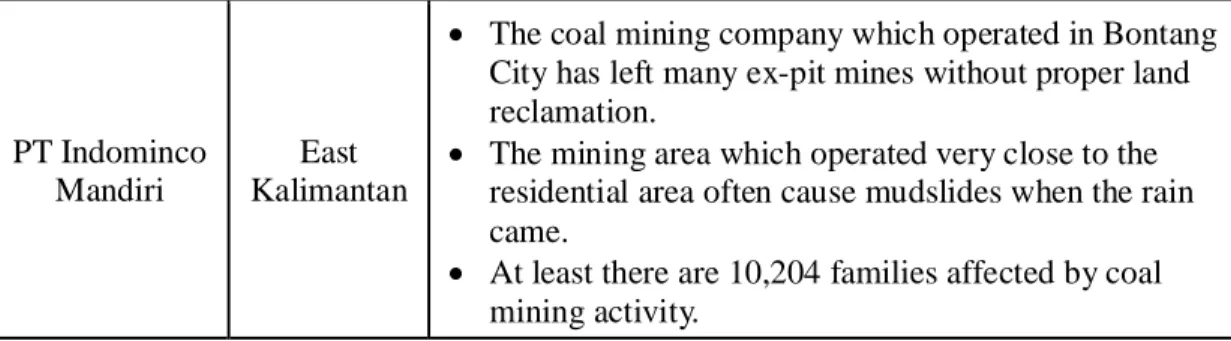
Table 2.3. Some of Environmental Security Issues in Indonesian Mining Areas Company’s
name Location Environmental Security Issues
PT Freeport McMoran Indonesia
West Papua
Tailing waste has buried in 110 km2 of Estuary area and cause severe environmental damage. Around 20-40 km of Ajkawa river has been contaminated by heavy metal, and 133 km2 fertile land has been buried by tailing disposal.
PT Newmont Minahasa
Raya
North Sulawesi
The company has used Buyat Bay as tailing (mine waste) dumping ground for its gold mining activities since 1996.
Local fisherman witnessed a sudden increase in fish deaths, unusual swelling in the fish body, the loss of young milkfish and several fish species in the bay area. The local people also complained about unusual health
problems including unexplained skin diseases, tremors, headaches, and unusual swellings on the neck, calves, wrist, buttocks and head.
The research then found several heavy metals including arsenic, antimony, mercury, and manganese
distributions in the area with the peak density around the tailing ground.
PT Lapindo
Brantas East Java
Mudflow disaster as a result of oil drilling activity has inundated 16 villages.
Approximately, 600 hectares of land has been flooded, causing the explosion of gas pipes, damaging 1,683 houses, malfunction of educational facilities, regional offices, and made 30 factories closed.
29 Table 2.3. Some of Environmental Security Issues in Indonesian Mining Areas (continued)
PT Indominco Mandiri
East Kalimantan
The coal mining company which operated in Bontang City has left many ex-pit mines without proper land reclamation.
The mining area which operated very close to the residential area often cause mudslides when the rain came.
At least there are 10,204 families affected by coal mining activity.
Source: Author review
Reflecting on the environmental cases that have occurred at both the national and international level, it could be seen that improper environmental management is the major factor of environmental problems related to the mining activity. Azam & Li (2010) found that the environmental problems are mostly associated with tailing management (Figure 2.3). The management failures are caused by a careless and hasty management of the mining company to exploit natural resources for their short term benefit. This condition leads to inadequacies of dam construction procedures, improper drainage structure maintenance, and weak long-term monitoring programs. On the other hand, the financial problem has also been considered in the obstruction of environmental protection. High-cost land rehabilitation and lack of local government involvement stalled the efforts in resolving the environment, social and economic problems as a result of mining activity (Laurentiue et.al, 2016).
Figure 2.3. Failure Distribution by Cause Source: Azam, 2010
30 2.4. How to Deal with Environmental Problem? Best Practices of CSR Implementation
from Mining Industry
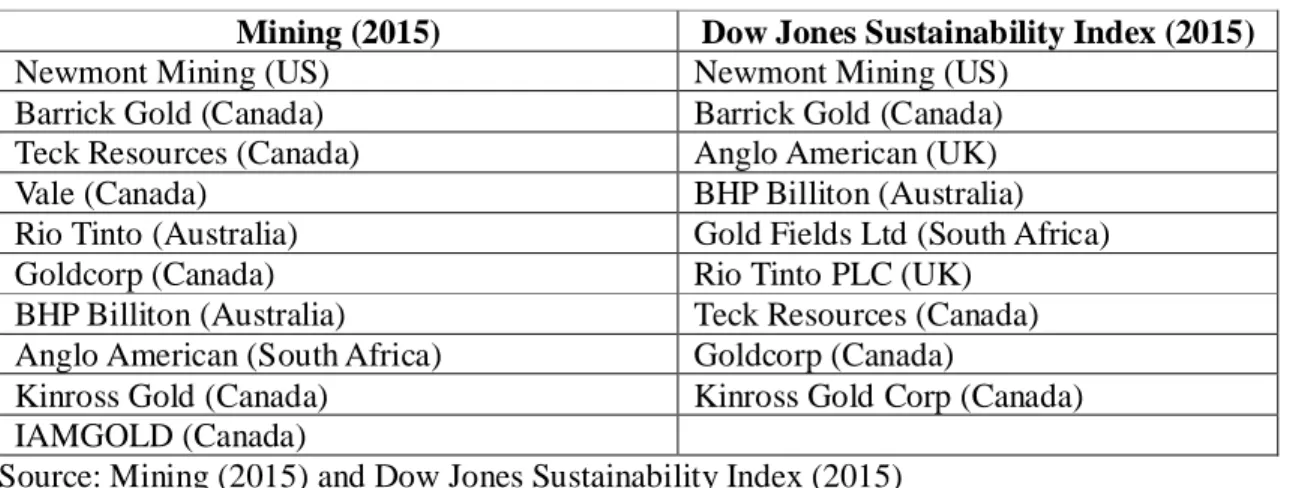
Addressing the environmental problems due to mining activity is a difficult task. Until now, there are several guidelines established by an international organization or a country to overcome environmental degradation. However, there is no universal formula which could comprehensively work to overcome the problem. But at least, a good CSR implementation or best practices possible has been carried out by several international companies. Mining Index and Dow Jones Sustainability Index has assessed and ranked 10 companies that are considered as companies with the best practices (Table 2.4). From two indexing reports, five companies are identified in both documents. These companies are recognized as responsible companies. These five companies include Newmont Mining which operated in United States, Barrick Gold in Canada, Teck Resources in Canada, BHP Billiton in Australia and Kinross Gold in Canada. Table 2.4 Top Ten Mining Companies with Best CSR Practices
Mining (2015) Dow Jones Sustainability Index (2015)
Newmont Mining (US) Newmont Mining (US)
Barrick Gold (Canada) Barrick Gold (Canada)
Teck Resources (Canada) Anglo American (UK)
Vale (Canada) BHP Billiton (Australia)
Rio Tinto (Australia) Gold Fields Ltd (South Africa)
Goldcorp (Canada) Rio Tinto PLC (UK)
BHP Billiton (Australia) Teck Resources (Canada)
Anglo American (South Africa) Goldcorp (Canada)
Kinross Gold (Canada) Kinross Gold Corp (Canada)
IAMGOLD (Canada)
Source: Mining (2015) and Dow Jones Sustainability Index (2015)
The companies have a similarity in referring to ISO and GRI for their CSR management, particularly for the reporting practices. In term of environmental management, the companies focused more on minimizing and mitigating the mining impact on water, air quality, climate change and biodiversity. These companies are working with stakeholders to find out the systemic solutions for the complexity of environmental challenges. Each focus area is supported by the company’s policy and equipped with environmental plans and works within the