第 54 卷 第 4 期
2019 年 8 月
JOURNAL OF SOUTHWEST JIAOTONG UNIVERSITY
Vol. 54 No. 4 Aug. 2019 ISSN -0258-2724 DOI:10.35741/issn.0258-2724.54.4.20 Research article
Computer and Information Science
D
IFFERENCES BETWEEN
A
D
H
OC
N
ETWORKS AND
M
OBILE
A
D
H
OC
N
ETWORKS
:
A
S
URVEY
特设网络与移动特设网络之间的差异
调查
Ali Abdul Wahhab Mohammed 1, Assad H. Thary Al-Ghrairi 2
1 Department of Remote Sensing, College of Remote Sensing and Geophysics, Al-Karkh University of Science, Baghdad, Iraq
2 Department of Renewable Energy, College of Energy and Environmental Sciences, Al -Karkh University of Science, Baghdad, Iraq
Abstract
The goal of this paper is to show the differences between ad hoc networks and mobile ad hoc networks (MANETs). The paper will show the routing in ad hoc networks and compare it to that of MANETs, after providing a brief introduction to MANETs. In addition, the types of routing protocols will be described as proactive and reactive protocols, where proactive routing attempts to maintain optimal routes to all destinations at all times, whether it is needed or not. In contrast, reactive protocols determine routes to given destinations only when there is data to be sent to those destinations. The paper will also provide a summary comparing uni-path and multi-uni-path routing, by considering different parameters. Multi-uni-path routing often has advantages more than uni-path routing, and Multi-path routing can also result in packet reordering. However, with uni-path routing, traffic allocation is not an issue since only one route is used.
Keywords:Routing Protocols, AODV, OLSR, DSR, Uni-Path Routing, Multi-Path Routing.
摘要 本文的目的是展示特设网络和移动特设网络 之间的差异。 在简要介绍 MANET 之后,本文将展示特设网络 中的路由并将其与 MANET 的路由进行比较。 此外,路由协议的类型将被描述为主动和被动协议,其中主动路 由尝试始终保持到所有目的地的最佳路由,无论是否需要。 相反,只有当有数据要发送到这些目的地时,被动 协议才能确定到达给定目的地的路由。 本文还将通过考虑不同的参数,以总结的形式在单路径和多路径路由之 间进行比较。 可以得出结论,多路径路由通常比单路径路由具有更多优点。 多路径路由可导致分组重新排序。 但是,使用单路径路由时,流量分配不是问题,因为只使用了一条路由。 关键词: 路由协议,AODV,OLSR,DSR,单路径路由,多路径路由。
I. I
NTRODUCTIONOver the past decade, the widespread availability of wireless communication and handheld devices has stimulated research into and development of self-organizing networks that do not require pre-established infrastructures or any centralized architecture. Those spontaneous networks, which are called ad hoc networks, should provide mobile users with worldwide communication capability and information access, regardless of their locations. A mobile ad hoc network (MANET) [1] consists of a collection of mobile wireless and autonomous hosts, referred to as simply ―nodes,‖ which spontaneously form a temporary network. A MANET is a kind of wireless ad hoc network and is a self-configuring network of mobile routers, and associated hosts that connect by wireless links, the union of which forms an arbitrary topology. The routers are free to move randomly and organize themselves arbitrarily; therefore, the network’s wireless topology may change rapidly and unpredictably [2]. Alternatively, a MANET may be considered as a mobile version of an ad hoc network. The idea of ad hoc networking is sometimes also called ―infrastructurelesse networking‖, while a MANET is at times referred to as a mobile mesh network. An ad hoc network is capable of operating autonomously and is completely self-organizing and self-configuring [3]. Therefore, it can be installed easily and rapidly. Essentially, a MANET is a collection of communication nodes that wish to communicate with each other, but it has no fixed infrastructure and no predetermined topology of wireless links. Thus, in an ad hoc environment, people and vehicles can be interworked in areas which that don't have pre-existing communication infrastructure or when the use of such infrastructure requires wireless extension. In contrast to conventional wireless networks, ad hoc networks have no fixed network infrastructure or centralized administrative support for their operations. Autonomous nodes may move arbitrarily so that the topology changes frequently without any prior notice. Consequently, the topology of the network and the interconnection patterns among the nodes may change dynamically so that links between nodes become unusable. Because of the dynamic nature of the topologies and interconnections, new routes must be considered for ad hoc networks, and these need to be maintained using routing protocols [4]. The aim of this paper is to provide information on ad hoc networks and MANETs, including the differences between them, as well as a survey of the routing in MANET. In Section II, the paper shows a brief description of ad hoc
networks, section III discuss the routing in ad hoc networks, section IV describe a MANET, section V explain concept of routing in MANETs. In sections VI and VII the paper describes the route discovery, maintenance and provide a comparison of uni-path and multi-path routing. And in the final, Section VIII present the conclusions along with suggestions for future works.
II. A
DH
OCN
ETWORKSAn ad hoc network is a collection of wireless mobile hosts that form a temporary network without the aid of any centralized administration or standard support services, where all the mobile nodes communicate with each other by wireless channels. A physical medium that can sustain data communication between two nodes is called a link. A link may be asymmetric between two nodes [5]. The transmission characteristics of a link depend upon the relative position or design characteristics of the transmitter and the receiver on the link. Due to the property of asymmetric links, a node may receive a message from another node but its transmitting message cannot reach the one that was transmitting Additionally, a link may be symmetric, in which case the nodes can communicate with each other by local broadcast. If there is a symmetric link between two nodes, they will be referred to as neighbors of each other [6]. When there is an asymmetric link between two nodes, these will be called semi-neighbors. Since there are two types of links in ad hoc networks, it is assumed that each node in the network must be detect their nodes of neighbors, and semi-neighbors that are transmitting by local broadcast. Each node will broadcast a beacon control signal within a given time period so that it can detect the state of a link: ―connected‖ or ―disconnected.‖ The control signal may communicate over the dedicated control channels. With our approach, only the symmetric links are applied in constructing the routing groups. In ad hoc networks, the message is routed along the links in the multi-hop style. All the mobile nodes act as routers. They are assumed to be willing to forward the message when a forwarding request is made. There is no cheating along these intermediate nodes when a message is forwarding [7]. However, the nodes are mobile. In ad hoc networks, the network topology that is constructed by the links is also dynamic. The main problems encountered with ad hoc networks involve the routing and characteristics of wireless communication. In infrastructure networks, a node can communicate with all the nodes in the same cell. In ad hoc routing, a node can communicate only with the nodes in its area. Although a particular node
can communicate with other nodes, a routing algorithm is required. Unlike wired communication, wireless networks have transmission problems with respect to data transmission, such as the possibility of asymmetric connections and higher interferences [2].
III. Routing in Ad Hoc Networks
Several different routing algorithms for ad hoc networks, with their special advantages and disadvantages, have been proposed in the past. These algorithms can be divided into two main branches: the proactive or table drive routing algorithms, and the reactive or on demand routing algorithms [8]. A node running a proactive routing algorithm has the full network view at every time, like a regular router in the Internet. All topology updates are broadcast immediately, or with a small time shift to all other nodes in the network. Therefore the route establishment can occur very quickly. The disadvantage of proactive routing algorithms is the number of required topology updates within a time period [9]. In case the number of nodes belongs to a network rising over a certain threshold, this kind of routing algorithm is not feasible anymore. In contrast, nodes using a reactive routing algorithm do not send any kind of topology updates to its neighbors. If they want to set up a route to another node, they will flood a route request through the network and get a response from the destination or an intermediate node, which knows the route to the destination by a formerly made route request [10].
IV. MANETs
MANETs consist of wireless hosts that communicate with each other in the absence of a fixed infrastructure. They are used in disaster relief, conference and battlefield environments, and received significant attention in recent years [11], [12], [13]. The position-based routing protocols are the type that use node location information instead of linking information to routing. The routing decisions are based on source node, neighbor nodes, and destination node locations. Each node finds its location by GPS or via another positioning system. The source node finds the location of a destination node with a suitable location server. MANETs have a dynamic topology, plus multihop capability characteristics which are both very important. In a dynamic topology, nodes are free to move arbitrarily. Each mobile host becomes a potential router, and it is possible to dynamically establish routes between them, as well as nodes to an existing route. The
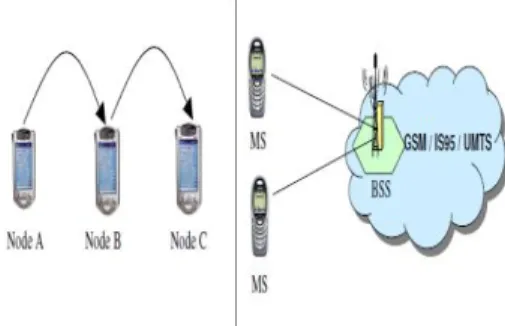
network topology changes rapidly and randomly at unpredictable times [13], [14]. In multihop capability, there must be a router in each node. In general, the cellular networks—also called single-hop networks— rely on a fixed wired infrastructure to achieve and maintain an end-to-end connection [15]. Conversely, a mobile node in an ad hoc network cannot reach the destination directly because of the node’s limited transmission range (unless, however, the destination node is the neighbor node) [16], [17]. Thus, the information must flow through other nodes. This requires the mobile hosts to incorporate routing functionality so that they can act both as routers and hosts (Fig. 1).
Figure 1. Multi-hop (hop-by-hop) routing is one of the essential characteristics of MANETs in comparison to today’s cellular
(single-hop) networks.
V. Routing in MANETs
Routing protocols are used to find and maintain routes between source and destination nodes. Traditional routing protocols were developed to support user communication in networks that had a fixed infrastructure with reliable high-capacity links. However, in the MANET, the network infrastructure dynamically changes and the links are wireless with less capacity and greater susceptibility to errors [18]. MANETs will be critical to future deployed military units, and several Army programs (such as the First Digitized Division) have requirements for this type of network. Recently, a number of routing protocols were proposed for MANETs as part of the Defense Advanced Research Project Agency’s (DARPA) Global Mobile (GloMo) program and the Internet Engineering Task Force (IETF) MANET working group [19]. These protocols generally fall into one of two categories: proactive or reactive [11]. Proactive routing attempts to maintain optimal routes to all destinations at all times regardless of whether they are needed. To support this, the routing protocol propagates information updates
about a network’s topology throughout the network. In contrast, reactive or on-demand routing protocols determine routes to given destinations only when there is data to send to those destinations. If a route is unknown, the source node initiates a search to find one. Proactive routing protocols have the advantage of having short routes available at all times, thereby avoiding the delay of searching for a route on demand. They also avoid any traffic surge that results from reactive route querying. Reactive routing protocols have the advantage of only generating routing overhead to find routes when they are needed, independent of network topology change.
A. Proactive and Reactive Routing
Routing protocols are divided into two categories: proactive and reactive. Proactive schemes calculate the routes to various nodes in the network. So the nodes can use a given route whenever they need it. Meanwhile, reactive scheme will calculate the route, if the nodes need to communicate with a destination node. The reactive schemes look like lazy schemes, because they will work if they have to. But the reactive schemes have smaller Route discovery overheads, because they don’t have to save all possible routes in the networks. Destination Sequenced Distance Vector (DSDV) is an example of a proactive scheme. Ad Hoc On Demand Distance Vector (AODV) and Dynamic Source Routing are examples of reactive schemes [20]. The most popular ones are AODV, DSR (reactive), and OLSR (proactive). Reactive protocols like DSR and AODV find the routes only when requested, and data need to be transmitted by the source host. These protocols generate low traffic and routing overhead [21], [22] but because they must first determine the route, delay increases, especially if the information is not available in caches. Reactive protocols are suitable for energy-constrained conditions. They use distance vector routing algorithms. However, proactive protocols like OLSR are table-driven protocols and use link state routing algorithms. Proactive protocols generate high traffic and routing overhead to keep the information up-to-date, but have less delay and can be used when bandwidth and energy resources are enough [23], [24]. Because of the high mobility of the nodes, the route update may be more frequent than the route requests and some of bandwidth is wasted, as most of the routing information is never used. Thus, both reactive and proactive protocols are suitable for some special scenarios [25], [26]. Designing a routing algorithm that has better performance for a special scenario is an important issue in MANETs [27].
1) AODV
AODV is a reactive protocol that reduces the number of broadcasts by establishing routes on a demand basis. This protocol does not maintain the whole routing information of all nodes in the network [28]. For Route Discovery a route request packet (RREQ) is broadcast whenever a node has a packet to transmit to the destination. It continues forwarding till an intermediate node, which has recent route information about destination or the destination itself, receives this packet. Then the intermediate node or the destination will send a Route Reply (RREP) message to the source by reverse path of RREQ; therefore, AODV uses a symmetric link. During forwarding a packet a node records in its tables from which the first copy of the request came. This is needed for establishing reverse path for RREP message. The intermediate nodes are allowed to inform the affected sources from link breakage. Link failure can be due to the node’s movement or exhausting the energy. When source node receives the Route Error packet (RERR) packet, it can initiate route again if still needed. Propagation of RERR packets in AODV can be conceptualized as a tree whose root is the node at that point of failure and the affected sources that receive the error packet as leaves [29]. To prevent route loops, AODV uses sequence numbers maintained at each destination to determine how fresh the routing information is [28]. The sequence numbers are carried by all routing packets. A node is active if it sends, receives or forwards packets for that route and if there is at least one data packet transmitted through this route within a fixed time interval. AODV has much less overhead than simple protocols that keep the entire network information from source to destination. Hello messages are responsible for the route maintenance [28].
2) DSR
Dynamic Source Routing (DSR) is another reactive protocol. The main feature of DSR is source routing. DSR is specially designed for multi-hop ad hoc networks and reduces bandwidth usage by eliminating periodic messages. In this protocol, the packet includes a complete list of all the nodes that should be forwarded toward them. DSR has two major mechanisms: ―Route Discovery‖ and ―Route Maintenance‖ [30]. During Route Discovery, a source node broadcasts a RREQ message; each intermediate node that receives this packet will rebroadcast it, unless it is the destination or it has route to the destination in its route cache. Such a
node will send a RREP message to the source [30]. The route the RREP packet carries is cached in the source node for future use. If link failure occurs, then a route error packet (RERR) will be sent to the source to notify it. The source node then removes that route’s failed link from its cache and if there is a new route to that destination in its cache, it will replace it; otherwise it will reinitiate route discovery. Both Route discovery and Route maintenance are on demand. It is loop-free because the sender can avoid duplicate hops in the routes selected. Unidirectional links and asymmetric routes are supported by DSR.
3) OLSR
Optimized Link State Protocol (OLSR) is a proactive protocol; therefore due to its proactive nature, the routes are always available when they are needed [30]. OLSR uses hop-by-hop routing. It uses MPR (Multi Point Relays) flooding mechanism to broadcast and flood Topology Control (TC) messages in the network. This mechanism takes advantage of controlled flooding by allowing only selected nodes (MPR nodes) to flood the TC message. Each node selects an MPR to reach its two-hop neighbors. OLSR uses topology discovery/diffusion mechanism by periodic and triggered Topology Control (TC) messages. TC messages are generated by MPR nodes and carry information about MPR selectors’ nodes. Neighbor sensing is done by using periodic broadcasts of Hello messages. These messages are one-hop broadcasts (never forwarded) that carry neighbor type and neighbor quality information [31].
B. Multipath Routing
Standard routing protocols in ad hoc wireless networks, such as AODV and DSR, are mainly intended to discover a single route between a source and destination node. Multipath routing consists of finding multiple routes between a source and destination node. These multiple paths between source and destination node pairs can be used to compensate for the dynamic and unpredictable nature of ad hoc networks.
1) Benefits of Multipath Routing
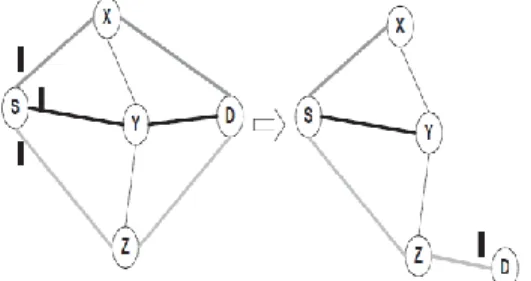
As mentioned above, multiple paths can provide load balancing, fault-tolerance, and higher aggregate bandwidth. Load balancing can be achieved by spreading the traffic along multiple routes. This can alleviate congestion and bottlenecks. From a fault tolerance perspective, multipath routing may provide route resilience. Fig.2, it demonstrates, how to allow the
multipath routing the paths to be simultaneously for routing the data. where node S has established three paths to node D. If node S sends the same packet along all three paths, and at least one of the paths does not fail, node D will receive the packet. While routing redundant packets is not the only way to utilize multiple paths. In addition, the aggregate bandwidth of the paths may satisfy the bandwidth requirement of the application. Since more bandwidth is available, a smaller end-to-end delay may be achieved [32]. However, due to issues at the link layer, using multiple paths in ad hoc networks to achieve higher bandwidth may not be as straightforward as in wired networks. Because nodes in the network communicate through the wireless medium, radio interference must be considered as transmissions from a node along one path may interfere with transmissions from a node along another path, limiting the achievable throughput.
Figure 2. Source node S routes the same packet to destination node D along the routes SXD, SYD, and SZD. When node D moves, routes SXD and SYD break, but route SZD is still able to deliver the
packet to node D.
2) Multipath Routing Components
Multipath routing consists of three components: route discovery, route maintenance, and traffic allocation. These components will be discussed in the following subsections.
VI. Route Discovery and Maintenance
Route discovery and maintenance involve finding multiple routes between a source and destination node. Multipath routing protocols may attempt to find node disjoint, link-disjoint, or non-disjoint routes. Node-disjoint routes, also known as totally Node-disjoint routes, have no nodes or links in common. Link-disjoint routes have no links in common, but they may have nodes in common. Non-disjoint routes can have nodes and links in common. Refer to Fig. 3 for examples of the different types of multipath routes.
Disjoint routes offer certain advantages over non-disjoint ones. For instance, non-non-disjoint routes may have lower aggregate resources than disjoint routes because
non-disjoint routes share links or nodes. In principle, node-disjoint routes offer the most aggregate resources because neither links nor nodes are shared between the paths.
Figure 3. Routes SXD, SYD, and SZD in (a) which have no links or nodes in common and are therefore node disjoint. Routes SXYZD and SYD in (b) have node Y in common and are therefore only link disjoint. Routes SXD and SXYD in (c) have node X and link SX in
common and are therefore non-disjoint.
Disjoint routes also provide higher fault tolerance. When using non-disjoint routes, a single link or node failure can cause multiple routes to fail. In node- or link-disjoint routes, a link failure will only cause a single route to fail. However, with link-disjoint routes, a node failure can cause the failure of multiple routes that share that node. Thus, node-disjoint routes offer the highest degree of fault tolerance. The main advantage of non-disjoint routes is that they are easier to discover. Since there are no restrictions requiring the routes to be node- or link-disjoint, more non-disjoint routes exist in a given network than node or link disjoint ones. As node-disjointedness is a stricter requirement than link-disjointedness, node-disjoint routes are the least abundant and hardest to find. It has been demonstrated that in moderately dense networks, only a small number of node-disjoint routes between any two arbitrary nodes may exist, especially as the distance between the nodes increases [33]. This is because sparse areas between the two nodes may act as bottlenecks. Given the trade-offs between using node-disjoint versus non-disjoint routes, link-disjoint routes offer a good compromise. In the following subsection, some of the proposed multipath protocols are reviewed for finding node-disjoint, link-disjoint, and non-disjoint paths. Intelligent path selection can be used to enhance the performance of multi-path routing. For instance, a certain subset of paths may be selected for use based on a variety of criteria such as characteristics of the paths and interactions with the link-disjoint routes. From a fault tolerance perspective, more reliable paths should be selected to reduce the chance of route failures. Path selection also plays an important role for Quality of
service (QoS) routing. In QoS routing, only a subset of paths that satisfies QoS requirement is selected [34], [35].
After a source begins sending data along multiple routes, some or all of the routes may break due to node mobility and/or link and node failures. As in unipath routing, route maintenance must be performed in the presence of route failures. As discussed previously for unipath routing, route discovery can be triggered upon failure of the route. In the case of multipath routing, route discovery can be triggered each time one of the routes fails or only after all the routes fail. Waiting for all the routes to fail before performing a route discovery would result in a delay before new routes are available. May degrade the QoS of the application, and however, by initiating route discovery every time one of the routes fails may incur high overheads.
Split Multipath Routing (SMR) that was proposed in [36], [37] is an on-demand multipath source routing protocol. SMR is similar to Dynamic Source Routing (DSR), and is used to construct maximally disjoint paths. Unlike DSR, intermediate nodes do not keep a route cache, and therefore, do not reply to RREQs. This is to allow the destination to receive all the routes so that it can select the maximally disjoint paths. Maximally disjoint paths have as few links or nodes in common as possible. Duplicate RREQs are not necessarily discarded. Instead, intermediate nodes forward RREQs that are received through a different incoming link, and whose hop count is not larger than the previously received RREQs. The proposed route selection algorithm only selects two routes. However, the algorithm can be extended to select more than two routes. In the algorithm, the destination sends an RREP for the first RREQ it receives, which represents the shortest delay path. The destination then waits to receive more RREQs. From the received RREQs, the path that is maximally disjoint from the shortest delay path is selected. If more than one maximally disjoint path exists, the shortest hop path that is selected by RREQs. If more than one shortest hop path exists, the path whose RREQ was selected and received by first. The destination then sends an RREP for the selected RREQ. AOMDV [38] is an extension of the AODV protocol for computing multiple loop-free and link-disjoint paths. To keep track of multiple routes, the routing entries for each destination contain a list of the next hops along with the corresponding hop counts. All the next hops have the same sequence number. For each destination, a node maintains the advertised hop count, which is defined as the maximum hop count for all the
paths. This hop count is used to send advertisements of the destination. Each duplicate route advertisement received by a node defines an alternate path to the destination. To ensure loop freedom, a node only accepts an alternate path to the destination if it has a lower hop count than the advertised hop count for that destination. Because the maximum hop count is used, the advertised hop count does not change for the same sequence number. When a route advertisement is received for a destination with a greater sequence number, the next-hop list and advertised hop count are reinitialized.
AOMDV may be used to find node-disjoint or link-disjoint routes. Finding node-link-disjoint routes does not require that each node immediately reject duplicate RREQs. Each RREQ that arrives via a different neighbor of the source defines a node-disjoint path because nodes cannot broadcast duplicate RREQs. Therefore, any of the two RREQs that arrive at an intermediate node via a different neighbor of the source cannot have traversed the same node. To get multiple link-disjoint routes, the destination replies to duplicate RREQs regardless of their first hop. To ensure link-disjointness in the first hop of the RREP, the destination only replies to RREQs that arrive via unique neighbors. After the first hop, the RREPs follow reverse paths, which are node-disjoint and, thus, link-disjoint. The trajectories of each RREP may intersect at an intermediate node, but each takes a different reverse path to the source to ensure link-disjointness. AODVM [33] is an extension of AODV that is used to find multiple node disjoint paths. Intermediate nodes are not allowed to send a route reply directly to the source. Also, duplicate RREQ packets are not discarded by intermediate nodes. Instead, all the received RREQ packets are recorded in an RREQ table at the intermediate nodes. The destination sends an RREP for all the received RREQ packets. An intermediate node forwards a received RREP packet to the neighbor in the RREQ table that is along the shortest path to the source. Whenever a node overhears one of its neighbors broadcasting an RREP packet, it deletes that neighbor from its RREQ table to ensure that nodes do not participate in more than one route. Because a node cannot participate in more than one route, the discovered routes must be node disjoint.
VII. Comparison of Uni-Path and
Multipath Routing
The main advantage of DSR over AODV is its simplicity. In DSR, while the nodes maintain route caches, they do not need to maintain routing tables with forwarding information, which is required in AODV. However, more overhead is incurred in DSR routing data packets since the entire route must be specified in the packet header. The multipath extensions of DSR and AODV inherit these advantages and disadvantages from their parent protocols. Therefore, the main advantage of SMR, and any multipath extension of DSR, is simplicity. Both AODV and DSR allow intermediate nodes to respond to RREQs, which may reduce the route discoveries time. However, neither SMR nor AODVM allow intermediate nodes to reply to route discoveries and ensure that the destination is able to select disjoint paths. The primary advantage of AOMDV is that it allows intermediate nodes to reply to RREQs while it selects disjoint paths. None of the three multipath protocols reject duplicate RREQs at intermediate nodes, enabling the discovery of additional paths. However, it also results in more messages overhead during route discovery due to increased flooding. In the multipath protocols the destination replies to multiple RREQs, which results in additional overhead. However, in SMR and AOMDV, the destination only replies to a subset of the received RREQs. The primary disadvantages of multipath routing protocols compared to unipath protocols are complexity and overhead. In multipath extensions of AODV, maintaining multiple routes to a destination results in larger routing tables at intermediate nodes. In multipath routing, as discussed in the next section, the method by which packets are allocated to the multiple routes must be considered. Multipath routing can result in packet reordering. In uni-path routing, traffic allocation is not an issue, since only one route is used.
VIII. Conclusions and Future Work
This paper has presented an overview of differences between ad hoc networks and MANET, illustrating their routing where mobility in the wireless networks is very popular nowadays. The presence of ad hoc networks covers the infrastructure’s weakness. Since the ad hoc networks are independent from infrastructure, the nodes must be able to work together to establish a greater network. They have multi hop packet, if they have to send a packet to a destination nodes outside their transmission range. Therefore, routing algorithms are
the main challenge. Since the nodes are mobile, links between nodes are not symmetric, and the topology is always changed. The routing algorithms used in wired network must be modified or must be invented. The ad hoc networks still have to deal with wireless problems, such as security and higher error rate. Specially MANETs have to consider their power supply, since they are not supported with fixed power supply. At least, the ad hoc networks are developed not to replace the infrastructure networks. With the great number of wireless user and frequency limitations, it is unlikely possible to control independent network. The ad hoc networks can replace the infrastructure networks only for a short time and are used for some specific situation. For future work, it would be desirable to develop a multipath protocol that can provide delay bounds or guarantees, which are required by some real-time applications. Using multipath routing to provide adaptive QoS using source coding is also a promising technique that can be expanded upon for applications other than video.