Hysteresis, limit cycles
and
mode interactions of standing
waves
with
Faraday
excitation.
A.D.D.
Craik
School
of
Mathematical & Computational Sciences,University
of
$St$Andrews, $St$Andrews,Fife
$K\mathrm{Y}I\mathit{6}\mathit{9}SS$,Scotland, $U.K$
.
(visiting the Department
of
Applied Mathematics 8 Physics, Facultyof
Engineering, Kyoto University)
Abstract
Complex interaction phenomena are known to arise
among
standing free-surfacewaves in fluids within containers subjected to small periodic vertical (Faraday)
oscillations. Here, we review theoretical and experimental work concerning (i)
hysteresis andlimit-cycle behaviourof’puret standing waves;and (ii) instability of
a ’pure\dagger standing wave to a pair of neighbouring modes, and the subsequent
modulations. We also discuss the special case of(iii) second-harmonicresonance.
1 lntroduction
Study ofwave motion excited by small periodic vertical vibrations of a cylindrical
container began with the pioneering studies of
Faraday1
andRayleigh.2,3
Such vertical oscillation is nowknown as tFaraday excitationt.The waves mostprone
togeneration are those with frequencies close to one-half of the forcing frequency; a
situation now commonly referred to as $\mathfrak{l}\mathrm{s}\mathrm{u}\mathrm{b}\mathrm{h}\mathrm{a}\mathrm{r}\mathrm{m}\mathrm{o}\mathrm{n}\mathrm{i}\mathrm{C}’,$
$’ \mathrm{p}\mathrm{a}\mathrm{r}\mathrm{a}\mathrm{m}\mathrm{e}\mathrm{t}\mathrm{r}\mathrm{i}\mathrm{C}’$, or $|\mathrm{F}\mathrm{a}\mathrm{r}\mathrm{a}\mathrm{d}\mathrm{a}\mathrm{y}^{1}$
resonance.The linear theory developed by
Beniamin&Urse11
established that, inthe inviscidlimit, eachsurface-wave mode isgoverned by an equation of Mathieu type, and so exhibits the
many
zones of instability characterised by this equation;but the strongest instability, and so that least likely to be suppressed by viscous
damping, is the subharmonic one. The corresponding linear viscous problem is
fully described by
Kumar&Tuckerman5.
Duringthe pastfifteen
years,
interest in Faraday excitation has greatly increased,due to important advances in the theory of nonlinear dynamical systems; and to
influential experimental studies that revealed a rich variety of behaviour, not all
yetfully understood. Most notably, Ciliberto&Gollub studied standing waves in
circularcylinders;$\mathrm{F}\mathrm{e}\mathrm{n}\mathrm{g}\ \mathrm{S}\mathrm{e}\mathrm{t}\mathrm{h}\mathrm{n}\mathrm{a}^{7}$,Simonelli&Gollub8those in
square
and almostsquare
rectangular containers; Ezerskii et $al^{9}.$, Douady &Fauve and Douady11studied short capillary waves in containers large compared with wavelength;
or travelling;Wu, $\mathrm{K}\mathrm{e}\mathrm{o}\mathrm{l}\mathrm{i}\mathrm{a}\mathrm{n}\ \mathrm{R}\mathrm{u}\mathrm{d}\mathrm{n}\mathrm{i}\mathrm{c}\mathrm{k}^{1}3$ examinedlocalised
$|\mathrm{s}\mathrm{t}\mathrm{a}\mathrm{n}\mathrm{d}\mathrm{i}\mathrm{n}\mathrm{g}$solitonst in a
long rectangular tank; Craik
& Armitage14
and Decent&
Craik15 studiedneighbouring plane standing-wave modes in a long
narrow
tank; Jiang, Ting,$\mathrm{P}\mathrm{e}\mathrm{r}\mathrm{l}\mathrm{i}\mathrm{n}\ \mathrm{S}\mathrm{c}\mathrm{h}\mathrm{u}\mathrm{l}\mathrm{t}\mathrm{z}^{1}6$ examined large-amplitude waves and their modulations due to
slightly-perturbed tank vibrations. The earlier work, and related theory, are
described in the review by Miles&Henderson17. Additionally, fine experimental
studies and related theory of
wave
motion in tanks subject to horizontal, rather than vertical, vibration have been made by Funakoshi&
Inoue18, whileKrasnopolskaya&van
Heijst19
have investigated wave-generation in an annulartank with radially-vibrating inner wall, finding both tdirectt generation of axisymmetric waves and parametric ’Faradayt excitation of non-axisymmetric
waves
at the subharmonicfrequency.The mutual stability and nonlinear interaction of different spatial modes with
similar (or, in degenerate cases, identical) natural frequencies has also been a
subjectof much activity. Inadditionto the above-mentioned experimental studies,
which also address theoreticalissues,the theoretical
papers
of$\mathrm{M}\mathrm{e}\mathrm{r}\mathrm{o}\mathrm{n}\ \mathrm{P}\mathrm{r}\mathrm{o}\mathrm{c}\mathrm{a}\mathrm{c}\mathrm{C}\mathrm{i}\mathrm{a}^{20}$, $\mathrm{N}\mathrm{a}\mathrm{g}\mathrm{a}\mathrm{t}\mathrm{a}^{21}’ 2,$$\mathrm{U}2\mathrm{m}\mathrm{e}\mathrm{k}\mathrm{i}\ \mathrm{K}\mathrm{a}\mathrm{m}\mathrm{b}\mathrm{e}^{2},$$\mathrm{K}3\mathrm{a}\mathrm{m}\mathrm{b}\mathrm{e}\ \mathrm{U}\mathrm{m}\mathrm{e}\mathrm{k}\mathrm{i}^{24}$, Umeki25 and Craik26may
bementioned. In all of these, the postulated interaction of two modes, each characterisedby a (slowly-varying) time-dependent complex wave amplitude, leads
to a pair of complex evolution equations. These have four real variables and the
structure of temporal orbits
can
be remarkably complicated. There are typicallyseveral equilibrium states that correspond to fixed points of the governing
equations, somestable and
some
unstable. The actual behaviour depends cruciallyon several constant parameters that
appear
in these equations; and these parameters in turn depend (sometimesvery
sensitively) on the preciseexperimental configuration.Theoretical determinationof theparameter values for
agiven configurationis not a trivial taskand, once accomplished, investigation of the nature of the solutions involves a mix of analysis-to determine fixed points
andtheir local stability-andextensive computations of solution trajectories. Even
after all this is accomplished, it is not
easy
to make meaningful connections between the different sets of results for different configurations. Noone
set ofexperimental
or
theoretical results is ’$\mathrm{t}\mathrm{y}\mathrm{p}\mathrm{i}\mathrm{C}\mathrm{a}\mathrm{l}\mathrm{t}$: the richness of possible behaviours
andsensitivitytoparameter values is too great.
A different scenario is
more
appropriate for interaction between modes with$s$imilar spatialstructure in a long
narrow
tank like that of Craik&Armitage14. Intheirconfiguration, where neighbouringmodes have
very
similarspatial structuremodes is important. Then, a single dominant finite-amplitude mode
may
be unstable to apair ofneighbouring modes. Suchinstability has similarities with the well-known $\mathrm{E}\mathrm{c}\mathrm{k}\mathrm{h}\mathrm{a}\mathrm{u}\mathrm{s}^{27}$andBeniamin-Feir28
instability, but with additional forcingeffects. This topic has recently been comprehensively treated by$\mathrm{D}\mathrm{e}\mathrm{c}\mathrm{e}\mathrm{n}\mathrm{t}\ \mathrm{C}\mathrm{r}\mathrm{a}\mathrm{i}\mathrm{k}^{29}$,
extending an earlierexploratory analysis of $\mathrm{C}\mathrm{r}\mathrm{a}\mathrm{i}\mathrm{k}3$, and it is discussed in section
3
below.
At, and nearto, a precise frequency, second-harmonic resonance occurs
among
capillary-gravity waves: see
e.g.
$\mathrm{M}\mathrm{c}\mathrm{G}\mathrm{o}\mathrm{l}\mathrm{d}\mathrm{r}\mathrm{i}\mathrm{c}\mathrm{k}^{3}1$.
Then, two waves haverespective
frequencies and wavenumbers in the ratio 1 : 2. When Faraday forcing has
frequency close to twice that of one of the resonant pair of waves, an interesting
mutual interaction
occurs
that is not describedby
theories that exclude suchresonance.
Such situations have been considered by Henderson $\ \mathrm{M}\mathrm{i}\mathrm{l}\mathrm{e}\mathrm{s}^{32}$, andsimilar equations arise fora forced resonant double pendulum $(\mathrm{B}\mathrm{e}\mathrm{c}\mathrm{k}\mathrm{e}\mathrm{r}\ \mathrm{M}\mathrm{i}\mathrm{l}\mathrm{e}\mathrm{s}^{33})$
.
Recent work of Forster
&Craik
draws attention to the fact that the simplestmodel equations for this situation admit solutions that display unbounded growth
: seesection4.
2 Hystere$s\mathrm{i}\mathrm{s}$and single-mode
limit cydes
Even for a single dominant standing-wave mode, theoretical
description
is farfrom straightforward, for the simplest approximation does not yield results in
agreement with observation. A full account, and a particular examination of
hysteresisof such waves astheimposed frequencyand amplitude of vibrations are
altered, is given by $\mathrm{D}\mathrm{e}\mathrm{c}\mathrm{e}\mathrm{n}\mathrm{t}\ \mathrm{C}\mathrm{r}\mathrm{a}\mathrm{i}\mathrm{k}^{15,3}5$
.
Earlier, Miles36and $\mathrm{C}\mathrm{r}\mathrm{a}\mathrm{i}\mathrm{k}\ \mathrm{A}\mathrm{r}\mathrm{m}\mathrm{i}\mathrm{t}\mathrm{a}\mathrm{g}\mathrm{e}^{14}$
had shown that nonlinear forcing and damping can significantly affect
single-mode hysteresis boundaries. Decent
&
$\mathrm{C}\mathrm{r}\mathrm{a}\mathrm{i}\mathrm{k}^{15,3}5$retained also higher-order
conservative terms,
obtaining
results thatagree
fairly well with their experiments and with those of Craik&Armitage for three separate liquid depths. A novel feature of their results is the prediction of aperiodically-modulating
standingwave, corresponding to a single-mode limit-cycle solution, in a limited region of
parameter
space:
but dear experimental confirmation of this does not yet exist.Their results for one spatial mode with liquid depth of $2\mathrm{c}\mathrm{m}$ are reproduced in
Figure 1, together with experimental results of Craik&Armitage on the linear
instability
boundary
and nonlinear lower hysteresis boundary for that mode. Thehorizontal axis represents a scaled frequency parameter $\Omega$ which
measures
thesmall $\mathrm{d}\mathrm{i}.\mathrm{f}$ference between half the forcing frequency and the natural linear
measures
the amplitude of the tank vibrations. In contrast, results for lcm and 1.$3\mathrm{c}\mathrm{m}$ depth$s$display no limit cydebehaviour.The analysis of $\mathrm{D}\mathrm{e}\mathrm{c}\mathrm{e}\mathrm{n}\mathrm{t}\ \mathrm{C}\mathrm{r}\mathrm{a}\mathrm{i}\mathrm{k}^{15,3}5$ incorporates an assumed value for their
nonlinear damping coefficient $Nj$ and the
range
of approximate validity of theircomposite evolution equation (obtained by combining two rationally-derived
evolution equations at successive orders of a governing small parameter $\epsilon$) is
unknown. Nevertheless, their results show quite good agreement with
experiment;and alater attempt by
Decent37
to estimate theoretically the parameter$N$ gives avalue consistentwiththat previously assumed. Certainly,theirresults at allthreeliquid depths are in reasonable agreementwithobservation.
$F$
$sl$
Figure 1. Location of neutralcurve,hysteresis boundary andlimit-cycleboundaries for one mode at
$2\mathrm{m}\mathrm{d}\mathrm{e}_{\mathrm{P}^{\mathrm{t}\mathrm{h}}}$,from
$\mathrm{D}\mathrm{e}\mathrm{c}\mathrm{e}\mathrm{n}\mathrm{t}\ \mathrm{C}\mathrm{r}\mathrm{a}\mathrm{i}\mathrm{k}^{15}$.Theexperimentalpointsforneutralcurveandhysteresis boundary
are from$\mathrm{C}\mathrm{r}\mathrm{a}\mathrm{i}\mathrm{k}\ \mathrm{A}\mathrm{r}\mathrm{m}\mathrm{i}\mathrm{t}\mathrm{a}\mathrm{g}\mathrm{e}^{14}$.Theaxes arefrequency-detuningandforcing parameters
$\Omega$and$F$
.
3 Standing-wave instability and modulations
When the experimental configuration admits modes of $s$imilar spatial
structure at similar frequencies, as does the long
narrow
channel of Craik &Armitage14,
then a single finite-amplitude standingwave
isprone
to instabilitydue to growthofits two tnearest neighbours:t for, the latter, though linearly stable when the liquid surfaceisflat,
may
beunstable when the standingwave
is present.resultant three-mode interactions, are subjects of a recent
paper
of Decent &Craik29.
Their analysis incorporates all cubic conservative interaction terms involving
the three modes, and estimates parametricallythe effect of nonlinear damping and
quintic conservative terms. When their equations are linearised with respect to
infinitesimal ’sidebandt modes, with complex amplitudes $A$ and $C$
say,
and thestanding wave amplitude $B$ corresponds to the known finite-amplitude
equilibrium solution, a 4-dimensional eigenvalue problem results. Its numerical
solution determines the$\mathrm{i}\mathrm{n}s$tabilitythreshold for the growthof the modes $A$ and C.
Though their results for lcm depth do not
agree
particularly well with theobserved threshold of Craik&Armitage’s experiment, those for $2\mathrm{c}\mathrm{m}$ depth show
much better agreement. The latter are shown in Figure 2. The observed onset of
wave modulations associated with sideband growth
agrees
rather well with the theoretical results. Note that the limit-cycle region shown in Figure 1 is much reducedbythe availability of the sideband instability; but thi$s$ effect will be absentin experimental configurations thatprohibit such’close neighbours’.
When the neighbouring modes
grow,
mutual interactions occur andthree-mode nonlinear solutions display rich structure, often with fast and slow
timescales. One feature, however, $\mathrm{d}\mathrm{i}s$plays no modulations at all. This is the
region labelled $|\mathrm{s}\mathrm{i}\mathrm{x}$-dimensional stationary
pointl. Within this, the
pure
standingwave $B$ isunstable to the sideband modes $A$ and $C$but theresultant state, in which
all three spatial modes are present, displays no temporal modulation: this,
therefore, is a three-mode standing wave, with each component locked in phase.
Decent
&Craik
point out that this standing wave neverpasses
through a flatsurface during its oscillation. Experimental confirmation of such standing-wave
motion remains to befound.
Temporal modulations canbe ofvarious sorts. Decent&Craik found that, for
a water depth of $\mathrm{l}\mathrm{c}\mathrm{m}$, intervals of strong wave activity are separated by
recurrent
nearly calm periods; but this recurrent calming does not occur with the larger
depth of $2\mathrm{c}\mathrm{m}$, for which modulations are typically periodic or chaotic. These
findings are inbroad agreementwith some observations of Craik&Armitage.Two
of $\mathrm{D}\mathrm{e}\mathrm{c}\mathrm{e}\mathrm{n}\mathrm{t}\ \mathrm{C}\mathrm{r}\mathrm{a}\mathrm{i}\mathrm{k}_{\mathrm{S}}^{\mathrm{t}}$ figures are
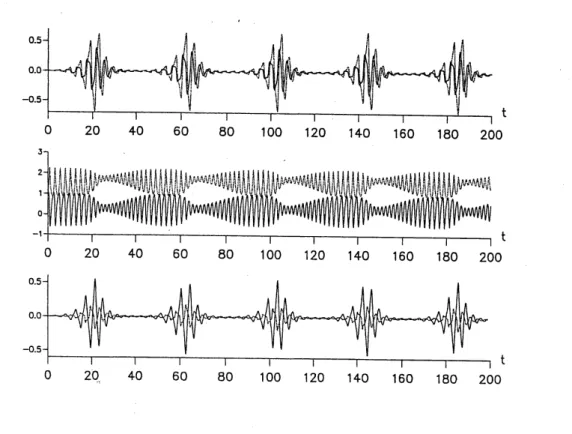
reproduced in Figures 3 and 4 below. The former
shows a case for lcm depth, in which quite long calm periods are seen, between
bouts ofwave activity.The central $B$-mode
appears
togrow,
and equilibrate, beforethe sideband modes$A$ and$C$ are driven unstable;but the growthof the sideband$s$
causes modulations that lead to the decay of all three modes to an almost calm
$\mathrm{F}$
$1l$
Figure2. Three-modestability diagram bomDecent&Craik for waterdepthof$2\mathrm{c}\mathrm{m}$.Theaxes are
frequency-detuning and forcing parameters $\Omega$ and $F$. Experimental points are from Craik &
Amitage14.Diamondsanddotted-dashedcurveshowthemeasuredandtheoreticallowerhysteresis
boundary (cf Figure 1 above); squares and solid curve denote observed and theoretical onset of
temporal modulations as$F$is increased. Thedashed curveis thelinear
stability boundaryfora flat
surface.Regionsofstable single-mode limit cycles and 6-dimensional (3-mode)stationarypoints are
also indicated.
depth, andisrecordedon videotape. In contrast, no such calming was observed by
them with water of $2\mathrm{c}\mathrm{m}$ depth; and none is
found theoretically either. Figure 4 shows a typical theoretical example at this larger depth. Somewhat similar
behaviour, observed experimentalIy by Armitage
&Sterratt
(unpublished), isreported, with permission,$\mathfrak{h}^{\gamma \mathrm{D}\mathrm{e}\mathrm{c}\mathrm{e}\mathrm{n}}\mathrm{t}\ \mathrm{C}\mathrm{r}\mathrm{a}\mathrm{i}\mathrm{k}^{29}$
.
In recent experiments, Jiang, Ting, Perlin $\ \mathrm{S}\mathrm{c}\mathrm{h}\mathrm{u}\mathrm{l}\mathrm{t}\mathrm{z}^{1}6$ reported spontaneous
temporal modulation ofa single gravity-wave mode, of the sort expected of the limit
cycle described above. However, these authors
express
doubtover
the origins of thi$s$modulation,whichwas not a consistently reproducible feature of their observations. Their subsequent investigations, employing deliberately-introduced sideband perturbations to the tankvibrations, showed that weakperturbations produced strong
wave
modulations, with a pronouncedresonance
peak. Certainly, inadvertent or deliberate signal noise is a possiblesource
of modulations; but their dismissal of theFigure3. An example ofthree-modemodulations, for lcm depth, from$\mathrm{D}\mathrm{e}\mathrm{c}\mathrm{e}\mathrm{n}\mathrm{t}\ \mathrm{C}\mathrm{r}\mathrm{a}\mathrm{i}\mathrm{k}^{29}$
.
4 Second-harmonic
resonance
Second-harmonic wave
resonance
with Faraday excitation was considered by$\mathrm{H}\mathrm{e}\mathrm{n}\mathrm{d}\mathrm{e}\mathrm{r}\mathrm{S}\mathrm{o}\mathrm{n}\ \mathrm{M}\mathrm{i}\mathrm{l}\mathrm{e}s^{32}$, who derived coupled evolution equations identical to those
governing a forced resonant double pendulum (Becker $\ \mathrm{M}\mathrm{i}\mathrm{l}\mathrm{e}\mathrm{S}^{33}$). Then, two
standing waves have wavenumbers in the ratio 1 : 2 and natural frequencies also
equal to, or
very
doseto, that ratio. One or other ofthese wavesissupposed excited byFaradayexcitation close to twice its naturalfrequency.Various aspects of the structure
of solutions are examinedbythese authors;butthey do not mention that their model
equations permit unbounded wave growth under suitable circumstances. Recent
work of Forster
&Craik34
draws attention to such unbounded solutions. Thoughunlimited growth is certainly ’
$\mathrm{u}\mathrm{n}\mathrm{p}\mathrm{h}\mathrm{y}\mathrm{s}\mathrm{i}\mathrm{c}\mathrm{a}\mathrm{l}’$, the
presence
of such solutions mustindicate a transition to larger amplitudes that cannot adequately be described by the
truncation,at quadraticorder,implicitin the model equations.
The equations studied byForster&Craik are a subset of those of Henderson&
Miles, restriced to exactlyresonant tuning withno viscous damping.These
are either
$\dot{a}_{1}=\lambda_{1}a_{1}a_{2}*+\mu a_{1^{*}}$, $\dot{a}_{2}=\lambda a_{1}^{2}2$ ’
or
$\dot{a}_{1}=\lambda_{1}a_{1^{*}}a_{2}$, $\dot{h}=\lambda_{2}a_{1}^{2}+\mu a_{2}*$,
for the respective complex wave amplitudes $a_{1}$ and $a_{2}$, depending on whether the
forcing drives the first $(a_{1})\mathrm{o}\mathrm{r}$ second $(a_{2})$ harmonic. Here, the overdot denotes
time-derivative, the stardenotes complex conjugate, $\lambda_{1},$$\lambda_{2}$ are known real constants with
opposite signs, and $\mu$ is a known imaginary constant. The former set is particularly
simple, for the forcingterm in $\mu$
may
be eliminated by a simple change of variables,yieldingthe unforced equations whichare solved in terms ofelliptic functions.
The second set, with forcing at the second harmonic, is more challenging. These
may
be rescaledto$\dot{B}_{1}=-B_{1}^{*}B_{2}$
, $\dot{B}_{2}=B_{1}^{2}+B_{2^{*}}$
where the overdot is now the rescaled time-derivative. Expressed in real and
imaginary parts $B_{1}\overline{=}x_{1}+iy_{1}$, $B_{2}\equiv x_{2}+iy_{2}$,the corresponding real four-dimensional
autonomous systemis
$\dot{x}_{1}=-x_{1}x_{2^{-\mathcal{Y}_{1}}}\mathcal{Y}_{2}$, $\dot{y}_{1}=x_{2}y_{1}-\chi_{1\mathcal{Y}_{2}\prime}$
$\dot{x}_{2}=x_{1}^{22}-y1+x_{2}$, $\dot{y}_{2}=2\eta y_{1^{-}}y_{2}$.
Various computedsolutions, bothbounded and showing unbounded growth, are given by Forster
&Craik.
Transformed equations yield further insight and better enable delineation of the sets of initial data that lead to bounded evolution andunbounded growth respectively.In particular, aHamiltonian constant ofmotion
may
be employed as a parameter; and thi$s$ eventually leads to a two-dimensional set of
coupled first-order non-autonomous equations, with a phase angle as independent
variable. Poincar\’e sections then graphicallyreveal the domain of bounded initial data
correspondingto the chosenvalue of the constant of motion.
Acknowledgment
I am grateful to the Faculty of Engineering, Kyoto University, and particularly to
Professor M. Funakoshi, for hospitality during
my
research leave from September 1997to January 1998.References
[1] Faraday, M.,Phil. Trans. R. Soc. Lond., 121,
pp.
319-346, 1831.[2] Rayleigh, Lord,Phil. Mag., 15,
pp.
229-235, 1883. [Sci. Papers,2,pp.
188-93, 1900].[3] Rayleigh, Lord,Phil. Mag., 16,
pp.
50-58, 1883. [Sci. Papers,2,pp.
212-19, 1900.][4] Benjamin,T.B.
&Ursell,
F., Proc. R. Soc. Lond. A, 225,pp.
505-515, 1954.[5] Kumar, K.
&Tuckerman,
K.L.S.J.
FluidMech., 279,pp.
49-68, 1994.[6] Ciliberto, S. &Gollub, J.P.,
f.
FluidMech., 158,pp. 381-398, 1985.[7] Feng,Z.C. &Sethna, P.R.,
J.
Fluid Mech., 199,pp.
495-518, 1989.[8] Simonelli, F.
&Gollub,
J.P.,J.
FluidMech., 199,pp.
471-494, 1989.[9] Ezerskii, A.B.,Rabinovich, M.I., Reutov, V.P.
&Starobinets,
I.M., Zh. Eksp. Teor.Fiz. 91,
pp.
2070-83 (transl. Sov. Phys.JETP
64,pp.
1228-36), 1986.[10] Douady, S. &Fauve, S., Europhys. Lett., 6,
pp.
221-226, 1988.[11] Douady, S.,
J.
FluidMech., 221,pp.
383-409, 1990.[12] Douady, S., Fauve, S.
&Thual,
O.,Europhys. Lett., 10(4),pp.
309-315,1989.[13] Wu, J., Keolian, R. &Rudnick, I.,Phys. Rev. Lett., 52,
pp.
1421-24, 1984. [14] Craik,A.D.D.&Armitage,
J.,Fluid Dyn. Res., 15,pp.
129-143,1995.[15] Decent, S.P. &Craik, A.D.D.,
f.
FluidMech., 293,pp.
237-268, 1995.[16] Jiang,L.,Ting, C.-L., Perlin,M.
&Schultz,
W.M.,J.
Fluid Mech., 329,pp.
275-307,1996.
[17] Miles, $\mathrm{I}^{\mathrm{W}}.$.
&Henderson,
D.,Ann. Rev. FluidMech., 22,
pp.
143-165, 1990.[18] Funakoshi,M. &Inoue, S.,
J.
FluidMech., 192,pp.
219-247, 1988.[19] Krasnopolskaya,T.S. &van Heijst, c.I.F.,
J.
FluidMech., 328,pp.
229-252, 1996.[20] Meron, E. &Procaccia,I., Phys. Rev. A, 34, pp.3221-3237, 1986.
[21] Nagata,M.,
J.
FluidMech., 209,pp.
265-284, 1989.[22] Nagata,M., Euro.
J.
Mech. $B/Fluid_{S}$, 10(2), Suppl.pp.
61-63, 1991.[24] Kambe,T. &Umeki, M.,
J.
FluidMech., 212,pp.
373-393, 1990.[25] Umeki, M.,
J.
FluidMech., 227,pp.
161-192, 1991.[26] Craik, A.D.D. tNonlinear interaction of standing waves with Faraday excitation,1
to
appear
in Nonlinear Instability, Chaos and Turbulence, eds. L. Debnath&D.N.
Riahi, Computational MechanicsPublications, U.K., 1998
[27] Eckhaus, W.,
J.
M\’ecanique,2,pp.
153-172, 1963.[28] Benjamin,T.B. &Feir,J.E.,
f.
FluidMech., 27,pp.
417-430,1967.[29] Decent,S.P. &Craik, A.D.D. submitted 1997
[30] Craik, A.D.D. In Nonlinear Instability
of
Nonparallel Flows: Proc. IUTAM Symp., Potsdam, N. Y. (eds. s.P. Lin, W.R.C. Phillips&D.T.
Valentine),pp.
382-396.Springer, 1995.
[31] McGoldrick, LF.,
J.
FluidMech., 42,pp.
193-200, 1970.[32] Henderson,D.M.
&Miles,
I.W.f.
FluidMech., 222,pp.
449-470, 1991.[33] Becker,
J.
&Miles,
$\mathrm{I}^{\mathrm{W}}.$.
Z.angew.
Math. Phys. 37,pp.
641-650, 1986.[34] Forster,G.K.
&Craik,
A.D.D. Wave Motion, toappear,
1997.[35] Decent,S.P. &Craik,A.D.D., Wave Motion 25,
pp.
275-294, 1997.[36] Miles, J.W.,