https://dspace.jaist.ac.jp/
Title
Knowledge Management in a Volunteer Community at
the Time of Disaster
Author(s)
Mizushima, Kazunori; Sugihara, Taro; Ikawa, Yasuo
Citation
2012 Proceedings of PICMET '12: Technology
Management for Emerging Technologies: 2274-2282
Issue Date
2012-08-01
Type
Conference Paper
Text version
publisher
URL
http://hdl.handle.net/10119/10942
Rights
Copyright (C) 2012 PICMET. Kazunori Mizushima,
Taro Sugihara, Yasuo Ikawa, 2012 Proceedings of
PICMET '12: Technology Management for Emerging
Technologies, 2012, 2274-2282.
Knowledge Management in a Volunteer Community at the Time of Disaster
Kazunori Mizushima, Taro Sugihara and Yasuo Ikawa
Japan Advanced Institute of Science and Technology(JAIST), Graduate School of Knowledge Science, Ishikawa, Japan
Abstract—On March 11, 2011, a massive earthquake struck
northeastern Japan and triggered the devastating tsunami and Fukushima nuclear disaster. A number of IT engineers collab-orated and launched websites and web services to assist the victims immediately the quake. One of the major websites was sinsai.info in which hundreds of volunteers participated. Even though the sinsai.info project was the loosely coupled volunteer community, it rapidly solved numerous unanticipated problems which occurred one after another in the project. This paper aims to clarify the reason why people collaborated efficiently and solved the problems quickly even in the loosely coupled community. We analyzed communication logs in the community from the aspect of knowledge management. We discovered the important role of communication channels in knowledge management.
I. INTRODUCTION
Many IT engineers acted spontaneously straight after 3.11, and launched websites which collect earthquake disaster in-formation. In these sites, it was witnessed that the engineers collaborated mutually and flexibly solved problems which occurred one after another. The collaboration was a brilliantly harmonious impromptu activity, which some observers ad-mired it.
Why could the IT volunteer engineers perform impromptu collaboration harmoniously in such a cataclysmic environ-ment? This is a research question of this paper.
This paper considers the earthquake disaster recovering site: sinsai.info. sinsai.info is one of the sites which were launched during the chaos immediately after the earthquake in the chaotic situation. It utilizes Ushahidi1 which is an open source software (OSS) and provides the service which plots disaster recover information on a map. We note that the crowdsourcing[9, 10, 3], which is an outsourcing activity uti-lizing crowd, and knotworking[5, 21], which is a impromptu activity, were performed simultaneously in sinsai.info. We analyze these collaboration from the viewpoint of Knowl-edge Management (KM), and show the important role of communication channels. As investigation data, we employ the media articles about sinsai.info, the presentation slides provided by the sinsai.info staffs, the mailing list log data, chat logs, Twitter logs, and the interview to a representative of the site.
In the following sections, we survey related previous re-search, look into the activities of the starting period of the site, and then analyze the activities from the viewpoint of KM. 1[oo-shah-hee-dee]-A Swahili word which means “testimony.” http://www.
ushahidi.com/
After that, we point out the important role of communication channels.
II. LITERATUREREVIEW
As research on the form of organization which flexibly responds to the changing environment, Nonaka and Takeuchi [14] are developing the organizational knowledge creation theory in which tacit knowledge and explicit knowledge interacts dynamically. Organizational knowledge creation is the capability of an organization to create new knowledge, to spread it in the organization, and to implement it into products, services and business systems. Nonaka and Takeuchi [14] proposed a model (SECI for Socialization, Externaliza-tion, CombinaExternaliza-tion, Internalization) which considers a spiraling knowledge process interaction between explicit knowledge and tacit knowledge. Axelrod and Cohen [2] discuss how the organizations and strategies can be designed to take advantage of the opportunities provided by complexity, rather than seeking to eliminate the complexity in a situation where the emerging future is difficult to predict. Teece et al. [19] defined dynamic capabilities as the firm’s ability to integrate, build and reconfigure internal and external competences to address rapidly changing environments. Helfat et al. [8] argue that firms must develop “dynamic capabilities” to survive and prosper under conditions of change. Malone [12] states that progress of Internet technology reduces communication cost and as the result enables us to move to a distributed organization from centralized one. He explains that the dis-tributed organization is essential in order to adapt promptly to a changing situation. He picks up Linux as an example and supposes that OSS activity is the organization of a new form which highly distributes knowledge work. Moreover, he advocates that the management style of an organization should change from “Command and Control” to “Collaboration and Cultivation.”
It can be said that this research tends to clarify an ideal cre-ative organization which can respond flexibly in the rapidly-changing business environment. However, in the catastrophic situation in which sudden events occur continuously such as at the time of a disaster, there is no organization discussed in the above researches. Even in such a situation, a collaborative organization sometimes emerges, and then responds to it with impromptu behavior. Knotworking[5, 21] is one of those such behaviors. The concept of knot intends to express phenomena that, even though each actor is loosely coupled, they suddenly become a strong knot responding the situation and are able to
TABLE I STATISTICS OF SINSAI.INFO
Items Statistics Number of Volunteers 200+ Moderators 40+ Developers 30 Supporting Companies 15 Reports: 10,000+
Page Views: 1,000,000+ PV/month
Unique Users: 500,000+ /month
perform impromptu work. In sinsai.info which is our research target, impromptu knotworking was repeated on the Internet. OSS activity is one of representative collaborations on the Internet. In OSS, engineers participate spontaneously and form a community, then perform organizational activity. Raymond [16] calls the developing process of OSS “great babbling bazaar of different agendas and approaches.” He mentions this bazaar system enables software development at amazing speed. Weber [20] studies open source as “a real-world research-able example of a community and a knowledge production process that has been fundamentally changed, or created in significant ways, by Internet technology.”
Crowdsourcing[9, 10, 3] is in the new form of collaboration work which came to be observed in recent years. The word “crowdsourcing” is a portmanteau word combining combined crowd and outsourcing. It literally means outsourcing numer-ous routine tasks to the crowds. Thanks to the Internet, the tasks can be outsourced to a large number of actors never before possible.
In this paper, we focus on the effect of communication channels which were seldom pointed out in the previous researches, and show it helps to shape the organization of the actors while they are responding flexibly to the fluid situation such as the time of a disaster.
III. CASE STUDY OF SINSAI.INFO
sinsai.info was built in order to support recovering of the Great East Japan Earthquake that occurred on March 11, 2011. It was built with the crowdsourcing tool Ushahidi which was utilized also in case of the New Zealand Earthquake on Febru-ary 21, 2011. Volunteer developers and data administrators are managing the site. sinsai.info is a kind of matching site which plots the information about the disaster and recovery of the earthquake on the map of the affected area. The information is verified by moderators, who check each report sent from the website, mail and Twitter, and then release the information.
sinsai.info started from almost zero straight after the earth-quake disaster, and grew rapidly to a large-scale site by April 22 as shown by the number in Table I. Even amid the chaos, many volunteer engineers cooperated promptly and developed the site. Hereinafter, we will survey the developing process of sinsai.info in chronological order.
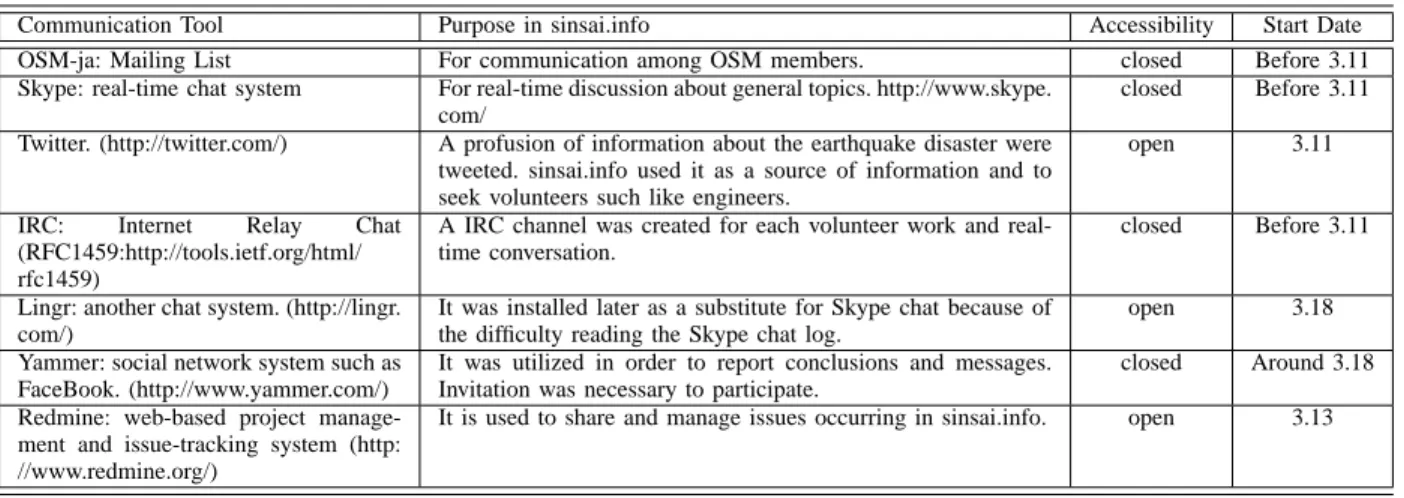
To explain the following sections, we list communication tools utilized in sinsai.info in Table II.
A. The first action: Base map drawing
sinsai.info started when Hiroshi Miura, a chairman of OpenStreetMap Foundation Japan (OSMFJ), asked OSM(OpenStreetMap) members “What can we act against the disaster as a member of OSM?” in the mailing list of OSM-ja. In the e-mail, he asked the members for cooperation to draw the base map of the affected area based on aerial photographs. These cooperators are called mappers. OSM is a project aiming at creating free geographic information data so that anyone can utilize map information data like road maps, etc., and is an activity started in Britain[7]. The map information is difficult to use freely because of commercial restrictions such as copyright. He considered an era of open data would come for data in the same way as there was OSS activity for software. Then he organized the OSM Foundation Japan in December, 2010. Its activity had just started before 3.11. The base map is a map used as the background on which information is plotted. The information relevant to the earthquake disasters, for instance discontinuity of a road, will be plotted on the base map.
B. Start of Ushahidi server: Collecting information
The Ushahidi server was started by a member of OSMFJ at 18:26 which was only 4 hours after the earthquake occurrence. This is the origin of sinsai.info. Ushahidi is an OSS which was originally developed in order to supervise the injustice of an election in Kenya and which collects information and visualizes it by plotting it on a map. It was utilized as an earthquake disaster information system “Haiti Crisis Map” at the time of the Haiti earthquake in 2010. At that time, one of the members of OSMFJ participated in the drawing up of a map, learnt of the existence of Ushahidi, and began investiga-tion. One of developers began localization and translation into Japanese was completed in October, 2010. The first sinsai.info was running on a tiny server in which a member of OSMJ just happened to install Ushahidi for verification two weeks earlier. Therefore, server environment was poor and many bugs also remained. However, since the situation was urgent, he tried to open it anyway, although did not know whether the server would be helpful.
The first message about Ushahidi server was tweeted at 18:58 on March 11 to call for collection of earthquake disaster information. 10 minutes later, at 19:07, the first information was submitted. At this time, the first recruitment of the moderators were called to the members of OSM-ja ML. In Ushahidi, there is a process in which the information must be verified once by the moderator to avoid misinformation and incorrect information. This process requires manpower. However, there were no standard of moderation and operations manual. The recruitment message said “learn by doing.”
At 4:13 on March 12, 6,617 tweets were already backlogged as the information from Twitter. The number of the moderators
TABLE II
COMMUNICATIONTOOLS USED IN SINSAI.INFO
Communication Tool Purpose in sinsai.info Accessibility Start Date
OSM-ja: Mailing List For communication among OSM members. closed Before 3.11
Skype: real-time chat system For real-time discussion about general topics. http://www.skype. com/
closed Before 3.11
Twitter. (http://twitter.com/) A profusion of information about the earthquake disaster were tweeted. sinsai.info used it as a source of information and to seek volunteers such like engineers.
open 3.11
IRC: Internet Relay Chat
(RFC1459:http://tools.ietf.org/html/ rfc1459)
A IRC channel was created for each volunteer work and real-time conversation.
closed Before 3.11
Lingr: another chat system. (http://lingr. com/)
It was installed later as a substitute for Skype chat because of the difficulty reading the Skype chat log.
open 3.18
Yammer: social network system such as FaceBook. (http://www.yammer.com/)
It was utilized in order to report conclusions and messages. Invitation was necessary to participate.
closed Around 3.18
Redmine: web-based project manage-ment and issue-tracking system (http: //www.redmine.org/)
It is used to share and manage issues occurring in sinsai.info. open 3.13
was insufficient. A member of OSM-ja sent an e-mail to the ML, “I think management of moderators is a key factor to utilize this site. The number of the moderators is nine now, but at least five more moderators will be necessary.”
At this time, the members of OSMJ did mapping, develop-ing and operatdevelop-ing the Ushahidi server, and moderatdevelop-ing a flood of tweets on the Twitter simultaneously and in parallel.
C. Providing sustainable service: Impromptu collaboration of elite team
Since Ushahidi did not fully support Japanese characters, various bugs about operating Japanese occurred one after another. In general the site was launched after debugging. However, since it was in the urgent situation, they launched it anyway, and then managed to operate and debug it simul-taneously.
An issue management tool called Redmine was installed on March 13 to share issues which should be solved. There was already a backlog of unresolved problems which were occurring wave after wave.
Because the Ushahidi server built on a powerless Virtual Machine (VM), its work load was reaching the limit on the following day, the morning of March 12. The server for trial could not process information and a more stable server was needed immediately. At that time Amazon Web Service (AWS)2 offered server resources to disaster information
web-sites. sinsai.info asked AWS to allocate new server resources. AWS is a type of cloud service of the IaaS (Infrastructure as a Service). It can provide scalable and robust server resources in a short time.
However, OSMJ did not have any engineers who had knowledge of AWS, server management and network. Then, they recruited the skillful engineers on the Twitter instead of OSM-ja ML on March 13. Thirty or more engineers of-fered cooperation immediately. Some of them were prominent
2http://aws.amazon.com/
engineers in the Japanese IT industry. Haruyuki Seki, the representative of sinsai.info, tweeted with emotion “The super team which will be never collected in an ordinary company is formed. They are solving server-related issues at quite a pace.” The Ushahidi move to AWS progressed at incredible pace, and the relocation was finished on the morning of March 14. It was only 15 hours after starting. It was miracle, Seki mentioned in the interview.
After that, when a new issue occurred, the engineers who had skills to solve it were recruited on the Twitter. If volun-teers appeared, they were led to IRC for engineers to discuss the detail of the issue. For example, on March 17, the database (DB) server performance was slowing down. Then sinsai.info tweeted to recruit DB engineers in a hurry and led them to engineer’s IRC.
D. Organizing Information by Crowdsourcing
When the earthquake disaster occurred, the social network services (SNS), such as Twitter and FaceBook, provided their service stably and a great deal of information was ex-changed. Twitter has powerful propagation characteristics[11]. By Retweet, a message can be spread to very many people in a short time. Therefore, the amount of information increased exponentially. It was almost impossible to discover the infor-mation actually needed.
In sinsai.info the information flooded on Twitter was or-ganized and plotted on the map. However, the information was hard to classify by software programs. It needed to be classified manually in almost all cases. The information needed also changed every moment according to the situation. For instance, in the first week the most important information was safety news of friends and family, but in the following week the volunteer recruitment information to support the af-fected area appeared. As mentioned above, the labor-intensive method was the only way to verify the complex information and judge the priority according to the situation.
sinsai.info outsourced moderation to the crowd. The vol-unteers to act as moderators were recruited on Twitter, the website and from NPO organizations and a total of 200 or more helpers joined. There was no documents for moderator in sinsai.info at the beginning. However, in order to instruct 200 or more helpers, the documented moderation procedure became necessary. In sinsai.info, a volunteer who noticed the necessity of documented procedures wrote a ad hoc manual. First of all newly joined moderators read the documented procedures and learned common rules in the site. Then they started moderation. The moderation itself was monotonous work, and special skill was not needed. Since the work was monotonous, volunteers tended to offer assistance for only short periods, and so there was a constant changeover in the volunteers staffing the website, and so the manual became indispensable.
IV. KNOWLEDGEMANAGEMENT IN SINSAI.INFO
In this section, we will analyze activities of sinsai.info from the knowledge management(KM) point of view.
A. Membership and type of Knowledge
The volunteers whom sinsai.info recruited were divided into three categories: mappers, moderators and engineers. The skill and the knowledge requested for every category differed from each other as shown in Table III. The knowledge requested, and the quality and quantity of volunteer’s work are organized from a viewpoint of KM.
1) Mappers: Those who make a base map from an aerial
photograph or a satellite photograph using special software. The skill to operate the software is necessary and the skill acquisition takes time. Therefore, mappers were basically recruited in OSM-ja ML and word-of-mouth (WOM) com-munication which was a skillful group of mapping rather than Twitter which targets an unspecified audience.
2) Moderators: Those who verify the accuracy of the
information collected from Twitter or the website. The work procedure was written in manual. They confirmed the submit-ted information with two or more information sources. The work was simple and did not required any special skill besides using a search engine. However, since there was a plethora of information about the earthquake, many workers were needed. Then, it is said that recruitment calls was periodically announced on Twitter.
3) Engineers: Those who had to respond promptly and
flexibly, and had to solve the issue occurred one after another to stabilize sinsai.info. In order to operate sinsai.info, broad knowledge across IT such like web, Twitter, programming languages, application server, database server and network were required. Naturally, since the one engineer did not hold all knowledge of them, the engineers for each knowledge area needed to be found. They recruited the skillful engineers on Twitter and from WOM networks of engineers.
B. Shared concept and action agenda
The site concept was documented in sinsai.info, because quite a few participants began to argue about the significance of existence of sinsai.info. sinsai.info documented the concept and guided new participants to read it because arguing con-sumed scarce time. Publishing its concept toward the staff and the users is exactly the same as the corporate philosophy in a company. It is said that sinsai.info raised the question “Who is the customer?” and defined it. This definition was needed in order to decide the design of the website. This is the same question mentioned by Drucker [4].
Moreover, Seki repeatedly mentioned “Eliminate bottle-necks.” For example, if Seki was the only person who has a server administrator authority, it would easily create a situation where work did not progress without him. In order to avoid such a situation, he gave two or more persons the authority. Eliminating bottlenecks is an action agenda in a company. In the very much chaotic situation during the start-up of sinsai.info, numerous problems arose. At the time, Seki showed the simple driving objective[15] of eliminating bottlenecks to the community. The driving object might give a direction to work.
As mentioned above, the view of using scarce time effec-tively was implicitly shared among members of sinsai.info.
C. Leadership
Seki said that he positively promoted sinsai.info to mass media. One reason was to collect as much information as possible and to provide it for as many people as possible. Another reason was to encourage participating volunteers’ motivation. He believed that it would increase the number of participants and maintain their motivation if the activi-ties of sinsai.info attracted attention. Keeping motivation of moderators was especially necessary because their work was monotonous. To maintain engineers’ motivation, they utilized positive feedback. When an issue was solved by someone, they mentioned “good job!” on-line to each other and recognized his or her work[13].
Seki realized himself as a scrum master[17] in scrum de-velopment method. The scrum master corresponds to servant-leader[6] classified in a leadership theory. It seems that he cared about creating a comfortable working environment by coordinating internally and externally, e.g. negotiating with media and sponsor companies. It could be also said that he was a distributed leader[1], because he distributed his authority by saying to the members “eliminating bottlenecks” as the driving objective.
We guess a perfect-leadership is impossible in such a chaotic situation and a distributed-leadership is suitable be-cause it will increase the team performance by distributing authority.
V. TWO WORKING STYLES
In this section, we will explain there were two kinds of working styles in sinsai.info at the same time(Table IV).
TABLE III
REQUIREDKNOWLEDGE FORVOLUNTEERS
Category Knowledge Type #Workers Recruiting Channel
Mapper Expert knowledge about mapping which takes a time to master
many Specific channels of skilled mappers like ML or WOM Moderator General knowledge to verify reports according
to the manual
lots Twitter
Engineer Wide range of IT knowledge to respond to impromptu action
elite Twitter or WOM
TABLE IV
TWOWORKINGSTYLES IN SINSAI.INFO
Working Style Crowdsourcing Knotworking
Knowledge Explicit Tacit
Worker Crowd Elite
One is a crowdsourcing which utilized explicit knowledge and manpower. The other one is a knotworking which fully utilized tacit knowledge and solved issues flexibly.
A. Explicit Knowledge and Crowdsourcing
The work of mappers and moderators is a routine work which can be distributed to many people, in other words, the crowd. Details of the work were prescribed by the newly-created evolving manual. The participants were requested to work according to it. They worked according to explicit knowledge documented in the manual rather than creating knowledge.
However, neither the manuals of mapping nor moderation existed at the beginning. The participants learned by doing because initially there was no manual. Some internal persons in sinsai.info who noticed necessity of utilizing external manpower wrote the manuals themselves. The manuals were able to save new participant’s educational time and standardize operating procedure.
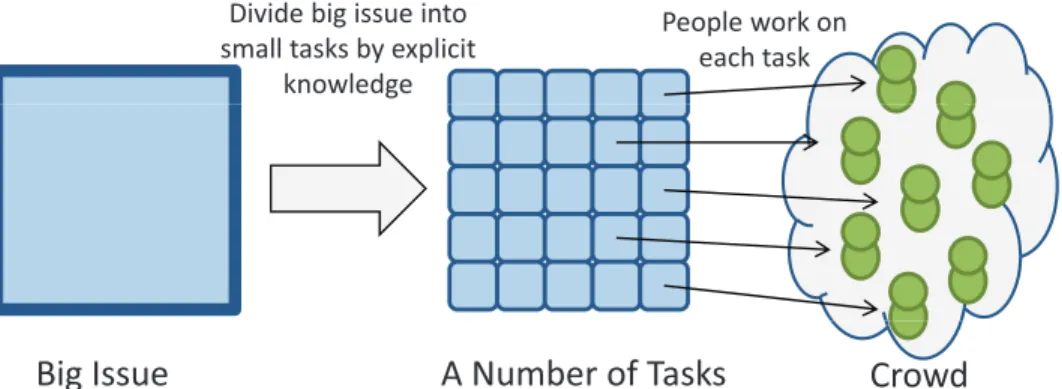
In terms of knowledge management, they transformed tacit knowledge into explicit knowledge as a manual. The explicit knowledge can divide a big issue into a number of tasks. Each task is a piece of standardized simple work that a participant can take and work on it easily. Explicit knowledge can accelerate crowdsourcing. Fig. 1 summarizes the above.
B. Tacit Knowledge and Knotworking
Knotworking is one of those which studied the behavior in the situation which a sudden phenomenon like an earth-quake disaster occurs continuously. It is the concept which Engestr¨om [5] advocates and is a form of emergent activity. It is one way for organizing and performing productive activity while many actors share the object of activity partially, when it is necessary to make the activity cooperate mutually at the shared place which affects it mutually. The concept of knot intends to express phenomena that their collaborative work
suddenly begins to pulsate, is distributed and shared, and re-sponds impromptu even though each actor is loosely coupled. In collaboration work, knots become to be bound or unbound. But neither a specific individual nor a settled organization lead in control. The place of leadership moves each moment in the series of knotworking. Hence, this concept, unlike stable teams and networks, tends to catch a phenomenon in which the combination of actors who solve an issue are constantly changing.
In that urgent situation, many problems occurred and should be solved as soon as possible. There was insufficient time for a member to learn the necessary knowledge to solve it. When no one could responded to an unknown issue, external engineers who had sufficient knowledge about it were recruited as shown in Fig. 2. A talented engineer found its root cause and solved it with his empirical knowledge, that is tacit knowledge. Seki mentioned that only engineers who could identify a issue and solve it could remain. Other engineers tried to learn the new knowledge implicitly by observing the new-comer’s solution process. That is the reason there was no time to transform it into explicit knowledge and, in any case, the knowledge would have been obsolete if the situation changed.
Therefore, in the engineer team, the engineers who excelled at mastering tacit forms could remain. Engineers who were unable to learn tacit knowledge were weeded out through natural selection.
One aspect we discovered was that mastering skill of tacit knowledge is significant to do knotworking in the cataclysmic situation.
VI. ROLE OFCOMMUNICATIONCHANNEL
Research introduced in the book “knotworking[21]” tries to explain flexible activity by impromptu work of the volunteers after the Great Hanshin Earthquake in terms of the concept of knotworking. That research targets real activities of vol-unteers at the time of disaster. On the other hand, almost all activities of sinsai.info were performed on the Internet. That is the reason it has some unique points. For example, this is the first instance in which looking for expert engineers by using Twitter is that there has not been in past disaster support activity. And communication tools were also various. sinsai.info effectively used the tools listed in Table II.
In this table there are simple two questions: how did they use different communication channels properly? and what was
Divide big issue into small tasks by explicit
knowledge
People work on each task
Big Issue
A Number of Tasks
Crowd
Explicit knowledge divides a big issue into a number of tasks and accelerates crowdsourcing.
Fig. 1. Explicit Knowledge and Crowdsourcing
Find Solve
Inside of sinsai.info
Inside of sinsai.info
Obscure
Obscure
Problems
Problems
Unknown Unknown issue issueissue
issue
Observe Move out issue issue Recruited to solveTalented engineer identifies an issue from obscure problems with his tacit knowledge and solve it. If an unknown issue occurs, an external engineer is recruited to solve it and other engineers learn new-comer’s tacit knowledge by observation.
Fig. 2. Tacit Knowledge and Knotworking
the effect of proper usage?
In this paper, we focus on different communication channel usage and describe its significant role in knotworking.
A. Time as Scarce Resource
At first, we would like to answer the question: “how did they use different communication channels properly?”
Time becomes the scarcest resource in a disaster. For example, it is said that the first 72 hours are the golden hours that determine life or death after the disaster. That is to say, it is the most critical time as rescue efforts may take time to implement.
As explained so far, we thought members participating sinsai.info shared a common understanding that time was the scarcest resource. The driving objective of eliminating bottlenecks was a simple action agenda so as to avoid wasting
time. The reason to document the concept of sinsai.info was also to avoid wasting time by useless arguments.
There were some messages about scarce time in chat logs in various locations. To avoid discussion which wastes time, there was a rule that the members should report only points summarized in advance in on-line regular meetings where all members were participating[18]. If an issue needed in-depth discussion, it was discussed in another communication channel among related members.
In order to utilize scarce time effectively, they sought optimized communication in sinsai.info. As a result, they used different communication channels for each specific purpose to reduce time consumption.
In the following section, we show that optimized commu-nication leads to an acceleration in knotworking.
B. Shared Issue
In a disaster, the situation is changing every moment. Needed personnel is also changing dynamically each moment. A person needed at a certain moment might no longer be needed for the next moment because needs were changing.
In order to respond to changing situations promptly, every-body should know the situation: which has occurred and how it has been solved.
As mentioned previously, sinsai.info introduced Redmine for the progress management of the project when the issues and participating engineers increased in number. Redmine is the project management software of OSS. When an issue occurred, it would be registered into Redmine and shared among the participants. A volunteer developer took over an issue as “ticket” and updated the progress of situation.
In terms of communication, the purpose of Redmine is to share the situation among all the participants.
C. Elite Team Building
In this section, we will explain the skill filtering and elite team building roles of communication channels.
Various skills are required for the changing situation. sinsai.info utilized Twitter when looking for engineers who possess specialized skills. As mentioned before, Twitter has powerful propagation characteristics[11]. Therefore, Twitter was the best communication channel to look for various talented people widely in a short time.
sinsai.info called for the volunteers on Twitter and led recruits to the IRC channel for real-time discussion. IRC is one of the established chatting systems. It is not so well-known and there is a hurdle to use it. In sinsai.info, this hurdle was used as a skill filter[13]. Those who did not know IRC couldn’t participate. Even if the recruits did not know how to use it, those who tried to master it by themselves could participate. If they did not have prerequisite skill and motivation, they could not participate.
It was a unique usage of communication channel to filter the participants by skill. Because of the Internet on-line community, it is possible. The excellent feature of this usage is that the participants were unaware that they were being filtered by skill.
In order to respond accordingly to the changing situation, the capability of learn-by-doing for insufficient skills was required. Skillful engineers who could continuously solve the issues and learn new skills remained as core members. Others were gradually moving to the periphery as onlookers.
Redmine, used in sinsai.info as an issue management tool, visualized the contrast of core members and peripheral ones. In Redmine, a developer took over an issue as a ticket. By this ticketing system, everyone knew who was proceeding with which issue and how much progression had been made. Skillful engineers took many tickets. So that classes divided by skill were made automatically as one of the members mentioned in an interview of on-line media[18]. On the
contrary, the visualization function defined the elite team of the core members.
D. Boundary of Knot
sinsai.info had the chatting communication channel for all participants. At beginning of sinsai.info, Skype was used for this purpose. Later on Lingr was used instead of it. In the chat, information was mainly reported and the argument which consumed time were avoided. When a issue was recognized to be discussed in depth, a new channel was created in Yammer only for the interested members. They argued in detail in that channel. This is the moment of emerging knot in sinsai.info. That is to say, the boundary of the knot was created by the channel which tied up specific members and the issue.
On-line virtual community can only form the flexible knots responding to the changing situation by controlling the com-munication channel.
E. On-line Knotworking Process
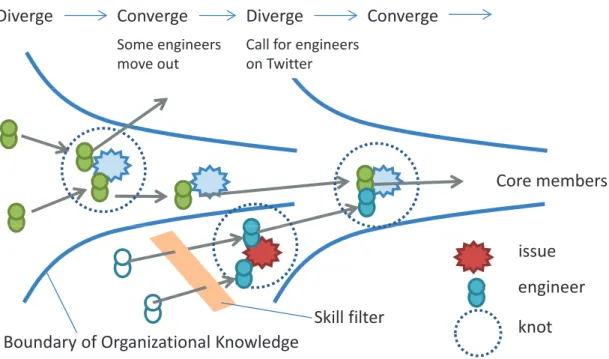
Fig. 3 summarizes knotworking inside sinsai.info. Knot-working repeats divergence and convergence to promptly re-spond to the changing situation. This repeat process condenses the members and creates the core members.
1) The engineers who have a skill to solve a specific issue are called for on Twitter.
2) Only skillful engineers can participate by the filtering of the communication channel.
3) All issues are listed and shared with all participants. 4) A participant will find the issue which he can solve,
and create a specific communication channel to discuss it among related participants. The channel becomes a boundary of the knot.
5) The participants in the knot share knowledge tacitly in a learn-by-doing manner.
6) Other participants who are able to learn tacit knowledge are weeded through natural selection. On the other hand, the core part is saturated with highly-skilled experts. The core part will become a group of the experts who can promptly respond to the changing situation, although they are loosely coupled.
7) When a new issue occurs, if it is possible to be solve by the existing participants, return to step 4 and repeat the knotworking among them. If it is impossible, return to step 1 and introduce a new knowledge from outside.
F. Shaping Organization
In sinsai.info, although the aspect of the organization was not presented at the beginning, it was shaping an organiza-tional structure gradually. In one month, teams other than a president and a vice-president, such as a design team, a development team, an operation team, and a judicial-affairs team, were formed.
As described in section III, when sinsai.info started, it worked only with the members of OSM. They drew the base
Diverge
Converge
Diverge
Converge
Some engineers
move out
Call for engineers
on Twitter
Core members
issue
engineer
knot
Boundary of Organizational Knowledge
Skill filter
Fig. 3. On-line Knotworking Process
developer developer moderator #Channels = 1 #Channels = 3+ developer moderator mapper High Communication Costs Optimized Communication Costs moderator mapper
Communication Costs Communication Costs
Fig. 4. Shaping Organization
map, developed and operated the server, and moderated in parallel simultaneously. The situation was confusing.
The real-time conversations were done on the on-line chat. When a different kind of works were discussed on the same chat, it caused confusion when two or more contexts were mixed up. Thus, specific IRC channels for each work were created and work could be discussed separately. The first three channels were for mappers, moderators, and developers. It can be said that these channels became the origin of organization. In sinsai.info, in order to use time effectively, the communi-cation channel was subdivided. As a result, this subdivided the organization as well shown in Fig. 4. In the virtual community on a network, a communication channel shapes the boundary of an organization.
VII. CONCLUSION
In this paper, we show knowledge management at the time of disaster and discover the important role and effect of the communication channels.
The explicit knowledge is mainly used in crowdsourcing. It enables us to divide a big issue into a number of small tasks and distribute them to crowd. On the other hand, the tacit knowledge is utilized in knotworking. People who posses tacit knowledge identify a issue from obscure problems in a chaotic situation and solve it. Also, only people who are talented to master new tacit knowledge from others by observation can remain in the community.
We show that the communication channels are used prop-erly to do knotworking process smoothly. It seems that the proper use of the channels is not intentionally designed. The only objective shared among the participants is effective use of scarce time. To save time, they use some communication chan-nels properly to optimize communication cost. As a result, this works as a mechanism which accelerates on-line knotworking even in the loosely coupled volunteer community.
Another effect of communication channel is to classify members. It works as a skill filter for participants without awareness. Issue-tracking system, which is a kind of commu-nication channel to share the issues, visualizes the contrast of core members and peripheral ones.
We also show the channels become the boundaries of an organization. Communication channels help shaping a loosely coupled organization.
In order to make the on-line disaster support activities more effective, we believe a unified communication tool is necessary to integrate separated channels. It should be a seamless user-friendly system which can create a knot promptly according to the changing situation.
REFERENCES
[1] D. Ancona, T. Malone, W. Orlikowski, and P. Senge, “In praise of the incomplete leader,” Harvard Business Review, 2007. [2] R. Axelrod and M. Cohen, Harnessing complexity:
Organiza-tional implications of a scientific frontier. Simon and Schuster,
2000.
[3] D. Brabham, “Crowdsourcing as a model for problem solving,”
Convergence: The International Journal of Research into New Media Technologies, vol. 14, no. 1, p. 75, 2008.
[4] P. Drucker, The practice of management. Harper Paperbacks, 2006.
[5] Y. Engestr¨om, From teams to knots: Activity-theoretical studies
of collaboration and learning at work. Cambridge Univ Pr, 2008.
[6] R. Greenleaf and L. Spears, Servant leadership: A journey into
the nature of legitimate power and greatness. Paulist Pr, 2002.
[7] M. Haklay and P. Weber, “Openstreetmap: User-generated street maps,” Pervasive Computing, IEEE, vol. 7, no. 4, pp. 12–18, 2008.
[8] C. Helfat, S. Finkelstein, W. Mitchell, M. Peteraf, H. Singh, D. Teece, and S. Winter, Dynamic capabilities: Understanding
strategic change in organizations. Wiley-Blackwell, 2007. [9] J. Howe, “The rise of crowdsourcing,” Wired magazine, vol. 14,
no. 14, 2006.
[10] ——, Crowdsourcing: Why the Power of the Crowd Is Driving
the Future of Business. Crown Business, 2009.
[11] H. Kwak, C. Lee, H. Park, and S. Moon, “What is twitter, a social network or a news media?” in Proceedings of the 19th
international conference on World wide web. ACM, 2010, pp.
591–600.
[12] T. Malone, The future of work: How the new order of business
will shape your organization, your management style, and your life. Harvard Business Press, 2004.
[13] H. Miura. (2011) Sinsai.info: Crowdsourcing disaster response/reconstruction platform and the next. LinuxCon Japan 2011. Unpublished. [Online]. Available: https://events. linuxfoundation.org/archive/2011/linuxcon-japan/open-forum [14] I. Nonaka and H. Takeuchi, The knowledge-creating company:
How Japanese companies create the dynamics of innovation.
Oxford University Press, USA, 1995.
[15] I. Nonaka, R. Toyama, and T. Hirata, Managing flow: a process
theory of the knowledge-based firm. Palgrave Macmillan, 2008.
[16] E. Raymond, “The cathedral and the bazaar,” Knowledge,
Technology & Policy, vol. 12, no. 3, pp. 23–49, 1999.
[17] K. Schwaber and M. Beedle, Agile Software Development with
Scrum. Prentice Hall, 2001.
[18] M. Takahashi. (2011) Volunteer engineers moved to support the recovery by IT (in japanese). [Online]. Available: http: //rikunabi-next.yahoo.co.jp/tech/docs/ct s03600.jsp?p=001906 [19] D. Teece, G. Pisano, and A. Shuen, “Dynamic capabilities and
strategic management,” Strategic Management Journal, vol. 18, no. 7, pp. 509–533, 1997.
[20] S. Weber, The success of open source. Cambridge Univ Press, 2004.
[21] K. Yamazumi and Y. Engestr¨om, Knotworking(in Japanese). Shin-Yo-Sha, 2008.