Vol. 15, No. 3, September 1972.
COMPLEMENTARY CONVEX PROGRAMMING
TOSHIHIDE IBARAKIKyoto University
(Received October 8, 1971 and Revised February 9, 1972)
Abstract
This paper is concerned with the complementary convex program-ming problem:
..
P: maximize z = aoo
+ ;E
aoj (-Xj),-1
subject to a.o~
,-1
;E
..
a'j Xj, i=
1,2, . .. , m1i= 1,2,· .. ,m2 XpX, = 0, for (xp, Xq) E C ,
where g.(x) are convex functions, and C is a given set of pairs of variables. A cutting plane method for solving P is proposed. It consists of three types of cuts: Kelley's cuts developed for convex constraints, C-cuts derived from the condition xpX'l =0, and J-cuts useful for guaran-teeing the finite J-mesh convergence. The J-mesh convergence is a newly introduced concept that the solution sequence converges to a J-mesh optimal solution of P(i.e., a point that maximizes z in the J-lattice of the feasible region). It is also proved that J-mesh optimal solutions come arbitrarily close to an optimal solution of P as J approaches to O.
Although a J-mesh optimal solution is in general a suboptimal solu-tion of P, it is shown that J can be selected so that the resulting J-mesh
Complementarg Convex Programming 139
optimal solution is an exact optimal solution in case P has no convex constraint (i.e., mz=O).
1. Introduction
In this paper, we will deal with complementary convex programming problems (CCP problems), which are convex programming problems with one more constraint, the complementarity condition (see (2) below), added. Several application areas of the complementarity condition are discussed in [6J, [7J.
A cutting plane method for solving a CCP problem will be developed. It is guaranteed to converge to a J-mesh optimal solution in a finite number of steps. The J-mesh optimal solution is a lattice point of the J-mesh in the feasible region of the problem, which maximizes the ob-jective value. It is in practice a good approximate solution to an optimal solution of the given problem. There are cases in which J-mesh optimal solution is also a real optimal solution. One is when an additional constraint that makes only lattice points of J-mesh feasible (consider the integer programming problem which assumes J
=
1) is imposed. The other is a complementary linear programming problem (Le., LP problem with the complementarity condition) for which it is known that J can be selected so that the resulting J-mesh optimal solution is a real optimal solution.The cutting plane method presented in this paper consists of three types of cuts: Kelley's cut [9J for the convex constraints, C-cuts for the complementarity condition and J-cuts for guaranteeing the finite J-mesh convergence. J-cuts are developed by extending the concept of Gomory's cuts [3J, [4J, [5J for integer constraints.
First let us define a convex programming (CVP) problem* by n
Q: maximize z(x) = aoo
+
;E
aOj(-xj)J-1
*
Althollgh the second constraints Xj= - (-lfj) are not really restrictions, they must be here to carry Ollt the simplex method based on the lexicographical order, discussed in Section 3.n
(I ) subject to X .. +; = a;o
+
~ a;j (-Xj)' i = 1,2, ... , ml;-1
X;=-(-Xj), j=I,2, ... ,n
X,+; = -g; (x) , i = 1,2, ... , m2
Xk20, k= 1,2, ···,n+ml+m2
where r=n +m1, X= (Xl' X2, .. , x .. ) ER", a;j E R, and g;(x) are convex
func-tions of X. x,,+;ER, i=l, 2, . . ,ml+m2 are slack variables. Note that the objective function is linear. Q has ml linear constraints
(con-straints given by linear inequalities) and m2 convex con(con-straints. Let C be a set of pairs of variables Xl> X 2, •• , X,.
The complementarity condition is defined for C by (2) xp Xq = 0 for every (xp, x,) E C .
A complementary convex programming (CCP) problem P is a CVP problem
Q
restricted further by the complementarity condition (2).For problem 5(=P, Q or anything else), solutions (Xl' X2,' .,x,,)ER" are feasible if they satisfy 5's constraints. The feasible region of 5, F(5), is the set of all feasible solutions. An optimal solution x of 5 is a feasible solution satisfying z(x) 2 z(x) for all xEF(5). The set of all optimal solu-tions of 5 is denoted by 0(5).
2. ..::2-Mesh Optimality
The A-mesh R,/,cR" is defined by the set of all vectors xER" such that their components are all multiples of A, where .1>0 and AER. In other words, xERA" if and only if x=Ax' where x' is an integer vector. Let
FA (5) =F(5)
n
R,t,where 5 is P, Q or anything else. xEFA(5) is a A-mesh optimal solution of 5 if
x
satisfies z(X) 2 z(x) for all xEFA(5). We denote the set of all A-mesh optimal solutions by 0 A(5).Complementarg Convex Programming 141
Throughout this paper, we assume that z and X .. +i, i=l, 2, .. ,ml' also take on multiples of J only for all x E
R,,/.
This assumption is for example accomplished if(3) aoo=O, aoj: integers,
/=
1,2, "',naio E R4 , aij: integers,
i
= 1,2, .. " ml1·=12 ..
·n
• " J
hold in (1). (In practice this does not lose any generality because if original coefficients and J are all rational numbers, we can multiply a positive number with those coefficients so that (3) may hold true.)
The last half of the condition (3) may be deleted from the assump-tion if we regard each linear constraint
n
x,,+i=aio+
I:
aij I-Xj) , X .. +i:;::: 0 j - las a special case of the convex constraint X'+i = - g; (x) , X,+; :;::: ()
(i.e., ml is set to 0 and m2 is set to 1nl +m2)' In this case, however, it
should be noticed that variables xp and Xg of the complementarity condi-tion cannot be variables X;'+i, i = 1, 2, .. , ml .
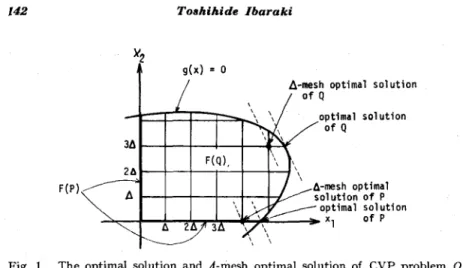
J-mesh optimal solutions of a CCP problem and a CVP problem are illustrated in Fig. 1. F(Q) of the given CVP problem Q is the region sur-rounded by Xl and X 2 axes, and the curve given by g(x) =0. J-mesh
optimal solution of Q is also indicated in Fig. 1. On the other hand, F(P) is given by two line segments on the
Xl
axis and X2 axis, because of thecomplementarity condition XlX2
=O.
Thus the optimal solution and J-mesh optimal solution of P are on the Xl axis as shown in Fig. 1.Consider a sequence of solutions
If .the sequence {Xk} converges to a .~-mesh optimal solution of S, it is said to have the property ofJ-mesh convergence. In particular, if
F(P)
g(x) = 0
A-mesh optimal sol ution of Q
optimal sol ution of Q 3A~-r--+--+--+-~~ A-mesh optimal solution of P ~ optimal solution ~~~~--~~T-~~'~,~--~x1 , , ofP \ \
Fig. 1. The optimal solution and A-mesh optimal solution of CVP problem Q and CCP problem P.
Xk = xk +1 = . .. and xk E O,d (5)
for a finite k, the sequence has the property of finite A-mesh convergence.
3. Cutting Plane Method and the Manipulation of Tableaus
The cutting plane method for CCP problem P consists of the genera-tion of a sequence of LP (linear programming) problems PI' P2 , • • , Pk , •• ,
such that each Pk has the same objective function as P and satisfies
(4) F(Pk ) ~ F,d (P) .
Theorem 1: Let Pk be an LP problem as defined above. Then if
XEO(Pk ) is also in F"iP), XEO,d(P) follows.
Proof: Let x' E
°
,d(P) and let z(x) and z(x') be the objective values ofx
and x'. Then z(x) ~ z(x') holds because of (4). On the other hand,z(x) sz(x') from the fact that xEF ,d(P). Thus, z(X) =z(x') follows.
QED.
Let us now assume that
x
E°
(Pk ) obtained in the computation is notin F ,d(P). Then, an LP problem Pk+l is generated froro Plo by adding a
Complementary Convex Programming 143
of points in F ,d(P). Thus Pk+l also satisfies (4) with k replaced by k+ 1.
This process is repeated until a J-mesh optimal solution of P is obtained. Specifically. the above process is carried out by using modified sim-plex tableaus (or simply tableaus):
(5) where i = 1.2 •...• ml n XI = am,+IO+
L
am,+/j (-tj ). I = 1.2 •...• n j - lX,+i = a,+io. i=I.2 •...• m2 Cj:?; 0. j = 1.2 •.. '. n )
Xk :?; 0. k = 1.2 •.. '. n+ml +m2
i = 1.2 •...• m2 •
In (5). tj. j = 1.2 •..• n. are nonbasic variables of the current LP problem. Let (5) be a tableau of LP problem Pk • We call the column
lexicographically positive if the topmost nonzero entry of aj is positive. This is denoted by aj>O. If ai-aj>O. we write ai>aj. Now introduce the following definitions:
Lexicographically dual feasible (LDF) condition#aj>O. j=l. 2 •. .• n.
Primal feasible (PF) condition # (alO. a20 •..• a,o):?; 0.
J-mesh condition#uko E, R,d. k=O. I •.. • r.
Next consider the solution given by
(6)
Xj = a"'l+jo, j = 1,2, ... , n
which IS obtained from tableau (5) by putting t1=t2=··· =t,,=O.
If tableau (5) of Pk satisfies the LDF condition and the PF
condi-tion, it is known (cf. the simplex method) that
x
given by (6) is in O(Pk ).Furthermore, we can easily prove. that if the tableau satisfies (i) the LDF condition and the PF condition,
(ii) the CF condition,
(iii) the complementarity condition of P, (iv) the LI-mesh condition,
then
x
given by (6) is in F A(P) and hence in 0 A{P),It is convenient to start the cutting plane method with the initial tableau (corresponding to PI) obtained by setting t1=X1 , t2=X2 , •• ,t .. =
X,,:
(7) x .. +.=aiO+I:aij(-Xj), n i=I,2,···,m1
j - l
Xj=-(-Xj), j=I,2, ... ,n
X,+i
= -
gi (0,0, ···,0) ,i
= 1,2, ... , m2 •We assume that (7) is LDF. In case (7) is not LDF, it is possible under a moderate assumption to transform the problem so that th~ LDF
t· condition may be satisfied. For example if F(P) is bounded, the technique of [IJ may be used to obtain an LDF tableau.
Now if (5) is LDF but has row i with the negative first entry aiO
(I ::;;.i::;;'r) (i.e., condition (i) above is violated), pivot operations can be applied so that resulting tableaus may be all LDF and furthermore column ao of the tableau may strictly decrease in the lexicographical sense (i.e., the dual simplex method. See [4J [5J). In particular, we have
Complementarg Convex Programming 145
(8) Z(l) ::?; Z(2) ::?; '" ::?; Z(k) ;2: ... ,
where z(k) is Qoo in the k-th tableau. After a finite number of pivot
operations a tableau satisfying the PF condition results if it is feasible. In the cutting plane method, a cut is generated if one of (ii) , (iii) and (iv) discussed above is not satisfied. The cut is written by
(9)
where
S::?;O
Po
<
0,in terms of the nonbasic variables tl, j = 1, 2, .. , n. After (9) added, a pivot operation is again incurred because (9) has the negative first entry Po. Now it is time to discuss three types of cuts corresponding to cases (ii) , (iii) and (iv).
4. Kelley's Cut for CVP Problems
Kelley's cut (abbreviated by K-cut) developed for CVP problems [9] is outlined in this section. Consider (5) and assume that
(10) X,+j = - gj (a", ,+10' am ,+20' .. " a""+,,o)
<
0 ,for some i. Namely, by
x
given by (6) the constraint g;(x):::;:O IS notsatisfied. If gj(x) is differentiable at X, then the constraint (11)
where
-(gj (x)-UTX)-UT x::?; 0
u = V' gj (x)
!s=%
works as a cut corresponding to the CF condition.
Theorem 2 [9J: Let Pk satisfy (4) and let XEO(Pk ) be given by (6). If
(10) holds, then K-cut defined by (11) excludes
x
from F(Pk ) but excludesno point in F(P) (and hence no point in F ,d(P)).
Note that (11) can be expressed in terms of the present nonbasic variables
t
1 ,t
2, ••,t"
of (5) (by substituting (5) into (11)) as follows:(12)
S20
where
Other generalized versions of KeUey's cut for CVP problems (for example, see [2J [1OJ) can also be used for our purpose, though we omit the detailed discussion.
5. Complementarity Cut for CCP Problem
Let us consider a pair (xp, Xq) E C expressed as follows in (5):
(13)
If the next holds,
(14) apo>O, aqo>O,
then the solution (6) obtained from (5) (i.e., (13)) does not satisfy the complementarity condition. For this pair, the following complementarity cut (abbreviated by C-cut) is obtained:
( 15) where S20
Po
= -1f>,
if Ukj::;: 0 for k =P,
qpj
=L·
Complementary Convex Programming 147
Theorem 3: Consider a tableau (5) of LP problem Plo having rows (13) satisfying (14). Then, C-cut (15) excludes X, obtained by (6), from F(P,,) but excludes no point in F(P) (imd hence no point in F A(P)),
Proof: First note that
x
given by (6) is obtained by letting t;="O,j=l, 2, . . ,n, in (5). But letting tj=O, j=l, 2, . . ,n, in (15) results in (16) s = -1
4:
° .
This means that
x
is excluded by C-cut (15). The second part of the theorem is proved by showing that every pointt
excluded by (15) does not satisfy XpXg=O. For that, note that sucht
must be in the regionn
(17) L:(3·(-t·)<1
j_1 J J
tf;z 0, j = 1,2, "', n .
Since IT{>o> 0, (17) leads to
(18)
By the definition of (31, we have
Hence
apj
>
0 => apj ::;;: -apo (3jap!::;;: 0 => apj::;;: 0::;;: - al;o(3j.
In a similar manner, xq>O is proved. Thus XpXg>O holds for any t in
QED.
(In
6. A-Guts
Let us assume that Xi, O::;;:i::;;:r, be expanded as follows:
(19) Xi = aiO
+
?:
n aij (-tj ). (Note Xi may be Xo = z) •Whenever aiO
It
RA' the next ,1-cut can be generated: (20) where (21) s:;:::: O.Po
= -10 {(fo/(,1-10)} aij, if aij
<
0p.
=J - a i j , if aij :;:::: 0
j=I,2, ... ,n 10 = aiO- [a,o/,1J ,1 .
[AJ is the integer part of A. ,1-cut may be considered as an extension of Gomory's cut [3J for mixed-integer programs. Although other Gomory's cuts [4J, [5J developed for all-integer programs can also give rise to cuts satisfying the next theorem, we. will use only (20) for simplicity.
Theorem 4: Let (5) be a tableau of Pk in which Xi be represented
by (19). If aiO
It
RA' then ,1-cut (20) excludes the present solution (6)from F(Pk } but excludes no point in RA".
The proof is omitted since it is similar to that of Gomory's [3].
7. Statement of the Cutting Plane Method and its Finite ,1-mesh Convergence
It was shown in Sections 4-6 that if the CF condition, the comple-mentarity condition or the ,1-mesh condition is violated in a tableau of Pk (satisfying the LDF and PF conditions), K-cut (12), C-cut (IS) or
,1-cut (20) can be generated respectively. In addition, each LP problem
Pk can be solved (i.e., a tableau satisfying the LDF and PF conditions
is obtained) in a finite number of pivot operations according to the dual simplex method. Consequently, the cutting plane method for a given CCP problem P and ,1>0, which was outlined in Section 3, may be summarized as follows.
Complementary Convex Programming 149
Cutting plane method:
Step 1: Start with Pl (see (7)). PI is assumed to be LDF. Solve PI' If PI is infeasible, F ,d(P)
=1>
holds. Terminate. Otherwise letk=1 and go to Step 2.
Step 2: If an optimal solution of Pk obtained is in F,d(P), terminate; it
is also in O,d(P). Otherwise, go to Step 3.
Step 3: Generate a cut (9) according to which of the CF, complemen-tarity and i1-mesh conditions, are violated in the optimal tableau of Pk (see the discussion below), and obtain Pk+l where (22) P k+l: P k and cut (9).
Solve Pk+1 • If Pk+l is infeasible, F ,d(P)
=1>
holds. Terminatethe computation. If feasible, after deleting the cut row annexed to Pk and increasing k by 1, return to Step 2.
Now consider the following three conditions imposed on the selection of cuts in Step 3 of the cutting plane method.
(a) If a,+i<O, l::;:i::;:m2, in the successive optimal tableaus for Ph, k= ko, ko
+
1, .. , then K-cut is generated after a finite number of pivot operations.(b) If apo>O, ago>O for some (xl'> Xg) E C in the successive optimal tableaus for Pk, k=ko, k o
+
1, .. , then C-cut is generated after a finite number of pivot operations.(c) If aio ft R,d for some i, (O:O;::i::;:r} in the successive optimal tableaus for Pk, k=ko, k o
+
1, .. , then i1-cut is generated after a finite number of pivot operations.As implicitly proved in the proof of the next theorem, the following selection rule, for example, guarantees that the above three conditions are satisfied.
Cut selection rule: Choose the topmost row which violates at least one of the CF, complementarity, and i1-mesh conditions. If the row violates more than one condition, generate a cut accOIding to the follow-ing priority order.
(23) LI-cut first, C-cut second, and K-cut third or LI-cut first, K-cut second, and C-cut third.
Under the above conditions, the finite A-mesh convergence is proved by using the argument similar to that of Gomory's [3J, [4].
Theorem 5: The cutting plane method for CCP problem P has the property of finite LI-mesh convergence provided that the cut selection conditions (a), (b), (c) are satisfied, that F(P) (and hence F A(P)) be compact (i.e., bounded), and that FA(P) be nonempty.
Proof: From the assumptions that F A(P) is bounded and not empty, there exists a LI-mesh optimal solution of P whose objective value is denoted by i'«oo). From (8) we have
(24) Z(l) ::?: Z(2) ::?: •.• :;;:: Z(k) ::?: ... ::?: ZO
where Z(k) is the value of z (i.e., aoo) in the k-th tableau. We first prove
that there exists a finite k such that
(25)
Z(k) E RA •
For that, assume that no such k exists. Let z(kd>z(k.), then there exists z(kg ) such that z(kl)::?:Z(k.) and z(k.) ERA, since LI-cut is generated from row
z
after a finite number of pivot operations (Condition (c)) and the new value of a oo after the pivot operation is in RA as easily proved (if Z(k.) E RA, let k2=k3). By assumption, there exists z(k.) such that z(k·»i(k.).Then by a similar argument we can prove the existence of Z(k,) such that
Z(kl»Z(k,) and z(k·)ERA• Thus Z(kl)-Z(k'):;;::LI. This process cannot
continue infinitely because the sequence z(k) is bounded below by i' and LI>O. Thus (25) is proved.
Next we turn to the second row X,,+l of tableaus. We have the
sequence
X"+l(k):;;:: X"+l(k+1):;;:: ••• :;;:: X"+l(l):;;:: ••• :::: x .. + 1o
where k is the one given by (25), and X"+lO is a lower bound of X"+l (X"+lO
Complementary Con.vex Programming
we can prove that after a finite number t,
is
satisfied.Xn+1 (I) = Xn+1 (I +1) = ...
Xn+1(1) E R,:j
151
Applying this argument to X n+ 2 •.. ,X"+,,, l ' Xl' .. , Xn successively, we
will see that after a finite number of pivot operations, X(S) = X(S+l) = ...
x(S)ER,:j"
holds. x(S) must be in F,:j(P) , since otherwise K-cut or C-cut must be generated after a finite number of pivot operations and it provides a new different solution, contradicting the fact that X has converged to x(s). Also, x(S) must be in O,:j(P) because F(Pu)~F,:j(P) from the defini-tion of cuts, where the s-th tableau is generated for LP problem Pu .
QED.
Although conditions (a), (b) and (c) are introduced to guarantee the finite convergence, other selection rules sometimes may prove effective in speeding up the convergence. For example the following rule appears reasonable that selects C-cuts or K-cuts first, until the improvement in the objective values becomes very small, and then relies on i1-cuts. After an appropriate number of Lt-cuts, C-cuts or K-cuts are again generated, and the process is repeated.
8. Example
L~t us solve the following CCP problem by the, cutting plane method. P: maximize z = 2(--x1)
+
(-x2)subject to X3= --14+2X1+7X2
Xl = -(-Xl) X2 = --(-X2)
x = -
~
exp [_2_ x -~
x+
..!]
4 4 15 I 5 2 5
LI is assumed to be 1.
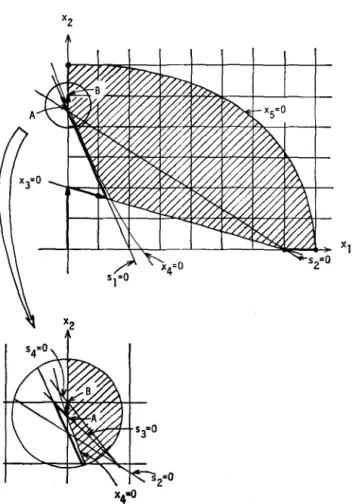
The feasible region of P without the· complementarity condition is the shaded region of Fig. 2. If we take into consideration the comple-mentarity condition, only the region given by the two bold line segments on
Xl axis and X 2 axis are feasible. Point A is apparently the optimal solution of P. Any point in RA" is an integer lattice point (since LI
=
1 in this case). Four dots in the line segments of Xl axis and X2 axis (which areF(P)) are points in FA(P). Thus, the LI-mesh optimal solution of P is obviously B which is located very close to A.
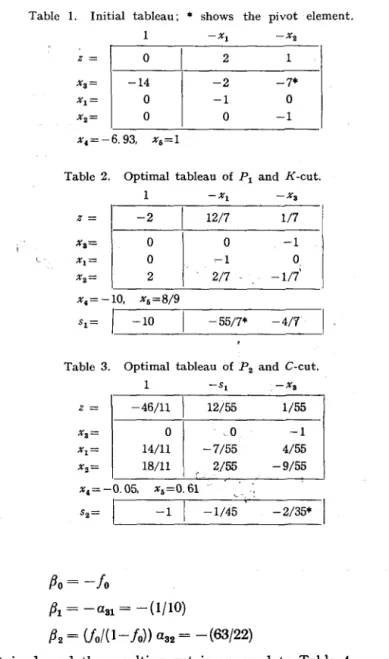
Table 1 shows the initial tableau of PI(see (7)). It is LDF. Since row Xa has the negative first entry, one pivot operation is applied to
Table 1 according to the dual simplex method. The resulting tableau is Table 2. A K-cut is generated in Table 2, since X4 is negative.
By (12) we obtain the K-cut annexed to Table 2. After one pivot opera-tion, Table 3 (optimal tableau of P2) results.
Table 3 does not satisfy the complementarity condition X IX2=O. From the pair of rows Xl and X 2, C-cut is then generated according to (15):
Po
= -1PI
= - (2/55){1l/18) = - 0/45)Complementary Convex Programming 153
Fig. 2. Application of the cutting plane method to a CCP problem.
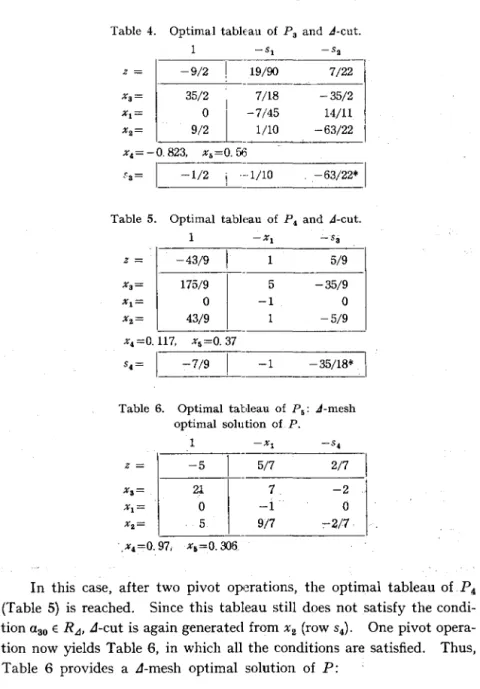
The resulting row is annexed to Table 3. After one pivot operation, Table 4 results (optimal tableau of P3). Although it is also possible to
generate K-cut from X 4 (note X 4 is negative), we generate J-cut fromll row X2' since a30 ft RA. Following (21),
Table 1. Initial tableau; * shows the pivot element. 1 Z= 0 1 2 1 -14 -2 -7* 0 -1 0 0 0 -1
Table 2. Optimal tableau of PI and K-cut.
1 - X l -X3 Z= -2 0 0 2 x.=-lO, x5=8/9 Sl=
I
-10 1 12/7 1/7 0 -1 ~l 0 2/7 -1/7 -55/7* -4/7Table 3. Optimal tableau of P2 and C-cut.
1 - S l -X3 Z= -46/11
I
12/55 1/55 0 .0 -1 14/11 -7/55 4/55 18/11 2/55 -9/55 " X.=-0.05, xli=0.61 S2 = 1---1---.1 ---1-/4-"5-;""":"""'---2-/3-5-*-1 Po = - fo PI = -aS1 = -(1/10) P2 = Uo/(I- fo)) aS2 = -(63/22)Complementary COn1Jex Programming
Table 4. Optimal tableau of Pa and A-cut.
1 -51 -52 Z= -9/2 19/90 Xl= 0 -7/45 X 2= 9/2 1/10 7/22 -35/2 14/11 -63/22 Xa=
~35/2
7/18 - - - , x,=-0.823, x.=O.56 sa = 1 -1/2 _.-1-/1-0---6-3/-2-2*-1Table 5. Optimal tableau of p. and A-cut.
1 -Xl -Sa Z= -43/9 1 5/9 X3= 175/9 5 -35/9 x l= 0 -1 0 x2= 43/9 1 -5/9 x.=0.117, x.=0.37 5.=
I
-7/9 -1 -35/18* 1 Table 6. Optimal tableau of p.: A-meshoptimal solution of P. 1 -Xl -5. Z= -5 5/7 2/7 X3= 2,1. 7 -2 x l= 0 -1 0 x.= 5 9/7 .,217 --,x.=0.97, x5=0.306 155
In this case, after two pivot operations, the optimal tableau of P4
(Table 5) is reached. Since this tableau still does not satisfy the condi-tion a30 ERA, J-cut is again generated from X 2 (row S4)' One pivot
opera-tion now yields Table 6, in which all the condiopera-tions are satisfied. Thus, Table 6 provides a J-mesh optimal solution of P:
Z= -5
Xl = O. x2 = 5.
The trajectory of solutions obtained for PI> P2 •• • • ps is also illustrated in Fig. 2.
Note that. however. the solution of Table 5 is also incidentally feasible in p. though aao tt RA' Thus if we terminated the computation at this stage. a better solution
Z
=
-(43/9)X 2 = 43/9
would have been obtained. Although this situation does not always occur. it will provide a better solution than the .:I-mesh optimal solution.
9. Relation between .:I-mesh Optimal Solutions and Optimal Solutions
The selection of .:I plays a crucial role in the cutting plane method. If the value of .:I is too large. the displacement from the real optimal solution of P could be intolerable. whereas if .:I is too small. the conver-gence speed would be slow. The next theorem relates the size of .:I with the accuracy of .:I-mesh optimal solution: .:I-mesh optimal solution can come arbitrarily close to some optimal solution of P if an appropriate .:I is chosen.
Let x E O{P) and ] (x) c {I. 2 •...• r} be such that (a) j E](X) implies Xj = O. and
(b) either
p
or q E] (x) for every (xp. Xq) E C . (26)We define that CCP problem P has C-interior if P has x E O{P). ](x) and
x
E R" such thatX'*X
= O. if k E]{X)
Xk {
Complementary Convex Programming 157
(27)
i=1,2,···,ml
X,+. = -g. (Xl' X2, ••• , _i,,)
>
0, i = 1,2, ... , m z .Theorem 6: Let us assume that coefficients of CCP problem Pare
all integers, F(P) is compact and P has C-interior. Let X.d stand for a J-mesh optimal solution of P. Then for any E>O, there exists .1 such that II~-x.dll ::::E. Furthermore there exists a sequence .11, .12" • ,Jk , • • such
that Hm X.dk E O(P).
k-+oo
Proof: Let x E O(P), ](x) and x be defined by (26) and (27). Let H
be the set of x E RIO such that =O,ifjE](x) xd:e:o, if jf](x), j== 1,2,
···,n
X,,+. { = 0, ifn+i
E] (x) :e:O, ifn+i
f](X), i= 1,2, ···,ml X,+i = - g i (x)>
0, i=1,2,···,m2 •H is nonempty (by assumption), convex and HcF(P). Now, for xEH, x(A.)=Xi+(1-X)~, 1:e:X>0, is also in H since H is convex.
Let B.(x(A.))={YEHI IIy-x(X)II<E}. Then for each A. and
e
it is possible to select .1 such that(28) B. (x(X))
n
RA"*'
cp
i.e., B. (x(X))n
F.d (P)*'
cp •
(By assumption on P, there exists XE:F(P)
n
B.(x("-)), whose components Xi, i=
1, 2, .. ,n, are all rational numbers. Then let .1 be any positive number satisfying 1/.1: integer and x,/J: integer for i=1, 2, .. , n.)Obviously any x'EB.(x(X))nRA" satisfies z(x):e:z(X.d):e:z(x'). Now for each A.k, k= 1, 2, .. , such that Hm "-k'=O, we can choose Ek and Jk
ing (28) and lim ck =0. Thus lim X(Xk)
=x
and hence lim lim x' =Xk-.cJO k-+co Ak-O! k-O
imply that z(x) =lim z(X.::Ik)' lim X.::Ik EF(P) follows from the compactness
k-+oo k-oo
of F(P). (Even if this limit does not exist, we can choose a subsequence {..1j } of {..1d so that X.::Ij has a limit, since F(P) is compact. Then {..1;}
may be regarded as the sequence t.1d.) This proves the second half of the theorem. The first half immediately follows from the second half.
QED.
From this theorem, we see that the sequence of ..1j ' j=l, 2, .. , for
example such that .1j=IJj always contains a subsequence {..1k} having
the property lim X.::Ik E O(P). .
k-oo
10. Discussion
When problem P has no convex constraint (i.e., 1#2=0), P is called a complementary linear programming (CLP) problem. In this case, the cutting plane method is considerably simplified; o~ly C-cuts and ..1-cuts are required to carry out the computation. This is a great saving because K-cut requires the differentiation of g. which is quite time con-suming.
Another advantage is that an exact optimal solution can be obtained
, , ' . ' . , ,
by the cutting plane method if we choose an appropriate value of ..1. As proved in [6J, there exists ..1 such:that
(29) F.::I (P)
n
O(P) =1=1>
for each
ctp
problem, under the· assumption that coefficients are all rational numbers (This follows from the fact that there exists XEO(P) which is also a basic solution ofQ
and that there exists only a finite number of basic solutions). Therefore if we use ..1 satisfying (29) and apply the cutting plane method, the resulting ..1-mesh optimal solution is also an optimal solution of P. The calculation of .1 of (29), however, is not easy for most of CLP problems. 'Thus it is difficult to consid~r thisComplementary Conl'ex Programming 159
approach as a practical method applicable to all CLP problems. In some cases such as CLP problems with unimodular coefficient matrices, how-ever, it is trivial to calculate J satisfying (29) and. the cutting plane method may be used to obtain an exact optimal solution.
Finally, note that our method can also be applied to CVP problems which do not have the complementarity condition. It still has the property of finite J-mesh convergence. This makes a contrast with the conventional cutting plane methods for CVP problems [9J, [IOJ, none of which has the property of finite convergence.
Acknowled~ment
The author wishes to express his appreciation to Prof. H. Mine of Kyoto University for his support and. valuable comments on the study. He is also indebted to one of the referees who has suggested a shorter proof of Theorem 3, which is adopted in this revision.
References
[1] Dantzig, G.B., L.R. Ford, and D.R. Fulkerson, "A Primal-Dual Algorithm for Linear Programs," in Linear Inequalities and Related Systems, H.W. Kuhn and A.W. Tucker (eds.), Princeton University Press, Princeton, 1956. [2] Eaves, B.C. and W.!. Zangwill, "Generalized Cutting Plane Algorithms,"
Technical Report, Department of Operations Research, Stanford University, 1969.
[3] Gomory, R.E., "An Algorithm for the Mixed Integer Problem," P-1885, The RAND Corp. Inc., 1960.
[4] Gomory, R.E., "An Algorithm for Integer Solutions to Linear Programs," in Recent Advances in Mathematical Programming, R.L. Graves and P. Wolfe
(eds.), McGraw-Hill, New York, 19G3.
[5] Gomory, R.E., "An All-Integer Integer Programming Algorithm," in Indus-trial Scheduling, J.R. Muth and G. L. Thompson (eds.). Prentice-Hall, 1963. [6] Ibaraki, T., "Complementary Progracnming," (in Japanese) Keiei Kagaku, 16
(1972), 33-51.
[7] Ibaraki, T., "Complementary Programming," OPerations Research, 19 (1971), 1523-1529.
[8] Ibaraki, T., "The Use of Cuts in Complementary Programming," to appear in
Contributions to Programming and Applications, E. Balas, R.W. Cottle, T.C. Hu and M.J.L. Kirby (eds.), ORSA, 1973.
[9] Kelley, J.E., Jr., "The Cutting-Plane Method for Solving Convex Programs," J. of SIAM, 8 (1960), 703-712.
[10] Topkis, D.M., "Cutting-Plane Methods without Nested Constraint Sets,"