South East Asian Studies, Vol. 14, No.3, December 1976
Chemical, Mineralogical and Micromorphological Properties
of Glaebules in Some Tropical Lowland Soils
Hisao FURUKAWA*, James HANDAWELLA* *, Kazutake KYUMA***, and Keizaburo KAWAGUCHI*
Introduction
In the course of field studies on padi soils in South and Southeast Asia, different kinds of secondary formations embedded in and/or resting on the soils were found under a wide variety of geomorphological and geological settings. These secondary formations correspond to what Kellogg (1949) called "concretions or nodules in a matrix of unconsolidated material", and "consolidated mass of such concretions or nodules". They are comprehensively called glaebules in this paper according to Brewer's nomenclature (1964).
Some properties of these glaebules from various soil samples were studied to obtain a general view on the prevailing conditions in soils and sediments which give rise to glaebules.
The geomorphological setting relative to ferruginous glaebule formation in the Central Plain of Thailand was previously described by Takaya (1968). He found the most striking occurrence of pisolitic concretions in the soil cover on Terrace II (Upper Pleistocene) where the soils are mostly oflow humic gley nature (Moormann and Rojanasoonthon, 1967). Terrace III and the Peneplain were described as capped by thin laterite and thick hard laterite respectively. Takaya presumed these glaebules to be formed in situ. The length of time of weathering to which each geomorphological surface was exposed was thought to be relavant to the occurrence of the various types of glaebules.
Fridland (1964) reported that pisolitic concretions occur on the middle terraces but not on the low terraces and flood plains of the Ngan-Fo river of Vietnam.
Although these findings give useful field cirteria for classifying geomorphological surface and for correlating specific stratigraphic strata in the quaternary deposits of different regions, the occurrence of a certain type of glaebule can not necessarily be used to estimate the age of soil material, even ifit may be used to estimate the areal
... ~JII.0..&t, )IIDf:E=.ll!~, Department of Soil Science, Faculty of Agriculture, Kyoto University. ... Agriculture Research Station, Maha, Ilupallama, Sri Lanka .
... .0..,!~-mIJ, The Center for Southeast Asian Studies, Kyoto University.
extent of a soil with the same morphology. The two differently evolving types of terrain distinguished by geomorphologists should be borne in mind. Van Wambeke (1962) has clearly illustrated the distribution pattern of soil units in the two different types of geomorphological process; one of these processes is characterized by rapidly rejuvenating erosion cycles, resulting in terrace formation, and the other by the development of a single erosion surface. Old soils are found on elevated terraces in the fonner, and on lower-lying sites in the latter.
Terrains in tropical Asia are considered to have been affected by both processes; soils on upper terraces are in general more weathered and mature than lower-lying soils, but at the same time they are more likely to have received soil material from rapidly eroding hillslopes.
Accordingly, the glaebules most frequently found in soils on older terraces may be partly relicts, and partly present formations resulting from the modern pedo- and geo-genetic environments. These considerations necessitate a detailed description of the properties of the glaebules, taking care not to make hasty conclusions on the pedological and geomorphological significance of the glaebules. In this paper we intend to relate the pedogenetic conditions in the field to the properties of the glaebules.
Materials and methods
All the glaebule samples from tropical Asia come from padi soils, with a few manganiferous glaebules from Reddish-brown soil on coral limestone (Matsuzaka et
at.,
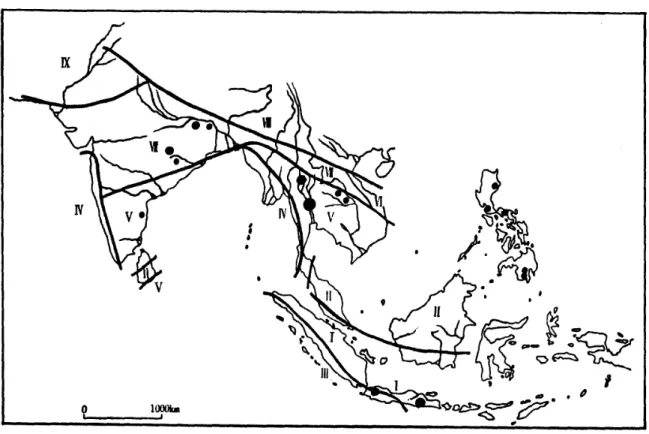
1971) from Okinawa Prefecture, Japan, and from Terra roxa estructurada eutrofica on basic eruptiva from Brazil. An indurated vesicular laterite crust derived from saprolitic agrillaceous rocks in West Malaysia was also included in the samples. The distribution of sample sites is mapped in Fig. 1 in relation to Kyuma's climatic regional division (1972).Indurated thick hard laterite is widely distributed in regions II, IV, V, and VII, and pisolitic ferruginous glaebules seem to occur predominantly in regions V and VII where the climate is characterized by the presence of dry season, namely the tropical monsoon (region V) and tropical-subtropical monsoon (region VII) climatic regions.
Soils rich in bases and montmorillonitic clay, such as those occurring in central Luzon in the Philippines, contain glaebules of manganiferous nature. Ferruginous glaebules are also found on older alluvium (Okagawa, 1970), but their size, round-ness, and greasy surface texture are not as developed as that of glaebules occurring in the central plain of Thailand and in India.
H.FURUKAWAet at.: Chemical, Mineralogical and Micromorphological Properties of Glaebules
Fig. 1 Glaebule sampling sites (using Kyuma's climatic regional division, 1972)
The infrequent occurrence of ferruginous glaebules in the soils of Java is also noteworthy, and may be related to the continuous rejuvenation of soil parent materials through active volcanism.
The distribution of carbonate glaebules is related to calcium-rich geology, such as leucite-bearing eruptiva and limestone.
The distribution of glaebules in the soil profile is variable and does not appear to show any regular change in abundance, size, and hardness related to position within a profile. A certain regularity, was noted in some previous studies, reviewed by Drosdoff and Nikiforoff (1940), in soils in the temperate regions, and, in a study by Nye (1955), in West African soils. All these soils can be regarded as more or less sedentary, while the samples used in the present study are transported soils.
Soil units at the sampling sites were given approximated names, using several sources (Moormann and Rojanassonthon, 1967; Survey of India Offices, 1954; Supraptohardjo et ai, 1960; Takaya and Kyuma, 1968; Barrera, 1964).
Glaebules samples were ground by a spexmill or an agate mortar. Major chemical composition of the samples was determined by means of the X-ray fluo-rescence spectroscopy, in which ignited ground powder was fused into a glass disc with a flux (Li2B407-Li2COs-La20s mixture) according to the method described by Norrish and Chappell (1967).
The calibration curves drawn with synthetic standard mixtures were sufficiently 36'1
straight for a wide range of concentrations. The mean total of nine oxides (Si02,
A120 3, Fe20 3, Mn30 4, CaO, MgO, K 20, and P20S) was 97.0±5.0 (57 samples)
on an ignited basis. The content of each oxide was recalculated to total 100%,
neglecting the matrix correction which would have yielded a small change in content.
F or mineralogical compos!hon the ground powder was mounted on etched
glass slides and scanned by an X-ray diffractometer with Fe Ka . Quartz, felspar,
goethite, haematite, calcite, and sometimes clay minerals were recognized and estimated semi-quantitatively by the peak height.
Oriented clay specimen obtained by Mehra-Jackson's deferration treatment
(1960) was X-ray diffracted, and the clay mineral composition of the glaebule samples was compared with that of the soil matrix.
For micromorphological observation, glaebules embedded in polyester resin under vacuum were cut and ground to thin sections by conventional methods in geological laboratories. The thin sections were studies under transmitted and re-flected light using a polarizing microscope. Color and fabric of the groundmass, voids, and skeletal grains were observed, described and interpreted mainly using the
terms proposed by Kubiena (1970).
Results and discussions
1. Appearance and chentical contposition
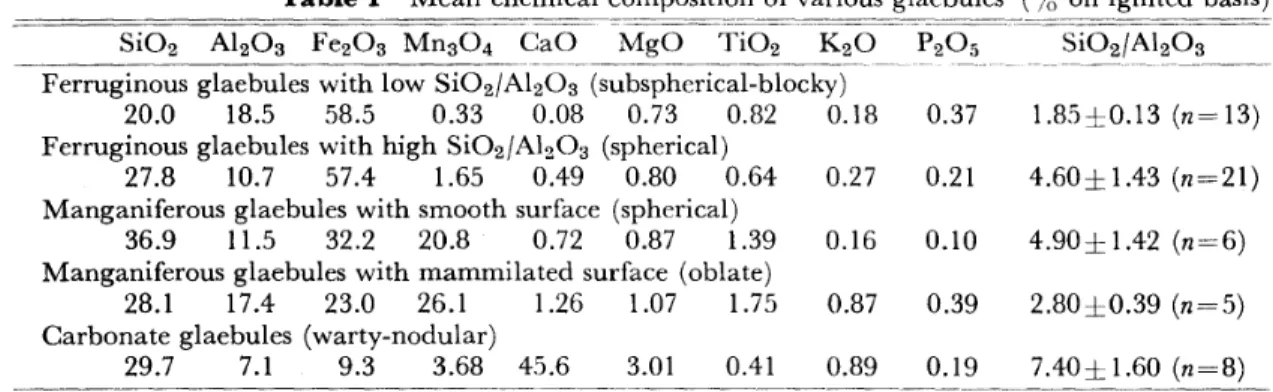
The glaebules studied may be grouped into three according to chemical com-position, that is, ferruginous, manganiferous, and carbonate glaebules (Table 1).
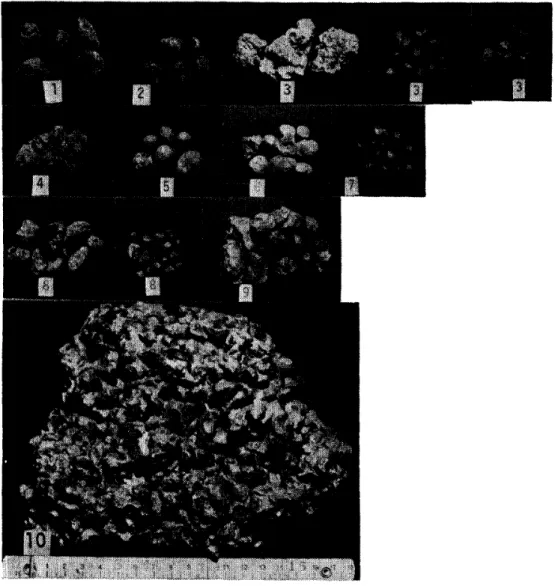
The appearance of the glaebules, described in terms of color, size, shape, surface texture, surface lustre, hardness, etc. is widely variable (Fig. 2). Ferruginous glaebules, in particular, showed wide variation;
(1) dark brown to brown, spherical granular, nodular to botryoidal of variable size,
with smooth surface texture and greasy lustre,
7.40± 1.60 (n=8) 1.85±0.13 (n= 13) 2.80±0.39 (n=5) 4.60± 1.43 (n=21) 4.90± 1.42 (n=6) 0.39 0.19 0.10 0.21 0.87 0.89 0.16 0.41 3.01
---~--"---Table I Mean chemical composition of various glaebules (% on ignited basis)
Si02 A120 3 Fe203 Mn304 CaO MgO Ti02 K20 P205 Si02/A120 3
-"~--"~"~-"~---"---'~.'_.." ' - - - ' - ' - - _ . _ - - ---_._-,"--Ferruginous glaebules with low Si02/A120 3 (subspherical-blocky)
20.0 18.5 58.5 0.33 0.08 0.73 0.82 0.18 0.37
Ferruginous g1aebu1es with high Si02/A120 3 (spherical)
27.8 10.7 57.4 1.65 0.49 0.80 0.64 0.27
Manganiferous glaebules with smooth surface (spherical)
36.9 11.5 32.2 20.8 0.72 0.87 1.39
Manganiferous glaebules with mammilated surface (oblate)
28.1 17.4 23.0 26.1 1.26 1.07 1.75
Carbonate glaebules (warty-nodular)
29.7 7.1 9.3 3.68 45.6
H.FURUKAWAet al.: Chemical, Mineralogical and Micromorphological Properties of Glaebules
Fig. 2 Representative glaebules and indurated laterite
1. Manganiferous gaebules from Reddish-brown soil on coral limestone, Okinawa Prefecture, Japan. Slightly mammilated surface texture.
2. Manganiferous glaebules from a Latosol on intermediate to basic eruptiva, Luzon, the Philippines. Smooth surface texture.
3. Warty blocky carbonate glaebules, coexisting with spherical ferruginous glaebules with greasy lustre, and subspherical manganiferous glaebules. Sampled on old alluvium in Central Thailand. 4. Botryoidal ferruginous glaebules forming a hardpan. Sampled on old alluvium in Northeast
Thailand.
5. Spherical ferruginous glaebules with smooth surface texture, but with dull lustre. Sampled on old alluvium in intermountain basin of Northern Thailand.
6. Spherical ferruginous glaebules with bleached appearance. Sampled from a Low Humic Gley soil in Central Thailand.
7. Nodular and spherical ferruginous glaebules with greasy lustre. Madhya Pradesh, India.
8. Blocky and nodular glaebules with a slight surface modification. Sampled from a Latosol derived from eruptiva, Madiun,]ava. Some spherical ones are shown.
9. Blocky to fragmental glaebules with smooth surface texture, and spherical ones with smooth and greasy-Iustred surface. Sampled from a slag-earth horizon on undulating plateau, Madhya Pradesh, India.
10. Indurated vesicular laterite from Melaka, Malaysia.
(2) dull brown to greyish yellow, spherical to sub-spherical, with rough surface texture and dull lustre,
(3) variously colored, blocky, with rough surface texture and dull lustre of slightly modified surface of weathered rock fragments.
The spherical glaebules with greasy lustre in the first group have been termed pisolite, concretion, buckshot, etc., as mentioned in previous studies. The second group appears bleached with respect to color and surface texture. These two groups show some regular internal structure on splitting, such as concentric bands, the peeling off of the brown crust from the darker core, etc. The third group shows no regular internal structure, and is dominant in samples from Java and the Philippines. The manganiferous glaeblues are brownish black, spherical and granular, with even to smooth surface texture, and are oblate in shape. The concentric thin laminae are very noticeable on fracture faces. The carbonate glaebules are irregular and warty in shape, light grey, with rough surface texture and dull lustre; they are sometimes polished and brownish, resembling the bleached ferruginous glaebules, but easily distinguishable from the latter by effervescence on contact with hydro-chloric acid.
Comparison of the chemical composition of the glaebules with that of the soil matrices indicated the change in the content of each chemical element during glaebule formation.
Frequency distribution is illustrated for the contents of the nine oxides and for the molar ratio of Ti02/A120 3 (Fig. 3). The soils analyzed comprise four hundred
and ten surface soil samples of padi soils in tropical Asia (Kawaguchi and Kyuma, 1974), but they are not necessarily the samples from which glaebules were separated. They cover, however, a range of chemical composition wide enough to provide a soil matrix for consideration of the loss and gain of elements in glaebule formation in tropical soils.
The frequency distribution patterns of the Ti02/A120 3 ratio are similar for
glaebules and soils, which may indicate the pedogenic nature of the glaebule for-mation.
Relatively high titania content (1.5-2.5%) in glaebules from Java and the Philippines might be due to the volcanic origin of parent materials, but it is not as high as the titania content reported in ferruginous concretions in Hawaiian Latosol
(Sherman and Kanehiro, 1954).
While it is known that active volcanism enhances the Ti02/A120 3 ratio In
ocean sediments (Bostrom et ai, 1973), this is not the case for surface soil samples. The highest Ti02/A120 3 ratios in the soil samples were for the quartziferous sandy
soils of the Khorat plateau of Thailand, but not for soils from active volcanic areas 370
H.FURUKAWAet al.: Chemical, Mineralogical and Micromorphological Properties of Glaebules 3.5 I 4.0(%) MgO 10 40 30 20 40 30 20 50 ClO 40 50 60 70 80 90 5 I I I I I 160(%1 I 50 60 70 80 90 7(%) 40 p.O, 30 TiO./A2.o. 20 10 0 0.5 0.6 0.2 0.3 I I I I 0.6 0.9(%) 0.4 0.4(%) 40 A2.0, 30 TiO. 20 10 0 20 25 30 35 I I I I 25 30 35 40(%) (%) FeJO, 40 Mn.O. 30 20 10 20 40 I I I 1.5 2.0 2.5 3.0 20 40 70(%)
Change in chemical composition of glaebules compared to that of soils • glaebules (n=57).
0
soils (n=41O).ordinate: frequency as percentage of total number of samples. abscissa: oxide content in percentage on ignited basis. Fig. 3 50 l
i
¥ II.. 10 0 40 l 30i
:J 20 ¥ 10 II.. 0 40 ~ 30i
20 ¥ 10 II.. 0 50 40 ~ 30(
20 ¥ II.. 10 0 40 ~30 3'11ofJava and the Philippines, where the high alumina content in soils due to advanced
alteration of ferro-magnesian minerals to clay caused rather low Ti02/AI20 a ratios.
The patterns of iron and manganese clearly show high mobility of both elements, which are transported and accumulated as glaebules.
Itis interesting to note that calcium and magnesium, which leach rapidly from
primary minerals, are found in glaebules to the same extent as in soils. A few peaks appear far away from the mode in case of calcium, while no such peaks appear for magnesium. This difference can be interpreted as indicating that mobilized calcium tends to form free carbonate, whereas magnesium tends to be philic to clay structure. The very low potassium content of the glaebules is due to the presence of glaebules in the Khorat plateau of Thailand and India. Except for these cases, potassium exists in glaebules, as in soils, at fairly high levels, and this indicates the high resistance of potassium to leaching, even under tropical weathering conditions. The overall coincidence between glaebules and soil in the frequency
distribu-tion patterns of AI20 a, MgO and K20, which accumulate in clay minerals, suggests
that clay fractions in the vicinity of the precipitation center have been incorporated into glaebules.
The loss of Si0 2 content in glaebules is very outstanding. This is due either to the leaching of silica during intensive weathering to form residual weathering crusts, or to the exclusion of sand grains in plasma precipitation.
Differential precipitation of iron and manganese is frequently observed in
micro-scale as exemplified by alternate concentric layers in single glaebules (Table2).
This is also observable in macro-scale, as in the predominance of ferruginous glae-buIes in highly leached soils on older terraces and that of manganiferous ones in lower-lying base-rich soils.
The differential concentration of either iron or manganese in glaebules as ex-pressed by a ratio (termed the iron-manganese ratio), Fe20a/(Fe20a+Mna04) would .be positively correlated with the ratio Si0 2/AI20 a, taking the sum of base content as an internal standard (all contents expressed in percentages). The ratios
Table 2 Chemical composition of outer shell and inner core in manganiferous glaebules
(% on ignited basis) Sample Si02 Al20 a Fe20a Mna04 CaO MgO Ti02 K 20 P20S Si02/AI2O a
26-1 outer shell 25.1 8.2 53.0 11.8 0.09 0.85 0.86 0 0.03 5.3
26-2 core 29.8 13.3 22.8 31.6 0.35 0.49 1.59 0 0.02 3.7
41-1 outer shell 33.7 17.6 19.5 23.6 1.43 0.94 1.31 1.19 0.55 3.2
41-2 core 24.6 18.8 17.8 33.0 1.76 1.03 1.35 1.05 0.43 2.2
Notes: 26 is a spherical granular (7-10 mm) manganiferous glaebules with smooth surface texture and dull surface lustre. From the surface horizon of a Latosol on eruptiva, Cauayan, Luzon, the Philippines.
41 is an oblate (7-15 mm) manganiferous glaebule with mammilated surface and dull lustre. From the surface horizon of Reddish-brown soil on coral limestone, Shimajiri, Okinawa, Japan.
H. FURUKAWAetat.: Chemical, Mineralogical and Micromorphological Properties of Glaebules are plotted on log-log coordinates in Fig. 4. The positive correlation is thought to be due to the increase of iron relative to manganese content as the silica (presumed to stand for quartziferous sand) increases relatively to alumina (clay). This result accords with the fact that iron oxides are known to be relatively immobile compared Table3 Relationship between major chemical composition and content of some minor elements in
some ferruginous, manganiferous and carbonate glaebules
for oxides and for
Ferruginous Manganiferous Carbonate
Sample 6-2 15-3 36-1 43 14-1 26-1 42-1 42-2 33-1 34-1 35-1 Si02 30.4 11.1 21.7 20.4 28.9 29.8 28.9 28.6 30.1 21.8 AI 20 3 7.9 10.8 10.5 19.5 15.3 13.3 16.9 16.2 5.2 5.1 6.3 Fe203 60.3 74.7 66.6 58.2 33.7 22.8 22.9 26.0 1.2 1.9 4.0 Mn304 0.32 0.57 0.62 0.18 18.3 31.6 25.8 23.7 0.41 0.42 0.59 CaO 0 0.12 0.29 0 0.08 0.35 1.45 1.49 66.0 57.8 60.7 MgO 0.32 0.94 0.72 0.97 0.98 0.49 1.16 1.54 2.37 3.52 5.32 Ti02 0.47 0.76 0.79 0.64 2.16 1.59 1.39 1.25 0.12 0.20 0.28 K20 0 0 0.59 0 0 0 1.08 0.99 0.63 0.75 0.73 P 20S 0.22 0.90 0.17 0.13 0.47 0.02 0.40 0.48 0.22 0.17 0.20 Na20 0.057 0.275 0.044 0.020 0.058 0.117 0.102 0.148 0.179 0.222 0.458 . _ - - - ' . , - - _.._ . _ - - " -"-,---"----"","-_.,--- . _ , _ . _ ~ -Cs 4.9 2.1 2.4 0.9 4.6 4.1 8.0 3.0 2.0 2.8 2.5 Ba 458 283 492 56 1665 5243 2643 1740 390 872 506 Ga 24.5 28.1 (25.0) 55.1 (25.0) (18.0) (30.0) (35.0) 5.8 7.2 (9.0) Sc 15.5 24.4 18.3 44.2 18.8 14.1 24.5 27.5 4.2 6.5 6.7 La 39.0 11.6 40.5 11.4 44.3 116 73.5 55.7 38.6 162 164 As 171 142 417 845 25.8 13.9 123 131 12.3 21.0 6.0 Sb 10.7 2.6 15.7 9.7 2.28 1.85 11.3 8.05 0.64 0.30 0.53 Cr 382 71.2 246 903 16.9 37.1 85.6 84.7 21.0 28.7 26.5 Co 128 30.4 107 1.2 546 1884 637 723 14.8 23.0 34.2
Note I. Oxides are on ignited basis, and elements are on air-dry basis. Values for Ga are est.lm;ated using the proportional relationship between Ga and Sc. Values in parenthesis for Ba are relative values.
Note2. Description of samples.
6-2. Spherical granular (2-5mm) ferruginous glaebules with smooth surface texture and dull lustre. Sampled from subsoil of Low Humic Gley soil on old alluvium in old delta, Thailand. 15-3.Spherical granular (2 mm) ferruginous glaebules with rough surface textutre and dull lustre.
Sampled from sub-surface horizon of Alluvial soil, Tangerang, java.
36-1.Sperical granular (3 mm) ferruginous glaebules with smooth surface texture and greasy lustre. Sampled from surface horizon of local alluvium in Red and Yellow soil zone on undulating plateau, Madhya Pradesh, India.
43. Indurated vesicular laterite derived from saprolitic argillaceous rocks in Melaka, Malaysia. 14-1.Spherical granular (5-8 mm) manganiferous glaebules with smooth surface texture and dull
lustre. Sampled from subsoil of a Latosol derived from basic and intermediate eruptiva, Bogor, java.
26-1.See note Table2.
42-1.Inner core of manganiferous glaebules with mammilated surface texture from Okinawa,japan. Similar to41.See note Table2.
42-2. Outer shell of the above glaebule.
33-1. Subspherical, warty carbonate gaebule (1.5-8mm) with rough surface texture. Sampled from subsoil of a Gray and Brown soil impregnated with salts on a low terrace in the Ganges South Delta, Uttar Pradesh, India.
34-1. Subspherical, warty carbonate glaebules (1.5-15 mm) with rough surface texture. Sampled from the sub-surface horizon of a Gray and Brown soil impregnated with salts on a high terrace in the Ganges South Delta, Uttar Pradesh, India.
35-1.Spherical (8-10mm) carbonate glaebules with rough surface texture. Sampled from surface horizon of Red Loam on local alluvium on an undulating plateau, Orissa, India.
to manganese oxides.
The correlation was even greater when the abscissa was replaced by a ratio Si02/(CaO+MgO+K20). This might be interpreted as indicating that iron may be concentrated in combination with colloidal silica, which may act as a protective colloid for iron, since in an acidic soil pH range, silica and poorly crystallized manganese oxides are known to be negatively charged, and iron oxides positively charged.
The content of some minor elements, determined by neutron activation analysis for a few glaebules (Table 3), seems to indicate that each element is selectively ac-cumulated mainly depending on its charge relative to that of either iron and manga-nese oxides sol (Landergren, 1948). Chromium and arsenic clearly accumulate in ferruginous glaebules, while cobalt, barium and lantanoids accumulate in manga-niferous ones. The high correlation between gallium and aluminium content can be explained by Goldschmidt's hypothesis concerning ionic radii (1945).
The accumulation of phosphorus in glaebules is noticeable (Fig. 4). However, no significant correlation between phosphorus and one or a combination of iron, aluminium, or manganese content is found. Phosphorus is a constituent of such primary minerals as apatite which is abundant in volcanic rocks, and this may be the
10 0 0 0 0
S
o 0 ~ o 00"
8 + 1 .I 0 0 0C) o 0 0 6' 6' 0 0 :IE o ClOO + o Cb 0 0 o 0 ,t3
Cb 08 0 0 0 ::::::: 0 0 0 00 '+:0 · 0 0 E 0.1 o0'fJ ~ OJ ClID c: ~ 00 c:~
c,g
0 «1»0 0.01 00 0.1 10 100Silica/alumina/(Cao + MgO + K'lO) r =0.91**
Fig. 4 Differential accumulation of iron and manganese in relation to the Silica/Alumina ratio. Base content of the glaebules was used as an internal standard.
ordinate: Fe20S(%)/(Fe20s+Mns04)(%)/(CaO+MgO+K20)(%) abscissa: Si02(%)/AI203(%)/(CaO+MgO+K20) (%)
H. FURUKAWAetat.: Chemical, Mineralogical and Micromorphological Properties of Glaebules
cause of the high phosphorus content of glaebules and soils from Java.
2. Mineralogical composition
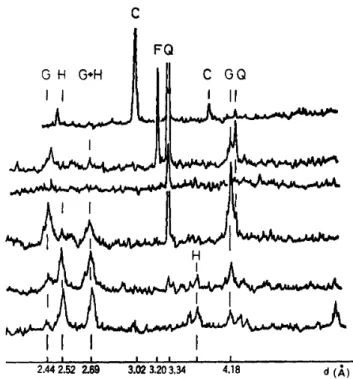
Some representative diffractograms of glaebules are shown in Figure 5.
Goethite was the predominant iron mineral in most ferruginous glaebules. Haematite was dominant only in the glaebules with laterite fabric and in the indurated laterite. Thus, glaebules with laterite fabric were considered to have been derived from the disintegrated laterite crust.
Calcite was the predominant mineral in carbonate glaebules.
Although goethite was detected, with rather diffuse peaks, no manganese miner-als were detectable in manganiferous glaebules.
Quartz was almost completely absent in glaebules characterized by a low Si02/AI20 s ratio and by a relative abundance of haematite, while it was conunon to abundant in pisolitic concretions with a high Si02/AI20 s ratio.
Feldspars were found in the samples from the northern intermountain basins of Thailand, and also in the inunature glaebules found in volcanic regions of the Philippines and Java.
Gibbsite was not detectable even in the samples with a low Si02/AI20 s ratio.
The clay minerals have not been broken down intensively that the alumina released
c
FQ G H G+H I I 2.44 2.52 2.69 3.02 3.20 3.34 C GQ I " 4.18Fig. 5 Crystalline minerals in glaebules. Diffractograms from powdered specimen with FeKa
G: goethite, H: haematite, F: feldspar, Q: quartz, C: calcite. From top to bottom: carbonate (33-1, see Table 3), ferruginous (4, see Table 4), manganiferous (41-1, see Table 2), ferrugi-nous (2, see Table 4), ferrugiferrugi-nous (38-3, see Table 4), indurated laterite (43, see Table 3).
is accumulated in the form of gibbsite. This agrees well with the general trend, to be stated later, that the clay minerals in glaebules and in soils are of nearly the same composition.
The color of the ground powder can be related to the nature of the iron minerals and manganese content. Goethite rich ferruginous glaebules are bright brown to dark brown (7.5YR to 10YR in hue and value/chroma ranging from 5/6 to 3/4).
As manganese increases the value and chroma decrease to 3/3-2/3, and if there is a high haematite content the hue shifts to 5YR or redder. Manganiferous glaebules mostly show brownish black (7.5YR 2/2). Haematite-rich iron glaebules are dark reddish brown to dark red in color (10R3/3-3/6).
It was previously claimed by Harada (1937) that an oxalic acid-potassium oxalate solution of pH 4.1 was effective in differential dissolution of iron compounds. Therefore, his method was adopted to study the present samples, with slight modifi-cations, as follows: 100 mg of ground powder was dissolved in 250 ml of 0.1 M potassium oxalate-0.025 M oxalic acid under an UV lamp or in the dark. The extracted iron expressed as Fe203 was called Fel and FellI for the light and dark treatment, respectively. A similar dissolution under an UV lamp and using a more dilute solution, 0.015 M potassium oxalate-0.05 M oxalic acid, was carried out to determine Fell. The amount of iron extrated was determined by atomic absorption spectroscopy.
Although the differences (Fel-Fell) and (Fell-FellI) were assumed by Harada to correspond to the amounts of haematite and limonite, respectively, this was not verified by the results of X-ray diffraction. This was because well crystal-lized haematite and goethite were only partly dissolved in the solution, even under an UV lamp. The same phenomenon was observed in Mehra-Jackson's deferration treatment.
The ratio FellI/FeI seems to be better correlated with the degree of crystalli-zation of iron compounds; when the ratio is high, X-ray amorphous iron compounds predominate, and when it is low, crystalline compounds are dominant (Table 4).
The Felll/Fel ratio seems to be equivalent to the "AktiviHitsgrad" (Schwert-mann, 1964) of iron oxides, which was effectively used in combination with the "crystallinity ratio" by Nagatsuka (1972) to distinguish some relict soils (paleosols) from the modern soils in Japan. In this case, however, a decrease in iron solubility for highly crystalline minerals would give a rather low "crystallinity ratio".
Diffractograms of clay separates from some glaebules are shown in Fig. 6. Itis interesting to note that the goethite peak persists after Mehra-Jackson's deferration treatment in well crystallized samples.
Clay minerals with 14 to 15
A
spacing on magnesium saturation are vermiculite 3'16H. FURUKAWA et al.: Chemical, Mineralogical and Micromorphological Properties of Glaebules Table 4 _~elation.between iron mineral~present andiro~_compounds extracted by oxalate solution
Relative abundance FellI/Fe! (FeI -FeIlI)/FeT
Goe. Hae. % % 38-3 43 2 14-2 15-3 36-2 3 6-2 7-2 26-3 4 7-1 36-3 41-2 5 41-1
++
++
2.4 71.6+
++
2.8 64.4++
+-
6.0 57.3+ +
± 14.3 64.7+
+-
± 8.4 61.3+ +
± 3.5 73.1+ +
13.7 58.1+-
+
3.7 77.1+ +
5.4 73.9+.+
12.8 68.0 -I- 12.1 80.2+
13.2 77.7 ± 36.7 45.2 ± 54.1 31.8 38.4 55.2 85.2 10.1Note 1. FeIII/FeI and (FeI-FeIII)/FeT would be equivalent to the "Aktivitiitsgrad" of Schwertmann (1964), and to the "crystallinity ratio" of Nagatsuka (1972) respectively.
Note 2. Description of samples.
38-3. Spherical (1.5-5 mm) ferruginous glaebules with smooth sufrace texture and greasy lustre. Sampled from slag-earth horizon in Red and Yellow soil zone, Madhya Pradesh, India. 43. See note Table3.
2. Botryoidal spherical ferruginous with greasy lustre coalesced by cementing material. Sampled from indurated hard pan underlying sandy soils on old alluvium, Ubon, Thailand.
14-2. Spherical (2 mm) ferruginous glaebules. See note Table 3. 15-3. See note Table 3.
36-2. Spherical (4-7 mm) ferruginous glaebules. See note Table 3.
3. Spherical(2-6 mm) ferruginous glaebules with smooth surface texture and dull lustre. Occur as ironstone layer in Low Humic Gley soil on old alluvium in intermontane basin, Chiangmai, Thailand.
6-2. See note Table 3.
7-2. Spherical (1.5-4 mm) ferruginous glaebules with smooth surface and greasy lustre. Sampled from throughout a profile of Low Humic Gley soil on old alluvium in old delta, Manorom, Thailand.
26-3. Spherical (2-6) with smooth surface and dull lustre. See note Table 3.
4. Spherical (2-4 mm) ferruginous glaebules with rough surface and dull lustre. Sampled from surface to sub-surface horizon of Low Humic Gley soil on semi-recent alluvium in intermontane basin, Chiangmai, Thailand.
7-1. Ferruginous and manganiferous glaebules coalesced into botryoidal ones (5-8 mrn). See note for 7-2.
36-3. Inner core of manganiferous glaebules. See note for 36-2. 41-2. See note Table 2.
5. Warty ferruginous glaebules with bleached appearance. Sampled from subsoil of the same profile as 4.
41-1. See note Table 2.
and montmorillonite.
loA
spacing is due to mica and illite. 7A
spacing is mostly due to kaolin minerals as this shifts to 10 to 10.5A
on hydrazin intercalation (Wada and Yamada, 1968).It should be noted that the clay mineral composItIOn of the clay separates of glaebules is not very different from that of surrounding soils.
For example, in the glaebule samples from Northern Thai intermontane basins 377
(1) (3) 20 (degree) K·Ad Mg-gly Mg-Ad. K-Hyd. Mg-gly. Mg-Ad.
~
K-Hyd. (4) 20 20 10 20(degree)Fig. 6 Crystalline clay minerals in glaebules. Diffractograms from oriented specimen with CuKa
K-Hyd.: potassium-saturated and intercalated by hydrazin, K-Ad.: potassium-saturated and air-dried,
Mg-Gly.: magnesium-saturated and glycerated, Mg-Ad.: magnesium-saturated and air-dried.
1. Kaolin, mica and quartz are dominant. Ferruginous glaebules 4. see Table 4.
2. Vermiculitic montmorillonite interlayered, quartz and kaolin are dominant. Carbonate glaebules 34-1. see Table 3.
3. Kaolinite predominates. Goethite peak is visible at 4. 18 A. Indurated vesicular laterite. 43. see Table 3.
4. Kaolinite predominates and mica is present. Goethite peak is visible. Ferruginous glaebules 38-1. see Table 4.
H.FURUKAWAet al.: Chemical, Mineralogical and Micromorphological Properties of Glaebules
(Fig. 6-1), 10
A
spacing due to mica and illite is greatly enhanced relative to that of the soil, whereas the potassium content of the glaebules is significantly less than that in the bulk soil. This can be interpreted as meaning that the glaebules had been formed in the course of weathering of granitic rocks prevalent in the area before they were transported to the detritus slope and from there to the alluvial plain. This may also hold true for pisolitic concretions from the upper Central Plain of Thailand. In samples from Java and the Philippines no significant difference between glaebules and the soils was detected.The interesting clay mineral composition of one carbonate glaebule (Fig. 6-2) is to be noted. The sharp and strong peaks at 14
A
to 15A
of Mg-saturated clay showed a decline to 10A
spacing on K-saturation, and on glyceration expanded to around 20A,
with part remaining at 14A.
Thus the presence of vermiculite and montmorillonite is evident, but the montmorillonite seems to be a grade mediate to vermiculite and could be called vermiculitic montmorillonite, and inter-stratified with Al-interlayered mineral (Hattori, private communication). According to Hattori, this kind of montmorillonite is frequently observed in montmorillonitic soils in tropical Asia, except in grumusols where it behaves more ordinarily.In the indurated laterite crust (Fig. 6-3), kaolinite is the dominant clay mineral. The clay material filling the vermicular voids has almost the same composition as clay material in the crust, except that goethite is lacking.
In glaebules with laterite fabric haematite and goethite are abundant, and kaolinite is much more prominent than clay in the soil.
In conclusion, it appears that the discrepancy in mineral composition of clay fraction between glaebules and soil matrix may be greater or lesser according to the lag between the time of formation of glaebules and soil. When a glaebule is an
in
situ formation, the discrepancy may be small, as could be the case for most manga-niferous glaebules from Central Luzon and East-Central Java. When it is trans-ported, the discrepancy may be greater; younger minerals may be found in glaebules as is the case with ferruginous glaebules from Northern and Central Thailand, and minerals at advanced stages of weathering may be found as is the case with laterite-derived glaebules from Madhya Pradesh, India.
3. Micromorphological observations
The most striking feature of the thin-sections of glaebules was observed under reflected light; the fabric and plasma were clearly differentiated.
The fabric of indurated laterite from Malaysia is characterized by a mosaic of the following two areas; (1) one is that part apparently corresponding to the vesicular void space, which shows a radial plasma orientation appearing brownish under the
transmitted light and bright yellow (abbreviated hereafter as brown/bright yellow), and the other is the area of the hardened crust, in which, while showing a similar orientation, plasma tends to be granulated into relatively coarse granules appearing opaque/lustrous red. Granules are "tied" (Humbert, 1948), or "knitted" (Alexander and Cady, 1962) by channels filled with clay. The iron compound is considered to be amorphous in the vesicular void, and haematite and goethite in the granulated area. The fabric described above may correspond to the "Braunlehm-Laterite" of Kubiena (1970).
The similarity of the two areas in both clay mineral composition and in orien-tation pattern may be taken as evidence of in situ plasma segregation. The growth of the network of granules contributed to the hardening of the laterite. Another charac-teristic of laterite fabric is the absence of coarse quartz grains.
The Braunlehm-Laterite fabric is also found in several glaebules from lowland soils of India and of Northeast Thailand, regardless of their shape, which may be concretionary, botryoidal, or nodular. The thin sections show that the laterite fragment is coated and/or coalesced by thinly laminated plasma, resulting in differ-ent shapes. There is little doubt that disintegrated laterite fragmdiffer-ents transported to low-lying areas acted as cores which absorbed plasma from the surrounding soil matrix under the alternate dry and wet conditions. The fact that fragmental slag-earths on the higher part of undulating terrain in Madhya Pradesh, for example, change into spherical glaebules in local alluvia suggests that the spherical shape has resulted from abrasion during transportation.
In the laterite fabric the size of the individual lustrous red granules ranged
Fig. 7 Micromorphology of some representative glaebules. Scale 0.5 mm
1. Indurated vesicular laterite. X28. Reflected light.Vesicular voids are filled by yellow clay (light-toned part). Dark granules are haematite crystallites. v\ihite part is vacant void.
2. Same sample at higher magnification. X70. Transmitted light (parallel nicols).
3. Ferruginous glaebule with earthy braunlehm fabric. 28. Reflected light. Core of earthy braun-lehm fabric is coated with concentric thin laminae of goethite and clay.
4. The same field under crossed nicols. Bright spots are quartz grains.
5. Repeptized ferruginous glaebule. ;x:70. Reflected light. The inner part of the core remains latcri-tized earthy braunlehm fabric, while the outer part is repeplatcri-tized to braunlehm. The core is coated with laminae of goethite and clay. Spots are quartz grains.
6. Concentric manganiferous glaebule. X28. Reflected light. Quartz grains are cemented by iron oxides, on which alternate preciptaition of manganese (darker lamenae) and iron (lighter lamenae) oxides is apparent. Outermost coating is ferruginous.
7. Poorly differentiated manganiferous glaebule. X28. Reflected and transmitted light (parallel nicols). Quartz nest in the center with unlaminated manganiferous precipitated on it.
8. Poorly differentiated glaebule with weathered rock fabric. X28. Reflected and transmitted light (parallel nicols). At top and bottom argillized feldspar can be seen; augite (pointed grains) and hornblende (columnar grains) are embedded in braunlehm.
9. Ferruginous glaebule with weathered rock fabric. X28. Transmitted light (crossed nicols). Striated extinction pattern is derived from weathered volcanic rock.
10. Carbonate glaebule. x28. Reflected and transmitted light (parallel nicols). Microcrystals of calcite densely fill the groundmass.
H.FURUKAWAetat.: Chemical, Mineralogical and Micromorphological Properties of Glaebules
Fig. 7
from 10 to 30p (Fig. 7-2). These granules appear to be identical with the "droplet" reported by Hamilton (1964), which was, however, exceptional in the old iron crust of west Africa. Our contention is that the segregation of iron compounds into granules or droplets of haematite is a rather common phenomenon in the laterite formations of tropical Asia, and that the glaebules derived from laterite can be easily distinguished from other kinds of glaebules. The second type of fabric, one of the commonest, is found in the pisolotic glaebules from the upper Central Plain of Thailand and from India (Fig. 7-3, 4). They are characterized by a fairly thick coating of thinly laminated plasma layers around the inner core. The coating is reddish brown to opque/yellow to dark yellowish brown, almost non-birefringent, has few voids other than some cracking voids, and has few quartz grains; the inner core is variously colored, with varying amounts of quartz grains but definitely more coarse grains than in the coating, and also has many voids mostly lined by bire-fringent plasma.
The fabric of the inner core may be understood as a variety of stabilized, that is, "erdified", braunlehm in which the dense groundmass ofbraunlehm is transformed into a structured groundmass, and the iron hydroxides move toward the crystalli-zation center along or in the voids. The degree of crystallicrystalli-zation of the iron hy-droxides may vary.
Based on the degree of "encasing" (Kubiena, 1970) of the groundmass by threads of plasma, and also on the degree of crystallization of plasma precipitated on ped faces or in the groundmass, several intergrades would occur, ranging from earthy braunlehm, via erde, to lateritized earthy braunlehm.
As described above, a very marked contrast exists between the coating and the inner core; absolute accumulation of iron from the transporting solution no doubt occurs in the former, while a relative accumulation of sesquioxides would be the main process occurring in the precursor of the core.
Since the fabric of the soil matrix in a low humic gley soil of, for example, the upper central plain of Thailand is dominated by earthy braunlehm fabric, those glaebules with lateritized earthy braunlehm fabric in the inner core have most probably developed on ferruginous soil clods transported from higher terrain. In situ formation is conceived, however, for those which have many quartz grains cemented by manganese compounds in the inner core and the laminated ferruginous shells in the coating.
The red mottles found in lowland alluvial soils may have been transformed into harder concretions or nodules as the sediments dried out, either because of uplift of the terrain or a lowering of the water table associated with an eustatic change. Hardening of red mottles is observed even today when subsoils are dug out and 382
H.FURUKAWAet al.:Chemical, Mineralogical and Micromorphological Properties of Glaebules exposed to the surface conditions. Then they give nodular hardened materials with vesicular voids filled with clay, very closely resembling laterite fragments. But ma-terials thus hardened can be distinguished from transported glaebules by such features as the lack of smooth surface texture and spherical shape, and the absence of a laminated coating of plasma.
The third type of fabric can be seen in the glaebules with a bleached ap-pearance (Fig. 2), which have a fabric suggestive of a change of the environment (Fig. 7-5). Repetization of iron compounds causes differentiation of the formerly homogeneous fabric into two parts; the inner part presumably consists of the former fabric of laterite and lateritized earthy braunlehm, whereas the outer part has changed into braunlehm. The components of the fabric except for the type of plasma, for example, the distribution of skeletal grains and voids, remain unchanged in parts.
This may be interpreted as follows; the ferruginous glaebules which had been formed in higher terrain with favorable conditions for dehydration and crystallization of precipitated and/or segregated iron compounds were transported to low-lying areas where redissolution or rehydration of the iron compounds took place under reduced conditions that were prevalent during the submerged period. The dis-solution of hard iron concretions has also been reported by Nye (1954) as occurring in soil on the down-slope and valley bottom of a West African catena.
Redissolution of precipitated plasma would be a more common phenomenon in manganiferous glaebules since the many forms of manganese compounds are of higher solubility and more mobile than iron compounds. Infact, the manganiferous glaebules in weakly acid to acid soils are in many cases coated by an often very thin ferruginous crust; otherwise, the development of the glaeubles would have been halted by the redissolution process. Thus the fabric of manganiferous glaebules is characterized by alternate precipitation of manganese and iron compounds, re-sulting in thinly laminated layers of remarkably developed concentric pattern (Fig. 7-6).
Incalcareous soils areas, for example, the Ganges Plain of India where manga-niferous and ferruginous glaebules coexist with carbonate glaebules, this concen-tricity is not prominent in manganigerous glaebules (Fig. 7-7). This implies a decline in the dissolution of iron and manganese compounds in an alkaline medium, while their precipitation from the transporting solution is favored.
In view of amorphous nature and high solubility of the precipitated iron com-pounds in the concentric fabric, many manganiferous glaebules seem to be of in situ formation.
The fifth type offabric is seen in many glaebules from]ava and the Philippines, 383
containing high amounts of weatherable minerals, such as plagioclase, augite, horn-blende, titaniferous minerals, and sometimes glass, all of volcanic origin. The degree of crystallization of precipitated compounds is low, as revealed by X-ray diffraction analyses. The fabric is predominantly of earthy braunlehm type, and plasma sepa-ration is mostly confined to micro-scale segragation from weatherable minerals embedded in the groundmass. (Fig. 7-8)
In other words, these glaebules show an initial stage of redistribution of plasma within a rock fragment rich in iron, manganese and bases. Part of the diffused plasma is precipitated on the surface of weathered rock fragments, and sometimes make them varnished (Fig. 2-8). Other parts of the diffused plasma would be carried farther by the transporting solution finally to precipitate on incipient glae-buIes. The varnished rock fragment, too, would be transported physically to low-lying land, and become the precursor of a glaebule. The spherical ferruginous glaebules with a relatively thick coating found in the older alluvium of Cagayan valley, Luzon (Fig. 7-9) are probably formed in this way. The inner core has a relict of rock fabric. The striated extinction pattern seen under crossed nicols is associated with the argillized rock structure of volcanic origin.
The fabric of the carbonate glaebules is characterized by abundant crystals, densely scattered through the whole groundmass (Fig. 7-10). These micro-crystals are very highly birefringent and from powder diffraction data are con-sidered to be calcite. It should be noted that calcite microcrystals are sometimes found in other types of glaebules at the same site, and these microcrystals show a referred distribution related to voids and the concentric layering pattern.
4. Conclusion
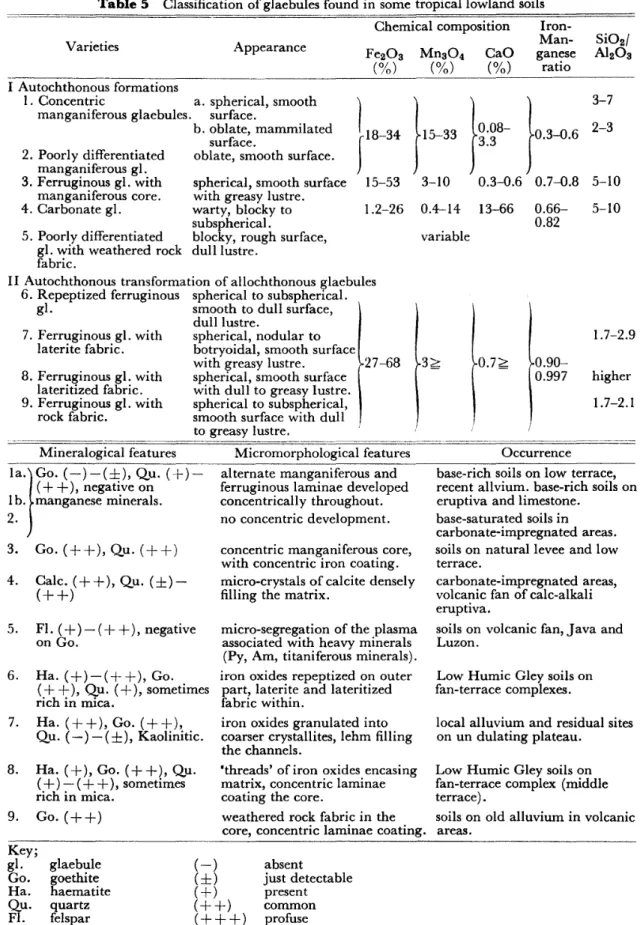
Following the results and discussions presented in the preceeding section, it may be possible and of interest to classify glaebules by their properties. We prefer a classification that allows us, first of all, to separate these glaebules ofin situ formation from those formed otherwise. A rigorous distinction, however, between autochtho-nous and allochthoautochtho-nous formation is difficult because of the transportation of mate-rials both chemically and physically. Autochthonous formation, therefore, is defined as the mobilization and precipitation of plasma that is mostly from the same geomor-phologic terrain to form glaebules.
The following are considered autochthonous formations.
(1) Oblate to spherical manganiferous glaebules, Those with smooth surface mostly occur in low-lying base-rich soils, particularly in the montmorillonitic soils of Java and the Philippines. Those with slightly marnrnilated surface texture tend
to occur in the base-rich soils on intermediate to basic eruptiva and on
H.FURUKAWAet ai.: Chemical, Mineralogical and Micromorphological Properties of Glaebules
stone. Alternate precipitations of amorphous manganese and iron oxides in a concentric pattern is a prominent feature.
(2) Spherical ferruginous glaebules with a thick mangeniferous core, which occur mainly on natural levees and on low terraces.
(3) Warty and irregular carbonate glaebules which mainly occur in limestone areas, carbonate-impregnated lowlands, and on volcanic fans of calc-alkali rocks. Microcrystals of calcite densely fill groundmass.
(4) Blocky to irregular weathered rock fragments with a slight modification of surface texture. Micro-scale segregation of iron and manganese occurs in associ-ation with partly weathered mineral grains such as pyroxenes, amphiboles and titaniferous minerals. These glaebules mostly occur on volcanic fans in Java and the Philippines.
The following may be grouped as autochthonous transforamtions on allochtho-nous glaebulcs.
(5) Subspherical to spherical ferruginous glaebules v,'ith light greyish color and dull lustre. The outer part consists of repetized iron compounds, while the inner part is a laterite or lateritized fabric. Sometimes they are coated by concentric laminae. These occur on fan-terrace complex areas, and on local alluvia on older terrains.
(6) Spherical, botryoidal and nodular ferruginous glaebules with greasy surface lustre and smooth texture. The core with laterite or lateritized fabric is coated with concentric ferruginous laminae. They occur on fan-terrace complex areas and on local alluvia on older terrain.
(7) Glaebules with a similar appearance 10 the above, but with a rock fabric in the core, occurring mostly on the older alluvia of the Luzon Plain and Java.
All the varieties of glaebules are listed in Table 5, in which further subdivision of the above-mentioned glaebules is included, putting a tentative name to each.
Iron, manganese, and calciunl are particularly concentrated in glaebules com-pared to the content in soils. This shows clearly that they can be mobilized, trans-ported and precipitated. The decisive processes involved in the geographical re-distribution of these elements are the chemical transformation of these elements and the hydrological behavior of the transporting interflow (Millot, 1970).
In addition, the physical transport of glaebules, which is clear from the present study, should be stressed. Physical transport may be carried out by soil creep, by sheet erosion, or by dissection of older terrain, in which glaebules are removed from higher land and transported to lower land. An intricate balance between these two processes leads to differential distribution of specific glaebules on a specific terrain.
Table 5 Classification of glaebules found in some tropical lowland soils
CaO
(%)
Varieties Appearance
Chemical composition Iron- Man-ganese ratio 1.7-2.1 1.7-2.9 higher 5-10 5-10 3-7 2-3 0.90-0.997 0.66-0.82 0.7G 13-66 variable 0.4-14 27-68
I
f8-34
15-53 1.2-26spherical, smooth surface with greasy lustre. warty, blocky to subspherical.
blocky, rough surface, dull lustre. 7. Ferruginous gl. with laterite fabric. 2.Poorly differentiated manganiferous gl. 3.Ferruginous gl. with manganiferous core. 4. Carbonate gl. 8. Ferruginous gl. with lateritized fabric. 9. Ferruginous gl. with rock fabric. I Autochthonous formations
1. Concentric a. spherical, smooth manganiferous glaebules. surface.
b. oblate, mammilated surface.
oblate, smooth surface.
5. Poorly differentiated gl. with weathered rock fabric.
IIAutochthonous transformation of allochthonous glaebules 6. Repeptized ferruginous spherical to subspherical.
gl. smooth to dull surface,
dull lustre.
spherical, nodular to botryoidal, smooth surface with greasy lustre.
spherical, smooth surface with dull to greasy lustre. spherical to subspherical, smooth surface with dull to greasy lustre.
Mineralogical features Micromorphological features Occurrence la'}Go,(-)-(±),Qu. (+)-(++),negative on Ib. manganese minerals. 2. 3. Go. (++),Qu. (++) 4. Calc. (+ +),Qu. (±)-(++) 5. Fl.(+) - ( + + ),negative on Go. 6. Ha. (+)-(++), Go. (+ +), Qu. (+), sometimes rich in mica. 7. Ha. (++),Go. (++), Qu. (-)-(±), Kaolinitic.
8. Ha. (+),Go. (++),Qu. ( + ) - ( + + ),sometimes rich in mica.
9. Go. (++)
alternate manganiferous and ferruginous laminae developed concentrically throughout. no concentric development. concentric manganiferous core, with concentric iron coating. micro-crystals of calcite densely filling the matrix.
micro-segregation of the plasma associated with heavy minerals (Py, Am, titaniferous minerals). iron oxides repeptized on outer
part, laterite and lateritized fabric within.
iron oxides granulated into coarser crystallites, lehm filling the channels.
'threads' of iron oxides encasing matrix, concentric laminae coating the core.
weathered rock fabric in the core, concentric laminae coating.
base-rich soils on low terrace, recent allvium. base-rich soils on eruptiva and limestone.
base-saturated soils in carbonate-impregnated areas. soils on natural levee and low terrace.
carbonate-impregnated areas, volcanic fan of calc-alkali eruptiva.
soils on volcanic fan, Java and Luzon.
Low Humic Gley soils on fan-terrace complexes.
local alluvium and residual sites on un dulating plateau.
Low Humic Gley soils on fan-terrace complex (middle terrace).
soils on old alluvium in volcanic areas. Key; gl. Go. Ha. Qu. FI. Calc. glaebule goethite haematite quartz felspar clacite (-) (±) ( +) (++) (+++) absent just detectable present common profuse 386
H.FURUKAWAet al.: Chemical, Mineralogical and Micromorphological Properties of Glaebules
SUlDlDary
The chemical and mineral composition, and micromorphological properties of several kinds of glaebules collected from padi soils in South and Southeast Asian countries were studied.
They were separated into ferruginous, manganiferous and carbonate glaebules, in terms of chemical composition. Silica content decreased in glaebules in compari-son with that of the padi soils of the area, while the content of bases remained at almost the same level in glaebules and soils. Alumina, titania, and the molar ratio Ti02!AI20 aalso stayed at the same level in both. These results suggest that clay in
the vicinity of the precipitation center was incorporated into glaebules, while sand grains were excluded.
The relative concentration of iron to manganese was correlated with the Si02
!
Al20 aratio, which could be an index of the degree of weathering. This result is compatible with observations that ferruginous glaebules are frequently observed on highly leached soils on older terraces.
The most common iron mineral was goethite except in glaebules with a laterite fabric, in which haematite predominates.
The crystalline structure of iron minerals estimated by X-ray diffraction ap-peared to be well correlated with a ratio nearly equivalent to the" AktiviHitsgrad". Well crystallized goethite and haematite resisted Mehra-Jackson's deferration treat-ment.
The clay mineral composition of many glaebules was more or less similar to that of the matrix soil, but the discrepancy was considerable for glaebules thought to have been transported.
Laterite fabric is characterized by the growth ofiron oxides into coarse granules, such granulated areas being connected or demarcated by channels filled with bi-refringent clay. Several ferruginous glaebules with laterite fabric were found among the samples from India and Northeast Thailand. They were embedded in the soils by physical transportation of laterite fragments, and underwent subsequent trans-formation of fabric as exemplified by a thin concentric coating, or by repetization of the outer part. The manganiferous glaebules have clearly developed concentric laminae, indicating the alternate precipitation of manganese and iron oxides in situ. The various glaebules were classified into two groups by their properties, with the aim of distinguishing between autochthonous and allochthonous formations.
References
Alexander, L.T. and j. G. Cady. 1962. "Genesis and hardening of laterite in soils," Soil Cons. Servo
Tech. Bull. 1282, pp. 90.
Barrera, A. 1964. "Classification and utilization of some Philippine soils," j. Trop. Geography, 18, pp. 17-29.
Bostrom, K., T. Kraemer and S. Gartner. 1973. "Provenance and accumulation rates of opaline silica, AI, Ti, Fe, Mn, Cu, Ni, and Co in Pacific pelagic sediments," Chern. Geol.,II,pp. 123-148.
Brewer, R. 1964. Fabric and Mineral Analysis of Soils (Pedological features III, Glaebules),john Wiley &
Sons, Inc.
Drosdoff, M. and C.C. Nikiforoff. 1940. "Iron-manganese concretions in Dayton soils," Soil Sci., 49, pp. 333-345.
Fridland, V. M. 1964. Soils and Weathering Crusts of Humid Tropics, Nauka, Moscow. (in Russian) Goldschmidt, V. M. 1945. "The geochemical background of minor-element distribution," Soil Sci., 60,
pp. 1-7.
Hamilton, R. 1964. "A short note on droplet-formation in ironcrusts," ed. by A. Yongerius, Soil
Micro-morphology. Elsevier Publ. Co.
Harada, H. 1937. "Studies on the weathering of igneous rocks, Part IV, Determinative method of free iron oxides (haematite and limonite) by photochemical reduction," Niho1l Nogei Kagaku Kai Shi, 13, pp.383-391.
Humbert, R. P. 1948. "The genesis oflaterite," Soil Sci., 65. pp. 281-290.
Kawaguchi, K. and K. Kyuma. 1974. "Paddy Soils in Tropical Asia, Part 2-Description of fertility characteristics," Tonan 4jia Kenkyu, Vol. 12, No.2, pp. 177-192.
Kellogg, C. E. 1949. "Preliminary suggestion for the classification and nomenclature for Great Soil Groups in tropical and equatorial regions," Comm. Bur. Soil Sci. Tech. Commun., 46, pp. 76-85. Kubiena, W.L. 1970. Micromorphological Features of Soil Geography. Rutgers University Press.
Landergren, S. 1948. "On the geochemistry of Swedish iron ores and associated rocks," Sveriges Geol.
Under., Ser C, 42(5), 112-124, 129-138. Reprinted in 1975. Geochemistry of Iron, ed. by H. Lepp, Dowden: Hutchinson & Ross, Inc.
Matsuzaka, Y., H. Otowa, Y. Yamada and T. Hamazaki. 1971. "Soils of Okinawa and Kume Islands,"
Bull. National Inst. Agr. Sci. (Japan), Series B,22, pp. 305-404.
Mehra, O. P. and M. L.jackson. 1960. "Iron oxide removal from soil clays by a dithionite-citrate system buffered with sodium bicarbonate," Clays and Clay Minerals, New York: Pergamon Press, pp. 317-327.
Millot, G. 1970. "Weathering and soil clays," Geology of Clays, Weathering, Sedimentology, Geochemistry, translated by W. R. Farrand and H. Paquet, Springer Verlag.
Moormann, F. R. and S. Rojanasoonthon. 1967. General Soil Conditions of Thailand, Scale 1:2,500,000. Nagatsuka, S. 1972. "Studies on genesis and classification of soils in warm-temperate regions of
south-west japan, Part 3, Some features in distribution and mode of existence of free iron and aluminium oxides in the soil profile," Soil Sci. Plant Nutr., 18, pp. 147-154.
Norrish, K. andB. W. Chappell. 1967. "X-ray fluorescence spectrography," Physical Methods in
Deter-minative Mineralogy, ed. by j. Zussman, Academic Press.
Nye, P. H. 1954. "Some soil-forming processes in the humid tropics,I.A field study of a catena in the West African forest," j.Soil Sic.,5, pp. 7-21.
Okagawa, N. 1970. "Geomorphological analyses of the central plain of Luzon in relation to the charac-teristics ofsoil sampling sites," Tonan Ajia Kenkyu, Vol. 8, No. I, pp. 113-122.
Schwertmann, U. 1964. "Differnzierung der Eisenoxide des Bodens durch Extraktion mit Ammonium-oxalat-Losung,"Z.Pflanzanerniihr. Dung. Bodenk.,105, pp. 194-202.
Sherman, G. C. and Y. Kanehiro. 1954. "Origin and development of ferruginous concretion in Hawai-ian latosols," Soil Sci., 77, pp. 1-8.
Supraptohardjo, M., D. Z. Sahertian, and R. Dudal. 1960. Exploratory Soil Map ofJava and Madura, Scale I :1,000,000, Bogor: Soil Rreseach Institute.
Survey ofIndia Offices, 1954. Soil Map of India, Scale 1:4,435,200.
Takaya, Y. 1968. "Quaternary outcrops in the central plain of Thailand," ed. by K. Takimoto, Geology
and Mineral Resources in Thailand and Malaysia,Kyoto: The Center for Southeast Asian Studies. Takaya, Y. and K. Kyuma. 1968. "Geomorphological setting of the soil sampling sites in India," Tonan
Ajia KenkyuVol. 6, No.3, pp. 614-625.
Van Wambeke, A. R. 1962. "Criteria for classifying tropical soils by age,"j.Soil Sci., 13, pp. 124-132. Wada, K. and H. Yamada. 1968. "Hydrazin intercalation-intersalation for differentiation of Kaolin
minerals from chlorites," Am. Miner., 53, pp. 334-339. 388