Jikeikai Med J 2015; 62: 8993
IntroductIon
Laparoscopic colectomy1 has been performed for colorectal cancer since 1991. One year later2 laparoscopic surgery was successfully used to treat 2 cases of ulcerative colitis (UC). Laparoscopic colorectal surgery at Kashiwa Hospital, The Jikei University School of Medicine, was in
troduced in 2001 by an author of this article (H.K.)38. Since then, the number of patients undergoing this proce
dure at our institution has steadily increased. On the oth
er hand, laparoscopic surgery was introduced for UC in 2002 after having been performed many times for colorectal
cancer. Total colectomy can now be performed with clip
less laparoscopic surgery according to the development of surgical techniques and the improvement of surgical devic
es8. The aim of the present study was to evaluate the re
sults of surgery for UC at Kashiwa Hospital, The Jikei Uni
versity School of Medicine, since 2000.
PatIentsand Methods
This study reviewed 51 patients who had undergone total proctocolectomy with ileal pouch anal anastomosis (IPAA), electively (34 patients) or as an emergency (17 pa
Received for publication, September 15, 2015
渡邊 一裕,河原秀次郎,共田 光裕,北條 誠至,秋葉 直志,矢永 勝彦
Mailing address : Hidejiro Kawahara, Department of Surgery, The Jikei University Kashiwa Hospital, 1631 Kashiwashita, Kashiwashi, Chiba 2778567, Japan.
Email : [email protected]
89
Surgical Challenge for Ulcerative Colitis at Kashiwa Hospital, The Jikei University School of Medicine
Kazuhiro watanabe1, Hidejiro Kawahara1, Mitsuhiro tomoda1, Seishi hojo1, Tadashi aKiba1, and Katsuhiko Yanaga2
1Department of Surgery, The Jikei University Kashiwa Hospital
2Department of Surgery, The Jikei University School of Medicine
ABSTRACT
Introduction : The results of surgical treatment for ulcerative colitis at Kashiwa Hospital, The Jikei University School of Medicine, have not been evaluated.
Patients and methods : We reviewed 51 patients who underwent total proctocolectomy with ileal pouch anal anastomosis (IPAA), electively (34 patients) or as an emergency (17 patients) for ulcer
ative colitis from January 2000 through December 2012. The medical records of all patients were reviewed.
Results : The patients had a mean (± SD) age of 41.8±16.7 years, and 34 of them were male.
The operations were 2 stages in 42 patients and 1 stage in 9 patients. The laparoscopic surgery was performed electively in 34 (67%) of the 51 patients, including 2 patients with a singleincisional pro
cedure. Conversion to open surgery was not required, and no postoperative deaths oc
curred. Eight patients (17%) underwent pouch resection after surgery because of severe pouchitis.
Conclusion : Total proctocolectomy with ilealpouch anal anastomosis for ulcerative colitis by ei
ther an open or laparoscopic approach is feasible and acceptable in the absence of severe pouchitis.
(Jikeiaki Med 2015 ; 62 : 8993) Key words : ulcerative colitis, laparoscopic surgery, total proctocolectomy
tients), for UC at Kashiwa Hospital, The Jikei University School of Medicine, from January 2000 through December 2012. The patients had a mean (± SD) age of 41.8 ± 16.7 years, and 34 of the patients were male. The medical re
cords of all patients were reviewed. Thirtyfour patients (67%), including 2 patients with a singleincisional proce
dure, underwent laparoscopic surgery electively. Forty two patients (82%) underwent a 2stage operation, in which IPAA is performed with ileostomy, which is later closed, and 9 patients (18%) underwent a 1stage operation, in which IPAA is performed without ileostomy. All of 9 pa
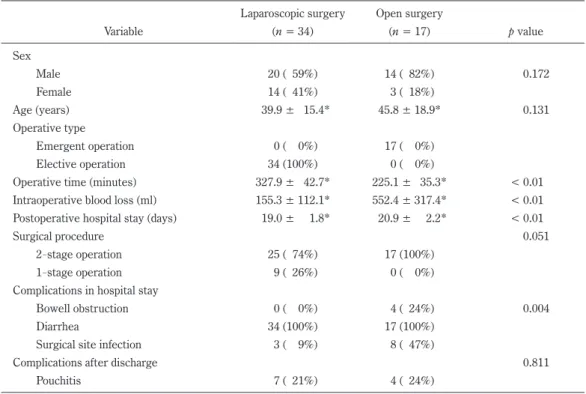
tients were successfully treated with laparoscopic surgery without conversion to open surgery (Table 1).
Indication for laparoscopic surgery
Laparoscopic surgery was performed in patients who had given written informed consent. Laparoscopic sur
gery was not performed if the patient required emergency operations, had a history of serious surgical or nonsurgical comorbidity, or had a body mass index of 30 kg/m2 or more.
Statistical Analysis
All data were analyzed with the software package IBM
SPSS Statistics, version 22.0 (IBM Japan Ltd., Tokyo, Ja
pan). Statistical significance was determined with the MannWhitney’s Utest and the Chisquare test. A pval
ue of less than 0.05 was considered to indicate significance.
results Number of operations
The number of operations performed per year from 2000 through 2012 ranged from 2 to 7, but the number of operations was not related with time (Fig. 1). After being introduced in 2002, laparoscopic surgery for UC has been performed for 34 (67%) of the 51 patients, including 2 pa
tients with singleincisional procedures.
Surgical outcome
The mean duration of surgery was significantly longer for laparoscopic surgery than for open surgery (Table 1). On the other hand, the mean intraoperative blood loss was significantly less and the mean hospital stay after sur
gery was significantly shorter with laparoscopic surgery than with open surgery. The number of postoperative complications was significantly greater with open sur
Table 1. Patient characteristics
Laparoscopic surgery Open surgery
Variable (n = 34) (n = 17) p value
Sex
Male 20 ( 59%) 14 ( 82%) 0.172
Female 14 ( 41%) 3 ( 18%)
Age (years) 39.9 ± 15.4* 45.8 ± 18.9* 0.131
Operative type
Emergent operation 0 ( 0%) 17 ( 0%)
Elective operation 34 (100%) 0 ( 0%)
Operative time (minutes) 327.9 ± 42.7* 225.1 ± 35.3* < 0.01
Intraoperative blood loss (ml) 155.3 ± 112.1* 552.4 ± 317.4* < 0.01 Postoperative hospital stay (days) 19.0 ± 1.8* 20.9 ± 2.2* < 0.01
Surgical procedure 0.051
2stage operation 25 ( 74%) 17 (100%)
1stage operation 9 ( 26%) 0 ( 0%)
Complications in hospital stay
Bowell obstruction 0 ( 0%) 4 ( 24%) 0.004
Diarrhea 34 (100%) 17 (100%)
Surgical site infection 3 ( 9%) 8 ( 47%)
Complications after discharge 0.811
Pouchitis 7 ( 21%) 4 ( 24%)
*mean ± SD
gery. In particular, the rate of surgical site infection was markedly higher with open surgery than with laparoscopic surgery. Eight of 11 patients with pouchitis after surgery (73%) underwent pouch excision with permanent ileostomy for severe pouchitis.
Comparison between 1 and 2stage operations in all patients No significant difference was found between the 1stage and 2stage operation groups in the mean duration
of surgery, the mean intraoperative blood loss, or the mean hospital stay after surgery (Table 2).
dIscussIon
Despite new therapies, including immunosuppressants and antibodies against tumor necrosis factor alpha, being developed, many patients with UC still require sur
gery. Restorative proctocolectomy with IPAA was first de
Fig. 1. Yearly number of open and laparoscopic operations for ulcerative colitis from 2000 through 2012 at our institution.
Table 2. Comparison between 1stage and 2stage operation in all patients 1stage operation 2stage operation
Variable (n = 9) (n = 42) p value
Sex
0.156
Male 3 ( 33%) 31 ( 74%)
Female 6 ( 67%) 11 ( 26%)
Age (years) 41.8 ± 10.0* 39.2 ± 17.0* 0.526
Operative time (minutes) 312.2 ± 26.1* 333.6 ± 46.5* 0.300
Intraoperative blood loss (ml) 111.1 ± 93.3* 171.2 ± 115.7* 0.159 Postoperative hospital stay (days) 18.1 ± 0.8* 19.3 ± 2.0* 0.185
Complications in the hospital stay 0.528
Bowell obstruction 0 ( 0%) 4 ( 10%)
Diarrhea 9 (100%) 42 (100%)
Surgical site infection 1 ( 11%) 10 ( 24%)
Mortality 0 ( 0%) 0 ( 0%)
Complications after the discharge 0.958
Pouchitis 2 ( 22%) 9 ( 21%)
*mean ± SD
scribed in 19789 and has since become the standard treat
ment of choice for most patients who require surgery.
Although laparoscopic surgery was applied for IPAA by many surgeons to treat UC, this technique was often nega
tive in the 1990s because of its complexity1012. However, over the past decade, the dramatic improvements made in laparoscopic devices and the greater experiences with colorectal cancer surgery have allowed surgeons to apply laparoscopic surgery to IPAA. After laparoscopic surgery was introduced to IPAA for UC at our institution in 2002, the number of patients undergoing this procedure has steadily increased. Of all surgeries for UC in 13 years, 67% were by laparoscopic surgery, including 2 in patients with singleincisional procedure. Laparoscopic surgery is of 2 major types : handassisted laparoscopic surgery and laparoscopyassisted surgery13. We perform only laparos
copyassisted surgery because its surgical techniques are similar to those of laparoscopic colorectal cancer surgery.
Between 1 and 2stage operations in laparoscopic sur
gery, we found no significant difference in the mean postop
erative hospital stay. Anal function and reservoir function may require approximately 2 weeks to recover to suitable levels after surgery, whereas dehydration due to diarrhea after surgery made the hospital stay longer. With regard to oral intake after surgery, 2stage operation may be more favorable than 1stage operation.
Severe postoperative pouchitis that necessitates pouch resection and permanent ileostomy has been reported to develop early in 58% and late in 52% of IPAA patients.
And performing resection rates have been reported in 3%
to 15% of all patients14,15. Pouchitis is characterized by higher rates of bowel movement, urgency, abdominal cramp, and discomfort. Although the exact cause of pouchitis is still unknown, the main contributing factors appear to be a history of UC and increased bacterial concentration by in
complete evacuation from the pouch1618.
In conclusion, our 13year experience with surgery for UC suggests that total proctocolectomy with IPAA by both open and laparoscopic approaches is feasible and acceptable if pouchitis does not develop after surgery.
Authors have no conflicts of interest.
references
1. Jacobs M, Verdeja JC, Goldstein HS. Minimally invasive co
lon resection (laparoscopic colectomy). Surg Laparosco En
dosc. 1991 ; 1 : 14450.
2. Peters WR. Laparoscopic total proctocolectomy with cre
ation of ileostomy for ulcerative colitis : report of two cas
es. J Laparoendosc Surg. 1992 ; 2 : 1758.
3. Kawahara H, Hirai K, Watanabe K, Kashiwagi H, Yamazaki Y, Yanaga K. New approach for laparoscopic surgery of the right colon. Dig Surg. 2005 ; 22 : 502.
4. Kawahara H, Yanagisawa S, Kashiwagi H, Hirai K, Yamazaki Y, Yanaga K. Implementation of Clinical pathway for laparo
scopic colorectal surgery. Int Surg. 2005 ; 90 : 1447.
5. Kawahara H, Watanabe K, Ushigome T, Noaki R, Kobayashi S, Yanaga K. Umbilical incision laparoscopic surgery with one assist port for anterior resection. Dig Surg. 2010 ; 27 : 364 6.
6. Kawahara H, Watanabe K, Ushigome T, Noaki R, Kobayashi S, Yanaga K. Laparoscopyassisted lateral pelvic lymph node dissection for advanced rectal cancer. Hepatogastroenterolo
gy. 2010 ; 57 : 11368.
7. Kawahara H, Watanabe K, Ushigome T, Yanagisawa S, Ka
bayashi S, Yanaga K. Lateral pelvic lymph node dissection using laterovesical approach with aspiration procedure for advanced lower rectal cancer. Hepatogastroenterology.
2012 ; 59 : 1169.
8. Kawahara H, Watanabe K, Tomoda M, Enomoto H, Akiba T, Yanaga K. Singleincision clipless laparoscopic total colecto
my. Hepatogastroenterology. 2014 ; 61 : 4535.
9. Parks AG, Nicholls RJ. Proctocolectomy without ileostomy for ulcerative colitis. Br Med J. 1978 ; 2 : 858.
10. Wexner SD, Johansen OB, Nogueras JJ, Jagelman DG. Lapa
roscopic total abdominal colectomy : a prospective trial. Dis Colon Rectum. 1992 ; 35 : 6515.
11. Schmitt SL, Cohen SM, Wexner SD, Noguras JJ, Jagelman DG. Dose laparoscopicassisted ileal pouch anal anastomosis reduce the length of hospitalization? Int J Colorectal Dis.
1994 ; 9 : 1347.
12. Sardinha TC, Wexner SD. Laparoscopy for inflammatory bowel disease : pros and cons. World J Surg. 1998 ; 22 : 3704.
13. Stocchi K. Laparoscopic surgery for ulcerative colitis. Clin Colon Rectal Surg. 2010 ; 23 : 24858.
14. Belliveau P, Trudel J, Vasilevsky CA, Stein B, Gordon PH. Il
eoanal anastomosis with reservoirs : complications and long term results. Can J Surg. 1999 ; 42 : 34552.
15. Fazio VW, Kiran RP, Remzi FH, Coffey JC, Heneghan HM, Ki
rat HT, et al. Ileal pouch anal anastomosis : analysis of out
come and quality of life in 3707 patients. Ann Surg. 2013 ; 257 : 67985.
16. Sanborn WJ. Pouchitis following ileal pouchanal anastomo
sis : definition, pathogenesis, and treatment. Gastroenterol
ogy. 1994 ; 107 : 185660.
17. Keighley MRB. Review article : the management of pouchi
tis. Aliment Pharmacol Ther. 1996 ; 10 : 44957.
18. Nicholls RJ, Banerjee AK. Pouchitis : risk factors, etiology,
and treatment. World J Surg. 1998 ; 22 : 34751.