A Study of Family Day Care Providers : An investigation of requirements for Family Day Care Providers in tokyo's 23 municipalities
著者名(英) Chiaki Sato
journal or
publication title
Bulletin of the faculty of home economics Kyoritsu Women's University
volume 63
page range 113‑119
year 2017‑01
URL http://id.nii.ac.jp/1087/00003122/
Creative Commons : 表示 ‑ 非営利 ‑ 改変禁止 http://creativecommons.org/licenses/by‑nc‑nd/3.0/deed.ja
共立女子大学家政学部紀要 第 63け (2017)
家庭的保育者に関する一考察
—東京 23 区の家庭的保育者の資格要件の調査から—
A Study of Family Day Care Providers
‑An investigation of requirements for Family Day Care Providers in tokyo's 23 municipalities‑
佐藤千晶
Chiaki SATO邦文要約
家庭的保育事業の法定化によって家庭的保 育者の要件が緩和された一方で、認可保育園の 代わりとして事業を長時間利用する需要が増え た。特に事業の実施率が高い東京都特別区の多 くが事業を「待機児童の応急的措骰」に位置づ けており"、家庭的保育者の要件の再考が必要 である。本稿では、
2012年に実施した東京
23区の家庭的保育者の資格要件に関する調査の結 果から、各区の資格要件の実態を明らかにし、
課題について考察した。結果から、資格を有す ることを家庭的保育者の必須条件にしている区 は事業実施区全体の
52%であり、残りの
48%は資格がなくとも保育勤務経験や育児経験があ ればよいという選択肢を設けていた。資格を保 育士に限定している区は僅か
5%であり、その 他の区は調査当時の「家庭福祉員制度」に基づ き幼稚園その他の教諭免許、看談師、保健師等 のいずれでもよいと定めていた。当該事業の今
8的目的と密室性や孤立性の観点から、資格要 件の見寵しの必要性について論じた。
INTRODUCTION
According to the Ministry of Health, Labour and Welfare, as of April 2015, the number of wait‑listed children in Japan was 23,167. Looking at the numbers by prefecture, the number of wait‑listed children was highest in Tokyo. According to its own research, Tokyo stated in 2016 that the number of wait‑listed children was at 8,466
—
an increase of 652 children fromthe previous year. Looking at Tokyo by munici‑ pality, the areas with the most wait‑listed chil‑ dren in descending order were Setagaya (1,198), Edogawa (397), and ltabashi (376); the areas with the greatest increases in number of wait‑ listed children from the previous year were Chuo (114), Arakawa (116), and Koto (110). Oyama and others (2008) already revealed that the problem of wait‑listed children was espe‑ cially concentrated in Tokyo's 23 municipalities
生
The intended purpose of "Family Day Care Services・111 was to protect and nurture local chil‑ dren in a household‑like environment as a small‑ scale childcare open to varying age groups, and the function of a professional, authorized day care center that was inherently secure and reliable for two‑income households requiring a lengthy period of childcare was a foreign
ー
1 1 3
ー共立女子大学家政学部紀要 第63
サ
(2017)concept. However, the problem of wait‑listed children in Japan is an especially important and pressing issue in Tokyo, and for the''The Comprehensive Support System for Children and Child‑rearing" started in 2015 reducing the number of wait‑listed children has become a main pillar. Under The Comprehensive Support System for Children and Child‑rearing, family day care services are positioned as a measure to help meet the childcare needs of wait‑listed children. Iwata and others (2011) said that in over 70% of municipalities providing the services have positioned it as "emergency measures for wait‑listed children" n. They also pointed out that there has been family day care provid‑ ers who are kindergarten teachers (or other school teachers) or only experienced personal childrearing in Tokyo, under Tokyo's original family day care system "Katei Hukushiin" 3>.
However, each municipality's requirement of family day care providers has not been revealed. Moreover, there is no material for study into requirement of family day care providers in Tokyo in other previous research and the admin‑ istrative documents. It is absolutely necessary to examine the quality of providers from the perspective of ensuring the long term childcare.
Thereupon, the purpose of this report is to examine and grasp the actual circumstances of requirements for family day care providers in Tokyo's 23 municipalities, and contribute for the improvement of Japanese family day care services.
EXAMINATION METHOD
The method of this study is actual condition survey of requirements for family day care pro‑ viders in 23 municipalities in Tokyo. Period for investigation is from July to November in 2012.
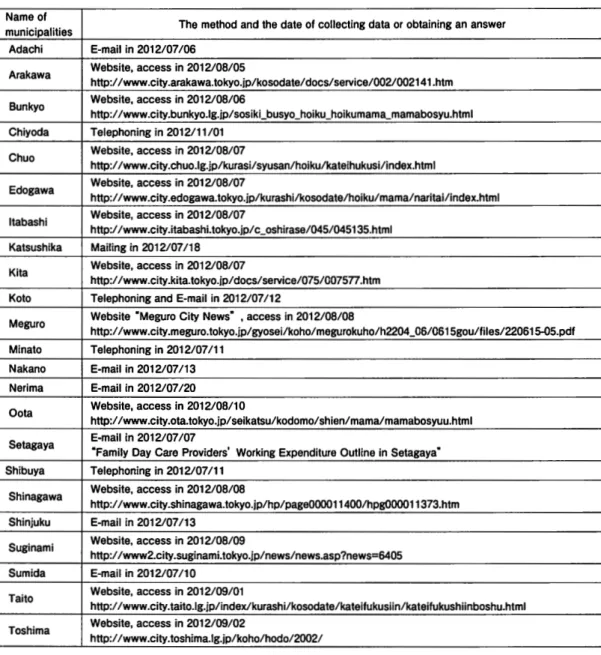
First, accessing all 23 municipalities'Website to examine whether the requirements of family day care providers are shown on the Website or not Second, making a hearing survey to munici‑ palities which did not show the requirements of family day care providers on their Websites. The answers were obtained by e‑mail, telephoning, and mailing. Its methods are shown in Table 1. The 12 municipalities were writing the require‑ ments for family day care providers clearly on their Websites. 7 municipalities answered by e‑mail, 4 municipalities answered by telephon‑ ing, and 1 municipality answered by mailing.
RESULTS
Basis of Providers of Family Day Care Services
At the extraordinary session of the Diet in December of 2008, part of the Child Welfare Act was amended, and "Family Day Care Services"
was entered into law, going into effect in April 2010. As a result, family day care providers are not limited to childcare license holders, and through parenting experience or receiving train‑ ing, local governments are able to recognize oth‑ ers as family day care providers and authorize them to engage in childcare.
Sugiyama and Tamura (2009) discuss that with the apparent lack of day care centers the Ministry of Health, Labour and Welfare, as a measure to deal with the wait‑listed chil‑ dren issue, has focused on seeking to legal‑ ize and regulate family day care services that can be provided less expensivel炉.Introducing laws would be expected to have the effects of strengthening the position of family day care services in appealing to local governments, and expanding the business as a means for respond‑ ing to the wait‑listed children problem. This law
ー 114ー
家庭的保育者に関する一考察
Table 1: The method of collecting data or obtaining an answer Name of
The method and the date of collecting data or obtaining an answer municipalities
Adachi E‑mail in 2012/07/06 Arakawa Website, access in 2012/08/05
http://www.city.arakawa.tokyo.jp/kosodate/docs/service/OOV002141.htm Bunkyo Website, access in 2012/08/06
http://www.city.bunkyo.lg.jp/sosiki̲busyo̲hoiku̲hoikumama̲mamabosyu.html Chiyoda Telephoning in 2012/11/01
Chuo Website, access in 2012/08/07
http://www.city.chuo.lg.jp/kurasi/syusan/hoiku/kateihukusi/index.html Edogawa Website, access in 201 VOS/07
http://www.city.edogawa.tokyo.jp/kurashi/kosodate/hoiku/mama/naritai/index.html ltabashi Website, access in 2012/08/07
http://www.city.itabashi.tokyo.jp/c̲oshirase/045/045135.html Katsushlka Mailing in 2012/07/18
Kita Website, access in 2012/08/07
http://www.city.kita.tokyo.jp/docs/service/075/0075n.htm Koto Telephoning and E‑mail in 2012/07/12
Meguro Website麟MeguroCity News・, access in 2012/08/08
http:/ /www.city.meguro.tokyo.jp/gyosei/koho/megurokuho/h2204̲06/0615gou/files/220615‑05.pdf Minato Telephoning in 2012/07/11
Nakano E‑mail in 2012/07/13 Nerima E‑mail in 2012/07/20 Oota Website, access in 2012/08/10
http://www.city.ota.tokyo.jp/seikatsu/kodomo/shien/mama/mamabosyuu.html Setagaya E‑mail in 2012/07/07
・Family Day Care Providers'Working Expenditure Outline in Setagaya"
Shibuya Telephoning in 2012/07/11 Shinagawa Website, access in 2012/08/08
http://www.city.shinagawa.tokyo.jp/hp/page000011400/hpg000011373.htm Shinjuku E‑mail in 2012/07/13
Suginami Website, access in 2012/08/09
http://www2.city.suginami.tokyo.jp/news/news.asp?news=6405 Sumida E‑mail in 2012/07/10
Taito Website, access in 2012/09/01
http://www.city.taito.lg.jp/index/kurashi/kosodate/kateifukusiin/kateifukushiinboshu.html Toshima Website, access in 2012/09/02
http://www.city.toshima.lg.jp/koho/hodo/2002/
reform would take the contents of this municipal industry that was traditionally unregulated and allow it to continue by and large as a national industry with eased requirements for care pro‑
viders that are nursery teachers or nurses. In this regard, in the 2009 White Paper on Child Care concern was shown that "as the spread of
family day care services is given priority one cannot help but feel a deep indignation and sense of danger with regards to the neglect of expertise in the field of childcare" 5>.
Although they are not enforceable, along with the addition of these laws by the Ministry of Health, Labour and Welfare in 2009, "Family
ー 115 —