Trop. Med., 36 (4), 187‑201, December, 1994 187
Dengue Haemorrhagic Fever in the South of Vietnam during 1975‑1992 and Its Control Strategy
DO Quang Ha1, VU Thi Que Huong1, HUYNH Thi Kim Loan1, DINH Quoc Thong1, Vincent DEUBEL2
1Pasteur Institute, 167 Pasteur Street, District 3, Ho Chi Minh City, Vietnam 2Pasteur Institute, 25 rue du Dr Roux, 75724 Paris, France
Abstract: The incidence of dengue (DEN) virus infection in Vietnam has increased dramatically in the past 30 years. From 1960 up to now, the number of dengue haemor‑
rhagic fever (DHF) cases has been continuing to increase and recorded as the greatest one in Southeast Asia and the Western Pacific Regions.
DHF was endemic in South Vietnam and 30‑380 cases/100,000 population were reported annually. Major epidemics have occurred in a 3‑4 years frequency, as in 1975, 1978‑1979, 1983 and 1987. The 1987 outbreak was the largest one with 83,905 cases and 904 deaths. DHF epidemics usually took place from June to November every year. The peak transmission was recorded in July‑August and September, coinciding with the rainy season and the breeding period of Aedes aegypti. The majority of confirmed cases was children of 5‑6 year‑old‑group, in which there was no sex difference.
In the virological surveillance in Ho Chi Minh City and in some surrounding pro‑
vinces, several DEN virus strains were isolated from patients' blood as well as from the mosquitoes. In the 1987 DHF outbreak, DEN‑2 was the dominant sero‑type (90.5%). But from 1990 the epidemic sero‑type has changed, DEN‑1 was introduced and was continu‑
ing to grow‑up (58%). Then in 1992 outbreak, the DEN‑2 was reintroduced, from 26.3%
in 1991 has increased to 41.4%. Serological investigation of healthy persons in 12/17 southern provinces had demonstrated that there were relatively wide circulations of DEN, Japanese encephalitis (JE) and chikungunya (Chik) viruses and the endemic strains of DEN were found different in some studied areas. There had been augmentation of primary infec‑
tion rate and decrease of the susceptibility rate in children prior to the DHF epidemic.
Seven JE virus strains were isolated from dengue fever (DF) patients' blood. This fact has introduced as a new concept in the isolation of JE virus.
In the final pant of the report, the authors stressed on the "Active surveillance" as a new strategy for controlling the DHF epidemic in South Vietnam. The goal of this active surveillance is to have early warning and predictive capability for epidemic dengue, based on serological and clinical surveillance. Because dengue cases were detected in January‑February of every year, so the base line is: when first cases of DF/DHF were detected, it needs to be promptly implemented the larval control and insecticide must be sprayed around the patient's houses. But now almost Provincial Centers of Hygiene and Epidemiology often waited and when big DHF epidemic had already occurred, they started to implement its control measures, so it is too late to control the DHF outbreak.
Key words: Dengue haemorrhagic fever, Vietnam.
INTRODUCTION
DHF and dengue shock syndrome (DSS) have now become a major public health pro‑
blem in Vietnam. From 1960 up to now DHF epidemics tend to spread widely with con‑
tinuous increase in number of patients and deaths (Do et al, 1989). In Hanoi Vietnam, a small and limited DF was first described in 1958, then in 1969 the first outbreak of DHF oc‑
curred in 19/25 provinces in the North (Doan et al, 1970; 1971). In South Vietnam, the disease first appeared sporadically in 1960 with about 60 children died. Thereafter in 1963, an outbreak occurred at Cai Be, Chau Doc, Hong Ngu, Tan Chau and Cao Lanh with 331 children were hospitalized, 116 of them died (Nguyen et al, 1971).
According to the statistics of the WHO (Umenai and Suzuki, 1990) from 1963 to 1988 the DHF patients and fatal cases in Vietnam were 1,111,734/10,415. This was the greatest patient number in comparison with other countries in Southeast Asia and the Western Pacific Regions. From 1963 to 1992 in South Vietnam there were 518,332 patients with 8,958 deaths and the number of DHF patients ranked only after diarrhea! diseases (Do et al, 1990; 1991).
MATERIALS AND METHODS
Epidemiological, entomological and clinical data
The epidemiological and entomological data were provided by Pasteur Institute Ho Chi Minh City. The clinical records were collected from the Center of Tropical Diseases, the Pediatric Hospitals No 1 and No 2 in Ho Chi Minh City.
Sp ecim e皿S
Blood samples were collected by venipuncture from children within 1 ‑4 days after the onset of illness. The blood was taken aseptically, agitated in bottle with glass beads, then centrifuged, the serum was withdrawn for viral isolation. Mosquito specimens, after identifica‑
tion, were kept for blood digestion, triturated with PBS pH 7.8, containing 0.4% bovine albumin, then centrifuged. The mid whitish liquid portion was pipetted out, filtered through Sartorius GmbH‑3.400 membrane (Gottingen, Germany) then used for viral isolation.
Viral isolation
From 1978 to 1986, blood samples were processed in suckling mice. From 1982, in Tox‑
orhynchites splendens (Rosen and Gubler, 1974) and from 1987 up to now, the C6/36 and TRA‑284SF (Igarashi, 1978; Kuno et at., 1985) cell cultures were used for virus isolation.
For identification of the isolates, the neutralization test in suckling mice was used. Then from 1987 the direct immunofluorescent antibody test (DFA) and the indirect immunofluores‑
cent antibody test (IFA) with specific monoclonal antibodies (MnAb) (Henchal et at., 1985) have been performed.
189
Serological studies
Serum samples for diagnosis were obtained by venipuncture from DHF/DSS patients in the Government Hospitals and Provincial Centers of Hygiene and Epidemiology. The first serum was taken on the day of admission and the second serum, on 3‑5 days later. Blood samples for serological survey were collected in 12/17 provinces. Blood was taken from the finger tip through a lancet puncture, then collected into capillary tube. All specimens were obtained at random in different age groups. Serum specimens are tested by the micro naemagglutmation‑inhibition (HI) test (Clarke and Casals, 1958) using DEN, JE and Chik an‑
tigens. The lgM capture ELISA (MAC ELISA) (Kuno et al, 1987) has been used since 1987.
Results were interpreted according to the standard outlined of the WHO meeting on DHF 1980 (Technical Advisory Committee on DHF, 1980).
Virus strains
Following virus strains were used: DEN‑1 (ATCC. VR. 71), Hawaiian, Mochizuki;
DEN‑2 (New Guinea C. VR. 222); DEN‑3 (H87. VR. 216); DEN‑4 (ATCC. VR. 217 H241); Chik (IPDA/CS 13); JE (Nakayama).
The biological products
The hyper‑immune mouse ascitic fluids (HIMAF) of 4 DEN types were produced at Yale Arbovirus Research Unit (WHO International Reference Center) and the National In‑
stitute of Allergy and Infectious Diseases Bethesda Maryland USA. The MnAb DEN‑1 Hawaii 15F3‑1‑15 and D2‑1Fl‑3, DEN‑2 New Guinea C 3H5‑1‑21, DEN‑3 H 87 5D4‑ll‑24 and DEN‑4 H 241 1HIO‑6‑7 were produced at CDC Atlanta Georgia USA.
The peroxidase conjugated anti一触vivirus human lgG was produced at CDC Atlanta Georgia USA. The anti‑flavivirus human lgG‑FITC conjugate was produced at CDC Puerto Rico USA and in Pasteur Institute Ho Chi Minh City. The anti‑mouse lgG‑FITC conjugates were produced by Sigma Chem. Co. St. Louis, MO USA and Pasteur Paris Production. The antトhuman lgM (〟‑chain specific) goat lgG was produced by Cappel Laboratories Pa USA. The hyperimmune sera of JE and Chik were produced in our laboratory, using white mice weighed 18‑20 g with viral strains mentioned above.
RESULTS AND DISCUSSION
The epidemiological data
The number of DHF patients and deaths by years were summarized in Tables 1 and 2.
In the first decade (Nguyen et al, 1971) DHF epidemics have occurred only in crowded pop山ation, then year by year the outbreaks trend to develop more largely. From 1975, the DHF outbreaks trend to overwhelm in 16 provinces except the mountainous region. During 1975‑1981 (Do et al, 1983) in every year Ho Chi Minh City had the highest number of pa‑
tients, but from 1982 this situation was transferred to 10 other provinces such as Tay Ninh, Song Be, Lam Dong, Dong Nai, Vung Tau, Long An, Tien Giang, Ben Tre, Kien Giang and
Minh Hai. Since 1963, large DHF epidemics have occurred every 3 to 4 years with a consis‑
tent increase in both prevalence of cases and deaths (Do et al, 1992). In 1988 the first large DHF outbreak occurred at Bao Loc‑Lam Dong which is a mountainous region and since then the DEN activities have occurred in all provinces in South Vietnam (Do et al, 1990).
Large DHF epidemics in South Vietnam in 1975, 1979, 1983, 1987 occurred at the same
time with big epidemics in the whole countryのo et al, 1992).
Table 1. Number of DHF patients and deaths by years Occurrence of DHF/DSS in South Vietnam by year
Year Reported cases (deaths) Year Reported cases (deaths)
CO ‑* LO CO l^ (XUco co co to co coO^ O"i O^ O"i CTi O^
l l l l 1 1
) ) ) ) ) ) (
」
>
c
^ 5 t
>
‑ i
‑ i
‑ . O 5
^ H t
>
‑ C O C 3
^
^ H 1 1 l ( ( ( ( ( ( O O O l
>
‑ C
>
J C O t O C O O O C M c o t o
‑ i u n l
CM CO ‑*
t
」
>
t
>
‑ t
 ̄
‑ t
‑ t
>
‑
CTi O"i O^ O"i O^ O^
1 1 1 1 1 1
) ) ) ) ) )
^
F
b
‑
t
>
‑
O
C
O
‑
^
f
^F 00 CM (8 0
2 2 4
( ( ( ( ( (
O l>
‑‑
*1 C O (X U 0
(古 LO t^. CO C」5 COto c^a i‑i co co CTS
ー 4 3
From 1963 to 1971 o山y仙e in‑patients were recorded.
Table 2. Reported DHF/DSS cases and dea血s m Sou血vietnam du血g 1975‑1992
M orbidity Mortality C a R
e a r
Y
No. Rate/105 No. Rate/1 05 % 1975 19, 416
1976 6, 151 1977 8, 362 1978 17, 055 1979 21, 285 1980 11, 997 1981 5, 933 1982 11, 281 1983 77, 087 1984 14, 562 1985 19, 927 1986 15, 647 1987 83, 905 1988 49, 237 1989 18, 923 1990 41, 517 1991 39, 917 1992 42, 330
‑^ CM oo t^‑ oo co co cn oo o ‑rF oo t‑ ‑^ CTi t‑ ^o
‑ r f ォ
」
>
C O C O
*
t o a s サ
o o o
‑
i c o o o ( H ) 3 6
c‑q un i>. ^ LO co o to o o ‑*f (Ni oc) t‑‑ OO Tf OO ‑^
C O
*
* O i c o c サ o L o o o i
>
‑ C T
>
[
^ t
>
‑
‑
‑ i c 古 7 6 7 T
‑ I T
‑ H C O C O C V J T
‑ I T
‑ I T
‑ I
t
‑ O O t
^
‑
^ F c n O C O L O C O C T
>
C O
‑
* C
‑
‑ O O ( 捕 ) 4 3
a} Ln ^f oo c」> o t‑ Lo o oo o ‑'* o oo t‑ a5 ‑<*' t>‑CO LD ‑* ‑3< ‑* LO CO CSJ CM CM OJ LO r‑I C^J CSI
l CTJ CO CO I^‑ CO ‑^ CTI OO Ca oO OO CM t‑ OO OO LO CO ^‑iCM CM LO CO LO CO OO t^ ‑rF CO Oi T‑1 O LO t‑‑ CVI O t>‑
(
N
I
C
O
O
J
C
S
I
C
^
I
C
^
O
O
t
」
>
<
*
"
(
M
O
‑ 5 t c o .
‑ r t i c o o o ォ o o o t
‑ o o c o
‑
^
<
L O C
‑ a 5
^ f '
‑ i O 0 3 (
‖ む C M 0 0 t
」
>
C T ) O L O O O 2 t
 ̄
‑ C O
‑
*
o o o o
IGJI
The seasonal fluctuation in DEN activities in South Vietnam
From 1975 to 1992, the number of DHF patients was recorded all year round but the transmission increased substantially from June to November with peak transmission in July‑August or September which was closely related with rainy season‑a breeding period of mosquito vector (Do et al, 1992). It is noted that a lot of DHF patients were recorded in every first trimester. From 1975 to 1982 (Do et al, 1983), depending on each year an approx‑
imate number of 400 to 2,000 patients was recorded in January. During 1983‑1990 the mean morbidity and lethality was 1,048/10 in January, 716/10 in February, 575/7 in March and 780/14 in April (see Fig. 1). These patients with overt diseases represented only the tip of the DHF iceberg protruding above the water (Gubler, 1987).
9000 8000 7000 6000 No of 5000 patients 4000 3000 2000 1000 0
M M O Months
Fig. 1. Monthly distribution of the mean number of DHF patients and fatal cases in South Vietnam, 1983‑ 1990.
Age distribution
During 1978‑ 1992, based only on laboratory confirmed cases, the number of patients suffering from DHF essentially consisted of children under 9 years old. The age subject to highest morbidity was 5‑6 year‑old‑group, with fewer cases occu汀ing in adults (2.75% of
DHF patients, in 1990) (Do βt alリ1992). Contrary to the South, the DHF morbidity in adults
in the North of Vietnam was high (53.12% in the 1983 epidemic). This is a meaning血1 dif‑
ference between the 2 regions (Do et al, 1985).
Sex distribution of laboratory confirmed cases
ln 1979, 1983, 1987 large epidemics, the male: female mean ratio was 0.942/1, but in ll intercalary smaller epidemics (excepted 1988) the male: female mean ratio was 1.017/1.
The difference in sex attacked by DHF in 3 large outbreaks (1979, 1983, 1987) compared with the remaining ones had no statistic significance (*2‑1.99 with P>5%). Thus, in South Vietnam the sex was not a risk factor for DHF/DSS (Do et al, 1992).
Some climatic and entomological data
The mean temperature in Ho Chi Minh City during 1983‑1990 was 27.4℃ the dif‑
ference between the rainy and dry season did not exceed 3.3‑C. The relative mean humidity in 1983‑1990 was 77.88%; 70.5‑71.25% in dry seasons and 82.5‑85% in rainy seasons.
Therefore the temperature and humidity were favorable for the breeding of the mosquito population, which tended to speed up virus replication and shortened the extrinsic incubation period. The Aedes aegypti density, the Breteau index and the mean rainfall by month during 1983‑1990 in Ho Chi Minh City were previously reported. During 1983‑1990 the Aedes aegy少ti mean density was 1.02‑1.30 in dry season and 1.93‑2.43 in rainy season (Do et al.,
1992). To summarize, the climate and weather in South Vietnam allow continous breeding of mosquito population. Such factors are propitious for DEN transmission that end with DHF outbreak in every year (see Fig. 2).
8000 ‑令一‑ Temperature 7000 J‑ ‑sS‑ Rainfall
No of patients
6000 5000 4000 3000 2000
★ Ae.aegypti
‑‑× No of patients
左7
1000 日
0
M M
Months
Fig. 2. The correlation between DHF epidemics with temperature, rainfall and Aedes aegypti density, 1983 ‑ 1990.
Viral isolation
During 1978‑1985, several DEN viruses were isolated (Do et al, 1985) but the domi‑
nant sero‑type could not be identified because small number of isolates were detected and some of them were isolated in January‑February. From 1987 by using C6/36 and TRA‑284SF cells, the number of isolates has increased and the dominant sero‑type can be established. In the largest 1987 outbreak DEN‑2 was the dominant epidemic sero‑type, oc‑
cupying 90.5% of the isolates (Do βt alリ1989). In 1988‑1989, transmissions of this
sero‑type were documented. Then in 1990 the dominant epidemic sero‑type gradually changed: from May to September, DEN‑1 was introduced in Ho Chi Minh City, Long An, Vinh Long, Dong Nai with the concurrent circulation of DEN‑2, this type was transmitted simultaneously throughout Ho Chi Minh City, Dong Nai, Vmh Long, Ben Tre and Dong
Thap. In the queue of this epidemic, DEN‑4 was detected in Cai Lay‑Tien Giang (Do βt
193
alリ1990; 1991). To summarize, the percentage of isolates was DEN‑1: 58.0%, DEN‑2:
32.2% and DEN‑4: 9.6% (Do et al, 1993). In 1991 the ratio of the sero‑type was DEN‑1:
47.3%, DEN‑2: 26.3%. Then in 1992 DEN‑2 has been reintroduced with the ratio:
DEN‑1: 58.6%, DEN‑2: 41.3%. Of interest is that if DEN‑2 became the dominant epidemic sero‑type in 1993 or 1994, a large DHF epidemic will possibly occur. Of more in‑
terest, was the fact that in 1992 one strain of DEN‑1 (1Fl) was isolated from a 12 years old patient diagnosed as "Encephalitis Syndrome '.
Apart from the DEN viruses recovered, 7 JE viruses were isolated from patients blood: of whom, 6 were children of 4‑ll year‑old group, one was a patient of 40 years old.
All of them were diagnosed as DF. These results are quite interesting as compared with previous knowledge, because the isolation of JE virus from patient s blood has still been so far universally recognized as very rare in the medical literature.
Relationships among DEN‑2 isolates in sequence comparative studies and the DEN‑ 1 sero‑type specific determinants identified by monoclonal antibodies
Structural and non‑structural viral antigens of DEN viruses: 29/44 strains of DEN‑ 1 (1990: ll strains; 1991: 4 strains; 1992: 14 strains) isolated in 1990‑1992 had the same iden‑
tification process as the DEN‑ 1 strain isolated from an American after a travel in Colombia (Gubler, 1986). These strains were very difficult to identify by IFA using MnAb DEN‑1 (15F3), only some cells with dull fluorescence were detected if compared with its DFA. It is possible that there was a higher ratio of virion to nonvirion antigen in the cell cultures, because the 15F3 was directed against non ‑structural viral antigen. Thereafter these strains were retested with the MnAb DEN‑1 (1Fl) and all these strains were identified as DEN‑1 with clear fluorescent brilliance seen in all infected cells. Moreover in 1992 we also isolated:
One strain of BEN‑1 (1Fl) which crossed in IFA with MnAb DEN‑1 (15F3).
One strain of DEN‑1 (15F3) which crossed in lFA with MnAb DEN‑3 and DEN‑4.
The conclusion is unclear, maybe this is a concurrent infection with 2 or 3 DEN viruses.
Genetic differences between strains of DEN‑2 from different geographic regions: A dendrogram was constructed by calculating the similarity score obtained by sequence pair comparison. A close relationship has demonstrated between the 4 strains of DEN‑2/Viet‑
nam/87 with the Caribbean topotype (Jamaica 1983) isolates (Deubel βt alリ1993). Two other
strains of DEN‑2/Vietnam/87 were also sent to R. Rico‑Hesse (Rico Hesse, 1990) and the results of above two studies were similar. There was a relatively close identity of these strains circulating in two regions which were very far from each other. R. Rico‑Hesse has hypothesized that the DEN‑2 endemic in the Caribbean basin countries has been possibly in‑
troduced into America by Cuban workers who were back home from Vietnam.
Clinical manifestations of children from whose blood viruses were recovered ln general, patients'clinic aspect of the large 1987 DEN‑2 epidemic (90.5%) was noted to be more severe than that of the 1990 outbreak (DEN‑1: 58.0%), but more cases of
hepatomegaly and abdominal pain were observed than those of the 1987 outbreak (Tran, 1991).
The serological data
The serological diagnosis was summarized in Table 3. From 1988 up to now the positive percentage of paired sera has been rather higher than those of the previous years, maybe the clinical diagnosis had much experience and by using the 2‑mercaptoethanol and 也e MAC ELISA to detect也e lgM antibody.
Table 3. Serologic response of paired sera by HI test using DEN‑1 antigen during 1978‑1992 Year No of sera %(‑) %(±) %(+)
7 ( 古 C M C O
‑
^ I O S O
!
>
O O
<
y
>
O i
‑ i O J
t‑ t‑ t‑ oo oo c古 (H) 00 00 00 00 00 00 01 05 02O"i O"5 O^ O^ O"i O^ O^ O^ CTi O^ O^ O^ CT5 O5 O^ O"i
l 1 1 1 1 l 1 1 1 l 1 1 1 1 1 1
811 2, 367 2, 062 550 661 854 838 137 105 24 146 139 37 270 345 43
L O C O C O L O C O C O
‑
* C M
‑
* C M
ー 2 ー OO tr‑ CT> LO O‑ t>‑ t>‑ LO O ) ‑* eg oo o>
O CO CO **t< ‑^ oo oi LO O Lo ai t‑ co
c o c o L O
<
N I
‑
^ o m ォ 3 I D O O i
‑ i C v ]
‑
i L O
‑
^ o o m t o i o t
^ c i J t o o o c M o o c o o o
1 l 1 4 ー ー ー ー ー l 1
L
o
t
o
C
T
>
C
T
5
C
T
5
<
>
a
c
r
i
C
‑
o
o
a
*
M
*
<
M
o
CTi Ln ce to c^ co oo o‑ LO ‑*1 co to ‑* c*j to(NJ ‑^ ‑^ CO CO ‑^ LO CO tD LO ‑^ t‑ OO t^ O‑ OO
The sero‑epidemiological study: The sero‑survey of DEN, JE and Chik has been con‑
ducted for the first time in Sou也Vietnam which are as follows (see map 1):
‑The cross‑sectional sero‑surveys in 1979 conducted in 4 localities: Ho Chi Minh Ci‑
ty, Vung Tau, My Tho and Mmh Hai were previously described (Do and Duong, 1982). Most of these 2,494 healthy persons had previously contracted DEN, JE and Chik viruses (63.6%, 72.3% and 48.5% respectively). Although regional viriations of the results were recorded but a general rule was postdated:也e positive rate and也e mean antibody titer increased pro‑
gressively with age in all of the 4 study areas. The other sero‑surveys conducted in 1981‑1989 were summarized in Table 4. From the above results, it was noted that: depen‑
ding on areas, the primary DEN infection rate in 14 localities oscillated between 6.4 to 23%.
The secondary infection increased by life time and most of the adults were immunized with DEN viruses. The human susceptibility varied upon localities but the highest rate was found in children groups.
195
‑Longitudinal sero‑surveys: see Table 5. Latent activities of DEN viruses were ex‑
pressed by the seroconversion by year in children. In 1986, serum samples were collected from children at creches and kindergartens at Ben Luc, Tan An, My Tho, Long Xuyen, Rach Gia. After 1 year, the second serum samples were taken from children in the same cohorts.
Following up the sero‑conversion in children from 1986 to the 1987 pre‑epidemic stage, it was noted that: the primary infection rate increased from 10 to 30% in the pre‑epidemic stage of the 1987 DHF outbreak, the susceptibility rate decreased from 80 to 40%. These results explained that the silent transmission of DEN virus had been occurring prior to the widespreadmg of DHF epidemic and仇ese remarks co血d be considered as血e risk factor for
Table 4. The human immune status by ages and years in some provinces.
Lo calities No of Primary infection sera DEN DEN DEN DEN
‑1 ‑2 ‑3 ‑4 %
infection
≧2×DEN
Second. suscep‑
tible
% 1981
D.10‑HCM city 445 39 34 18 20. 60 38.40 40. 80 5‑14y
1983
SDa‑DMC 165 Tay Ninh
Cay Gao‑V. An 164 Dong Nai
70. 30
50. 60
29. 70
49.40
1984
SDa‑DMC 214 82. 20 17. 80
1985
Long Xuyen 3 ー 山■ 4 4 16 9.84 69.52 20.63
1986 Vam Co My Tho Can Tho 1‑4y Rach Gia l‑4y
OO ‑^ ‑* OOO CO LO CT:
>‑ 1 CM i
‑I C
‑s l
9.57 82.97 7.44 12 11.11 44.87 44.01 6.40 7. 10 86.30 29 12.00 16.50 71.30 1987
Hiep Thuong DQ ‑ DNai
322
Tan Phu‑DNai lll 16 a
39. 40 60. 60
19.82 41.44 38.73 1988
Ca Mau 276 23 24 21. 01 55.43 23. 55
1989
Bao L∝ 502 24 21 16 54 22. 90 J. 72 7. 37 Ben Tre 232 39 19. 40 78. 45 2. 16
y: years old.
Table 5. Primary, secondary infection and the DEN endemic strains circulating in children of 1‑4 year‑old‑group at 4 localities during 1986‑1987
Localities雲:r:f号音l'雲ecoi ifeci
:2x雲onsusceptible DENo/
1986 B.Luc,T.An
My Tho Long Xuyen
Rach Gia
L O O O
‑
I O
<M CO ‑* CT)CO CO (NI CO CO CO LOl
O
C
O
t
>
‑
*
2 (H) OO IO O22
4 3 広 U 0
O O CO C<1
ー ー ー ー
CO CO COl
C O C O O O L O
CO OO LO tO2 ー ー
C
O
<
*
C
O
O5 1
‑I O >
‑I
t」> t‑ OO t>‑
1987 B.Luc,T.An
My Tho Long Xuyen
Rach Gia
l (8 ー 4
OO CO CM CO
CM CO C>J CM CVJ OO6 CSI CO (NI C」>C‑J i‑i CO ,‑< CO O5 CO OCO i‑I ,‑c to o LO ooO
i
‑I C O CT 5
co co oa CM
1 5 3
(M oo to c‑o
5 3 7 (XU2 3 2 i‑i O OS O5
"
*
L
O
O
O
t
‑
H
TP tO CO ‑^F
a community, a precursory sign to predict an epidemic.
‑The mapparent infection and the circulation of DEN endemic stains: As mentioned above, second serum samples were taken from children who had had negative results or monotypic responses, if the second serum become positive or having non‑monotypic response, all these children are considered to be infected inapparently by the DEN endemic strains.
‑Studies in Ho Chi Minh City, Vung Tau, My Tho in 1979 (Do et al, 1983).
'In Ho Chi Minh City, the result of examination of 96 paired sera has shown that the DEN‑2 was in circulation and the rate of JE inapparent infection was 7/96.
"At Vung Tau, among 49 observed children, recent DEN infection was not detected, but JE and Chik inapparent infections have occurred.
'At My Tho with 65 paired sera, the circulations of DEN‑3 and DEN‑4 viruses were demonstrated and JE inapparent infection rate was 5/65.
‑Inapparent infection and DEN endemic sero‑type at Long Xuyen, 1986: see Table 6. In 1986, at Long Xuyen there were 27/33 children (81.8%) who were still kept negative status as in 1985, 6/33 children have had sero‑conversions: 4 children contracted primary in‑
fections and 2 previously infected primarily have contracted secondary infect五ons.
‑The mapparent infection and the DEN endemic strains circulating at Long An, My Tho, Long Xuyen and Rach Gia, 1987: see Table 7. In 1986, 335 children without DEN an‑
tibodies and 37 with monotypic responses were studied. At the end of 1987 the sero‑conver‑
sion of their sera was still negative, the rate was from 42 to 73%; contracted primary infec‑
tion: from 25 to 34%; contracted secondary infection: from 1.3 to 27%. The endemic strains circulating were different depending on areas, such as DEN‑2 in Ben Luc, Long Xuyen, Rach Gia; DEN‑1 in Tan An and DEN‑3 in My Tho.
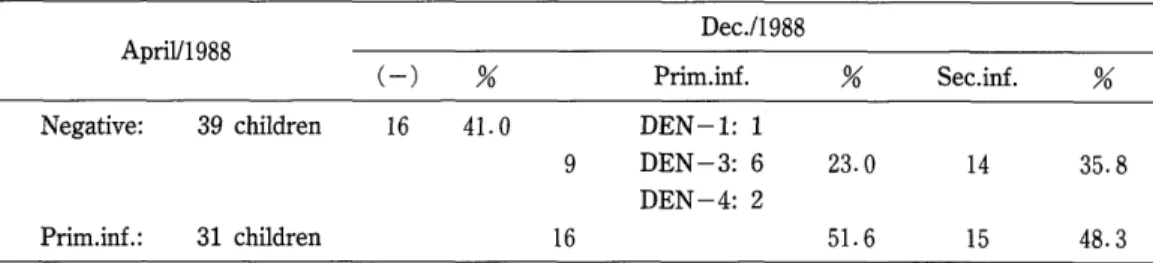
‑The inapparent infection and the DEN endemic strains circulating at Ca Mau ‑ Mmh Hai, 1988: see Table 8. Among 70 children without DEN antibodies or primarily in‑
197
fected, a氏er也e 1988 epidemic stage也eir results were changed as follows: negative become primarily infected: 9/70; negative become secondarily infected: 14/70; primarily infected become secondarily infected: 15/70. In general, there was 54.2% of children who have had sero ‑ conversion.
Table 6. The sero‑conversion in 33 children who had had negative results or monotypic responses at Long Xuyen, 1986
1986 1985
Prim.in£ Sec.in£ % Negative: 31 children 27 87. 1 4 DEN‑ 1 12. 9
Prim.mf. : 2 children
Table 7. The sero‑conversion in healthy children having first negative sera or primary infected in 1986 and whose second sera were retested in 1987
1987 Prim.in£
55 43. 7 DEN‑1:28
43 DEN‑2:12 DEN‑3: 3
6
Sec.in£ % Localities 1 986
Negative : 1 26 children
Ben Luc Tan An
Prim.inf.: 1 3 children
34.1 28 22.2
6/13 /13
My Tho
Negative: 76 56 73. 7 DEN‑1: 1 children
19 DEN‑2: 2 DEN‑3:16
Pnm.inf∴ 1 children
1
25.0 1.3
Negative: 63 28 44. 4 DEN‑1: 1 children
Pnm.inf∴ 1 2 children
Long Xuyen
18 DEN‑2:12 DEN‑3: 5
7
28.6 17 27.0
7/12 /12
Rach Gia
Negative: 70 30 42. 9 DEN‑1: 4 children
DEN‑2:10
21 DEN‑3: 5 30.0 19 27.1 DEN‑4: 2
Pnm.inf.: 1 1 children
5 5/11 /ll
Table 8. The second sera of 70 children who have had first negative results or primary infected were tested at the end of 1988
Dec./1 988 April/1 988
( ‑ ) % Prim.inf. % Sec.inf.
Negative: 39 children 16 41. 0 DEN‑1: 1
DEN‑3: 6 23.0 14 DEN‑4: 2
Prim.inf.: 31 children 16 51. 6 15 48. 3
A proposed strategy for the control of DHF in South Vietnam
The current option available for prevention and control of DHF epidemic is to eradicate the principal vector Aedes aegypti. Unfortunately the normal course that we have been applying up to now is to wait until epidemic occurs and thereafter implement control measures. This approach generally had little effect on the course of an epidemic because the DHF iceberg to this period is too big in the meaning of morbidity, lethality and inapparent cases. In the public health, the social and economic sectors impact of DHF was also a great disaster. Therefore m the whole DHF aspect, the old attitude must be changed and a new strategy designed to prevent actual epidemic transmission is a high priority. The basic pro‑
blem is that the prevention and control of DHF must be started immediately in the beginning of the silent transmission period prior to the epidemic stage by using the effective active surveillance which based on serological and clinical surveillance. These surveillances aim to provide early and precise information to the public health service for starting the active con‑
trol. If a DEN transmission can be detected early enough, an effective emergency mosquito control can be implemented immediately at that moment, and major DHF epidemic might be prevented (Gubler, 1987).
In South Vietnam the basic proofs for implementing the active DHF prevention and control are based on, in the first trimester of every year.
(1)‑DHF patients have been already detected.
(2)‑Inapparent and confirmed DHF cases have been serologically diagnosed.
(3)‑DEN viruses have been isolated in this period.
Only (1) and (2) are sufficient proofs to confirme that the DEN transmission has started. Therefore it must be the time of choice to implement the active DHF control pro‑
gramme with the objective to transfer the mosquito control programme from the Government to every person living in the community. It must be emphasized and addressed to the in‑
dividual responsibility of all persons and they must be made to understand that DHF exists only because they allow mosquitoes to breed in and around their home. Persons living in com‑
munities must be educated to accept responsibility for their own health destiny and for their own family too. For carrying out the mosquito eradication project successfully, the highest responsibility belong to the Authorities at all levels, who will direct and motivate all the peo‑
pie to participate in this programme.
In conclusion, in front of the constant increase of DEN prevalence in Vietnam, an
199
effective national line for DHF prevention and control should be achieved. We hope that an
active surveillance which combine with both emergency and long‑term community‑based vector control programme will be performed in a very near future.
CoNCLU SION
1) In South Vietnam, from 1963 to 1992, DHF has occurred every year. The DHF prevalence has increased annually and major epidemic occurring every 3 to 4 years. In the largest 1987 outbreak, the province which had a highest morbidity was Vung Tau:
1,614/100,000 population and the province with highest lethality was Minh Hai:
121100,000 population.
2) DHF cases were recorded all year round and epidemics have usually occurred from June to November with peak transmission in July‑August or September which have closely related with the rainy season‑the breeding period of mosquito vector.
3) DHF patients were mostly children, the most affected age was 5‑6 year‑old‑group and the sex was not a risk factor in DHF.
4) Numerous DEN viruses have been isolated from DHF patients'blood as well as from mosquitoes. The dominant sero‑type of the 1987 outbreak was DEN‑2. In 1990 the
DEN‑ 1 appeared and slowly increased, since 1992 DEN‑2 was reintroduced and slowly
grown ̄up.
5) Genomic structure of DEN‑2/Vietnam侶7 was somewhat different in comparison with many topotypes in the world.
6) From 1978 to 1982, six Chik virus strains were isolated from patients diagnosed as DHF.
7) Serological investigations of healthy persons in 12/17 southern provinces have demonstrated that there were relatively wide circulations of DEN, JE and Chik viruses.
The sero‑type of DEN endemic strains were found different in some studied areas.
8) The inapparent DEN infections have been detected in all studied areas.
9) There were augmentation of the primary infection rate and decrease of the susceptibility rate in children prior to the DHF epidemic.
10) Seven strains of JE virus were isolated from DF patients'blood and this is possibly the concu汀ent infection between the two epidemic processes.
AcKNOWLED GMENTS
We thank Dr. DJ. Gubler in CDC Colorado and Dr. J. L. Ladinsky in the University of Wisconsin ‑ Madison USA for the advices and for supplying us many biological products and cell cultures during this study.