アジア産キイチゴ属の分類学的ノート(4) 新雑種, ゴショクサイチゴ
著者 鳴橋 直弘, 八崎 宏美
著者別表示 Naruhashi Naohiro, Yazaki Hiromi
雑誌名 植物地理・分類研究
巻 56
号 2
ページ 113‑117
発行年 2008‑12‑30
URL http://doi.org/10.24517/00053400
Creative Commons : 表示 ‑ 非営利 ‑ 改変禁止 http://creativecommons.org/licenses/by‑nc‑nd/3.0/deed.ja
鳴橋直弘
1・八崎宏美
2:アジア産キイチゴ属の分類学的ノート(4)新雑種,ゴショクサ イチゴ
Naohiro Naruhashi
1and Hiromi Yazaki
2: Taxonomical notes on Asiatic Rubus(Rosaceae)
(4)Rubus×masakihisashii
Naruh., hybr. nov.
山口県山口市徳地町(旧佐波郡徳地町)には,ゴショイチゴ
Rubus chingii Hu
が数多く生育し,モミジイ チゴR . palmatus Thunb.との間にゴショモミジイチゴ R .
×calopalmatusNaruh. et Masaki
という雑種(Masaki and Naruhashi 1992)が,ビロードイチゴ
R . corchorifolius L. f.との間にビロードゴショイチゴ R .
×pseudochingiiNaruh. et Masaki
という雑種(Naruhashi et al. 1994)が存在する。今回取り上げた植 物は,1986年に真崎 久氏の案内で,徳地町白井谷で発見した植物で,その付近のキイチゴ属植物から,ゴ ショイチゴとクサイチゴR . hirsutus Thunb.
の雑種と考えられた。発見に繋がった案内者を記念して,その 植物をゴショクサイチゴR .
×masakihisashiiと名付けた。現地から生植物を採集し,富山大学で栽培,観察 するとともに,外部形態,花粉稔性,染色体を調査した結果,ここに新雑種として記載発表する。A.外部形態
花(花の付き方,花の直径,花弁の色と形,花弁の長さと幅,がく片の形,がく片の長さと幅,雄ずいと雌 ずいの形,雄ずいと雌ずいの数),果実(集合果の色,集合果の高さと直径),小核(小核の形と表面,小核の 大きさ),葉(葉の形),茎(茎の様子,茎の高さと太さ)の形質について調査した。
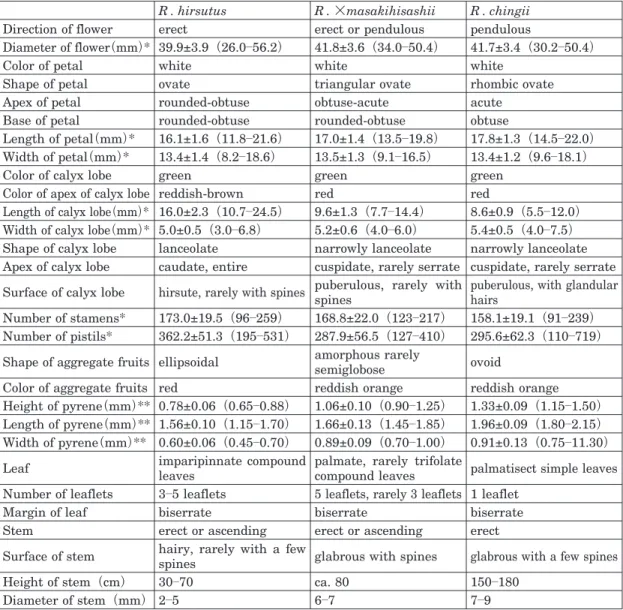
比較形態の結果は
Table 1
に示した。葉の形は,クサイチゴは羽状複葉,ゴショイチゴは掌状深裂単葉,ゴ ショクサイチゴは花の近くでは3
深裂単葉となるも,普通は掌状複葉か三出複葉である(Fig. 1)。花の直径 は,クサイチゴは約4 cm,ゴショイチゴは約 4.2 cm,ゴショクサイチゴは約 4.2 cm
であり,花のサイズで はほとんど差が無かった(Fig. 2)が,花弁には違いが見られた。クサイチゴは先端が円形の卵形でしわがな く,ゴショイチゴは先端が鋭形の菱形状卵形でしわがあり,ゴショクサイチゴは先端が鈍形の三角状卵形でし わがある(Figs. 2, 3)。クサイチゴとゴショイチゴは円錐状楕円体の集合果を作るが,ゴショクサイチゴの果 実は普通成熟しない。まれに,1花に1~5
個の小果実が熟すことがある。一見正常な集合果のように熟したの は,1992年から1994
年の3
年間で1
集合果のみであった。この集合果のサイズを両親と比べると,高さは クサイチゴが15.8±1.5 mm : Mean±S.D.(N=30)
,ゴショイチゴが19.5±0.5 mm(N=30)
,ゴショクサイチ ゴが13.2 mm(N=1)
,直径はクサイチゴが19.1±1.2 mm,ゴショイチゴが 21.3±0.9 mm,ゴショクサイチ
ゴが
15.1 mm
で,それぞれ両親よりも小さかった。このことはゴショクサイチゴの集合果が正常に成熟していないことによると思われる。果実の色は,クサイチゴは赤色,ゴショイチゴは赤橙色,ゴショクサイチゴは 赤橙色である。小核は
3
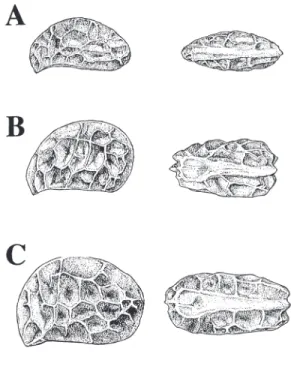
分群とも網目模様の隆起があり,良く似ているが,ゴショクサイチゴは隆起が強く,その点でゴショイチゴに類似し,サイズは両親の中間の大きさであった(Fig. 4)。
B.花粉稔性
3
分類群それぞれ10
花,各300
粒で調べたところ,クサイチゴでは正常な花粉は94.2±2.8% : Mean±S.D.
(1993年),ゴショイチゴでは
98.6±0.5%(1993
年),ゴショクサイチゴでは3.6±1.6%(1992
年);14.1±0.7%(1993年)であった。このことからゴショクサイチゴの花粉はほとんど稔性がないことが分かった。
C.染色体
ゴショクサイチゴは
2 n=14
であり,クサイチゴ(Jinno 1958 ; Iwatsubo and Naruhashi 1992)とゴショ イチゴ(Iwatsubo and Naruhashi 1992)と同じ2n=14
の2
倍体であった。本植物は,両親と推定されるクサイチゴとゴショイチゴの生育地で発見されたこと。ゴショクサイチゴは,
形態的にクサイチゴもしくはゴショイチゴと同じか,または中間的形質を多く所有すること。花期も同じであ ること。花粉の稔性が低いこと。果実は普通成熟しないこと。以上のことからこの植物の雑種の可能性は非常 に高いと考える。希にできる種子の発芽能力は未確認であるが,地下部の栄養繁殖によって増えている。
現地を案内下さった眞崎 久氏,染色体を観察下さった岩坪美兼氏,原稿を読んでコメントをいただいた杉 本 守氏,英文校閲をしていただいた
Madjit Hakki
氏にお礼申し上げる。Rubus
×masakihisashiiNaruh., hybr. nov.(Figs. 1 B, 2 B, 3 B, 4 B, 5 B-F)
Rubus hirsutus Thunb.
×R . chingii Hu
Haec hybrida Rubo hirsuto et Rubo chingio valde affinis est, sed ab ipsis foliis palmatis, ternatis vel pedatis facile distinguitur.
113
Japanese name : Gosho-kusa-ichigo, nov.
Erect shrubs, ca. 80 cm tall. Stems glabrous, prickly. Prickles straight, to 5 mm long. Leaves palmate, trifoliate compound, 3-parted simple at near flower ; leaflets
(1―)3―5, membranaceous, narrowly ovate to rhombic oblong, 3―7 cm long, 1―3 cm wide, apex acute, base obtuse, doubly toothed, appressed pubescent on nerves on both surfaces. Petiole slender appressed pubescent with minute prickles. Stipules acicular to lanceolate, pubescent on lower surface and on margin, to 8 mm long. Flowers solitary, erect or pendu- lous, ca. 4 cm across ; pedicels 1―5 cm long, pubescent with sparingly minute prickles. Calyx pelviform.
Sepals lanceolate to triangular oblong, caudate, ca. 10 mm long, short pubescent on both surfaces. Petals white, triangular ovate, obtuse to acute, claw at base, irregularly wringled, 13―20 mm long, 9―16 mm wide, horizontally patent, later recurved. Stamens numerous, glabrous, erect and reflexed ; filaments linear ; anthers elliptic. Pistils numerous ; short pubescent on lower part of styles and upper part of
R . hirsutus R .
×masakihisashiiR . chingii
Direction of flower erect erect or pendulous pendulous
Diameter of flower
(mm)* 39.9±3.9(26.0―56.2) 41.8±3.6(34.0―50.4) 41.7±3.4(30.2―50.4)
Color of petal white white white
Shape of petal ovate triangular ovate rhombic ovate
Apex of petal rounded-obtuse obtuse-acute acute
Base of petal rounded-obtuse rounded-obtuse obtuse
Length of petal
(mm)* 16.1±1.6(11.8―21.6) 17.0±1.4(13.5―19.8) 17.8±1.3(14.5―22.0)
Width of petal
(mm)* 13.4±1.4(8.2―18.6) 13.5±1.3(9.1―16.5) 13.4±1.2(9.6―18.1)
Color of calyx lobe green green green
Color of apex of calyx lobe reddish-brown red red
Length of calyx lobe
(mm)* 16.0±2.3(10.7―24.5) 9.6±1.3(7.7―14.4) 8.6±0.9(5.5―12.0)
Width of calyx lobe
(mm)* 5.0±0.5(3.0―6.8) 5.2±0.6(4.0―6.0) 5.4±0.5(4.0―7.5)
Shape of calyx lobe lanceolate narrowly lanceolate narrowly lanceolate Apex of calyx lobe caudate, entire cuspidate, rarely serrate cuspidate, rarely serrate Surface of calyx lobe hirsute, rarely with spines puberulous, rarely with
spines
puberulous, with glandular hairs
Number of stamens* 173.0±19.5(96―259) 168.8±22.0(123―217) 158.1±19.1(91―239)
Number of pistils* 362.2±51.3(195―531) 287.9±56.5(127―410) 295.6±62.3(110―719)
Shape of aggregate fruits ellipsoidal amorphous rarely
semiglobose ovoid
Color of aggregate fruits red reddish orange reddish orange
Height of pyrene
(mm)** 0.78±0.06(0.65―0.88) 1.06±0.10(0.90―1.25) 1.33±0.09(1.15―1.50)
Length of pyrene
(mm)** 1.56±0.10(1.15―1.70) 1.66±0.13(1.45―1.85) 1.96±0.09(1.80―2.15)
Width of pyrene
(mm)** 0.60±0.06(0.45―0.70) 0.89±0.09(0.70―1.00) 0.91±0.13(0.75―11.30)
Leaf imparipinnate compound
leaves
palmate, rarely trifolate
compound leaves palmatisect simple leaves Number of leaflets 3―5 leaflets 5 leaflets, rarely 3 leaflets 1 leaflet
Margin of leaf biserrate biserrate biserrate
Stem erect or ascending erect or ascending erect
Surface of stem hairy, rarely with a few
spines glabrous with spines glabrous with a few spines
Height of stem(cm) 30―70 ca. 80 150―180
Diameter of stem(mm) 2―5 6―7 7―9
Table 1. Morphological comparison in three Rubus taxa
* Mean±S.D.
(Range). The number of samples
(N)are 30 in each locality. Samples are from 7 localities of R . hir- sutus, one locality, but two different years of R.
×masakihisashiiand 3 localities of R. chingii .
** Mean±S.D.
(Range). The number of samples
(N)are 30 in R. hirsutus and R . chingii, and 26 in R.
×masaki-hisashii from a single locality.
114
ovaries ; ovaries subreniform. Receptacles ovoid.
Fruits usually sterile, very rarely globose, reddish orange ; fruitlets with spreading short hairs. Py- renes kidney-shaped ellipsoidal, reticulate, ca. 1 mm height, ca. 1.7 mm length, ca. 1 mm width.
Chromosome number : 2n=14.
Type : Cultivated plant at the Garden of Univer- sity of Toyama, Toyama-shi, Toyama Prefecture
(Plant from Shiraidani, Tokuji-cho, Yamaguchi-
shi, Yamaguchi Prefecture) , Jun. 2, 1994, N. Na- ruhashi, no. 94060214(holotype, OSA ; isotype, HYO, KYO, MAK, TI, TNS, TOYA)
Specimens studied. Japan. Yamaguchi Pref.
Shiraidani, Tokuji-cho, Yamaguchi-shi : N. Naru- hashi & H. Masaki, no. 86042904, Apr. 29, 1986.
Toyama Pref. Cultivated plant at the Garden of University of Toyama, Toyama-shi : N. Naruhashi no. 89060701 Jun. 7, 1989, no. 91050601 May 6, 1991, no. 91060601 Jun. 6, 1991, no. 93061801 Jun. 18, 1993, no. 95050501 May 5, 1995.
Note : The present hybrid was discovered at
Fig. 2. Flowers of three Rubus taxa. A, R . hirsutus ; B, R.
×masakihisashii; C, R. chingii .
Fig. 3. Petals of three Rubus taxa. A, R. hirsutus ; B, R.
×masakihisashii; C, R. chingii . Bar : 5 mm.
Fig. 1. Leaf silhouette of three Rubus taxa. A, R . hir- sutus ; B, R.
×masakihisashii; C, R . chingii. Bar : 5 cm.
Fig. 4. Pyrenes of three Rubus taxa. Left, side views ; right, hilum side. A, R. hirsutus ; B, R.
×masaki-hisashii ; C, R. chingii . Bar : 1 mm.
115
Fig. 5. Rubus
×masakihisashii. A, Habitat at Shiraidani, Tokuji-cho, Yamaguchi-shi ; B, Leaves and a stem atShiraidani ; C, A flowering stem at Shiraidani on 29th of April, 1986 ; D, A flower of middle stage at Shirai- dani ; E, A flower of late stage at Toyama on 27th of April, 2003 ; F, A back view of a flower at Toyama.
116
Shiraidani, Tokuji-cho, Yamaguchi-shi, Yamaguchi Prefecture, which presumptive parent species, R . hirsutus and R . chingii are found in the same area. Morphological comparison in three taxa was shown in Table 1. Many morphogical characteristics resemble parents, however remarkable differences are plant height and leaf shape(Fig. 1) . The hybrid is sterile in pollen grains, therefore it usually does not bear fruit. Rarely we observe 1―5 fruitlets per flower. The aggregate fruits in the half sphere was only once. However, this hybrid does a vegetative propagation by an organ under the ground. The present new hybrid was named after Mr. Hisashi Masaki, commemorating the local guidance that became the motive of the discovering of the hybrid.
引用文献
Iwatsubo, Y. and Naruhashi, N. 1992. Cytotaxonomical studies of Rubus(Rosaceae)I. Chromosome numbers of 20 species and 2 natural hybrids. J. Jpn. Bot. 67 : 270―275.
Jinno, T. 1958. Cytogenetic and cytoecological studies on some Japanese species of Rubus I. Chromo- somes. Bot. Mag. Tokyo 71 : 15―23.
Masaki, H. and Naruhashi, N. 1992. A new natural hybrid Rubus
×calopalmatus(Rosaceae)from Japan.
J. Phytogeogr. Taxon. 40 : 79―86.
Naruhashi, N., Sugibayashi, C., Iwatsubo, Y. and Masaki, H. 1994. A new natural hybrid, Rubus
×pseudochingii(Rosaceae)
, from Japan. J. Phytogeogr. Taxon. 42 : 3―10.
(1〒591―8022 大 阪 府 堺 市 北 区 金 岡 町