TheSour c eo fGr o wt hi nHo r t i c ul t ur a l I mpo r t so fJapanf r om De v e l o pl ● ngCount r i e s
MasayoshiHonm a
Internationaltradein horticulturalcommoditiessuch ascut‑ flowers,fruits,andvegetablehasbeen expandingatahigh errate than in other agrlCulturalcommodities. Although currenthorti‑ culturaltradeisdominatedbydevelopedcountriesinbothdemand and supply,the rapid growth in internationalmarkets attracts many developlng COuntries'attention becausefutureexpansion of agriculturalexportsfrom developlng COuntriesisrecognized tolie in thearea ofhorticulturalcommodities.Theexpansion orhorti‑ culturalexportsisexpected to contributeto agrlCulturaldiversifi‑ cation,employmentopportunity,andforelgnexchangeearningsin developlngCOuntries.DespitesuchincreasingImportanceandinter‑
ests,littleresearchhasbeen conductedonthisarea.1)Forunder‑
standing currelltdevelopmentandfutureprospectsin horticultural trade,detailedcountrystudiesareneeded.
In thispaper,Wefocusourattention on a rapidly expanding singlemarket,Japan,andexaminethesourceofitsimportgrowth forselectedhorticulturalcommoditieswithemphasisontradeflows from developlngCOuntries.Japanisnotonlyincreasingthevolume 1)Amongfew studies,thereportbyIslam ishelpfultoseetheglobal
viewofworldhorticulturaltrade.
〔153〕
154 商 学 討 究 第44巻 第 1・2号
butalso expanding therangeorcommoditiesin horticulturalim‑
ports.Buttradestatisticsarenotdisaggregated enough to cover mostofnew commoditiesin detail.With thislimitation and our interestin importsfrom developoing countries,weselectded seven commodities :cutrlowers (including buds),bananas (fresh),pine apples (fresh),mangoes (fresh),avocados (fresh),bambooshoots (preparedorpreserved),and ginger (notpreservein preservative solutions).MajorForeignsupplierswhoexportatleastoneofthese commoditiestoJapanareTaiwan,Thailand,thePhilipplneS,Mex‑
ico,China (mainland China),the Netherlands,and the United States.
Table1showsJapan'simportperformanceforthesecommodi‑ tiesbysourceofimportsfortheperiodof1979‑81to1987‑89. The annualgrowthratesofimportvaluemeasuredinJapaneseyenwere higherthan10percentforten oftheseventeen tradeflowslistedin Table1duringtheperiod.Butthegrowthratesarenotnecessarily grouped by commodity. For example, cutflowers as a whole recordedahighrateofimportgrowthinJapanbutthetradeflows from individualcountriesshow quitedifferentgrowthrates.Inthe case ofbamboo shoots,even the direction ofgrowth isdifferent between Taiwan and other suppliers. Forelgn Suppliers may be moreinterested in thevaluegrowth ratesin U.S.dollar.During theperiodof1979‑81to1987‑89,Japaneseyenwasappreciatedby62 percentsothatthegrowthratesofimportvalueinU.S.dollarwere furtherhigherby5.9percentinannualratethaneach ofthevalue growthratesexpressedinJapaneseyen.Therefore,alltheforelgn suppliersenjoyed U.S.dollarearningsby horticulturalexportsto JapanathigherratesthanthoseinTable1.
TheSourceofGrowthinHorticuitural ImportsofJapanfrom DevelopingCountries 155
Table 1. Japan'sim portgrowth and im portpriceChangesof seven horticulturalcom m oditiesby orlgin for1979‑
81to1987‑89,%α
Commodity andorigln
Importvalueb growthrate
Import ImportprlCe C Importvalue quantity changerate share1987‑89 growthrate
1.Cutflowers:
Taiwan Thailand Netherlands
Tota1 2.Bananas:
Taiwan PhilipplneS
Tota1 3.Pineapples:
Taiwan PhilipplneS
Tota1 4.Mangoes:
PhilipplneS Mexico
Tota1 5.Avocados:
Mexico U.S.A.
Tota1
6.Bambooshoots Taiwan
Thailand China
Tota1 7.Ginger:
Taiwan Thailand China
Total
5.8 12.8 14.8 21.6 84.2 93.0 16.7 18.6
1.5 0.7 1.5 ‑1.2 2.9 0.5
14.7 7.4
‑0.2 2.5 0.6 2.7
22.1 27.6 4.0 7.6 14.5 20.2
13.2 26.4 14.1 22.2 13.9 22.9
‑6.3 ‑8.1 46.4 41.1 46.3 54.9 ll.7 11.1
ll.3 10.6
‑5.8 11.2
‑5.2 32.5
‑8.1 27.3
‑1.4 100.0
‑1.6 13.5 0.4 75.8 0.1 100.0
6.3 8.9
‑2.6 90.8
‑2.1 100.0
‑4.3 72.5
‑3.2 25.2
‑4.7 100.0
‑10.6 22.2
‑6.7 77.3
‑7.5 100.0
‑0.9 22.2 2.7 12.9
‑5.9 64.2
‑0.3 100.0
0,7 43.5 33.7 44.5 ‑6.4 2.3 3.3 12.0 ‑8.7 43.9 6.6 10.9 ‑3.4 100.0 aCompoundedperannum ratesforthechangesfrom 1978‑81averageto1987‑89average.
bimportvaluesarec.i.∫.importvalues.
cimportpricesarec.i.∫.unitvaluesinJapaneseyenadjustedbytariffrates.
Source:JapanTariffAssociation,JapanExpor・tsandImports/CoTnmOditybyCountry (variousissues)
156 商 学 討 究 第44巻 第 1 ・2号
Theimportgrowthinvalueterm isviewedasaresultofimport quantitygrowthandimportprlCeChange.Table1summarizesboth movementsin quantity and prlCe.Itisimportantto notethatnot only importquantity butalso importprlCe movements differ by sourceofsupplywithinthesamecommoditylmpOrtS.Thisimplies thateach tradeflow mayhaveitsown marketand mayhavetobe examined individually. Also the degree ofproductdifferentiation and substitutability among trade flows vary by commodity and shouldbeexaminedin anemplricalanalysュs.In thefollowing,we discusshow todealwith such tradeflowswhich behavedifferently within thesamecommoditylmpOrtSandexplorethefactorswhich causedrapidincreasesinJapan'shorticulturalimports.
A Two‑StageImportDeTnandModel
WehaveseenthedifferencesinJapan'simportbehaviornoton‑
ly among commoditiesbutalso among sourcesofsupply oreach commodity.ThisleadsustoapresumptlOnthatconsumersdiffer‑
entiateproductsofhorticulturalcommoditiesby placeofproduc‑
tion.Thispresumption ofproductdifferentiation by placeofpro‑
ductionmaybereasonablebecausehorticulturalproductsarechar‑
acterized by thediverslty Ofvarietiesand variabilityofproduction seasonsinsupplyingcountries.Ⅰndealingwith Japan'simportde一 mand forhorticulturalcommodities,therefore,itseemsapproprト atetoadoptatheoreticalframeworkofthetwo‑stagebudgetingpro‑
cedurein importbehavior,in which productsaredistinguished by theirplaceofproductionandarenotperfectsubstitutes.
In thetwo‑stagebudgeting procedure,first,theamountofex‑
penditureforallimportsofa commodity,say mangoes,isdeter‑
TheSourceofGrowthinHorticulturallmportsofJapanfromI)evelopingCountries 157 minedassumingthatthiscommoditylSWeaklyseparablefrom all otherkindsorcommoditiesinconsumer'sutilityfunction.2) Then, inthesecondstage,theexpendituredeterminedinthefirststageis allocated among the imports coming from different supplying countries,saymangosefrom thePhilipplneS,mangOeSfrom Mexi‑ co,and soon.Based on thistwo‑stagebudgeting hypothesis,the importdemand foreach tradeflow ofthecommodity can beex‑
pressedasafunctionoftheimportprlCeSbysupplyingcountryand theexpenditureonalltheimportsofthisspecificcommodity.
Now wespecifytheimportdemandequationforeachtradeflow ofacommodityinadouble‑logarithmicform asfollows :
1nM E‑a.A+ ∑β7ノ=1 ,1n (PM j/PM)+γiln(E/PM ) (1)
whereM tisthe quantity Imported from country 1 ; PM,isthe prlCeOfimportsfrom countryJ; E istotalexpenditureon allim‑
portsofthiscommodity;and PM isStone'sgeometricprlCeindex forimportsofthiscommodityweightedbyvaluesharesinthetotal imports
ltisknownthatingeneralwecannotimposethetheoreticalre‑
strictionsofsymmetry and adding‑up on thedouble‑log specifica‑
tion ofdemand equation (Deaton and Muellbauer).Itis desired thatthesecond‑stageimportdemand equationsarespecified in a completedemandsystem suchastheAlmostIdealDemandSystem
(AIDS)models,theTranslog models,ortheRotterdam models.
However,thepreliminaryexaminationsorthesemodelsapplyingto
2)Itisassumedthatdomesticproductorthesamecommodity,irany,
isalsoweaklyseparablefrom theimports.
158 商 学 討 究 第44巻 第 1・2号
thetradeflowsofhorticulturalimportsin Japan didnotresultin stable estimatesofparameters. Thedouble‑log specification is a compromisewiththerealitythatJapan'shorticulturalimportper‑
formanceisnotonlyarerlectionofconsumer'sbehaviorbutalsoa resultofbusinessactivitiesoftraderswhomaynotdirectlytrans‑ mittheconsumer'spreferenceintheirimportbusiness.Therefore, thecoefficientstobeestimatedareconsideredcompositecharacter‑
isticsorJapan'simportperformanceratherthanthecharacteristics ofpureconsumerdemand.Meanwhile,thedouble‑logspecification hastheadvantageofeasymanlpulationofestimatedcoefficientsin agrowth‑accountinganalysisthatfollowslaterinthispaper.
Ⅰn thefamily ofthetwo‑stagebudgeting procedure,themost popularspecification orthesecond‑stageimportdemand isArm‑
ington model,whichisoftenfoundintheagrlCulturaltradelitera‑
ture(e.g. Babula;Grennes,Johnson,and Thursby; Haniotis;
Pensonand Babula ; andSarris).Armington modelfurthersim‑
plifiesthesecond‑stageimportdemandandsummarizesinasingle parameter to be estimated,the elasticity ofsubstitution among tradeflows(Armington).Namely,Armington modelappearstobe nested within thedouble‑log specification ofequation(1)imposing restrictionson theparametersforseparability ofeach tradeflow from othertradeflowsぴ ij‑0forallj≠ i); homotheticityofim‑
portdemand on totalimportexpenditure(γ i‑1for alli); and equalityofown‑pricecoefficients(動 i‑ β= foralliandj).There‑
fore,thedoublIe‑log specification can beusedtotestdirectlythese ArmingtonassumptionsforhorticulturalimportsinJapan. Testing Armington assumptionsisparticularlyimportantforinternational trade modeling and CGE modeling(AIston,Carter,Green,and
TheSourceofGrowthinHorticulturalImportsofJapanfromDevelopingCountries 159 Pick).
In connection with thetrade‑flow equations,thefirst‑stagede一 m礼ndequationforthetotalimportsofacommoditywhicharesep‑
arablefrom allothercommoditiesisspecifiedinthefollowingman‑
ner.
lnM ‑
6
0+61ln(PM /PI) +
621n(PA/PI) +
631n(Y/pI) (2)where M is the import expenditure variable appeared in the trade‑flow equation(1),expressed astheexpenditureon thetotal imports (E) dividedbythepriceindexoftheimports (PM)3) ;pA isthepriceOfsubstitutesfortheimports ; Y isincomeoftheim‑
portingcountry ;andPIistheconsumerprlCeindexortheimport‑ ingcountry.
StatisticalEstimation
Thetrade‑flow equationsand thefirst‑stagedemand equations were estimated for Japan's imports ofseven horticulturalcom‑
moditiesusing annualdata.Fortrade‑flow equations,dataofim‑
portquantity and importvalue by commodity and by country of orlglnWereObtainedfrom theJapanTariffAssociation,NihonBoe‑
kiGeppyo(JapanExportsan dImports ;CommoditybyCountry) andimportprlCeSWereCalculatedbydividingImportValuebyIm‑
portquantityandadjustedbytariffrateswhichwereobtainedfrom the Japan Tariff Association, JikhoKanzeiritstLHyo (Customs
3)Namely,equation (2) isequivalenttotheexpenditureequation on total importsofthecommodityiflnPM isaddedonbothsidesofthe equation.
160 商 学 討 究 第44巻 第 1・2号
TariffSchedulesorJapan).Theuseofimportunitvaluesforim‑
portpricesisJustifiedforhorticulturalimportsbecausemosthorti‑ culturalproductsarecountryorreglOnSpecificinvarietiesandthe composition ofproductsin each tradeflow isnotmuch changed.
Forexample,cutflowersfrom Thailand areorchidswhereascut‑ flowersfrom Taiwan aremostlychrysanthemums,mangoesfrom thePhilippinesarepelicanmangoesbutthosefrom Mexicoareap‑
plemangoes,and soon.ForthefirsLstageimportdemandequa‑
tions,theprlCeSOrSubstitutesforimportsare Japan's domestic consumer cutflower prlCe index for cutflowers,consumer fruit prlCeindex forbananas,plneapples,mangoesand avocados,and consumervegetableprlCeindexforbambooshoots.Theseconsumer priceindexesweretaken from theManagementand Coordination Agency,ShohishaBukhaShisuNenpo(AnnualReportontheCon‑
sumerPriceIndex).Asa substitutepriceforgingerimports,the importpriceOfanothertypeofginger,whichispreservedinpreser‑
vativesolutions,isused,andthedatawereavailableinNihonBoe‑
hiGeppyomentioned above.Nationalincomeandpopulation were obtainedfrom theInternationalMonetaryFund(IMF),International FinaTWialStatistics.Population data were used to define allthe
equationsonpercapitabasis
Thetrade‑flow equationswereestimated using iterativeseem‑
inglyunrelatedregressions(Su且)techniquesappliedtoeachsetof equationsby commodity,which consistsoftradeflowsfrom the countrieslistedinTable1.Ⅰncaseswherethefirst‑orderautocorre‑
1ation in errors wasfound in the preliminary individualregres‑ sions,thefirststageregressionsinSUR procedurewere corrected for thatand the variables in the system were replaced by their
TheSourceofGrowthinHorticulturalImportsofJapan fromDevelopingCountries 161 first‑ordertransformsforthesecondstageSUR procedureusing themethod developed by Berndtand Savin4). h addition,among the Armington assumptions separability ofeach flow from other tradeflowswasexamined on theprocessorestimation and those cross‑prlCecoefficientswhichwerenotstatisticallysignificantwere eliminatedin thefinalestimation avoiding thelossofefficiencyof otherestimatesduetothepresenceofirrelevantvariables5) (Pindy‑
ckandRubinreld,p.130).
Thefirst‑stageimportdemandequationswereestimated sepa‑
ratelyusing theordinary leastsquare (01.S)method with correc‑
tionforfirstorderseriallycorrelatederrorsifnecessary.
Trade‑FlowEqLLations
Theresulrsofestimationfortrade‑flow equationsaresumma‑
rizedinTable2.Alltheown‑prlCecoefficients,whicharethediago‑
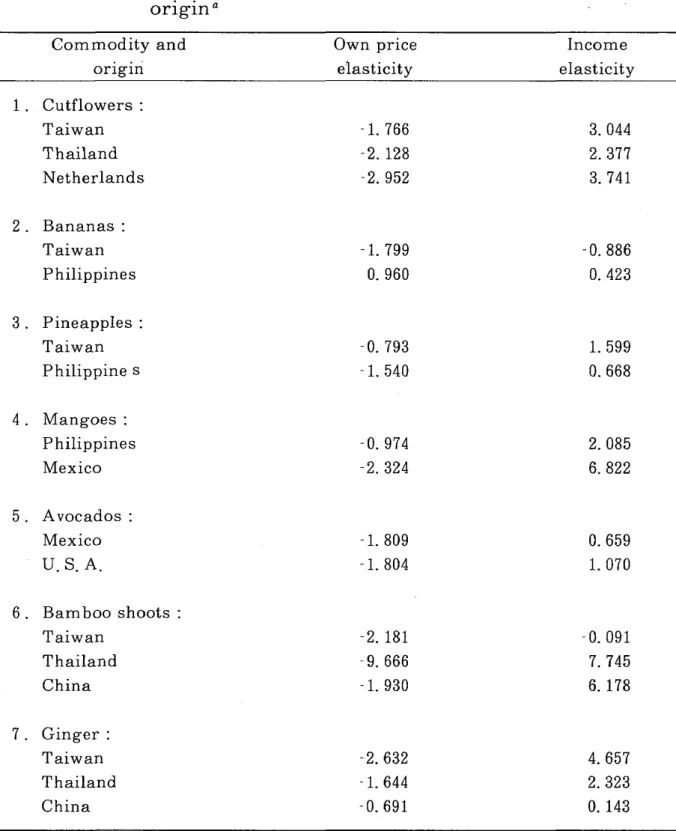
nalelementsin importprlCe block,Show the expected slgn and mostofthem arehighlyslgnificantwithlarget‑values.Itisnote‑
worthythatfifteen estimatedown‑pricecoefficientsofseventeen in totalaremorethanoneinabsolutevalue.Thismeansthattheim‑
portdemandsforhorticulturalcommoditiesglVen an expenditure on totalimportsforeach commodity arevery prlCeSensitiveand thatsuppliersarefacingprlCeCOmpetitionsin increasingtheirex‑
portstoJapan.Itisalsoobservedthatthemagnitudeofown‑prlCe elasticitiesvarieswiththesourceorimports.Itisnaturaltoexpect
4)IfXtistheoriginalvariable,thenitisreplacedbyXt‑pX,̲ I,Where pistheautocorrelationparameter.
5)Thosecross‑pricecoefficientswhichhavet‑valueoflessthanonewere excluded.