MEG–BMI to Control Phantom Limb Pain
Takufumi Y ANAGISAWA ,
1,2,3,4Ryohei F UKUMA ,
1,3Ben S EYMOUR ,
5,6Koichi H OSOMI ,
1,7Haruhiko K ISHIMA ,
1Takeshi S HIMIZU ,
1,7Hiroshi Y OKOI ,
8Masayuki H IRATA ,
1,4Toshiki Y OSHIMINE ,
1,4Yukiyasu K AMITANI ,
3,9and Youichi S AITOH
1,71
Department of Neurosurgery, Osaka University Graduate School of Medicine, Suita, Osaka, Japan;
2
Osaka University Institute for Advanced Co-Creation Studies, Suita, Osaka, Japan;
3
Department of Neuroinformatics, ATR Computational Neuroscience Laboratories, Seika-cho, Kyoto, Japan;
4
Division of Clinical Neuroengineering, Global Center for Medical Engineering and Informatics, Osaka University, Suita, Osaka, Japan;
5
Computational and Biological Learning Laboratory, Department of Engineering, University of Cambridge, Cambridge, UK;
6
Center for Information and Neural Networks, National Institute for Information and Communications Technology, Suita, Osaka, Japan;
7
Department of Neuromodulation and Neurosurgery, Osaka University Graduate School of Medicine, Suita, Osaka, Japan;
8
Department of Mechanical Engineering and Intelligent Systems, The University of Electro-Communications, Chofu, Tokyo, Japan;
9
Graduate School of Informatics, Kyoto University, Kyoto, Kyoto, Japan
Abstract
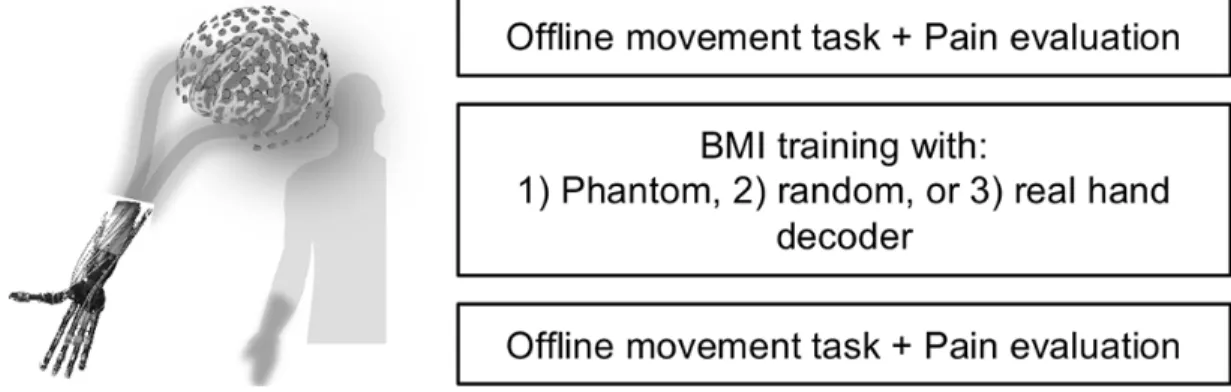
A brachial plexus root avulsion (BPRA) causes intractable pain in the insensible affected hands. Such pain is partly due to phantom limb pain, which is neuropathic pain occurring after the amputation of a limb and partial or complete deafferentation. Previous studies suggested that the pain was attributable to maladaptive plasticity of the sensorimotor cortex. However, there is little evidence to demonstrate the causal links between the pain and the cortical representation, and how much cortical factors affect the pain. Here, we applied le- sioning of the dorsal root entry zone (DREZotomy) and training with a brain–machine interface (BMI) based on real-time magnetoencephalography signals to reconstruct affected hand movements with a robotic hand.
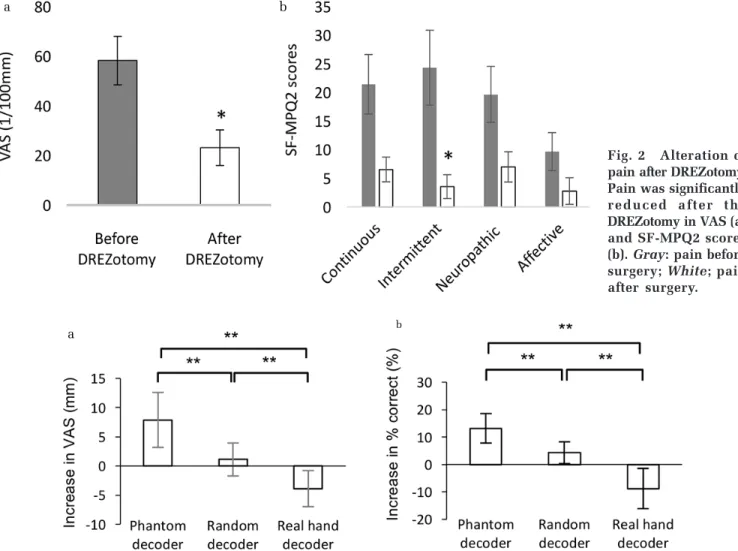
The DREZotomy successfully reduced the shooting pain after BPRA, but a part of the pain remained. The BMI training successfully induced some plastic changes in the sensorimotor representation of the phantom hand movements and helped control the remaining pain. When the patient tried to control the robotic hand by moving their phantom hand through association with the representation of the intact hand, this especially decreased the pain while decreasing the classification accuracy of the phantom hand movements. These results strongly suggested that pain after the BPRA was partly attributable to cortical representation of phantom hand movements and that the BMI training controlled the pain by inducing appropriate cortical reorganization. For the treatment of chronic pain, we need to know how to modulate the cortical representation by novel methods.
Key words: cortical plasticity, magnetoencephalography, neurofeedback, phantom limb pain, robotic hand
Received April 6, 2018; Accepted May 7, 2018
Copyright© 2018 by The Japan Neurosurgical Society