Economy
著者 CHOWDHURY Mahbubul Alam
journal or
publication title
The Journal of Nagasaki University of Foreign Studies
number 16
page range 169‑190
year 2012‑12‑30
URL http://id.nii.ac.jp/1165/00000105/
Migrant Workers and Remittances in Bangladesh Economy*
Mahbubul Alam CHOWDHURY**
Abstract
バングラデシュ経済は 年代初期からマクロ経済の安定的な成長・貿易の自由化・農村インフラ
や農業への投資を通じて、経済成長を遂げ貧困を削減してきた。その原動力は、「マイクロ・ファイ ナンス活動や海外出稼ぎ労働者からの送金および既製服の輸出の つである。本稿はバングラデシュ の海外出稼ぎ労働者による外国からの送金は、増加傾向にある。これは輸出額の半分弱に相当する。
海外出稼ぎ労働者からの送金には乗数効果が見られる、また、資本財と原材料の輸入、海外からの帰 国によって生み出されている知識の外部効果は、技術移転、マーケットシステムの成立及び経済発展 に向けた構造変化の推進に対して重要な機能を果たしている。
1. Introduction
The flow of international migration and remittances have received a growing amount of attention from researchers, academicians, policy makers, international organizations, migrant associations and certain financial institutions. Recently, the World Bank (WB) published , which focused on the economic implications of migrant workers and remittances (WB [2005]).
However, remittances have emerged as an important effort of economic growth and poverty reduction in Bangladesh, increasing at an average annual rate of more than 20 percent in the last three decades. The remittances flow in Bangladesh has grown not only in size but also in importance in terms of as a share of gross domestic product (GDP). Remittances represent the second largest source of foreign currency earnings after exports, which have contributed above 10 percent of GDP.
Remittance inflows have therefore been supportive of economic growth, particularly in Bangladesh, and other South Asian countries. As World Bank data shows, “Remittance inflows to South Asia contracted by a modest 1.8 percent in 2009, compared with a 7.5 percent decline for developing countries, excluding South Asia” (WB, [2010]). Despite the global economic slowdown, remittance flows to Bangladesh have been relatively robust. Flows of migrant workers to Bangladesh have started to slow down since the last quarter of 2009, mainly due to a decrease in inflows of emigrants from the Gulf Cooperation Council (GCC) countries (WB, [2010]). Nonetheless, it was lower than the years 2007 and 2008 (Siddiqui [2011]). The Bangladesh Bank recorded increasing inflows towards the end of 2009 of US$ 873.86 million in December, compared to the slight declines of the year before (US$758.03 million),(Bangladesh Bank: BB, Website).
Although, it is difficult to accurately estimate the number of migrant workers from Bangladesh1), some studies have shown that a large part of remittances remains unrecorded and it could be as large as 50 to 200 percent of the officially recorded remittances (Aggarwal [2006]). It is important to
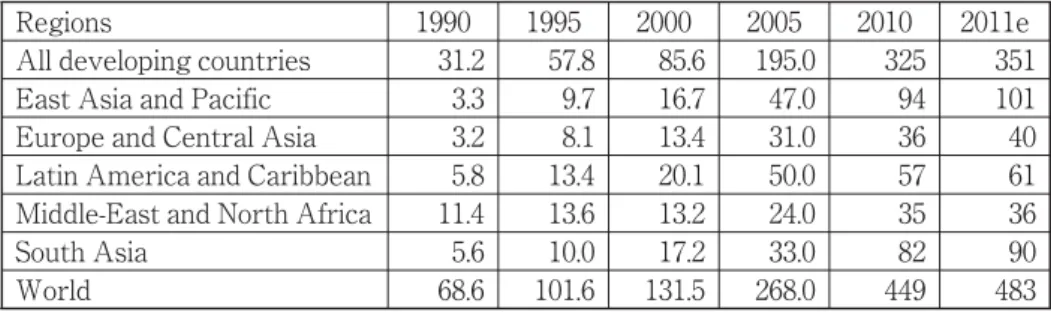
Table 1: Flows of Remittances from 1990 to 2011
Regions 1990 1995 2000 2005 2010 2011e
All developing countries 31.2 57.8 85.6 195.0 325 351
East Asia and Pacific 3.3 9.7 16.7 47.0 94 101
Europe and Central Asia 3.2 8.1 13.4 31.0 36 40
Latin America and Caribbean 5.8 13.4 20.1 50.0 57 61 Middle-East and North Africa 11.4 13.6 13.2 24.0 35 36
South Asia 5.6 10.0 17.2 33.0 82 90
World 68.6 101.6 131.5 268.0 449 483
Note: e = estimate
Source: Authorsʼ calculation based on data from IMF and World Bank country data.
mention that not all migrants send remittances to their family. Remitting behavior depends on many different factors including age, education, occupation, employment, gender, size of the household, access to credit, and years since migration (John Page and Sonia Plaza [2005]).
Therefore, there are so many different arguments and opinions about remittances flows to developing countries. It will survey, document, primary and secondary data2)and studies conducted in research papers, surveys of research and government documents, the Bureau of Manpower, Employment and Training (BMET), Bangladesh Bank (BB) reports of the Asian Development Bank (ADB), International Organization for Migration (IOM)3), The International Labour Organization (ILO), The United Nations Conference on Trade and Development (UNCTAD), the World Bank (WB) and internet concerning the impact of international migrant workers and remittances on economic growth.
This paper contributes to the existing empirical studies. It will aim to broaden the scope of these studies by examining the impact of remittances on economic growth, poverty alleviation and social development, all of which are reflected in previous studies of Bangladesh.
This paper is organized as follows. In section 2, a brief recapitulation of international migration and remittances is offered; in section 3, international migration and remittance in Bangladesh are discussed; section 4 discusses the impact of remittances on the economy of Bangladesh; and the final section offers concluding remarks and a brief outline for future research.
2. A Brief Recapitulation of International Migration and Remittances
The remittance flow of migrant workers has been increasing fifteen-fold to developing countries.
In 1988, remittances were only $ 20 billion, though that has been increasing to $328 billion in 2007, and reached US$ 440.1 billion in 2010. Developing countries accounted for US$326 billion in same period.
(table 1, and WB, [2011]). Regarding this flow of remittances five out of the top ten countries were in the Asian region notably India, China, the Philippines, Bangladesh, and Pakistan ( table 2, WB, [2011]).
This paper will analyze empirical evidence, and it will ask how remittance of migrant workers has contributed to the economic growth and social development of their countries. There has been controversy amongst economists and researchers of international organizations over remittances impact upon economic growth.
The early studies mentioned the sources of economic growth of developing economies (Lewis, [1954], Solow, [1956], Chenery and Strout, [1966], Denison, [1967], Myrdal, [1968], Harris-Todaro, [1970], Schultz, [1980], and Fields, [1980]). More recent research has pointed out how remittances impact upon economic growth, savings, consumption, poverty alleviation, human resources development and social development. It has disputed a positive relationship between the growth of GDP and remittances, as well as a positive impact on capital formation (Blomstrom [1996] and Casseli, et al. [1996]). On the other hand, Barro [1991] has found a negative relationship between the GDP growth and remittances in a cross-country empirical study. Research on the effect of remittances on economic growth is scant so far and has yielded mixed results. Broadly, this paper demonstrates the positive impacts and negative impacts of the remittance of migrant workers.
2.1. Positive impacts of remittances
Scholars who argue for the positive impacts of remittaces offer point out that remittances provide financial support to households, contribute to the alleviation of poverty, savings and investments.
According to the
, migration contributes to poverty reduction at both the individual and the community level by providing migrants with access to higher salaries at their destinations, and remittances sent by migrants to their families constitute an important driver of development (IOM, [2008], WB [2008]).
More importantly, UNCTAD analysis found, that remittances of migrant workers have become significant private financial resources for households in some countries, although they cannot be considered as a substitute for FDI, ODA, debt relief or other public sources of financial development.
(UNCTAD [2008], UNCTAD XII). Taylor [1992] and Faini [2002] also find a positive association between remittances and economic growth. Taylor [1999] found that every dollar Mexican migrants send back home or bring back home with them increases Mexicoʼs GNP from anywhere between US
$2.69 and US$3.17. In contrast, Spatafora [2005] finds that there is no direct link between per capita
Table2: Top recipient countries of remittances
(in USD billions)
Country 2006 2007 2008 2009 2010
India 26.9 27 45 55.06 55
China 22.52 25.7 40.5 n.a. 51
Philippines 12.7 14.4 16.4 17.3 21.3
Mexico 25.6 26.1 25.1 21.2 22.6
Poland 8.5 12.5 13.75 n.a. 9.1
Bangladesh 5.5 6.6 9.0 10.7 11.7
Nigeria n.a. n.a. n.a. 9.6 10
Pakistan 5.1 6.0 7.0 8.7 12.94
Morocco 5.1 5.7 6.9 8.0 6.4
Vietnam n.a. n.a. 7.2 6.8 7.2
Note: n.a. (not available)
Source: WB [2011], “Remittance” http://pandapedia.com/wiki/Remittance,
access June 2
nd, 2012,
output growth and remittances.
The majority of the current studies emphasize the positive, using cross country data and find out the remittances flow effect economic growth direct and indirect, especially for the developing countries (Ratha, [2003], Giuliano ., [2004]; Gupta . [2009], Barajas ., [2010]). Remittance beneficiaries in developing countries have a high propensity to save, suggesting that remittances have the potential to be directed into activities beyond consumption. Remittances can be a valuable input into the cycle of savings and investment.
In June 2004, at the 92nd International Labour Conference (ILC) in Geneva, its conclusions recognized the positive contribution of international labour migration and called for maximizing its benefits for employment, growth and development in both countries of origin and destination (ILO Website). In addition, migrant workers gained knowledge, technological expertise and experience that could add significantly to country has the potential to benefit their countries in wide number of ways.
migrants provide different forms of capital that have contributed to the developmental impact on the country. These contributions may be linked to financial, social, cultural, political and economic development. However, these impacts can be examined at both the micro and macro level, like households, poverty alleviation, social development, and GDP growth. The authors then interpolate the positive effect on development by invoking existing studies showing the positive impact on economic growth in Bangladesh.
2.2. Negative Effects of remittance of migrant workers
Those scholars who believe remittances do not contribute to economic growth point out that they are frequently spent on conspicuous consumption and that any savings are spent on consumption rather than on the accumulation of productive assets (Stahl and Arnold [1986]). Chami [2003], using a panel of data for 113 developing countries over 29 years, found that remittances have a negative effect on economic growth. They argue that receiving remittances might lower recipient householdsʼ labor force participation or savings rates and limit their job search efforts and, therefore, lead to poor economic performance. The next section will examine the importance of remittances in the Bangladesh economy. For the sake of brevity only international migration and remittances in Bangladesh will be discussed.
3. International Migration and Remittance in Bangladesh
Like many other developing countries international migrant workers and remittances have been contributing to employment, economic growth, poverty alleviation, and social development in Bangladesh. Bangladesh is a country a of a labor-abundant, total civilian labor force which has been estimated at 57.1 million as per preliminary report of Labor Force Survey 2010, of which 40.2 million are male and 16.9 million are female (Bangladesh Bureau of Statistics: BBS [2011] p. XX). While it has sent over an estimated 7.7 million migrant workers worldwide since the mid-1970s, representing
nearly 5 percent of the total population and 10 percent of the labor force. Most of these workers temporarily migrate to work in Europe, America, the Middle East and Southeast Asia. The flow of remittances were $11.65 billion in the 2010-11 fiscal year (BB [2011]), exceeded four times higher than the total aid and 9 times the foreign direct investment (FDI) received by the country (Siddiqui [2009]).
Globally, Bangladesh was the 6th largest remittances recipient country (table 2) in 2010, and was ranked 19th in terms of its share of remittances to GDP in 2009 (Ratha, ., [2010]).
3.1. Historical Perspective of International Migration
There is a long history of international migration in Bangladesh. The flow of international migration had in the 18th and early 19th century, when British merchants employed in the navy, sailors from Chittagong, Noakhali and Sylhet. Some of them settled in the UK and the USA. Most of the migrants became long-term residents and some adopted citizenship of the countries of destination.
In the 1940s to 1950s Bangladeshi migrants went to UK under a statutory mechanism of
“Employment Vouchers” issued to individuals selected by the British Government. In addition, another piece of research pointed out Bangladeshi nationals had migrated to the port cities of London and Liverpool in United Kingdom and obtained British citizenship by naturalization after staying four to five years in 1942 (Mahmood [1991]). For certain reasons, however, this flow had weakened by the 1960 s and the direction of the migration flow changed in the 1970s.
3.1.1. Category of Migrant Workers
There are several unique features of migrants from Bangladesh. Firstly, well-educated, high or middle income earners migrate mainly to American and Britain. Recently this trend has changed, and at present this category (well educated and middle income) of migrant are all most developed and industrialized countries all over the world. Secondly, low and middle income people those have no education and unemployed, they are migrate to industrialized countries. Thirdly, there is a major group of migrant laborers, who are residing for a specific period of time in Middle Eastern (Saudi Arabia, UAE, Kuwait), South-East Asian (Malaysia, Singapore) and some industrialized countries.
According to a government document, the first two groups amount to more than a million emigrants (BMET Website).
In the past the bulk of the migrants consisted of professional and skilled, semi- and unskilled labor migration (table 3). Siddiquiʼs study found that there were 875,055 people who migrated in 2008, of which 32 percent were skilled, 16 percent semi-skilled and 52 percent unskilled (Siddiqui [2009]).
Migration decreased by over 17 percent to 383,150 in 2010 from 465,351 in the previous years ((BMET Website).
In terms of skill composition of the short-term migrant workers, professional workers like doctors, engineers, teachers, and nurses. Semi-skilled workers like tailors and masons. Unskilled migrants are employed in construction, manufacturing, and services such as domestic workers. The huge increase in outward migration as indicated above makes Bangladesh as one of the major
Table 3: Overseas Employment by Profession in Bangladesh
Year Workerʼs Category Recruiting Media Remittance Earned
Professional Skilled Semi-skilled Less-skilled Total BMET BOESL Agent Individual Million $ Million Tk.
1976 568 1775 543 3201 6087 5279 0 284 524 23.71 358.5
1980 1983 12209 2343 13538 30073 5715 0 7773 16585 301.33 4929.5
1985 2568 28225 7823 39078 77694 0 1221 39397 37076 500 14196.1
1990 6004 35613 20792 41405 103814 0 435 40258 63121 781.54 26916.3
1995 6352 59907 32055 89229 187543 73 627 74921 111922 1201.52 48383.1 2000 10669 99606 26461 85950 222686 1 524 91475 130686 1954.95 10199.12 2005 1945 113655 24546 112556 252702 n.a. 645 81608 170449 4249.87 273043.3 2006 925 115468 33965 231158 381516 n.a. 977 104949 275590 5484.08 383665.6 2007 676 165338 183673 482922 832609 n.a. 619 362531 469459 6568.03 457244.4 2008 1864 292364 132825 458916 875055 773 2172 207018 665092 9019.6 622507.4 2009 1426 134265 84517 255070 475275 n.a. n.a. n.a. n.a. 10717.73 73981.46 2010 387 90621 20016 279678 390702 n.a. n.a. n.a. n.a. 11650.32 69359.67 2011 1192 229149 28729 308992 568062 n.a. n.a. n.a. n.a. 12165.25 89855.95 Total 182,915 2409912 1140511 3966613 7699951 42775 14811 2333526 3874797 90838.77 558462.73 Notes: n.a.(not available) BMET (Bureau of Manpower, Employment and Training), BOESL(Bangladesh Overseas Employment
and services Limited) Sources: BMET Website
remittance recipient countries in the world.
3.1.2. Destination of Migrant Workers
In the early sixties, Middle Eastern countries economies progressed on the basis of oil exploration and they started to recruit various kinds of manpower. As a result a number of Bangladeshi workers had taken up employment in Saudi Arabia and Qatar mostly by individual initiatives. There is dramatically changed of migrant workers after the independence of Bangladesh in 1971, most Bangladeshi migrants sought to look for a job in the Middle East as well as selected EU countries (mainly Germany). From the Middle East several delegations visited Bangladesh to recruit workers between1972-75. Bangladesh government created the BMET to devise policies to export manpower in a coordinated manner and keeping the systematic records of flow of migration and remittances.
Migration from Bangladesh started in 1976 with a modest number of 6078 persons (Chowdhury, [1992]). Since the mid-1970s more that 70 percent have migrated from Bangladesh to the Middle East.
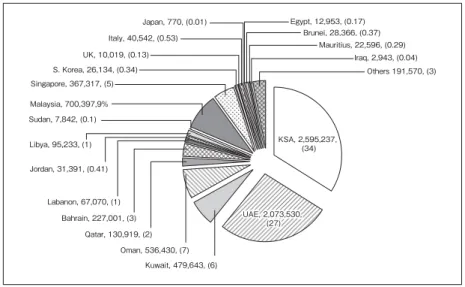
Over the past 35 years migration workers from Bangladesh has registered a steady increase. Siddiqui study find from 1990 onwards on an average 225,000 Bangladeshis are migrating on short-term employment, mostly to 13 countries (Figure 1). Saudi Arabia took the top position in receiving the manpower up to 2010, followed by UAE, Kuwait, Bahrain, and so on. In 2006, UAE scored the highest position in employing Bangladeshi migrant workers. Iraq stopped importing manpower from 1991 just after the Gulf War. Other countries inviting Bangladeshi workers are Libya, Jordan, Brunei, Mauritius, UK, Italy, Lebanon, Laos, Ireland was observed in the 1990s and onward.
KSA, 2,595,237, (34)
UAE, 2,073,530, (27) UAE, 2,073,530,
(27) UAE, 2,073,530,
(27)
Kuwait, 479,643, (6) Oman, 536,430, (7) Qatar, 130,919, (2) Bahrain, 227,001, (3) Labanon, 67,070, (1) Jordan, 31,391, (0.41) Libya, 95,233, (1) Sudan, 7,842, (0.1)
S. Korea, 26,134, (0.34) UK, 10,019, (0.13)
Italy, 40,542, (0.53)
Egypt, 12,953, (0.17) Brunei, 28,366, (0.37)
Mauritius, 22,596, (0.29) Iraq, 2,943, (0.04)
Others 191,570, (3) Japan, 770, (0.01)
Malaysia, 700,397,9%
Singapore, 367,317, (5)
3.1.3. The media of recruitment
A number of organizations and agencies are directly and indirectly involved in activities relating to overseas employment, migration of workers and remittances (table 3). BMET is a department under the control of the Ministry, which was established in 1976 to execute all plan and policy of the Ministry for enhancing the labor migration as well as protecting welfare of the migrants and training of the workers. BMET is controlling and monitoring the activity of the recruiting agent. There are five channels of recruitment from Bangladesh for migrant workers. These are (i) BMET, the Government Agency; (ii) Bangladesh Overseas Employment and Services Limited (BOESL); (iii) Licensed private Recruiting Agents; (iv) Individuals through friends and relatives stationed abroad; (v) Bangladeshi firms operating abroad.
These agencies, which must be licensed by the government, collect information about the demand for foreign employment from brokers in the host countries who, in turn, are in direct contact with prospective employers. Recruiting agencies help prospective migrants to secure a passport, make travel arrangements and obtain clearance from the BMET. In 1984, the recruiting agencies organized themselves under the Bangladesh Association of International Recruiting Agencies (BAIRA) to promote their interests and interact with the government. The same year, the government set up the BOESL to compete with private providers in conducting direct recruitment.
3.1.4. Policy Related to Migrant Workers
Bangladesh adopted Overseas Employment Policy in 2006 to organize overseas employment sector and to ensure welfare of Bangladeshi workers abroad. Salient features of the Oversees employment policy are as follows (BMET Website)
・Ensure the prospect of regular migration of long term and short term for both men and women from all parts of Bangladesh at a rational cost.
Figure 1: Destination of Migrant Worker of Bangladesh from 1976 to 2010
Notes: parentheses figures are percent (%)
Source: Compiled by author from BMET Website
・
・
・
・
・
・
・
Allocation of necessary resources and strengthen the existing institutional infrastructure and personnel is necessary for the successful implementation of the above policies. There is a lack of coordination among the Ministries responsible for formulation and implementation of policies and programs with respect to overseas employment. In this regard, planning, execution, monitoring and evaluation of development projects and programs need to be streamlined and organized more efficiently.
3.2. Trend of Remittances Flow in Bangladesh
Bangladesh is one of the leading remittance recipient countries in the South Asia region. The flow of remittances has become one of the largest foreign exchange earners for the country. Remittances income increased from a low of $24 million in 1976, to a dramatic increase of 400 percent to $9689.3 million in 2001, to over $11.65 billion in the 2010-11 fiscal year (accounts for 13.68 percent GDP of the country). Remittances are also associated with increased household investments in education, entrepreneurship, and health―all of which have a high social return in most circumstances.
Remittances have emerged as a key driver of economic growth and poverty reduction in Bangladesh (BB, Website). These large inflows of remittances are having numerous economic and development effects for Bangladesh.
3.2.1. The sources of Countries and Regions of Remittances
The sources of remittances to Bangladesh are changing over time. Migrant workers are mainly employed by MENA4)countries, South East Asian countries, as well as by Australia, UK, US, Italy, Japan, Germany and South Korea. In the recent past, most of the remittance came to the country from the contribution of expatriates working in Middle Eastern countries. From the early 2000s, Bangladesh has emerged as one of the major manpower exporting countries in South Asia and the flow of remittances is increasing at an ever faster rate. The global economic recession and Middle Eastern political unrest has changed the scenario of migrant workers and remittance. In FY 2010-11, the amount of remittance from Middle Eastern country totals USD 7,215.53 million which is 0.10
KSA 29%
UAE 17%
UAE 17%
UAE 17%
Kuwait 9%
Oman 3%
Qatar 2%
Bahrain 2%
Malaysia 6%
Singapore 2%
UK 8%
USA 16%
USA 16%
USA 16%
Others 6%
Figure 2: Country wise Remittance Flow in Fiscal Year 2010-11
Source: BB Website
percent less than that of FY 2009-10. However, remittance from non-Middle Eastern countries in FY 2010-11 totals USD 4,434.79 million, which is 17.80 per cent more than that of the previous fiscal year of USD 4,434.79 million. Saudi Arabia still tops the list, employing 1.5 million Bangladeshi workers followed by United Arab Emirates (UAE), USA, Kuwait and UK comes fifth in 2010 (Figure 2, BB, Website).
3.3.2. Channels Used in Sending Remittances
In the absence of systematic studies of the magnitude of informal, unrecorded remittances it is difficult to assess their impact or the policy significance of efforts to move them into formal financial channels. Official recorded remittances are much lower than the actual remittances that take place through official and unofficial channels of remittances are coming through different ways like friends, relatives and 5) system. According to World Bank, there are 54 percent remittances flows through informal channels (WB, [2006], p. 85). Due to high charged by financial institutions, insufficient ATMʼs services are pushing some migrants into remitting money through the system (Developing-86)2008, IOM [2005] p.29). Compared to formal channels, the system is not only less expensive but also more and easily accessible. Under these circumstances the government of Bangladesh reform the official channels and adapt them to the needs of the migrants and their families. The most important measures has taken are reduce of transaction time; reduction of transaction costs; making remittances tax free; regular monitoring to ensure service; penalizing unauthorized remittances dealer (IOM [2005]p.47). As a result informal remittances drop from 40 to 20 percent (Mahmood [2006]). The IOM found in Bangladesh, there were 73 percent remittances received through banks, unofficial channels like hundi and others were 8 to 10 percent in 2009 (IOM [2010] ).
4. Remittance and Economic in Bangladesh
The empirically analysis finds the positive impacts of remittances on economic development in Bangladesh. As noted by an official associated with labor migration, “remittances have been causing a
Table 4: Impacts of One Per Cent Increase in Remittances on Growth and Poverty
Growth Direct Impact Indirect Impact
Total Human Investment Growth
0.00 0.02 0.01 n. a 0.03
Poverty -0.28 -0.06 n. a -0.09 -0.43
Note: n.a. (not available) Source: Juthathip [2007] p.16.
silent economic revolution in Bangladesh.” (De Bruyn and Kuddus [2005], pp.42). Some others studies examined the impacts of remittances and foreign direct investment on the economic growth of developing countries as well as Bangladesh. However, the remittances and economic development in Bangladesh can be broadly explained in two ways: overall macroeconomic and microeconomic level.
4.1. Macroeconomic Impact of Remittance
There were some studies that found the positive effects of remittances on economic growth through increased consumptions, savings and investments (Durand, ., [1992], Glytsos, [2005]). In table 4, shown below, an increase one percent in remittances is associated with an increase in human capital by 0.008 percent and investment by 0.03 percent. An increase of one percent in remittances is associated with an increase in economic growth by 0.03 percent (Table 4). These results also suggest that remittances can alleviate credit constraint as well as private investment.
4.1.1. Impact on GNP and GDP growth
The impact of remittances on macroeconomic, a theoretical perspective, some studies have adopted a Keynesian model for eight countries (Algeria, Egypt, Greece, Jordan, Morocco, Portugal, Syria and Tunisia) for the period of 1969-1993 and then further extended in the other study 1969-1998.
The Keynesian model can be explain in these ways, remittances are mainly used for consumption purposes, investment, imports and output that would spur long-run economic growth (Giuliano and Ruiz-Arranz, [2006], Glytsos [2005]).
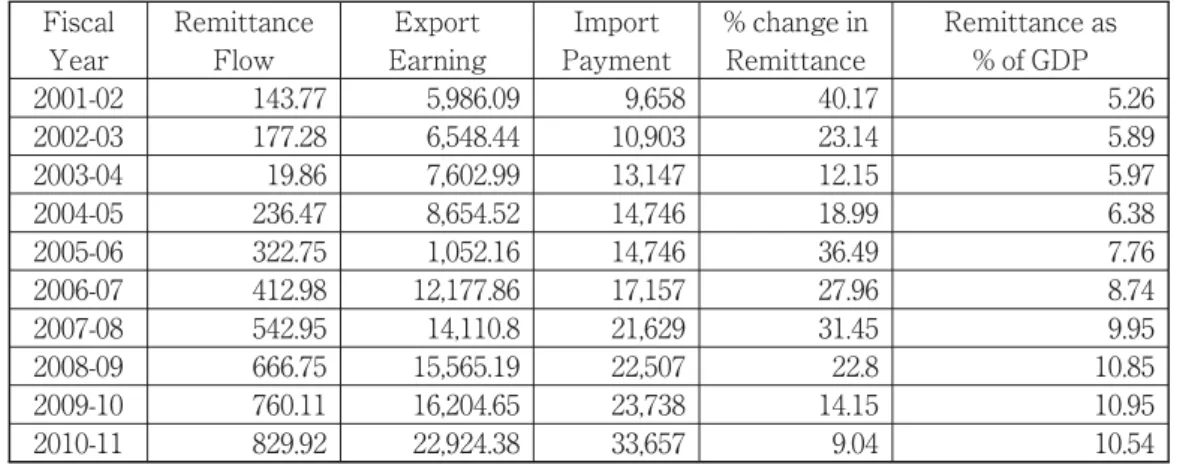
There have been only a few studies that use micro-level survey to examine the economic effects of remittances in Bangladesh. To the best of our knowledge, there is hardly any work that, systematically investigate the overall macroeconomic impacts of remittances in Bangladesh7). However, studies for other countries have shown that these remittance flows could have significant macroeconomic consequences (Vargas-Silva [2009]). Even if the remittances are spent on consumption or real estate, there are multiplier effects and increases in demand for goods stimulated by these activities (Chimhowu et al. 2005), once again showing the positive link between remittances and GDP (Table 5).
4.1.2. Earn of Foreign Exchange
Remittances have been contributing to Bangladeshʼs economy. It has contributed more than 10 percent to the countryʼs GDP and almost 30 percent of foreign exchange earnings. According to annual report of Bangladesh Bank flows of remittances increased by 6.03 percent in the 2010-11 from previous year, and total amount of US dollar 11.65 billion while foreign currency reserve increased by only 1.50 percent and total amount of US dollar 10.91 billion (BB Website). Bangladesh has deficits in her balance of trade. The valuable remittances are used largely in payment of the import bill.
4.1.3. Saving and Investment
As mentioned earlier, remittance income is used primarily for consumption purposes. While this is valuable to the economy via the multiplier effect, further economic progress would be expected if there was broader development. As the micro-level remittances go directly to individuals or households, raising their income level and ability to save and consume. The remittances to help migrant families to save and invest for long-term projects; and financial institutions to provide easily accessible and affordable services for remittance recipients.
4.1.4. Remittance exceeding the ODA and FDI
A recent World Bank [2006] study recorded that, remittances have grown faster than foreign direct investment, or official development assistance. In fact, remittances have become even more important than FDI as a source of capital inflow to developing nations, exceeding FDI for the first time in 2008 when remittances peaked in Asian countries (Table 6). As for Official Development Assistance (ODA), in the same year remittances were nearly three times as large in ODA received. According to UN Economic and Social Commission for Asia and the Pacific (UN-ESCAP), the annual remittances exceed ODA and FDI in Bangladesh. The remittances also represent around 40 percent of export values, and providing foreign currency and financing the countryʼs trade deficit (Daily Star, April 01, 2006).
Table 5: Export, Import and Remittance as a percentage share of GDP (in USD million)
FiscalYear
Remittance Flow
Export Earning
Import Payment
% change in Remittance
Remittance as
% of GDP
2001-02 143.77 5,986.09 9,658 40.17 5.26
2002-03 177.28 6,548.44 10,903 23.14 5.89
2003-04 19.86 7,602.99 13,147 12.15 5.97
2004-05 236.47 8,654.52 14,746 18.99 6.38
2005-06 322.75 1,052.16 14,746 36.49 7.76
2006-07 412.98 12,177.86 17,157 27.96 8.74
2007-08 542.95 14,110.8 21,629 31.45 9.95
2008-09 666.75 15,565.19 22,507 22.8 10.85
2009-10 760.11 16,204.65 23,738 14.15 10.95
2010-11 829.92 22,924.38 33,657 9.04 10.54
Source: Complied by Bangladesh Bank and Export Processing Bureau.
4.1.5. International Migration Relief of Labor Burden
Bangladesh is a huge labor surplus country. According to the BBS in 2011, there were 57 million labor forces in Bangladesh included about 5 percent, or 7.7 million migrants. The International Labour Organisation (ILO) document also shows, the unemployment growth rate in Bangladesh was 1.9 percent in the nineties, increased 3.7 percent in recent years (ILO Website). Some others scholar found 2.7 million young people are becoming eligible for jobs whereas only 0.7 million of them are getting employment (Mansur Ahamed [2010]). Under these circumstances, international migration is an important factor to release the unemployment burden from Bangladesh. As mentioned before on average, about 225,000 people annually migrate all over the world. The employment of workers abroad is quite sensitive to the prevailing socio-economic and political environment of the recipient countries. The Middle East political crisis and worldwide economic slowdown led to a decline in migrant workers.
4.2. Microeconomic Impact at Household Level.
There is a considerable amount of research on the economic and social impacts of remittance of migrant on household economies. This research finds the contribution of remittances to the countryʼs economic growth through earning of foreign currencies, consumption, education, investments, balance of payments, poverty alleviation and the improvement of the socio-economic status of migrant-sending households. Since the 1980s the debate has shifted to underscore the importance of remittances in alleviating liquidity constraints in low income households, promoting investment in new agricultural techniques, education and further migration. (Taylor and Wyatt, [1996]). Some other studies suggest that at the household level, remittances can spur entrepreneurial activity (Yang 2004, Woodruff and Zenteno [2004]). However, most of the empirical evidence explained the contribution of remittances on both the economic and the household level. Table 7 shows from 2001 to 2005 the survey has not big difference, but in 2009 the survey shows a big difference with others surveys. However, utilization pattern of remittances in Bangladesh discovered that 20.45 to 81 percent of remittances are used for food and cloths, more than 11 percent for agricultural land purchase, 7 to 15 percent for home construction and repair, above 10 percent for repayment of loans (for migration), 9 percent or less for social ceremonies, 7 percent for sending family members abroad, and finally just over 4 percent is used
Table 6: Comparison of Remittances with ODA, and FDI in some Asian Countries
Countries GDP 2009 US$ (billions)
Remittances 2008 US$ (millions)
ODA 2008 US$ (millions)
FDI 2008 US$ (millions)
Bangladesh 230 8,941 2,061 1,010
India 3,783 49,941 2,108 41,169
Indonesia 967 6,794 1,225 9,318
Nepal 34 2,727 716 1
Pakistan 446 7,039 1,539 5,438
Philippines 326 18,642 61 1,544
Source: World Bank remittance data inflows developing countries, 2010
Table 7:Percentage Distribution of Remittances by Expenditure Categories
Expenditure Categories Percentage of remittances spentSiddiquisʼ 2001 IOMʼ 2002 IOMʼ 2005 IOMʼ 2009*
Food and clothing 20.45 34.4 20-36 81
Purchase of land 11.24 11.5 3-40 5.1
Home construction and repair 15.02 11.2 2-30 7.3
Repayment of loans 10.55 16.7 10-19 42.6
Wedding and other social ceremonies 9.07 3.7 0-10 2.9
Education 2.75 2.1 0-5 29.8
Savings 3.07 3.1 3-7 7.1
Funding other people is migration 7.19 3.5 0-7 1.3
Investment in business 4.76 5.4 0-5 1.5
Health care 3.22 3.5 0-4 34.2
Note: Study C* survey was conducted by IOM in 2009. 10,565 households interviewed throughout the country.
Percentages add to more than 100 percent due to multiple answers provided by respondents.
Source: Siddiqui, [2003]; IOM [2002]; IOM [2005]; (IOM [2009])
for investment in business and just over 3 percent for savings (Table 7).
4.2.1. Increase of Household Consumption
Studies have found that a continuous flow of remittances has a multiplier effect on the rural areas of Bangladesh. Some micro-level studies found that the remittance-receiving households use the largest fraction of remittances for consumption, purchase of land, construction and repair of houses, and repayment of loans. Some studies found impact of remittances has focused on issues such as poverty, education, health, entrepreneurial activity, and the social development. Table 7 illustrates the percentage distribution of remittances spent by the most important expenditure categories. For the most part, remittances seem to be used to finance consumption or investment in human capital, such as education, health, and better nutrition.
Under Keynesian principles, the net impact of the transfer depended on the portion that would be spent on consumption in Bangladesh. Even in the short-run, remittances may contribute to the growth of output in the economy by augmenting aggregate demand if the remittance-receiving households spend most of these transfers on consumption. Remittance plays a significant role for the economic development of Bangladesh.
4.2.2. Purchase of land
According to Mahmood, land is the most important utilization of overseas remittances. Land constitutes the safest way to invest remittances in Bangladesh (Table 7, Siddiqui and Abrar [2001]) . Table 7 shown about 11 percent remittances invested in land purchase. Arable land provides direct economic return through crop production and land can increase in value over time. The use of remittances in releasing mortgaged out land is also quite important in the rural context as it re- establishes the right of the person to cultivate the land.
4.2.3. Remittance on human resources
Education is a major avenue of Human Resources Development (HRD). In fact, it is one of the biggest consumers of its own output. Education and literacy were widely promoted on theoretical and empirical grounds as a means to escape poverty. In poorer households, remittance may finance the purchase of basic consumption goods, housing, and childrenʼs education and health care (Table 7).
While analyzing the importance of remittances on human capital formation by improving the literacy rate, (Adams [1991], Cox and Ureta [2003], Hanson and Woodraff [2003]) research illustrates the positive effect of remittances on increasing schooling and literacy rate and thus augmenting human capital formation.
4.2.4. Investment in Business
Several other studies (Maimbo and Ratha, [2005]; Woodraff and Zeleno, [2001]; Yang [2005]) suggest a positive relationship between remittance recipient families and entrepreneurship. In Bangladesh there are 5 percent of remittances invested in business purposes (Table 7). In addition to describing the state of knowledge regarding flows of people and migrant remittances worldwide, it focuses on the current literature dealing with the developmental impact of transfers of money, knowledge, technological knowhow and skills by migrants back to their home countries.
4.2.5. Poverty alleviation
There is an empirical analysis and study that demonstrates the positive impact of remittances on economic growth, poverty alleviation in developing countries (Aggerwal, ., [2006]). The accelerated rate of international migration from Bangladesh has been associated with a redistribution rather than a reduction of poverty. In terms of poverty a number of other studies (Adam, [2005], Taylor ., [2005]) also found significant positive poverty alleviation effects of remittance flow on developing countries. Adam and page [2005] examine impacts of remittances on poverty in 71 developing countries. The results show that both international migration and remittances significantly reduce the level, depth and severity of poverty in these countries. More importantly, World Bank finds that remittances reduce poverty levels by 6 percent in Bangladesh, (WB [2006]). Ratha [2009], in a cross country analyses, also indicates that a 10 percent increase in remittances reduced poverty by 3.5 percent. In particular, a UNESCAP working paper examined that, an increase in remittances of 1 percent can alleviate poverty incidence by 0.43 percent (Table 4, Juthathipsʼ [2007]). Bangladesh has been able to considerably reduce poverty during the last four decades, as indicated by national- account based poverty estimates, and has achieved relatively low levels of poverty today. However, an additional reduction of extreme poverty appears difficult.
4.3. Negative Impact of Remittances in Bangladesh
Empirical evidence on the growth effects of remittances, however, remains mixed (Ratha [2009]).
The impact of remittances on growth depends on how recipient households use them. Once again
Table 8: Impact of Remittances in Bangladesh
Positive Negative
・Allowing families to meet basic needs
・ Opening up of opportunities for investing in childrenʼs education, health care, nutrition.
・Loosening of constraints in family budget to invest in business or saving
・Emergency resources
・Social security for the elderly
・Boost of local economy
・Effect on inequality
・Dependency of remittances
・Neglect of local productive activities by families
・Inflation
・Effect on levels of inequality
Source: IOM [2005] p.41.
empirical studies yield an array of possibilities. One view is that remittances would mostly be used for consumption, sometimes even conspicuous consumption, and that the same community characteristics that led to migration would also reduce the productive use of incoming remittances (Table 8).
As we pointed out in section two, there is much debate on the role that remittances play in the economic development of less developed countries. Some argue against its impacts due to conspicuous consumption. In Bangladeshʼs case the majority of remittance payments are in fact used for consumption purposes as opposed to investment and savings. Indeed, there is a close and statistically significant correlation between remittances and consumptions the correlation coefficient between remittances and investment is conversely not significant (IMF [2007], p.8.). Furthermore, Bangladeshʼs current consumption in 2003 was estimated to comprise a large amount, 50-60 percent, of remittance spending while investment spending comprised a mere 10 percent (Siddiqui and Abrar 2003).
However, despite these facts, as the above Granger results illustrate, remittances do in fact contribute to economic growth in Bangladesh.
4.3.1. Dependency on remittances
The second important conclusion is that remittances exacerbate dependency of the recipients (Weist, [1984]; Kapur, [2004]). When the recipients become highly dependent on the “easy-money”, they may simply decide not to participate in the labor market since the required amount of income is available even without the need for any effort on their part. This could reduce labor supply and reduce economic growth.
4.3.2. Moral hazard
This effect is also suggested by Chami [2003], who argues that there exists the problem of moral hazard between remitters and recipients. They show that recipients become more and more dependent on remittances, which causing them to reduce labor market participation. However, as recipients are price takers, they fail to see that such decision raise the probability that output will be
low. Empirical results of Chami , based on their theoretical argument also suggest that remittances do effect economic growth negatively.
4.3.3. Negative impact on development
Remittances will increase conspicuous consumption and thus, create a possibility for individual families to enjoy higher standard of living without creating the opportunity of sustained economic growth. This was also the conclusion from a review of thirty-seven papers by Durand and Massy [1992]. These studies mainly show that familiesʼ standard of living was improved by using remittances on mostly consumer goods within migrant communities. Oberoi and Singh [1980], while explaining the net effect of remittances in rural areas, it also mentioned the possibility that remittances may be used for conspicuous consumption or unproductively by an excessive degree of capital intensity in the agricultural sector, which would have a negative impact on development.
5. Conclusion
Bangladesh, like other least developed countries (LDC), has a large rural population and agricultural labor force. In this paper, it can be concluded that migration and remittances transition in Bangladesh in conjunction with its economic growth and social development. Bangladesh experienced an annual growth of 6.3 percent between 2004 and 2008. In 2009, despite the global financial crisis, Bangladesh recorded a 5.9 percent real GDP growth, only a 0.3 percentage point decline from 6.2 percent growth in 2008 and 6.1 percent growth in 2010. BBS shows that the real GDP growth rate stood at 6.7 percent in 2011, the highest ever recorded since 1990s (BB website). This contribution was largely led by remittances and exports.
The country has vast economic potentially with an underutilized workforce. It is pertinent, that by better utilizing the human resources, the country can augment economic output and ensure a higher standard of living for its citizens (BBS [2007]). The Bangladesh work force of 57 million in 2011 included about 5 percent, or 7.7 million migrants. The migrants were concentrated by location, industry, and occupation, with most workers in unskilled jobs in Middle East and the Southeast Asian countries. The number of migrants and the range of occupations, industries, and areas in which they are employed have been increasing.
The study has found that, the impact of remittances contributing more than ODA and FDI on the economic growth and development in Bangladesh. Migrant workers and remittances in Bangladesh economy as the above analysis found that increase in remittances lead to a increase in the GDP in Bangladesh.
In addition, the results show that remittance of households to have spending on health, education, housing, nutrition, and other household items can enhance their productivity and spur their economic growth. It suggests that the key to increasing the longer-term development impact of remittances is to implement economic and governance policies that support a sound business investment
environment, provide for the economic growth performance, not only by investing on the traditional sources of growth such as investments in physical and human capital, trade, and foreign direct investment. In addition, policies must favor savings and investment so that, at the margin, remittances of household income that exceeds the needs of basic subsistence can be saved or invested. There may be some questions about this study, and that will be the focus of future research.
Notes
* This is the revised version of a paper entitled “Migrant Workers and Remittances in Bangladesh Economy” presented at the 11th International Conference of the Japan Economic Policy Association (JEPA), on October 20-21, 2012, at Nagoya Gakuin University in Nagoya, Japan. The author has highly grateful to Professor Terukazu Suruga, Kobe University, Japan, and participants in the Conference for their highly thoughtful comment, discussion and suggestion on the topic.
** Professor, Faculty of Foreign Language Studies, Nagasaki University of Foreign Studies.
1) This number almost exclusively includes temporary workers who have officially migrated for employment overseas, and does not include most Bangladeshis who have permanently emigrated to Europe and North America and/or those who illegally migrated to others countries, mainly to India. If those groups are included, the number of Bangladeshi migrants will be several times larger.
2) The primary and secondary data, survey by several research groups and organization. The Refugee and Migratory Movements Research Unit, an affiliate of the University of Dhaka (RMMRU) Tasneem Siddiqui, Professor of Political Science, Dhaka University, has contact with vast research and field survey on migration labor. Tasneem Siddiqui, and Abrar ([2001]
surveyed on 100 families in Chittagong and Tangail districts; [2002] 200 families in Dhaka, Comilla, Madaripur and Chittagong districts; Siddiqui [2004] 82 Bangladeshi expatriates residing in New York, 52 in London). Some other studies have field survey specifically on remittance aspect Mahmood [1991] 368 returned migrants in Dhaka, Noakhali, Chittagong and Sylhet;
Chowdhury [1992] surveyed 70 remittance receiving household in Sylhet district; Afsar [1999] surveyed 600 migrants in Dhaka city; Hossai [2001] surved 1176 migrants in Comilla district;. International Organization of Migration (IOM) and United Nations International Research and Training Institute for the Advancement of Women (INSTRAW)[2000] surveyed among 200 female migrant households. Besides BMET and Bangladesh Bank have regular statistical updates on labor and remittance flows. All these constitute the secondary source of information for the study.
3) IOM[2009], the survey was conducted by Mitra and Associates in 2009 to 10,565 households and commissioned by the International Organization of Migration. The analysis in this document is based from the survey data. The summary report is
“Bangladesh Household Remittance Survey 2009”.
4) The term MENA refers to 20 member countries of the Middle East and North African Countries.
5) is an old informal way of transferring money or settling account believed to be originated in India. Siddiqui and Abrar (2003) estimate that forty percent of remittances to Bangladesh are channeled through . While the actual figure remains unknown, several interviewees coincided in the perception that has lost importance in recent years as formal services and exchange rate have improved.
6) Developing-8, is an organization for development cooperation among the Bangladesh, Egypt, Indonesian, Iran, Malaysia, Nigeria, Pakistan and Turkey.
7) Vargas-Silva (2009) includes Bangladesh in a panel study of 26 countries from Asia to investigate the macroeconomic effects of remittances on economic growth and poverty reduction.
References
Adams, R., [2005], “Remittances, Household Expenditure and Investment in Guatemala”, Policy Research Working Paper Series 3532, WB.
Adams, R., and H. Richard, [1991],“The Effects of International Remittances on Poverty, Inequality, and Development in Rural Egypt,” IFPRI Research Report 86 (Washington: IFPRI).
Afsar, R. [2003], “Internal Migration and the Development Nexus: The Case of Bangladesh.”
Conference on Migration, Development, and Pro-poor Policy Choices in Asia, Dhaka, 22-24 June.
(http://www.livelihoods.org/hot̲topics/docs/dhaka̲cp̲6.pdf)
Afsar, R. M. Yunus, and A.B.M.S. Islam [2002], Are Migrants after the “Golden Deer”? A Study on ost-
Benefit Analysis of Overseas Migration by Bangladeshi Labour.
, Dhaka.
Aggarwal, R., Demirguc-Kunt, A. and M. Peria, [2006], “Do Workers Remittances Promote Financial Development?” World Bank Policy Research Working Paper No.3957, WB.
Bahar, Habibullah, Abdul Awwal Sarker and Ballal Hossain, [2006], “The Flow of Workersʼ Remittances in Bangladesh: Performance, Challenges and Policy Options.” Draft Working Paper,
, Dhaka.
Bangladesh Bank, Various Issues, Dhaka, available at: http://www.bangladesh-Bank.org/
Bangladesh Bureau of Statestics Various Issues, Dhaka, available at: http://www.bangladesh-
Barajas, A., Chami, R., Fullenkamp, C., Gapen, M., and P. Montiel, [2010], “Do Workers Remittances Promote Economic Growth?”, Washington, D.C., IMF.
BMET, (Bureau of Manpower Employment and Training, Government of the Peoples) Various Issues, Dhaka, available at: http://www.bmet.org.bd.
Barro, Robert J. [1991], “Economic Growth in a Cross Section of Countries”, , 106(2): pp.407-443.
Blomstrom, Mangnus, Richard Lipsey, and Mario Zejan, “The impact of remittances on economic growth and development in Africa”. , 111 (1): pp.269-276.
Casseli, Francesco, Gerardo Esuivel, and Fernando Lefort, [1996], “Reopening the Convergence Debate:
A New Look at Cross-country Growth empirics,” , 1 (September): pp.
363-389.
Chowdhury, K. and M. Chowdhury, [1992], “Trade in Labour Services and It s Macroeconomic Effects on a Small Economy: Evidence from Bangladesh”
, 1992, 6, pp. 327-334.
Chami, R., C. Fullenkamp, and S. Jahjah, [2003] “Are Immigrant Remittance Flows a Source of Capital for Development?” , International Monetary Fund, WP/03/189.
Chenery, H. B. and A. M. Strout [1966], “Foreign Assistance and Economic Development”.
, 56, pp. 679-733.
Cox Edwards, A., and M. Ureta, [2003], “International Migration, Remittances, and Schooling: Evidence
from El Salvador,” , 72: December, pp.429-61.
De Bruyn, T., & Kuddus, U. [2005]. “Dynamics of remittance utilization in Bangladesh”.
. Migration Research Series, No. 18. Geneva.
Denison, E.F., [1967], “Why Growth Rates Differ Post-War Experience for Nine Western Countries”, Washington: DC.
Developing-8, Secretariat, [2008] “High Fees Drive Bangladesh Remittance Into Informal Channels”, Developing 8.
Durand, J. and D. S. Massy [1992]. “Mexican Migration to the US: A Critical Review”.
, 27(3), pp.3-42.
Easterly, William and Ross Levine, [2001], , the MIT Press, Cambridge,
MA.
Faini, Riccardo [2002], “Development, Trade, and Migration”, , 1-2: pp.85-116.
Fields, G.S., [1980], , Cambridge University Press, Cambridge,
England.
Spatafora Nikola and Freund, Caroline, [2006] “Remittances, Transaction Costs, and Informality”, (2007) (2), WB.
Glytsos NP [2002], “Dynamic Effects of Migrant Remittances on Growth: An Econometrics Model with an Application to Mediterranean Countries”, Discussion Paper, No. 74, , Economics Working Paper.
Glytsos NP [2005], “The Contribution of Remittances to Growth: A dynamic Approach and empirical analysis”, ., 32(6): pp. 468-496.
Giuliano, P., and M. Ruiz-Arranz, [2004], “Remittances, Financial Development, and Growth,” IMF Working Paper 05/234.
Goldman Sachs[2005] “The N-11: More Than an Acronym” Global Economics Paper No: 153.
Gupta, S., Powell, R. and Y. Yang, [2009], “Effect of Remittances on Poverty and Financial Development in Sub-Saharan Africa”, , 37:1, pp.104-115.
Hanson, H., and C. Woodruff, [2003], “Emigration and Educational Attainment in Mexico,” Mimeo, University of California, San Diego.
Harris, J.R.M. Todaro, [1970], “Migration, Employment, and Development: A Two-Sector Analysis, , 60 (March): pp.126-142.
International Labour Organisation (ILO) Website
IMF (International Monetary Fund), Various Issues, , Washington: DC.
IOM, (International Organisation for Migration) Various Issues, Dhaka, available at: http://www.iom.nt /jahia/media/press-briefing-notes/pbnAS/.
John Page and Sonia Plaza [2005] “MIGRATION REMITTANCES AND DEVELOPMENT: A Review of Global Evidence” Paper presented at the Plenary Session of the African Economic Research Consortium, in the WB in May, 29, 2005.
Juthathip, Jongwanich [2007] “Workersʼ Remittances, Economic Growth and Poverty in Developing Asia and the Pacific Countries” , Working Paper.
Kapur, D. [2004] “Remittances: The New Development Mantra?” , 29. Retrieved on June 25, 2008 fromhttp://www.unctad.org/en/docs/gdsmdpbg2420045̲en.pdf
Lewis, W. A. [1954], “Economic development with unlimited supplies of labour”, , Economic and Social Studies, 22, (May): pp.139-191.
Lucas, Robert E. [1988], “On the Mechanics of Economic Development,”
, 22, pp.3-42.
Mahmood, R. A. , [1991], “International Migration, Remittances and Development: Untapped Potentials
for Bangladesh”. , 12 (4).
Maimbo, M. S., and D. Ratha, [2005], “Remittances: Development Impact and Future Prospects”, Washington, D.C.: WB.
Mansur Ahamed (2010) “Unemployment problem in Bangladesh” http://goarticles.com/article/
Unemployment-problem-in-Bangladesh/2784210/ accesses July 20th, 2012
Myrdal, G. [1968], , New York, Twentieth Century
Fund.
Oberoi, A. S. and J. K. M. Singh [1980] “Migration, Remittances and Rural Development: Findings a Case Study in the Indian Punjab”. , 119, pp.229-41.
Ratha, D., Mohapata, S., and A. Silwal, [2010], “Outlook for Remittance Flows 2010-11” Migration and Development Brief 12, Development Prospects Group, World Bank.
Ratha, D. et al. [2009] , Migration and Remittances Team,
Development Prospectus Group, the World Bank, Washington, D.C.
Ratha, D., [2003], “Workers Remittances: An Important and Stable Source of External Development Finance,” in Global Development Finance, 2003, Washington: World Bank.
Romer, P., 1986, “Increasing Returns and Long Run Growth,” , (October):
1002-1037.
Schultz, T.W., 1980, “The Economics of Being Poor,” Journal of political Economy, (August): 639-651.
Siddiqui, Tasneem, Md. Motasim Billah [2011], “Migration Trends Analysis 2011: Achievements and Challenges” RMMRU, Dhaka
Siddiqui, Tasneem et al, 2010, “Targeting Good Governance: Incorporation of Migration in the 6th Five
Year Plan”, , RMMRU: Dhaka
Siddiqui, Tasneem, [2009], “International labour migration and Remittance Management in
Bangladesh”, , Dhaka
Siddiqui, Tasneem, [2004], “Efficiency of Migrant Workersʼ Remittance: The Bangladesh Case.”
Manila.
Siddiqui, T. and Abrar, C. R. [2003] “Migrant Worker Remittances and Micro-finance in Bangladesh”.
, Working Paper no.38.
Siddiqui, Tasneem and Chowdhury R. Abrar. [2001], “Migrant Worker Remittances and Micro-Finance in Bangladesh.” Working Paper No. 38, International Labour Office.
Solow, R. M. (1956). A contribution to the theory of economic growth. , 70, 65-94.
Stahl C (1982). “Labour Emigration and Economic Development.” . Vol.
16: 868-99.
Taylor, J.E. (1992), ʻRemittances and Inequality Reconsidered: Direct, Indirect and Intertemporal
Effectsʼ, , Vol. 14 (2): 187-208.
̲̲̲̲̲̲̲̲̲̲ Mora J and Adams R (2005).“Remittances, inequality and Poverty: Evidence from Rural Mexico.”Unpublished Manuscript. University of California, Davis, CA United State.
The Daily Star (News Paper)
UN Website
UNCTAD (United Nations Conference on Trade and Development) [2010]
United Nations, New York and Geneva, November.
̲̲̲̲̲̲̲̲̲̲ [2008], UNCTAD XII: Accra Accord, paragraph 122.
Vargas-Silva, Carlos, Shikha Jha, and Guntur Sugiyarto [2009], “Remittances in Asia: Implications for the Fight against Poverty and the Pursuit of Economic Growth.”
, No. 182, Asian Development Bank
Weist, R. (1984). External Dependency and the Perpetuation of Temporary Migration to the US. In R.
Jones (ed.), , Mexico and the United States, 110-135, Totowa, NJ: Rowman and Allanheld.
Woodruff C, Zenteno RM (2004), “Remittances and Micro Enterprises in Mexico”, Graduate School of International Relations and Pacific Studies (unpublished; San Diego, California: University of California, San Diego, and ITESM).
World Bank, [2011], , Second Edition, The World Bank,
Washington DC.
̲̲̲̲̲̲̲̲̲̲ [2010] , Washington, D.C.
̲̲̲̲̲̲̲̲̲̲, [2006], ,
Washington: World Bank.
̲̲̲̲̲̲̲̲̲̲, . (Various Issues) Washington, DC.
Yang, Dean, (2004), “International Migration, Human Capital and Entrepreneurship: Evidence from Philippine MigrantsʼExchange Rate Shocks.”Working Papers 531, Research Seminar in International Economics, University of Michigan.