A Study of Code‑Switching in Newsletter Articles Written by Native English Speakers Residing in Japan
Nigel Stott
Abstract: Code‑switching is typically described as,“going from one language to the other in mid‑speech”(Cook,1996,p.83).Although most research concentrates on oral interaction,
this paper looks at code‑switching found in newsletter articles written by and for native English speakers residing in Japan, so it may help to broaden the picture in this field of sociolinguistics. In this investigation, it was found that Japanese words, phrases, or quota-
tions occurred in 77.8% of articles and was employed by88.9% of article writers.Suggestions are given as to why these writers used code‑switching and statistical analysis of the data reveals that the greatest influence on switching was probably article topic,but that individual characteristics such as age may also have played a part, although Japanese ability did not seem to affect use.
Key terms:code‑switching, lexical borrowing, sociolinguistics, writing
1. Introduction
Code‑switching has been defined as “a change by a speaker (or writer) from one language or language variety to another”
(Platt, Platt & Richards,1992,p.58).Despite the inclusion of writers in this definition,
most studies ignore writing and focus on spoken interaction between bilinguals, with code‑switching typically being described as,
“going from one language to the other in mid
‑speech when both speakers know the same languages”(Cook,1996,p.83).The use of two languages in written texts may be less com-
mon but it certainly exists and the relative paucity of studies appears to constitute a gap in sociolinguistic research (see Buell 2004,p.
98).
The present study looks at English newsletter articles in which the inclusion of Japanese words or phrases was common even though the articles were written by and for native English speakers. The individuals involved were mainly Assistant Language Teachers
(ALTs)‑participants in the Japan Exchange and Teaching (JET) Programme ‑ and the
articles appeared in the Fukuoka group news- letter over a 20‑month period. Most of the writers had been in Japan for between one and three years and came from the USA,the UK, Canada, Australia, New Zealand and Ireland. Their use of Japanese words and phrases in English language articles was quite extensive and,of the 158articles inves-
tigated,123(77.8%)included code‑switching to a greater or lesser extent (see Section 3).
It is believed that this phenomenon is worthy of study,not least because code‑switching by writers may be subject to more conscious choice (and thus purpose) than seems to occur in spoken interaction. It may also be useful to draw it to the attention of these English teachers themselves to help combat their own negative attitudes (see Duran,
1994)to code‑switching by Japanese people.
For example,the group representative wrote sentence (1)below.
(1)Are you… ready to join battle against the forces of Japlish?
Ironically, however, the very thing criticized was equally common in the writing of these same individuals, the above writer providing an example (2)in his next paragraph.
(2)Thanks again for all your efforts.O tsukare sama deshita .
[ =(lit.)you must be tired;=good job!]
Before making an examination of the data,
the following section will look briefly at code
‑switching and borrowing as they are discus- sed in the literature.
2. Code‑Switching
Code‑switching is a very common phenome-
non among bilinguals and occurs in a variety of forms and for a wide number of reasons
(see Li Wei, 2000, p.16). Romaine states:
Many linguists have stressed the point that switching is a communicative option available to a bilingual member of a speech community on much the same basis as switching between styles or dialects is an option for the monolingual speaker. Switching in both cases serves an expressive function and has meaning.
Romaine (1994, p.60)
It is unfortunate that there is still consider- able disagreement among researchers regard- ing the correct terminology to use for the different types of language alternation and the situations in which these occur. Confus-
ingly, some researchers (e.g. Kachru, 1983) make a differentiation between ʻcode‑switch- ingʼand ʻcode‑mixingʼ,with the former refer- ring to changes from one sentence to the next,and the latter indicating changes within one sentence.It seems more logical,however,
to refer to both of these types as code‑switch- ing and specify whether an instance is inter- sentential or intrasentential. Another prob- lem is the distinction between code‑switching
and lexical borrowing (see Myers‑Scotton, 1988;Poplack,1999).While it is usually rela- tively easy to identify a longer instance of alternate language (i.e.intersentential)as an example of code‑switching, the insertion of an individual word or phrase taken from the second language is less easy to categorize.It has been stated that borrowing involves indi-
vidual words or phrases of the L2which are
“adapted phonologically and morphologically to the language being spoken” (Grosjean,
1982, p.308), but this is not always the case and is perhaps even more difficult to ascer-
tain in studies of writing,such as the current one. In some cases, inserted second language words might be clear examples of code‑swit-
ching, while in others the use of so‑called loanwords obviously falls into the category of borrowing. The problem lies in the fact that,
in a great many cases, the language alterna- tion (word or set phrase) lies somewhere between these extremes. A group of individ-
uals might have borrowed certain words for their in‑group communication, but these words are not yet loanwords as such and are not recognized by people outside the group,
nor perhaps by all members of the group itself.Some of these words may later become established as loanwords, however, and so it may be better to consider code‑switching and borrowing as part of a continuum and not attempt to differentiate at all (see Myers
‑Scotton,1993;Myers‑Scotton,1995).Thus,in the current paper, I will simply use the term code‑switching as an umbrella term to
describe all kinds of language alternation in discourse, and only remove established loan-
words from the analysis.
What is of enormous interest is when and why individuals choose to employ code‑swit-
ching, particularly in situations such as the current one, where message‑givers and receivers share one dominant language. One reason for code‑switching is the reporting of another individualʼs speech (Cook, 1996, p.
84). Another is that “some topics are more appropriate to one language than another”
(p.85). Alternatively, the switch may occur because“speakers cannot express themselves adequately”in the main language (Crystal,
1997,p.365).Code‑switching may also “signal the speakerʼs attitude towards the listener”
(p.365) and perhaps one of the most signifi- cant factors is its function as “a common means of showing solidarity with a social group”(p.365).Brown and Levinson (1987,p.
110) state that participants in a discourse attempt to “claim common ground”through the use of “in‑group language,” indicating that they share similar background knowl-
edge and values. Examples from the current study data and further discussion of the fac-
tors behind code‑switching will be given in Section 4.
Linked to the questions of when and why code‑switching occurs is the existence of variation both between and within individuals and one of the challenges for sociolinguistic
research is attempting to uncover systematicity in this variation (Ellis,1994,p.
119). Gumperz (1982, in Ogane, 1997, p.109)
“suggested that CS [code‑switching] is a discourse strategy used by bilinguals in much the same way monolinguals use style shifting and prosody.”Similarly, Bickertonʼ s model
(in Ellis, 1994, p.126) describes “intra
‑speaker variation”when speakers who are able to use more than one ʻ lectʼcode‑switch during conversation and choose which to use
“in accordance with situational factors such as the topic of discourse,its purpose,and the addressee” (p.126). As Gardner‑Chloros
(1991,in Ogane,1997,p.110)states,variation in code‑switching is also “connected with individual factors which concern peopleʼ s lin-
guistic histories as well as their personal- ities.”In the present study, variation both between writers and within the writing of individuals was observed and an attempt is made in Section 5to uncover systematicity in the data.
Based on the above discussion, the following constitute the research questions of this study:
1. To what extent is code‑switching em- ployed and what types occur?(Section 3) 2. When and why is code‑switching em-
ployed?(Section 4)
3. What variation exists? What factors influence this variation?(Section 5)
3.Research Question One:To what extent is code‑switching employed and what types of code‑switching occur?
This section contains a categorization and examples of code‑switching in articles writ-
ten for the Fukuoka JET Programme news- letter entitled ʻTrue Gaijinʼ[gaijin = for- eigner]. As was discussed above, there is a certain amount of controversy over the dif-
ferentiation of code‑switching and borrow- ing. It could be said that many of the exam- ples given in this paper are lexical borrow- ings from Japanese, but for simplicity, I am using the term code‑switching to describe any use of Japanese that is not standardized.
On the other hand,well‑established Japanese loanwords − those appearing in the Cambrid-
ge International Dictionary of English (Procter,1995)−are not included in this anal- ysis. Thus, words such as karate and sake were not considered to be instances of code
‑switching, and so examples (3) and (5) below were not counted as code‑switched.On the other hand, because the Japanese words in (4)and (6)are not established loanwords,
these sentences were regarded as examples of code‑switching.
(3)I do miss the friendships of my peers from my karate club back home
(4)Hiroe and I changed into our karate
‑gi and then walked to the dojo
[gi=karate/judo clothing;dojo=exer- cise hall]
(5)Andrew pulled out several beers and two bottles of sake
(6)Pack up the onigiri and sake on your way to the local park for some hanami action
[onigiri = rice ball;hanam i = cherry blossom viewing]
In addition,only Japanese words and phrases used by authors who assumed common knowledge were counted, while those ex-
plained by the author were ignored in the analysis. For example, sentence (7) was regarded as code‑switched but sentence (8a)
was not and neither was (8b) in the same article.
(7)Monbusho and the government are trying to change
[Monbusho=Japanese Ministry of Edu- cation, Science and Culture]
(8a)[he was]on a Monbusho(Japanese Ministry of Education)scholarship
(8b)a Monbusho scholarship student
Using these identification criteria, the 158 articles in the investigation included 123 (77.8%) with at least one instance of code
‑switching and,of the 63authors,56(88.9%) utilized code‑switching at some point.Of the total count of 6790 sentences in the code
‑switched articles,677sentences (10%)were considered to exhibit switching. In order to look more closely at the motives behind the use of code‑switching, the occurrences were categorized into three main types:
intrasentential, intersentential, and tag. The first two refer to changes over sentence or clausal boundaries (intersentential), or to changes w i t h i n t h e s e b o u n d a r i e s
(intrasentential).Tag‑switching involves the use of second language add‑ons such as “a tag, an exclamation, a formulaic expression,
or a discourse particle”(Ogane,1997,p.107).
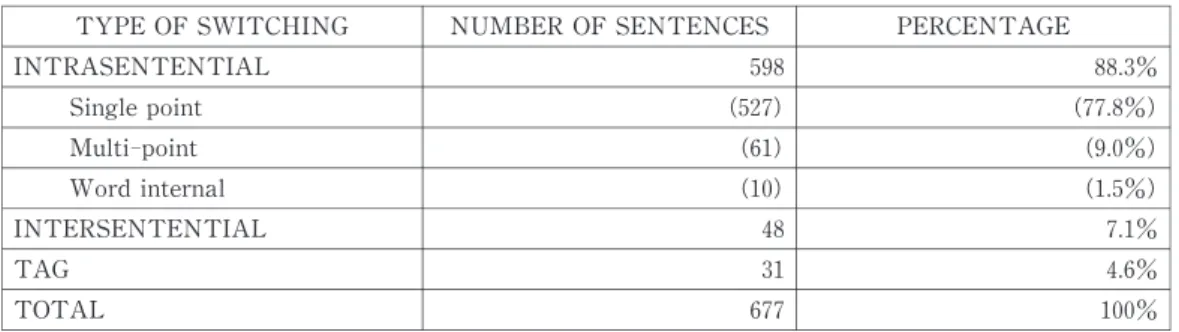
Table 1shows the numbers of sentences that contained each of these types of code‑switch-
ing.
TYPE OF SWITCHING NUMBER OF SENTENCES PERCENTAGE
INTRASENTENTIAL 598 88.3%
Single point (527) (77.8%)
Multi‑point (61) (9.0%)
Word internal (10) (1.5%)
INTERSENTENTIAL 48 7.1%
TAG 31 4.6%
TOTAL 677 100%
Table 1:Types of code‑switching in the Fukuoka JET Programme newsletter.
3.1 Intrasentential switching
Intrasentential switching made up the bulk of the data (88.3% of switched sentences), and was subdivided according to the position of the switch(es)into:single point (examples 9
and 10), multi‑point (examples 11 and 12), and word‑internal (examples 13 and 14).
Single point intrasentential switches were most numerous and the figure of 77.8% here is similar to the84% reported by Cook (1996,
p.85).
(9)across the inaka of Japan,itʼs harvest time again
[inaka=rural districts]
(10)my quickly becoming kusai garbage
[kusai=smelly]
(11) Women are moving up from the jimusho to the kyoto‑ senseiʼs desk[but]
kocho is still out of sight
[jimusho = office;kyoto‑sensei = vice
‑principal;kocho=principal]
(12)Tatemae,gomasuri and oseji may be effective techniques of socialization, but theyʼve hampered my honne .
[tatemae=surface or professed intention;
gomasuri= flattery;oseji = compliment;
honne=true feeling or intention]
(13)in the genki est voice I can muster
[genki=cheerful, enthusiastic]
(14) I was naru hodoʼd to learn that Tanaka‑sensei had been to twenty coun-
tries
[naru hodo = of course, now I see]
[‑sensei=suffix for teachersʼnames]
3.2 Intersentential switching
Intersentential switching occurred in 7.1% of code‑switched sentences and was used pri-
marily in quoting what people had said in conversations. Quotes were from both native Japanese speakers (example 15) and the authors themselves (example 16).
(15)she immediately went into hysterics:
“Wakata! Wakata! Wakata! Eigo!”
[=“I understood!I understood!I under- stood English!]
(16)I gave a remarkably short speech...
“Tammy Hennessy desu. Canada no Toronto kara kimashita. Doozo yoroshiku onegaishimasu.”
[=“Iʼm Tammy Hennessy.I come from Toronto, Canada. Please look after me.”]
3.3 Tag switching
Tag switching constituted 4.6% of switches and took the form of parenthetical comments
(example 17) or formulae inserted into the text (example 18).
(17) Non‑renewers split (samishii ne), newcomers arrived, chaos ensued
[= sad/lonely, isnʼt it] [The English slang ʻsplitʼmeans ʻ departedʼ]
(18) a huge gokekkon omedetou gozaimasu to all those JETs who have just gotten married
[=congratulations on your wedding]
The distinction between intersentential swit- ching and tag switching was not always clear because some formulaic tags were outside sentence boundaries (example 19).
(19)Once again I ask for your considera- tion and support.O negai itashimasu!
[=Please!]
For the purposes of this study,formulae were called tag switches even when occurring intersententially. One case (example 20)
stood out,however,both for its indeterminate nature(tag or intersentential switch)and the fact that it included three languages (English then Spanish/Japanese).
(20) The doorʼs always open:mi jutaku es su jutaku desu.
[jutaku=house;phrase from Spanish:mi casa es su casa=my house is your house]
This section has described the incidence and categorization of code‑switching found in the data. The following section provides a more
in‑depth analysis of the instances of code
‑switching and possible reasons for their occurrence.
4.Research Question Two:When and why is code‑switching employed?
Perhaps above all else,use of code‑switching would appear to demonstrate a desire to claim membership of the ʻ in‑groupʼand thus create solidarity (see Section 2;and Crystal,
1997,p.42).The in‑group in the current study refers primarily to the JET Programme par-
ticipants in Fukuoka (approximately 150 people) but also includes the community of Westerners residing in Japan.The title of the publication,ʻTrue Gaijinʼ [gaijin=foreigner/
outsider],is interesting because Japanese use of the word gaijin often offends members of this group. The word gaijin also occurred in
25(16%)of the articles analyzed,sometimes in a neutral way(example21)and sometimes to reflect perceived discrimination (example
22).
(21)a club frequented by many gaijin
(22) No matter how great I get at Ikebana, Iʼm only ever going to be a gaijin
[ikebana=Japanese flower arranging]
Contributors to and readers of this newsletter were almost all members of the same group and so most writers were well aware of the abilities and personalities of their audience.
This may have influenced the use of code‑
switching through positive feedback in that, because authors knew their audience inserted Japanese into their everyday speech, and because previous articles included code‑swit-
ching, it may have seemed normal (“unmar- ked”in Myers‑Scotton 1988). Authors may also have thought that they would be seen as patronizing if they translated everything into English. In addition, the writers came from several different countries and were perhaps conscious of differences in the varieties of the English their readers spoke(especially Amer-
ican and British English),so they might have been even more inclined to use Japanese in order to make certain words neutral. Exam-
ples of this would be kocho[AmE =principal;
BrE = headteacher] or shogakko[AmE =
elementary school;BrE =primary school].
For convenience,the data will be divided into the three code‑switching categories de-
scribed in Section 3 although, inevitably, there will be some overlap in the motivation for their utilization.
4.1. Intrasentential Switching
As reported in Section 3,intrasentential swit-
ching was the most frequently occurring type, with a total of 196 different Japanese words involved in these switches.There is no space here to give the full list,but a few categorized examples of some of the words are presented in Table 2 below. Incidences were based on numbers of articles in which words appeared rather than word counts because it was felt
WORD
GROUP EXAMPLES INCIDENCE
(No. of articles) Work kencho[local government office];kocho[principal];monbusho[Ministry
of Education];nenkyu[paid leave]; shutcho[business trip];meishi
[business namecard]
108
People gaijin[foreigner]; sensei[teacher]; kocho[principal]; sarariiman
[businessman];‑san[polite address form]
105
Food/drink natto[fermented soybeans];obento[lunchbox];ocha[green tea];onigiri
[riceball];yakitori[grilled chicken];yatai[food stall]
92
Culture ikebana[flower arranging];enka[old Japanese songs];shodou[calligra phy];hanami[cherry blossom viewing]
- 43
Language kanji[Chinese characters];kotowaza[proverb/saying];nihongo[Japanese];
pera pera[fluent]
27
Travel shinkansen[bullet train];onsen[hot spring];omiyage[souvenir gift] 25 Home/life gomi[rubbish/trash];kyoshokuin jutaku[teachersʼapartments];tatami
[reed matting];kotatsu[heated table]
24
Adjectives
or feelings genki[cheerful/healthy];kawaii[cute];sukebe[lewd];oishii[delicious] 21 Other man[ten thousand];inaka[rural district];tatemae[professed intention] 39 Table 2:Categorization and examples of Japanese lexical items found in the study articles
[ note:there is some overlap because words fall into more than one category,e.g.kocho is in both the work‑related group and the people group.]
that word counts would misrepresent the situation. For example, the word bunraku [=
Japanese puppet show]appeared in only one article but occurred 13times,whereas tatami
[=reed matting]appeared in six articles but the word count was just eight.
As might be expected, most Japanese words were related to life in Japan ‑work, people,
food and drink, culture, language, travel and so on.Although knowing these words is bene-
ficial, this does not directly explain their use in articles written for fellow English speakers. In many cases it seems that,
because the concepts involved are Japanese, the use of Japanese follows in much the same way as kimono has been adopted into the English lexicon. Examples of such words include foods such as natto [fermented soy-
beans], onigiri[rice balls] and yakitori
[grilled chicken]; other examples include yukata[light cotton kimono], tatami[reed matting],enka[old Japanese songs],hanami
[cherry blossom viewing],and so on.English equivalents were often absent perhaps because authors felt that, in this situation, it was more appropriate or accurate to use Japanese. This may explain the incidence of words such as shodou[Japanese calligraphy],
ocha[green tea],budo[martial art],ikebana
[flower arranging], and onsen[hot spring].
Many of these words describe aspects of Japanese culture that the writers were study-
ing and so may also reflect genuine interest in and respect for Japanese language and cul-
ture. Respect probably also accounts for the
adoption of the Japanese terms of address such as ‑san and ‑sama [honorific suffixes for names], and sensei [teacher]. For exam-
ple (23)and (24)below.
(23) weʼve asked... the legendary Inoue
‑sensei to add an air of refinement
(24) Day Smith is one of the most well
‑known and best professional[BMX]
freestyle riders in the world... the ever
‑present presence of Day Smith‑sama...
Interestingly, Japanese adaptations of Eng- lish words also appeared;for example,sarar- iiman[businessman; office worker], and yankii[youths who dye their hair and behave anti‑socially;not equivalent to “Yankee”as in American]. Despite criticism of such ʻ Ja-
plishʼwhen used by Japanese speakers,these words occurred in articles quite frequently
(sarariiman:8 times;yankii:4 times) in sen- tences such as (25)and (26).
(25) I sat next to a traditional‑looking sarariiman
(26)a Yankii pulled up next to me
It could be argued that the use of such Japanese loanwords does not demonstrate code‑switching, but I believe that it does because normal native English speakers would probably not understand these sen-
tences correctly and the writers could have
used English terms, such as, “Japanese businessman”instead of sarariiman. To the English‑speaking community in Japan, these terms may activate relevant schemata (see Carrell, 1983)more fully than their (native)
English equivalents. They may, for instance, distinguish between Japanese sarariiman and Western male office workers, with a sarar-
iiman schema including perhaps: working long hours, always wearing a suit, going to karaoke bars after work, and so on.
The authors were mainly recent university graduates and many probably had no direct prior experience of some work‑related con-
cepts, leading them to adopt Japanese terms such as:nenkyu[paid leave], shutcho[busi-
ness trip], and meishi[namecards]. Also, as teachers in Japanese schools, they would be used to referring in Japanese to the people they meet in this environment:kocho [princi-
pal], ‑sensei [teacher honorific suffix], ichinensei[first year students], etc.. Thus, example (27) may invoke a richer schema than its English equivalent.
(27)[I was]trailed by a growing proces- sion of curious shogakusei
[shogakusei=primary school students]
Some Japanese words might have been used because they were shorter or more efficient in expressing certain concepts, which pos-
sibly accounts for the occurrence of:kencho
[local government office of the prefecture];
monbusho[Ministry of Education, Science and Culture];kanji[Chinese characters];and inaka[isolated rural districts]. The same may be true for sentences that referred to money, a common unit of currency being the man[ten thousand]yen note (example 28).
(28)[My boss said]if you earn 10man a month I want you to work as if you are getting 25man
Another important and extremely interesting reason for the use of intrasentential code
‑switching is the humorous effect it can produce:heightening contrast (example 29);
substitution in common sayings (examples 30 and 31);and word internal lexical surprises (examples 32‑35). Note that example (30) includes the Japanese loanword bijinesu origi- nally borrowed from the English word busi- ness, but now used in its Japanese form by a native English speaker. This spelling might not even be recognized as the word business by most native English speakers. Some researchers might argue that this is not code
‑switching,but I have included it because the writer has obviously made a choice to use the non‑typical spelling to indicate how a Japanese person might say the word, and is therefore using code‑switching as a kind of parody.
(29) what started out as a kawaii mon- key, ended up as a chest‑pounding frea- ked‑out angry ape[kawaii=ʻcuteʼ]
(30)[While practising Judo]Iʼm going about my bijinesu throwing poor Ishii
‑kun
[‑kun=name suffix for boys;bijinesu= business; play on English phrase: going about my business]
(31)I still remember my first gomi expe- dition... like it was kinou
[gomi=junk,rubbish;kinou=yesterday;
play on the English phrase: like it was yesterday]
(32) This is a great chance to promote kenship
[“ken”= prefecture;kenship alludes to ʻkinshipʼ]
(33) one bright and breezy morning we ikimashoo ed
[“ikimashoo” = “letʼs go” (volitional form of verb iku =to go)]
(34)another ten minutes of yoroshikuing, doozo ing
[“doozo yoroshiku”=a greeting phrase, and not a verb!]
(35) an aloof man who seemed uncom- fortable with my gaijinity
[gaijin= foreign;gaijinity = foreigness, but humorously alluding to virginity?]
It should be mentioned that some instances of multi‑point intrasentential switching (see
example 12 above) might be attempts at humor in that the writer presumably realizes that it is uncomfortable to read such sen-
tences and has therefore marked the sen- tence. Alternatively, these kinds of sentence could have been written by authors who wanted to show off their extensive knowl-
edge of Japanese.It is hard to understand the motives of these writers without interviewing them individually. In addition, the way in which these sentences are understood or the audienceʼs reaction to them would be very interesting to discover.
4.2. Intersentential Switching
Intersentential switching was mainly to report speech (examples 36‑38). It could be said that such quotation is not really code
‑switching in that it is simply an exact repeti- tion of what was said, but this argument misses the point that the writer could have provided a translation instead of the original language and has therefore made a conscious decision to switch. The writer makes the assumption that his or her audience will understand the Japanese in the quotation. In most cases,this choice of style was probably used to enliven the text,making the situation more realistic and/or dramatic.
(36) So I said, “nihongo de ii deshou.”
His jaw dropped...
[=“itʼs OK to speak Japanese (Iunderstand).”]
(37) a Japanese cowboy yelling at my
riding technique in Japanese. His final verdict was that I was “ chotto ma ma jozu desu.”
[=“not too bad.”]
(38)[When looking for jobs] I got the same reply:“Gaijin desu ka... gaijin wa dame!”
[= “A foreigner? We donʼt want for- eigners.”]
Another use of intersentential switching was found in one article, about the experience of participating in a traditional Japanese festi-
val, where the author used the same phrase (capitalized)eight times as a kind of framing device, as the extract (39) below demon-
strates.
(39) ...The heat was intense as I stum- bled along, trying to keep my feet under me, literally running with bodies packed all around. “WASHOI! WASHOI!”
I tried to ignore the obvious pain and discomfort and tried to flow with the crowd.Gregʼs face flashed by mine,and I saw he was in a rip tide of half naked bodies surging the opposite way of my crowd. “GREG!”“TIM!”“Aaahhhhhh!”
“WASHOI!”...[“Washoi!”=a team shout or cheer]
4.3. Tag Switching
As shown in Section 3, tag switching gener-
ally took the form of comments and Japanese polite formulae,which normally only occur in spoken discourse. McCarthy and Carter
(1994, p.8) point out that, although written text usually contains features of written mode, the occasional introduction of speech mode forms may be highly effective in cer-
tain contexts.Thus,the untypical insertion of Japanese tags can be seen to create a special effect,perhaps lightening the tone,such as in
(40)and (41).
(40)[Hokkaido is]home to only about 114ALTs (sabishi, ne)
[sabishi, ne =lonely, eh]
(41) and a hearty o kaeri nasai to all those who took trips over Golden Week
[o kaeri nasai =welcome back]
Also, in some instances, a Japanese formula may emphasize the message both by its untypicality (therefore markedness) and by demonstrating the special in‑group relation-
ship between the message‑giver and recipient (examples 42and 43).
(42)A big domo arigato gozaimashita to Kay.
[domo arigato gozaimashita =thank you very much indeed]
(43) I would like to acknowledge the ladies who prepared the food. Otsukar-
esama deshita!
[Otsukaresama deshita=(lit.)You must be tired;=Good job !]
From the foregoing discussion,it can be seen that there are numerous potential reasons for the presence of code‑switching in these arti-
cles. However, there was much variation, both between articles written by different authors and within the work of a single author, and this is the subject of the next section.
5.Research Question Three:What variation exists and what factors influence this varia-
tion?
The 158newsletter articles in this study were written by63authors and there was consider-
able variation in the incidence of code‑swit- ching both between authors and within the work of individuals. The majority (56
writers) utilized Japanese words or phrases but seven writers used no Japanese and 20of those who did code‑switch also produced at least one article with no switching.
5.1. Inter‑writer Variation
In an attempt to find possible sources for variation, statistical analyses were perfor-
med to test the following three factors:
Japanese ability, age, and article topic.
5.1.1. Japanese Ability
Based on the researcherʼ s personal knowl-
edge and information from other sources (mainly subjectsʼown self‑estimates),the 49 article writers for whom information was available were divided into four levels of Japanese ability, from 1 to 4 (1 denoting advanced level; and 4 denoting low level).
The incidences of code‑switching (percent- age of article sentences) used by these four groups were compared using a one‑way Analysis of Variance (ANOVA) (see Table
3).
The F‑ratio for the between‑group estimate and the within‑group estimate was 1.64
(p> 0.1)so there was not a statistically sig- nificant difference between any of the means of the four groups.It would therefore appear that the degree of use of code‑switching by these authors was not related to their Japanese ability. However, caution should be exercised because, firstly, ability levels were mainly self‑estimates and,secondly,not all authors were included in the analysis.
5.1.2. Age
Authors were divided into three groups according to age:Group A (23‑25years old),
Group B (26‑28 years old), and Group C (29+ years old). It should be noted that age did not indicate length of time in Japan,since most individuals had come on the JET Pro-
gramme and had therefore been in the country for less than three years. For exam-
ple, one person in his mid‑thirties had only
been in Japan for six months, while one 24‑year‑old had lived in Japan for three years.
A one‑way ANOVA was applied to compare code‑switching by the three age groups and the F‑value was calculated to be 5.35
(p 0.01),thus showing a statistically signifi- cant difference between the means at the 1%
significance level (see Table 4). To deter- mine which means were significantly differ- ent, an LSD range test was performed using Fisherʼs Least Significant Difference proce-
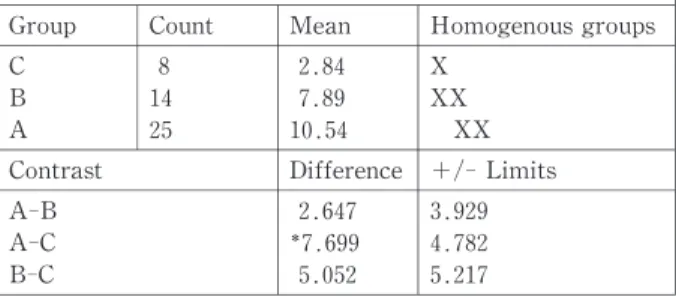
dure (see Table 5). From this it was found
that the means for the younger age group (A) and the older group (C) were significantly different from one another, which would seem to indicate that age might have been a factor in determining the amount of code
‑switching, with younger authors tending to employ a greater number of switches than older authors. If true, this may reflect a stronger desire on the part of younger people to belong to the in‑group and to appear tren-
dy, older authors either writing from outside the group or not feeling the same pressure to conform to in‑group language.Of course,this
Age group N Mean SD Min. Max.
A (23‑25years) 25 10.54% 5.40 0.0% 20.0%
B (26‑28years) 14 7.89% 7.44 0.0% 23.7%
C (29+ years) 8 2.84% 3.41 0.0% 8.88%
Source Sum of
squares DF Mean
square F‑ratio P‑value
Between Groups 365.248 2 182.624 5.35 p 0.01 Within Groups 1501.24 44 34.119
TOTAL (corr.) 1866.49 46
Table 4. ANOVA results for comparison of author age and percentage of code‑switched sentences.[Please note that author age does not indicate length of time in Japan]
Japanese Ability (1=high;4=low)
N Mean SD Min. Max.
1 8 10.23% 7.21 0.0% 23.7%
2 8 12.46% 7.45 0.0% 24.2%
3 22 7.37% 6.07 0.0% 18.0%
4 11 6.97% 5.74 0.0% 15.7%
Source Sum of
squares DF Mean
square F‑ratio P‑value
Between Groups 202.942 3 67.647 1.64 0.1937 Within Groups 1857.400 45 41.275
TOTAL (corr.) 2060.340 48
Table 3. ANOVA results for comparison of Japanese ability and percentage of code‑switched sentences.
needs to be investigated further through author surveys and interviews.
5.1.3. Article Topic
For the purposes of analysis, articles were divided into ten categories according to topic
(and one miscellaneous category).The topics were as follows. A: group information; B:
computers; C: editorial; D: education/work;
E: Japanese culture; F: life/experiences in Japan;G:travel in Japan;H:music;I:travel overseas;J:life/experiences in home country.
The means for the percentage of code‑swit- ched sentences for each of these groups were compared by ANOVA and this generated an F‑value of8.133(p 0.05),indicating that the means were significantly different at the 5%
significance level (see Table 6). Information
RESPONSE VARIABLE =% code‑switched sentences METHOD:95.0% LSD
Group Count Mean Homogenous groups
C 8 2.84 X
B 14 7.89 XX
A 25 10.54 XX
Contrast Difference +/‑Limits
A‑B 2.647 3.929
A‑C 7.699 4.782
B‑C 5.052 5.217
Table 5. Range test to compare the code‑switching means of three age groups.
(* denotes a statistically significant difference)
Article Type N Mean SD Min. Max.
A 15 15.40% 6.71 1.6% 31.8%
B 4 0.25% 0.50 0.0% 1.0%
C 17 12.70% 7.37 4.3% 30.8%
D 15 8.85% 7.70 0.0% 22.7%
E 12 15.40% 10.10 2.6% 31.0%
F 39 10.20% 9.14 0.0% 38.6%
G 13 12.30% 7.08 2.6% 31.5%
H 5 2.40% 5.37 0.0% 12.0%
I 18 1.14% 1.85 0.0% 7.0%
J 12 1.15% 2.69 0.0% 7.0%
Source Sum of
squares DF Mean
square F‑ratio P‑value
Between Groups 3910 9 434.500 8.133 p 0.05
Within Groups 7480 140 34.119
TOTAL (corr.) 11390 149
Table 6. ANOVA results for comparison of article type and percentage of code‑switched sentences
from the group representatives (A), editori- als (C),and articles about Japan (topics E,F, G),were more likely to have a high incidence of code‑switching;while articles about com-
puters (B), music (H), overseas travel (I), and home countries (J) were more likely to have low use of switching.Education or work
‑related articles (D)fell somewhere between high and low use.
This finding is not altogether surprising in that it is only natural for articles about Japan to contain more Japanese words than articles unrelated to Japan. The editorials and local group information were also high in Japanese use and this may be due to the mainly light
‑hearted nature of their content, the authors also, perhaps, wishing to appear trendy and to establish rapport with the readership by using the in‑group language. Education and work‑related articles,however,despite being related to experiences in Japan, were more serious and used less Japanese, authors usu-
ally writing from an expert standpoint.
5.2. Intra‑writer Variation
Where authors had contributed more than one article, considerable intra‑writer varia-
tion in the amount of code‑switching was observed (although not for all individuals).
This variation can, to a large extent, be explained by topic (see section 5.1.3) as can be seen in Table 7below.
Topic could not have been the only factor involved, however, because there were also instances of authors varying the amount of code‑switching between articles on similar topics. Other factors could have included mood, time spent writing the article, proof
‑reading by another person (and who), and numerous other possible influences. Further-
more, there was evidence of variation within individual articles, where authors used an English term at one point and its Japanese equivalent at another point (see Table 8).In these cases the code‑switching may have been the result of attempts to reduce lexical repetition (see Hoey, 1991).
Author Code Topic code‑switched sentences
CE Harvest time in Japan 34.6%
CE School meeting 14.6%
CE Trip to Nepal 0.0%
DS Editorial 19.2%
DS Advice on weight training 1.1%
JU Editorial 30.8%
JU Trip to Vietnam 0.0%
MH Representativeʼs information 18.8%
MH Civil rights and Catholicism 0.0%
PM Trip to Oroshima, Japan 31.5%
PM Music review 0.0%
Table 7:Examples of intra‑writer variation in code‑switching related to article topic.
This section has attempted to describe and explain some of the variation in code‑switch-
ing frequency in the data.Much of the varia- tion was apparently due to article topic but this was also subject to individual character-
istics (such as age) and other factors which have yet to be determined.Ellis (1994,p.136)
supports the existence of so‑called ʻfree vari- ationʼin the insertion of second language structures but admits that the code‑switching may well be systematic and “the researcher has simply failed to uncover the factors which make it systematic”(Ellis,1994,p.136;
after Tarone, 1988).
6. Conclusion
This paper has focused on code‑switching found in newsletter articles written by and for native English speakers residing in Japan.
Most other research concentrates on code
‑switching in oral interaction, so it is hoped that the current study helps to broaden the picture in this field of sociolinguistic investi-
gation.
It was found that code‑switching was quite extensive in the texts under scrutiny, affect-
ing 77.8% of articles and employed by 88.9%
of article writers (see Section 3). Further analysis of the data established that most of the switching involved the insertion of single Japanese words but there were also multi
‑point insertions, word‑internal switches, intersentential switches and tag switches(see Section 3).Suggestions were given as to why these writers used code‑switching and these included in‑group solidarity, discussion of Japanese concepts, respect for Japanese cul-
ture and people, richer schema activation, habit, efficiency, comic effect, realism and dramatic effect, framing, and emphasis (see Section 4). Statistical analysis of the varia-
tion both between different authors and within the work of individual authors revealed that the greatest influence on swit-
ching was probably article topic, but that individual characteristics such as age may also have played a part, although Japanese ability did not seem to have affected use(see Section 5).
Unfortunately this study is rather narrow in that it examines only the code‑switching found in a single publication, although the
Author Code Word Frequency within single article
AM Gaijin x8
Foreigner x1
Outsider x1
Non‑Japanese x2
CE Gomi x2
Garbage x5
trash x2
Table 8:Two examples of articles where Japanese and English equivalents were used.
![Table 4. ANOVA results for comparison of author age and percentage of code‑switched sentences.[Please note that author age does not indicate length of time in Japan]](https://thumb-ap.123doks.com/thumbv2/123deta/6389827.2134765/14.816.179.639.125.356/table-results-comparison-percentage-switched-sentences-please-indicate.webp)