• 検索結果がありません。

Palaeoceanographic variability in Late Pleistocene deep-sea sediments of the Wilkes Land margin (East Antarctica): a multi-proxy approach M. Presti

N/A
N/A
Protected

Academic year: 2021

シェア "Palaeoceanographic variability in Late Pleistocene deep-sea sediments of the Wilkes Land margin (East Antarctica): a multi-proxy approach M. Presti"

Copied!
2
0
0

読み込み中.... (全文を見る)

全文

(1)

Palaeoceanographic variability in Late Pleistocene deep-sea sediments of the Wilkes Land margin (East Antarctica): a multi-proxy approach

M. Presti

1

, F.J. Jimenez-Espejo

2

, X. Crosta

3

, L. De Santis

1

, C. Escutia

4

, G. Kuhn

5

, R. G. Lucchi

1

, P. Macrì

6

, S. Schmidt

3

, A.

Caburlotto

1

, R. Tolotti

7

1

Instituto Nazionale di Oceanografia e Geofisica Sperimentale (OGS), Trieste, Italy

2

Department of Biogeosciencies,

(JAMSTEC), Yokosuka, Japan

3

UMR-CNRS 5805 EPOC, Université Bordeaux I, France

4

Instituto Andaluz de Ciencias de la Tierra (CSIC-UGR), Spain

5

Alfred-Wegener-Institut Helmholtz Zentrum für Polar- und Meeresforschung (AWI), Bremerhaven,

Germany

6

Istituto Nazionale di Geofisica e Vulcanologia (INGV), Rome, Italy

7

DipTeRis, Università degli Studi di Genova, Italy

Recent studies point that the East Antartic Ice Sheet (EAIS) was more sensitive than expected to global surface temperature variations (Cook et al., 2013; Patterson et al., 2014). Certain EAIS areas, as the Wilkes Land sector, have been specially investigated because the overlying Wilkes Subglacial Basin is partly grounded below sea level and, thus, is potentially highly sensitive to sea-level variations. In addition, in Wilkes Land the Adélie Land Bottom Water (ALBW) is originated on the continental shelf (Rintoul, 1998). The ALBW is a large component of the Antarctic Bottom Water (AABW), whose production is fundamental for the deep-water circulation of the world ocean and for the transfer of CO

2

to the deep ocean (Sigman et al., 2010).

In order to study paleoceanographic and sedimentological changes in this region for the last ~700 ka on the continental slope four different cores from the margin will be compared in order to discriminate between local vs. regional variations in a complex sedimentological environment such as the Antarctic margin. Studied sediment cores generally yield an alternation of diatom-bearing hemipelagic silty-clays rich in Ca and Ba, corresponding to interglacial stages, and greenish-grey muddy sediments deposited during glacial stages, enriched in Al, K, Ti and Fe among other elements. The only site with sediments older than the Mid-Brunhes Event (MBE, 430 ka BP) records the influence of a larger ice-sheet margin and/or greater terrigenous delivery to the core sites before the MBE, with a lower variability in the abundance of elemental proxies between glacial and interglacial intervals. In all sites, glacial deposits show a difference in characteristics after the MIS 6 /MIS 5 transition (130 ka BP) compared to older glacial material. After 130 ka BP, coarser turbiditic layers and packages of silt/clay laminations become less common, indicating a lower down-slope density currents intensity during post-MIS 6 glacial periods.

Redox-sensitive elements (Mn and Ni) show distinct enrichments predominantly during glacial to interglacial transitions almost during the entire studied period. These enrichments have been interpreted as post-depositional migration of redox fronts and re-oxidation of sediment layers. The extensive reoxidation events have been linked to major ocean circulation changes along the entire margin at the onset of a deglaciation. Described changes can be explained by variations in the ice-sheet extension and in the rate of well oxygenated deep-water formation along the margin.

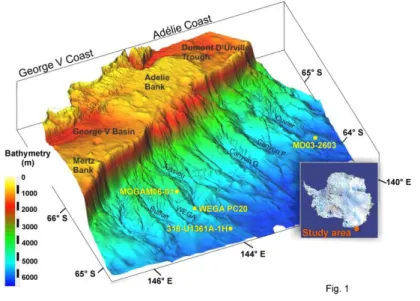
Figure 1. Antarctic margin (Wilkes Land) bathymetry map and location of the studied site from different marine campaigns: WEGA-PC20,

MOGAM06-01, CADO-MD03-2603 and IODP U1361.

(2)

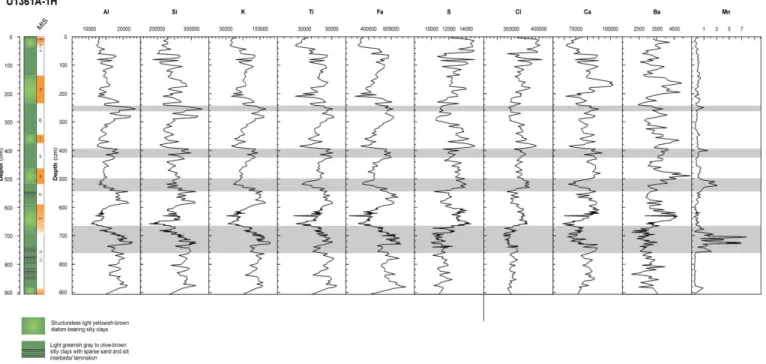
Figure 2. Core U1361A-1H depth profiles of different elements (Al, Si, K, Ti, Fe, S, Cl, Ca, Ba and Mn). Orange bars indicate Marine Isotope Interstadials. Grey bars indicate Mn enrichments.

References

Cook, C.P., T. van de Flierdt, T. Williams, S.R. Hemming, M. Iwai, M. Kobayashi, F.J. Jiménez Espejo, C. Escutia, J.J.

González, B.K. Khim, R.M. McKay, S. Passchier, S.M. Bohaty, C.R. Riesselman, L. Taxue, S. Sugisaki, A. Lopez Galindo, M.O. Petterson, F. Sangiorgi, E.L. Pierce, H. Brinkhuis and IODP Expedition 318 Scientists, Dynamic behaviour of the East Antrartic ice sheet during Pliocene warmth, Nature Geosciences, 6, 765-769, 2013.

Patterson, M.O., R. McKay, T. Naish, C. Escutia, F.J. Jimenez-Espejo, M.E. Raymo, S.R. Meyers, L. Tauxe, H. Brinkhuis and Exp. 318 Scientist, Orbital forcing of the East Antartic Ice Sheet during the Pliocene and Early Pliocene, Nature Geosciences, in press, 2014.

Sigman, D., M.P. Hain, G.H. Haug, The polar ocean and glacial cycles in atmospheric CO

2

concentration. Nature 466, 47-55, 2010.

Rintoul, S.R., On the origin and influence of Adélie Land bottom water. Ocean, Ice and Atmosphere: Interactions

at the Antarctic Continental Margin. American Geophysical Union, Washington DC, 151–171, 1998.

Figure 1. Antarctic margin (Wilkes Land) bathymetry map and location of the studied site from different marine campaigns: WEGA-PC20,  MOGAM06-01, CADO-MD03-2603 and IODP U1361
Figure 2. Core U1361A-1H depth profiles of different elements (Al, Si, K, Ti, Fe, S, Cl, Ca, Ba and Mn)

参照

関連したドキュメント

Laplacian on circle packing fractals invariant with respect to certain Kleinian groups (i.e., discrete groups of M¨ obius transformations on the Riemann sphere C b = C ∪ {∞}),

The only thing left to observe that (−) ∨ is a functor from the ordinary category of cartesian (respectively, cocartesian) fibrations to the ordinary category of cocartesian

Eskandani, “Stability of a mixed additive and cubic functional equation in quasi- Banach spaces,” Journal of Mathematical Analysis and Applications, vol.. Eshaghi Gordji, “Stability

Finally, we give an example to show how the generalized zeta function can be applied to graphs to distinguish non-isomorphic graphs with the same Ihara-Selberg zeta

As with subword order, the M¨obius function for compositions is given by a signed sum over normal embeddings, although here the sign of a normal embedding depends on the

We present sufficient conditions for the existence of solutions to Neu- mann and periodic boundary-value problems for some class of quasilinear ordinary differential equations.. We

It turns out that the symbol which is defined in a probabilistic way coincides with the analytic (in the sense of pseudo-differential operators) symbol for the class of Feller

Then it follows immediately from a suitable version of “Hensel’s Lemma” [cf., e.g., the argument of [4], Lemma 2.1] that S may be obtained, as the notation suggests, as the m A