TOKYO METROPOLITAN UNIVERSITY
DISSERTATION FOR A DEGREE OF DOCTOR OF TOURISM SCIENCE TITLE:
Tourism Impact on Environmental Sustainability in the Context of Wildlife Watching Tourism in Protected Areas
: A Study of Elephant Watching Tourism in Udawalawe National Park, Sri Lanka AUTHOR
RANAWEERAGE Eranga Hemanthi Ranaweera
EXAMINED BY Chief Examiner
Examiner
Examiner
QUALIFIED BY
THE GRADUATE SCHOOL OF URBAN ENVIRONMENTAL SCIENCES Dean
Date
TOKYO METROPOLITAN UNIVERSITY
Tourism Impact on Environmental Sustainability in the Context of Wildlife Watching Tourism in Protected Areas
: A Study of Elephant Watching Tourism in Udawalawe National Park, Sri Lanka
DOCTORAL DISSERTATION SUBMITTED TO
THE GRADUATE SCHOOL OF URBAN ENVIRONMENTAL SCIENCES IN PARTIAL FULFILLMENT OF THE REQUIREMENT FOR
THE DEGREE OF DOCTOR OF TOURISM SCIENCE
DEPARTMENT OF TOURISM SCIENCE
BY
RANAWEERAGE ERANGA HEMANTHI RANAWEERA
2013
CONTENTS
Acknowledgements
Abstract
List of figures
List of tables
List of plates
I. INTRODUCTION 1
II. CLASSIFICATION OF WILDLIFE WATCHING TOURISM, ITS IMPORTANCE
AND ISSUES IN PROTECTED AREAS 9
1. Classification of wildlife watching tourism in protected areas 9
2. Importance of wildlife watching tourism 13
3. Environmental issues associated with wildlife watching tourism 18
III. WILDLIFE WATCHING TOURISM IN SRI LANKA 27
1. Trends in tourism and status of wildlife watching tourism in Sri Lanka 27
2. Conservation and recreational value of Udawalawe National Park in Sri Lanka 37
2.1. Conservational value of Udawalawe National Park 37
2.2. Elephant watching tourism at Udawalawe National Park 40
IV. CHARATERISTICS, VALUES AND BEHAVIOR OF WILDLIFE WATCHING TOURISTS
: CASE STUDY OF UDAWALAWE NATIONAL PARK IN SRI LANKA 44 1. Measuring tourists’ characteristics, values and behavior 44 2. Specialization and wildlife values of tourists 50 3. Tourist behavior during elephant watching tours 55
4. Implications for visitor management 61
V. TOURISM DISTURBANCE ON WILDLIFE
: CASE STUDY OF ELEPHANT WATCHING TOURISM AT UDAWALAWE
NATIONAL PARK IN SRI LANKA 65
1. Measuring tourism disturbance on wildlife 65
2. Directions for observation of elephant behavior 70 3. Observation of elephant behavior in relation to elephant watching tourism 72 4. Behavioral responses of elephants to tourists 85
5. Implications for mitigating disturbance 89
VI. CONCLUSION 107
Bibliography 111
Appendix 124
ACKNOWLEDGEMENT
First, I would like to thank the Ministry of Higher Education, Sri Lanka and the Ministry of Education, Culture, Sports, Science and Technology, Japan for approving and accepting me as a government scholar to conduct this study. Equally, my deepest gratitude goes to Prof. Toshio Kikuchi, my supervisor for all his guidance, assistance, advice, understanding, encouragement and appreciation extended to me in studies as well as life in Japan. This study has been enhanced by his valuable contribution. Comments and suggestions by the professors, associate professors and assistant professors as well as the students in the department of tourism science, Tokyo Metropolitan University also contributed to improve this study. I owe all the map data in this research to Mr. Naoto Yabe, former Assistant Professor and a GIS specialist in the Department of Tourism Science. He was always available for assistance whenever I required his guidance even after he left Tokyo Metropolitan University. I also acknowledge the support and assistance given to me for statistical analysis by Mr. Koun Sugimoto, my fellow doctoral candidate, Mr. Takuya Koike in the master course and specially, Mr. Shantha Hewage at Tokyo University. Their work added a significant value to this study.
I thank Professor Devaka Weerakoon, University of Colombo, Sri Lanka for being the principal coordinator of my research in Sri Lanka, obtaining research permission from the department of wildlife conservation to conduct research at Udawalawe National Park in Sri Lanka, and introducing Mr. Ashoka Ranjeewa as research assistant for field observations. I thank Ashoka and all the people who helped me in fieldwork. Ashoka’s previous research experience about elephants at Udawalawe national park was a distinct advantage for elephant behavioral observations in this study.
I thank my friends in Sri Lanka, Ms. Tomoe Koide, Mrs. Madumi Perera and Mrs. Nayomi Wijesekara for their endless support by coordinating my research with various relevant parties in Sri Lanka. I could not have achieved this without their support. I also wish to thank Mr. Loshaka Perera, a senior lecturer at the University of Moratuwa and his students for their support in conducting the questionnaire survey at Udawalawe National Park.
I always remember with much gratitude, Ms. Noriko Yamada, associate professor at Sapporo City
University, for all her well wishes and encouragement throughout. People like her are hard to find in
today’s world. Finally, I acknowledge the endless support and affection from my family in Sri Lanka and
Japan. I dedicate this work to my father, Mr. Ranaweerage Dayaratne whose sole wish and happiness was
to see me pursuing higher studies.
ABSTRACT
Tourism in natural areas continues to grow. Consequently, the concerns for impact of tourism on environmental sustainability also grow. Wildlife is an important element of natural environment as well as a main attraction and resource for tourism. Non-consumptive uses of wildlife such as wildlife watching in protected areas have become a very popular nature based tourism sector worldwide. This study aimed to examine tourism disturbance on wildlife, which is one of the main concerns for environmental sustainability associated with wildlife watching tourism in many protected areas worldwide.
Studies related to tourism disturbance on wildlife in protected areas are mainly focused on behavioral dimensions of wildlife. Human dimensions of wildlife such as tourist behavior and tourist activities have not been revealed together. Consequently, the result of these studies can only show whether there is a disturbance due to tourism or not, and cannot specify what aspects of tourism is leading to disturbance. Therefore, this study examines both wildlife and tourism aspects simultaneously in identifying tourism disturbance on wildlife and discussing ways to mitigate such impacts. The study is based on elephant watching tourism in a famous national park in Sri Lanka.
Two approaches were taken in the study in revealing tourism disturbance on wildlife. First
approach aimed to identify the characteristics, wildlife values and behavior of tourists and to discuss their
impact on wildlife. Tourist characteristics were revealed based on a concept called recreational
specialization. Wildlife values were assessed based on a wildlife value orientation scale. Direct
observations were conducted to examine tourist behavior during the tours. It is often assumed that people
who participate in non-consumptive wildlife tourism such as wildlife watching are environmental
sensitive and supportive of conservational efforts. However, the results of this study showed that most
tourists to a natural park on elephant viewing were novices with no or less experience and orientation
towards wildlife. As a result, they tended to behave disruptively to wildlife during the tours. Therefore,
identification of tourists in terms of their specialization in the activity and their values provides important
implications for the park management in finding ways to influence tourist behavior to encourage minimal
impacts on wildlife. The second approach of the study aimed to identify how wildlife responds to tourists and to discuss possible causes of disturbance. Focal animal sampling method was used in the behavioral observation of elephants along with individual recognition. Four types of behavioral responses of elephants (alert, fear, stress and aggression) were observed as indicators of disturbance on elephants’
feeding activity in the presence versus absence of tourists. The frequency and the durations of the four responses were significantly high in the presence of tourists compared to the absence of tourists. Certain differences in the way of responding could also be identified among different age-sex-group classes of elephants. Tourist disruptive behaviors such as talking during the tours, close distances when watching elephants, vehicle activity, and the time of the tours were found significant in causing disturbance to elephants, among which tourist disruptive behaviors and vehicle activity were the most influential factors leading to disturbance. Elephants are one of the most attractive wildlife for tourism. At the same time, elephants are one of the most endangered wildlife in the world. Therefore, it is important to mitigate tourism disturbance to wild elephants by adopting calm behaviors, controlled vehicle activity and also appropriate distances and time during the elephant watching tours for the benefit of both tourism and conservation.
Countries with high level of biodiversity, such as Sri Lanka, are popular wildlife tourist
destinations. While tourism provides revenue and contributes significantly to the country’s economy,
increasing pressure of tourism on the natural environment and wildlife tends to be critical. Therefore,
non-consumptive wildlife tourism such as wildlife watching, which is often assumed as harmless and an
environmental friendly tourism suitable for protected areas, can also become detrimental on wildlife if
managed poorly. Comparison of human dimensions of wildlife such as tourist characteristics, wildlife
values and behavior along with the behavioral dimensions of wildlife provides important insight to the
problem and implications for park management in wildlife areas. Protected areas focusing on wildlife for
tourism should monitor behavioral responses of wildlife in relation to tourism activities as a mean of
identifying measures to reduce tourism disturbance on wildlife. Further, the role of interpretation and
guide systems in mitigating tourism disturbance on wildlife is also highlighted in this study.
FIGURES
2-1 Relationship of wildlife-based tourism with other types of tourism 13 2-2 A conceptual model of the responses of wildlife to disturbance 26
3-1 Foreign tourist arrivals to Sri Lanka from 1994-2012 34
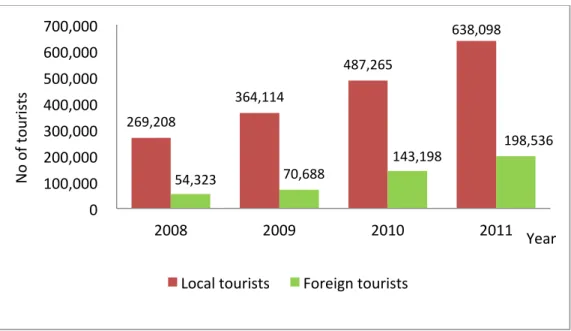
3-2 Number of local and foreign tourists to wildlife parks in Sri Lanka from 2008-2011 35 3-3 Revenue from entrance fees for local and foreign tourists in wildlife parks in Sri Lanka
from 2009-2011 35
3-4 Location of Udawalawe National Park 42
3-5 Park map of Udawalawe National Park 42
3-6 Number of local and foreign tourists to Udawalawe National Park from 2009-2011 43 3-7 Revenue from entrance fees for local and foreign tourists to Udawalawe National Park
from 2009- 2011 43
4-1 Wildlife Value Orientation Scale (WVOS) 49
4-2 The distribution of answers for “To what extent does the opportunity to view wildlife
influence your decision when making for holidays?” 52
4-3 Frequency of participation in wildlife excursions 52
4-4 Visit to the park was main destination or not 53
4-5 Purpose of visit to the park 53
4-6 Equipment ownership of the three groups 53
4-7 Environmental group affiliation of the tourists 54
4-8 Wildlife Values of the tourists to Udawalawe National Park 55 4-9 Behavior of the there groups during elephant watching tours 58
4-10 Group size of the three groups 58
4-11 Behavior of tourists based on the group size 59
4-12 Comparison of behavior between (Individual+couple) and groups 59
4-13 Behavior of the three groups based on the group size 60 4-14 Distance maintained when watching elephants by the three groups 60 5-1 Frequency of overall elephant behavior in the presence vs. absence of tourists 93 5-2 Duration of overall elephant behavior in the presence vs. absence of tourists 93 5-3 Frequency of each behavior in the presence vs. absence of tourists 94 5-4 Duration of each behavior in the presence vs. absence of tourists 94
5-5 Frequency of behavior of female vs. male elephants 95
5-6 Duration of behavior of female vs. male elephants 95
5-7 Frequency of behavior based on age-sex classes of elephants 96 5-8 Duration of behavior based on age-sex classes of elephants 96
5-9 Adult male behavior based on different male group types 97
5-10 Adult female behavior based on different female group types 98 5-11 Sub adult male behavior based on different male group types 98 5-12 Sub adult female behavior based on different female group types 99 5-13 Male elephant (adult male + sub adult male) behavior based on different
male group types 99
5-14 Female elephant (adult female+ sub adult female) behavior based on different
female group types 100
5-15 Comparison of elephant behavior with distance 102
5-16 Comparison of elephant behavior with the vehicle sound 103
5-17 Comparison of elephant behavior with the time of the day 103
BOXES
3-1 Development scenarios for the parks/reserves in Sri Lanka 33
3-2 A tourism impact research in Ruhuna National Park (Yala) in Sri Lanka 36
5-1 List of Dos and Don’ts for watching elephants in the wild in Sri Lanka 105
TABLES
1-1 Number of global protected areas and the land area 6
1-2 Some examples of tourism disturbance research on various wildlife species 7
2-1 Economic Impact of wildlife watching tourism 16
3-1 Summary of tourism strategies and targets of Sri Lanka 31
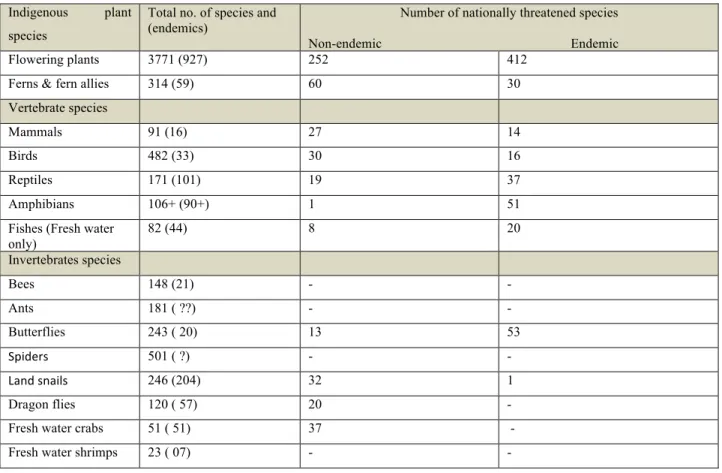
3-2 Species diversity and conservation status of some flora and fauna in Sri Lanka 34 3-3 Conservation status of some wildlife species inhabiting Udawalawe National Park 40
4-1 Factors assessed in Wildlife Value Orientation Scale 49
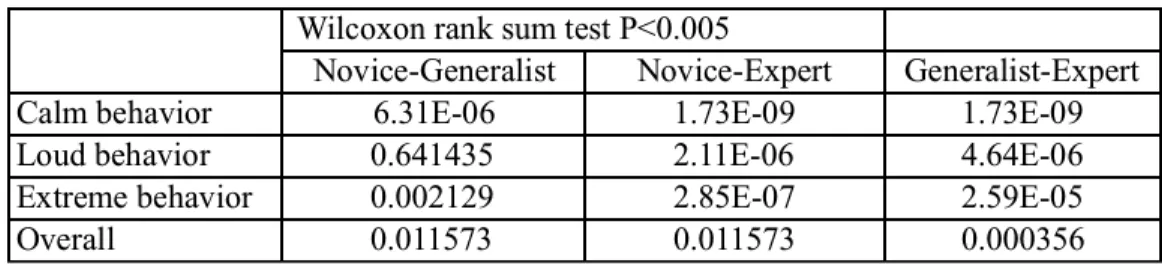
4-2 Comparison of the three groups for each specialization indicator 54 4-3 Pairwise comparisons of behavior of the three tourist groups 56 4-4 Multiple comparisons of behavior of the three tourist groups 56 4-5 Multiple comparisons of different group sizes with behavior 57 4-6 Pairwise comparisons of tourist group sizes with tourist behavior 57 4-7 Comparison between Individual and couples with groups for behavior 57
5-1 Features used to identify elephants individually 76
5-2 Comparison of elephant behavior in the presence vs. absence of tourists 94 5-3 Significance of difference female behavior vs. male behavior 96 5-4 Pairwise comparisons of behavior for difference among different age-sex classes 97 5-5 Fisher’s Exact Test pairwise comparisons of behavior among different group types
of elephants 101
5-6 Fisher’s Exact test pairwise comparisons of behavior with distance based on age
categories 102
5-7 Fisher’s Exact test for comparison of behavior and distance based on group type 102 5-8 Fisher’s Exact test comparison of behavior with the time of the day based on group type 103
5-9 Results of the Binary Logistic Regression analysis 104
PLATES
4-1 Tourists watching elephants at Udawalawe National Park 64
5-1a Different ear features of elephants used for individual identification 77 5-1b Different body shapes of elephants used for individual identification 77 5-1c Example for a body mark of an elephant used for individual identification 78 5-1d Examples of different tail features used for individual identification 78
5-2 Adult male elephant in Udawalawe National Park 79
5-3 Adult female elephant in Udawalawe National Park 79
5-4 Sub adult male elephant in Udawalawe National Park 80
5-5 Sub adult female elephant in Udawalawe national Park 80
5-6 Adult female, infant and juvenile in Udawalawe National Park 81
5-7 Adult female and a newborn in Udawalawe National Park 81
5-8 An adult male and a sub adult male in Udawalawe National Park 82
5-9 An adult female (on the right) and a sub adult female 82
5-10 Male pair Udawalawe National Park 83
5-11 Male group in Udawalawe National Park 83
5-12 Small Cow-calf group in Udawalawe National Park 84
5-13 Medium cow-calf group in Udawalawe National Park 84
5-14 Large cow-calf group in Udawalawe National Park 85
5-15a Difficulty in observing elephants in the shrub habitat areas 106
5-15b Difficulty in observing elephants in the shrub habitat areas 10
I. Introduction
Protected areas have been very attractive settings and resources for tourism. “The link between protected areas and tourism is as old as the history of protected areas” (Eagles et al. 2002). “The relationship of tourism to conservation can take forms of ‘conflict’, where tourism has adverse effects on the environment or ‘coexistence’, where tourism has no impact on the area in which it operates or
‘symbiosis’, where conservation values are enhanced by tourism” (Lindsay et al. 2008). However, in general “all forms of tourism have impacts on natural environment” (Buckley 2004). Therefore, “the challenge of protected area management is to create a relationship between tourism and conservation that ensures ‘conflict’ is always less than the compensating ‘symbiosis’ so that both ventures will be sustainable” (Lindsay et al. 2008).
Table 1-1 shows the types of protected areas as classified by IUCN management categories.
National parks cover the highest proportion among the six categories in terms of land area. “A significant amount of the world’s most significant biodiversity conservation sites is located in Category I and II sites”
(Eagles et al. 2001). Nature based tourism is highly dependent on the quality of natural environment.
Consequently, protected areas have been the main settings and resources for nature based tourism
worldwide, especially national park is closely associated with nature-based tourism, being a symbol of a
high quality natural environment with a well-designed tourist infrastructure (Eagles et al. 2001). The
recent increase and expansion in this segment of tourism has led to a greater use of parks and other
protected areas by people (Boyle & Samson 1985, Papouchis et al. 2001, Eagles et al. 2001). As a result,
various negative impacts on environment sustainability (The term environment sustainability is used in
this paper with the meaning of ensuring the natural values of the area and protecting such values for
future generations) of protected areas have occurred. Therefore, consumptive uses of natural environment
for tourism have been prohibited or restricted in many protected areas while non-consumptive forms of
tourism have been recommended as an alternative (Blanc et al. 2006). With the expansion of nature based
tourism in many parts of the world, there is a growing concern that the non consumptive uses for tourism can also have detrimental effects on the natural environment (Knight and Cole 1995).
Wildlife is the main tourism attraction in natural parks in many countries. For example, wildlife is the number one tourism resource in national parks in Australia (Eagles et al. 2002). Many parks encourage non-consumptive uses of wildlife for tourism such as observing and taking photographs in which wildlife is not permanently removed or killed. This type of tourism is called “wildlife watching tourism”. It is different from viewing animals in a captive environment (such as a zoo) because tourists have to visit the natural areas where animals actually exist and animals are not brought to where people live. Wildlife watching tourism is chosen by protected areas for its non-consumptive nature and with the aim to foster a symbiosis relationship between conservation and tourism. In the past, non-consumptive wildlife tourism has been considered relatively harmless in terms of its effects on wildlife. However, there is growing concern that activities such as wildlife viewing, photography, and even the simple act of walking through an animal’s territory, can have serious negative impacts on wildlife (Knight & Cole, 1995). These impacts may be easily noticeable such as habitat modification or can be very subtle such as disturbance on wildlife (Beale 2007, Taylor and Knight 2003). Many wildlife face habitat changes linked with tourism activities and these potential threats have already been well documented and many protected areas aim at reducing their impact (e.g. Madsen and Fox 1995, Madsen et al. 1998). However, disturbance induced by non-consumptive tourism like wildlife watching has long been neglected (Blanc et al., 2006).
“Tourism induced disturbance is increasingly becoming a concern to environmental sustainability”
(Wight 2002) and “in the current context of rapid increase of these activities, it seems essential to quantify their effects on wildlife” (Blanc et al. 2006). Therefore, this study focuses on tourism disturbance on wildlife in discussing the impacts of tourism on environmental sustainability in protected areas.
“Disturbance is any deviation from normal behavior in response to unexpected occurrences in the
vicinity of animals” (Beale, 2007). Changes in animal behavior are the most obvious consequences of
human activities, also the easiest to detect in understanding impacts (Constantine et al. 2004, Dyck and
Baydack 2004). “The reaction of an animal to a potential disturbance is the result of a complex trade-off
between many factors acting at various levels, from the propagation or perception of the disturbance to its interpretation by the animal, and its choice to respond to it or not” (Beale 2008). Among these factors are
“the individual paradigm and characters, genetic, behavioral (Shy or not), physiological (body-condition, stress hormones), social (dominant or subordinate), historical and secondly the environmental conditions such as refuge availability, climate conditions, etc.” (Blanc et al. 2006).
Table 2 includes some examples for studies on tourism disturbance on different wildlife species based on the behavioral responses of wildlife. For example, Constantine et al. (2004) observed five behavior patterns of bottlenose dolphins in the presence of tourist boats for one year and found out decreased resting, forage, social behaviors in dolphin schools due to tourist activities. Dyck and Baydack (2004) revealed the vigilance behavior of different age, sex classes of Polar bears in the presence of tourist vehicles in Churchill, Canada and found out that the vigilance clearly increased in the presence of tourists compared to absence of tourists. They also found out that the male and female bears reacted differently to tourist vehicles. Some studies use experimental approaches trying to standardize the disturbance event and the same observer walks towards the animals to measure behavior (Lords et al.
2001). “The response of wildlife to tourism disturbance is complex, being neither uniform nor consistent
as different species of wildlife have different tolerances for interactions with humans. Even within a
species, tolerance levels for interactions will vary by time of year, breeding season, animal age, habitat
type, and individual animal experience with tourists” (Blanc et al. 2006). Seasonal and spatial effects
appear to be strongly tied to habitat requirements and utilization (Anderson 1995). For example, if a
species is already under physiological stress from limited food and other environment factors, interaction
with humans may be especially serious (Blanc et al. 2006). Previous studies on tourism disturbance are
mainly focused on wildlife behavioral aspects, and most of them lack analysis on tourism aspects such as
types of tourists, tourist behavior or tourist activities during wildlife watching (Table 1-2). One of the
fundamental components, and the primary source of disturbance, is people. People, or more specifically,
tourists, hold a wide variety of values, beliefs, and expectations regarding wildlife, recreation and other
natural components (Cline et al., 2007). Most people practicing in tourism activities do not think their
activities can affect wildlife (Taylor and Knight 2003). People do not feel responsible for causing disturbance, as soon as they have adhered to the instructions they were given (Klein 1993). Natural habitat managers themselves are not always conscious they can be sources of disturbance (Farrell and Runyan 1991). “A combination of sociological and biological data on recreation impact is vital for an informed decision” (Manfredo et al. 1995).
Research about tourism disturbance is numerous and focuses on various wildlife species (Buckley 2004). However, in many studies, comparison of the aspects of tourism such as tourists, tourism activities and the background or the context in which tourism occurs have not been conducted along with the wildlife behavior as factors causing disturbances. Thus, tourism is considered detrimental as a whole.
Consequently, the result of these studies only show whether there was disturbance due to tourism or not, and do not specify what aspects of tourism is leading to disturbance. Further, studies on tourism impact on wildlife can be divided into two categories: one focusing on wildlife behavior and the other on the tourism aspects. For example, Dyck and Baydack (2004) and Lemelin et al. (2008) revealed tourism impact on polar bears in the context of polar bear viewing in Churchill, Canada. The first study revealed the behavioral changes of polar bears due to tourism and the latter revealed type of tourists to identify possible impact on polar bears. The first study in this example revealed only the differences in behavior of polar bears in the presence versus absence of tourists. The second study analyzing the characteristics of tourists could only provide indications of a high potential of tourism disturbance on polar bears. The actual causes of disturbance related to tourism (whether it was tourist behavior, whether it was tourist vehicle activity etc.) were not clear in the results of both studies. The current study attempted to fulfill the gap between these two categories of tourism disturbance studies by combining the two approaches and aimed to contribute to park management and tourism planners in shaping their planning process in terms of conservation and tourism development by
• Identifying the characteristics of tourists who participate in wildlife watching tourism (such as
their specialization in wildlife watching, their wildlife values and orientation towards wildlife)
and their behavior during the wildlife watching tours. A questionnaire survey (based on two
concepts called “recreation specialization” and “wildlife values”) and direct observations of tourist behavior were used in this purpose (a detailed description is given in chapter 3).
• Identifying how wildlife react (behavioral responses such as increased alert, aggression, stress, fear) to tourists, tourist behavior and to tourist activities. A sampling method called focal animal sampling was used to observe wildlife behavior (a detailed description is given in chapter 4).
• And determining the significant association between tourist behavior/activities and wildlife behavior (see statistical analysis in chapter 4 and 5).
This study attempts to cover one of the unrevealing areas of tourism disturbance studies, which is linking human dimension of wildlife with wildlife behavioral dimensions to humans. Therefore, this paper includes not only the analysis of wildlife behavioral changes to tourism, but also analysis on different types of tourists who utilize protected areas on non-consumptive basis, their concerns about wildlife and their behavior during the tours to provide insights to the problem and imply mitigation methods.
The study is based on elephant watching tourism in protected areas in Sri Lanka, because Sri
Lanka is recognized as the best place to view elephants in the wild in the world providing opportunities to
observe large number of elephant herds at any given time of the year (World bank 2010). Sri Lanka is
also recognized as the country with the highest biodiversity per unit area in Asia, and identified as a
biodiversity hotspot in the world by scientists and especially famous for its unique subspecies of Asian
elephant population (Mittermeire et al. 1999). To qualify as a hotspot, a region must meet two strict
criteria: it must contain at least 0.5 percent or 1,500 species of vascular plants as endemics, and it has to
have lost at least 70 percent of its primary vegetation (World bank 2010). Sri Lanka maintains a similar
network of protected areas as IUCN management categories stated in table 1-1. Consumptive forms of
wildlife tourism or human activities are not allowed in protected areas in the country except wildlife
watching, which is the main tourism activity in many national parks and sanctuaries. There were
fluctuations in tourism in the country until 2009 as a result of an internal conflict. However, there has
been a fast recovery and a significant increase in tourist arrivals as well as a rapid development of overall
tourism from 2009 (see chapter 3). Human-elephant conflict is a serious issue in Sri Lanka in which
agrarian communities conflict with wild elephants for land and other resources (Ranaweerage, 2012).
Protected areas therefore become important habitats for elephants without people living in. Even though there are no communities living within protected areas in Sri Lanka, except sanctuaries, visitation is encouraged as forms of wildlife watching tourism. With the expansion of tourism in Sri Lanka, the pressures on wildlife has also become a serious concern, especially elephants being already in conflict with humans can easily suffer from disturbance from tourism in their important habitat areas. Therefore, this study used case studies from Sri Lanka in discussing environment sustainability issues in protected areas in the context of non-consumptive wildlife tourism.
Table 1-1 Number of global protected areas and the land area Protected areas globally IUCN category Number Percent Total area
in Km2
Percent
Ia. Nature reserve 4,395 14 982,487 7
Ib. Wilderness 806 3 940,344 7
II. Nature Park 3,386 11 4,000,825 30
III. Natural Monument 2,122 7 193,022 1
IV. Habitat Area 11,171 37 2,460,283 19
V. Protected Landscape 5,584 18 1,067,118 8
VI. Resource Management 2,897 10 3,601,447 27
(Source: Eagles et al. 2001)
Table 1-2 Some examples of tourism disturbance research on various wildlife species
Title Methods Results Remarks
Dolphin-watching tour boats change bottlenose dolphin (Tursiops truncates) behavior in Bay of Islands, New Zealand
(Constantine et al. 2004)
Boat based observations of dolphin behaviors (Instaneous and Scan sampling) such as social, forage, rest, slow travel, travel, fast travel and mill in the presence of tourist boats vs. research boat.
One school was observed per day.
About 3 months study
Observation of 55 focal schools Significant difference of dolphin behavior was found in the presence of research boat vs. tourist boats, and the behavior was also influenced by the number of boats, type of boat,dolphin school size, the departure time of the boats
Tourist behavior was not considered as a disturbance factor Research boat was maintained at a 50m distance for observations and research boat was also considered as a point of disturbance.
Effects of tourist activities on ungulate behavior in a mountain protected area (Pelletier 2006)
Road surveys and counting of groups of four ungulate species seen in areas within the sight of roads during weekdays (low traffic volume) and weekends (high volume),
Observation of reactions of Big horn sheep to domestic dogs vs.
natural predators
2 year road survey, 6 months behavioral observation of Big horn sheep
78 road surveys.
High traffic volume decreased ungulate use of habitat areas within sight of the road.
Big horn sheep ran longer distances when encountered domestic dogs compared to encounters of natural predators.
The effects are discussed mainly based on the number of vehicles.
Asian Rhinos, Rhinoceros unicornis on the run? Impact of tourist visits on one population. Chitwan national park in Nepal
(Lott and MacCoy 1995)
Observation of individually recognized Rhinos (one-zero sampling) from an observation tower and elephant-borne spotting comparing the rhino behavior (alert, walking, feeding) before, during and after elephant-borne tourist visits, proximity from elephant-borne tourists were also analyzed
17 study days
14 individually identified rhinos
During the visits, the rhinos spent more time on alert and less time feeding.
Close approaches (especially those under 10 m) were more disruptive as feeding rates decreased while alerts &
walking increased
In this park, tourists watch rhinos on elephant rides.
Causes of disturbance for rhinos could be either elephants or tourists on elephants or behaviors of both. These differentiations were not given.
Vigilance behavior of polar bears (Ursus maritimus) in the contextof wildlife-viewing activities at Churchill, Manitoba,
(Dyck and Baydack 2004)
Vigilance behavior is recognized as a indicator of disturbance on resting bears. Observation of vigilance behavior of resting Polar bears in the presence vs. absence of tourist vehicles from an observation tower and by a vehicle. (Focal animal sampling) 1.5 months study
43 individually identified bears Increase in vigilance in the presence of tourist vehicles compared to absence of tourist vehicles in male bears but not in females. It was assumed that female bears use tourist vehicles as a safety buffer to protect their off spring from male bears
Sample size for female bears was small
Distances between vehicles and bears, vehicle activity in the immediate vicinity of a bear during viewing, and noise of tourists were not considered
Responses of woodland caribou to winter ecotourism in the Charlevoix Biosphere Reserve, Canada
(Duchesne et al. 2000)
Observation of 6 types of caribou behaviors- vigilance, foraging, resting, standing, walking and other (Scan sampling) and Compare the behaviors during and after visits with their behavior during days without visits about 3 months study
58 different age-sex classes of caribou
In the presence of tourists, caribou increased time spent vigilant and standing, mostly at the expense of time spent resting and foraging. After visits, caribou tended to rest more . Caribou reduced timespent foraging during ecotourist visits as the number of observers increased. The impact of tourists appeared to decrease with the progress of winter and visits were short
All visits to the caribou area were in the form of organized tours led by naturalists.
Only the number of tourists and the distance were taken as disturbance factors
Responses of Chimpanzees to habituation and tourism in the forest Kibale, Uganda (Johns 1996)
Record chimpanzees' initial reactions such as flight, charge, approach and wait for another, stealthy retreat, loud vocalisation, softvocalisation, hide, curiosity, ignore to contacts with tourists together with other factors such as numbers of tourists present, distance from tourists to
chimpanzees, habitat type and the method used to locate the chimpanzees.
1.4 years
Habituation over time could be seen in males, whereas there was no significant in females.
Distance to the tourist had a great significant as animals encountered at a distance of between 10 and 20 m either fled or charged. When the animals feed on plants, they were more likely to react with flight or charge than when they were resting. The way the chimpanzees are located also had an effect on their reaction.
Numbers of observers, the chimpanzees' party size and the density of vegetation did not have an impact on the chimpanzees' reaction
Differences of age categories of chimpanzees were not measured Tourist behavior when observing was not considered
Water bird behavioral responses to human disturbances (Klein 1993)
Compared visitor behavior such
“stop vehicle within the sight of bird, but do not get out”, “get out of the vehicle, but do not approach”, “get out and slowly approach” etc. with responses of birds such as “bird look up”, “gave alarm call”, “slowly moved away”,
“quickly move away” or “no observable response”
15 species of birds 1 year period
As intensity of disturbance increased, avoidance response by the birds tended to increase responses was also related to the type of disturbance For example, Most species were sensitive to approaches on foot
A method of an experimental disturbance was used
Visitors and their purpose of visit were categorized based on visitor activities
e.g. Photographers
were defined as having a 35-mm camera or more sophisticated equipment and spending -50% of their time photographing wildlife
Behavioral responses of Dingoes in Fraser Island, Australia
(Lawrence and Higginbottom 2002)
Incident survey to rangers to find out whether different
characteristics of dingoes such as age and gender and people such as group size and behavior affected the aggressive behaviors of Dingoes.
Observations of dingoes in the field on foot and by vehicle in environments with high and low levels of human use. (continuous sampling for 14 days)
Sequence sampling to compare tourist behavior (run, walk, submission and aggression) as a form of experiment and Dingo behavior
2 months study
63 individually identified Dingoes
No difference in the time spent in different states in different environments. But there was a significant interaction between event and environment type as frequency of events in areas of high levelof human use was high compared to areas of low human use
Dingo responses were significantly related to human behaviors and influenced by the presence of tourists
Unable to collect any Incident surveys were not done rangers during the study period Small sample size
Human behavior was observed based on an experiment and not on real situation