Effect of Dairy Cooperatives on Small Scale Farmers’ Economy in Afghanistan
- A Case Study of Kabul Dairy Union (KDU) –
(アフガニスタンにおける酪農協同組合の小農 経済に対する効果-カブール酪農組合を事例と して-)
By
HABIBULLAH HIMAT
Thesis Submitted in partial fulfilment of the requirements of the degree of
M.Sc. Agric
International Reginal Resources Science Department of Sustainable Economics Science Graduate School of Bioresources, Mie University
Tsu, Japan
September 2018
DEDICATION
Dedicated to my parents who sacrificed
much of their life to bring me up to this
level. I wish Almighty ALLAH I could
serve them in whole my life.
BIOGRAPHICAL SKETCH
The author was born in Kabul city third district Afghanistan in 5 January 1982.
He attended his primary and secondary school at Deh-i-Now School known as Professor Rsuol Amin and Qala-e-Wahed which are found in third and fifth districts of Kabul city.
He completed his High school education in Naderya High School in September 2001.
Later he joined Kabul University mid-2004 and graduate from Department of Agriculture
Economics and Extension Faculty of Agriculture. On September 2009 he completed his
Bachelor of Science Degree studies From Kabul University. Also from 2001 to 2014 he
was as employee of government in deferent organizations such with ministry of
agriculture irrigation and livestock. Following that, author applied for master degree in
competition among MAIL staffs in 2015. In 2018 September he graduates from
Department of Sustainable Economic Science, Mie University, Japan.
ACKNOWLEDGEMENT
First of all, I would like to thank the almighty ALLAH who gave me the opportunity to peruse my graduation study at Mie University where I gained much. I would like to thank government of Afghanistan and cooperation of Japan government through Japan International Cooperation Agency (JICA) that have supported and funded my research expanses in accomplishment this thesis work. My heartfelt appreciation goes to my major advisor Prof. Hiromi TOKUDA for his valuable guidance, suggestions and provision of related study materials in both proposal development and thesis writing.
I would like to express my sincere appreciation to Dr. Miraqa HUSSAIN KHAIL, Head of Department of Agriculture Economics and Extension Faculty of Agriculture Kabul University, Lutfullah Rlung National Professional Officer with UN-FAO and Fazel Hamed Salimee Dairy Industry Officer with UN-FAO National Officer IDS project in Afghanistan. My sincere acknowledgement goes to the members and staffs of Kabul Dairy Union in provision of data for writing of this thesis.
I am highly indebted to my parents, my wife, daughter, son and others who consistent encouragement me throughout the thesis work and deeply from my hearth I am grateful from them. Last but not least my special thanks go to those who encouraged me throughout this study.
ABBREVAITIONS
CSO Central Statistic Organization
FAO Food and Agriculture Organization Department of the United Nations IDS Integrated Dairy Scheme
MAIL Ministry of Agriculture Irrigation and Livestock MCC Milk Collection Center
KDU Kabul Dairy Union
GDP Gross Domestic Production NGO Non-governmental Organization ICA International Cooperative Alliance AI Artificial Insemination
DACD Directorate of Agriculture Cooperative Development SPSS Statistical Package for Social Science
AFG Afghanistan Currency
TTG Temporary Transitional Government
ITGA Islamic Transitional Government of Afghanistan
WB World Bank
ILO International Labor Office
PACCA Programme on Agricultural Credit and Cooperatives in Afghanistan SIDA Swedish International Development Assistance
STATEMENT OF AUTHOR
I declare that this thesis is the result of my own research and all data and materials
used for this thesis have been duly acknowledged. This thesis is submitted in partial
fulfillment of the requirements for an advanced degree of Master of Science in Department of Sustainable Economics Science Mie University, JAPAN and to be made available at the university library under the rules of the library. I HABIBULLAH HIMAT, confidently declare that this thesis has not been submitted to anywhere for the award of any academic degree, diploma of certificate.
Brief quotations from this thesis are allowable without permission, provided that accurate acknowledgement of source is made. Requests to permission for extended quotation from or reproduction of this manuscript in whole or part may granted by Dean of the Department of Sustainable Economics Science, Graduate School of Bio resources, Mie University. When all other instances, however, permission must be obtained from the author.
Name: Habibullah Himat Place: Mie University
Date of submission: September 10, 2018 Signature:
E-mail: [email protected]
TABLE OF CONTENTS
DECLARATION ...
エラー!
ブックマークが定義されていません。DEDICATION ... ii
BIOGRAPHICAL SKETCH ...iii
ACKNOWLEDGEMENT ... iv
ABBREVAITIONS ... iv
STATEMENT OF AUTHOR ... v
TABLE OF CONTENTS ... vi
LISTS OF TABLES ... ix
LISTS OF FIGURES ... xi
Abstract ... xii
Chapter 1... 1
Background and Subject... 1
Agriculture in Afghanistan ... 2
Livestock in Afghanistan ... 4
Problem Statement ... 6
Importance and Benefits of the Proposed Study ... 7
Limitation of the Study ... 8
Research Objectives ... 8
Outline of the Study ... 9
Chapter 2 ... 9
Methodology ... 9
Description of Research ... 10
Research Site ... 11
KDU as Channel for Marketing ... 12
Type and Method of Data Collection ... 12
Farmers’ Survey ... 13
The Data of KDU Performance ... 13
Sampling Procedure ... 13
Data Collection ... 14
Sample Size Determination ... 14
Data Analysis ... 14
Descriptive Analysis ... 15
Economic Analysis ... 15
Chapter 3... 16
Review of the Study ... 16
Previous Study in Afghanistan ... 16
Previous Study in Developing Countries ... 18
Chapter 4 ... 21
Review of Cooperative History in Afghanistan ... 21
Cooperative from 1955 to 2000 ... 21
Cooperative from 2001 to 2017 ... 24
Membership Regulation in Afghanistan’s Cooperatives ... 26
Cooperative Functions ... 26
Chapter 5... 29
KDU Organization Formation ... 29
Cooperative Functions ... 30
KDU Functions ... 30
Growth in KDU Membership ... 30
Milk Production Growth and Increase in Annual Payment to Farmers ... 31
Milk Price ... 32
Milk Collection ... 33
Milk Transportation to KDU ... 33
Milk Processing ... 34
KDU Link Farmers to Market ... 35
Members Marketing Participation ... 36
Transaction Costs ... 36
KDU Value Chain System ... 36
KDU Benefits to the Society ... 38
IDS Model Implemented in Afghanistan ... 42
Chapter 6 ... 43
Result and Discussion ... 43
6.1. Households Socioeconomic Characteristics ... 43
6.1.1. Age of Household Head ... 43
6.1.2. Education Level... 44
6.1.3. Household and Labor Size ... 45
6.1.4. Farm Size in Hectare ... 46
6.1.5. Main Source of Income ... 47
6.2. Effect of KDU on Members Economy ... 48
6.2.1. Average Daily Net Income Obtained ... 48
6.2.2. Milk Selling to Market ... 48
6.2.3. Providing Technical Services ... 49
6.3. Herd Size and Reproduction Performance of Cows ... 50
6.3.1. Herd Size ... 50
6.3.2. Feeding Systems and Management ... 52
6.3.3. Water Sources ... 54
6.3.4 Record Keeping ... 55
6.4. Milk Production and Consumption ... 56
6.4.1. Average Milk Production per Cow Daily ... 56
6.4.2. Family Milk Consumption ... 57
6.4.3. Comparison Analysis on Effectiveness of Being Cooperative Member ... 57
6.5. Benefits of Cooperative Participation... 58
6.5.1. Milk Transportation ... 58
6.5.2. Price Determination ... 59
6.5.3. Manure as a Source of Income ... 60
6.5.4. Comparative Analysis and Changes between the Members and Non-members ... 61
6.6. Milk Production and Marketing Problems Statement of Cooperative Members and Non-members ... 63
Chapter 7... 65
Conclusion ... 65
1. Household Characteristics ... 66
2. Milk Marketing Channel and Technical Services ... 67
3. Number of Milking Cows and Milk Production Performance ... 68
4. Milk Production and Consumption ... 68
5. Benefits of Cooperative Participation ... 69
Summary ... 69
Recommendations ... 70
Policy Recommendations ... 71
Recommendations for Further Research ... 72
References ... 73
Appendices ... 76
LISTS OF TABLES Table 2-1 Total number of farmers in Ibrahim Khel village ……….…………...……..14
Table 2-2 Selected areas and sampled respondents……….. ………....………..15
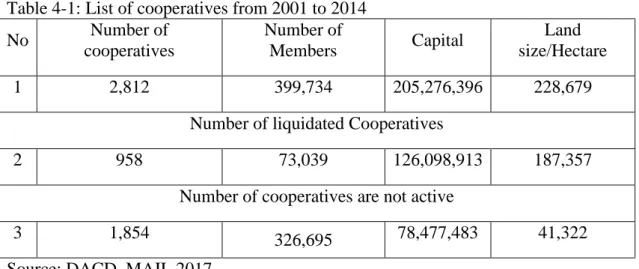
Table 4-1 Lists of cooperatives from 2001 to 2014……….………26
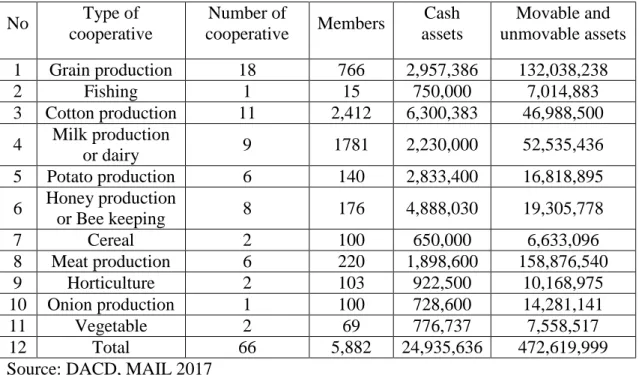
Table 4-2 Lists of registered cooperatives from 2014 to 2017……….………...………27
Table 5-1 Increase in KDU membership from 2003 to 2016………..……33
Table 5-2 Milk production, annual payment to farmers………...…...34
Table 5-3 Average price per/liter paid to farmers………….………..……35
Table 5-4 List of KDU staffs and their monthly salaries…….………..40
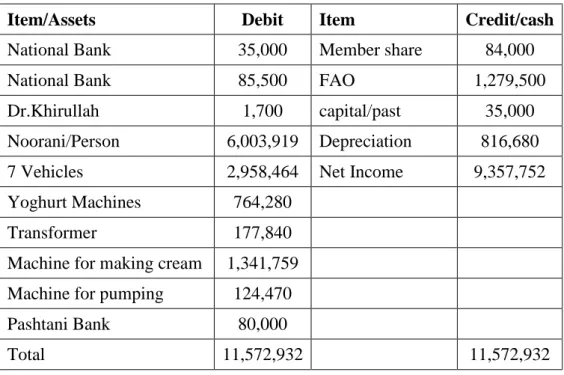
Table 5-5 KDU balance sheet 2011……..……...………….………..41
Table 5-6 KDU balance sheet 2013……..……...………….………..41
Table 5-7 KDU balance sheet 2014……..……...………….………..42
Table 5-8 KDU balance sheet 2015……..……...………….………..42
Table 5-9 KDU balance sheet 2016……..……...………….………….……….43
Table 5-10 KDU balance sheet 2017……..……..………….……….43
Table 6-1 Age of households………..……...………….………45
Table 6-2 Education level of cooperative members and non-members……….….…...46
Table 6-3 Household composition of cooperative members and non-members….…...48
Table 6-4 Farm size in hectare………...……….………48
Table 6-5 Main occupation and source of income for both groups…...……….……....49
Table 6-6 Average daily income from milk selling………...……….………50
Table 6-7 Cause of motivation selling milk to this union…..………...……….……….51
Table 6-8 Services provided to milk producers.………...……….……….52
Table 6-9 Number of milking cows during the last few years...………...…….…….53
Table 6-10 Number of cow’s cooperative members and non-members bought....…...53
Table 6-11 Comparison of herd size before KDU membership and after....…….……54
Table 6-12 Provision of fodder………....……..…....55
Table 6-13 Feeding system…..………....….….……55
Table 6-14 Cost of fodder per/cow daily.………....….….…….56
Table 6-15 Source of water supply.………....…..….…….57
Table 6-16 Milk production records keeping………....…….……58
Table 6-17 Milk production per/day local cow and breed cow in 2018………58
Table 6-18 Family milk consumption daily ………..59
Table 6-19 Comparison of average milk production per/day/liter at the beginning and now ………60
Table 6-20 Milk transportation to MCC ....………...….……60
Table 6-21 Source of market information...………....…...….62
Table 6-22 Animal manure usage ………..………….………....……..…....62
Table 6-23 The differences of dairy performance between the members and non-
members………...…..63
Table 6-24 The changes in milk production ….……….…….…..64
Table 6-25 Main problems of milk production ………...….65
Table 6-26 Main problems of milk and dairy marketing……….……….66
LISTS OF FIGURES Figure 1-1 Afghanistan map ………...……….……..1
Figure 2-1 Wardak province map ……….13
Figure 2-2 Kabul province map ……….…..13
Figure 5-1 KDU formation ……….……..31
Figure 5-2 Milk processing procedure, milk and yoghurt packages……….…..36
Figure 5-3 Milk production to marketing …… ………...….…..39
Figure 5-4 IDS model implemented in Afghanistan ………..……….…..44
Abstract
The research was done to show the effect of Kabul Dairy Union (KDU) in increasing milk production, marketing and as well as small farmers’ income. In the survey 100 small farmers randomly was selected and interviewed through using questionnaire. Data on their milk production, marketing and income were collected and analyzed by Ms. Excel, SPSS and Prism Graphpad. Factors such age of the households was very important when it comes to decision making. As well as educated members in cooperative were the key for success and had the significant role in management of cooperative and are adoptable in accepting of new technologies. Using family members as a source of labor prevents hired labor that avoids cost addition. Land was the most important asset for both groups and have important role in providing green hay for the animals. Livestock was the main occupation of cooperative members and non-members, which stood as the main source of income. Before the establishment of KDU, farmers were faced with difficulties in milk marketing, establishment of a stable market for milk selling through KDU was very significant. Provision of services in different fields for cooperative can be one of the strong points in case of improving their economic condition. Furthermore, KDU could lead to introduce a complete value chain which covering the production, collection, processing, marketing of milk and dairy products. Cooperative members had bigger herd size which can be attributed to an improvement in access to improved breeds and other veterinary services through KDU. For this reason cooperative members had better economic situation compared to non-members. Cooperative doesn’t only create economic benefits for members but also as social group which improves social networks among rural farmers.
Training programs related to animal husbandry for cooperative members caused to fed better the animals. This could be one of the reasons for more milk production by the cooperative members. In addition, lack of access to enough water was the other problem for farmers which might partly explain the poor performance of dairy cows.
Cooperative had made an improvement to water availability and quality by ensuring
that farmers had access to piped water from the well. Further, record keeping for
cooperative members was important to make sound decisions, control production
and reproductive performance of dairy cattle as well as help to determine profit made
that KDU has provided Record Keeping Book. While non-members didn’t keep records, it was difficult for them to control their activities. Cooperative members produced higher milk compared to non-members and obtained higher income daily.
This is an indication that cooperatives have played a positive role in increase of milk marketed by cooperative members. Meanwhile, cooperative members consume more milk compared to non-members. Transportation was one of the main problems for cooperative members in the past, whereas non-members still face problem-related to milk transportation. Therefore, KDU has created MCC in the villages for cooperative members. Regardless of the high demand for milk in the country for local dairy products, farmers are unable to get profitable prices. Because the government does not intervene in price setting in the dairy industry as well as doesn’t even control dairy imports to protect local dairy products and support rural productions. For making clear the effect of KDU, the comparative analysis between the members and non-members were conducted by the farmers’ survey data. The members’ dairy income per day was 476 Afg (6.8 US$) on average, while the non- members’ income was 262 Afg (3.7 US$) on average in 2018. The members earned near twice larger than non-members. Such a difference was mainly caused by the larger number of keeping cows, higher proportion of improved bred cows in total keeping cow, and larger amount of produced milk per cow. There were no significant differences in these factors before KDU had established. KDU seemed to contribute to an improvement of the members’ animal husbandry practice. The provision of services, concentrated fodder and technical training is thought to be important factors for the improvement of KDU which is the most successful agriculture cooperatives in Afghanistan seems to play the important role for improvement of farmers’ economy by joint marketing and technical support. Development of agricultural cooperatives can be thought the effective policy for improvement of farmers’ economy in Afghanistan. But most of the cooperatives haven’t gone well, though a large number of cooperatives had established since 2003. The important issue for development in agricultural cooperatives is to spread the effective systems and management of cooperatives which contribute to improvement in farmers’
economy.
Chapter 1
Background and Subject
Afghanistan is located in the Central Asia and have border with the following countries. From the north and west 2,430 kilometers border with Pakistan, east 936 kilometers with Iran, from the south 744 kilometers with Turkmenistan and 1,206 kilometers, 137 kilometers with Uzbekistan and Tajikistan. 76 kilometers the narrow WA-khan Corridor extends from northeastern most Afghanistan to meet China.
Afghanistan occupies approximately 652,860 square kilometer
1. Figure 1-1 Afghanistan map
According to the estimation of Afghanistan Central Statistic Organization (CSO) in 2017, the population was estimated around 29.7 million
2. Majority of the people live in rural areas. Boros and McLeod stated: close to 77% of the Afghanistan population was engaged in agriculture-related activities
3. Due to existence decades of civil war and
1
Library of Congress – Federal Research Division (2008), p.4.
2
Afghanistan Statistical Yearbook 2015-2016, http://cso.gov.af/en, accessed December 26- 2017.
3
Boros and McLeod (2014), empowering women in Afghanistan: reducing gender gaps through
integrated dairy scheme, p. 15.
conflict in the country, it has been not possible to conduct the second survey and the existed census is estimated from the previous census.
From the total area 46% is permanent pasture, 39% is mountainous which is not usable for agriculture, 3% is covered by forests and just 12% is arable land. Agriculture is the backbone for Afghanistan economy. Majority of farmers in Afghanistan are small farmers who have less than one hectare land and many dilemmas prevent them to produce standard products. Besides farming the farmers at least have 1 or 2 milking cows and busy in animal husbandry. Animal husbandry is the inseparable part of agriculture in Afghanistan and has the deep correlation. Farmers produce milk in rural area for the family consumption and as well as selling to the market. Therefore, animal husbandry plays important role in Afghanistan economy.
Agriculture in Afghanistan
Agriculture is the main source of employment in rural areas more than 2/3 of the populations are engaged in agriculture practices. Although most farmers are busy in agriculture activities, but are unable to provide their own food. Agricultural practices are mostly done in extremely traditional manners. Poor economic conditions of farmers and inadequate infrastructures have caused agriculture practices remain in weak condition.
World Bank (WB) list of economies (June 2017) reported that Afghanistan was one of the lowest income country in the world
4.
Afghanistan is land lock country with economy which heavily depends on agriculture. Livestock is extremely important sub-sector of agriculture which can provide multifunction for rural farmers; for instance provision of foods, income, saving, manure and transport. Bonnier stated: in 1970s the country was self-sufficient in meat and milk and enjoyed significant exports of animal fiber and high-value processed products such as carpets and skins garments
5. The evidence is indicating that Afghanistan was self- sufficient in livestock products in the past and animal husbandry was playing essential role in economic development.
4
World Bank list of economies (June 2017), accessed September 30/2017 https://data.worldbank.org/country/afghanistan.
5
Bonnier (2007), Dairy Production and Processing in Afghanistan, MAIL, HLP, appendix 4, p.2.
Decades of civil war damaged all infrastructures and industries that much of which depended on animal husbandry output. In 2001 Afghanistan became little quiet and out of war. From 22 December 2001 Afghanistan governed by Temporary Transitional Government (TTG) and Islamic Transitional Government of Afghanistan (ITGA) till 2004. In October 9/2004 election, Karzai was elected as Afghanistan’s president and the parliament was inaugurated on December 19/2005. The President presented his cabinet for vote of confidence to Wolesi Jirga (Lower House of Parliament) in 2006
6. Since establishing of the new government small-scale trade in urban centers and agriculture in rural regions revived quickly.
Despite several years of efforts on improving agriculture outputs, agriculture system didn’t improved very well. Even now civil war is going on in some rural areas.
This caused insecure villages’ that created many obstacles for agricultural development and agriculture practices have remained predominantly traditional. Based on the observation of milk producers in the surveyed area low quality of agricultural inputs that imported illegally from neighbor countries mostly Iran and Pakistan have harmed farming practices and have caused the low production quality. Inadequate agriculture inputs such as seed, fertilizer, pesticides and new technology also unstandardized agriculture products imports are the main problem for Afghanistan agriculture. Poverty is the other problem as CSO reported: country’s poverty level has continuing to remain high, with 42% of the population living below the poverty line and the overall unemployment rate estimated at 46%
7. The poverty level has increased to 54% in 2018
8.
Marketing of agriculture products is a serious problem for small scale farmers and in rural area they don’t have access for market. In rural area those who have much money have the most influence in rural market. Agricultural products are mostly perishable items including milk. Farmers are in weak economic condition, as in harvest time of crops and mostly daily milk production they urgently need cash for providing input materials and family daily livelihood expenses. As a matter of fact they have to sell the milk or other agriculture products in lower price compare to market to local retailers and middlemen
6
Kenneth (2015), Afghanistan: Politics, Elections, and Government Performance, p. 5.
7
Boros and McLeod (2014), empowering women in Afghanistan: reducing gender gaps through integrated dairy scheme, p. 14.
8
Afghanistan, CSO (2016-17) living condition survey, Analysis report, p,105. accessed July 07- 2018.
than any formal organization such as cooperative. Hence in this situation cooperative can play connector role to join cooperative members to market.
Livestock in Afghanistan
Animal husbandry through dairy cooperatives in developing countries play significant role in contributing to rural livelihood especially for small-scale farmers. Kaur stated: Dairy cooperative is one of the best examples of co-operative achievement in the developing economy
9. WB reported: that in 2009 the sector was estimated to constitute approximately a third of agricultural gross domestic products (GDP) in developing countries and this share was rising
10. Fast increase in livestock production in developing countries is attributed to a rapid-growing demand for livestock products resulting from an urban population as well as rising consumer income. Dairy production forms part of the livestock sector and is regarded as an important activity for rural people in developing country that provide supplementary income, employment and nutrition to a number of people the situation is similar to Afghanistan. Dairy development is one of the priorities of Afghanistan government livestock program.
Agriculture constitutes 23% GDP in Afghanistan and animal husbandry accounts 3% of Afghanistan’s GDP in 2016
11. Recent investigations by the FAO programme have shown that for 85% proportion of the rural population, cattle are the most important animal species that increased milk production for sale and home consumption are seen by many families as an important part of their food security and an income generation opportunity
12.
According to FAO reports large number of households in Afghanistan had 1 or 2 milking cows since at beginning of the IDS project. During last 15 years these numbers have increased. Average KDU members have 2 to 3 milking cows and are engage in livestock practices besides of farming. Thus animal husbandry can play significant role in improving of small scale farmers’ economy in rural area. Kaur stated: that the Dairy
9
Kaur (2014), A Detailed Analysis of Anand Milk Union Limited (Amul) in India, Indian Journal, p.1.
10
Smallholder dairy farming in Asia - CSIRO
publishing .publish.csiro.au/ebook/chapter/9780643095168_CH3.
11
Afghanistan Central Statistic Organization Statistical Yearbook 2015-2016, http://cso.gov.af/en, accessed January 07- 2018.
12
FAO (2010), Integrated dairy schemes project, Kabul Afghanistan, P, 74.
Cooperatives have helped in ending the exploitation of farmers and demonstrated that when our rural producers benefit, the community and nation benefits as well
13.
Large numbers of farmers producing milk in Afghanistan are small scale farmers.
They traditionally process the milk into dairy products such as yoghurt, chees, Quroot (milk mix with flour, some salt and dry it). Farmers in the remote villages don’t have access to local market or difficult to have access. Most of milk producers in rural areas are trying to improve the quantity of milk production. Majority of the small scale farmers keep few animals include (cows, goats, sheep, mules, horses and etc.). Milk is always not produced the same quantity, it has fluctuation and differs in the seasons. During autumn and winter there is limited availability of feed for dairy cows hence, the supply of milk from the major Milk Collection Center (MCC) declines. During spring and summer milk production quantity is larger than winter. Small-scale farmers produce milk near Kabul city and through Kabul Dairy Union (KDU) the milk process to pasteurized by-products then sent to the stores for marketing. Actually it provides regular income through dairy cooperative to small scale farmers and it can also improve farmer’s power in the market.
The livestock sector in developing countries can play important role. The rapid increase in livestock production in the developing countries include Afghanistan is one of the sustainable project to make changes in small-scale farmers life in rural areas. Dairy production is an important activity in Afghanistan and it is a source of income and empowerment generation for small scale farmers. Over the last several years, Afghanistan dairy industry has been expanding to meet the increasing demand for milk and dairy products. Provincial agricultural departments of MAIL reported: that number of cattle's are 5.2 million, sheep 13.3 million, goats 7.4 million and chicken 11.9 million in Afghanistan
14.
FAO reported in 2015 the number of cattle in the four provinces of the IDS focus project, in 2003 Herat had the largest cattle population with approximately 186,000, followed by Kunduz with 158,000, Balkh with 75,000 and Kabul with 58,000. The latter also consumes milk from producers in two nearby provinces: Logar and Wardak
15.
13
Kaur (2014), A Detailed Analysis of Anand Milk Union Limited (Amul) in India, Indian Journal, p.1.
14
Afghanistan Statistical Yearbook 2015-2016, http://cso.gov.af/en, accessed January 07- 2018.
15
Boros and McLeod (2015), empowering women in Afghanistan, reducing gender gap through integrated
dairy schemes, p.7.
Problem Statement
For supporting Ministry of Agriculture Irrigation and Livestock (MAIL) policy of agricultural cooperatives, FAO and German government had done the project in the selected villages to establish agricultural cooperatives and set development goal to promote milk production and marketing in order to meet or at least partially meet local demand for milk and dairy products. Dairy product supply can’t meet continues increase in local demand. This situation is mainly attributed to low production resulting from a number of challenges faced by small scale farmers as well as the prevailing marketing system in the country. In addition, the increase in the cost of meat and poultry which milk competes with as a source of protein in recent years has increased the demand for milk tremendously. MAIL reported: approximately 37% of milk supply was produced in the country
16.
Efforts have been made in various aspects to help and develop the local industry, especially to help small scale farmers to improve their production and marketing capabilities. Previous studies conducted by the Food and Agriculture Organization (FAO), MAIL in the country concluded that the small scale farmers had the greatest potential to increase national dairy production. Despite this and decade of development, small scale farmers still lack essential inputs, limited access to guaranteed markets and credit for their products have been faced with high transaction costs. Cooperatives have been expected to play a major role in improving productivity, minimizing transaction costs, and improving marketing capabilities of farmers. As a result, a number of cooperatives have been established under KDU in the dairy sector and formation of these organizations is being encouraged and supported by the FAO, MAIL and Garman government.
For farmers to improve their productivity and access markets, they need to overcome the constraints they are faced. Considering the fact that farmers’ producing milk in cooperatives can benefit the smallholder sector, the focus of the study therefore is to generate information on whether cooperatives in the context of Afghanistan are able to promote small farmers dairy production and marketing by minimizing the numerous constraints and the high transaction costs that characterize this sector.
16
Ministry of agriculture irrigation and livestock, (2017).
Importance and Benefits of the Proposed Study
Dairy production is an important activity in Afghanistan. It provides income- generating opportunities for the rural as well as urban population and contributes to the nation’s nutrition. The study will provide useful information whether cooperatives benefit small scale farmers in dealing with challenges they are faced. Assessing the role played by dairy cooperatives, especially for the smallholder sector is crucial for the improvement of milk production and marketing in the country. Accordingly, the study sheds light on whether dairy cooperative indeed contribute to small scale farmers in dairy development with respect to milk production and marketing.
Kaur stated: ever since the movement was launched fifty-five years ago, Gujarat’s Dairy Cooperatives have brought about a significant social and economic change to our rural people, the Dairy Cooperatives have helped in ending the exploitation of farmers and demonstrated that when our rural producers benefit, the community and nation benefits as well
17. This information is vital for police makers to take appropriate action towards facilitating the establishment and development of dairy cooperatives. Addressing constraints in the smallholder sector will enable more participation of farmers in markets and thereby satisfy the high demand milk in the country.
Kaur stated: that dairy cooperatives have been able to create a market perception of honesty & transparency with their clean management
18. However, small scale farmers are unable to fully exploit this profitability because of challenges they face in rural area.
For them to realize the profitability of the dairy enterprise, they need considerable support from government, NGO’s and other development organizations. International experience shows that constructive partnership between government and cooperatives is possible and can be established. Movsisyan stated: in the spheres where Government provides social support to vulnerable groups, cooperatives can play a significant role
19.
Development and implementation of policies as well as programs in the dairy industry to support the establishment, development and sustainability of cooperatives is imperative. This will help in increasing income because of guaranteed market and access to adequate inputs. Therefore, minimization of constraints will help farmers to be more
17
Kaur (2014), A Detailed Analysis of Anand Milk Union Limited (Amul) in India, Indian Journal, p.1.
18
Kaur (2014), A Detailed Analysis of Anand Milk Union Limited (Amul) in India, Indian Journal, p.4.
19
Movsisyan (2013), The Role of Cooperatives in the development of Agriculture in Armenia, Asian
Countries & EU (Worldwide case studies), ICD, p.10.
productive and will result in an increase in milk production which will in turn help to curb the sever milk shortage in the country.
Evidence from East Asia and Africa such as India, Bangladesh, Pakistan and Ethiopia suggests that cooperatives are available strategy in which challenges in small- scale farmers sector can be addressed. Cooperatives play a major role in improving productivity, minimizing transaction costs, and improving marketing capabilities of farmers.
Limitation of the Study
The study was constrained by finances and time. In fact the survey was self- funded. The survey was done with many obstacles and time limitation. In addition, some of the farmers in the area were not eager to give out information related to their production and marketing activities. Furthermore, the study found that the majority of cooperative members keep records, but non-members didn’t keep. Hence, some of the collected information was based on recollection of recent events, such as procurement rates. The inputs provided by farmers therefore, could not be checked for authenticity. Although KDU one out of five dairy unions in Afghanistan was selected for this study, results cannot be generalized for the whole population of small scale farmers in Afghanistan because of differences among the regions.
Research Objectives
Goal: The main purpose of this study is to evaluate the effect of KDU, which is the most successful agricultural cooperatives in Afghanistan, on improving small scale farmers’ economy. In this research focuses on:
The object cooperative is dairy cooperative.
The members and non-members live in same area.
To compare the farmers economic situation before establishment of the cooperatives and after.
Analyze the activities, which affected the farmers’ economy.
Analyze the cooperatives financial management.
The main objective of this research is to assess the current condition of KDU
through dairy cooperatives. Investigate the livestock role in rural area development and
show the importance of dairy cooperatives in improving small farmers’ economy, effectiveness of mobilizing small milk producers around cooperative and find sustainable market through dairy cooperatives. The finding of this research through desk study international journals, papers along with field visit and own observations from the KDU will support and strengthen the development of dairy cooperatives in Afghanistan.
This study is going to assess the role of KDU in encouraging innovation and market oriented to small scale farmers’ income. The study is limited to KDU which is located in Kabul province. In this study the role of dairy cooperative in improving small farmers’ economy through using veterinary services, providing standard fodder, milk collection, processing and marketing will evaluate and farmers to get dairy cooperative membership to use input and output supply and enable the bargaining power of farmers in the market.
Outline of the Study
The thesis is organized into seven chapters. The first chapter gives general information of related to agriculture in Afghanistan. The second chapter contains Methodology. The third chapter gives general information related to agriculture cooperatives in developing countries and Afghanistan. Chapter four provide information about cooperatives history in Afghanistan. Chapter five describes KDU functions and organization system. Results and discussions on household characteristics, milk production and marketing in Kabul city and gives a summary of the findings, descriptive, econometric results on the effect of cooperatives are presented in chapter six. Conclusions and recommendations aim at solving the current problems in the dairy industry in Kabul have presented in chapter seven.
Chapter 2
Methodology
In this chapter description of the study area, types and sources of data, methods
of data collection, sampling method and sample size determination, methods of data
analysis are presented.
Description of Research
To understand the importance, impacts and influences of dairy cooperatives as marketing instrument that connect farmers to market, a case study of KDU (Effect of Dairy Cooperatives on Improving Small Scale Farmers’ Economy in Afghanistan) was carried out in Ibrahim Khel village Maidan Shar, Wardak province. The survey in research field was conducted with 100 milk producers in one village. The selected small scale farmers were chosen randomly. The earliest interviews with KDU, FAO, MAIL and other related staffs paved the way to the researcher for general information on animal husbandry activities and marketing of dairy products through KDU. Among the milk producers, different methods were chosen to narrate their full success stories and thanks to both cooperative members and non-members that eagerly responded to questions and narrated their different success stories.
Personal observation was one of the important techniques used in this study, researcher visited KDU processing milk center asked about pasteurized dairy products in Kabul and the whole milk collection procedure in the village also heard story of changes in farmers’ livelihoods that had occurred after KDU membership in the selected area.
Comparing their previous traditional milk production with now, researcher personally observed milk collection that farmers have preforming in the village. Meanwhile, researcher also observed marketing and other process of dairy products such as milk qualities check, collection, transportation system, packaging and shipping the products to the market. Also group discussion with cooperative members and non-members in Ibrahim Khel village were used in this research to obtain deep understanding of the subject.
The first group discussion with KDU and FAO staffs was conducted in
development of dairy production regarding the current situation of animal husbandry and
discussed more on finding ways to look for a wider adoption of dairy production in other
provinces over Afghanistan. The second focus group discussion was done with both
cooperative members and non-members in the selected village. In addition, both focus
group discussions helped researcher to get the real picture of current improvement in dairy
production in rural area and marketing of dairy products as well as obtaining the
information on challenges in which small scale milk producers currently are facing.
In general this study is mainly focuses on effectiveness of dairy cooperatives (KDU) on improving small scale farmers’ economy in Afghanistan. This study describes the findings of the collected data to the lately improvement of farmers in Ibrahim Khel village and KDU role for processing, marketing of dairy products in Kabul city. Ibrahim Khel village was selected as the case study due to its better development and better security. The collected data from KDU, FAO, MAIL, other related organizations, cooperative members and non-members shows that how the farmers have been encouraged to start milk production for sale to increase their own income.
Research Site
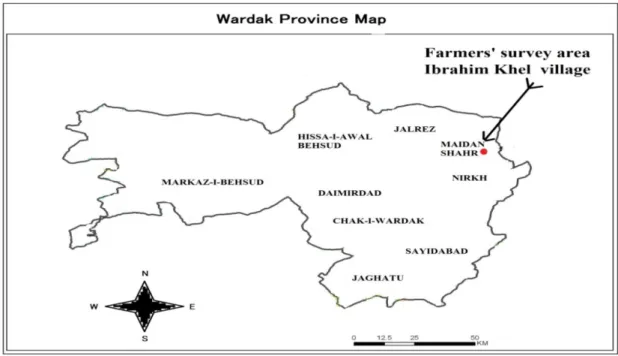
This research study was conducted with farmers in same village that have pointed in Figure (2-1). Wardak province is located at the east of Kabul and has 9 districts include Maidan Shar where is the center of the province; it’s about 30 minutes away from Kabul.
Maidan Shar is the capital of Wardak which has 140 villages and Ibrahim Khel is one of that
20.
Figure 2-1: Wardak province map
20
Australia Government, (2010), Refugee Review Tribunal, Country Advice Afghanistan.
KDU as Channel for Marketing
KDU located in Kabul city and has good location for marketing of dairy products because of huge population. FAO, German government and MAIL in 2003 with the cooperation of each other installed processing machinery in KDU for processing and marketing of dairy products.
Figure 2-2: Kabul province map
Type and Method of Data Collection
Both primary and secondary data collected to analyze proposed research topic.
Farmers’ Survey
Farmers’ survey was conducted with cooperative members and non-members in Ibrahim Khel village, which is the member cooperative of KDU. 100 farmers were selected for the respondents of the survey from cooperative members and non-members respectively by random sampling. The survey was done during February to March 2018.
The Data of KDU Performance
The data were gathered from KDU and related organization such as FAO Kabul office, MAIL and KDU. Type of data was such as:
The changes in number of members and milk production.
The changes in milk price and payment to farmers.
Annual balance sheets and the other financial documents.
The secondary data such as the statistics of dairy farming in Afghanistan were also used in analysis.
Sampling Procedure
A random sampling selection was applied using farmers list from the KDU coverage areas. As mentioned, these parts of the country were purposively selected because they have a higher percentage of small scale farmers. Moreover, these areas were selected because of the existence of KDU with huge dairy market potential, thus cooperative members and non-members were used for the study. Therefore, from 76 cooperative members and 100 non-members in two individual lists, 100 farmers were chosen as shown in Tables (2-1) and (2-2).
Table 2-1: Total number of farmers in Ibrahim Khel village
Region
Non-members Cooperative members
Total Non-
members
Number of members
Name of cooperatives
Number of members Wardak Non-
members 100 Ibrahim Khel 76 176
Source: Researcher survey from the field.
However, this number is not true reflection of small scale farmers producing milk
in the country because most farmers are not-registered in cooperatives. Researcher own
observation indicating that there are more independent farmers compared to cooperative
members in the study area as well as in whole Afghanistan. However for ease analysis the same number of cooperative members and non-members were used in the study.
Table 2-2: Selected areas and sampled respondents
Study area Sampled cooperative members Sampled non-members Total
Ibrahim Khel 50 50 100
Source: Researcher survey from the field
Data Collection
Primary field survey of sampled small scale farmers who were cooperative members and non-members, were conducted to gather information on their milk production and marketing activities through the use of questionnaire. Data from secondary sources that include both published and unpublished documents were obtained from MAIL, FAO and KDU in Kabul Afghanistan as well as the internet.
Sample Size Determination
The study made use of primary data collected by means of an appropriate structured questionnaire. Both open-ended and closed-end questions were used in the questionnaire because of the nature of the data that had to be collected from small scale farmers. Data that were collected through questionnaire comprised of farmers’ socio- economic characteristics, milk production, marketing, input and output level of milk, farm management practices, as well as income received from dairy activities.
Therefore, the results of sample size are 100 respondents. Once prepared, the questionnaire was discussed with researcher, supervisor and relevant personal; it was then pre-tested to ensure validity and reliability of data collected. Five farmers were selected from pre-tested of the questionnaire. After approval of the questionnaire, face to face interviews were conducted by the researcher to generate all the required data from farmers.
Data Analysis
Upon completion of data collection, two methods of analysis namely descriptive
and economic analysis were used for analyzing the data. Prior to this data were first
recorded in Microsoft Excel for ease of analysis. Then imported to Graphpad Prism
online(www.graphpad.com/quickcalcs/ttest1.cfm) and Statistical Package for Social
Science (SPSS). Descriptive statistics were used to describe the general characteristics of sampled households, their production as well as their marketing systems in order to depict differences in performance between cooperative members and non-members.
Econometric analysis was used to determine whether being cooperative members have any positive effect.
Descriptive Analysis
A descriptive analysis was used to compare characteristics of the different sampled households whereby frequencies, percentages, means, standard deviations and independent simple t-test were used to describe the socio-economic characteristics of small scale farmers, milk production and marketing, input and output levels, milk handling and farm management practices as well as income received from dairy activity.
Tables and figures have created to illustrate trends, especially in performance indicators, such as age, education, household size, herd size, milk production and income levels among cooperative members and non-members. This provides a general insight into how cooperative members and non-members differ in terms of their production and marketing behavior. In addition, the descriptive analysis of the effect of cooperative participation on fodder costs and veterinary services was done. This was made possible by analyzing problems and constraints and differences in their marketing systems.
Economic Analysis
An econometric analysis was carried out to determine whether being a cooperative
member has any positive influence on transportation, milk price, sub-income of livestock
keeping, generating income cooperative members compare to non-members and daily
income. This was captured through the amount of milk farmers’ sell, whereby milk
marketed by cooperative members is predicted to be higher than milk sold by non-
members, as well as provision of fodder.
Chapter 3
Review of the Study
Previous Study in Afghanistan
Dairy cooperative in developing countries had success history. Therefore, evidences from the past in Afghanistan related to agriculture cooperatives have shown that agricultural cooperatives as ladder (step by step) was good source for small farmers to gather them in an umbrella and provide input and output supply facilities easily. But the local war and some other challenges have prevented cooperative development in Afghanistan. Even though, MAIL had tried many times to overcome the challenges by formation of cooperatives. Lack of skilled staffs, unawareness of members, weak management, lack of credit and some problems have harmed to success these projects.
Beside of these constraints KDU the most successful union in Afghanistan have successful achievement.
The supply of good quality farm inputs with reasonable price through collectively in bulk purchasing, such as seed and fertilizer or the supply of sufficient and cheap credit is crucial for farming practice. Farmers can easily access to such kind of services through creation of agricultural cooperative. By establishing agricultural cooperatives, farmers hope to solve their farm problems jointly through discussing in cooperative meetings, to increase their farm income and strengthen their economic.
Dairy cooperatives in developing countries are the instrument to help small scale farmers and access them to input materials as well as marketing services. Few researches related to cooperatives in Afghanistan have been carried out, not exactly related to role of dairy cooperatives. There were only few studies about achievement of agricultural cooperatives in Afghanistan that showed the effect of agricultural cooperatives on farmers’
economy, which was “The Effect of Agricultural Cooperatives on Farm Income in Rural Afghanistan (Miraqa Hussain Khail and Atsushi CHITOSE). This study pointed out:
- The members of agricultural cooperatives got more income than the non-
members.
- The factors of more income were better product price and low production cost of the members
21.
However there are some considerations in previous study:
• The study was the case study of only crop farming cooperatives.
• The study conducted comparative analysis between the members and non- members. Nevertheless these two groups locations were differed each other, for this reason, there is some possibility that the location influenced the difference in their income.
• The study compared only income of the surveyed year. It didn’t compare their income before the cooperatives had been established. Probably it could not say the difference was because of cooperatives.
• The study didn’t mention the activities of cooperatives which effected on farmer’s income.
The objective of the current research (Effect of Dairy Cooperatives on Improving Small Scale Farmers’ Economy in Afghanistan, A Case Study of KDU) have presented in chapter one page 8.
Hussain Khail and Chitose stated: that agriculture cooperatives have a potential to benefit farmers through supplying production input materials and marketing farm productions in favor of farmers and would contribute to reduction in rural poverty also the accomplishment of potential agriculture cooperatives have definitely requires continues supports from the government and international community
22.
The last three decades local war in the country has deeply damaged all infrastructures, agriculture sector and cooperative is no exception. Therefore, limited research related to agriculture cooperatives have been carried out, not exactly about the title of this thesis. Lack of limited researches have caused that the researcher use references related to the review of the study from other developing countries that have similarity in culture and social living.
21
HUSSAIN KHAIL and CHITOSE, (2011) the Effect of Agricultural Cooperatives on Farm Income in Rural Afghanistan.
22
HUSSAIN KHAIL and CHITOSE, (2011) the Effect of Agricultural Cooperatives on Farm Income in
Rural Afghanistan.
Mohamed stated: that development is one of the main goals that all communities try to achieve in order to improve the living standards for individuals in those communities
23. In this case agricultural cooperatives are the most important organizations in rural area that by launching training programs, workshops, awareness about farming and livestock, introducing new technologies and the mentioned organization encourages farmers to do jointly their agricultural activities through agricultural cooperatives services and surely its outcome will strength farmers economic mainstay.
Noor Muala stated: that India has basically an agrarian economy with 72% of its total population residing in rural areas and the rural people need lot of services in daily life which are met by the village cooperative societies
24. Barnabas stated: that agricultural cooperatives was playing an important role in improving of farmers’ livelihood and economy by providing production inputs and marketing of agricultural products at favorable prices
25. As well as Popal report: that during 1973 to 1978, 6000 ton agricultural products such as fruits, vegetables, cotton and beet were sold through agricultural cooperatives in the national and international markets
26.
Previous Study in Developing Countries
Dairy cooperatives have played developing role in south Asian countries (India, Bangladesh, Nipple and so on). Pinto stated: that cooperatives have been privileged forum for discussing and finding solution to common problems
27. Developments in agriculture by the cooperatives have sustainable achievement in different sections. Cooperative has stable positive effect in improving of agriculture products and it’s marketing as a cornerstone. If the cooperative activities manage honestly by the board of directors, executive manager and cooperative members it’s extremely efficient. Otherwise it could be a problem related to the marketing of products resulting in low farm gate prices compare to cost price of products. Purchasing good quality input materials such as fertilizer, pesticide, access to input and output for farm products collectively would be
23
Mohamed (2004), Role of Agricultural Cooperatives in Agricultural Development, Institute fur Agrarpolitik, p.1.
24
Khan (2008), cooperatives in agriculture and its implications in less developed countries, Sarhad J. Agric, p.2.
25
A. P. Barnabas (April, 1970), Farmers Characteristics I Koh-i-Daman, Pilot Area.
26
Popal, (2012), Cooperatives in Afghanistan,p.2
27
Pinto (2009), agricultural cooperatives and farmers’ organizations, Swedish Cooperative Centre, p.3.
more efficient if farmers do it through cooperatives jointly. The main goal of establishing cooperative is to improve farming condition and carry out jointly marketing activities.
Chagwiza and Muradian (2016) stated: that dairy cooperatives in Ethiopia are strong in facilitating technological transformations and commercialization to cooperative members, annually cooperative members on average receive more income than non- members. The factors of development are that several governmental policies and interventions by the international cooperation which have been put in place recently aiming to foster the development of the incipient modern dairy value chain (which involves processing and pasteurization) supplying the growing urban market. Also government with stakeholders have provide suitable environment for intensification by facilitating and enhancing technologies and new varieties cows with animal feed and stable market. Sometime non-members may obtain indirect benefits from cooperatives’
activities in the region
28.
Julius (2015) stated: that cooperative members have more access to farm inputs (labor, loan, herbicide, insecticide, rodenticide, fertilizer, tractor services, storage equipment and processing equipment) while the non-members had more access to land.
The government has recommended formation of cooperatives in different levels in coordination with non-government organizations support cooperatives. The factors that cooperative members had more access to farm inputs implies that government and non- governmental organizations or agencies interested agricultural development should encourage the formation of viable cooperative societies by farmers.
29.
Ghosh and Maharjan (2014) stated: that dairy cooperatives have made a significant impact on milk production and household income for the dairy cooperative members. Artificial Insemination (AI), veterinary services, animal health, fodder provision, higher milk price for cooperative members, higher milk production, hygienic milk are the factors cooperative members could receive more income than non-members.
They have set up their own milk processing centers, own veterinary services, milk marketing channels and established their own transportation system with the assistance
28
Clarietta Chagwiza and Roldan Muradian (2016), Cooperative membership and dairy performance among smallholders in Ethiopia, http://www.elsevier.com/locate/foodpol.
29
Ajah Julius (2015), Comparative Analysis of Cooperative and Non-cooperative Farmers’ access to,
European Journal of Sustainable Development. Farm Inputs in Abuja, Nigeria
of the government. On the other hand, non-members are unable to receive available dairy inputs from government sources and do not have organized market to sell milk and often they sell their milk at low price
30.
One of dairy cooperative aim is to increase efficiency of dairy marketing system and transfer the milk from rural to urban. Moreover dairy cooperatives can play an important role to enhance newer innovation approaches to production, technology transfer, input supply, credit and output marketing, information generating and utilization continuum. Therefore, investigating the role of dairy cooperative in accessing market oriented for small farmers’ to develop their income and access input and output supply services easily than individual farmer. In addition finding of this research work will give awareness for the researchers and other students in similar research theme for further investigating in other area.
30
Ashoke Kumar GHOSH and Keshav Lall MAHARJAN (2014), Development of Dairy Cooperative and Its Impacts on Milk Production and Household Income: A Study on Bangladesh Milk Producers’
Cooperative Union Limited
Chapter 4
Review of Cooperative History in Afghanistan
Cooperative from 1955 to 2000
According to International Cooperative Alliance (ICA), cooperative is an autonomous association of persons united voluntarily to meet their common economic, social and cultural needs and aspirations through a jointly-owned and democratically controlled enterprise
31. In both developed and developing countries cooperative have the success and failure histories in the world. Koopmans stated: that certainly in different parts of the industrialized world the formation of agricultural cooperatives have played a major role in development of agriculture during the last 150 years
32.
In addition for the first time in 1955, 13 silk and Qaraqul (sheep skin) cooperatives were established at the northern provinces of Afghanistan by silkworm and Qaraqul producers with financial and technical support of FAO and the International Labor Office (ILO). These cooperatives were created to sale farmers products jointly in the market.
Barnabas stated: the cooperatives functions were finding a stable market for farmer’s products and providing materials inputs jointly at lower prices
33. Unfortunately on that time unawareness of members about cooperative principles, lack of technical staffs and weak management caused cooperatives to discontinue.
As the first principle of ICA, cooperatives establish voluntary and according to the Afghanistan cooperative law everyone can have membership in cooperative and use the services, however the past experience in Afghanistan have illustrated that cause of cooperative failing was unawareness of members and somewhat compulsory membership.
In the past the plan was designed from the top to bottom to establish cooperative, on that time Afghanistan rural society ( farmers) were not appropriate to establish cooperative, MAIL did not train farmers about concept and aim of cooperative establishment. People were religious and resistance, they were opposite of cooperative idea and were thinking
31
International Cooperative Alliances, http://old.ica.coop/en/whats-co-op/co-operative-identity-values- principles, accessed 20/1/2018.
32
Koopmans (2006), Starting a cooperative, Farmer-controlled economic initiatives, Netherlands, ISBN Agromisa: p. 6.
33
A. P. Barnabas (April, 1970), Farmers Characteristics I Koh-i-Daman, Pilot Area.
that cooperative is opposite of their religion and culture. So this was one of the reasons of failing cooperatives. Furthermore, farmers in Afghanistan weren’t aware of cooperative principles such as an organized economic, social and cultural organization.
Still some farmers aren’t aware of cooperative concept and they think to be member of cooperative can receive grants and assistance from governmental organizations and NGO’s or donor countries. The reason is this, cooperative have introduced to farmers such a charity organization.
The past background have made clear that working collectively for the farmers were common way to find solution to the problems related agriculture and livestock in rural areas for the developing of agriculture activities, for instance cleaning of raceway, canal for drinking water and traditional agriculture irrigation system, traditionally it’s called Ashar (team work). Pinto stated that: due to the compulsory membership system, farmers never understood the meaning of cooperative organizations and were not prepared to defend it
34.
In 1963 Afghanistan government comprehended the importance of cooperative society in the globe. ILO sent few cooperative technical staffs, but this time again they hurriedly established five depreciation cooperatives in Logar province in Afghanistan.
Once more lack of cooperative law, inadequate fund, weak management and unawareness about cooperative have caused that cooperatives couldn’t continue their activities and in a short term smashed.
Afghanistan government has understood the significant role of cooperatives and always endeavors to establish cooperatives and consolidate farmers around cooperatives in every village. In 1974 extension directorate of MAIL started Programme on Agricultural Credit and Cooperatives in Afghanistan (PACCA) with FAO technical assistance and financial support of Swedish International Development Assistance (SIDA) the project was running through agricultural cooperatives. The aim of the project was to inform farmers’ about cooperatives base and principles to understand the real meaning of cooperative and to access input material and they can supply output easily than individual farmers. PACCA project had three centers, 1
stcenter was agricultural cooperative institution in Badam Bagh-i-Kabul province that inaugurated 6 months
34
Pinto (2009), agricultural cooperatives and farmers’ organizations, Swedish Cooperative Centre, p.2.
courses for agriculture bachelor new graduates and 18 months for agriculture institute graduates. Also this center was responsible to design plan for cooperatives development and train technical staffs. The 2
ndcenter was in Koh-i-Daman Mir Bachakoat, there were 30 staffs to provide credit for cooperative members, to increase grapes and raisins productions, provide agriculture input materials and to teach bookkeeping, record of transactions for cooperative board directors, audit board and other members.
The 3
rdcenter was in Baghlan province which was very important for the Baghlan farmers who had were producing beet. This program was efficient for improvement of cooperatives. After assessment few cooperatives were established in different places according to farmer’s interests. Meanwhile, in 1974 Directorate of Agriculture Cooperative Development (DACD) was created independently in the formation of MAIL.
Contemporary on that year the agriculture cooperative first law was approved by the parliament.
Consequently, cooperative directorate made a wide plan for creation of cooperatives. The decision was to cover one province in a year. Until 1978, 135 cooperatives (4 depreciation cooperatives, 1 beekeeping, 6 industrial cooperatives and 124 agricultural) were registered in cooperatives directorate. The mentioned cooperatives could succeed to have plan and based to their plans they could succeed to have access to credit from Agricultural Bank for their economic activities. The cooperatives economically and socially had achievements for its members
35.
Also educational institute was established in cooperative directorate chart. In 1979 the training institute started and was responsible to launch training programs for cooperatives staffs and members. Every year some cooperatives staffs trained, annually educational institute had plan to send DACD staffs abroad for obtaining experience from the foreign countries. In 1981 agricultural cooperative law was revised in 6 chapters and 30 articles, till 1993, 1271 agricultural cooperatives were registered
36. Unfortunately, by starting the civil war all Afghanistan’s basement destroyed.
In the past the goal for Afghanistan government was to mobilize the farmers especially small scale farmers in forum of agricultural cooperatives in every village to
35
Popal (2012), Cooperatives in Afghanistan, p.5.
36