Distinction of Individual Northern Fur Seal Pups, Callorhinus ursinus, Through Their Call
Akira TAKEMURA, Kazumoto YOSHIDA*, and Norihisa BABA*
The calls of six northern fur seal pups, Callorhinus ursinus, transported from Robben Island to Mito Sea Paradise were analized. The calls of northern fur seal pups consist of a short one of a few-tenths of a second and a shriek type of 1-2 seconds or longer. They have frequency compo- nents which range from a few-tens Hertz to eight kilo-Hertz. Each call consists of a clear main peak frequency and a sub-main peak frequency. The call of each pup has a characteristic structure which hardly changes according to the physiological condition. It is considered that a mother seal distinguishes the call of the pup and uses it as the first clue to find her pup.
It has been said that a mother northern fur seal, Callorhinus ursinus, never fails to return to her pup during the breeding season after going out to the sea for about five days to seek for food and then returning to the rookery to feed her pup for about two days. When a mother seal goes out to the sea to seek for food, she and her pup are separated from each other by as much as several tens to over a hundred miles. It is a very interesting fact that a , mother seal can pick out her own pup from among the numerous others when she returns to the rook- ery after having been away from the pup for some time.
The pinniped often emit sounds on the rookery.
The fact their sound is the important tool of com- munication for their social life has been revealed in a number of reports: Schevill et al. ( 1963 ) and Martin (1975, unpublished paper) on various spe- cies of the pinniped; Terhune et al. (1979) concern- ing harp seals, Phoca groenlandica; Sterling et al.
(1979) on leopard seals, Hydrurga leptonyx, and crabeater seals, Lobodon carcinophagus; Terhune et al. (1973) concerning hooded seals, Cystophora cris- tata; Bartholomew et al. (1962) and LeBoeuf et al.
(1969) on northern elephant seals, Mirounga angus-
tirostris; Poulter (1966) , Gentry (1967) , Schester- man et al. (1967), and Schusterman et al. (1972) on
California sea lion, Zalophus calzfornianus; Schevill et al. (1977) on walruses, Odobenus rosmarus; Sterl-
ing (1973) concerning ringed seals, Phoca hispida.
Peterson et al. (1969) stated that the cows of California sea lions seem to distinguish the call of her pup, but a number of other reports did not refer
to this interesting point.
In the case of the California sea lions on San Miguel Island (a rookery in California, U. S. A.), it can be observed that a cow makes a loud call similar to the call of a sheep when she swims parallel to the shore near the coastline before coming on land. Her pup on the land makes a loud call, as if responding to the mother's call. When the mother comes on land she goes almost straight to the pup as if targetting only by the call of the pup.
She feeds the pup after confirming by sniffing the pup's snouts, that it is her own pup. However, when she fails to confirm it as her pup, she moves to other places to look for it. Based on such observations, it can be assumed that a cow uses the call made by the pup as a first clue for looking for it. As mentioned above, there is also the act of sniffing * Part IX of the study series on the underwater sound
* * Far Sea Fisheries Research Laboratory, 1000 Orido, Shimizu, Shizuoka, 424, JAPAN
the snouts to confirm the pup. Based on these facts,
it is certain that a cow distinguishes the call of her pup with a considerable degree of accuracy, maybe not perfectly though.
In the case of the cows of northern fur seals, it is said that they distinguish the landing place ac−
cording to topography. But their acts for confirma−
tion of their pups after landing are quite similar to those of the California sea lions. Thus, the re−
searchers investigated whether there is any individ−
ual difference in the call of pups, which sound similar to human ears.
Materials and Methods
On July 31, 1981, 50 northern fur seai pups (23 male and 27 female) of around 20−days old were transported from Robben lsland to the breeding room in the Mito Sea Paradise, lzu, to study breed−
ing by artificial feeding.
Three months after the breeding began. when the pups were seemed to be used to artificial feed−
ing and the breeding room, the calls of six lively pups were recorded. The pups used for the experi−
ment are as shown on Table 1. The recording was conducted from 14:00 to 15:00 in the breeding room while they were naturally making crying sounds.
The microphone used is a SONY F−99S, and the tape recorder a SONY TC−3125. The frequency response of these instruments is 50−IO,OOO Hz and flat. For analysis, a RION SG−07 sound−spectro−
graph was employed, and the analysis was carried out up to 8 kHz. The effective filter band width of the analyzer is all 300 Hz.
Table l. Materials
Sex Body Wei窪ht Body Length
W−4 M 7.7㎏ 73cm
Y−12 F
7.1 69B−2 M 6.2 63
B−3 M 7.2 68
P−3 F・
5.9 66P−8 F
4.9 68Results and Some Considerations
1 . Call of Northerh Fur Seal Pups
Northem fur seal pup,s were quiet for a while after they are fed, otherwise they cry quite frequent−
ly like the pups of other pinniped. Their call was loud and could be classified into two types; one was a short call of which duration was a few−tenths of a second and the other was a longer one of which duration was 1 to 2 seconds or longer. The short call was often repeated, though sometimes only once. Generally this type of call seems to be used for scare. The frequency range of this type of call was from several tens of Hz to over 8 kHz, but the major component was mainly around 1 kHz.
Also, there were several peak frequencies in which little change was observed from the begin−
ning to the end of one call. Among those peak frequencies the especially strong one is here after called a main peak frequency . Depending on the individual pups, some had one main peak frequency and others two or three. A peak frequency which is somewhat weaker than a main peak frequency is called a sub−main peak frequency . ln this report,
these sub−main peak frequencies are called in order No. 1, No. 2, No. 3, ..... starting from the lowest.
These calls consisted of a series of pulse sounds, but since the repetition rate was very high, they sound as if they are a continuous harmonic sound.
2 . Characteristics of the Call of Each Pup As mentioned above. each call had several com一
mon features. But there were slight differences in the calls according to the individual pups. Since each pup was tagged by a different color and number for identification, the tags represent indi−
vidual pups. The characteristics of the call of each pup are shown below.
A. W−4
The main peak frequency of the call of this pup was around O.5−1kHz. This was further divided into 2 or 3 intermittent frequency ranges. Since each frequency range overl aps with the other, the band width fluctuates sharply. There were about five sub−main peak frequencies in the frequency
断萎蕩三
S?
唱葦・・
馨
蟻︵3
搬醐鍵・
Wes触P
お アニ
e二 s;
望。、
臨.1・l
in@1・
F
︐
臨池嚇暴榊榊瞬
≧郵 E 嫁
麟翻醸 Ptk,
丁纏緯 h轍
伽 納 sec
1三
一Si ,,
糞;i 蜘画鴇 ,蒼・・
㌦・三冠糠輪
.2 .4 .6 .8 1,0 1,2 IA IS L8 2,Q T}me ln sec
露一
ii・
ll二
零細
い、2
Fig. 1.
一4
ぜ 穐離 k
縛輔膨
蟻
了麟e 罰 5ec、
A variety of calls of White−4
range which was higher than the main peak fre−
quency. Generally the lower the number of a sub−main peak frequency was, the stronger it was;
sub−main peak frequency No.5was extremely
weak. When the call was loud, all these sub−main peak frequency bands were heard, but when the call was weak, some of the higher−numbered sub−main peak frequency were not observed. The sub−main peak frequencies No.2 and No. 3 were strong,although they were somewhat lower at the beginn−
ing, there was hardly any change in the frequency.
Sub−main peak frequency No. 1 was the sound observed in the latter part of a call, and fluctuation
2 タ
.6 .8 垂、oT㈱ 画sgCL
3・
7 窃・
亭さ=
竃4=
砂3・
簑・
重eN む の 1=
・t蝉≒噸晦・轡轡i、tsl噛・〜・き岬・
.2 \鴻 β .8 L◎
7㎞◎ 恥 舗。,
おう
7= )・・t t−
6二
うハ じ
蓄・1
整. .。、
1嘱 与弓
櫛鎌瀬紳轡轡轡轡・1ン .2 .4 β
[2 1.4 1.6
癬購細・
IB 2.0
1.Z
.蝦翻恐く
卍
偶 1,ff
.8 t.O 了襯 蜘 sec
i.蒙 1,4
1.g 2.b
協t・・ 誘季 鱒、鱒嚇亀回 し6 1.臼 2.◎
e・
アニ
6J 5二
茎4:
一S i ・st
㌦幽聡警灘編∴
,2 .4 .6 、8 書,◎ 恥2 L4 し6 1、8 2.◎
T㎞e 塘 sec
in frequency was little and weak. Sub−main peak frequencies N o. 4 and No. 5 rised toward the end.
These components were extremely weak as men−
tioned earlier. Sub−main peak frequency No. 5 was frequently observed in the latter part of a call.
Several samples of the call of this pup are shown in Fig. 1. One can see that each call is quite similar to the others. Concerning the individual pups men−
tioned below, only representative call is referred to.
B. Y−12
The main peak frequency of the call of this pup was characterized by the fact that it was present at two bands, O.8−1.l kHz and 2.0−2.4 kHz. Sub一
main peak frequency No.1to No.3were all heard at the begiming of a ca11, all of its frequency range was wide with little change in frequency. The higher・numbered sub・main peak frequency of the call of this pup was weaker than that of the lower・
Y−12 ぷの
ぎ アN ミ
曝犠
薯蜘蓬頚
蕊
,2 .4 β .$ し◎ 」.2 し4 1.E ㌻r辮 納 弱㏄.
B−2 3・・
アむ
蔭= ・ミ穴、
婁4、
壽馨,.鋤
郵曝る 毛 、ヒ,傘 2.o マ顧唇 i轟 sec.
B−3 .3
アニ
・ リ ゼ麟・
晦畷 ゆ
.5.
瓢1
器
蕃・:軋i
亀
鳥ε
,2 .4
幾・
寧
.6 .8 L◎ し2 マ繍e in set
q
講噸華β
聖轟距延
︐
畿蠕
ヒ
8 ぎ 晒 ︐ β鵡 も 毒 鞠ぼ訂ぐ︑ り 陰 ごひ論書費亀
駆
彗ii
繋∵,瑠擁、
麟 馨.6 L8 2.o
絶三州擁・
P−3
攣毒
.$、.。1,纏憾、,メ:ε
掌覇ein sec.
馨・
あ
ポ ∫鱒
う婁4: 一
二,.、
1・ゼ
転二
.・〜磯疑趣碁・,
黛
マime m 戦.
Fig.2. Typical call of fur seal pups。
P−8
1
惰∵郵誌、
Lfi 18 2 t)・
individual northern
numbered one. (Fig. 2).
C. B−2
The main peak frequency of the call was present at two bands, 1.0−1.4 kHz and 1.8−2.4 kHz. The frequency width of these two bands was narrower than that of Y−12. Sometimes one to four main peak frequencies were observed in the frquency range of O.7−2.2 kHz. Generally two sub−main peak frequencies were observed, but they were longer than those of Y−12 and sub−main peak frquency No.2 was very weak. Sub−main peak frequency N o. 1 was also weak compared with that of other pups (Fig. 2).
D. B−3
The main peak frequency of a call of this pup was present only at the band, 1.0−1.5 kHz with hardly any fluctuation. For scaring away, it became as low as O.7−1.3 kHz. The characteristic of the call of this pup was that the sub−main peak frequency N o. 1 was often divided into two to three frequency components at the latter part of a call.
Because of this, frequency became somewhat lower at the latter half of a call. There was hardly any fluctuation in sub−main peak frequencies No. 2 and No.3. Sub−main peak frequency No.3 was extre−
mely weak and observed in the latter part of a call
(Fig. 2).
E. P−3
There was only one main peak frequency in a call. lt was high at the beginning but was soon lowered with little further change. ln other words,
at the beginning of a call, the frequency band was at 1.2−1.6 kHz and soon became lower to 1.1−1.4 kHz and stayed there. On the other hand, the sub−main peak frequency became higher from 2.1
−2.4kHz to 2.6−3.2 kHz and then stabilized.
Sub−main peak frequency No. 2 was at 4.1−4.8 kHz and almost flatted with a weak sound, often too weak to be observed. lt was not observed at all when the call was for scaring away (Fig. 2).
F. P−8
The main peak frequency of the call of this pup was in O.9−1.l kHz. This was a sound with a narrow frequency range and little fluctuation.
Sub−main peak frequency No. 1 was short, observed
at the latter part of a call and flatted. lt was generally weaker than sub−main peak frequencies No.2 and 3, but sometimes it wa$ shown strongly.
While sub−main peak frequency N o. 2 rised higher at the beginning, sub−main peak frequency No.3 became low at the beginning. Sub−main peak fre−
quencies No.1 to 3 appeared at almost equal inter−
vals in terrns of frequency. But sub−main peak frequency No. 4 appeared somewhat apart, and was weak little fluctuation (Fig. 2).
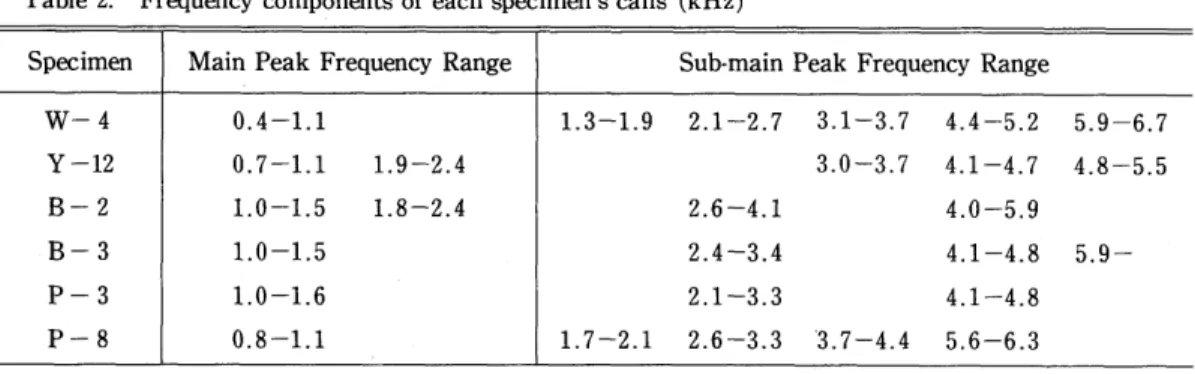
The calls of the individual pups as mentioned above are shown on Fig. 3 as a schematic pattern.
The frequency components and duration of the
calls of the individual pups are shown on Tables 2 and 3.
As mentioned above, individual pups had special characteristics in their calls. These structural characteristics of an individual pup did not change greatly at each call. Accordingly, it was quite possible to distinguish an individual pup from others by analysing its call alone. lt is also con−
sidered that a mother seal uses the difference in the call of her pup as the first clue to find it. However,
since the number of cases applied in this study was small and the study was conducted in a limited environment, it is necessary to carry out more
幽ε﹄と塁9ζ
W−4
B−2
…姻 繍 il蜘
繍繍i・1
t
P−3
殉緬lll!1 ・ ll蜘llill締1 Wl・[ll
膠・
勲岬榊軸黒門榊ll
Y−12 職.
繍 燗 御B−3 ド隔w 川1・いt
・lll齢ll榊lw 齢1 榊l/aiu
鰍 糊1㈱脳繍 騨
︐ ︶
i [Yti,ili Wl V 1 11 X. iA i i
g v
P−8
噛ll/l騨tl ll 榊llll榊!l.曲i・
.側
し
E亘aps ed Time
Fig.3. Schematic pattem of each pup s ca11.
Table 2. Frequency components of each specimen's calls (kHz)
Specimen Main Peak Frequency Range Sub-main Peak Frequency Range
W- 4 0. 4 -1 . 1 L3-1.9 2.1-2.7 3.1-3.7 4.4-5.2 5.9-6.7
Y -12 0.7-L1 1.9-2.4 3.0-3.7 4.1-4.7 4.8-5.5
B- 2 1 . 0 -1 . 5 1 . 8 -2 . 4 2.6-4.1 4.0-5.9
B- 3 1.0-1.5 2.4-3.4 4.1-4.8 5.9-
P - 3 1.0-1.6 2.1-3.3 4.1-4.8
P - 8 0 . 8 -1 . 1 1.7-2.1 2.6-3.3 3.7-4.4 5.6-6.3
studies of this kind. An experiment of mother seals' reaction is also needed. One can say, however, that as a result of this study it has become clear that there are differences in the calls between pups and that it is highly probably that a mother seal can distinguish the call of her own pup.
References
Bartholomew, G. A. and N. E. Collias (1962). Anim.
Behay., 10, 1-2.
Gentry, R. L. (1967). J. Auditory Res., 7, 187-193.
LeBoeuf, B. J. and R. S. Peterson (1969). Science, 166, 1654-1656.
Peterson, R. S. and G. A. Batholomew (1969).
Anim. Behay., 17, 17-24.
Poulter, T. C. (1966). J. Auditory Res., 6, 165-173.
Schevill, W. E., W. A. Watkins and G. C. Ray (1963) . Science, 141, 50-53.
Schevill, W. E., W. A. Watkins and G. C. Ray (1966) . Zoologica, 51 (3) , 103 -111.
Schusterman, R. J. and J. Schmook (1967). Zoo-
Table 3. Duration of each specimen's calls
Specimen Duration (sec)
W- 4 0.8-0.9 1.1-1.9
Y -12 0.6- 1.25
B- 2 1 . 2 -2 . 2
B- 3 0.5-0.9 1.1-2.0
P - 3 0. 8 - 1 . 0 -1 . 2 P - 8 . 8 - 1 . 2 -1 . 9
logica, 52 (1) , 21 -24.
Schusterman, R. J., R. F. Balliet and J. Nixon (1972). J. exp. Analysis Behay., 17, 339-359.
Stirling, I. (1973). J. Fish. Res. Bd. Can., 30 (10), 1592-1594.
Stirling, I. and D. B. Siniff (1979). Can. J. Zool., 57, 1244-1248.
Terhune, J. M. and K. Ronald (1973). Can. J. Zool., 51, 319-321.
Terhune, J. M., R. E. A. Stewart and K. Ronald (1979). Can. J. Zool., 57, 1337-1338.
オ ッ トセ イ 仔 獣 の 発 生 音 の個 体 差 に つ い て 竹 村 陽 ・吉 田 主 基 ・馬 場 徳 寿
ロベ ン島 で捕 獲 され,三 津 シー パ ラ ダ イス に搬 入 され た オ ッ トセ イ仔 獣6頭 の 発 生音 を解析 した.オ ッ トセ イ仔 獣 の 発 生音 は1秒 の数 分 の1の 短 い もの と,1〜2秒,時 に は数 秒 持 続 す る大 きな ワメ キ音 で,数 十Hzか ら8kHz以 上 に も達 す る周 波数 成 分 よ り成 る.各 発 生音 は顕 著 な 主極 大 周 波数 と副 極 大周 波 数 よ り成 る.各 仔 獣 の発 生 音 は各 々特 徴 的 な構 造 を有 し,発 音 時 の生 理 的 状 態 に よ って 大 き く変 わ るこ とはな い.母 獣 は これ らの 発 生音 を識 別 して,自 己 の 仔 獣 を発見 す る最 初 の手 掛 りと して い る と考 え られ る.