Work Ethic in a Japanese Museum Environment : A Case Study of the National Museum of
Ethnology
著者(英) Alex De Voogt, Shimpei Ota, Jonas W. B. Lang journal or
publication title
Bulletin of the National Museum of Ethnology
volume 42
number 4
page range 435‑448
year 2018‑06‑14
URL http://doi.org/10.15021/00009097
*Department of Economics and Business, Drew University
** Department of Cross-Field Research, National Museum of Ethnology
*** Department of Personnel Management, Work, and Organizational Psychology, Ghent University Key Words:museum administration, organizational psychology, organizational manage-
ment, lottery question, post-industrial society
キーワード:博物館経営,組織心理学,組織マネジメント,ロッタリー質問,ポスト 産業化社会
Work Ethic in a Japanese Museum Environment:
A Case Study of the National Museum of Ethnology
Alex de Voogt*, Shimpei C. Ota**, and Jonas W. B. Lang***
日本の博物館環境における労働倫理の研究
―国立民族学博物館を事例として―
アレックス・デ=ヴート,太田心平,ジョーナス・W・B・ラング
1 Work Ethic
2 Theoretical Ideas about the Changes in Work Ethic
3 Setting and Contexts
4 Preliminary Ethnographic Study 5 Method and Measures 6 Results for the Minpaku 7 Discussion
Museums are organizations that, depending on their size, each have a unique combination of workers. Typically included are employees whose duties are con- cerned with visitors, the public raison d’être of a museum. Collections and exhibits require academically trained specialists while the organization as a whole needs administrators and managerial staff. In addition, there are possible for-profit activi- ties, such as museum shops and restaurants, in an otherwise mostly non-profit environment. This situation may be further complicated by volunteer, temporary, part-time, long-term or even tenured contracts for the people involved.
資料 Research Resources
The unique and complex combination of workers of a museum is commonly housed in a singular building, a space in which all people may interact or encounter each other daily. As a result of the organic relationships among all staff members, the organization is still a whole, i.e., a museum, and not a combination of unrelated practices.
When employees of organizations are studied within management or organiza- tional psychology disciplines, this diversity among employees is often absent.
Non-profit organizations are already less often studied but especially part-time and non-managerial workers are rarely included in surveys that seek to understand orga- nizational behavior (Bergman and Jean 2015).
The following study of people working at the National Museum of Ethnology, or Minpaku, a Japanese institution with the largest ethnographic collections in Japan, includes a wide array of employees. They were provided with a one-page questionnaire on work ethic to confirm or contrast results from previous research elsewhere. Where the findings contradict earlier studies, recommendations are made for future research in which studies on museum organizations can play a pivotal role to address the needs in fields of management and organizational psychology.
1 Work Ethic
Early industrial and organizational psychology saw work as primarily a physi- cal and reward-based activity (Münsterberg 1912). This view rapidly changed in the human relation movement of the 1930s. Led by Mayo (1933), industrial and organiz- sational psychologists realized that social relations and social climate in an organization frequently had a stronger impact on workers’ motivation than physical characteristics of the work environment, such as light conditions or financial com- pensation. A construct that emerged from the human relations movement is work ethic or workers’ tendency to derive more than economic benefit from work.
Subsequently, this became a central theoretical concept in the field of work and organizational psychology.
One leading tool for measuring work ethic is a thought exercise known as the lottery question (Morse and Weiss 1955): “Would you continue to work if you inherited enough money to live comfortably without working?” (yes/no). Highhouse, Zickar, and Yankelevich, (2010) reported values around 70% “yes” for U.S. workers.
Similar or even higher numbers have been documented in other industrialized and post-industrial countries (Warr 1982; Harpaz 1989; Ruiz and Wilpert 1991; Misumi and Yamori 1991).
Morse and Weiss (1955) are referred to as the first to have posed the lottery
question. Their U.S. sample showed that men with middle-class jobs and farming
jobs gave an 86% positive answer to the lottery question and those in working-class
jobs 76%. A second study was conducted by Tausky (1969) who sampled 267
American craftsmen, foremen, operatives and laborers to determine work ethic for what he called “blue-collar workers” and found 82%. Although differences related to work interests were found between workers of different social classes, the com- mitment to work “is expressed among the general population irrespective of social class” (Kaplan and Tausky 1974: 187). Vecchio (1980: 366) in another study of American men opined that cross-cultural studies may provide “interesting insights as to the relative standing of the U.S. labor force vis-à-vis the rest of the world”.
Warr (1982) found a different score for British workers who reported an overall 69% of men and 65% of women who would continue to work. Also, Highhouse’s team investigated variations in “macroeconomic environment” through time and compared data for U.S. workers at different intervals between 1980 and 2006. They reported a decline in value to around 70% “yes” for US workers that were “remark- ably similar across different aspects of the U.S. working population”. They conclude that fluctuations in responses “seem to be linked to economic conditions”
(Highhouse et al. 2010: 354).
2 Theoretical Ideas about the Changes in Work Ethic
The work ethic literature and specific research on the lottery question have been interpreted from two different theoretical perspectives. One group of research- ers has suggested that a high percentage of “yes” answers to the lottery question in extant research is a result of the special nature of Western industrialized society (Vecchio 1980; Harpaz 2002). Especially the American and the British cultures have frequently been characterized as unusually industrious due to a Protestant, Judeo-
Protestant or American work ethic, terms that go back to Weber (1904; 1905) whospeaks of the Protestant ethic to explain the rise of capitalism. With recent research on non-industrialized contexts, this suggestion of a religious factor is shown to be particularly problematic (de Voogt and Lang 2017).
Although the idea of a Protestant work ethic in Western industrialized society
is common, it contrasts with theoretical ideas in value and culture research where
researchers have suggested that the desire to work independently of financial benefit
is a universal cultural trait (Schwartz and Bilsky 1990) and the result of a gradual
postmodern culture shift in industrialized and post-industrial societies that deempha-
sizes modernist ideas of individual achievement (Ingelhart 1997). The notion of
work ethic predicts that non-industrialized countries show a lower work ethic while
the universality of work values suggests that the differences are minimal. The notion
of a postmodern value shift would suggest that industrialized countries have a work
ethic that declines over time and that work ethic may be higher in less economically
developed and non-industrialized contexts because a postmodern shift has not yet
taken place. This latter notion about the postmodern shift seems reinforced by recent
data (de Voogt and Lang 2017).
Diachronic studies in the Western world have shown that “non-financial employment commitment”, as Warr defined it (1982), has declined. Vecchio (1980:
362) already suggested “Cultural-change theorists … have argued that since the middle of this century a steady decline has occurred in the value attached to work.”
He found a significant decline from 80% to 72.2% among American males. In refer- ences to the high work ethic in Japan, Yugoslavia, and Israel, countries that were all industrialized extensively in the twentieth century, Heller (1991: 148) states that “it seems likely that, in due time, the work ethic will decline in importance there as well; in Japan, this is already occurring.” The findings by Misumi and Yamori (1991) as well as Ruiz-Quintanilla and Wilpert (1991) partly support his statement for Japan and Germany. Highhouse et al. (2010) have shown this for both men and women in the United States for a later time. But in contrast Harpaz (2002), in a study compar- ing data ranging from the period 1981 to 1993 in Israel, found that despite the social and economic events and changing work attitudes, work centrality seemed to have retained its importance in this population.
The role of industrialization, or “the macroeconomic environment”, in the understanding of work ethic and its possible decline remains unclear; it is expected to decline in industrialized countries but does not always do so. At the same time, previous studies seem to show that work ethic within each country is largely the same for different types of workers. The following study features a more extensive investigation of different types of workers within a museum organization in Japan, a country where work ethic as measured by the lottery question is thought to be in decline. The wide variety of workers present in a museum made this location partic- ularly suitable for such an investigation.
3 Setting and Contexts
Minpaku, founded by the Japanese government in 1974 as a national inter-uni- versity research institute, has exhibition halls and provides graduate-level training in ethnology as one of the core institutes of the Graduate University for Advanced Studies. The annual budget of the financial year 2016 (April 2016 – March 2017) was 2,772 million yen (about 25 million US dollars) and nearly 43% of it was spent on personnel expenses (National Museum of Ethnology 2017).
In Minpaku, the work space is shared by various types of workers. As it is a
research and higher educational institute, it has 52 professors excluding vacancies,
and 8 research associates, about 20 part-time laboratory assistants, as of October
2017, and a 60 to 100 fluid number of postdoctoral and guest researchers most of
whom are only affiliated and very rarely seen in Minpaku. Except for these academ-
ics, the number of workers that are working inside Minpaku is not fixed but
averages around 170 for the month of October 2017. This includes its 48 regular
officials, almost half of whom are being dispatched for some years from other
national institutes of higher education, such as Osaka University, a system known as
“human resource exchange” (National Museum of Ethnology 2006: 28–29).
The number of these exchanged offi cials has been going down since Minpaku was incorporated as an “inter-university research institute corporation” to become independent from the government in 2004
―the same time as when all nationaluniversities became “national university corporations” in Japan. Until the incorpora- tion, Minpaku did not employ any of their own regular offi cials other than technical staff , while all the management offi cials were dispatched from other institutions within the system (Figure 1). The HR situation is, however, changing. The museum administration has started to employ their own regular offi cials after the incorpora- tion, and those offi cials who began their work as rank-and-fi le employees are now becoming team-leaders and even subsection managers (Ota 2014).
Apart from these regular offi cials, a few dozen contract offi cials will be rotating off in three to fi ve years. Also, a similar number of temporary staff dispatched by outside companies are working at Minpaku. Some of the temporary staff are engi- neers working in a computer environment and in video production projects, while others are librarians and, occasionally, collection conservators. And the others are working for an outside non-profi t foundation that facilitates outsourcing for Minpaku. They oversee museum shops, ticketing, memberships, monitoring of exhibition halls and so on, while others are working for the museum restaurant. The restaurant serves regular lunch menus and temporary ethnic dishes adjusted to the theme of the on-going special exhibition for museum visitors, as well as prepares
Figure 1 Organization Chart of Minpaku (as of April 1, 2017) (Source: National Museum of Ethnology 2018)
lunch for the employees. Finally, the guards and cleaning staff are all outsourced as well. The total number of workers including these people but excluding academics is roughly 170 as was already mentioned above.
The museum work space is in a four-story building that was designed under the architectural philosophy of metabolism in the 1970s (Schmal et al. 2005), except for two independent buildings: one used for special exhibitions, and the other as an extra storage unit that does not have workspaces. Therefore, we may assume that all employees are sharing the same building (Photo 1).
Photo 1 Buildings of Minpaku
(Source: National Museum of Ethnology)
Minpaku is a unique museum in which it has no curators. Since its establish- ment, Minpaku has been an advanced institute of ethnology and cultural anthropology despite including the term “museum” in its name. And, as all national inter-university research institutes it directly belonged to then Ministry of Education (current Ministry of Education, Culture, Sports, Science and Technology) and was under the Japanese national universities system. Its faculty was regarded as profes- sors of a national university. This is the reason why Minpaku has no curator though Japanese museum law requires all museums to employ more than one curator (Umesao 1975: 260–263; 1987a: 45; 1990: 70–71).
Therefore, for instance, any unusual event in the exhibition halls such as van-
dalism, danger of damage from insects and so on is commonly discovered by the
staff from the Section of Information Planning, or by guards, and is then reported to
the administrative and managerial staff as well as to the professors in charge of the
exhibitions. The exhibitions are planned to display and make public the fruits of
research conducted by professors, just as are academic articles (Umesao 1987b:
125–126) and are planned by temporary teams that include the professors, the staff of the Section of Information Planning and external professionals, such as researchers of other institutes, professionals from design companies and so on. (See the commit- tee members of each exhibition at its website or at its catalog book.) Generally speaking, at a museum that has researchers separate from curators, it is the curators’
duty to plan and control the museums’ exhibitions while researchers concentrate on their individual academic research, without touching the exhibitions. Comparing curators and researchers at those museums, the duty of the professors in Minpaku is not the same as either. But it is also true that they are expected to be on the “front line” of the museum (Umesao 1975: 260–263), as well as to conduct their research, teach classes, tutor their doctoral students at the Department of Regional Studies and the Department of Comparative Studies of the Graduate School for Advanced Studies, commit to the organizational services and lead domestic / international joint projects with the other researchers inside / outside the museum. The last part of their duty is key since Minpaku is regarded as a national center unlike other research and higher education institutes. Thus, they have no obligation to teach undergraduate and M.A. courses and devote their time to joint projects, while their outputs include exhibitions (Ota 2014: 5).
Minpaku does not necessarily assign any assistants to their academic workers, other than administrative and managerial support staff. Since this institute does not have any undergraduate or master courses, professors also cannot use teaching assistants except for a few student research assistants dispatched to some projects.
Instead, professors are known to hire temporary part-time staff with their own research grants obtained from external sources; some part-timers have been working for Minpaku for longer periods of time than their supervisors who are professors, while others are temporarily hired after graduating the doctoral course at the Graduate University for Advanced Studies or at other universities.
For these reasons, even professors need to directly meet and talk several times and almost every working day with non-academic staff, such as those in the Section of Finance and the Subsection of Human Resources. This is common in other uni- versities in Japan. In sum, most of the workers in Minpaku are expected to cooperate with each other.
4 Preliminary Ethnographic Study
The cooperation among various workers seems to be more common for activi-
ties at Minpaku than expected. One of the authors conducted an ethnographic study
prior to the research reported here. He determined that museum exhibitions be con-
structed through a process that often accepts non-academic workers’ opinions even
though museologists have argued that exhibitions are mixed outcomes predicated on
the individual abilities and ethics of curators together with the trends and contexts of the academy and the world (Ota 2014).
Examples of this type of collaboration are manifold. For instance, a regular official in the Section of Information Planning sometimes makes a drastic revision of a draft of captions that was originally written by a professional for an exhibit and then asks for his/her agreement, stating: “this is just a suggestion from me that has a point of view similar to our visitors’, but ……” While anthropologists are consider- ing how to arrange the exhibits in a hall under renewal, a temporary worker, who is otherwise assisting collection management and inspection, will talk to them, asking:
“do you like this?” The suggestion might even be adopted in the end. When there is a plan to add some more exhibits in a hall, a guard, who often enjoys chatting with professors, procured ideal material at no cost from his/her neighbor and donates it for this purpose, asking: “doctor, does this not be helpful?” All of this might sound unusual, but these events are actual examples that have been regularly reported in Minpaku in the past ten years by some professors. The participation of workers with unrelated job descriptions in the construction of some parts of an exhibition are not known even by the external researchers who evaluate and criticize the exhibitions at Minpaku. These parts are, however, integral to the exhibitions’ development.
Conversely, museum exhibitions reflect the work of those that are not academic, administrative or managerial staff.
The results of the preliminary ethnographic study are hinting at two kinds of new directions in museum studies. One is exhibition museology, in which it can be shown that a larger variety of actors and agents might be involved in planning museum exhibitions than was supposed before. Although Minpaku is not representa- tive of most other museums in the world, this ethnographic case study suggests that these actors and agents are relevant. It may inspire subsequent research, just as Gell (1998) opened up new research possibilities of the arts by including in his analyses the surroundings of artists and art works.
The other result is found in museum administration studies, especially studies of museum organizational behavior, which could point out that the understanding of the organizational behavior of museums should not be limited to administrative and managerial staff as the focus of the literature in this field has so far been limited.
Without broadening our research focus, studies of museum organizational behavior would not be inclusive both in the case of qualitative research by way of an ethno- graphic method and in the case of quantitative research using validated questionnaires for statistical analysis. Including multiple methodologies comes closer to what is generally called a “holistic approach” in sociocultural anthropology.
5 Method and Measures
The authors collected paper questionnaires in 2017, thereby avoiding a bias that
only people with access to a computer would fill out the survey. The text of the questionnaire was translated from English into Japanese and back-translated to ensure its accuracy. The regular officials were approached during one of their biweekly meetings with an explanatory note from the director-general about informed consent. The temporary officials were asked by those regular officials to join this survey, with the same explanatory note. Workers not employed directly by Minpaku were approached individually with the same explanatory note and often a verbal explanation. In many cases, the filled-out forms were placed in sealed enve- lopes to ensure anonymity.
The lottery question was phrased: “If you were to get enough money to live as comfortably as you would like for the rest of your life, would you continue to work, or would you stop working?” following Highhouse et al. (2010) and with a binary choice for an answer. Following the same study design of Highhouse et al. (2010), a five-point scale on relative financial status from far below to far above average was included. One scale about life (exciting, routine, dull) and one on overall satisfac- tion (very happy, happy, not too happy) together with questions about age and gender that were also incorporated. In addition to their job title, a description of the main tasks of their job was also requested to clarify their position. The scale used by Highhouse
et al.(2010) on job satisfaction was expanded and included six questions on a five-point scale on job satisfaction ranging from very dissatisfied to very satis- fied following Tsui, Egan and O’Reilly (1992). Following de Voogt and Lang (2017) the respondent’s religion was also asked.
6 Results for the Minpaku
The first group surveyed consisted of 95 employees directly employed by the Minpaku organization, mainly consisting of people tasked with administrative or managerial duties. Just 53% answered positively to the lottery question.
The second group comprised 27 workers that had contracts with outside com- panies but who conducted their work inside the institution. This selection included personnel that worked in the shop and restaurant, or as guards and cleaning staff.
Such workers are commonly excluded from organizational psychology surveys.
Only 46% of this group of workers indicated that they would continue to work.
The second group had a lower score on job satisfaction compared to the first group. The nature of the work was scored as 3.52 instead of 3.83 for the first group, and overall job satisfaction was scored as 3.15 in contrast with 3.57 for the others. It confirms that work ethic is a measure separate from job satisfaction, but it also indicates that the workers commonly excluded from surveys have more to gain in terms of job satisfaction. In other words, their exclusion is particularly problematic as their satisfaction is already lower.
A small group of twelve people working in two nearby museums also com-
pleted the survey and although this sample is too small, 75% noted a positive answer.
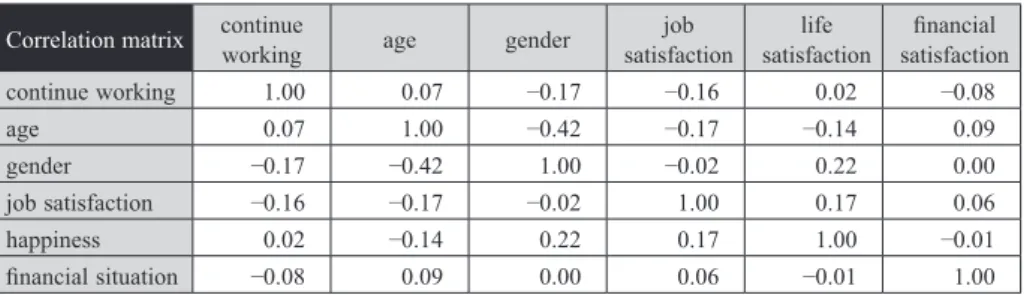
Table 1 shows a correlation matrix that relates the lottery question to partici- pants’ age, gender as well as perception about their job, life, and financial circumstances. Contrary to some studies (Morse and Weiss 1955; de Voogt and Lang 2017), age is not related to “yes” answers in this dataset.
7 Discussion
This survey provides a series of surprising results. It confirms the notion expressed in the literature that the scores on work ethic are gradually falling in industrialized countries such as Japan. It is remarkable though that in this nation the score already dropped to around 50% while the lowest scores so far have been above 60% in other industrialized countries. As multiple studies have shown that such scores are independent of the type of employment (Tausky 1969; Kaplan and Tausky 1974), the drop of this score in Japan is not immediately explained by the specificity of the sample. The data also confirmed that the difference between the different types of workers within Minpaku does not seem to be significant. A more fine-grained analysis would perhaps show otherwise but at present, the number of people for each type of position in the museum organization does not allow for such a statistical analysis.
Although the data from Minpaku seem to confirm a rapid decline in work ethic as defined by the lottery question, the small number of surveys collected at other museums in Japan seems to contradict this result. This raises the question whether this result is specific for this institution or can be generalized for all museums or for Japan. The contrast with other museums, however, is complex. The Minpaku survey did not include curators while the other set that was collected did. Also, the smaller set is taken from much smaller institutions so that the responsibilities of individual staff create a rather different job description. This leaves at least two possible expla- nations: the difference is organization-specific, or the difference is job-specific. Both
Table 1 Correlation matrix showing no correlations between answers to the lottery question and age, gender, and satisfaction.
Correlation matrix continue
working age gender job
satisfaction life
satisfaction financial satisfaction
continue working 1.00 0.07 –0.17 –0.16 0.02 –0.08
age 0.07 1.00 –0.42 –0.17 –0.14 0.09
gender –0.17 –0.42 1.00 –0.02 0.22 0.00
job satisfaction –0.16 –0.17 –0.02 1.00 0.17 0.06
happiness 0.02 –0.14 0.22 0.17 1.00 –0.01
financial situation –0.08 0.09 0.00 0.06 –0.01 1.00
explanations contradict earlier findings in the literature on work ethic. It is noted that the scores for job satisfaction were not significantly different between the out- side museums and Minpaku. It is, therefore, of interest to expand the survey to other museum institutions to verify if there are significant differences between organiza- tions or specific jobs that are brought about by the lottery question.
Additionally, it would be also of interest to compare data from public museums with sets of data from government offices. The social discourse in Japan suggests that people prefer to be government officials rather than private or public company employees due to their higher job stability. It may explain why work ethic of the workers in public museums is generally low. It does not explain, however, why the scores of the temporary employees and outsourced workers are not significantly dif- ferent from those of regular employees at Minpaku.
Museum environments allow us to contrast a diverse set of workers in one organization. Understanding the differences between the groups within an organiza- tion as well as in contrast with outside peer institutions helps current management and also the disciplines of organizational psychology and management to more effectively address the needs and well-being of its people. It confirms that studies of museum organizational behavior have a wider application and significance.
References
Bergman, M. E. and V. A. Jean
2015 Where Have All the “Workers” Gone?: A Critical Analysis of the Unrepresentativeness of Our Samples Relative to the Labor Market in the Industrial-Organizational Psychology Literature.Industrial and Organizational Psychology 9(1): 84–113.
de Voogt, A. and J. W. B. Lang
2017 Employee Work Ethic in Nine Non-Industrialized Contexts: Some Surprising Non-POSH Findings.Industrial and Organizational Psychology 10(3): 398–403.
Gell, A.
1998 Art and Agency: An Anthropological Theory. Oxford: Oxford University Press.
Harpaz, I.
1989 Non-financial Employment Commitment: A Cross-National Comparison. Journal of Occupational Psychology 62(2): 147–150.
2002 Expressing a Wish to Continue or Stop Working as Related to the Meaning of Work.
European Journal of Work and Organizational Psychology 11(2): 177–198.
Heller, F.
1991 Reassessing the Work Ethic: A New Look at Work and Other Activities. The European Work and Organizational Psychologist 1(2–3): 147–160.
Highhouse, S., M. J. Zickar, and M. Yankelevich
2010 Would You Work if You Won the Lottery?: Tracking Change in the American Work Ethic.
Journal of Applied Psychology 95(2): 349–357.
Ingelhart, R.
1997 Modernization and Postmodernization: Cultural, Economic, and Political Change in 43 Societies. Princeton, New Jersey: Princeton University Press.
Kaplan, H. R. and C. Tausky
1974 The Meaning of Work among the Hard-Core Unemployed. The Pacific Sociological Review 17(2): 185–198.
Mayo, E.
1933 The Human Problems of an Industrial Civilization. Cambridge: Harvard University Press.
Misumi, J. and K. Yamori
1991 Values and Beyond: Training for Higher Work Centrality in Japan. The European Work and Organizational Psychologist 1(2–3): 135–145.
Morse, N. C. and R. S. Weiss
1955 The Function and Meaning of Work and the Job. American Sociological Review 20(2): 191–
Münsterberg, H.198.
1912 Psychologie und Wirtschaftsleben Ein Beitrag zur angewandten Experimental Psychologie.
Leipzig: Barth.
National Museum of Ethnology
2006 Kokuritsu Minzokugaku Hakubutsukan Sanjunenshi(A Thirty-Year History of the National Museum of Ethnology). Osaka: National Museum of Ethnology (in Japanese).
2017 Kokuritsu Minzokugaku Hakubutsukan Yoran 2017 (Museum Survey and Guide 2017).
Osaka: National Museum of Ethnology (in Japanese).
2018 Museum Survey and Guide 2017–2018. Osaka: National Museum of Ethnology.
Ota, S. C.
2014 Minpaku no butaiura de: Tenji ni matsuwaru hitobito to sono gyomujo no sairyo (Behind the Scenes: How Staff Prepare Exhibitions and Make Choices).Minpaku Tsushin 144: 2–7 (in Japanese).
Ruiz-Quintanilla, S. A. and B. Wilpert
1991 Are Work Meanings Changing? The European Work and Organizational Psychologist 1(2–3):
91–109.
Schmal, P. C., I. Flagge, and J. Visscher
2005 Kisho Kurokawa: Metabolism and Symbiosis. Berlin: Jovis.
Schwartz, S. H. and W. Bilsky
1990 Toward a Theory of the Universal Content and Structure of Values: Extensions and Cross- Cultural Replications. Journal of Personality and Social Psychology 58(5): 878–891.
Tausky, C.
1969 Meanings of Work among Blue Collar Men. The Pacific Sociological Review 12(1): 49–55.
Tsui, A. S., T. D. Egan, and C. A. O’Reilly, Ⅲ
1992 Being Different: Relational Demography and Organizational Attachment. Administrative Science Quarterly 37(4): 549–579.
Umesao, T.
1975 Minzokugaku Hakubutsukan(Museum of Ethnology). Tokyo: Kodansha (in Japanese).
1987a Hakubutsukancho no Junen: Kokuritsu Minzokugaku Hakubutsukan no Kiroku(Ten Years of a Museum Director-General: A Record of the National Museum of Ethnology). Tokyo:
Heibonsha (in Japanese).
1987b Media toshite no Hakubutsukan(Museums as Media). Tokyo: Heibonsha (in Japanese).
1990 Joho Kanri Ron(Information Administration). Tokyo: Iwanami Shoten (in Japanese).
Vecchio, R. P.
1980 The Function and Meaning of Work and the Job: Morse and Weiss (1955) revisited. Academy of Management Journal 23(2): 361–367.
Warr, P.
1982 A National Study of Non-Financial Employment Commitment. Journal of Occupational Psychology 55(4): 297–312.
Weber, M.
1904 Die Protestantische Ethik und der Geist des Kapitalismus. Archiv für Sozialwissenschaft und Sozialpolitik 20: 1–54.
1905 Die Protestantische Ethik und der Geist des Kapitalismus. Archiv für Sozialwissenschaft und Sozialpolitik 21: 1–110.
Appendix: Questionnaires
If you were to get enough money to live as comfortably as you would like for the rest of your life, would you continue to work or would you stop working?
|_| I would continue to work |_| I would stop working How old are you?: _____ yrs
Are you: |_| male |_| female
Are you married? |_| no |_| yes
Do you have children? |_| no |_| if yes, how many? _____
What is your highest level of education?
|_| elementary school |_| junior high school |_| junior high school |_| university / college What is the name or title of your current job? ____________________
How many people do you supervise? _____
What are the main (important) tasks you need to do in your job?
1.____________________________
2.____________________________
verydissatisfied very satisfied How satisfied are you with the nature of the work you
perform? 1 2 3 4 5
How satisfied are you with the person who
supervises/facilitates/administrates you? 1 2 3 4 5
How satisfied are you with your relations with others in the
organization with whom you work? 1 2 3 4 5
How satisfied are you with the pay you receive for your job? 1 2 3 4 5 How satisfied are you with the opportunities which exist in this
organization for advancement or promotion? 1 2 3 4 5
Considering everything, how satisfied are you with your
current job situation? 1 2 3 4 5
In general, do you find life
|_| exciting |_| pretty routine |_| dull
Taken all together, how would you say things are these days? Would you say that you are
|_| very happy |_| pretty happy |_| not too happy How do you consider your financial status relative to other people in this country
|_| |_| |_| |_| |_|
far below average below average average above average far above average What is your religion? _________________
What is your nationality? _________________
If people who work in your country were to get enough money to live as comfortably as they would like for the rest of their life, how many (out of 100%) do you think will answer:
(A) __ % They would continue to work (B) __ % They would stop working (A+B=100) If people who work with you every week were to get enough money to live as comfortably as they would like for the rest of their life, how many (out of 100%) do you think will answer:
(A) __ % They would continue to work (B) __ % They would stop working (A+B=100)
ࡶࡋࡶṧࡾࡢே⏕ࢆዲࡁ࡞ࡔࡅᛌ㐺㐣ࡈࡏࡿࡃࡽ࠸ࡢ࠾㔠ࢆᚓࡿࡇ࡞ࡗࡓࡋࡓࡽࠊ
࠶࡞ࡓࡣ࠾ࢆ⥆ࡅࡲࡍ㸽 ࡑࢀࡶ㎡ࡵࡲࡍ㸽
|_| ࠾ࢆ⥆ࡅࡓ࠸ |_| ࠾ࡣ㎡ࡵࡓ࠸
ᚚᖺ㱋: _____ ṓ
ᛶู: |_| ⏨ |_| ዪ 㓄അ⪅ࡢ᭷↓: |_| ↓ |_| ᭷
Ꮚࡶࡢ᭷↓: |_| ↓ |_| ᭷ Ѝ _____ே
᭱⤊ᏛṔ: |_| ᑠᏛᰯ |_|୰Ꮫᰯ |_| 㧗➼Ꮫᰯ |_| Ꮫ
⌧ᅾࡢ࠶࡞ࡓࡢ⫋ྡࡣ㸽 ____________________
ఱேࡢ⫋ဨᣦ♧ࢆ࠼ࡿ❧ሙ࡛ࡍ㸽 _____ே
࠶࡞ࡓࡢ⫋㈐࡛࡞ࡿ㸦㔜せ࡞㸧ᴗົࡣఱ࡛ࡍ㸽 1.____________________________
2.____________________________
‶ ‶㊊
ᚚ⮬㌟ࡢ࠾ࡢ✀ู‶㊊ࡋ࡚࠸ࡲࡍ㸽 1 2 3 4 5 ᚚ⮬㌟࠾ࡢᣦ♧ࢆ࠼ࡿྠࡸ⟶⌮⪅‶㊊ࡋ࡚࠸ࡲࡍ㸽 1 2 3 4 5 ᚚ⮬㌟ࡀࢃࡿ⫋ሙࡢே㛫㛵ಀ‶㊊ࡋ࡚࠸ࡲࡍ㸽 1 2 3 4 5 ᚚ⮬㌟ࡢ⤥㔠㢠‶㊊ࡋ࡚࠸ࡲࡍ㸽 1 2 3 4 5
⫋ሙ࡛࠼ࡽࢀࡿ᪼㐍ࡸ᪼⤥ࡢᶵ‶㊊ࡋ࡚࠸ࡲࡍ㸽 1 2 3 4 5 ࡍ࡚ࢆ⥲ྜࡋ࡚ࠊ⌧ᅾࡢ⎔ቃ‶㊊ࡋ࡚࠸ࡲࡍ㸽 1 2 3 4 5
⥲ࡌ࡚࠶࡞ࡓࡢே⏕ࡣ㸽
|_| ࣡ࢡ࣡ࢡ |_| ༢ㄪ |_| ࡃࡔࡽ࡞࠸
⥲ࡌ࡚ࡇࡢ㡭ࡢ࠶࡞ࡓࡣ㸽
|_| ࡚ࡶᖾࡏ |_| ࡩࡘ࠺ࡢᖾࡏ |_| ᖾࡏࡣ࠸࠼࡞࠸
᪥ᮏ࡛ᬽࡽࡍࡢேࡧẚ࡚ࠊ࠶࡞ࡓࡢ⤒῭≧ែࡣ㸽
|_| |_| |_| |_| |_|
࡞ࡾୗࡢ᪉ ᖹᆒࡼࡾୗ ᖹᆒⓗ ᖹᆒࡼࡾୖ ࡞ࡾୖࡢ᪉
᐀ᩍࡣ㸽 _________________
ᅜ⡠ࡣ㸽 _________________
ࡶࡋࡶṧࡾࡢே⏕ࢆዲࡁ࡞ࡔࡅᛌ㐺㐣ࡈࡏࡿࡃࡽ࠸ࡢ࠾㔠ࢆᚓࡿࡇ࡞ࡗࡓࡋࡓࡽࠊ
᪥ᮏ࡛ാࡃேࡢఱ㸣ࡀ࠾ࢆ⥆ࡅࡓࡀࡿᛮ࠸ࡲࡍ㸽 ㎡ࡵࡓࡀࡿᛮ࠸ࡲࡍ㸽
(A) __ % ࡣ࠾ࢆ⥆ࡅࡓࡀࡿ (B) __ %ࡣ㎡ࡵࡓࡀࡿ (A+B=100)
ࡶࡋࡶṧࡾࡢே⏕ࢆዲࡁ࡞ࡔࡅᛌ㐺㐣ࡈࡏࡿࡃࡽ࠸ࡢ࠾㔠ࢆᚓࡿࡇ࡞ࡗࡓࡋࡓࡽࠊ
࠶࡞ࡓാࡃேࡢఱ㸣ࡀ࠾ࢆ⥆ࡅࡓࡀࡿᛮ࠸ࡲࡍ㸽 ㎡ࡵࡓࡀࡿᛮ࠸ࡲࡍ㸽
(A) __ % ࡣ࠾ࢆ⥆ࡅࡓࡀࡿ (B) __ %ࡣ㎡ࡵࡓࡀࡿ (A+B=100)