Minorities in between China and Japan:
Complexity of legal status and identity
著者(英) Tien‑shi Chen
journal or
publication title
Bulletin of the National Museum of Ethnology
volume 31
number 3
page range 419‑437
year 2007‑03‑23
URL http://doi.org/10.15021/00003963
* National Museum of Ethnology, Department of Advanced Studies in Anthropology
(国立民族学博物館先端人類科学研究部)
Key Words: minorities “in between”, stateless overseas Chinese, imperial subjects, war orphans, subjective identity, perceived identity
キーワード: はざま のマイノリティ,無国籍華僑,帝国臣民,残留孤児,自己認 識のアイデンティティ,他者認識のアイデンティティ
Minorities “in between” China and Japan:
Complexity of legal status and identity
1)CHEN, Tien-shi*
日本と中国の はざま のマイノリティ
―
複雑化する法的地位とアイデンティティの葛藤
― 陳 天璽Nation states classify their nations and foreigners by nationality, and integrate people by unifying their languages and cultures. They also terri- torialize individual identity by granting nationality. The themes of nation state and nationality were rather a minor issue in anthropology until recently.
This is because studies in anthropology mainly focus on primitive or tribal societies which existed much earlier before the birth of nation states. There- fore, the term minority is often used to describe aborigines or groups of peo- ple who share ethnic and cultural characteristics, and who often have a firm identity base on these. This article, rather, pays attention to nation states, and focuses on the minorities who cross borders or transfer their national- ity due to political events occurring among the nation states related to them.
In particular, I study three groups of people who have been affected by Sino- Japanese relations. These are stateless overseas Chinese, Taiwanese, and war orphans resident in Japan, whom I term “minorities in between China and Japan.” The historical transitions causing them to be minorities will be described, and the complexity of their nationalities and identities will be ana- lyzed.
国家は国籍によって国民と外国人を分別し,文化や言語を統一することに よって国民の統合をはかり,また国籍を与えることによって個人のアイデン
ティティを領土化した。これまで人類学において国家や国籍というテーマは,
副次的なものであった。なぜなら,人類学が主な研究対象としてきたのは未開 社会や部族社会など国家形成以前の社会であったからである。よって,マイノ リティというときも,先住民や少数民族など民族的・文化的な特徴を持つ人び とをさし,彼らはしばしば,そうした特徴による確固としたアイデンティティ を有する人びとであった。本論では,むしろ国家に着目し,その政治的変動 によって越境を行い,また国籍など法的な身分が変更した結果マイノリティと なった人びとに注目する。つまり,日本に在住する人で日中関係に翻弄された 人びと,具体的には,日本と中国の外交関係の変動の結果無国籍となった華僑,
帝国臣民であった台湾人,満州に渡った残留日本人孤児の3つのグループに注 目する。彼らを「日本と中国のはざまのマイノリティ」とし,彼らがそのマイ ノリティとなるに至った歴史的背景,そして,その複雑化したアイデンティティ を分析する。
1 Introduction
This paper focuses on the complexities of the legal status and identities of dif- ferent minority groups who reside in Japan. I called these groups as minorities “in between” China and Japan. They are (1) stateless Chinese residents in Japan, (2) Chinese from Taiwan who were once Japanese imperial subjects during the period of Japanese colonial government, (3) Japanese war orphans who were left in China after the defeat of Japan in the Second World War.
These minorities are unique because they are classified as minorities not nec- essarily due to the ethnic background they were born into, but rather as a result of political events occurring between China and Japan, such as the Second World War and transitions in diplomatic relations, which cause disparities between their legal statuses, their awareness of own identities, their cultural background and the perception of the majority in the society they live in.
These minority groups are victims of the historical events that took place in the mid-20th century. The complication of their identities is a consequence of the turbulence in the socio-political environment in East Asia during that time. This tur-
1 Introduction
2 Complexity of Identity 3 Chinese Migrants in Japan
: transitions of history and population 4 Taiwanese who were once Imperial Subjects
of Japan
5 The “Two Chinas” and the Shift in Japan’s Diplomatic Policy
6 Living as Stateless Overseas Chinese in Japan
7 Japanese War Orphans 8 Conclusion
bulence changed the policies of governments, the populations of ethnic groups in various locations and sometimes governments themselves.
This paper first explains how people can be classified as minorities, portrays the historical events that created these minority groups and finally describes the current situation of the three groups of minorities “in between” China and Japan. The aim of the paper is to draw attention to the existence of these minority groups in Japan, highlighting how the policies of government can cause great inconvenience to these minorities, discrimination and even sometimes affect their basic human rights. The historical events that occurred between China (both PRC-China and ROC-Taiwan) and Japan in the mid-1920s are described in detail in this paper to clarify the back- ground of these groups of people and illustrate the main points.
The information contained in this paper was gathered through interviewing individuals belonging to the minorities “in between” China and Japan, and through interviews with government officials, especially to clarify the legal status of state- less Chinese.
2 Complexity of Identity
Dictionary definitions refer to identity as “the condition of being a specified person of thing”; in contrast to this, postmodern discussions define identity in a far looser way. Stuart Hall writes, “Identities are ... points of temporary attachment to the subject positions which discursive practices construct for us” (Hall 1996: 6).
Fixed identities do not exist by this definition. Identity is better thought of as fall- ing between these two extremes: it is neither as clear as the dictionaries claim nor as tenuous as the postmodernists claim. After Anthony Giddens, Gordon Mathews defined identity as the ongoing sense which the self has of who it is, as conditioned through its ongoing interaction with others. Identity is how the self conceives of itself, and labels itself (Giddens 1991; Mathews 2000).
There is both personal identity and collective identity, the former referring to one’s sense of oneself apart from others, and the latter referring to who one senses oneself to be in common with others. The balance of these modes of identity may vary widely. The elements of collective identity include gender and social class, both of which are essential to the way most of us conceive of ourselves (Mathews 2000: 17). In this article I deal with the personal identities of people in minorities, which are shaped under interaction with or within nation-states, as well as by inter- actions with other people in the same minority group. These identities are diverse and ambiguous and even contradict each other.
Many countries in Asia today are nation states made up of majority ethnic groups. For instance, the population in Japan is mainly made up of Japanese and the population in Korea mainly consists of Koreans. In these nation states, one is clas- sified as belonging to a minority if one’s ethnic group is different from the majority
ethnic group in that nation. The contrast between the majority and the minorities in such countries, which I call nation states in this paper, is more obvious than that in countries that are made up of migrants like Singapore.
In a migrant nation, policy makers may create special rules to cater for the needs of a specific ethnic group. For instance in Singapore, Sikh motorcyclists who wear turbans do not need to wear helmets, which are required by law for other motorcyclists. Even in some nation states, policy makers may acknowledge the exis- tence of minorities and create laws to cater for their needs. In that case, the nation state acknowledges the existence of the different ethnic groups within it, and creates policies that will address the needs of those minority ethnic groups and promote their coexistence with the majority ethnic group. However, this may not be the case for every nation state.
When a nation state does not differentiate between ethnic identity and legal identity or chooses to ignore the existence of an ethnic group in it, the needs and well being of the minority ethnic groups living in that nation state will not be looked after. When the nation state does not acknowledge the existence of the minorities, those minority groups will not have a legitimate identity, and thus no significant political power. As a result, their situation will not be improved, even in a demo- cratic society.
Beside ethnic and legal identity, the cultural background of a person also has an impact on identity. For instance, a Korean brought up in Japan may speak only Japanese, enjoy Japanese cartoons and generally feel culturally more at home with the majority in Japan rather than with the Korean minorities that he or she ethni- cally belongs to. In that case, the cultural dentity of this particular person belongs to Japan rather than the source of ethnic identity—Korea. In a situation where there is a disparity between the cultural identity and the ethnic or legal identity, one may choose how to align oneself. In the same example that we mentioned earlier, the Korean brought up in Japan may choose to align himself or herself as “Japanese Korean (zainichi-korean)” (Harajiri 1998; Kan 2004).
Even if this person speaks Japanese as their mother tongue and knows more about Japanese cartoons than almost anybody in the country, in the view of some Japanese people, they may be treated only as foreigner, or “other”, and may not be accepted in the inner circles of society. This is due to the identity perception of the majority group.
Hence, the identity of an individual, especially the identity of one in a minority, can be multi-dimensional. The identity of an individual is a complex combination of ethnic identity, legal identity, cultural identity, subjective identity and the identity perceived by the majority group.
Ethnic identity refers to the racial, or biological, character of an individual.
The uniqueness of ethnic identity is that it is determined by birth and is impossible to change. This is obvious given its biological origin.
Legal identity, which can also be termed nationality, is often given by the state that one was born into or inherited from the legal identity of parents2). This legal identity usually determines the rights and duties of the individual, which can range from the right to attend public schools run by the state at affordable cost, the amount of tax one needs to pay, to the right to vote and to be elected to office.
Compared to ethnic identity, legal identity is relatively more “configurable”. This is especially true for a highly educated elite in the global society that we live in today.
In this modern world, a member of this elite may choose his or her state based on the quality of living in that particular country (Ong 1999; Hamilton 1999). How- ever, regardless of how highly educated one may be, one can never change one’s ethnic identity.
The concept of cultural identity3) is relatively more fuzzy than the ethnic or legal identity. This is because cultural identity is not obtained by birth or given by an authority. A person is often classified as belonging to a certain cultural group based on the languages they speak, their accent in the language being spoken, the kind of arts appreciated, the kind of food eaten, etc. Cultural identity is often the result of the education one receives and the background where one lives. Cultural identity is also unique as cultural skills can be learnt and one can learn to acquire a number of them and assume multiple cultural identities as one wishes.
However, what is most interesting is the subjective identity which relies on the self-consciousness of individual. This subjective identity normally depends on a person’s ethnic identity, legal identity, cultural identity and may sometimes be affected by the perceived identity of others. In some situations, a person who is capable of multiple cultural skills chooses to belong to different groups from time to time based on their own consciousness. The subjective identity is one that is purely based on individual choice.
By contrast, perceived identity refers to the identity of an individual from the viewpoint of another group of people. Perceived identity wholly depends on the view of others, over which the individual has very little control.
Although I have highlighted five distinct classifications of identity in this paper, their categorizations are inter-related. For example, ethnic identity is often related to the cultural identity of an individual. More interesting is the relation between subjective identity and perceived identity. In some cases, these two identities may be contradictory and the clash between the subjective identity and the perceived identity may cause trouble. On the other hand, an individual may choose to change his or her cultural identity to relieve the pressure of the perceived identity.
In most cases, the different classifications of one’s identity align with each other. For example, a Han Chinese born in Beijing as a citizen of the People’s Republic of China, who speaks Mandarin Chinese as his mother tongue may social- ize in the Han Chinese cultural circle with a group of similar individuals with simi- lar backgrounds.
Conventionally, “minority” refers to people who are acknowledged as not being core members of, or playing a major role in, the main society. The population is relatively small. An individual in such a minority is given a “legal” identity as such. However, the minority groups that I describe in this paper are classified as minorities as long as any one aspect of individual identity deviates from the norm of the majority. In some cases, people may legally belong to the majority group but are socially perceived as in a minority; or they belong to an ethnic minority group but are legally disregarded by any state. Below, I examine the historical events that have led to this phenomenon.
3 Chinese Migrants in Japan: transitions of history and population The first big wave of Chinese migrants to Japan occurred in the second half of the 19th century (1858), when Japan opened its doors to the rest of the world (Nishikawa and Ito 2002)4). Treaties concluded with the United States and European powers successively opened the ports of Shimoda, Hakodate, Kanagawa, Niigata, Hyogo, Edo and Osaka to Western residents. As in the treaty ports in China, West- erners enjoyed extra-territoriality in the foreign concessions, a status which permit- ted them to be tried by their own courts and laws (Hsu 1999). The majority of the Western merchants that appeared in these ports had run businesses in China, and when they established branch firms in Japan, they brought with them their Chinese employees and servants. Many Chinese who came as middlemen or compradors were crucial intermediaries between these Europeans, who spoke no Japanese, and the local Japanese, who spoke no foreign language and lacked any experience of dealing with Europeans—so much so that these Chinese have been described as
Figure 1: Chinese middleman translating for Westerners and Japanese at a Western firm in Yokohama
Source: Yokohama Archives of History
“agents of Westernization” in Japan (Hsu 1999; Nishikawa and Ito 2002). Even Chinese who could not speak the language could communicate with Japanese in writing, since Japanese adopt many Chinese characters.
Westerners and Chinese lived in the foreign resident areas (kyoryuchi) pro- vided by the Japanese government near port cities. Until the abolition of the foreign settlements in 1899, foreigners were only allowed to live and conduct their business in the resident areas, and were not generally allowed to travel outside those areas.
They could not visit other parts of Japan freely, and had to apply for permission if they wanted to do so. Thus the resident areas were composed mainly of foreigners, and the Chinese parts of them became today’s Chinatowns.
The political turbulences and flows of people
In 1894 when the Sino-Japanese War began, almost half the Chinese population moved back to their homeland in China, and only 3000 remained. After the War, the number of Chinese in Japan increased due to the revival of economic relations between the Qing Dynasty and Japan. In addition, an increasing number of Taiwan- ese entered Japan from the Japanese colony. The Chinese population in Japan grew up to more than 30000 in 1930s.
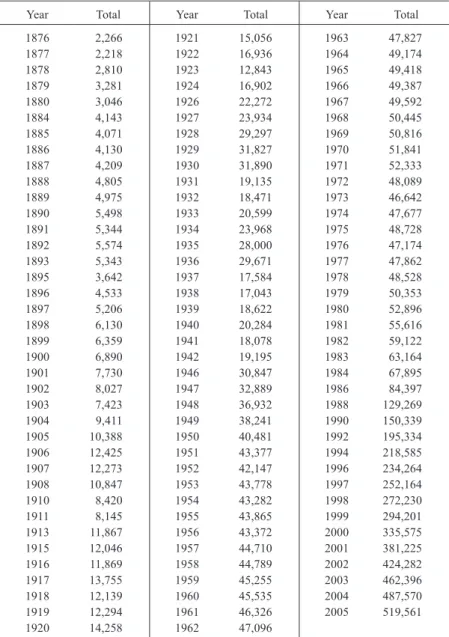
During the Second World War, the population of Chinese in Japan reduced to around 20,000, because a considerable number left Japan again during the war period. After the War, in 1948, the population of Chinese in Japan bounced back to 36,932. This was because of an increase in the number of ethnic Chinese from
Figure 2: The Chinese Streets in Yokohama in the early 20th century Source: Yokohama Archives of History
Table 1: Chinese Population in Japan, 1876–1942 and 1946–2005
Year Total Year Total Year Total
1876 2,266 1921 15,056 1963 47,827
1877 2,218 1922 16,936 1964 49,174
1878 2,810 1923 12,843 1965 49,418
1879 3,281 1924 16,902 1966 49,387
1880 3,046 1926 22,272 1967 49,592
1884 4,143 1927 23,934 1968 50,445
1885 4,071 1928 29,297 1969 50,816
1886 4,130 1929 31,827 1970 51,841
1887 4,209 1930 31,890 1971 52,333
1888 4,805 1931 19,135 1972 48,089
1889 4,975 1932 18,471 1973 46,642
1890 5,498 1933 20,599 1974 47,677
1891 5,344 1934 23,968 1975 48,728
1892 5,574 1935 28,000 1976 47,174
1893 5,343 1936 29,671 1977 47,862
1895 3,642 1937 17,584 1978 48,528
1896 4,533 1938 17,043 1979 50,353
1897 5,206 1939 18,622 1980 52,896
1898 6,130 1940 20,284 1981 55,616
1899 6,359 1941 18,078 1982 59,122
1900 6,890 1942 19,195 1983 63,164
1901 7,730 1946 30,847 1984 67,895
1902 8,027 1947 32,889 1986 84,397
1903 7,423 1948 36,932 1988 129,269
1904 9,411 1949 38,241 1990 150,339
1905 10,388 1950 40,481 1992 195,334
1906 12,425 1951 43,377 1994 218,585
1907 12,273 1952 42,147 1996 234,264
1908 10,847 1953 43,778 1997 252,164
1910 8,420 1954 43,282 1998 272,230
1911 8,145 1955 43,865 1999 294,201
1913 11,867 1956 43,372 2000 335,575
1915 12,046 1957 44,710 2001 381,225
1916 11,869 1958 44,789 2002 424,282
1917 13,755 1959 45,255 2003 462,396
1918 12,139 1960 45,535 2004 487,570
1919 12,294 1961 46,326 2005 519,561
1920 14,258 1962 47,096
Sources: For 1876–1942 and 1946–1996, Hsu Shuzhen. 1998. “Japan”, in Lynn Pan (Ed.), The Encyclopedia of the Chinese Overseas, p. 334. Cambridge, Massachusetts: Harvard University Press. For 1997–2005, 『在留外国人統計』(Statistics of the Foreigners Regis- tered in Japan), 財団法人入管協会 (Japan Immigration Association).
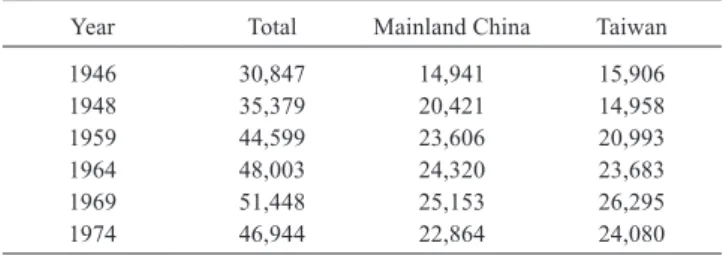
Taiwan. The population of Taiwanese in 1948 was 14,958, which is almost 40% of the whole ethnic Chinese population in Japan at that time.
The sharp increment in Chinese from Taiwan was a consequence of policy changes in Japan due to the defeat in the Second World War. Before the War, both Taiwanese and Koreans were legally treated as Japanese5) (teikoku shinmin, mean- ing imperial subject, or subject of the Meiji Emperor) when they were ruled by the Japanese Colonial Government. They were educated in Japanese and in many respects assimilated into Japanese culture. Some even served in the Japanese mili- tary and fought against Chinese during the War. After its defeat in the Second World War, Japan was forced to give up its colonies. In 1947, as soon as the Foreigners’
Registration Act was established, those from Taiwan and Korea were recategorized as foreigners, losing their Japanese nationality (Tanaka 1995: 64–69). Some were repatriated to their home countries, and some remained in Japan, as for some people it was not an easy choice to be sent back to their homeland, since they were cul- turally already assimilated to Japan. That is why the Chinese population in Japan increased drastically in the 1950s.
4 Taiwanese who were once Imperial Subjects of Japan
One of the cases of minority “in between” I focus on are the Taiwanese who were once imperial subjects of Japan. Needless to say, they were ethnic Chinese, but legally Japanese. Under the colonial government, they were very much influenced by Japanese culture and language. The Japanese government tried to deracinate and instil Japanese national identity into the people in its colonies. As mentioned before, some even served in the Japanese military and fought against Chinese during the War (Lim 1997). After the end of the Second World War and the decolonization of Taiwan, their legal identity shifted from Japanese to Chinese (Republic of China).
This group of people speaks both Japanese and Chinese, although their Japa- nese may be much better than their Chinese. However, their lifestyle may be more aligned to the Taiwanese than the Japanese. This makes them a unique cultural
Table 2: Population of Chinese in Japan based on Birthplace
Year Total Mainland China Taiwan
1946 30,847 14,941 15,906
1948 35,379 20,421 14,958
1959 44,599 23,606 20,993
1964 48,003 24,320 23,683
1969 51,448 25,153 26,295
1974 46,944 22,864 24,080
Sources: Yasui Sankichi (安井三吉) 2005.『帝国日本と華僑』(Impe- rial Japan and Overseas Chinese) p. 261. 青木書店 (Aoki Shoten)
group, though with similarities to the Peranakan of South East Asia. Although they are aware that they are Taiwanese and differentiate themselves from Chinese main- landers, they are perceived as Taiwanese or Chinese by Japanese.
Mr. Wu, who is one of the best-known leaders of the Chinese community in Yokohama, was born in Tainan in 1927, and came to Japan in 1941. At the age of 16, he entered the Japanese army, and was sent to Korea in 1945. He was captured by the Soviet military and detained in Central Asia for two years. In 1947, he was sent back to Japan, and after graduating from Hosei University, he worked in the Over- seas Chinese Bank in Yokohama. Later he had left the Chinese community bank and tried other jobs, but he found it was not easy for him to join the mainstream of Japanese society. He was always treated as overseas Chinese or Taiwanese. In the end, after a decade, he found himself back in the bank in Chinatown again, and later became a director there. He was active in his community, and assumed important posts in the Chinese community in Yokohama, but he is always aware of his differ- ent historical experiences from other majority overseas Chinese which keeps him from having a unique identity6).
5 The “Two Chinas” and the Shift in Japan’s Diplomatic Policy
The civil war in China resulted in two governments, both of which claimed legitimacy in China. They are the People’s Republic of China (PRC) in Mainland China, established in 1949 and embodying the Communist Party, and the Republic of China (ROC) in Taiwan incorporating the Nationalist Party. At first, the Japanese government regarded the Republic of China (ROC) as the sole legitimate govern- ment of China, and there were no diplomatic relations between the PRC and Japan.
The flow of population between the PRC and Japan was also restricted.
Between the 1950s and the beginning of the 1970s, a considerable number of ethnic Chinese from Taiwan migrated to Japan. Many of these new immigrants were relatively highly educated and came to Japan to study. They continued to reside in Japan after completing their education. As a result, the population of Chinese increased to 50,000 at the beginning of the 1970s.
Shift in diplomatic policy
State policy can easily change the nationality and legal identity of people; this phenomenon was demonstrated again in 1972. In that year, Japan changed its dip- lomatic relations with China by recognizing the PRC as the legitimate government of China. At the same time, Japan decided to terminate its diplomatic relations with the ROC in Taiwan. This had a great effect on overseas Chinese in Japan.
With the change in Japanese government policy, Chinese living in Japan who held ROC passport were concerned about their position. They were advised to change their legal identity if they wanted to remain living in Japan. Hence, overseas
Chinese with ROC nationality were presented with three choices:
1. To convert from ROC nationality to PRC nationality 2. To be deracinated and convert to Japanese nationality 3. To become stateless
Under these unstable circumstances many overseas Chinese changed their legal identity. At first, many overseas Chinese hesitated to convert to Japanese national- ity because the process of conversion required some form of deracination such as changing their names. The perception of Japan as a war enemy was an additional factor in dissuading some from conversion. Some new immigrants from Taiwan also hesitated to acquire PRC nationality because they did not believe in the communist ideology of the PRC, especially during the chaos and destruction of the Cultural Revolution. Moreover, most overseas Chinese were merchants and it was certain that they would be stigmatized as capitalists by Communist China. As a result, a certain number chose the third option and become stateless (Chen 2005).
According to Mr. Qiao, who served in the ROC government’s embassy at that time, quite a number of overseas Chinese shifted their legal status in the early 1970s7). Based on figures gathered from the Ministry of Justice, we can see there were only 930 stateless people in 1971, but in 1974 the number suddenly increased to 9200, and then in 1977 decreased to 29008). We can easily assume that the rise in the number of stateless people in Japan was due to the change in policy and the resulting political transition. The decrease a few years later was due to to the fact that many stateless overseas Chinese finally naturalized as Japanese or re-migrated to the United States or other Western countries, where it is legally more open for immigrants to obtain nationality.
6 Living as Stateless Overseas Chinese in Japan
Mrs. Chang, an overseas Chinese who became stateless, said, “my father was a leader of the Chinese Nationalist party, so I could not bear to acquire either Japanese or PRC nationality. I choose to be stateless. However, I still have very strong con- fidence in my identity as Chinese, and I have educated my children as Chinese”9). Mrs. Chang was born in mainland China, moved to Taiwan in 1948, and migrated to Japan in 1964. She is a permanent resident in Japan and is registered as state- less in her alien registration certificate in Japan. For traveling, she has been using a ROC passport issued by the Taipei Economic and Cultural Representative Office in Japan and the re-entry permit, “Sainyuukoku Kyokasho”, issued by the Ministry of Justice in Japan (see figure 3). On her old re-entry permit, there was a correction in her nationality from “Chinese” to “Stateless” with a red mark. When she visits her hometown in mainland China every year, she uses the “Taibao zheng (special travel document for overseas Chinese who hold ROC passports)” issued by the embassy of the PRC in Japan.
Mr. Fu, who chose to be legally stateless said, “I was told that the PRC could force us to take its citizenship if we continued to hold ROC passports in Japan at that time. So I chose to be stateless, because I heard that the United Nations and international law would protect the human rights of stateless people”. He was born in mainland China but was forced to leave his hometown since he came from a landlord family and was also pro-Nationalist. He moved to Taiwan in 1949, and was planning to go back to his hometown after a few years, but it was a few decades before he was able to visit his hometown in the 1990s. “I even stopped contacting my family in my hometown after the 1960s because they told me it might cause danger to them if they were in contact with an overseas Chinese. I was afraid to be trapped because of my background, so I decided to become stateless”10).
“I wanted to be naturalized Japanese, but it was difficult for me to apply for nationality since Japan requests all members of a household to be naturalized together, and some of my family hesitated. Besides that, I didn’t have enough income to be independent”, said Mrs. Wang, who is a second generation resident became stateless when she was 18. “Japan is the place where I feel most at home”11).
Today, 30 years after the events, some stateless overseas Chinese have been naturalized as Japanese, but there are still hundreds residing in Japan without nationality. Their certificates of status of residence and re-entry permits show them to be long term residents (teijyusha), or permanent residents (eijyusha) in Japan (see figure 4 and 5).
Some privileges that a citizen enjoys cannot be taken for granted. For instance, a citizen with a legal identity in the state can return there freely and live there as
Figure 3: Re-entry Permit, “Sainyukoku Kyokasho”
long as he or she wants. However, this is not the case for a stateless person. In order to live in Japan, he or she needs an Alien Registration Certificate, which has an expiry date and must be regularly renewed. Furthermore, when a stateless person travels out of Japan, they need to apply for a document from the Red Cross or a travel document issued for overseas Chinese by either PRC or ROC consulate in
Figure 4: Certificate of Status of Residence
The entry for Nationality shows 無国籍 (Mukokuseki means Stateless).
Figure 5: Re-entry Permit
Status of Residence shows 定住者 (Teijyusha means Long Term Resident).
Japan, and also to apply for a visa for almost every country they travel to.
Needless to say, stateless overseas Chinese are ethnic Chinese. Culturally, they are accustomed to both the Chinese and Japanese way of living, food, and so on.
However the second generation are relatively more assimilated to Japanese cul- ture and speak Japanese better than Chinese. They are aware of their ethnicity as Chinese, and are also perceived as Chinese in Japan because of their names and historical background as well as their legal status. On the other hand, they are seen as Japanese by Chinese back in China and Taiwan. This mismatch between their subjective identity and their identity as perceived by others can sometimes be pain- ful, adding to the inconvenience brought about by their lack of legal identity.
7 Japanese War Orphans
We cannot overlook the existence of another minority group “in between”
China and Japan, who have had similar experiences to Taiwanese and stateless overseas Chinese. These are the Japanese war orphans, who are ethnically Japanese but culturally adapted to Chinese society.
Manchuria and Japanese migrants
The Japanese military invaded China and occupied three provinces in the Northeast. In 1931, the puppet government of Manchuria was established in North- eastern China, and declared its independence from the Chinese Republic under Jap- anese sponsorship. Many Japanese migrated to Manchuria following this political transition. Some were sent as government officers, but many went as “Kaitakudan”, that is, “pioneers” or “developers”. Most were farmers from rural areas seeking land to develop. Many came to Manchuria accompanied by their families, and were full of dreams and hope in the new land.
However, the dream did not last long. Conflicts between the political powers continued ceaselessly. Following the defeat of Japan, Japanese migrants residing in Manchuria had to flee back to the homeland. In the chaos, quite a number of children were left behind in China. They were the Japanese war orphans (Sugawara 1998).
Many were adopted and raised by Chinese families (Asano and To 2006).
Some orphans knew or were told that they were Japanese, while others lived with- out knowing their ethnicity. They were educated in Chinese language and culture and totally assimilated. Some of them spoke a little Japanese, but this rather brought them unpleasant experiences, because they could be discriminated against as descen- dants of the war enemy. Some were called “xiao-riben”, a discriminatory expression meaning “little Japanese” (Sugawara 1988: 177). During the Cultural Revolution especially they were criticized and experienced hardship.
Ms. Song, a Japanese war orphan living in Liaoning, knew that she was Japa-
nese when she was studying in elementary school. In 1960, she graduated from mid- dle high school in Shengyang, and worked in industry. In 1969, during the Cultural Revolution, she was sent to a rural area to conduct heavy labor work (xia-fang in Chinese). She said, “I was suspected of being a spy, maybe because I am a Japanese war orphan” (Sugawara 1998: 159).
Orphans back “Home”
In 1972, the very year Japan established diplomatic relation with the PRC, leading many overseas Chinese to become stateless, China and Japan agreed to ter- minate war hostile relations, resolve remaining problems and develop friendly dip- lomatic ties. One of the projects that they started was the investigation of Japanese war orphans in China.
According to statistics reported by the Ministry of Health and Welfare in Japan in 2001, 2,747 orphans were left in China. With Japanese government funding, families of Japanese war orphans were sponsored to visit China and some Japanese war orphans were given the opportunity to visit Japan in search of long-lost mem- bers of their families. After years of investigation since 1972, 1,266 orphans have found their relatives in Japan based on memories, evidence left behind, and blood test results. Over 2,400 orphans and their families have come to Japan12).
After returning to Japan, not all war orphans were issued with Japanese nation- ality. Some are stateless because they do not have sufficient legal documentation to prove their status.
They are finally back “home” after a long journey full of joy and hope, able to live with their blood relatives. However, the agony of these Japanese war orphans who suffered in China did not end when they returned to their motherland. In real- ity, Japan is a totally alien society to them, because they cannot speak even simple Japanese and are not accustomed to the culture and society. They are treated as “out- siders,” and sometimes discriminated against as “Chinese” by some Japanese, even sometimes by their own relatives13). It is very hard for them to adapt to Japanese society after all those years blanked out by historical experience.
They are ethnically Japanese, but culturally Chinese. Living in Japan is not easy for these Japanese war orphans. As they can hardly communicate in Japanese, they have difficulties in acquiring reasonable jobs. The limited financial support from the Japanese government is not enough for them to make a living. To start with, a lot of orphans found jobs in the Chinese community or in Chinatown because of their language ability. They rather adapted to Chinese communities in Japan because they share a common cultural identity with Chinese. They are having a hard time adapt- ing to Japanese society and feel it much easier to socialize in Chinese communities, no matter that they are back “home”. That is also why they are easily labeled a
“Chinese” group14).
8 Conclusion
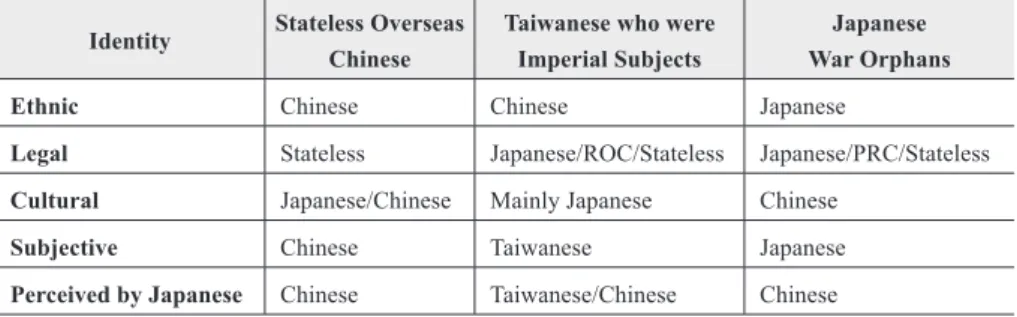
In this paper, I have focused on three minority groups, 1) Taiwanese who were once imperial subjects of Japan, 2) Stateless overseas Chinese, 3) Japanese war orphans, and I have analyzed their complexity of nationality and identity (see Table 3). These minorities were not created by their ethnic or cultural characteristics, but due to turbulence in political situations, as well as government political policies which forced them to change their legal identity. They are treated as minorities, or
“other” in both Chinese and Japanese society, and are easily neglected since they are “in between”.
Nation states aim to unify their peoples by providing services such as protec- tion and security. In reality the establishment of nation states and their political decisions rather create minorities and threaten their basic human rights, as we can see from this article. For instance, governments set nationality laws in order to dif- ferentiate between the nation and foreigners, and protect the nation. However, quite a few minorities may be marginalized because they do not fit in under any single government, or may be excluded by all nation states and become stateless—“the essential outsider”. The minorities “in between” China and Japan which I have stud- ied here are such cases.
Apart from the political reasons that we have seen in this article, there are other conditions in which minorities “in between” could be produced. For instance, the variety of nationality laws among governments in this transnational era may cause stateless through conflict of laws15). Law should be formulated not only to provide stability to society and to protect the interests of nationals belonging to a majority;
it should also be extended to provide protection and basic human rights to minori- ties, among which minorities “in between” should not be overlooked.
Table 3: The Complexity of Identity of the Minorities “in between” China and Japan Identity Stateless Overseas
Chinese
Taiwanese who were Imperial Subjects
Japanese War Orphans
Ethnic Chinese Chinese Japanese
Legal Stateless Japanese/ROC/Stateless Japanese/PRC/Stateless Cultural Japanese/Chinese Mainly Japanese Chinese
Subjective Chinese Taiwanese Japanese
Perceived by Japanese Chinese Taiwanese/Chinese Chinese
Notes
1) This article is based on a paper read at the international conference organized by the Center of the Study of Chinese Southern Diaspora held at The Australian National University, Canberra 2001. I would like to thank to interviewees for their acceptance of my interviews as well as providing infor- mation and documents. Most of names I used here are fictitious. I am also grateful to anonymous referees of the Bulletin of National Museum of Ethnology for many suggestive comments.
2) Basically, legal identity or nationality is given to an individual by birth. Every country has its own nationality law and issues nationality to people based on it. Nationality law can be roughly divided into two types, jus soli, based on birth place, and jus sanguinis, based on “blood” and nationality inherited from parents.
3) The cultural identity mentioned in this paper refers to a more general categorization of culture, although cultural identity can be further broken down based on many other criteria, especially under globalization.
4) Before this wave, there was a small settlement of Chinese merchants in Nagasaki.
5) Although these Taiwanese were issued with Japanese nationality, they were categorized differently from Japanese on family registration; Japanese mainlanders in naichi (inland) and colonial people in gaichi (outland).
6) Interview with Mr. Wu in Yokohama in March 2002. Also see Taiwan Times (May, 1st, 2004) 7) Feb. 2000, interview with Mr. Qiao, who was an officer of the ROC Government Embassy in Japan.
He managed nationality issues in the 1970s.
8) Figures of Foreigners in Japan, Division of Civil Affairs, Ministry of Justice. The number is the total population of stateless people in Japan. It does not show the origin of people categorized as stateless, so it is not possible to give the number of Chinese among them.
9) Interview with Mrs.Chang in Yokohama, Japan, July 2003.
10) Interview with Mr. Fu, in Yokohama Japan, July 2001 and October 2003.
11) Interview with Mrs. Wang in Fukuoka, Japan, August 2001.
12) Report by the Ministry of Health and Welfare, May 2001. The reports also can be obtained at http://
www.kikokusha-center.or.jp.
13) Interview with Mrs. Yang in Tokyo, 2004.
14) In the special exhibition on “Multiethnic Japan—Life and History of Immigrants”, held at the National Museum of Ethnology, the War Orphan booth was categorized together with that of ethnic Chinese.
15) A baby born in Japan to a couple with U.S. citizenship must be registered at the U.S. embassy.
Otherwise the baby may become stateless, as Japanese law is based on the principle of jus sanguine, not jus soli. On the other hand, if the child of a Japanese couple is born in the U.S., the baby can have both U.S. and Japanese nationality. The U.S. government will issue nationality to the baby based on jus solis, and the baby will also obtain Japanese nationality if parents also register the birth at the Japan consulate. This means the child will have a choice of nationality in the future. As we can easily infer from this example, the differences in legal policy among nation states can produce enormous differences in the human rights of individuals in this global/transnational era.
References
English Language Sources Barth, Frederic (ed.)
1998 Ethnic Groups and Boundaries: The Social Organization of Culture Difference. New York:
Waveland Press.
Baubock, Rainer
1992 Immigration and the Boundaries of Citizenship. Coventry: University of Warwick.
Chirot, Daniel and Anthony Reid
1997 Essential Outsiders: Chinese and Jews in the Modern Transformation of Southeast Asia and Central Europe. Seattle: University of Washington Press.
Giddens, Anthony
1991 Modernity and Self-identity: Self and Society in the Late Modern Age. Stanford: Stanford University Press.
Fukuyama, Francis
1995 Trust: The Social Virtues and the Creation of Prosperity. New York: The Free Press.
Hall, Stuart
1996 Who Needs Identity? In S. Hall & P. du Gay (eds.) Question of Cultural Identity. London:
Sage.
Hamilton, Gary G.
1999 Cosmopolitan Capitalist: Hong Kong and the Chinese Diaspora at the End of the Twentieth Century. Seattle: University of Washington Press.
Hsu, Shu-zhen
1998 Japan. In Lynn Pan (ed.) The Encyclopedia of the Chinese Overseas, pp. 332–340. Cam- bridge and Massachusetts: Harvard University Press.
Mathews, Gordon
2000 Global Culture/Individual Identity: Searching for Home in the Cultural Supermarket. New York: Routledge.
Ong, Aiwah
1999 Flexible Citizenship: the Cultural Logics of Transnationality. Durham: Duke University Press.
Pan, Lynn
1999 The Encyclopedia of the Chinese Overseas. Cambridge and Massachusetts: Harvard Univer- sity Press.
Rex, John
1995 Ethnic Identity and the Nation State: the Political Sociology of Multi-cultural Societies.
Social Identities 1 (1): 21–34.
Schuck, Peter
1998 Citizen, Strangers, and In-Between: Essay on Immigration and Citizenship. Oxford: West- view Press.
Soysal, Yamemin Nuhoglu
1994 Limits of Citizenship: Migrants and Postnational Membership in Europe. Chicago: The University of Chicago.
Japanese Language Resources
Asano, Shinichi and To Gan(浅野慎一・佟岩)
2006 『異国の父母』(Parents in a Foreign Land)岩波書店(Iwanami Shoten)。
Chen, Tien-shi(陳天璽)
2005 『無国籍』(Stateless)新潮社(Shinchosha)。
Harajiri, Hideki(原尻英樹)
1998 『「在日」としてのコリアン』(Korean as Foreigner in Japan)講談社(Kodansha)。
Kan, San-jun(姜尚中)
2004 『在日』(Korean in Japan)講談社(Kodansha)。
Lin, Kingbing(林景明)
1997 『日本統治下台湾の『皇民化』教育』(The Education of Imperial Sublects under the Japanese Colonization in Taiwan)高文研(Koubunken)。
Moriki, Kazumi(もりき和美)
1995 『国籍のありか』(Frontier of Nationality)明石書店(Akashi Shoten)。
Nishikawa, Takeomi and Ito, Izumi(西川武臣・伊藤泉美)
2002 『開国日本と横浜中華街』(The Opening of Japan and Yokohama Chinatown)大修館書 店(Taishukan Shoten)。
Sugawara, Kousuke(菅原幸助)
1998 『日本国籍をください』(Give Me the Japanese Citizenship)三一書房(Sanichi Shobou)。
Tanaka, Hiroshi(田中宏)
1995 『在日外国人』(Foreigners in Japan)岩波書店(Iwanami Shoten)
Yasui, Sankichi(安井三吉)
2005 『帝国日本と華僑』(Imperial Japan and Overseas Chinese)青木書店(Aoki Shoten)。