Special Feature
The Visible and the Invisible when Considering Northern European
Permanent Spent Fuel Storage: Forsmark and Onkalo
Robert Jacobs
Hiroshima Peace Institute
1. Introduction: the dilemma of spent nuclear fuel
Human beings have never had to grapple with a problem like high-level nuclear waste
(HLW). The spent nuclear fuel rods resultant from over 70 years of plutonium production
for nuclear weapons, and over 60 years of nuclear power being used as a source of civilian
electricity will remain dangerous to future generations of human beings, and to the
eco-system as a whole, for over 100,000 years. Plutonium-239, which was invented by human
beings in 1940, has a half-life of over 24,000 years, making it deadly to human beings for
several hundred thousand years.1 Currently all spent nuclear fuel rods, totaling millions of
tons worldwide, are held in temporary storage and awaiting final—permanent—disposal.
The need to safely contain this dangerous waste for periods of time roughly equivalent
to the length of time that homo sapiens have existed as a species presents human beings
with an array of problems both previously unimaginable, and also technologically
daunt-ing. How can this deadly waste be safely contained so that it does not pose a risk to the
thousands of generations of human beings for whom it will be an enduring presence? How
can we imagine the conditions such containment may be subject for millennia? And how
can we coherently communicate these risks to people who may come into contact with the
waste, or who may engage in activities that will put the containment facilities at risk of
being breached?
While many permanent repositories are being planned, and several are being
con-structed, no HLW has yet to be deposited into such containment. Some high-level nuclear
waste has been placed in permanent repositories, such as the Waste Isolation Pilot Plant
(WIPP) built to contain high-level military nuclear waste in New Mexico, but currently no
spent nuclear fuel has been permanently deposited.2 The WIPP site has suffered structural
collapses, fires and explosions during its first decade of operation, including radiation being
detected offsite.3
The two permanent repositories for spent nuclear fuel that are closest to being
Sweden has built a test repository, and from that test is now proceeding to build a
perma-nent repository at Forsmark. Finland, working from the Swedish model, is well advanced in
constructing a permanent repository at Olkiluoto. This paper will examine the current plans
and progress of the Swedish and Finnish sites, and explore the technological strategies
being deployed to achieve the goals of waste containment and message communication.
It will argue that they embody a culture of competence that undergirds such scientific and
technological endeavors, and discuss how this discourse of “competence” operates
sepa-rately from the competencies required by the tasks themselves. What is ultimately revealed
is the production of a theater of competence that patinaʼs over a vast sea of uncertainty.
In choosing to manufacture these materials, we have entered into a relationship that
spans hundreds of thousands of years. We have collectively produced or concentrated
hundreds of thousands of tons of the most toxic substances on Earth, and they will remain
dangerous to living creatures, and to the ecosystem as a whole, for millennia. We claim to
be able to contain this nuclear waste as if we fully understand what containing highly toxic
materials for millennia entails in a world that has had agriculture for about 10,000 years,
and the capacity to generate electricity for less than 200. This period of containment is
equivalent to the entire history of homo sapiens as a species. Our temporary, rudimentary
forms of nuclear waste storage, in use for less than 70 years, are still somewhat effective, so
we extrapolate that our technological competence will be sufficient to insure these
materi-als can be successfully contained for tens of thousands of years. When we design storage
plans for this waste, we envision actions that future civilizations may take in terms of our
own existing technologies and our own socially constructed behaviors and beliefs. We
cannot project the culture and technology of people 50,000 years from now with any more
certainty than Neanderthals could imagine our world, our motivations, and our actions.
I would like to invoke a disruption to our perspective of time, and the consequences of
our actions. Looking at the world in 1000 or 5000 years, there could easily be radiological
contamination in numerous locations where the wastes from the military and commercial
nuclear programs were ultimately stored. Whether or not we have additional power plant
meltdowns may be immaterial to people living in these times, it may be that their legacy
from our behavior is analogous: dire health impacts, radioactive “no-go” zones, ecological
degradation. We have put tens of thousands of generations at risk—and in relationship to
the waste that we have created, and the behaviors we have normalized.
We can tell ourselves that we have avoided catastrophe, but this discourse of
catastro-phe and competence is a temporally limited discourse that is blind to this relationship. We
2. Current spent nuclear fuel storage
When spent nuclear fuel rods are removed from nuclear power plants, they are immediately
placed into spent fuel pools (SFP) for cooling. These SFPs are usually located in the same
buildings as the nuclear reactors, since the spent fuel is too hot to safely move any signifi
-cant distance. SPFs resemble large swimming pools to the eye; they are big rectangular
containers filled with water in which the fuel rods are kept below at least 20 feet of water
to shield workers. The fuel rods are transferred to the pools via water canals so that
work-ers are not exposed to their lethal levels of radiation during the transfer. The pools hold
multiple assemblies of spent nuclear fuel and are filled with water that contains Boron-10 to
absorb neutrons, and which circulate the water constantly to transfer heat radiating from the
fuel which continually heats the water. The pools both shield workers from the high levels
of radiation the fuel emits and also slowly cools the rods by constantly recirculating the
water. This is one reason that nuclear reactors are always sited near abundant water sources.
Spent nuclear fuel pools can be many different sizes, from small enough to hold multiple
assemblies from a single reactor, to large enough to hold assemblies from multiple reactors
for indefinite periods of time.
minimum of three years after they are removed from reactor cores, although six to ten years
is more typical. The rods are then sufficiently cooled to be transferred to dry cask storage.
Dry casks are typically steel containers that hold the spent nuclear fuel during the interim
period in which they await final permanent disposal. These casks can hold from 24 to 100
fuel assemblies.4
75 years after the advent of nuclear technology, almost all of the spent nuclear fuel
from all of the worldʼs nuclear power plants, both those used to manufacture plutonium and
those used to generate electricity remain in either SFPs or dry cask storage. A small amount
has been used for reprocessing such as the MOX fuel in unit #3 at the Fukushima Daiichi
plant at the time of its meltdown (Sweden and Finland, the subjects of this inquiry, are not
among those nations that currently reprocess their spent fuel). In the United States, which
has had over 100 commercial nuclear power plants, almost 70% of its spent nuclear fuel Figure 2: spent nuclear fuel pool in Sweden (photo: Curt-Robert Lindqvist)
remains in SPFs, some having been in the pools for multiple decades.5
3. Geological disposal
While research into the geological disposal of HLW has been ongoing since 1982, and
some countries have operated disposal sites for high and medium level waste, no state has
made significant progress towards the permanent disposal of its spent nuclear fuel. The
most substantive progress towards this goal has been in Finland and Sweden. In these two
countries, plans have been approved, money allocated and construction initiated for the
permanent storage of the spent nuclear fuel resultant from their commercial nuclear power
programs, although fuel has yet to be deposited in either country.
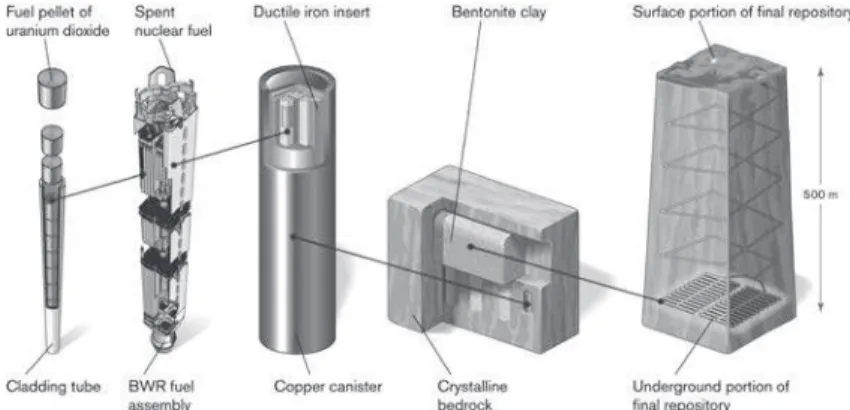
The simple idea of deep geological containment is to place multiple barriers between
the spent fuel and surface of the Earth. In both Sweden and Finland this involves encasing
the waste in a container that is designed to withstand leaking, placing that container inside
of chemical elements that will repel water effectively, and constructing this series of
barri-ers deep underground; in these two cases this depth is approximately half a kilometer. The
containers are made of copper and then they are buried in holes dug along corridors in the
deep underground shafts. These holes are filed with Bentonite clay, which expands when it
encounters water. Bentonite is made from soil minerals that have a high content of
mont-morillonite, and is a primary ingredient in cat litter.6 Once all of the holes in a corridor are filled with sealed copper canisters full of spent nuclear fuel, the entire corridor will be filled with Bentonite clay. Eventually the entire underground labyrinth of corridors will be filled
with Bentonite all the way up to the access points where the waste is first brought deep
underground on trucks. Then the entrance will be sealed. This method, developed by SKB,
the Swedish Nuclear Fuel and Waste Management Company (Svensk
Kärnbränslehanter-ing Aktiebolag), is referred to as the KBS-3 method (the “3” referring to the three barriers:
copper, Bentonite clay, and bedrock).7
4. Sweden
Sweden has operated 12 commercial nuclear power plants at four sites since the first one
came online in 1975, six of which are still in operation. Sweden has built several test
labo-ratories to be used to design and test waste disposal methods. This includes the Canister
Laboratory, the Bentonite Laboratory and the Äspö Hard Rock Laboratory, all adjacent to
the reactor complex at Oskarshamn. The Canister and Bentonite laboratories work on the
technology related to the first two of the barriers in the system, the copper canister that
will hold the spent nuclear fuel and Bentonite clay that will fill in the underground spaces
once the canisters are set in their final storage holes. The Äspö Hard Rock Laboratory is a
test of the technology necessary to construct a deep underground storage facility. The lab
extends half a kilometer underground, as will the finished Spent Fuel Repository, which
will be located in Forsmark on the Baltic Sea. In essence, the lab is a working facsimile of
the planned Spent Fuel Repository. It is dug into bedrock similar to that of the Forsmark
repository, and tests are conducted on all of the systems that will be necessary for the final
repository such as drilling, transportation, ventilation and safety systems for workers, and
operational design. The eventual Spent Fuel Repository will largely mirror the Äspö Hard
Rock Laboratory with adjustments based on experimental outcomes.
The spent nuclear fuel currently in storage in Sweden is in the Clab (Central Interim
Storage Facility for Nuclear Fuel) nearby the Oskarshamn complex. Once the Spent Fuel
Repository in Forsmark is completed, the fuel rods will be moved from the spent fuel pools
at the Clab facility to Forsmark by boat. The Clab facility currently holds 6,500 tons of
spent nuclear fuel, with an anticipated maximum of 11,000 tons which may be stored there
before final disposition at Forsmark.8
5. Finland
Finland began using commercial nuclear power in 1977, eventually operating four plants
at two sites. Another two reactors are planned, one under construction (which has been
dramatically delayed and substantially over budget)9 and another at a new location. Unlike
the central interim storage facility in Sweden, Finland currently stores spent nuclear fuel
currently store spent nuclear fuel in spent fuel pools onsite awaiting permanent disposal.
Posiva, a company jointly owned by the two nuclear power companies in Finland,
Fortum (owner of the Loviisa plants) and TVO (owner of the Olkliuoto plants), is
cur-rently building a single deep geological disposal site called Onkalo, located adjacent to the
Olkliuoto plants in Eurajoki, also on the Baltic Sea. Onkalo will be built to contain 2,500
tons of spent nuclear fuel.10 Onkalo will also use the KBS-3 method for containment of its
spent nuclear fuel and so is built about half a kilometer underground and is very similar to
the Äspö Hard Rock Laboratory.
Onkalo is scheduled be the first permanent spent nuclear fuel repository to operate
in the world. As a result, there is substantial interest in the site, which was the subject of
a documentary film, Into Eternity made by Danish filmmaker Michael Madsen in 2010.11
As Finland is nearing completion of a new nuclear power plant (Olkliuoto 3), with another
slated to begin construction within ten years, Onkalo is designed to continue to place spent
nuclear fuel canisters into the repository for approximately 100 years before it is sealed
with Bentonite clay.
Figure 5: Graphic of the completed Onkalo site (image: Posiva Oy)
6. Assumptions: siting the repositories
One of the first assumptions of competence has to do with the selection of a site to house
the deep geological storage site for spent nuclear fuel. In the cases of both Sweden and
were chosen. The administrative agencies and the public/private corporations charged with
locating and constructing the two sites both claim to have painstakingly determined the
best possible sites, and reduced their short list of possible sites to the one that was the most
scientifically sound. Both used a blend of methods that analyzed both a “systemic strategy”
emphasizing geological criteria, and a “flexible strategy” that also stressed social factors.12
In Sweden, KBS details the selection: “The search for a site for a final repository for
spent nuclear fuel was initiated in the 1970s. Investigations were conducted in large parts
of the country and finally identified two areas with good prospects for a number of
view-points: Forsmark in Östhammar Municipality and Laxemar in Oskarshanm Municipality.
Analyses and results from investigations of the bedrock and on the ground surface
subse-quently led to the selection of Formsark.”13
The Posiva website describes the process of choosing the Onkalo site: “Preparations
for the final disposal of spent nuclear fuel in Finland began at the same time as the
com-missioning of the first nuclear power plants in the late 1970s. The schedule for the final
disposal was set in 1983, when the Government decided on the objectives and programme
for nuclear waste management.” In the early years of the program, spent nuclear fuel was
shipped to the former Soviet Union, and then Russia, for reprocessing, but when news of
the decades earlier spent fuel explosion and fire at the Soviet Mayak plutonium production
site known as the Kyshtym Disaster (1957) became public in Finland, public pressure grew
to keep Finish spent nuclear fuel within national borders for disposal.14
The Finnish Ministry of Trade and Industry sponsored an extensive environmental
impact study that narrowed hundreds of potential sites to four final contending sites for
permanent storage. These included the two existing sites at Eurajoki and Loviisa, where
nuclear reactors had been operating in Finland. At the conclusion, the Olkiluoto site in
Eurajoki was selected, in part because, “Of these two, the Olkiluoto island in Eurajoki had
a larger area reserved for the repository. Furthermore, the larger portion of the spent nuclear
fuel was already on the island.”15
Here at the point of selecting the locations for the deep geological disposal sites, we
can already see how hard it is to make decisions in the present that will impact future
gen-erations. In both Sweden and Finland, independent assessments coincidentally chose sites
for spent nuclear fuel disposal that happened to be already owned by the utility companies
needing to dispose of the fuel, and where large amounts of the fuel were already located.
There are clear advantages to making such choices. First, there is no need to acquire the
land. Second, the local communities already had longstanding relationships with the
nuclear power companies, and were often largely populated by people economically
already decades old is partly alleviated.
Can it be that the best sites for the permanent storage of spent nuclear fuel did just
happen to be on land adjacent to operating nuclear power plants, and already owned by the
utilities? Posivaʼs own site selection summary report describes how the long-term
ecologi-cal impacts of the repository came to be seen as secondary to concerns of construction of
the repository and the implementation of the waste deposition, “The classification of the
environmental factors was not considered to have any great significance with respect to the
long-term safety of the repository, but was mainly concerned with the potential
environ-mental impact of carrying out both site investigations and the construction and operation
of a repository in the investigation areas.”16 Matti Kojo explains that, “the Radiation and
Nuclear Safety authority stated that the selection ought to pay particular attention to the
geological variations of the areas. Furthermore, Olkiluoto in Eurajoki [the Onkalo site] was
chosen on the basis of a separate definition. According to the companyʼs safety analysis,
the site of the NPP was in a special position because the proximity of the facilities would
reduce the transportation of the SNF.”17 Given this construct, psychosocial considerations
become more paramount. The Environmental Impact Assessment (EIA) conducted by
Posiva on behalf of the Finnish Ministry of Trade and Industry has extensive sections on
the psychosocial components of site selection.
While the EIA emphatically concludes that “The studies carried out show that the
environmental impacts in all candidate municipalities would be minimal,” it does detail
sig-nificant differences in the psychosocial aspects. “Peopleʼs views are affected by familiarly
or unfamiliarity with nuclear power technology, the employment situation in the
municipal-ity, general development (municipal economy, population) local population perspectives
and the compatibility of nuclear waste with the cultural, natural and production base of
the locality,” explain the authors, and this results in “the municipalities where are power
plants, final disposal was considered to be part of the nuclear power industry as a whole
and people are accustomed to the safe operation of the power plant.”18 These policies can be
seen filtering down into the discourse of site promotion at Onkalo. On my visit to the site
in 2016 a public relations officer told me that the bedrock under Finland is so uniform that
anyplace could have worked. He said that building the site under Helsinki would have been
as good as building it at Olkiluoto but was politically impossible.19
Here, alongside the existing ownership and rights to the land, and the final sites in
both Sweden and Finland minimizing the transport of spent nuclear fuel, the psychosocial
legacies of employment and community relationships with existing nuclear power plants
become supporting criteria in the eventual site selection of waste that must be contained
of those decisions diverging. For residents of the area 10,000 years from now, the actual
criteria for the siteʼs selection will be entirely meaningless.
7. Assumptions: containing the waste with barriers
According to criteria for both the Swedish and the Finnish spent nuclear fuel storage sites,
the waste must be completely contained in the repository for 100,000 years. This means
that the canisters cannot leak, and that radiation cannot be detected offsite for that length of
time. Any breach of containment, either by a system failure, or by a breach resulting from
people, animals or anything into the site is defined as a failure. Thus, there are two aspects
to consider: the integrity of design of the containment systems (canisters and disposal site),
and the risk of intrusion from outside forces (natural and unnatural).
When designing and constructing containment for 100,000 years, it is first essential to
consider the timeframe itself: human beings and human civilization have yet to engage in
any intentional activity for 100,000. Thinking in terms of 100,000 years is radical enough,
believing that one can exercise sustained technological competence over such a period is,
at best, aspirational, and at worst, delusional. It is true that the project here relies on a few
hundred years of technological operation, followed by reliance on the accurate assessment
and geological stability of the site selection and design: it is meant to run on auto-pilot once
it is sealed. However, the second of the two aspects cited above, that of the risk of intrusion
from outside forces, does rely on the ongoing competence of the original design and
execu-tion, regardless of how stable the specific geological site selection.
Fundamental to the selection of the two sites is the determination that both sites place
the repository into bedrock that has remained geologically stable for over a billion years.
It is extrapolated that there is no indication that there will be any geological instability
during the 100,000-year containment period. Planners assume that they can anticipate any
potential future geological instability, for example earthquakes. During the last ice-age
there were frequent earthquakes during the period of glacial thaw, and by burying the waste
below the level of previous permafrost, it is assumed that any future earthquakes will be
mitigated, “One reason that we go 420 metres with the depositories is that we are below
the level at which we have had the permafrost in previous ice ages,” Posiva hydrogeologist
Anne Kontula advises.20
While planners assume that the past is indeed prologue, a characteristic to the epoch
now geologically referred as the Anthropocene is that a primary shaper of geological
change is human activity. While one can extrapolate that activities such as fracking can
one can also examine the phenomenon known as “bombturbation.” Geologist Joseph Hupy
and geographer Randall Schaetzl offer the definition that, “This article introduces the term
ʻbombturbationʼ for cratering of the soil surface and mixing of the soil by explosive muni-tions, usually during warfare or related activities.”21 While Hupy and Schaetzl focus on soil,
their work, and the work of Roger Hooke and others, also investigates the disturbance of
bedrock and other more stable elements of the landscape through human bombardment.
It is not a great leap to ask what would become of the solid bedrock of the Forsmark and
Onkalo repositories were they the direct, or accidental, targets of nuclear weaponry?22 A
billion years of geological inertia is no guarantee in an era when human activity, which was
not influential for that previous billion-year period, becomes the dominant force in
geologi-cal change. One could as easily posit the direct strike on one of these sites by a meteor.
While assessing the past geological activity of a deep geological repository can give
assur-ance about its historical stability, it is no guarantee of future dynamics over millennia.
Doubts have also been expressed about the integrity of the copper canisters that form
another of the essential barriers to the multiple barrier system of containment. SKB reports
claim that all research has determined that in the absence of oxygen, the corrosion to be
expected on copper is “a few millimetres in one million years.”23 Swedish chemist Peter
Szakálos and colleagues contend that experiments have demonstrated that the decay rate
assumed in the SKB report vastly underestimates the corrosion of copper, an assertion that
was in turn challenged by SKB scientists.24 Again we can see the imagination that
condi-tions can be accurately predicted and anticipated, in this case for a million years. Perhaps
they can, perhaps they cannot: we ourselves will not know the eventual outcome. However,
decisions are being made on the assumption that we have the technological competence to
effectively design for 100,000 years of intact containment.
8. Assumptions: anticipating human behavior for millennia
The primary efforts towards adequate design for the repositories is the physical containment
of the spent nuclear fuel, however, a secondary concern is to insure the site is not breached
from the outside by human beings. This requirement has led to some fascinating research
and theorizing, and given birth to the field of nuclear semiotics. Nuclear semiotics
postu-lates a means of effectively transmitting information about the dangers of the buried waste
to future generations. The purpose of containing and burying the waste is to keep it from
harming future human beings and degrading the ecosystem. If people in the future dig up
the buried waste, or breach the sealed repository in any way, all the efforts put into
to people who will live thousands of years from the time the waste is buried is, to say the
least, vexing.
A primary assumption is that people who live thousands of years from now will not
speak the same languages what we speak, and so text alone will be insufficient to transmit
this vital information. Thus, the work of semioticians, among others, has been central to
this effort. The first efforts towards grappling with this problem in the US were undertaken
by the Human Interference Task Force (HITF) convened the United States Department
of Energy (DOE) and its subcontractor Bechtel 1981, and tasked with producing possible
means of “marking” the proposed Yucca Mountain nuclear storage facility slated to be built
in Nevada. Their preliminary report, “Reducing the likelihood of future human activities
that could affect geologic high-level waste repositories,” published by Bechtel in 1984, is
among the founding documents of the field.25 Reflecting the broad intellectual scope
con-sidered by the Task Force, members included: scientists, engineers, nonverbal
communica-tion specialists, an anthropologist, an archaeologist, a climatologist, a lawyer, a semiotician
and a behavioral psychologist.
The Task Force introduces its findings with a bold declaration:
“The disposal of radioactive wastes in deep geologic formations provides a means of iso-lating the waste from people until the radioactivity has decayed to safe levels. However,
isolating people from the wastes is a different problem, since we do not know what the
future condition of society will be. The Human Interference Task Force was convened by
the U.S. Department of Energy to determine whether reasonable means exist (or could be
developed) to reduce the likelihood of future humans unintentionally intruding on
radio-active waste isolation systems. The task force concluded that significant reductions in the
likelihood of human interference could be achieved, for perhaps thousands of years into
the future, if appropriate steps are taken to communicate the existence of the repository.”26
The Task Force defined its missionʼs relationship to the larger enterprise, “There are three
primary mechanisms for reducing the likelihood of human interference. These are (1)
reducing the incentive for human interference, (2) designing the repository to increase the
difficulty of interference, and (3) communicating the existence of the repository to
genera-tions far into the future. For the reasons discussed in this report, the task force focused on
the third mechanism.”27 The findings of the Task Force emphasized the need to consider
the site of the repository as being unlikely to be of interest to future societies for its natural
resources or advantageous setting. The Task Force also strongly supported the importance
of markers: “Based on its studies, the task force places very heavy emphasis on the use of
long-term markers to communicate the existence of a repository. As discussed in the report,
periods of time. Other things being equal, a site offering surface features which are
ame-nable to transformation into long-term markers should be considered as an advantage.”28
The issue of long-term markers is a complicated issue. When considering the human
past, coherent intergenerational communication can only be traced for a few thousand
years. Incoherent, or indirect communication can be said to have gone back further, for
example in the rock carvings cited above, or in the cave paintings left by numerous
Paleo-lithic cultures. However, the messages of such communications are uncertain and their
interpreted meaning can alter as more sophisticated archaeological and anthropological
theorizing evolve, making their received meanings fluid, and reflective of the subjective
cultural conditioning of the inquirer.
“Message durability” was an essential focus of the Task Force, and of the many subse-quent scholars who considered the effective composition of nuclear markers. The
assump-tion that language, and text, would be insufficient to the task spawned a range of ideas that
have often been ridiculed, or presented in camp form, by critics and commentators. Many
public examinations of the challenges of the permanent disposal of spent nuclear fuel have
ended up focusing primarily on these “messages” because of this entertainment value.
Much of the speculation around long term messaging considered means of
transmit-ting an understanding of the dangers of the repository through cultural practices. Some
imagined that new religious institutions or mythologies could play the role of temporal
messenger. Task Force semiotician Thomas Sebeokʼs seminal 1984 work, Communication
Measures to Bridge Ten Millennia postulated how such a process would work:
These persistent and widely diffused mythological and iconographic resonances of the
assignment to which the Task Force is seeking a resolution lead to the first
recommenda-tion, to wit: that information be launched and artificially passed on into the short-term
and long-term future with the supplementary aid of folkloristic devices, in particular a
combination of an artificially created and nurtured ritual-and-legend. The most positive
aspect of such a procedure is that it need not be geographically localized, or tied to any
one language-and-culture (although, clearly, when linguistic and ethnic boundaries are
crossed, both the verbal component and the associated set of rites are likely to undergo
changes and an attenuation of the original rationale).
The legend-and-ritual, as now envisaged, would be tantamount to laying a “false trail,”
meaning that the uninitiated will be steered away from the hazardous site for reasons other
than the scientific knowledge of the possibility of radiation and its implications;
essen-tially, the reason would be accumulated superstition to shun a certain area permanently.
A ritual annually renewed can be foreseen, with the legend retold year-by-year (with,
we might call for dramatic emphasis – an “atomic priesthood,” that is, a commission of
knowledgeable physicists, experts in radiation sickness, anthropologists, linguists,
psy-chologists, semioticians, and whatever additional expertise may be called for now and in
the future. Membership in this “priesthood” would be self-selective over time.29
The notion of intentionally creating a “priesthood” that could coherently retain, and transmit
a strategic relationship to a parcel of land for millennia has been widely ridiculed, but we
can see embedded into this construct the capacity to exercise competence over millennia.
Subsequent cultural transmission ideas included the establishment of a nuclear waste theme
park modeled after Disneyland with a villainous mascot named Nickey Nuke, and
geneti-cally engineering cats to change color when exposed to radiation, accompanied by “myths”
that when cats change color it is a sign of danger.30
Figure 6: Nickey Nuke (image taken from the film, Containment)31
The Nickey Nuke scenario was molded on the capacity for cultural communication
packets to outlive physical monuments, “Something as seemingly frail and unsubstantial as
a story or poem, it turned out, was more durable than the most established social institution
or the toughest metal, plastic, or stone.”32 As the writers of Boston Team Report appendix
of the WIPP study theorized:
Long after metal had disintegrated and granite worn smooth of markings, the legends of
Nickey Nuke remained in peopleʼs minds everywhere on Earth (much as Robinson Crusoe
in Wonderland or Mickey Mouse were universally recognized across cultures, space, and
time, or even, if YOU please, as the story of the Garden of Eden had lasted thousands of
years).
Fictional Nickey Nuke—stalwart, heroic, and duty-bound—carried the memory of WIPP
and its dangers into the collective consciousness of the peoples of the Earth,
forever-more.33
Ultimately the Task Force, and similarly construed authorities in Scandinavia, determined
that combinations of text and structural markers would be used, although there was
consid-eration of the concept of geological disposal with no markers at all: landscaping over the
waste repository with the intent of leaving no sign of previous human activity. In choosing
the strategy of active marking, planners were well aware that historical efforts to warn
away future generations from entering sites, such as the tombs of buried leaders, or buried
treasures, often served to invite exploration and grave robbing to subsequent human beings.
How would the planners for spent nuclear fuel repositories insure that their markers would
discourage entry rather than encourage entry? The answer was to be the careful design and
redundancy of the marking process.
While all nations designing nuclear markers take as a fundamental that the
lan-guages being spoken now will not be spoken by the vast majority of the people for whom
the repositories will present danger, all have nonetheless integrated the use of existing
languages into their designs. The American WIPP site calls for a series of markers to be
integrated into a larger marker implementation plan. This would be composed of large
surface markers, smaller subsurface markers, and a centrally located information center.
“Each Large Surface Marker will have warning messages engraved in the seven languages.” These seven, existing languages (English, Spanish, Russian, French, Chinese, Arabic, and
Navajo), would be augmented by visual information communicated both graphically and
sculpturally.34
The performance criteria of the markers have four stated objectives:
1. Alert an intruder to the existence of the site.
2. Convey a warning of danger to an intruder.
3. Inform an intruder about the nature and degree of danger.
4. Endure inform and function for the longest time possible.35
However, once this system of markers has been constructed, the burden is understood to
fall on those who encounter it, regardless of their understanding of the seven languages and
their interpretation of the visual communication markers, “The U.S. Department of Energy
has taken the position that: ʻalthough this generation bears the responsibility for protecting
responsibil-ity for any risks which arise from deliberate and informed acts which they choose to
per-form.ʼ” Creating the markers is an endpoint of the responsibility for the society engaged in
passing down a toxic legacy whose endpoint will endure beyond tens of thousands of years,
“This societyʼs obligation should be discharged by providing a secure isolation system that would continue to function if left undisturbed, by avoiding probable causes of disturbance,
and by transmitting knowledge of the repository to future generations, thus allowing them
to plan their activities accordingly.”36 This criteria demands that future generations
recog-nize their role in ensuring the competence of our safety designs. Such far-fetched
intellec-tual constructs establish boundaries that allow teams of planners to imagine the completion
of their tasks as being “successful.”
9. Invisibilities
What makes humans believe that they can exercise technologically competent control over
a complex system for millennia? This depends on what is made visible and what remains
invisible in the process. Tests of canisters, or borehole samples, assessments of the
geologi-cal past, allow for teams of human planners to design task objectives in which they can
achieve some measure of success. Towards this end, one must often define those objectives
in ways that are structurally incongruous.
Among the incoherencies in the careful planning of siting these permanent
reposito-ries for spent nuclear fuel is the disparity for the length of time that the waste must be “
con-tained” and the length of time that information about that waste must be “communicated”
to people in the future. The design parameters of the containment call for the waste to be
without intrusion for 100,000 years for the sites to be considered successful, yet many of
the design parameters for message permanence in communicating the dangers of the site
define success as 10,000 years of communication. Why is it sufficient to effectively
com-municate 100,000-year dangers for only one tenth of the time? What is different about the
physical containment of the waste and the message permanence about those dangers?
The early benchmark report of the Human Interference Task Force offered an
expla-nation for the shortened timeframe for message permanence, “The emphasis for
transmit-ting information will focus on the first 10,000 years after repository closure. This period
of time considers both the decreasing degree of risk of radioactive exposure over time and
uncertainties due to natural phenomena. First, the radioactivity hazard associated with the
nuclear waste diminishes over time. Relatively rapid decay of fission products occurs
dur-ing the first 1,000 years after closure. Slower decaying transuranic elements would reach
assertion here seems to be that the degree of danger from the radioactive waste being
con-tained in the repository is inconsequential after 10,000 years. One must ask, then, why is
the physical containment of the waste considered essential for ten times longer if the waste
is not of sufficient danger to warrant communicating those dangers?
To clarify this inconsistency, it may be useful to look at the tasks being considered.
Those who are tasked with determining a location that is geologically predictable for
hun-dreds of thousands of years have the skill to determine past geological activity for millions,
or even billions of years. They feel competent to describe the future in terms of these spans
of time. On the other hand, those tasked with trying to establish means of cultural
commu-nication do not have immense expanses of time to mine for their models. The longest intact
human communications have remained coherent for mere thousands of years. The oldest
religions in the world have not endured for longer than 5,000 years. Even the early years
of those religions are only understood in terms of the traditions that can first be materially
interpreted from thousands of years after the origin points. Is it any mystery that those
tasked with designing message durability think in terms related to the longest enduring
cultural messages they can examine? Or that these teams think in terms of Disneyland and
taboo? With no evidence of cultural messages lasting longer than several thousand years,
their design parameters reflect these models.
Science and technology are human activities. All science and technology reflect their
human origin and practice. That does not mean that they are entirely subjective, but rather,
that their complexity necessarily includes subjective human aspects. Historian of science
Thomas Kuhnʼs work on paradigm shift among physicists has long recognized this aspect
of how humans practice science.38 Those tasked with both the material and the cultural
challenges of siting high-level nuclear waste, and warning future generations of the dangers
of such a site are no exceptions to the social practices of science as a community.
Anthropologist Vincent Ialenti conducted fieldwork among the various communities
of “nuclear waste experts” working on the Onkalo site in Finland for several years. “Since
the day I relocated from Cornell University in the United States to Europeʼs Far North, I
have encountered nuclear waste riskʼs deep timescales frequently,” reports Ialenti. However,
“Over time, it would seem that I have come to see nuclear waste riskʼs deep timescales as less and less enchanted with the auras of mystery, terror, or sublimity common in popular
depictions. Instead, I have come to see them increasingly as sites of busy technical
calcu-lation, of banal documentation requirements, of frustrating uncertainties, of
difficult-to-manage office predicaments, and of specialized labors of analysis and re-analysis. Hence, it
seems my ethnographic work has taught me, first and foremost, how to engage with nuclear
And that “timescale” was emphatically more human than geological, “Indeed many of the
questions, problems, and happenings that captured field informantsʼ imaginations most
in our ethnographic chats were not primarily about the forbidding expanse of deep time.
Rather, informants seemed to be caught up mostly in scientific, legal, and engineering
details—that is, in the technicalities of their work. Therefore, they often appeared focused,
like other professionals in other highly specialized sectors, on markedly short-term futures
as they grappled with challenges, frustrations, and imperatives”39 And with the successful
completion of these project based tasks, these “informants” imagine they are also
success-fully completing their millennial tasks. Since the later cannot be truly known, the former fills in for the later in the emotions of those engaged in the tasks. Thus, as was pointed out above, the “secure isolation” of the waste becomes redefined as meeting this generationʼs
obligations of protecting the generations to follow: we completed our “task,” and so we
have met our “obligations.” How else can we assess our achievement?
These efforts at containment and communication require immense and ongoing
expenditures, and the resources of teams of scientists and engineers. Human societies
would be unable to engage in such endeavors without some assurance that these efforts
could be judged “successful.” Ambiguity would threaten funding, and also the interest of
skilled workers to devote their careers to the projects. They must be enacted in a way that
can be deemed competent. Thus, competence is manufactured as a product of the
endeav-ors. While we cannot be certain if we spare the future ecosystem from contamination, or
that we will protect thousands of generations of human beings from radiogenic diseases, we
can be certain that the people who design, construct and seal these “permanent” repositories
will feel that their work has been done competently.
Perhaps it would be more realistic to assume that we will get some things right, and
we will get some things wrong. It is unrealistic to think that every phase of these projects
will be enacted precisely as designed by their competent designers. And, to think that the
Earthʼs geological behavior will be exactly as imagined, or that future societies will
coher-ently pass information forward through tens of thousands of years of shifting cultures and
social organization. Surely some aspects of this grand endeavor will not be achieved as
designed. How can we endure such uncertainty? How does it reflect on our decades of
producing waste we had no idea how to dispose? How does it reflect on the ongoing use of
such technologies, both for military and non-military uses? The manufacture of competence
is as much about taking care of ourselves in this historical moment as it is about caretaking
future generations.
Rather than the “false trail” imagined by Task Force scholars we can instead envision
communicate dangers to unknowing future humans, perhaps it would be more effective
to try to be honest with them. Rather than imagining that we have the competence to both
contain the most dangerous physical substances on Earth for periods of time that are longer
than any other human activity, and to craft messages that will carry information to people
whose world we cannot envision, perhaps what we should communicate is our
incompe-tence. Perhaps finding a way to transmit an apology would be more enduring. Maybe we
should not imagine that the deadly waste we bury will remain invisible: we should assume
it will be horribly visible, either through leaching out of the sites or through the breaching
of the sites by humans or natural intrusion. If we assume that we do not have the power of
invisibility over this waste, but that its visibility will be almost certain, our apology for this
behavior will echo forward in time because that is useful information.
If our goal is to take care of and honor the people of the future, we need to start by
being honest with ourselves about the legacies of our choices, and our competences in
controlling nature and human evolution.
* This paper was supported by a generous research grant from the Hiroshima Peace
Insti-tute.
NOTE 1
Siegfried S. Hecker, “Plutonium and its alloys: From atoms to microstructure” Los Alamos Science 26 (2000)
2
United States Department of Energy WIPP website: http://www.wipp.energy.gov/wipprecovery/ recovery.html (accessed 8 September 2017)
3
Ralph Vartabedian, “Nuclear accident in New Mexico ranks among the costliest in U.S. history,” Los Angeles Times (22 August 2016): http://www.latimes.com/nation/la-na-new-mexico-nuclear-dump-20160819-snap-story.html (accessed 2 September 2017)
4
Brian Gutherman and Daniel LeDuc, Summary of design criteria for dry cask storage systems for ISFSI storage of shutdown reactor spent nuclear fuel (Savannah River Laboratory, 2015) SRNL-TR-2015-00106
5
Robert Alvarez, “Pushing the storage horse with a nuclear waste cart: the spent fuel pool problem” Bulletin of the Atomic Scientists (9 August 2017): http://thebulletin.org/pushing-storage-horse-nuclear-waste-cart-spent-fuel-pool-problem11002 (accessed 15 September 2017)
6
Ola Karnland, et al, “Mineralogy and sealing properties of various bentonites and smectite-rich clay materials,” TR-06-30 Svensk Kärnbränslehantering AB (December 2006): 13
7
“Our methodology,” SKB website: http://www.skb.com/future-projects/the-spent-fuel- repository/our-methodology/ (accessed 26 August 2017)
8
“Clab,” SKB website: http://www.skb.com/our-operations/clab/ (accessed 28 August 2017) 9
10
Author interview with Posiva spokesman at the Onkalo site (13 October 2016) 11
Into eternity, dir. Michael Madsen, prod. Lise Lense-Møller (Atmo Media Network, 2010) 12
Göran Sundqvist, The bedrock of opinion: Science, technology and society in the siting of high-level nuclear waste (Dordrecht: Kluwer Academic Publishers, 2002): 101
13
SKBʼs mission is to take care of the Swedish radioactive waste, (Stockholm: Svensk Kärnbränslehantering AB, 2012): 9
14
“Nuclear power in Finland,” Country Profiles, World Nuclear Association: http://www.world-nuclear.org/information-library/country-profiles/countries-a-f/finland.aspx (accessed 2 September 2017)
15
“Selecting the site: The final disposal at Olkiluoto,” Posiva website: http://www.posiva.fi/en/final_ disposal/selecting_the_site_the_final_disposal_at_olkiluoto (accessed 2 September 2017) 16
Tim McEwen and Timo Äikäs, The site selection process for a spent fuel repository in Finland - Summary report (Helsinki: Posiva Oy, 2000): 45
17
Matti Kojo “The strategy of site selection for the spent nuclear fuel repository in Finland,” in, Matti Kojo and Tapio Litmanen, eds., The renewal of nuclear power in Finland: Energy, climate and the environment series (London: Palgrave Macmillan, 2009): 170
18
The final disposal facility for spent nuclear fuel: environmental assessment impact report (Helsinki: Posiva Oy, 1999): 165, 171, 195
19
Author interview with Posiva spokesman at the Onkalo site (13 October 2016) 20
Quoted in, Helen Gordon, “Journey deep into the Finnish caverns where nuclear waste will be buried for millennia,” Wired UK (24 April 2017): http://www.wired.co.uk/article/olkiluoto-island-finland-nuclear-waste-onkalo (accessed 11 September 2017)
21
Joseph P. Hupy and Randall J. Schaetzl, “Introducing “bombturbation,” a singular type of soil disturbance and mixing,” Soil Science 171:11 (November 2006): 823-836; see also, Roger LeB. Hooke, “On the history of humans as geomorphic agents,” Geology 28:9 (September 2000): 843-846 22
Some scholars claim that the radiation released from such a nuclear detonation would render the radiological impact of the leaking repository meaningless. See, Human Interference Task Force, Reducing the likelihood of future human activities that could affect geologic high-level waste repositories (Battelle Memorial Institute) BMI/ONW1-537 (May 1984): 5
23
Fuel and canister process report for the safety assessment SR-Can (TR-06-22) Svensk Kärnbränslehantering AB (October 20016): 102
24
Peter Szakálos, et al, “Corrosion of copper by water,” Electrochemical and Solid-State Letters 10:11 (January 2007); Michael J. Apted, et al, A review of evidence for corrosion of copper by water (Report 2009:30) Swedish Radiation Safety Authority (September 2009)
25
Reducing the likelihood of future human activities that could affect geologic high-level waste repositories 26 Ibid., iii 27 Ibid., 6 28 Ibid., 16 29
Thomas Sebeok, Communication measures to bridge ten millennia (Battelle Memorial Institute) BMI/ONWI-532 (April 1984): 24
30
See, Stephen C. Hora, et al., Expert judgment on inadvertent human intrusion into the Waste Isolation Pilot Plant (Sandia National Laboratories) SAND90-3036: C-57; The Ray-Cat Solution: http://www.theraycatsolution.com/#10000 (accessed 11 September 2017)
31
32
Expert judgment on inadvertent human intrusion into the Waste Isolation Pilot Plant: C-58 33
Ibid., C-57-58 34
Permanent markers implementation plan (United States Department of Energy) DOE/WIPP 04-3302 (19 August 2004): 16, 19
35
Ibid., 6 36
Reducing the likelihood of future human activities that could affect geologic high-level waste repositories: 6, 9
37
Reducing the likelihood of future human activities that could affect geologic high-level waste repositories: 11
38 Thomas S. Kuhn, The structure of scientific revolutions (Chicago: University of Chicago Press,
1962) 39