
JAIST Repository
https://dspace.jaist.ac.jp/
Title 折り畳み可能な単頂点展開図に関する研究
Author(s) 大内, 康治
Citation
Issue Date 2020‑03‑25
Type Thesis or Dissertation Text version ETD
URL http://hdl.handle.net/10119/16649 Rights
Description Supervisor:上原 隆平, 先端科学技術研究科, 博士
Doctoral thesis
Research on Flat-Foldable Single-Vertex Crease Patterns
by
Koji Ouchi
Supervisor: Ryuhei Uehara
Graduate School of Advanced Science and Technology Japan Advanced Institute of Science and Technology
[Information Science]
March, 2020
Abstract
This paper aims to help origami designers by providing methods and knowledge related to a simple origami structure calledflat-foldable single-vertex crease pattern. Acrease patternis the set of all givencreases. A crease is a line on a sheet of paper, which can be labeled as “mountain” or “valley”. Such labeling is calledmountain-valley assignment, or MV assignment. MV-assigned crease patterndenotes a crease pattern with an MV assignment. A sheet of paper with an MV-assigned crease pattern isflat-foldableif it can be transformed from the completely unfolded state into the flat state that all creases are completely folded without penetration. In applications, a material is often desired to be flat-foldable in order to store the material in a compact room. Asingle-vertex crease pattern(SVCP for short) is a crease pattern whose all creases are incident to the center of the sheet of paper. A deep insight of SVCP must contribute to development of both basics and applications of origami because SVCPs are basic units that form an origami structure.
A decision problem whether a given crease pattern is flat-foldable or not was studied by Bern and Hayes in 1996.
There are several theorems related to flat-foldable SVCP: for example, the Kawasaki Theorem, the Maekawa Theorem, and the Big-Little-Big Lemma. Aforcing setis one of the promising properties in origami applications. A forcing set is a subset of a given flat-foldable crease patternC. If the creases in the forcing set are folded according to given MV assignment µ, the all other creases inCare also folded according to µ. In an application called self-folding origami, a thin material folds into an intended shape by rotating the planes around creases according to the label mountain or valley assigned on the creases. The cost of such an application can be reduced if it is enough to put actuators on a subset of creases. Such an optimization problem can be modeled as aminimum forcing set problem. The minimum forcing set problem supposes us to find a forcing set with the minimum number of creases. The input of this problem is a flat-foldable MV-assigned crease pattern(C, µ). Damian et al. proposed an algorithm for finding a minimum forcing set for arbitrary 1D origami in 2015. Ballinger et al. developed an algorithm for Miura-ori in 2015. The minimum forcing set for arbitrary 2D origami may be important in origami applications. However, there is no algorithm for such case so far.
In this paper, we propose an algorithm for finding a forcing set of flat-foldable MV-assigned SVCP, which might help us to construct an algorithm for arbitrary 2D origami. Our algorithm, which runs inO(n2)time wherenis the number of given creases, is a variant of the algorithm by Damian et al. Furthermore, we show that the number of creases in the minimum forcing set for SVCP isn/2 orn/2+1. The proof for the size of minimum forcing set is by considering a situation that we repeatedly crimp consecutive creases forming a minimal angle with different assignments. Roughly speaking, such size isn/2if the number of remaining creases after crimp repetition is two, and otherwise it isn/2+1.
It is also interesting to know how many flat-foldable MV-assigned crease patterns there are. In the case of SVCP, the tight upper and lower bounds on such count has been shown by Hull in 2003. However, enumeration of flat-foldable crease patterns has not been studied actively, although it is relative to counting. This paper tackles an efficient enumeration of flat-foldable MV-assigned SVCPs. Such enumeration provides us concrete examples of MV-assigned SVCPs, which must be helpful to construct a new origami structure. In this enumeration, let a positive even numberqbe an input, and let the angle between two adjacent creases be a multiple of unit angle(360/q)◦. Our algorithm reduces symmetrically duplicate patterns up to rotation and reflection. As far as the author knows, MV-assigned SVCP enumeration introducing the unit angle and reduction of symmetry in this paper is the first trial in the world. The author notes that the problem condition in this paper is different from that for the upper and lower bounds on counting by Hull. Our enumeration algorithm is composed of three phases: (1) enumerate crease patterns of at mostq creases satisfying the Kawasaki Theorem; (2) enumerate MV assignments on the crease patterns obtained in (1) satisfying the Maekawa Theorem; (3) test flat foldability of the obtained MV-assigned SVCPs. The phase (1) can be done in parallel to (2) and (3) with master-worker model: the master process computes the phase (1); a worker process computes the phase (2) and (3) for an SVCP given by the master process. In experiment, our algorithm enumerates approximately4.07×1013flat-foldable MV-assigned SVCPs forq=40 in 34 hours using a supercomputer.
This paper contributes to the development of origami by proposing algorithms for two problems: minimum forcing set for MV-assigned SVCP and enumeration of flat-foldable MV-assigned SVCPs with unit angle. The result of minimum forcing set for MV-assigned SVCP must help investigation of minimum forcing set for arbitrary 2D origami. The enumeration provides us examples of flat-foldable MV-assigned SVCPs and reveals that the number of flat-foldable SVCPs and that of flat-foldable MV-assigned SVCPs are numerous.
Keywords: computational origami, flat foldability, forcing set, enumeration
Acknowledgments
The author greatly appreciates the constant encouragement and the kind guidance of his supervisor Professor Ryuhei Uehara of Japan Advanced Institute of Science and Technology during this work. The author would like to thank Assistant Professor Giovanni Viglietta of Japan Advanced Institute of Science and Technology for his helpful discussions and suggestions. The author would like to thank Associate Professor Yota Otachi of Kumamoto University for his helpful discussions and suggestions.
The author is grateful to all who have affected or suggested his areas of research. The author devotes his sincere thanks and appreciation to all of them and his colleagues.
Contents
Abstract i
Acknowledgments ii
1 Introduction 1
1.1 Background . . . 1
1.2 Contents of Thesis . . . 4
2 Related Work 6 2.1 Flat Foldability of Origami . . . 6
2.2 Forcing Sets . . . 8
2.3 Enumeration and Counting of Origami . . . 10
3 Minimum Forcing Sets for Single-Vertex Crease Pattern 12 3.1 Introduction . . . 12
3.2 Preliminaries . . . 14
3.2.1 Crimpable Sequences [6] . . . 14
3.2.2 End Creases [6] . . . 16
3.3 The Size of a Minimum Forcing Set of an SVCP . . . 17
3.3.1 SVCP of Generic Angles . . . 17
3.3.2 SVCP of Equal Angles . . . 19
3.3.3 General SVCP . . . 21
3.4 Constructing a Minimum Forcing Set . . . 21
3.4.1 Crimp Forest Construction . . . 22
3.4.2 Forcing Set Algorithm . . . 24
3.5 Proof of Correctness . . . 25
3.6 Conclusion . . . 28
4 Efficient Enumeration of Flat-Foldable Single-Vertex Crease Patterns 29 4.1 Introduction . . . 30
4.2 Outline of Algorithm . . . 32
4.3 Description of Algorithm . . . 34
4.3.1 Phase 1: Assignment of “crease”/“flat” . . . 34
4.3.2 Phase 1: Satisfying the Kawasaki Theorem . . . . 35
4.3.3 Phase 2: Assignment of “mountain”/“valley” . . . 37
4.3.4 Phase 3: Test of Flat Foldability . . . 43
4.3.5 Analysis of Algorithm . . . 44
4.3.6 Parallel Processing . . . 44
4.4 Experimental Results . . . 44
4.4.1 The Number of Crease Patterns . . . 45
4.4.2 Solution Space . . . 45
4.4.3 Computation Time . . . 47
4.5 Conclusion . . . 47
5 Conclusion 52
References 54
Publications (refereed) 58
Publications (unrefereed) 59
Chapter 1
Introduction
1.1 Background
From the viewpoint of industry, folding is a promising way to make a thing compact with flexibility to easily expand, e.g., for solar panels of artificial satellites. Such an origami structure can be defined by acrease patternand amountain-valley assignment(orMV assignmentshortly). A crease pattern C is a set ofcreases that are lines to be folded on the sheet of paper. MV assignment µ is a function that gives a label “mountain” (M) or “valley”
(V) to each crease, that is, MV assignment tells us the direction (upward or downward) of rotation of paper around a given crease. Figure 1.1 shows a mountain fold and a valley fold. We call (C, µ) an MV-assigned crease pattern.
Origami can be classified by dimension and characterizations. One
(a) Mountain fold. (b) Valley fold.
Figure 1.1: Example of mountain fold and valley fold.
dimensional origami (1D origami) is defined as folding a strip of paper with creases orthogonal to the longer edges of the strip. We can abstract 1D origami by a line segment for the strip and points on the segment for the creases (see Figure 1.2). Stamp folding is a 1D origami such that the distances between consecutive creases are equal.
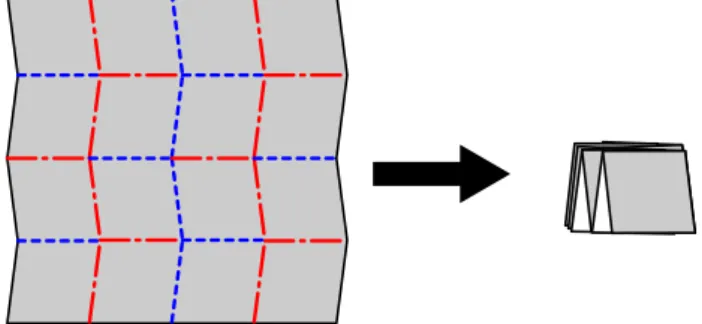
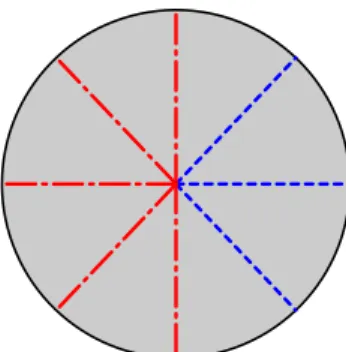
Two dimensional origami (2D origami) has creases with arbitrary di- rections on a piece of paper and the folded shape is flat. Flat-foldable single-vertex crease pattern(SVCP) is a 2D origami whose creases are in- cident to the center of a sheet of paper to be folded. We consider the sheet of paper for SVCP is a disk. Figure 1.3 is an example of flat-foldable MV- assigned SVCP. Miura-ori is a class of 2D origami, whose crease pattern is made of two dimensional array of congruent parallelograms as shown in Figure 1.4.
Three dimensional origami (3D origami) is considered to have non-flat folded shape. Its crease pattern is usually on a flat piece of paper.
In applications of origami, a sheet of paper, or a thin material, is often desirable to satisfyflat foldabilityin order to make the size of the material small. Flat foldability means whether a crease pattern or an MV-assigned crease pattern can be folded into a flat shape without penetrating itself if all creases are folded completely. There are some pieces of software to help designers’ tough investigation of origami. Mitani developed ORIPA1 [21, 22], which is software for drawing MV-assigned crease pattern, eval- uating its flat foldability, and estimating the state of the folded sheet of paper. Origamizer2 [25] by Tachi creates an MV-assigned crease pattern which can be folded into the input 3D model. Although the software help designers very well, testing whether a crease pattern is flat-foldable or not is substantially difficult: Bern and Hayes showed that such test on a given MV-assigned crease pattern is NP-hard [4].
In application called self-folding origami [11, 14, 18, 19], it is preferable to use fewer actuators that implement motion of planes around creases to
1http://mitani.cs.tsukuba.ac.jp/oripa/
2http://origami.c.u-tokyo.ac.jp/˜tachi/software/
Figure 1.2: An example of 1D origami.
Figure 1.3: An example of flat-foldable MV-assigned SVCP.
Figure 1.4: An example of Mimura-ori.
reduce the production cost, which leads to minimum forcing set problem.
A forcing set is a subset of given flat-foldable creases which forces other creases to follow the given MV assignment when folding. A minimum forcing set is a forcing set with the minimum number of creases. Finding a minimum forcing set of arbitrary 2D origami is an open problem.
In design of origami, designers often introduce a constraint that an angle between creases incident to a vertex is only multiples of22.5◦,15◦or some other specific unit angle which divides 360◦. This restriction reduces the choice of creases which is a part of difficulty of designing, however, such designing is still tough work. In addition, designers often aim to obtain a flat-folded shape. Therefore, designers may want a catalog of components of flat-foldable crease patterns to make their design easier, which requires a kind of enumeration.
This paper focuses on flat-foldable SVCP. We can consider that SVCP is a basic component of a crease pattern because a crease pattern is a set of SVCPs. Therefore, investigating SVCPs may contribute to study and design of 2D origami. We also denote an SVCP with MV assignment by an MV-assigned SVCP. Although SVCP is a fundamental and important component of origami, there are few pieces of previous research compared to complicated 2D and 3D origami applications. This paper studies two topics; one is minimum forcing set for SVCP, and the other is enumeration of flat-foldable MV-assigned SVCPs with unit angle. These must give us insight for further development of 2D origami studies and applications.
1.2 Contents of Thesis
Chapter 2 gives an overview of related work in computational origami: flat foldability, forcing set, and enumeration and counting. Flat foldablility is a main component of our research. Our key theorems and lemma on flat foldability are the Kawasaki Theorem, the Maekawa Theorem, and the Big-Little-Big Lemma. Forcing set is studied for 1D origami [6] and Miura- ori [3]. Matsukawa et al. studied an enumeration of flat-foldable crease pattern and possible folded shapes in 45◦ system with 4 × 4 grid [20].
Mitani developed an enumeration of all possible flat-folded states after folding [21, 22]. Counting MV assignment is actively studied by Hull.
He derived the tight upper and lower bound on the MV assignment for flat-foldable SVCP. Ginepro and Hull also counted the MV assignments for Miura-ori of h×w grid.
In Chapter 3, we consider minimum forcing sets for SVCP. Minimum forcing set problem is a model for saving resource in self-folding origami:
the number of actuators for self folding can be reduced to the size of the minimum forcing set for a given MV-assigned crease pattern. We analyze the size of minimum forcing set for SVCP and propose an algorithm for finding a minimum forcing set for a given MV-assigned SVCP.
In Chapter 4, we propose an algorithm for enumerating the all distinct flat-foldable MV-assigned SVCPs under an assumption that every angle between two creases is multiple of (360/q)◦ for given q. The algorithm considers that crease patterns and MV-assigned crease patterns are equiva- lent if they are equal up to rotation and reflection. The result of enumeration can be seen as knowledge for designing origami because SVCP is a com- ponent of an origami model. The number of enumerated patterns is highly exponential, which implies how difficult SVCP origami is.
Chapter 5 notes the results and future work.
Chapter 2
Related Work
2.1 Flat Foldability of Origami
This paper entirely works on flat-foldable crease pattern. A crease pattern or an MV-assigned crease pattern is flat-foldable if it can be folded into a flat shape without penetrating itself when all creases are folded completely.
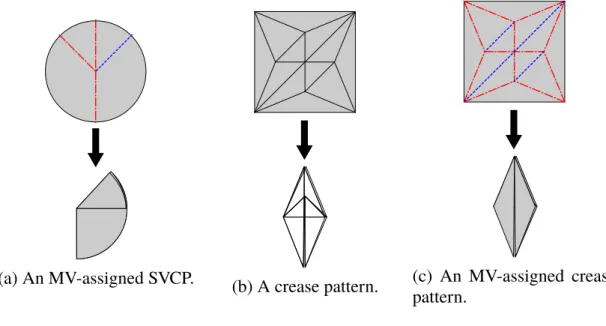
Great work on flat foldability was done by Bern and Hayes [4]. They showed the hardness of flat foldability in 3 situations: an MV-assigned SVCP (Figure 2.1a), an arbitrary crease pattern (Figure 2.1b), and an arbitrary MV-assigned crease pattern (Figure 2.1c).
The test for an MV-assigned SVCP takes linear time with respect to the number of creases. If only a crease pattern is given, we can test the existence of MV assignments such that the area around each vertex is flat-foldable.
This problem is calledlocal flat foldability problem. The test of local flat foldability can be done in linear time as well, and so is generating a valid assignment [8]. However, computing flat foldability is NP-hard even if we are given a valid MV-assigned crease pattern. The proposed algorithm in Chapter 4 uses the test of flat foldability for MV-assigned SVCP in order to detect flat-foldable ones in the enumeration.
Assuming that given n creases are indexed clockwisely and the index starts from 1, there are several conditions related to flat foldability of MV- assigned SVCP as follows:
(a) An MV-assigned SVCP.
(b) A crease pattern. (c) An MV-assigned crease pattern.
Figure 2.1: Three situations for flat foldability. We can obtain a wire frame of folded shape in (b).
Theorem 2.1 (The Kawasaki Theorem [16]) Let θi be an angle between theith and the(i+1)st creases. We assume that either mountain or valley is assigned to each crease. An SVCP defined by anglesθ1+θ2+· · ·+θn = 360◦ is flat-foldable if and only ifnis even and the sum of the odd anglesθ2i+1is equal to the sum of the even anglesθ2i, or equivalently, either sum is equal to180◦: θ1+θ3 +· · ·+θn−1 = θ2 +θ4+· · ·+θn = 180◦.
Theorem 2.2 (The Maekawa Theorem [8, Chapter 12] ) We assume that a given MV-assigned SVCP defined by angles θ1 + θ2 + · · · + θn = 360◦ is flat-foldable. Then the number of mountains and the number of valleys differ by±2.
Lemma 2.1 (Big-Little-Big Lemma [15, 16]) If an angleθiis strictly min- imal, that is, θi−1 > θi < θi+1 holds, then the creases forming θi have as- signment different from each other in any flat-foldable MV-assigned crease pattern.
Lemma 2.2 (Generalized Big-Little-Big Lemma (Theorem 4 of [13])) If a sequence of k angles θi, θi+1, . . ., θi+k−1 is strictly minimal, that is, θi−1 > θi = θi+1 = · · · = θi+k−1 < θi+k holds, then the difference of the
number of mountains and the number of valleys on the creases between the anglesθi−1, θi . . ., θi+k is zero for odd k and is one for even k.
Note that the Kawasaki Theorem is a necessary and sufficient condi- tion on angles between creases and others are necessary conditions. The Maekawa Theorem and the Big-Little-Big Lemma are components of proof in Chapter 3. These conditions are used to reduce the computation time of the enumeration algorithm in Chapter 4.
2.2 Forcing Sets
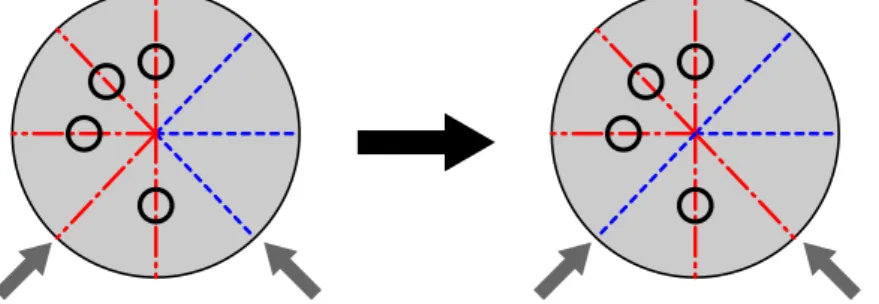
Forcing set is a new topic in computational origami. A forcing set F is a subset of a given flat-foldable crease patternC. If the creases in the forcing set are folded according to given MV assignment µ, the all creases inC\F are also folded according to µ and no other way to be folded. Figure 2.2 depicts the concept of minimum forcing set for a flat-foldable MV-assigned SVCP.
In an application called self-folding origami [11, 14, 18, 19], a thin material folds into an intended shape by rotating the planes around creases according to the label mountain or valley assigned on the creases. The cost of such an application can be reduced if it is enough to put actuators on a subset of creases. Such an optimization problem can be modeled as a minimum forcing setproblem. The minimum forcing set problem supposes us to find a forcing set with the minimum number of creases. The input of this problem is a flat-foldable MV-assigned crease pattern(C, µ). Table 2.1 shows the current progress of studies on minimum forcing set.
Damian et al. proposed an algorithm for finding a minimum forcing set of arbitrary 1D origami in 2015 [6]. Outline of their algorithm is as follows: repeat crimping minimal distance sequence of creases to construct a forest whose nodes represents the sequences, where the sequence of a parent node includes a crease surviving the crimp on the sequence of a child node; traverse the forest in preorder manner to decide the forcing
Figure 2.2: An example of a minimum forcing set for the flat-foldable MV- assigned SVCP in Figure 1.3. Each crease with a small circle is the crease of the forcing set. Given MV assignment is a unique foldable assignment if we try all possible MV assignments on not forcing creases.
Table 2.1: An overview of studies on minimum forcing set. Dim. means dimension, and MFS means minimum forcing set.
Dim. Constraint Finding MFS Bounds for the size of MFS Paper
1D Arbitrary O(n)time Open [6]
2D Arbitrary Open Open —
2D Miura-ori O(h2w2)time forh×wgrid
Lower: h+w−2,
Upper: ⌈hw/2⌉ [3]
2D Single-vertex O(n2) time n/2orn/2+1 Our result
creases.
Ballinger et al. developed an algorithm for finding a minimum forcing set of 2D Miura-ori in 2015 [3]. To describe the problem, they used equivalence between locally flat-foldable Miura-ori MV assignments and 3-vertex colorings of a grid graph with one vertex pre-colored shown in [10].
They showed tight bounds of the number of the creases in the minimum forcing set, and proposed a method for testing whether a given set is forcing or not as well. The minimum forcing set for arbitrary 2D origami may be important in origami applications. However, algorithm for such case has
Table 2.2: An overview of studies on enumeration and counting of origami.
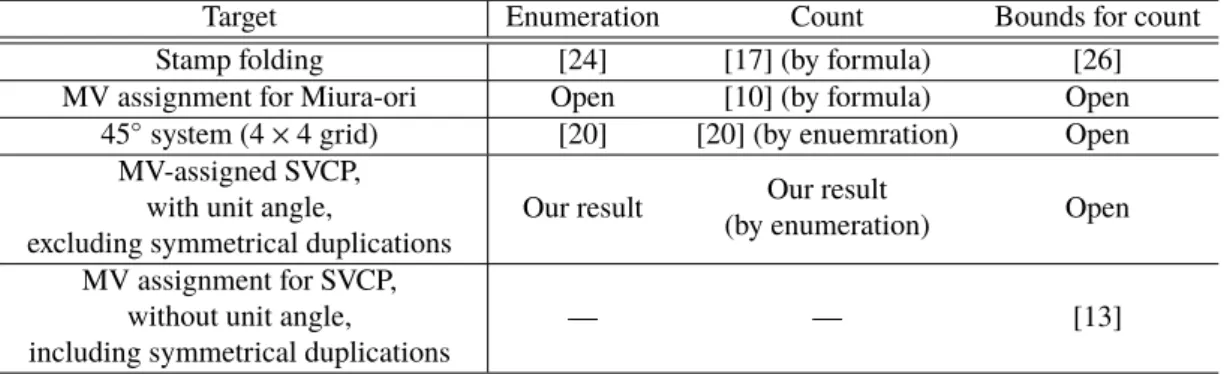
Target Enumeration Count Bounds for count
Stamp folding [24] [17] (by formula) [26]
MV assignment for Miura-ori Open [10] (by formula) Open
45◦system (4×4grid) [20] [20] (by enuemration) Open MV-assigned SVCP,
with unit angle,
excluding symmetrical duplications
Our result Our result
(by enumeration) Open
MV assignment for SVCP, without unit angle, including symmetrical duplications
— — [13]
not been developed.
In this paper, we propose an algorithm for finding a minimum forcing set of flat-foldable MV-assigned SVCP by converting the algorithm in [6], which might help us to construct an algorithm for arbitrary 2D origami.
We also show the size of a minimum forcing set for SVCP isn/2orn/2+1.
As far as the author knows, our work is the first trial for minimum forcing set of SVCP.
2.3 Enumeration and Counting of Origami
Enumeration is an emerging topic in computational origami due to a rise of calculation speed of computers. Mitani has implemented in ORIPA [21, 22]
an enumeration of all possible flat-folded states after folding input MV- assigned crease pattern. If we focus on the size of the output of enumeration, the problem can be seen as a counting problem. Table 2.2 summarizes the current progress of studies on enumeration and a count of origami.
Hull showed tight upper and lower bounds on the count of MV as- signments for flat-foldable SVCP [13]. The situation is similar to our enumeration of flat-foldable MV-assigned SVCP in Chapter 4, but Hull did not remove duplications up to rotation and reflection. Therefore Hull’s result cannot be applied to the analysis of our enumeration.
Koehler studied counting of stamp folding which is a kind of 1D origami [17]. Stamp folding considers to fold a strip of square or rect-
angular stamps which are separated by creases, and we are supposed to fold along the all creases without penetration. He derived complicated formulas to compute the counting and listed such numbers by computer for N ≤ 16 where N is the number of stamps. Sawada and Li developed a constant amortized time algorithm to generate stamp foldings in [24]. The numbers of stamp folding is known for N ≤ 45so far, listed as A000136 in OEIS1.
Uehara showed that the lower bound of the count is Ω(3.065N) and the upper bound isO(4N) [26].
Ginepro and Hull counted the number of locally flat-foldable MV as- signments on Miura-ori of h×w grid where h andw are given [10]. They derived recurrence and closed formula for w ≤ 5 and arbitrary h, and computed the numbers of MV assignments for w ≤ 5 and h ≤ 8. The computed numbers fit with existing integer sequence of the number of ways of 3-coloring the vertices of a grid graph with one vertex pre-colored (A078099 in OEIS), where a grid graph is a dual of the given Miura-ori crease pattern regarded as a graph. They showed such correspondence occurs for anyh and w.
Matsukawa et al. enumerated flat-foldable crease patterns and possible folded shapes in45◦system with4×4grid [20]. They did not count the order of layers in a folded shape. Their enumeration removes duplications up to rotation and reflection. It is shown that there are 259,650,300 flat-foldable crease patterns and 13,452 folded shapes in such situation.
Contribution of this paper in this field is that the author enumerates and counts flat-foldable MV-assigned SVCPs introducing the concept of unit angle for the first time in the world. The count in Chapter 4 is done by enumeration. Deriving the closed formula of the count is future work.
Upper and lower bounds for the count is an open problem as well.
1The On-line Encyclopedia of Integer Sequences: http://oeis.org/
Chapter 3
Minimum Forcing Sets for Single-Vertex Crease
Pattern
This chapter is based on the author’s paper published as [OU19b]. We propose an algorithm for finding a minimum forcing set of SVCP. A forcing set is a subset of given creases that forces all other creases to fold according to the given labels. Our algorithm is a modification of an existing algorithm for 1D origami [6]. We show that the size of a minimum forcing set of an SVCP isn/2or n/2+1where nis the number of the creases in the SVCP.
3.1 Introduction
In an origami application called self-folding origami, a thin material folds into an intended shape by rotating the planes around creases according to the label mountain or valley assigned on the creases [11, 14, 18, 19]. The cost of such an application can be reduced if it is enough to put actuators on a subset of creases. Finding such a subset of creases can be modeled as a forcing set problem.
Forcing set problem is a new topic in computational origami, which
was considered in [1, 3, 6]. Especially, minimum forcing set for flat foldability was studied for 1D origami [6] and 2D Miura-ori [3]. In a forcing set problem for flat foldability, a flat-foldable MV-assigned crease pattern (C, µ) is given. A forcing set F is a subset of C where c ∈ F is assigned the value µ(c), and F makes the other creases c′ ∈ C \ F to be assigned the value µ(c′): F is not a forcing set ifc′can have the assignment opposite to µ(c′) to make the given crease pattern fold flat. A forcing set F is called minimum if there is no other forcing set with size less than |F|. This chapter focuses on minimum forcing sets for flat-foldable SVCP.
If |C| is two, we are to fold the sheet of paper in half, and it is obvious that the size of the minimum forcing set is one. To simplify calculation of index circulation, we assume the index of creases starts with 0 in this chapter. An SVCP is a sequence of creasesC = (c0,c1, . . .,cn−1)which are put clockwisely on the disk incident to the center. θi denotes the clockwise angle fromci toci+1 modn (see Figure 3.1).
Figure 3.1: Notation of creases and angles.
In this chapter, we develop an algorithm to find a minimum forcing set of a given flat-foldable MV-assigned SVCP in O(n2) time. As far as the author knows, our algorithm is the first one for finding a minimal forcing set of flat-foldable MV-assigned SVCP, even though SVCP is an important component of origami. Our algorithm is based on that for 1D origami in [6] because the structure of SVCP is similar to 1D origami if we regard it as a ring by cutting away the inner space of the sheet of paper: the creases reduce to points on the ring, and the sheet of paper becomes 1D origami
if we cut the ring at some point. We also reveal that the size of F is n/2 or n/2+1. Precisely, |F| is n/2 if the SVCP is of generic angles, which is a case that the angles to be operated always differ. In the case when all the angles in the SVCP are equal, |F| is n/2 if n = 2, otherwise |F| is n/2+1. For a general SVCP, which does not have any constraints, the size of F is n/2+ 1 if the crease pattern can be reduced to an SVCP of equal angles with size four or more by repeatedly crimping consecutive two creases (ci,ci+1 modk) with different MV assignment where θi is minimal, otherwise |F| = n/2.
3.2 Preliminaries
This section introduces some terminology and preliminary results follow- ing [6]. Throughout the chapter we work with a flat-foldable MV-assigned crease pattern (C, µ), where C = (c0,c1, . . .,cn−1) is a flat-foldable SVCP and µis a flat-foldable MV assignment.
3.2.1 Crimpable Sequences [6]
We slightly change the definition of crimpable sequence to fit the as- sumption that C is circular. A crimpable sequence in SVCP is com- posed of consecutive creases where the angles between the creases are equal, with the property that the two angles adjacent to the left and right end of the sequence are strictly larger than the equal angles. Formally, for integers 0 ≤ i < n and 0 < k < n, a sequence of consecutive creases (ci,ci+1 modn, . . .,ci+kmodn) is crimpable if θi = θi+1 modn = · · · = θi+k−1 modn and θi−1 modn > θi < θi+k modn. Figure 3.2 shows an example.
We note that we have to take a mod on the index for circulation. Thus we may have (i −1) mod n = (i +k) mod n.
A monocrimp operation is defined as a fold about a single pair of consecutive creases of opposite MV parity in a crimpable sequence. (See Figure 3.3.)
Figure 3.2: (c4,c5,c0,c1,c2) is a crimpable sequence.
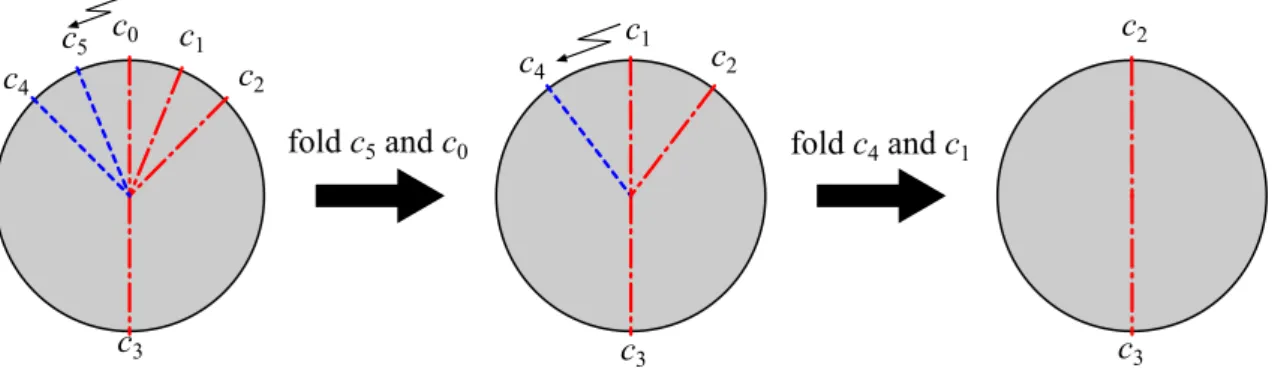
Figure 3.3: We can monocrimp (c5,c0) because they are in a crimpable sequence (c4,c5,c0,c1,c2) and their MV assignment are different. A monocrimp makes the sheet of paper conic. We describe such a conic crease pattern by an image captured from the upside of the cone.
A crimp operation is a set of monocrimps repeatedly conducted on a crimpable sequence while the sequence is crimpable (Figure 3.4). In our proofs for the minimum size of a forcing set, we characterize such size by considering the conditions for flat foldability on a given SVCP while repeating a crimp operation to fold the SVCP flat. A crimp on an MV-assigned SVCP on a disk changes the disk to a cone and further crimps make the cone sharper. Such change of the shape does not affect flat foldability [8, Chapter 12]. The following theorem described with crimpable sequence is equivalent to Lemma 2.2, which will be needed in Section 3.5.
Theorem 3.1 (Theorem 1 from [6]) Let α be a crimpable sequence in a
Figure 3.4: An example of a crimp operation. After monocrimping(c5,c0), new MV pair (c4,c1) appears and are folded by another monocrimp as a part of the crimp operation.
flat-foldable MV-assigned SVCP. The difference in the number of M and V assignments for the creases inαis zero (one) ifαhas an even (odd) number of creases.
In the case of a crimpable sequence α of odd length, we say that the crease remaining after a crimp operation on α survives the crimp. We note that the surviving crease in α is with majority assignment in α ([6, Observation 1]). Majority assignment denotes the assignment M or V which is major in a sequence or a set of creases.
3.2.2 End Creases [6]
End creases are the remains after exhaustive crimps. Exhaustive crimps mean repeating a crimp operation until there is no crimpable sequence (for example, see Figure 3.5). The following lemma holds for SVCP.
Lemma 3.1 The end creases of an flat-foldable SVCP form a flat-foldable SVCP of equal angles.
To prove this lemma, we need the Maekawa Theorem (Theorem 2.2) and the following lemma:
Lemma 3.2 (Corollary 12.2.11 from [8]) An SVCP of equal angles is flat- foldable iff |#M−#V| =2.
Figure 3.5: An example of exhaustive crimps. SVCP becomes equal angles by the exhaustive crimps.
Details about the Maekawa Theorem can be found in [8, Chapter 12].
Now let us prove Lemma 3.1.
Proof. We will make exhaustive crimps, that is, we will repeat crimps while processed C satisfies θi−1 modn > θi = θi+1 modn = · · · = θi+k−1 modn <
θi+k modnfor someiandk. After this repetition, the crease pattern becomes one that consists of all equal angles as shown in Figure 3.5.
The original foldable (C, µ) satisfies the equation in Lemma 3.2 by the Maekawa Theorem. A monocrimp does not change the difference between the number of Ms and the number of Vs. Therefore after crimping all crimpable sequences in (C, µ), the crease pattern satisfies |#M−#V| = 2.
By Lemma 3.2, the obtained SVCP of equal angles is flat-foldable.
3.3 The Size of a Minimum Forcing Set of an SVCP
This section is devoted to proof of the theoretical minimum size of forcing sets.
3.3.1 SVCP of Generic Angles
In this section, let a given SVCP be of generic angles, that is, consecutive angles to be crimped always differ. Formally, SVCP is of generic angles if θi −θi+1 +θi+2 −θi+3 +· · ·+ θj−1 , θj − θj+1 +θj+2 − θj+3 +· · · +θk−1
holds for any i, j, and k where the length of each sequence is odd. (This definition is from [8, Subsection 12.2.2].) First we show the existence ofF with sizen/2, then we prove thatF with sizen/2−1or less does not exist.
Lemma 3.3 There is a forcing set of an SVCP of generic angles, whose size isn/2.
Proof. First we use a contradiction in order to show that there are al- ways consecutive three angles which satisfy Lemma 2.1. Assume there are consecutive different angles θ0, θ1, . . ., θn−1, and any consecutive three of them do not satisfy Lemma 2.1. Then, for example, we can assume θ0 > θ1 > θ2. By the condition and assumption, θ1 > θ2 > θ3 holds.
Similarly, θ0 > θ1 > θ2 > θ3 > θ4 > · · · holds and the sequence mono- tonically decreases. However, θn−1 > θ0 could never happen, which is a contradiction. Thus, we can always apply Lemma 2.1.
Applying Lemma 2.1 on (θi−1 modn, θi, θi+1 modn) repeatedly, we can fold flat the sheet of paper. Let(ci,ci+1 modn) be the pair of creases between the three angles. If we determine the assignment on one of (ci,ci+1 modn), the assignment on the other of the pair is also determined. Hence we can make a forcing set by picking a crease in each pair as an element of the forcing set. We have n/2 such pairs because generic angles are the worst case of the number of such pairs. Therefore the size of the forcing set is n/2.
Lemma 3.4 There is no forcing set of an SVCP of generic angles whose size is less thann/2.
Proof. The proof is by contradiction. Assume a forcing set F with size n/2−1or less exists.
We monocrimp (θi−1 modn, θi, θi+1 modn) according to Lemma 2.1. Ev- ery pair (ci,ci+1 modn) is isolated from other pairs and there are n/2 pairs, thus every crease appears in a pair only once. Because |F| < n/2, there is an indexi such that both in(ci,ci+1 modn) are not inF. This contradicts the
Figure 3.6: An example of flat-foldable equal-angle SVCP.
definition of F because the sheet of paper folds flat in the following two cases: we assign (M,V) on (ci,ci+1 modn), or (V, M) on (ci,ci+1 modn).
By Lemma 3.3 and Lemma 3.4, we obtain the following theorem.
Theorem 3.2 The size of a minimum forcing set for SVCP of generic angles is n/2.
3.3.2 SVCP of Equal Angles
In this section, let a given SVCP be of equal angles, orequal-angleSVCP.
(An example of equal-angle SVCP is in Figure 3.6.) Hence θi = θi+1 modn
holds for any integeri where0 ≤ i < n.
Lemma 3.5 There is a forcing set of an equal-angle SVCP whose size is n/2+1 if n ≥ 4. Furthermore, the forcing set is composed of all creases with majority assignment.
Proof. Assume that F consists of all majority M creases (thus all V creases are not in F). If F is not a forcing set then we can choose some crease in C \ F to be M, contradicting Lemma 3.2.
Lemma 3.6 There is no forcing set of an equal-angle SVCP whose size is less thann/2+1if n ≥ 4.
Proof. We prove it by contradiction. Assume F is a forcing set of an equal-angle SVCP, whose size is n/2 or less. Then there may be a pair of
Figure 3.7: F is not forcing: two Ms can be inverted to fold flat.
Figure 3.8: F is not forcing: one M and one V can be inverted to fold flat.
an M crease and a V crease which are not in F (Let M be the majority in the crease pattern). We denote such pair by p. We note that the creases in p do not have to be consecutive.
If all V creases are in F, pdoes not exist. In this case, we can invert the assignment of a pair of M creases in C \ F to Vs (Figure 3.7), where the pair is not necessary to be consecutive. This operation holds Lemma 3.2, a contradiction.
Otherwise we can swap the MV assignment in p, and the resulting SVCP is flat-foldable by Lemma 3.2 (Figure 3.8). This is a contradiction to our assumption thatF is forcing.
Theorem 3.3 Assume that a given SVCP is of equal angles. If the number of creases in the SVCP is two, then the minimum forcing set consists of one crease. Otherwise the size of the minimum forcing set of the SVCP is n/2+1. By Iverson’s convention, it can be described asn/2+[n ≥ 4].
Proof. It is obvious if the number of creases in an equal-angle SVCP is two.
Lemma 3.5 and Lemma 3.6 imply thatn/2+1is the minimum size of F if n ≥ 4.
3.3.3 General SVCP
Here we consider that a given SVCP has no constraints.
Theorem 3.4 Let m be the number of monocrimps performed until the given SVCP becomes a flat-foldable equal-angle SVCP (cf. Lemma 3.1). F denotes a minimum forcing set of the given SVCP. Then|F| = n/2+[n−2m ≥ 4].
Proof. As the case of generic angles, we crimp the creases in crimpable sequences as many as possible. For each monocrimp, one of the creases in the pair must be inF. Such monocrimps contribute to m elements inF.
After monocrimping m times, the crease pattern has become a flat- foldable equal-angle SVCP (cf. Lemma 3.1). This equal-angle SVCP is composed of n− 2m creases because two creases are consumed per one monocrimp. By Theorem 3.3, the size of a minimum forcing set of the equal-angle SVCP is (n−2m)/2+[n−2m ≥ 4].
The minimum size of F is the sum of the sizes of the two sets of forcing creases obtained above. This is because the sets do not have intersection and both are minimum. Thus, |F| = m + (n− 2m)/2 +[n− 2m ≥ 4] = n/2+[n−2m ≥ 4].
3.4 Constructing a Minimum Forcing Set
This section describes how to obtain a minimum forcing set for a given flat- foldable SVCP. We regard SVCP as a kind of 1D origami by the following way: cut away the inner space of the sheet of paper to make the sheet of paper a ring; the creases reduce to points on the ring, and the ring becomes 1D origami by cutting the ring at some point. Hence we can see that flat- foldable SVCP is a 1D origami with a constraint that the two end points of
the paper segment locate at the same point in the folded shape. Another difference between flat-foldable SVCP and ordinary 1D origami is that the end creases of flat-foldable SVCP are always equal angle (or equidistant from the viewpoint of 1D origami). Such conditions suggest a need to consider Lemma 3.5 in this section.
3.4.1 Crimp Forest Construction
We convert the crimp forest algorithm in [6] to an algorithm for SVCP by allowing circulation of the index of creases when finding a crimpable sequence. The converted algorithm is shown in Algorithm 1. A circu- lating crimpable sequence (ci,ci+1, . . .,c0,c1, . . .,ck) may occur when the algorithm finds and crimps crimpable sequences, but it does not change the behavior of the other parts of the algorithm. The algorithm constructs a forest in bottom-up manner. The edges are added if the sequence in the parent node includes the crease surviving the crimp on the sequence in child node. Figure 3.9 depicts an example of a crimp forest.
Algorithm 1: CrimpForestSVCP(C, µ) InitializeW ← ∅
whileC has a crimpable sequencedo
Let s be the crimpable sequence inC with the smallest starting index. // modified from [6].
create a node v corresponding to s, and add v toW.
Makev the parent of each root node inW whose crimpable sequence has a surviving crease that is in s.
Apply the crimp operation to s.
UpdateC to be the resulting crease pattern.
end return W
A straightforward implementation of Algorithm 1 takes O(n2) time because a naive way to find a crimpable sequence takes O(n) time: start searching from c0 clockwisely; skip monotonically nonincreasing angles;
stop at the right side creasecr which satisfiesθr−1 modn < θr; counterclock-
Figure 3.9: An example of a crimp forest construction. [·] is a crimpable sequence to be crimped. The surviving creases are underlined. Inclusion of a surviving crease is presented as an edge of a tree.
wisely fromcr, search the left side crease cl which satisfies θl−1 modn > θl; other operations can be done in constant time; since the algorithm loops at mostntimes, the time complexity of the algorithm isO(n2).
The following lemma describing the properties of crimp forest holds for SVCP as well.
Lemma 3.7 (Lemma 4 from [6]) Given a crease pattern C and two fold- able MV assignments µ1 and µ2, let W1 and W2 be the crimp forests corresponding to (C, µ1) and (C, µ2), respectively. Then the following properties hold:
(1). W1 andW2 are structually identical.
(2). Corresponding nodes inW1 andW2 have crimpable sequences of the same size and the same interval angles between adjacent creases.
(3). Creases involved for the first time in a crimpable sequence at a node in W1 have the same position in the crimpable sequence at the corresponding node inW2.
3.4.2 Forcing Set Algorithm
We convert the forcing set algorithm in [6] by three modifications: switch CrimpForest(C, µ) to CrimpForestSVCP(C, µ); initialize F to the ma- jority of end creases according to Lemma 3.5 instead of all end creases;
remove one crease from F if |F| = 2 in the initialization according to Theorem 3.3. See Algorithm 2 for the detail.
Algorithm 2: ForcingSetSVCP(C, µ)
InitializeW to the output generated byCrimpForestSVCP(C, µ) // modified from [6].
Initialize F to the all creases with majority assignment in end creases that remain after running CrimpForestSVCP(C, µ) // modified from [6].
if |F| = 2then// added to [6]
Remove one crease from F.
end
foreach treeT ∈ W do
foreach nodev in a preorder traversal ofT do if v’s crimpable sequence has even lengththen
Add to F all creases from v’s crimpable sequence having M assignment.
else if the surviving crease fromv’s crimpable sequence is already in F then
Add to F all creases from v’s crimpable sequence having the majority MV assignment.
else
Add to F all creases from v’s crimpable sequence having the minority MV assignment.
end end end
The preorder traversal takes O(n) time because each node is visited only once and the sum of lengths of the sequences in the nodes isn. Thus the main factor of computation time is CrimpForestSVCP, which takes O(n2) time.
We need the following lemma for the proof in Section 3.5:
Lemma 3.8 (Lemma 6 from [6]) Let (C, µ1) be a foldable MV-assigned crease pattern, and let F be the forcing set generated by Algorithm 2 with input(C, µ1). Let (C, µ2) be a foldable pattern such that µ2 agrees with µ1
on the forcing setF, that is, µ2(c) = µ1(c) for c ∈ F. LetT1 andT2be two structurally equivalent trees generated by the forcing set algorithm(C, µ1) and (C, µ2), respectively. If a crease cin a crimpable sequence α1 ∈T1 is inF, then a crease (not necessarilyc) with the same MV assignment occurs in the corresponding crimpable sequence α2 ∈T2, in the same position as inα1.
3.5 Proof of Correctness
This section proves thatF created by Algorithm 2 is forcing and minimum.
The proof is almost the same as [6] because Damian et al. use local properties of crimpable sequence and abstract properties of crimp forest, which are not affected by the change from 1D to SVCP. In this section, we organize the proof in [6] to follow and prove the different points.
Assume that there exists a different foldable MV assignment µ2 for C such that µ2(c) = µ(c) for c ∈ F. For symmetry, let µ1 = µ. We obtain W1 and W2 by running ForcingSetSVCP with input (C, µ1) and (C, µ2), respectively. As stated in Lemma 3.7,W1andW2are structurally identical.
Let corresponding nodes v1 ∈ T1 and v2 ∈ T2 be a pair of maximal depth in the trees whose assignments differ. We call two crimpable sequencesα1
and α2 similar if they have the same size, the same MV assignment read from left to right, and same interval angles.
The proof in [6] for forcing property is by contradiction with a case analysis as follows:
1. v1andv2are dissimilar. Letlbe the length of the crimpable sequences corresponding to v1 and v2.
(a) l is even.
(b) l is odd.
i. The creases of v1 with majority MV assignment are in F.
ii. The creases of v1 with minority MV assignment are in F.
2. All corresponding nodes in W1 and W2 have similar crimpable se- quences.
Case 1a leads to a contradiction as shown in [6]. In this case, v1 and v2 are root nodes in T1 and T2 because they do not have surviving crease.
l/2 creases of v1 are put into F with M assignment by the algorithm. The creases with M assignment in F have a copy in v2 by Lemma 3.8, and remaining creases must have V assignment by Theorem 3.1. Then v1 and v2 are similar, which is a contradiction to the assumption that v1 and v2 are dissimilar.
Case 1(b)i also contradicts as shown in [6]. By Lemma 3.8, the creases with majority MV assignment of v1 have a copy in v2 with the same MV assignment and located in the same positions. All other creases in v1, v2
must have the opposite assignment by Theorem 3.1. Thus v1 and v2 are similar, a contradiction.
The difference is in Case 1(b)ii and Case 2. In Case 1(b)ii, we have two new cases due to the second and third steps of Algorithm 2:
A. The survivor of the root node is inF. (Hence the majority in the root node are in F.)
B. The survivor of the root node is not in F. (Hence the minority in the root node are in F.)
The proof for Case A is the same as the proof of Case 1(b)ii shown in [6].
Assume without loss of generality that the minority assignment ofv1is M.
In Case B, we must encounter a node with majority assignment V, or an equal number of M and V assignment. Assume to the contrary that we encounter nodes with majority M assignments only. At the root noder1 of T1, V creases are selected as a part of F since we assume surviving crease is not in F. Similarly, on each node fromr1 to v1, V creases are selected as elements of F, which contradicts the assumption that the minority M creases ofv1are inF. Letw1′ be the first node encountered on the path from v1 tor1 ofT1 having majority assignment V or an equal number of M and V assignments. As addressed in [6], the differences in v1, v2’s crimpable sequences must be in first-time creases.
Figure 3.10: The case that first-time creases are different between v1 and v2, and w1′ have majority assignment V. Underlined are the creases in F.
Let p1be the parent node of v1. In Case B, ifp1 , w1′, p1’s majority are M (by definition ofw1′) and its creases with M should be in F (otherwise it contradicts the assumption that minority of v1 are in F). The difference of first-time creases in v1 and v2 causes a contradiction of Theorem 3.1 on p2 in the following cases: (1) w1′ has majority assignment V; (2)w1′ has equal M and V assignments. Figure 3.10 shows the first case. Assume c1 and c′1 in Figure 3.10 are first-time creases and c0′ survives a crimp operation.
Then c3 and c4 are copied to c3′ and c′4 by Lemma 3.8. This contradicts Theorem 3.1 on p2.
In Case 2, the end creases form a flat-foldable equal-angle SVCP (cf.
Lemma 3.1). Because ForcingSetSVCP puts all majority creases of the equal-angle SVCP into F, the remains of the creases in the equal-angle SVCP are forced to be with minority assignment, and it is not possible that
µ1and µ2differ on the equal-angle SVCP. It follows µ1 = µ2, and therefore F is a forcing set.
We have shown that the theoretical minimum size ofFisn/2+[n−2m ≥ 4]where m is the number of monocrimps performed in exhaustive crimps (cf. Theorem 3.4). Here we show how F yields n/2 + [n − 2m ≥ 4]
creases byForcingSetSVCP. The creases from the end equal-angle SVCP added to F in the second and third steps in the algorithm contributes to (n−2m)/2+[n−2m ≥ 4]creases. The same argument as [6] can be applied for the crimped creases: corresponding to each crimpable sequenceαwith sizel, the forcing set algorithm adds toF precisely ⌊l/2⌋creases; summing up over all crimp performed by the algorithm, we getmcreases contributed toF.
3.6 Conclusion
This is the first attempt to generate and analyze a minimum forcing set of flat-foldable SVCP. We have developed an algorithm1 to find a minimum forcing set of flat-foldable SVCP in O(n2) time by converting existing algorithm for 1D origami. We proved that the size of such forcing set isn/2 or n/2+1. The proof of the correctness of the algorithm was done with the framework used in a proof in prior research for 1D origami. Minimum forcing set of arbitrary 2D origami is attractive as future work.
1The implementation is at https://ouchi-koji.visualstudio.com/_git/ForcingSet.
Chapter 4
Efficient Enumeration of
Flat-Foldable Single-Vertex Crease Patterns
This chapter is based on the author’s papers published as [OU17, OU19a].
We investigate enumeration of distinct flat-foldable MV-assigned SVCP under the following assumptions: positive integerqis given; every pattern is composed ofqpotential linesincident to the center of a sheet of paper; every angle between adjacent potential lines is equal to (360/q)◦; every potential line is classified to “crease” or “flat,” and “crease” lines are then assigned with “mountain” or “valley”; MV-assigned crease patterns are considered to be equivalent if they are equal up to rotation and reflection. In this natural problem, we can use two well-known theorems for flat foldability: the Kawasaki Theorem and the Maekawa Theorem in computational origami.
Unfortunately, however, they are not enough to characterize all flat-foldable crease patterns. Therefore, so far, we have to enumerate and check flat foldability one by one using computer. In this study, we develop the first algorithm for the above stated problem by combining these results in a nontrivial way and show its analysis of efficiency.
4.1 Introduction
Recent origami is a kind of art, and origamists around the world struggle with their problems; what is the best way to fold an origami model? One of these problems is the issue of a unit of angle that appears in the origami model. Some origamists restrict themselves to use only multiples of a unit angle which divides360◦, e.g.,22.5◦,15◦, and so on. A nontrivial example, which was designed by the author, is shown in Figure 4.1. It is based on a unit angle of 15◦. Once origamists fix the unit angle as (360/q)◦ for suitable positive integerq, their designs are restricted to one between quite real shapes and abstract shapes, which is the next matter in art.
Figure 4.1: “Maple leaf” designed and folded by the author (left). Its crease pattern is based on15◦ unit angle (right).
When we are given a positive integerq, we face a computational origami problem which is interesting from the viewpoints of discrete mathematics and algorithms. We consider the simplest origami model which is a kind of MV-assigned SVCPs; all creases are incident to the single vertex at the center of origami, and each angle between two creases is a multiple of (360/q)◦. We are concerned with only flat-foldable MV-assigned crease patterns.
We note that the ordering of the layers of paper is not given, and it is not easy to compute it even if an MV assignment is given. The flat foldability of MV-assigned SVCP can be computed in linear time [4, 8].
In fact, the algorithm also gives us the ordering of the layers in the same time. However, its rigorous proof is not so simple, which is the main topic of Chapter 12 in [8]. Roughly speaking, the algorithm repeatedly folds and glues the locally smallest angle in each step. In other words, we have no mathematical characterization for this problem, and we have to check one by one.
The problem of computing a folding for a crease pattern is very different from the case of MV-assigned crease pattern. Hull investigated this problem from the viewpoint of counting [13]. Precisely, he considered the number of flat-foldable MV assignments to a given crease pattern ofncreases which were incident to the single vertex. In [13], he gave tight lower and upper bounds. These bounds are given in two extreme situations; one is given in the case that allnangles are different, and the other is given in the case that alln angles are equal to each other. From the viewpoint of origami design, we are interested in the case between these two extreme situations. To deal with reasonable situations between extreme ones, we slightly modify the input of the problem. The input of our problem is a positive integerq, and we restrict ourselves to the single vertex folding of unit angle (360/q)◦. We place q potential lines incident to the vertex with unit angle (360/q)◦. A potential line may eventually become a crease. In order to investigate our problem, we first give a label “crease” or “flat” to each potential line to generate crease patterns, then assign “mountain” or “valley” to each
“crease” lines to generate MV-assigned crease patterns. When a potential line is labeled “flat,” this line is not folded in the final folded state. Let us call a potential line with a label “crease” acrease. In this way, we can deal with the SVCPs and MV-assigned SVCPs of unit angle equal to (360/q)◦, which is more realistic situation from the viewpoint of origami design.
Our aim is to enumerate all distinct flat-foldable assignments of “moun- tain,” “valley,” and “flat” labels on q potential lines. In other words, our
algorithm eventually enumerates all flat-foldable MV-assigned SVCPs of unit angle (360/q)◦. We consider the sheet of paper is a disk, the vertex is at the center of the disk, and two crease patterns (or MV-assigned crease patterns) are considered to be equivalent if they can be equal up to rotation and reflection (i.e., including turning over and exchanging all mountains and valleys). Our algorithm enumerates all distinct MV-assigned SVCPs under this assumption.
For flat foldability of a given MV-assigned SVCP, there are two well- known theorems in the area of computational origami, which are called the Kawasaki Theorem and the Maekawa Theorem (Theorem 2.1 and The- orem 2.2). We note that the Kawasaki Theorem gives a necessary and sufficient condition for flat foldability, however, MV assignments are not given. That is, we have to compute foldable MV assignments for foldable SVCP satisfying the Kawasaki Theorem. In order to compute a flat-foldable MV assignment, we can use the Maekawa Theorem. Note that the Maekawa Theorem is a necessary but not sufficient condition.
In the last decades, enumeration algorithms have been well investigated, and many efficient enumeration algorithms have been given, e.g., [2, 28, 27].
Using techniques that follow above properties of origami, we construct an enumeration algorithm for flat-foldable MV-assigned crease patterns for given q, where each angle between two crease lines is a multiple of (360/q)◦. As far as the author knows, this is the first algorithm for the realistic computational origami problem. As a result, we succeeded to enumerate flat-foldable crease patterns up to q = 40in a reasonable time.
4.2 Outline of Algorithm
Based on the Kawasaki Theorem and the Maekawa Theorem, for a given q, we can design the outline of our enumeration algorithm as follows:
(1) Assign “crease” or “flat” to each of q potential lines incident to the single vertex so that the Kawasaki Theorem is satisfied. The result



![Figure 3.9: An example of a crimp forest construction. [ · ] is a crimpable sequence to be crimped](https://thumb-ap.123doks.com/thumbv2/123deta/6173670.1084717/29.892.126.762.120.605/figure-example-crimp-forest-construction-crimpable-sequence-crimped.webp)
