Japan Advanced Institute of Science and Technology
JAIST Repository
https://dspace.jaist.ac.jp/
Title Ziegler‑Natta触媒の構造と重合性能の相関解明に向け
ての新規アプローチ法の確立
Author(s) 舟子, 俊幹
Citation
Issue Date 2015‑03
Type Thesis or Dissertation Text version ETD
URL http://hdl.handle.net/10119/12774 Rights
Description Supervisor:寺野 稔, マテリアルサイエンス研究科,
博士
Novel Approaches to Elucidate Structure Performance Relationship in Ziegler-Natta Olefin Polymerization
Terano Laboratory, Student Number: 1240012, Toshiki Funako [Introduction]
The elucidation of quantitative structure performance relationship is one of ultimate goal of catalyst chemistry. The catalyst developed recently were carried out precise control of catalyst structure with applying multicomponent and hierarchical structure in order to perform improved performances and multi functions. Though performances were improved, the correlation between structures and performances became too complex to control further improvement.
Therefore the elucidation of these relationship became strongly demanded. The Ziegler-Natta catalysts for polyolefin production in industry is one of example catalysts. The performances of this catalyst were improved by making particle multicomponent and construct hierarchical structure. However those improvements made the correlation between structure and performance complex. Therefore systematic improvement method has been not established until now. The main causes are come from three features of Ziegler-Natta catalysts systems. First is difficulty of characterization on catalyst structure which ranges from angstrom scale to millimeter. Second is difficultly of systematic change of catalyst morphology because current industrial preparation methods are not able to control only one structure parameters. Third is difficulty of quantitative elucidation of structure effect because catalytic performances were determined by various structural parameters with concerted or opposed mechanism.
Therefore elucidation of structure performance relationship became very difficult task from above problems. This study aims to elucidate structure performance relationship quantitatively in Ziegler-Natta olefin polymerization with solution of three difficult problems. There the establishments of multilateral characterization to quantitative all structural parameter and of the statistical analysis which can were tried for elucidation of complex structure performance relationship (Figure 1).
[Results and discussion]
The complex hierarchical structures were parameterized by established multilateral characterization methods.
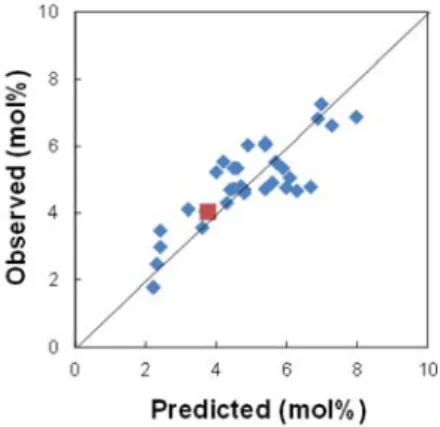
Additionally, parameterized structure and performance were analyzed based on statistical techniques. Statistical analysis was used as exploring the correlation and evaluation of obtained models. Finally, establishment of the way to elucidate structure performance relationship was carried out based on a combination of statistical analyses and obtained the correlation were quantitative. The correlation between predicted and measured values about comonomer insertion efficiency of catalyst in ethylene/1-hexene
copolymerization were shown in Figure 2 as a example. As can be seen, model equation showed not only good validity and accuracy (blue point) but also excellent prediction of new catalyst performance (red point). This accomplishment possesses great meaning that first establishment of quantitative structure performance relationship and to obtain knowledge of systematical catalyst development.
Especially, these results suggested that the combination of multilateral characterization and multivariate analyses were powerful tool for direct structure-performance relationships in heterogeneous Ziegler-Natta catalysis. Additionally, this established method are able to use not only Ziegler-Natta olefin polymerization but also any heterogeneous catalyst systems even if catalyst systems possesses multicomponent, complex hierarchy and/or complex reaction mechanism. Therefore, this investigation results will largely contribute developments of catalyst chemistry development.
Key word: Ziegler-Natta catalyst, olefin polymerization, statistical analysis, multilateral characterization
Figure 1. The concept of this study
Figure 2. The evaluation of prediction validity (copolymer insertion efficiency in ethylene/1-hexene copolymerization)