Japan Advanced Institute of Science and Technology
JAIST Repository
https://dspace.jaist.ac.jp/
Title
未利用芳香族アミノ酸 4‑アミノ桂皮酸を用いた芳香族
バイオベースポリマーの開発
Author(s)
GREWAL, Manjit Singh
CitationIssue Date
2017‑06
Type
Thesis or Dissertation
Text versionETD
URL
http://hdl.handle.net/10119/14755
RightsDescription
Supervisor:篠原 健一, マテリアルサイエンス研究科
, 博士
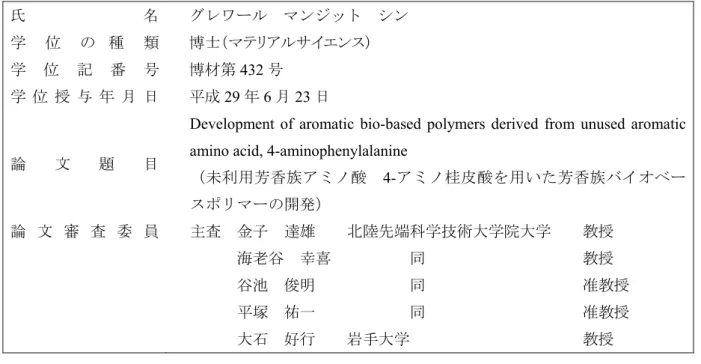
氏 名 グレワール マンジット シン 学 位 の 種 類
学 位 記 番 号 学 位 授 与 年 月 日
博士(マテリアルサイエンス)
博材第432号 平成29年6月23日
論 文 題 目
Development of aromatic bio-based polymers derived from unused aromatic amino acid, 4-aminophenylalanine
(未利用芳香族アミノ酸 4-アミノ桂皮酸を用いた芳香族バイオベー スポリマーの開発)
論 文 審 査 委 員 主査 金子 達雄 北陸先端科学技術大学院大学 教授 海老谷 幸喜 同 教授 谷池 俊明 同 准教授 平塚 祐一 同 准教授 大石 好行 岩手大学 教授
論文の内容の要旨
Background
Development of high-performance bioplastics, which are indispensable to establish green sustainable low-carbon based society, poses a challenge to the scientific society worldwide as commonly developed aliphatic bio-based polymers such as poly(lactic acid)1, polyhydroxyalkanoate2, poly(butylene succinate)3, and polyamides4 have low thermomechanical performance, and hence, limited industrial applications. A number of aromatic biopolyamides (PA)s5 and biopolyimides (PI)s6 from the photodimer of microorganism-derived 4-aminocinnamic acid (4ACA) which was biosynthesized based on shikimic pathway7 have been developed. Isolated from the same pathway, another functionalized aromatic amino acid, 4-aminophenylalanine (4-APhe), as diamine monomer, is also promising for developing high-performance polymers.
HN
COOMe
COOMe HN
COOMe
COOMe N O A O
O
O
N O
O H A
N
COOMe
COOMe HN
O O
HN H N A
n n
n
Figure 1: Bio-based high-performance polymers derived from 4-aminocinnamic acid.
Aim
The primary purpose of the present study is to investigate the possibilities of synthesizing a large number of unconventional, alternative unreported high-performance polymers (specifically, polyureas and polyimides) from a bio-based source. My research goals also include investigation of: (1) thermal
properties, (2) mechanical properties, and (3) some of the practical applications of the synthesized polymers. Here, I have synthesized new bio-based polyureas (PUs) and polyimides (PIs) using 4-aminophenylalanine (4-APhe) as a diamine monomer bioavailable by fermentation process using genetically modified Escherichia coli. The polyureas (PUs) and polyimides (PIs) were synthesized by carrying out chemical reactions using 4-APhe with a series of diisocyanates and dianhydrides respectively.
High solubility of the polymers keeping aromatic structure is expected because of the flexible moiety of aliphatics in the polymer backbone and asymmetric structure. The introduction of aromatic rings in the backbone of polymer chain boosts their thermal and mechanical performances and widens their application fields into electronics, automobiles, and optical materials.
Experimental
Instrumentation. The data for this research were gathered using latest sophisticated techniques at JAIST such as Nuclear magnetic resonance (NMR) measurements by Bruker biospin AG 400 MHz;
Fourier-transformed infrared (FT-IR) spectra were recorded with a Perkin-Elmer Spectrum One spectrometer; mass spectra were measured using a Fourier-transformed ion cyclotron resonance mass spectrometer (FT-ICR MS, Solarix); X-ray diffraction (XRD) using rotor X-ray emitter (RINT 2000;
Rigaku Smart Lab); tensile measurements were carried out on a tensiometer (Instron 3365, Kawasaki, Japan); number average molecular weight (Mn), weight average molecular weight (Mw) and molecular weight distribution (PDI) of the polymers were determined by gel permeation chromatography (GPC;
Shodex GPC-101 with a tandem connection column system of KD-803 and KD-807 (Shodex, Tokyo, Japan)); ultraviolet-visible (UV-vis) transmission spectra were recorded by Perkin Elmer, Lambda 25 UV/Vis spectrometer, Differential scanning calorimetry (DSC) was carried out by using Seiko Instruments SII, X-DSC7000T, thermal analysis by thermogravimetry (TGA; SSC/5200 SII Seiko Instruments Inc.).
Materials. The materials used in the research are of super grade quality and from renowned chemical companies like Aldrich, TCI, Japan, Kanto, Japan, Watanabe chemicals, Japan. The selection of appropriate monomers is necessary for tuning the properties of polymers. Aromatic diisocyanates were selectively and preferably chosen for the synthesis of polyureas as the aromatic diisocyanates such as diphenylmethane diisocyanate (MDI) or toluene diisocyanate (TDI) are more reactive than the aliphatic ones such as hexamethylene diisocyanate (HDI) or isophorone diisocyanate (IPDI). The compatibility factor with aromatic diamine in aromatic diisocyanates also plays pivotal role in their selection besides the economic factor. TDI and MDI are generally less expensive and more reactive than other isocyanates.
The influence of the structure of the aromatic diisocyanates on the preparation and the properties of polyureas were also investigated through this research. Dianhydrides for the synthesis of polyimides are also carefully chosen. Dianhydrides such as pyromellitic dianhydride (PMDA: from TCI), 1,2,3,4-tetracarboxycyclobutane dianhydride (CBDA: from Aldrich), 3,3’,4,4’-benzophenone
tetracarboxylic dianhydride (BTDA: from Aldrich), 4,4’-oxidiphthalic anhydride (OPDA: from Aldrich), 3,4,3’,4’-biphenyltetracarboxylic dianhydride (BPDA: from Aldrich), and 3,3’,4,4’-diphenylsulfone tetracarboxylic dianhydride (DSDA: from Aldrich) were purified by using sublimation process or recrystallized in acetic anhydride by refluxing for 5h and then cooling to 0~5 °C. The crystals were carefully collected by filtration, washed in hot dioxane, and dried in vacuo. The solvents used in the chemical reactions were either purified by distillation or used as such if super grade quality.
Results and discussion
In chapter 2, syntheses, characterization, thermal and mechanical properties of a series of aromatic polyureas (PUs) from 4-aminophenylalanine (4-APhe) are described. Most of PUs are processable into films or fibers having excellent mechanical properties; mechanical strength at maximum around 150 MPa and strain energy density around 10 J/cm3 at maximum, which means that PUs are much tougher than those of conventional bioplastics. The synthesized PUs are also soluble in some of the commonly used organic solvents like DMSO, DMF, DMAc, NMP which make their processability easier.
N n H N
H HN
HOOC O
NH N H O
Figure2: Representative chemical structure and film image of PU.
Later, the cell adhesion was also checked onto different polyurea films in order to check the cell-compatibilty. It was found that PU films showed good cell compatibility. A mouse fibroblast-like cell line (L929) was selected for all the biological assays in order to determine compatibility factor.
Chapter 3 discusses about further attempts or possibilities to use 4-aminophenylalanine as aromatic diamine monomer for the synthesis of bio-poly(amic acid) (BPAA) or bio-polyimide (BPI). The project was designed to improve the thermo-mechanical properties of polymeric substances synthesized from 4-APhe. Polyimides show improved thermo-mechanical properties based on the stiff aromatic backbones resulting from both dianhyrides and diamines constituents. 4-APhe reacted with various dianhydrides to create poly(amic acid), and then successive heat treatments yielded the polyimides (PI). The combination of 3,3’,4,4’-benzophenone tetracarboxylic dianhydride (BTDA), 4,4’-oxidiphthalic anhydride (OPDA), 3,4,3’,4’-biphenyltetracarboxylic dianhydride (BPDA) with 4-APhe (diamine) created the toughest films than other dianhydrides with 4-APhe. The PAA films were unbreakable when folded completely. Over most of the conventional plastics, PIs show high thermal and mechanical performance: a 10 % weight loss temperature (T10) over 427 °C, a glass transition temperature (Tg) over 350 °C, high tensile strength and a
high Young’s modulus, with maximum values of 75 MPa and 5 GPa, respectively, and good cell compatibility. The properties of PI films such as high mechanical strength and good transparency make them useful candidates in the development of electronic devices.
n N N
O
O
O
HO O O
O
Figure3: Representative chemical structure and film image of PI.
Later in chapter 4, the composites materials using carbon fibres and the matrix of synthesized polymers (polyureas and polyimides) were developed by stacking alternatively the layers of carbon fibres and polymer. The mechanical strength of the composites was tested.
Figure4: Representative cartoon illustration of preparation of polymer composites.
The results showed the composites have good mechanical strength compared to the carbon fibres or polymer considered separately because of the reinforcement effects. Such composites materials developed with sophisticated techniques could potentially be used in various practical applications such as automobiles, fishing nets etc.
On the basis of the results of this research about development of unconventional alternative novel bio-based polymers, specifically, polyureas and polyimides, it was concluded that bio-polymers prepared showed molecular weights high enough to evaluate the thermal and mechanical properties. The polymer films showed excellent cell-compatibility which makes them a potential candidate in ophthalmological applications. Some of the polymeric films created were so flexible and tough that they were unbreakable when folded completely. Further challenges lie in improving the transparency of PU films, ductility of the PIs, incorporation of metal ions in polymeric materials to investigate further improvement or discovering new properties, preparation of nano-composites using these polymeric materials, biocompatibility and
processibilties of the polymers so as to widen their usage in industrial applications or practical devices to make life easy for human comfort.
KEYWORDS. Amino acids; Polyureas; Poly(amic acid)s; Polyimides; Mechanics; Bioplastics; Polymer films, High-performance polymers
論文審査の結果の要旨
バイオプラスチックは、植物などに由来する再生可能資源を原材料とするプラスチックで、
二酸化炭素削減と廃棄物処理に有効であるとされている。一方、そのほとんどは柔軟なポリエ ステルであり耐熱性の面で従来のプラスチックより劣る。本論文では、最近注目されている未 利用資源のアミノ酸である 4-アミノフェニルアラニンの新規利用方法を示したものであり、か つ溶解性と高耐熱性を両立するバイオプラスチックを開発するための分子設計指針を構築する ことを目的として研究を進めた。
第一章では、従来報告されてきたバイオプラスチックをレビューすることで構造と物性の相関 を解説し、同時にポリイミドの構造的特徴やその応用例を説明することで、本論文の研究背景と 目的を述べた。
第二章では、4-アミノフェニルアラニンの塩酸塩からの精製およびカルボン酸部位の保護条件 に関して記載した。また、本アミノ酸は異なる 2 種類のアミノ基を持つために異なる効率の化 学反応を同時に利用しつつ重合する必要があるため、一般に高反応性とされるイソシアネートを 対モノマーとして選択し、重付加によりバイオポリ尿素を合成できることを示した。これにより、
本アミノ酸がモノマーとして使用可能であることを明確にした。
第三章では、4-アミノフェニルアラニンと種々のテトラカルボン酸二無水物を反応させること で一連のポリアミド酸を合成し、そのキャストフィルムを熱処理することでポリイミドを得る条 件を明らかにした。得られたポリイミドの熱的・力学的物性を測定したところ、10%重量減少温 度が最大378 ℃、ガラス転移温度が最大275 ℃以上、最大125 MPaの破断強度、最大15 G Paのヤング率を示し、極めて高い値であった。さらに全てのバイオポリイミドはトリフルオロ 酢酸に溶解し、特にジフェニルスルホン部位を有するバイオポリイミドに関しては、一般の非プ ロトン性アミド系溶媒にも溶解するなどポリイミドとしては稀な高溶解性を示すことが特徴で あった。
第四章では、前章で合成したバイオポリイミドの高溶解性を応用するために、湿式法でカーボ ンクロスと複合化させることで繊維強化樹脂を作成する条件を見出した。
第五章では、全ての章を総括し、本論文で作成した一連のバイオプラスチックの構造物性相関 を纏めて説明した。
以上、本論文は未利用資源である、4-アミノフェニルアラニンのバイオ由来ポリ尿素およびポ
リイミドの原料としての新しいルートを示したものであり、高溶解高耐熱プラスチックを開発す るなど学術的に貢献するところが大きい。よって博士(マテリアルサイエンス)の学位論文とし て十分価値あるものと認めた。