JAIST Repository
https://dspace.jaist.ac.jp/
Title ポリキューブの展開図に関する研究
Author(s) Xu, Dawei Citation
Issue Date 2017‑09
Type Thesis or Dissertation Text version ETD
URL http://hdl.handle.net/10119/14825 Rights
Description Supervisor:上原 隆平, 情報科学研究科, 博士
Research on Developments of Polycubes
by
Dawei XU
submitted to
Japan Advanced Institute of Science and Technology in partial fulfillment of the requirements
for the degree of Doctor of Philosophy
Supervisor: Ryuhei Uehara
School of Information Science
Japan Advanced Institute of Science and Technology
Sept, 2017
Supervisor: Ryuhei Uehara
School of Information Science
Japan Advanced Institute of Science and Technology
Sept, 2017
Doctoral Dissertation
Research on Developments of Polycubes
Dawei XU
Abstract
In this thesis, we study the folding and unfolding problems of polycubes. A polycube is a kind of polyhedron that composed of identical cubes. It has an important role in the field of computational geometry.
The first problem is about the common developments that can fold to two or more incongruent polycubes, boxes. These developments are simple polyominoes that consist of unit squares of four connected so that the boxes and their corresponding developments have the same surface area. In searching for common developments that fold to two or more boxes, we start from a relatively simple task: finding two or more boxes that their surface areas are equal, but sizes are different.
The smallest surface area is 22 which admits to fold to two boxes of size 1×1×5 and 1×2×3. All common developments of these two boxes were enumerated by Matsui in 2011. The next smallest integern such that surface arean can fold to two different boxes is 30. Previous study tried to list the common developments of two different boxes of size 1×1×7 and 1×3×3 of surface area 30, however, it failed due to the limitation of computational power. We fill this gap and research further.
By a new algorithm on a parallel computer, we first enumerate all common develop- ments of two boxes of size 1×1×7 and 1×3×3. Starting from the partial development of surface area 1, we repeat adding one new unit square to all possible places of the partial development to generate new developments. In each loop, the new developments will get checked whether they can cover the boxes or not. The algorithm loops n times, where n= 30.
Finally, we obtained all common developments of two boxes of size 1×1×7 and 1×3×3.
There are 1080 common developments.
Surface area 30 is consistent to the surface area of a cube of size√ 5×√
5×√
5. There- fore, next, we try to find a polyomino of surface area 30 that fold to these three different boxes. It is a great improvement from previously known one that the smallest surface area that folds to three different boxes is greater than 500. To achieve that, we propose a
new algorithm. It determines if a polyominoP that can fold to two boxes of size 1×1×7 and 1×3×3 can also fold to a box of size√
5×√ 5×√
5.
As a result, nine out of 1080 developments can fold to the cube of size √ 5×√
5×√ 5.
While eight developments have only one way of folding to the cube of size √ 5×√
5×√ 5, the other development has two different ways of folding to it, for there is an angle of 26.6 degrees to the unit square’s edge clockwise and counter-clockwise. That is, the last development can actually fold to 3 boxes in 4 different ways of folding: the box of size 1×1×7, the box of size 1×3×3, and 2 ways of the box of size √
5×√ 5×√
5.
In these results, there are some common developments with a special property that they are central symmetric. We call them the centrosymmetric common developments.
The way to enumerate the centrosymmetric common developments is a bit different from the enumeration of normal common developments, which needs more computations.
However, the size of data is relatively small, and it runs in loops of n/2 in total, where n is its surface area.
As a result, in 2263 common developments of two boxes of 1×1×5 and 1×2×3, only 45 centrosymmetric common developments exist. We confirm the exact numbers of cen- trosymmetric common developments from surface area 22 to surface area 54. Especially, we show that there is no centrosymmetric common development of three different boxes of surface area 46. The surface area 46 is the smallest candidates of three boxes of in- tegral size of 1×1× 11, 1×2×7, and 1 ×3×5. It is still open that if there is a common development of three boxes of these sizes, and we give a partial answer to this open problem.
The second part of this thesis is research on the “rep-cube”, which is a new notion derived from the classic notion of “rep-tile” with the idea of the development. A rep-tile of orderk is a polygon that can be divided into k replicas congruent to each another and similar to the original one. It was proposed by Solomon W. Golomb in 1962. In 2016, a new notion of rep-cube was proposed. A polyomino is a rep-cube of order k if it is a development of a cube, and it can be divided into k polyominoes such that each of them can fold to a cube. If each of these k polyominoes has the same size, we call the original polyomino a regular rep-cube of orderk.
A recent study shows that there exist regular rep-cubes of order k for each k =
2,4,5,8,9,36,50,64, and also k = 36gk′2 for any positive integer k′ and an integer g in {2,4,5,8,9,36,50,64}. That is, there are infinitely many k that allow regular rep-cube of order k. These results lead us to the following natural question: how many rep-cubes of order k exist for some k?
As a consequence, we enumerate all regular rep-cubes of order 2 and 4 of surface area 12 and 24, respectively. For example, there are 33 rep-cubes of order 2 of surface area 12; that is, there are 33 dodecominoes that can fold to a cube of size√
2×√ 2×√
2 and each of them can be divided to two developments of the unit cube. Similarly, there are 7185 regular rep-cubes of order 4 of surface area 24.
keywords: Polyomino; folding algorithm; enumeration; polyhedron.
Acknowledgement
I am grateful to my supervisor, Prof. Ryuhei Uehara, whose expertise, understanding, generous guidance and support made it possible for me to work on a topic that was of great interest to me. It was a pleasure working with him.
I am grateful to Assoc. Prof. Takashi Horiyama for giving his experience in enumerating algorithm and help me in off-campus research.
I would also like to thank Ms. Tomoko Taniguchi, her keen eyes and expertise in English help me remove spelling mistakes.
I would like to express my gratitude to the staff of RCACI (Research Center for Advanced Computing Infrastructure) for replying my question on parallel computers.
I would also like to thank my friends for accepting nothing less than excellence from me. Last but not the least, I would like to thank my parents, who have raised me up and provided me through moral and emotional support in my life.
Thank you!
Contents
Abstract i
Acknowledgement iv
List of Figures vi
1 Introduction and Background 1
1.1 Common Developments of Boxes . . . 2
1.2 Research of Rep-cubes . . . 7
1.3 Contents of Thesis . . . 9
2 Preliminaries 10 2.1 Developments . . . 10
2.2 Theorems of Developments . . . 10
2.3 Boxes with the Same Surface Area . . . 12
2.4 The Existing Algorithm . . . 13
2.5 Adjacency Lists of Boxes . . . 13
2.6 Removal of Redundant Developments . . . 13
2.7 Serialization and Storing . . . 15
3 Common Developments of Three Boxes 17 3.1 Enumerating Common Developments . . . 17
3.1.1 Enumerating all Common Developments of Two Boxes of Size 1× 1×7 and 1×3×3 . . . 17
3.1.2 Improving Performance by Parallel Computing . . . 20
3.1.3 Enumerating all Common Developments of Three Boxes of Size 1× 1×7, 1×3×3, and√
5×√ 5×√
5 . . . 21 3.1.4 Checking the Box . . . 22 3.1.5 Some Tricks for the Cube of Size √
5×√ 5×√
5 . . . 28 3.2 Results of Enumerating Common Developments of Boxes . . . 29
3.2.1 Common Developments of Two Boxes of Size 1×1×7 and 1×3×3 of Surface Area 30 . . . 29 3.2.2 Common Developments of Three Boxes of Size 1×1×7, 1×3×3, and
√5×√ 5×√
5 of Surface Area 30 . . . 30 3.3 Enumerating Centrosymmetric Common Developments . . . 35 3.4 Results of Enumerating Centrosymmetric Common Developments . . . 37
4 Rep-cubes 40
4.1 Enumerating Rep-cubes . . . 40 4.2 Results of Enumerating Rep-cubes of Orderk for k= 2,4 . . . 44
5 Concluding Remarks 51
5.1 Contribution and Conclusion . . . 51 5.2 Future Work . . . 52
References 53
List of Figures
1.1 A polygon folding to two boxes of size 1×1×5 and 1×2×3 in [9]. . . . 3
1.2 Cubigami. . . 3
1.3 The common development shown in [14]. (a) It folds to a box of size 1×2×4, and (b) it also folds to a box of size √ 2×√ 2×3√ 2. . . 5
1.4 Rep-tiles. . . 7
1.5 A regular rep-cube of order 2; each T shape can fold to a cube, and this shape itself can fold to a cube of size √ 2×√ 2×√ 2 by folding along the dotted lines. . . 8
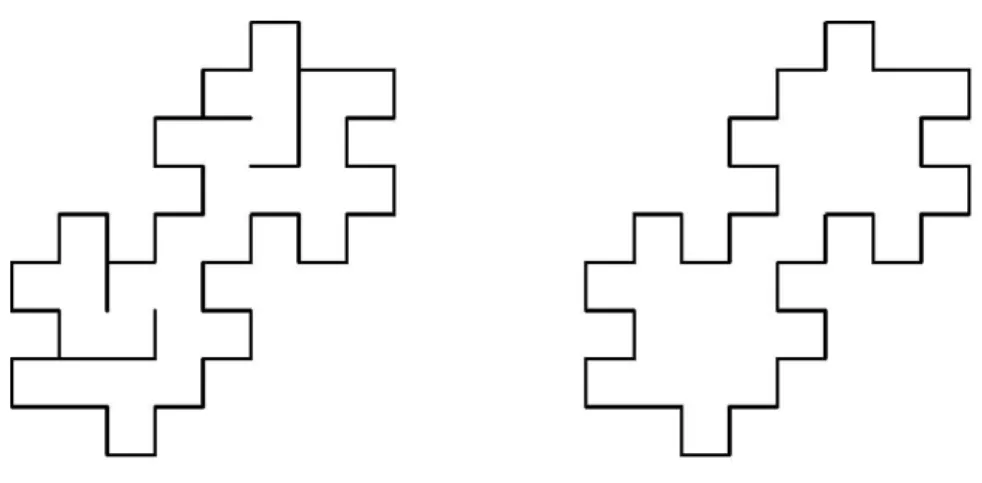
2.1 Development with a cut (left), development with no cut (right). . . 11
2.2 Development with an overlap. . . 11
2.3 An unfolding of the box of size 1×1×1. . . 13
2.4 Polyominoes of the same shape. . . 14
2.5 Matrix representation of polyominoes of the same shape. . . 15
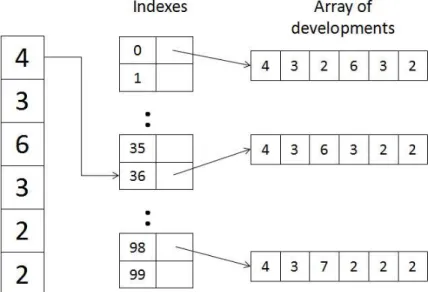
2.6 Compression of the development. . . 16
2.7 Storage of the development. . . 16
3.1 Possible results of adding one square. . . 19
3.2 Matrix and corresponding development. . . 20
3.3 The detail of parallel computing. . . 21
3.4 The graph induced by the cube. . . 22
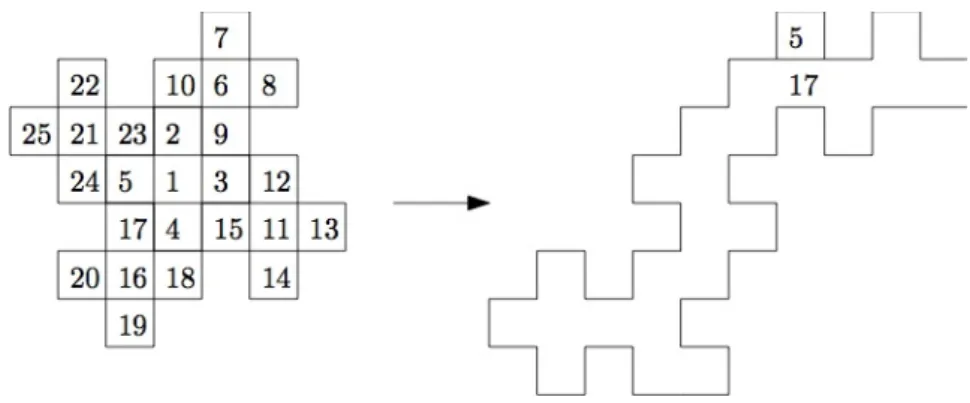
3.5 A hole and an overlap occur when we fold along the dotted lines to make a cube while the number of the squares around each vertex is 3. . . 23
3.6 An unfolding of the cube of size √ 5×√ 5×√ 5. . . 25
3.7 Neighbor-squares of start point marked in step 3. . . 25
3.8 Further neighbor-squares of start point marked in step 3. . . 27
3.9 Every square is marked in step 4. . . 27
3.10 There are 10 choices for letting a unit square s with respect to the square grid of size√ 5. . . 28
3.11 Boxes of size 1×1×7 and 1×3×3 of surface area 30. . . 29
3.12 The number of partial developments of surface area from 1 to 16. . . 31
3.13 Some common developments of two boxes of size 1×1×7 and 1×3×3. . . . 32
3.14 The number of partial developments of surface area from 17 to 30 (from a randomly picked development of surface area 16). . . 32
3.15 Boxes of size 1×1×7, 1×3×3, and √ 5×√ 5×√ 5 of surface area 30. . . 32
3.16 Developments having three or four ways of folding to three different boxes of surface area 30. . . 33
3.17 The development having four ways of folding: (a)1×1×7 (b) 1×3×3 (c) √5×√ 5×√ 5 (d) √ 5×√ 5×√ 5. . . 34
3.18 Possible locations for the center of symmetry on a unit square. . . 35
3.19 Centrosymmetric common partial developments of S4. . . 36
3.20 Attach q1 and q2 to make a new centrosymmetric polyomino Pi. . . 37
3.21 All centrosymmetric common developments of surface area 30 that can fold to two boxes of 1×1×7 and 1×3×3. . . 39
3.22 Centrosymmetric common developments of other surface areas. . . 39
4.1 The setS1 of all developments of one unit cube. . . 41
4.2 All possible adjacency empty squares on the boundary of a development of a 1×1×1 cube. . . 41
4.3 Every square ofP is marked with a unique number according to the adja- cency list. . . 43
4.4 All 17uniform rep-cubes of order 2, marked rep-cubes are central symmetric. 47 4.5 All regular rep-cubes of order 2 that are not uniform. . . . 48
4.6 Some uniform rep-cubes of order 4. . . 49
4.7 List of the numbers of uniform rep-cubes of order 4 made by each of 11 shapes. . . 49
4.8 Two different patterns can make the same rep-cube of order 4. . . 50
Chapter 1
Introduction and Background
In 1525, the German painter and thinker Albrecht D¨urer published his masterwork on geometry “On Teaching Measurement with a Compass and Straightedge”, which opened the area of computational geometry with a lot of open problems [1]. That area consists of the folding and unfolding problems. Despite a long history, it has not been studied extensively in the mathematical literature until decades ago.
In general, we are interested in how polyhedra can be reconfigured to certain con- straints depending on the type of object and the problem of interest. Typically, the process of unfolding approaches a more basic shape, whereas folding complicates the shape [2].
In the big picture of the area, there are three sections corresponding to the type of the object being folded: linkages, origami, and polyhedra. The problem we introduce belongs to the polyhedra area. We study the folding and unfolding problems of the polycubes, which are polyhedra that composed of identical unit cubes in face-to-face gluing manner.
The development is the unfolding obtained by slicing the surface of the solid, and it forms a single connected simple polygon without self-overlap [5]. In this thesis, as developments, we only consider orthogonal polygons that consist of unit squares in edge- to-edge gluing manner, which are called polyominoes[16].
Recently, a research presents a new paper-building design methodology using the re- search of common development of plural boxes. Paper, as an innovative material, has many advantages such as durability, lightweight, environment-friendly, and aesthetic prop- erty. In particular, in resource-limited societies, these advantages are extremely impor-
tant. The designer can simplify the paper building or part of the paper building as plural orthogonal polyhedra, which are actually boxes. Then the designer can choose a proper common development that can fold to these boxes to build the house.
1.1 Common Developments of Boxes
In the first half of this thesis, we study common developments that can fold to two or more incongruent orthogonal convex polyhedra, namely, boxes. This folding problem is very natural however quite counterintuitive; for a given polyomino that consists of unit squares, the problem asks are there two or more ways to fold it to different simple convex orthogonal polyhedra (Figure 1.1).
The research starts from a problem proposed by Lubiw and O’Rourke in 1996 [3], which is about polygons that can fold to a (convex) polyhedron. In 2007, Demaine and O’Rourke published a scholarly book, which is about geometric folding algorithms [5].
In general, we can state the development/folding problem as follows:
1 Input A polygon P and a polyhedron Q.
2 Output Determine whether P can fold to Q or not.
When Q is a tetramonohedron (a tetrahedron with four congruent triangular faces), Akiyama and Nara gave a complete characterization of P by using the notion of tiling [11, 12]. Except that, we have quite a few results from the mathematical viewpoint.
Hence, we can tackle this problem from the viewpoints of computational geometry and algorithms.
For example, Demaine and O’Rourke gave an O(n3) time algorithm for a convex polyhedron Q in [5]. Precisely, the algorithm determines if P can fold to some convex polyhedronQ, however, it does not give the concreteshapeofQ. The algorithm computes the matching of edges for gluing in P to fold to a convex polyhedron Q, and it also determines the vertices of Q by checking the curvature of the vertices. However, it does not give the crease pattern of P for folding, which forms the set of edges on Q. We remark that the shape is uniquely determined from its convexity ofQby the Alexandrov’s Theorem (see [4]). Moreover, such a shape can be determined by the pseudopolynomial
Figure 1.1: A polygon folding to two boxes of size
1×1×5 and 1×2×3 in [9]. Figure 1.2: Cubigami.
time algorithm for Alexandrov’s Theorem proposed in [4]. However, the algorithm in [4]
runs in O(n456.5) time (with some geometric parameters), and hence, it is not practical so far. Thus, we still have to decide the crease lines to make the shape by experiments.
In other words, it is quite difficult to determine the shape Q obtained from a polygon P by folding even if we can find its edge matching of gluing. Recently, some restricted cases were discussed in [13]; they give efficient algorithms for the cases that P is a petal polygon, and Q is a pyramid or its variants.
From the viewpoint of computation, one natural restriction is that considering the orthogonal polygons and polyhedra which consist of unit squares and unit cubes, respec- tively. We call this kind of polygon as polyomino, which was proposed by Solomon W.
Golomb in 1954.
Such polygons have many applications including toys and puzzles. For example, the puzzle “cubigami” (Figure 1.2) is a common development of all tetracubes except one (since the last one has surface area 16, while the others have surface area 18), which is developed by Miller and Knuth. We can find some related results in the books on geometric folding algorithms by Demaine and O’Rourke [5, 1].
In searching for common developments that fold to two or more boxes, we start from a relatively simple task: finding two or more boxes whose surface areas are equal, but sizes are different.
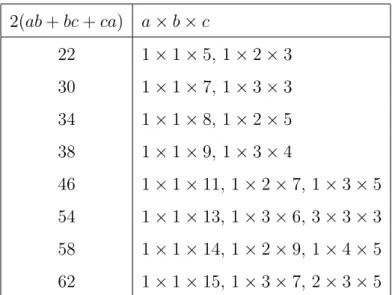
It is easy to see that two boxes of size a×b×cand a′ ×b′ ×c′ can have a common development only if they have the same surface area, i.e., when 2(ab+bc+ca) = 2(a′b′+ b′c′+c′a′) holds. We can compute small surface areas that may admit to fold to two or more
2(ab+bc+ca) a×b×c
22 1×1×5, 1×2×3 30 1×1×7, 1×3×3 34 1×1×8, 1×2×5 38 1×1×9, 1×3×4
46 1×1×11, 1×2×7, 1×3×5 54 1×1×13, 1×3×6, 3×3×3 58 1×1×14, 1×2×9, 1×4×5 62 1×1×15, 1×3×7, 2×3×5
Table 1.1: A part of possible size a×b×cof boxes and its common surface area 2(ab+ bc+ca).
boxes by a simple exhaustive search. We show a part of the table for 1≤a≤b≤c≤50 in Table 1.1. From the table, we can say that the smallest surface area is 22 to have a common development of two boxes, and then their sizes are 1×1×5 and 1×2×3 [7]. In fact, Abel et al. have confirmed that there exist 2263 common developments of two boxes of size 1×1×5 and 1×2×3 by an exhaustive search [6]. On the other hand, the smallest surface area that may admit to fold to three boxes is 46, which may fold to three boxes of size 1×1×11, 1×2×7, and 1×3×5. However, the number of polyominoes of area 46 seems to be too huge to search. This number is strongly related to the enumeration and counting of polyominoes [16]. The number of polyominoes of area n is well investigated in the puzzle society, but it is known up to n = 45, which is given by the third author of [8] (see the OEIS (https://oeis.org/A000105) for the references). Therefore, since their common area consists of 46 unit squares, it seems to be hard to enumerate all common developments of three boxes of size 1×1×11, 1×2×7, and 1×3×5.
We follow the previous research and extend it from the case of the surface area 22 in Table 1.1. The next area after 22 in the table is 30, which admits to fold to two boxes of size 1×1×7 and 1×3×3. When Abel et al. confirmed the area 22 in 2011, it took around 10 hours. Thus, we cannot use the straightforward way in [6] for the area 30.
Also, if we use the same way as one for area 22 shown in [6], it will consume too much memory. Therefore, we use a hybrid search of the breadth first search and the depth first
search. We first enumerate all common developments of two boxes of size 1×1×7 and 1×3×3. There are 1080 common developments in total.
In [14], they proposed that there was a polygon that folded to two boxes of size 1×2×4 and √
2×√
2×3√
2 (Figure 1.3). Its crease lines of the second one are not folded along the edges of the unit squares. In this context, we can observe that the area 30 may admit to fold to another box of size √
5×√ 5×√
5 by folding along the diagonal lines of rectangles of size 1×2. This idea leads us to the problem that asks if there exist common developments of three boxes of size 1×1×7, 1×3×3, and√
5×√ 5×√
5 among these 1080 common developments of two boxes of size 1×1×7 and 1×3×3.
Figure 1.3: The common development shown in [14]. (a) It folds to a box of size 1×2×4, and (b) it also folds to a box of size √
2×√
2×3√ 2.
We remark that this is a special case of the development/folding problem mentioned above. In our case, P is one of the 1080 polygons that consists of 30 unit squares, and Q is the cube of size √
5×√ 5×√
5. We can use a pseudopolynomial time algorithm for Alexandrov’s Theorem proposed in [4], however, it runs in O(n456.5) time, which is not practical [13]. Alexandrov’s Theorem states that every metric with the global topology and local geometry required of a convex polyhedron is in fact the intrinsic metric of some convex polyhedra. Thus, if P is a development of a convex polyhedron, then the shape is uniquely determined [22].
For a given orthogonal polygon and the size of a box, to check whether the orthogonal
polygon can fold to the box, Horiyama and Mizunashi recently developed an efficient algorithm [21]. That algorithm runs in O((n+m) logn) time, where n is the number of vertices in P, and m is the maximum number of line segments that appear on a crease line. We remark that the parameter mis hidden and can be huge comparing to n. In our case, P is a polyomino, and this hidden parameter is linear to the number of unit squares inP.
Based on these results, we propose an efficient algorithm specialized in our case that checks whether a polyomino P of area 30 can fold to a cube Q of size √
5×√ 5×√
5.
Using the algorithm, we check if these common developments of two boxes of size 1×1×7 and 1×3×3 can also fold to the third box of size√
5×√ 5×√
5 and obtain an affirmative answer. We find that nine of 1080 common developments of two boxes of size 1×1×7 and 1×3×3 can fold to the third box of size√
5×√ 5×√
5 (Figure 3.16). Moreover, one of the nine common developments of three boxes has another way of folding. Precisely, the last one (Figure 3.16(9)) admits to fold to the third box of size√
5×√ 5×√
5 in two different ways. These four ways of folding are depicted in Figure 3.17.
We summarize the main results:
Theorem 1. (1) There are 1080 polyominoes of area 30 that admit to fold (along the edges of unit squares) to two boxes of size 1×1×7 and 1×3×3. (2) Among the above 1080, nine polyominoes can fold to the third box of size √
5×√ 5×√
5if we admit to fold along diagonal lines. (3) Among these nine polyominoes, one can fold to the third box in two different ways.
In these results, there are several common developments that have a special property that they are central symmetric. We call it thecentrosymmetric common development.
The way to enumerate the centrosymmetric common developments is a bit different to the enumeration of normal common developments, which needs more computation.
However, the size of data is relatively small. Moreover, let n be the surface area of common developments, then the algorithm runs in n/2 loops.
Based on these observations, we enumerated all centrosymmetric common develop- ments of surface arean for each ofn= 22,30,34,38,46,54. As results, we confirmed that there is no centrosymmetric common development of three boxes of surface area n up to 54. These results give a partial answer to an open problem that asks if there is a common
development of three boxes of surface area 46 (and 54).
1.2 Research of Rep-cubes
As mentioned above, the definition of polyomino is a “simply connected” set of unit squares. This definition was introduced by Solomon W. Golomb in 1954. Since then, a set of polyominoes has been playing an important role in recreational mathematic society (see, e.g., [16], [18]). In Figure 82 in [18], it was shown that the set of 12 pentominoes can fold to a cube of size √
10×√
10×√
10 by gluing them properly.
Eight years after Golomb proposed the notion of polyomino, he proposed another notion of “rep-tile” in 1962 [19]. A rep-tile of order k is a polygon that can be divided into k replicas congruent to one another and similar to the original (see [19, Chap 19]).
Some examples of rep-tile are shown in Figure 1.4.
Figure 1.4: Rep-tiles.
Inspired by the notion of rep-tile and polyomino, a question was proposed: Is there any polyomino that can fold to a cube and can be divided into k pieces such that each piece is a development of a cube for some k?
To answer this question, a new notion of rep-cube was proposed in 2016 [17]. A rep- cube of order k is a polyomino that is a development of a cube, and it can be divided
into k polyominoes such that each of them can be folded to a cube. If each of these k polyominoes has the same size, we call the original polyomino a regularrep-cube of order k. It becomes another branch of the geometric folding problem.
For each of rep-cubes, crease lines for the developments may be different. Although each polyomino consists of unit squares, the crease lines may not be orthogonal to the edges of unit squares when it folds to a cube. For example, a regular rep-cube of order 2 folds to a cube by folding along the diagonals of unit squares, see Figure 1.5.
Figure 1.5: A regular rep-cube of order 2; eachT shape can fold to a cube, and this shape itself can fold to a cube of size √
2×√ 2×√
2 by folding along the dotted lines.
In [17], they show that there exist regular rep-cubes of orderkfor eachk = 2,4,5,8,9,36,50,64, and also k= 36gk′2 for any positive integerk′ and an integerg in{2,4,5,8,9,36,50,64}.
That is, there are infinitely many k that allows regular rep-cubes of order k.
In this thesis, we enumerate all regular rep-cubes of order k for small k. We mention that the following problem is not so easy to solve efficiently: for a given polygon P, determine if P can fold to a cube or not. We can use a similar technique above that checks the positional relationships of each unit square on the development in our case.
As a result, we enumerate all regular rep-cubes of order 2 and 4 of certain surface areas. For example, there are 33 rep-cubes of order 2 of surface area 12; that is, there are 33 dodecominoes that can fold to a cube of size √
2×√ 2×√
2, and each of them can be divided into two developments of a unit cube. Similarly, there are 7185 rep-cubes of order 4 of surface area 24.
We summarize the main results of this part:
Theorem 2. (1) There are 33 regular rep-cubes of order 2 of surface area 12 that can fold to a cube of size √
2×√ 2×√
2. (2) There are 7185 regular rep-cubes of order 4 of surface area 24 that can fold to a cube of size 2×2×2.
1.3 Contents of Thesis
This thesis is organized as follows. In Introduction, we give a brief introduction about the polyominoes and polycubes, the history of the problems, and the application. The big picture of our original problem is about the folding and unfolding problems of polygons and polyhedra.
In Preliminaries, we give definitions to the terms we use in this thesis, and we describe some common techniques we use in the following chapters.
In the third chapter, we describe the approach of searching for the common develop- ments of three boxes and the results of experiments.
As one special kind of development, the centrosymmetric common developments ap- pear to be hard to find. The way for enumerating the centrosymmetric common develop- ments is different from the normal ones, which needs more computation.
In Chapter 4, we describe the approach of enumerating all regular rep-cubes of order 2 and 4 and the results of experiments. We also propose a new notion ofuniform rep-cubes that is a special kind of regular rep-cubes consist of pieces of the same shape.
In the last chapter, the conclusion of this thesis is given. We describe the main contribution. Some discussions are conducted, and open challenges are given. These challenges are worth solving, which can contribute to the computational geometry domain.
The searching for a common development of three boxes still does not come to an end.
Besides, the problem of finding regular rep-cubes of a larger order can be the future subject.
Chapter 2
Preliminaries
2.1 Developments
In [5], we can find the definition of the development of a polyhedron as the net. In this thesis, we use the “development” instead of “net” since the word “net” has several meanings. Briefly, the development is the unfolding obtained by cutting the surface of the solid, and it forms a single connected simple polygon without self-overlap. The common development of two (or more) solids is the development that can fold to the solids. In this thesis, as developments, we only consider orthogonal polygons that consist of unit squares, which are called polyominoes. A polyomino is a simple polygon that consists of unit squares of four connected [16]. Two unit squares of the polyomino are adjacent if they share an edge interior to the polygon [20].
Polyominoes obtained from a development by removing some unit squares are called partial developments of it. We call a convex orthogonal polyhedron a box.
2.2 Theorems of Developments
The followings are known theorems of developments of convex polyhedra, which are useful in our research.
Theorem 3. [9] Let P be a polygon that can fold to a box B. If P has a cut inside without hole, we glue it and obtain P’ with no cut inside. Then P’ can also fold to B (Figure 2.1).
Figure 2.1: Development with a cut (left), development with no cut (right).
Theorem 4. [9] Let B be an orthogonal box and P a polygon that can fold to B. Then, P is not necessarily simple (Figure 2.2).
Figure 2.2: Development with an overlap.
Theorem 5. [9] Let B be an orthogonal box and P a polygon that can fold to B. By Theorem 3, we assume that P contains no unnecessary cuts. We lay out P on the plane, and let P’ be a silhouette of P. Then P is simple if and only if P’ does not contain a hole.
In this thesis, we only consider a simple polyomino without hole as a development of a polycube. In fact, as shown in Theorem 4, there are some polyomino P which can be obtained from a development of a box such that its silhouette P′ is not simple, that is, P′ has a hole. In this case, to fold a box from P′, we have to cut the line in P that joins the boundary of P and the hole inside. This is another (further) topic, and we do not consider this case.
2(ab+bc+ca) a×b×c
22 1×1×5, 1×2×3 30 1×1×7, 1×3×3 34 1×1×8, 1×2×5 38 1×1×9, 1×3×4
46 1×1×11, 1×2×7, 1×3×5 54 1×1×13, 1×3×6, 3×3×3 58 1×1×14, 1×2×9, 1×4×5 62 1×1×15, 1×3×7, 2×3×5 64 1×2×10, 2×2×7, 2×4×4
70 1×1×17, 1×2×11, 1×3×8, 1×5×5 88 1×2×14, 1×4×8, 2×2×10, 2×4×6 90 1×1×22, 2×5×5, 3×3×6
94 1×1×23, 1×2×15, 1×3×11, 1×5×7, 3×4×5 112 1×2×18, 2×2×13, 2×3×10, 2×4×8, 4×4×5
118 1×1×29, 1×2×19, 1×3×14, 1×4×11, 1×5×9, 2×5×7 136 1×2×22, 2×2×16, 2×4×10, 2×6×7, 3×4×8
150 1×1×37, 1×3×18, 3×3×11, 3×4×9, 5×5×5
Table 2.1: A part of possible size a×b×cof boxes and its common surface area 2(ab+ bc+ca).
2.3 Boxes with the Same Surface Area
In searching for common developments that fold to two or more boxes, we have a set:
P(S) ={(a,b,c) |(ab +bc +ac)×2 = S}(S,a,b, c are positive integers, 0<a≤b≤c).
When|P(S)|≥2, there may exist a common development of|P(S)|boxes of corresponding size. The list of boxes with the same surface area is shown in Table 2.1.
The smallest surface area that different boxes can appear in Table 2.1 is 22 which admits to fold to two boxes of size 1×1×5 and 1×2×3. All common developments of these two boxes have been already known. The next smallest integern such that surface area n can fold to two different boxes is 30.
2.4 The Existing Algorithm
In searching for common developments of two different boxes of size 1×1×7 and 1×3×3 of surface area 30, we applied the algorithm that connects a unit square at a time from scratch. It starts from polyomino of one unit square. By edge-to-edge gluing unit squares, a large number of partial common developments are generated. The algorithm stops when the surface area of polyominoes is equal to the size of the surface area of given boxes.
2.5 Adjacency Lists of Boxes
To check whether a polyomino can cover a box without overlap or not, we use the adja- cency list of the box.
We use an array to represent the position relationship of unit squares on the box. Every box has its unique position relationship of unit squares. Since Alexandrov’s Theorem implies that, if P is a development of a box, then the shape is uniquely determined. For example, Figure 2.3 and Table 2.2 are shown as the unfolding and adjacency list of the box of size 1×1×1. Every unit square has four unique adjacency neighbors in four numbered directions. Thus, we can tell that a development can fold to the box or not.
Figure 2.3: An unfolding of the box of size 1×1×1.
2.6 Removal of Redundant Developments
During the processing, many redundant developments are generated. These redundant developments include the rotation and the reflection of the “canonical” development.
Table 2.2: The adjacency list of the box of size 1×1×1.
Square ID UP RIGHT DOWN LEFT
01 04 06 02 05
02 01 06 03 05
03 02 06 04 05
04 03 06 01 05
05 01 02 03 04
06 01 04 03 02
Figure 2.4: Polyominoes of the same shape.
The algorithm should not process and store the redundant developments to improve the efficiency. To reduce the amount of data, all polyominoes involved in this algorithm are made free polyominoes. Free polyominoes are polyominoes that are considered unchanged by rigid transformation (translation, rotation, reflection or glide reflection).
In general, each polyomino can be represented in eight different ways (Figure 2.4), we sort these shapes and pick the first one as the canonical one to store.
More precisely, the algorithm lists all rotations and reflections of a development in matrices, then sorts these matrices by a certain ordering and picks the matrix on top to the storing process.
The steps are shown as below.
Step 1: The algorithm puts the development in a matrix of size X ×Y, such that Y ≥X.
Step 2: In general, each polyomino can be represented in eight different arrays, we sort these arrays and pick the first one to store. Then the algorithm transforms the matrix to an array, we will describe the detail later. The algorithm sorts those eight arrays and
picks the first one to the storing process.
Top right array of Figure 2.5 is the first one after the sorting, so it is picked by the algorithm.
Figure 2.5: Matrix representation of polyominoes of the same shape.
By this way, all rotation and the reflection of the original development are represented as the same binary array. They are regarded as the same one polyomino in storing process.
2.7 Serialization and Storing
The polyominoPi is represented in the matrix in processing, and we compress the matrix into a binary array in storing to shrink the size.
Storing the matrix of the development straightforwardly consumes too much memory.
It is necessary to compress the matrix into a smaller size. Every row of the matrix of 0s and 1s can transform to a binary number. In this way, a matrix is transformed into a binary array. The height and width values of the matrix are put in the top of the array for transform back to the matrix (Figure 2.6).
When we need to process this compressed development, the algorithm does the reverse operation: First, it reads the height and width values to create an initialized matrix. Then it reads the array, transforms the data from a binary number to a line of 0s and 1s line by line. At last, we get the original partial development represented by a matrix.
Figure 2.6: Compression of the development.
Figure 2.7: Storage of the development.
Chapter 3
Common Developments of Three Boxes
In this chapter, we give the details of our algorithm for finding all common developments of three boxes and further research of finding for the centrosymmetric common developments.
As the first step, we find all common developments of two boxes of size 1×1×7 and 1×3×3. Then, we check each polyomino in the results of the first step if it can fold to a cube of size √
5×√ 5×√
5.
In the results of enumerating all common developments of three boxes of size 1×1×7, 1×3×3 and√
5×√ 5×√
5, there are some centrosymmetric common developments. We find all centrosymmetric common developments of surface area from 22 to 54.
3.1 Enumerating Common Developments
3.1.1 Enumerating all Common Developments of Two Boxes of Size 1 × 1 × 7 and 1 × 3 × 3
Here, we describe the algorithm for generating all common developments of two boxes of size 1×1×7 and 1×3×3. The basic idea is similar to one in [6] for finding two boxes of size 1×1×5 and 1×2×3.
Let s be the surface area of two given boxes, and Si be the set of all common partial developments of area i of these two boxes. Then, S1 consists of a unit square, and each
breadth first search for each i= 2,3, . . . , s.
The algorithm will check whether Pi can cover the boxes without overlap or not. We name this Procedure CheckCover, and the details will be described in the next section.
As mentioned in Preliminaries, we use the adjacency list of the boxes in checking. We let Bi be the adjacency list of the ith given box.
Our final goal is to obtain the setSsthat contains all common developments of surface area s from the set S1.
More precisely, it repeats the following process for each i= 2,3, . . .:
Algorithm 1: Outline of the exhaustive search algorithm.
Input : The surface area of two boxes,s;
the adjacency list of two boxes, B1, B2; Output: All common developments of two boxes inSs;
1 Initialize S1 by a set of unit square;
2 for i= 2 to s do
3 foreach partial development Pi−1 in Si−1 do
4 attach a square q1 toPi−1 at each possible adjacency square on the boundary of Pi−1 to obtain a new polyomino Pi;
5 if CheckCover(Pi, B1, s)==1 and CheckCover(Pi, B2, s)==1 and Pi has no hole then
6 store Pi into Si; // Pi is a partial development of the boxes
7 return Ss;
As shown in Algorithm 1, the algorithm works in a loop as follows, it picks up a polyominoPi−1 inSi−1, then attaches a square q1 by edge-to-edge gluing to Pi−1 at each possible adjacency empty square on the boundary of Pi−1 as shown in Figure 3.1. By this step, we generate a new polyomino Pi. The polyomino Pi still needs to be examined whether it can fold to a part of the boxes if size 1×1×7 and 1×3×3 or not. This loop terminates at i = s when the polyomino Ps can fold to the given boxes. For example, consider the case s = 30. Wheni = 1, S1 contains one unit square. When i comes to 2, the algorithm selects one polyominoP1 fromS1, since i−1 = 1, then it attaches a square q1 by edge-to-edge gluing toP1 clockwise, and it calls Procedure CheckCover to check the
component can fold to part of the boxes or not. Then, the algorithm stores it into S2 if the generated one is a partial development and no hole in it. The loop ofi= 2 ends after it tried all P1. When i comes to 3, the algorithm selects a polyomino P2 fromS2 one by one, attaches q1 to P2, calls Procedure CheckCover to check the component, checks for holes, and stores it as a partial development to S3, and it repeats the loop. The loop of i = 3 ends after the algorithm tried all elements of S2, then i comes to 4, 5, . . . , 30.
The algorithm simply repeats the loop of gluing, checking and storing steps. At last, the S30 contains all common developments that can fold to two boxes of size 1×1×7 and 1×3×3.
Figure 3.1: Possible results of adding one square.
As mentioned in Preliminaries, to reduce the amount of data, all polyominoes involved in the algorithm are free polyominoes. By this way, all rotations and reflections of the canonical development are represented as the same binary array. To compress data, all partial developments are serialized to the binary arrays and stored in a hash table in the storing process. This method consumes less memory.
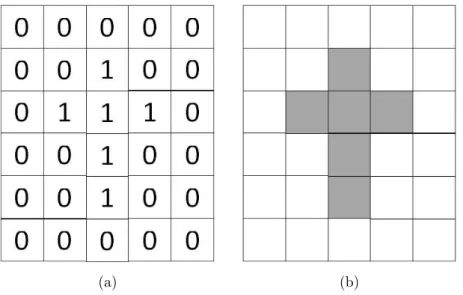
The polyomino Pi is represented in matrix of 0 and 1 in processing (Figure 3.2), and we compress the matrix into a binary array in storing to shrink the size. We maintain the sets Si−1 and Si in two hash tables of size O(maxi{i|Si|+ (i−1)|Si−1|}). At the start of each loop, we access Si−1 from one hash table and store Si into another hash table, and make the hash table for Si−1 empty in the end of each loop. With the increasing of i, the size of the hash tables can be incredibly huge that may cause memory overflow on a normal personal computer (e.g. i= 17 when the surface area is 30).
(a) (b)
Figure 3.2: Matrix and corresponding development.
3.1.2 Improving Performance by Parallel Computing
When the surface areai is not too large, we can get theSi fromSi−1 by the breadth-first search of adding a square to thePi−1.
This simple idea works up to 22 for two boxes of size 1×1×5 and 1×2×3 in [6] since the maximum number of |Si∪Si−1| takes 1.01×10⁷ when i= 18. It ran in 10 hours in 2011 and 5 hours in 2014 in our experiments on a usual PC. However, for the surface area 30, it does not work even on a parallel computer (CRAY XC30) due to memory overflow when i= 22.
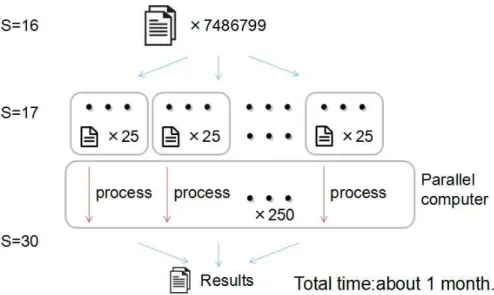
Thus, we divide the computation to two phases. In the first phase, we compute Si for each i= 2, . . . ,16. As a result, we have S16 that consists of 7486799 common partial developments of two boxes of size 1×1×7 and 1×3×3.
In the second phase, we divide S16 into 75 disjoint subsets S16j with 1 ≤ j ≤ 75.
For each S16j , we divide it into many small groups of common partial developments. For example, if each small group contains 25 common partial developments. Then, a S16j contains 4000 small groups when 1 ≤j ≤74 (S1675 contains rest of them). In the parallel computer, we use 250 processes (each process on a core, in total it takes 250 cores) to process these small groups. Each process independently calculates a small group by the BFS algorithm at a time. On average, it takes about 40 minutes for a process to calculate a small group of 25 common partial developments fromi= 17 toi= 30. In the final step, we merge S30j with 1≤j ≤75, remove duplicates, and obtainS30.
Figure 3.3: The detail of parallel computing.
The program runs, in total, in about 1 month on the parallel computer (CRAY XC30), and we obtain 1080 common developments inS30of two boxes of size 1×1×7 and 1×3×3.
It is worthwhile to note that the total calculation time depends on the amount of requests to the parallel computer. If there is another request with a higher priority, we may have to wait for some time. We give the detail of the results in Section 3.2.1. If we conduct the same calculation on a normal notebook computer with a single process, it may takes a much longer time.
3.1.3 Enumerating all Common Developments of Three Boxes of Size 1 × 1 × 7, 1 × 3 × 3, and √
5 × √
5 × √ 5
We check each of the common developments of two boxes of size 1×1×7 and 1×3×3, with the Procedure CheckCover. If it can fold to the cube of size√
5×√ 5×√
5, then it can fold to three boxes of size 1×1×7, 1×3×3, and √
5×√ 5×√
5.
Let S30 be the set of all common developments of two boxes of size 1×1×7 and 1×3×3, and B3 be the adjacency list of the cube of size √
5×√ 5×√
5. As shown in Algorithm 2, the algorithm checks all common developments P30 in S30. If P30 can fold to the third box, the cube of size √
5×√ 5×√
5, then algorithm stores P30 intoS30′ . At last, all elements inS30 are checked and the algorithm outputsS30′ , which is the set of all common developments of three boxes of size 1×1×7, 1×3×3, and √
5×√ 5×√
5.
Algorithm 2: Outline of the algorithm for checking the third box.
Input : The common developments of two boxes,S30, the adjacency list of the cube, B3;
Output: All common developments of three boxes S30′ ;
1 foreach common development P30 in S30 do
2 if CheckCover(P30, B3, 30)==1 then
3 store Pi into S30′ ; // P30 is a common development of three boxes
4 return S30′ ;
The program runs less than 1 minute on a laptop computer, and we obtain 9 common developments in S30′ of three boxes of size 1×1×7, 1×3×3, and √
5×√ 5×√
5. We give the detail of the result in Section 3.2.2.
3.1.4 Checking the Box
In this section, we give the details of Procedure CheckCover.
The previous study mainly focuses on the “normal” orthogonal polyhedra. That is, the crease lines are orthogonal to the edges of unit squares.
Figure 3.4: The graph induced by the cube.
However, the development of the cube of size √ 5×√
5×√
5 cannot fold along the edges
of unit squares, which means the previous method of checking the development can fit the box or not is no more available. We have two algorithms for the approach of checking the cube of size √
5×√ 5×√
5. The first algorithm checks for each P the vertices of the cube on the development boundary. The angle between the folding line and an edge of a unit square is 26.6 degrees. Besides, the vertex of the cube is made of three squares, which means every vertex unfolded on the development should be surrounded by 3 squares.
Therefore, we need to check whether there is a development that fits such requirements:
all vertices of the cube are on the boundary of development, constituting a grid of size√ 5 of 26.6 degrees to the unit square’s edge, the number of the squares around each vertex should be exactly 3.
The second algorithm checks the positional relationships of each unit square on the development. Consider any polyhedron, e.g., a box, if it can be unfolded to a development that is made of unit squares, we can get an adjacency graph of unit squares on the box as shown in Figure 3.4. At this point, for any development, if its unit squares have the same positional relationships as the adjacency list, it can fold to the box. Besides, the first algorithm does not consider the dislocation of the center square, which can make a hole and an overlap on the cube (Figure 3.5). Therefore, we apply the second algorithm to handle it.
Figure 3.5: A hole and an overlap occur when we fold along the dotted lines to make a cube while the number of the squares around each vertex is 3.
Procedure CheckCover can check if a polyomino Pi can fold to (a part of) the box or not. For example, the box is the cube of size√
5×√ 5×√
5 (Figure 3.6), the adjacency list
Procedure CheckCover(Pi, B, s) Input : Polyomino Pi in Si;
adjacency list B of the given box;
integer of the surface area of the given boxess;
Output: WhetherPi can fold to the box B or not;
1 for i= 1 to s do
2 mark the leftmost of the topmost square with number i as the start point;
3 foreach marked square in Pi do
4 mark its unmarked adjacent squares as the adjacency matrix of the box
5 if every square of Pi is marked by a unique number then
6 return 1; // Pi can fold to the cube
7 else if any square of Pi is marked by 2 or more numbers then
8 break; // Pi has an overlap to fold to the cube
9 else if 2 or more squares of Pi are marked by the same number then
10 break; // Pi has an overlap to fold to the cube
of the cube is shown as Table 3.1. The detail of the algorithm consists of 4 steps shown as below.
Step 1: With the adjacency list of the box, the algorithm marks one unit square on the partial development as astart point (basically, the leftmost of the topmost square for it is always the first to be visited in traversal).
Step 2: According to the Table 3.1, the algorithm marks the “start point” with a number.
By default, the procedure runs in s loops to try all possible numbers of the start point. It works for ordinary boxes like 1×1×7 and 1×3×3. However, the cube of size
√5×√ 5×√
5 can take less trials with some special tricks (Section 3.1.4).
Step 3: Assume the partial development can fold to the part of the target box as the start point is numbered. Then starting from the marked start point, the algorithm marks the neighbor-squares of the start point with the corresponding neighbor numbers on the adjacency list (Figure 3.7). If there is no neighbor of the start point in a certain direction, then skip it.
Figure 3.6: An unfolding of the cube of size √ 5×√
5×√ 5.
Figure 3.7: Neighbor-squares of start point marked in step 3.
Table 3.1: The adjacency list of the cube of size √ 5×√
5×√ 5.
Square ID UP RIGHT DOWN LEFT
01 02 03 04 05
02 10 09 01 23
03 09 12 15 01
04 01 15 18 17
05 23 01 17 24
06 07 08 09 10
07 30 29 06 22
08 29 13 12 06
09 06 12 03 02
10 22 06 02 23
11 12 13 14 15
12 09 08 11 03
13 08 29 28 11
14 11 28 19 18
15 03 11 18 04
16 17 18 19 20
17 05 04 16 24
18 04 15 14 16
19 16 14 28 27
20 24 16 27 25
21 22 23 24 25
22 07 10 21 30
23 10 02 05 21
24 21 05 17 20
25 30 21 20 27
26 27 28 29 30
27 20 19 26 25
28 19 14 13 26
29 26 13 08 07
Repeat this step, the algorithm extends the marking to further neighbor-squares of the marked ones (Figure 3.8) until every square is uniquely marked.
Figure 3.8: Further neighbor-squares of start point marked in step 3.
Step 4: If any two squares are marked with the same number, or one square is marked by two different numbers by two or more its neighbors, then it means an overlap occurs andP should be discarded. After the overlap checking, we have two conditions to examine P; (1) all squares in connected P are marked with their unique numbers, which means P can wrap the cube of size √
5×√ 5×√
5 with consistency, and (2) P has the same area of the cube. If P only satisfies the first condition, then P is a partial development.
Otherwise, if P satisfies these two conditions, it is a common development (Figure 3.9).
Figure 3.9: Every square is marked in step 4.
After checking all 5 possible start points on P, the algorithm repeats checking on the reflection ofP since there are two ways of folding to the cube of size√
5×√ 5×√
5. These two folding ways mirror each other as shown in Figure 3.10. It is necessary to check the reflection of P.
3.1.5 Some Tricks for the Cube of Size √ 5 × √
5 × √ 5
The cube Q of size √ 5×√
5×√
5 is made up of six same square faces. Thus, 30 unit squares of P are partitioned into six same groups, which is a group of a surface. Each of these groups contains 2 small groups. One consists of only one unit square, which is the center square of one face of Q. The other small group consists of 4 unit squares, located on the corner. In Figure 3.6, squares 1 to 5 are on the same surface, and the square 1 is the center square.
Once we fix the way of folding of a unit square, we can determine the square grid defined by the folding line, which completely gives the folding lines to foldQ. For a fixed unit square s in P, carefully counting (Figure 3.10), there are 5 choices of the situation of s (another 5 choices for the reflection ofP). To make the algorithm runs faster, start point can be numbered as 1˜5.
1 7 10 6 8
9 2
5 1 3
4
Figure 3.10: There are 10 choices for letting a unit square s with respect to the square grid of size √
5.
3.2 Results of Enumerating Common Developments of Boxes
3.2.1 Common Developments of Two Boxes of Size 1 × 1 × 7 and 1 × 3 × 3 of Surface Area 30
The program is compiled in C language to find the common developments of two boxes of size 1×1×7 and 1×3×3 of surface area 30 (Figure 3.11). Since a normal PC cannot with- stand large amounts of data generated, the running environment is the parallel computer Cray XC30.
Figure 3.11: Boxes of size 1×1×7 and 1×3×3 of surface area 30.
Experimental results are shown in Table 3.2 and Table 3.3, and the charts in Fig- ure 3.12 and Figure 3.14 for more intuitive expressions. The charts show the number of partial developments changes with the increasing of the surface area.
Processing first 16 steps takes 3 hours, generating 7.5 millions of the partial common developments as intermediate results. Processing every single development from step 17 to step 30 takes 40 minutes. Processing all 7.5 millions of developments by the parallel computer takes about 1 month.
The number of developments of surface area s=1 to s=16 is the same as the previous study. After the step 17, the process starts from each single partial development of the surface area 17. We can find the number of partial developments starts increasing rapidly froms=9, reaches its maximum at s=24, then decreases rapidly.
The final result is 1080 that is the number of common developments which can fold to
two boxes of size 1×1×7 and 1×3×3 of surface area 30. Some examples of the common developments are shown in Figure 3.13.
Table 3.2: The number of partial developments of surface area from 1 to 16.
Set of partial developments Number of developments
S1 1
S2 1
S3 2
S4 5
S5 12
S6 35
S7 108
S8 368
S9 1283
S10 4601
S11 16405
S12 57879
S13 200209
S14 682639
S15 2288392
S16 7486799
3.2.2 Common Developments of Three Boxes of Size 1 × 1 × 7, 1 × 3 × 3, and √
5 × √ 5 × √
5 of Surface Area 30
The program is written in C language to find the common developments of three boxes of size 1×1×7, 1×3×3, and √
5×√ 5×√
5 of surface area 30 (Figure 3.15). The running environment is ASUS A43S laptop.
Our new algorithm based on the adjacency list checked whether each of 1080 common developments of two boxes of size 1×1×7 and 1×3×3 of surface area 30 can fold to the
Figure 3.12: The number of partial developments of surface area from 1 to 16.
Table 3.3: The number of partial developments of surface area from 17 to 30 (from a randomly picked development of surface area 16).
Set of partial developments Number of developments
S17 22
S18 230
S19 1430
S20 5834
S21 16589
S22 33997
S23 50497
S24 53420
S25 38989
S26 18605
S27 5249
S28 714
S29 28
S30 1
Figure 3.13: Some common developments of two boxes of size 1×1×7 and 1×3×3.
Figure 3.14: The number of partial developments of surface area from 17 to 30 (from a randomly picked development of surface area 16).
Figure 3.15: Boxes of size 1×1×7, 1×3×3, and√ 5×√
5×√
5 of surface area 30.
cube of size√ 5×√
5×√
5. As a result, nine out of 1080 developments can fold to the cube (Figure 3.16). While eight developments have only one way of folding to the cube of size
√5×√ 5×√
5, the other development has two different ways of folding to the cube of size
√5×√ 5×√
5, for there is an angle of 26.6 degrees to the unit square’s edge clockwise and anti-clockwise. That is, the last development can actually fold to 3 boxes of size 1×1×7, 1×3×3, and √
5×√ 5×√
5 in two different ways as shown in Figure 3.17.
(1) (2) (3)
(4) (5) (6)
(7) (8) (9)
Figure 3.16: Developments having three or four ways of folding to three different boxes of surface area 30.
Figure 3.17: The development having four ways of folding: (a)1×1×7 (b) 1×3×3 (c)
√5×√ 5×√
5 (d) √ 5×√
5×√ 5.
![Figure 1.3: The common development shown in [14]. (a) It folds to a box of size 1 × 2 × 4, and (b) it also folds to a box of size √](https://thumb-ap.123doks.com/thumbv2/123deta/6141936.1080717/17.892.358.542.414.726/figure-common-development-shown-folds-size-folds-size.webp)