Japan Advanced Institute of Science and Technology
JAIST Repository
https://dspace.jaist.ac.jp/
Title 参照解析と法令質問応答への適用
Author(s) Tran, Thi Oanh Citation
Issue Date 2014‑03
Type Thesis or Dissertation Text version ETD
URL http://hdl.handle.net/10119/12109 Rights
Description Supervisor:島津 明, 情報科学研究科, 博士
Reference Resolution and Its Application to Legal Question Answering
by
Tran Thi Oanh
submitted to
Japan Advanced Institute of Science and Technology in partial fulfillment of the requirements
for the degree of Doctor of Philosophy
Supervisor: Professor Akira Shimazu
School of Information Science
Japan Advanced Institute of Science and Technology
March, 2014
Abstract
Natural languages are highly related by references within them. These references bring precious information: the sentences of a discourse could not be interpreted without know- ing who or what entity is being talked about. Resolving resolution, therefore, is a very important task in natural language processing research. Of all reference phenomena, the coreference is the most popular phenomenon, and is attracting much research in reference resolution. In this dissertation, we will concentrate on this challenging task -coreference resolution in general texts. Moreover, we will also focus on resolving references in a spe- cific type of texts, i.e. legal texts. The information on reference resolution not only helps people in understanding texts, but also supports other tasks such as question answering, text summarization, and machine translation. To illustrate one of these benefits, in this thesis, we will also investigatean application of reference resolution to the task of question answering restricted to the legal domain.
Most previous research proposed a pairwise approach to solve the task of coreference resolution. The drawback of this approach is that it can allow only one or two antecedent candidates to be considered simultaneously. So, it only determines how good a candidate is relative to the mention, but not how good a candidate is relative to all candidates.
Our goal is to investigate another approach which can address this drawback. While coreference resolution in general texts attracts much attention among researchers, the task in legal texts has received very little attention so far. The main reasons are mostly the complex and long legal structures and sentences, specific terms, and especially the lack of language resources (i.e. annotated corpora) in this specific domain. Focusing on this interesting legal domain, this dissertation also aims at building a system which can automatically extract referents for references in real time. This is a new interesting task in the Legal Engineering research. Moreover, the goal of this dissertation also includes building an application of these reference resolvers to a useful question answering system restricted to the legal domain. Particularly, the following three problems are targeted in this research:
• To realize coreference resolution in general texts, we present an empirical study on a listwise, which can address the drawback of the previous approach. This approach exploits a listwise learning-to-rank method which considers all antecedent candidates simultaneously, not only in the resolution phase but also in the training phase.
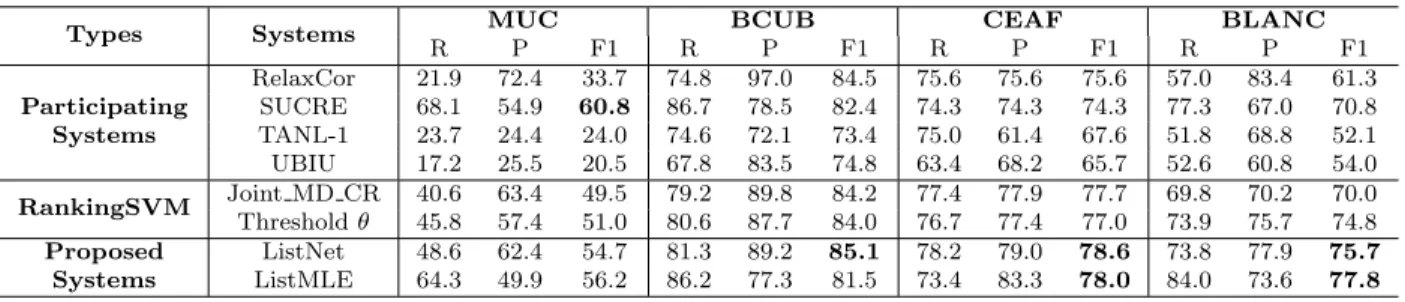
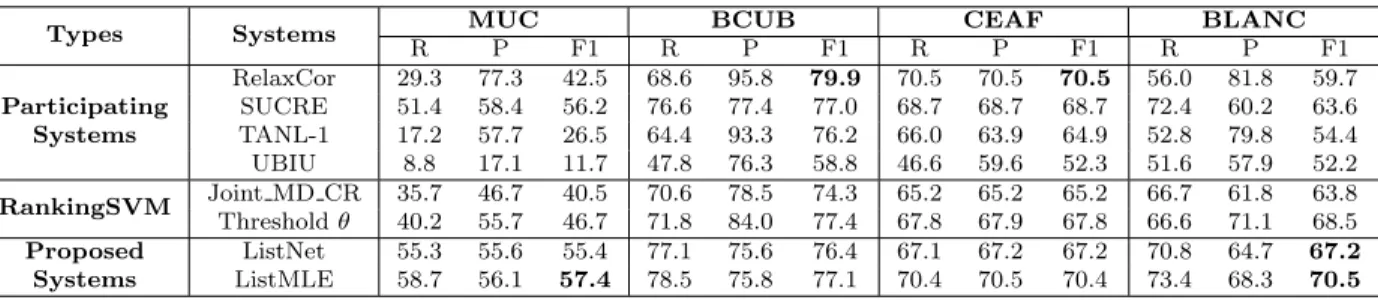
Experimental results on the corpora of SemEval-2010 shared task 1 show that the proposed system yields a good performance in multiple languages when compared to previous participating systems as well as a baseline pairwise system using the ranking support vector machine as the learning algorithm. In comparison to the best participating system SUCRE, which uses the Decision Tree algorithm with best-first clustering strategy, the proposed system achieves comparative performance.
• For the task of reference resolution in legal texts, different from previous work that only considered the referent at the document targets, this work focuses on resolv- ing references to the sub-document targets. Referents extracted are the smallest
fragments of texts in documents, rather than the entire documents that contain the referenced texts. Based on the structures of references in legal texts, we propose a four-step framework to accomplish the task: mention detection, contextual infor- mation extraction, antecedent candidate generation, and antecedent determination.
We also show how machine learning methods can be exploited in each step. The final system achieves 80.06% in the F1 score for detecting references, 85.61% accu- racy for resolving them, and 67.02% in the F1 score on the end-to-end setting task on the Japanese National Pension Law corpus.
• This dissertation also presents a study aimed at exploiting reference information to build a question answering system restricted to the legal domain. Most previous research focuses on answering legal questions whose answers can be found in one document1 without using reference information. However, there exist many legal questions, which require answers extracted from connections of more than one doc- ument. The connections between documents are represented by explicit or implicit references. To the best of our knowledge, this type of questions is not adequately considered in previous works. To cope with them, we propose a novel approach which allows to exploit the reference information between legal documents to find answers to these legal questions. This approach also uses the requisite-effectuation structures of legal sentences and some effective similarity measures based on legal terms to support finding correct answers without training data.
The contribution of this dissertation includes linguistic and computational aspects.
Considering the linguistic viewpoint, our research helps in interpreting the sentences of any discourse. In the computational viewpoint, our research proposes effective solutions for linguistic problems using machine learning approaches.
Keywords: reference resolution, coreference resolution, legal texts, question answer- ing, pairwise approach, listwise approach, learning-to-rank, logical structure, requisite- effectuation structures, mention detection, JNPL corpus.
1The term ‘documents’ corresponds to articles, paragraphs, items, or sub-items according to the naming rules used in the legal domain.
Acknowledgments
First of all, I would like to express my special thanks to my great supervisor, Professor Akira Shimazu of the Natural Language Processing laboratory, at the School of Informa- tion Science, of JAIST, for the patient guidance, encouragement and advice which he has offered me throughout my study time. He always gave me more enthusiasm and pushed me to do better in my research topic. He transmitted to me much invaluable knowledge in not only the way to formulate a research idea, to write a good paper, etc. but also the vision and much useful experience in academic life. I feel really lucky and so proud to be one of his students.
I would also like to express my special thanks to Associate Professor Kiyoaki Shirai for his useful and valuable discussions and comments during my study period.
I also would like to express my gratitude to Associate Professor Nguyen Le Minh for many helpful discussions with him on conducting the research. He has given me many valuable comments, experience and constant support in my study since my early days at JAIST.
My sincere thanks also go to Professor Ho Tu Bao for his support and encouragement during my life at JAIST and my research, especially for my sub-theme study.
I would like to thank committee members, consisting of Professor Takenobu Tokunaga at the Tokyo Institute of Technology, Professor Satoshi Tojo, Professor Ho Tu Bao, and Associate Professor Kiyoaki Shirai at JAIST, who have been supportive beyond the call of duty. They have reviewed my dissertation and provided valuable insight. My dissertation is improved very much through valuable comments.
I would like to express my appreciation to my former supervisor, Associate Professor Ha Quang Thuy, and my former co-supervisor, Associate Professor Le Anh Cuong, for their guidance to my master’s thesis and my bachelor thesis. Professor Ha Quang Thuy is also a leader of a scientific research group at the University of Engineering and Technology, the Vietnam National University in Hanoi, where I accquired much knowledge through weekly seminars.
I would like to thank the English Language Education for Science, Technology and Engineering (CELESTE) for their help in proofreading and correcting errors in my papers.
I have learned a lot from them.
I sincerely thank all my friends and colleagues who always supported me in times of need. I greatly appreciate all members of the Shimazu and Shirai laboratory for their help and contributions in building a wonderful and supportive academic environment. I also would like to thank many Vietnamese friends at JAIST for the good times we spent together over four years.
I also deeply acknowledge the Monbukagakusho for financial support during my PhD course at JAIST through a scholarship funded in the form of the Japanese Ministry of Education, Culture, Sports, Science, and Technology. I also would like to thank the Grant-in-Aid for Scientific Research, Education and the Research Center for Trustwor- thy e-Society, JAIST Research Grants, and the JAIST Overseas Training Program for
3D Program Students in supporting me to do the research and attending international conferences for presenting my work. I also would like to thank all JAIST staff for its kind support in many official procedures.
Last, but not least, I would like to express my gratitude to my sweet family, which is really my biggest motivation. They always give me encouragements, care, love, and support in my daily life. They are endless sources of inspiration for me to move forwards, so this thesis is dedicated to them.
Contents
Abstract i
Acknowledgments iii
1 Introduction 1
1.1 Background . . . 1
1.2 Focus of Research . . . 4
1.3 Thesis Outline . . . 5
2 Background: Backgrounds on Statistical Machine Learning Models Ap- plied in NLP 7 2.1 Sequence Labelling . . . 7
2.2 Some Robust Classifiers . . . 8
2.2.1 Maximum Entropy Models . . . 9
2.2.2 Support Vector Machines . . . 10
2.3 Learning-to-Rank Methods . . . 12
2.3.1 Introduction to Learning-to-Rank . . . 12
2.3.2 Major approaches in Learning-to-Rank . . . 13
2.3.3 Algorithms for Learning-to-Rank . . . 14
3 An Empirical Study on a Listwise Approach to Coreference Resolution using Learning-to-rank 18 3.1 Introduction . . . 18
3.2 Previous models for the coreference resolution task . . . 20
3.2.1 Mention-pair models . . . 21
3.2.2 Entity-mention models . . . 21
3.2.3 Mention-ranking models and cluster-ranking models . . . 22
3.3 A listwise approach to coreference resolution using learning-to-rank . . . . 22
3.3.1 Coreference resolution as a learning-to-rank problem . . . 22
3.3.2 Formulating coreference resolution as a Learning-to-rank problem . 23 3.3.3 Comparing this listwise learning-to-rank model to previous models . 26 3.4 Experiments and Results . . . 27
3.4.1 SemEval 2010 shared task on coreference resolution in multiple lan- guages . . . 27
3.4.2 Participating systems . . . 28
3.4.3 Evaluation metrics . . . 29
3.4.4 Feature sets . . . 30 3.4.5 Comparing the listwise approach with previous participating systems 31
3.4.6 Comparing the effect of joining discourse-new detection to corefer-
ence resolution . . . 34
3.4.7 Comparing the proposed models with a pairwise learning-to-rank baseline model . . . 35
3.4.8 Comparing two methods of getting training instances . . . 35
3.4.9 Some more results . . . 36
3.4.10 Discussion . . . 37
3.5 Conclusion . . . 39
4 Automated Reference Resolution in Legal Texts 40 4.1 Introduction . . . 40
4.2 Related work . . . 43
4.2.1 Studies on resolving a fragment of texts to documents or sub-document targets . . . 43
4.2.2 Studies on reference and anaphora resolution in general texts . . . . 44
4.2.3 Studies on reference resolution within the legal domain . . . 44
4.3 Characteristics of references in legal texts . . . 45
4.4 A four-step framework to reference resolution in legal texts . . . 47
4.5 Solutions to each step of the framework . . . 48
4.5.1 Mention detection and mention splitting . . . 48
4.5.2 Mention classification . . . 50
4.5.3 Position recognition . . . 51
4.5.4 Antecedent candidate generation . . . 52
4.5.5 Antecedent determination . . . 55
4.6 Experiments . . . 56
4.6.1 Corpus . . . 56
4.6.2 Experimental setup . . . 57
4.6.3 Experimental results . . . 58
4.6.4 Analyzing the impact of each step on the final system . . . 61
4.6.5 Improving the performance of the final system . . . 62
4.6.6 A true working example of using the final system . . . 65
4.7 Error analysis . . . 65
4.8 Discussion . . . 66
4.8.1 Comparison with previous work . . . 67
4.8.2 The versioning problem of laws . . . 67
4.9 Conclusion and future work . . . 67
5 Answering Legal Questions by Mining Reference Information 69 5.1 Introduction . . . 69
5.2 Related Work . . . 71
5.2.1 Question Answering using coreference information in general texts . 71 5.2.2 Question Answering using coreference information in legal texts . . 72
5.3 A Type of Legal Questions Raised from Characteristics of Legal Texts . . . 73
5.3.1 The Characteristics of Legal Texts . . . 73
5.3.2 A type of questions raised from the characteristics of legal texts . . 74
5.4 A Proposed Framework for a Legal Question Answering System . . . 75
5.4.1 Question Processing . . . 76
5.4.2 Article Retrieval . . . 77
5.4.3 Passage Pairing . . . 78
5.4.4 Paired-Passages Ranking . . . 78
5.4.5 Answer Extraction . . . 79
5.5 Experimental Results of the QA system . . . 80
5.5.1 Experimental Setups . . . 80
5.5.2 Experimental results using the traditional QA system and the pro- posed system . . . 81
5.6 Conclusion and Future Work . . . 84
6 Conclusion and Future Work 86 6.1 Conclusion . . . 86
6.2 Future Work . . . 87
A Questions and Answers List 89
References 94
Publications 104
List of Figures
1.1 Reference operations and relationships with respect to the discourse model. 1 1.2 An example of reference phenomena in legal texts. In this figure, references
are bounded by red angle brackets (hi) while their referents are bounded
by green square brackets ([ ]). . . 2
1.3 An overall framework of the thesis. . . 4
2.1 Graphical structure of a chain-structured CRFs for sequences. . . 8
2.2 Small margin and large margin. . . 11
2.3 Calculation of the margin in SVMs framework. . . 11
2.4 Learning-to-rank framework (cited from Liu [59]). . . 13
3.1 A motivating example of coreference resolution using a listwise approach. . 19
3.2 An example of a permutation probability distribution over three candidates named A, B, and C. . . 25
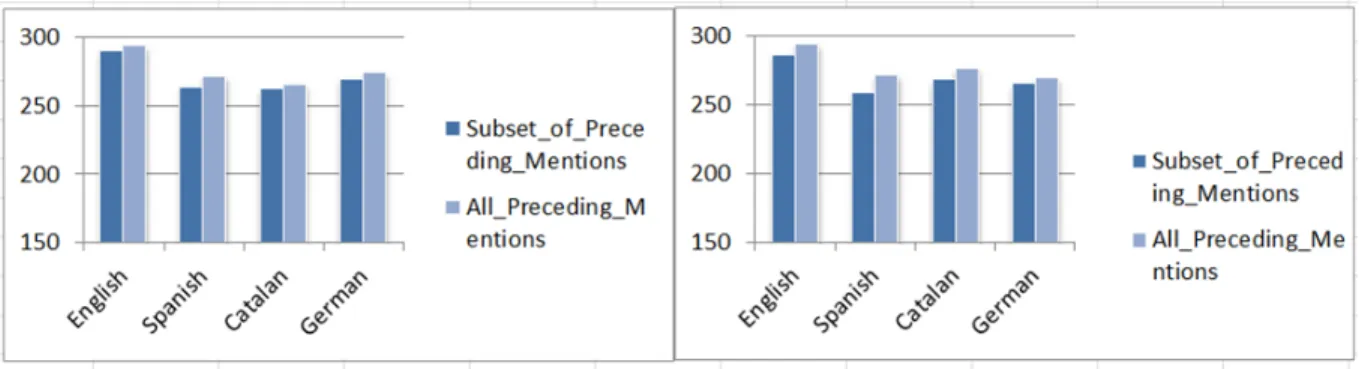
3.3 Sum of four metrics on listwise learning-to-rank methods (On the left: ListNet; On the right: ListMLE). . . 36
3.4 P-R curves on four evaluation metrics of four languages. . . 37
3.5 This example shows that our method correctly determined the antecedent for the mentionthe town. While the baseline pairwise method cannot find this antecedent and therefore determined this mention is non-anaphoric. . . 38
3.6 This case shows two examples in which the listwise method correctly deter- mines the antecedent for each mention while the baseline pairwise method could not. . . 38
4.1 Examples of reference phenomena in legal texts (In this figure, references are bounded in red angle brackets (hi) while their referents are bounded in green square brackets ([ ]).). Expressions start after a colon (:) or a semicolon (;) in the bounded texts are the identification expressions (ID) of these texts (i.e. A12P1-1). A reference and its referent have the same ID 41 4.2 The structure of mentions in legal texts. . . 46
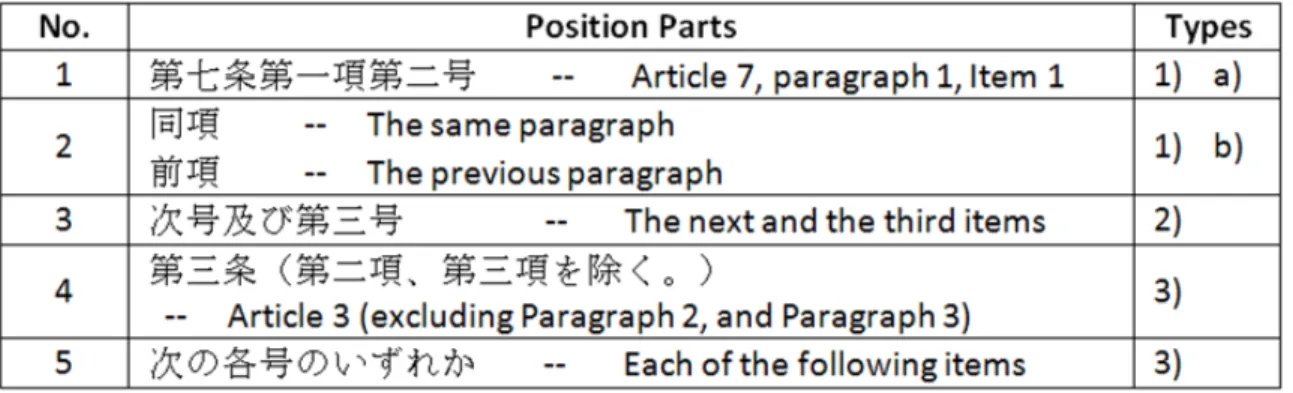
4.3 Some examples of different types of position parts of mentions in legal texts. 47 4.4 A four-step framework for resolving references in legal texts. . . 47
4.5 Mention Detection: A law sentence in the IOB, IOE and FIL notations. . . 49
4.6 Mention Splitting: A law mention in the IOB notation. . . 50
4.7 Some examples of mentions of two classes. . . 50
4.8 Some examples of the output of the position recognition step. . . 51
4.9 An example of generating candidates using strategy 1(a)(nhead = 17). . . . 52
4.10 An example of parsing the sentence in the document of Article 12, Para- graph 1. . . 53
4.11 Candidates generated by using the first strategy to generate candidates for
the reference ‘the notification in the provision of para 1’. . . 54
4.12 The architecture of the JNPL corpus on reference resolution. . . 57
4.13 The accuracy of the ListNet method depends on the number of iterations (the learning rate is fixed at 0.01). . . 61
4.14 The accuracy of the ListMLE method depends on the tolerance rates (the learning rate is fixed at 0.01). . . 61
4.15 An example of Brown word-cluster hierarchy. . . 63
4.16 Semi-supervised learning framework. . . 64
4.17 An output example of our system. . . 66
4.18 Some error examples of the mention detection step. . . 67
5.1 A question is solved in this chapter. In this figure, references are bounded in angle brackets (hi) while their referents are bounded in square brackets ([ ]).). . . 70
5.2 An example of law sentences and their logical parts (A: Antecedent part; C: Consequent part; T: Topic part). . . 74
5.3 A framework to extract answers for a type of legal questions. . . 75
5.4 A true example of the proposed system. . . 76
5.5 An example of the question processing step (A: Antecedent part; C: con- sequent part; T: Topic part). . . 77
5.6 An example of the answer extraction step (A: Antecedent part; C: conse- quent part; T: Topic part). . . 80
5.7 The framework of the traditional QA system. . . 81
5.8 Some typical examples of the systems. . . 84
A.1 This is a list of questions with their gold answers and the proposed system’s answers. . . 89
List of Tables
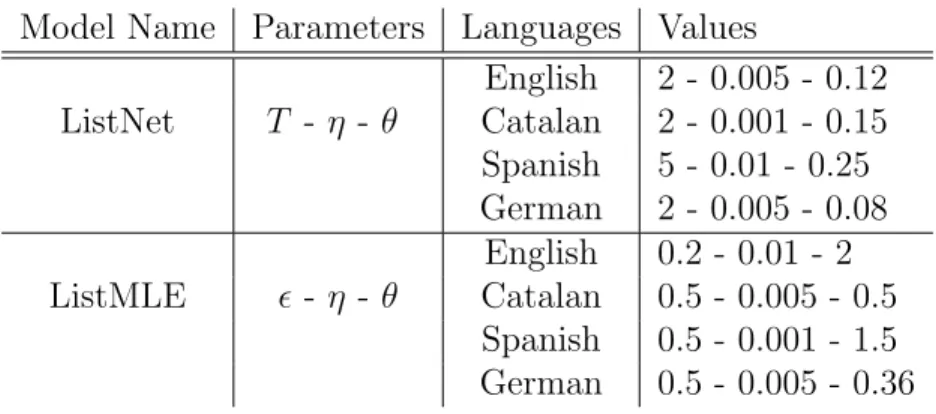
3.1 The main characteristics of all approaches. . . 26 3.2 Parameter sets of ListNet and ListMLE algorithms . . . 27 3.3 The feature sets used for all four languages). Non-relational features take
on a value of YES or NO. Relational features indicate whether they are COMPATIBLE, INCOMPATIBLE orNOT APPLICABLE. . . 31 3.4 Experimental results of the proposed models on English (P: precision; R:
recall; F1: F-score) . . . 32 3.5 Experimental results of the proposed models on Catalan (P: precision; R:
recall; F1: F-score) . . . 33 3.6 Experimental results of the proposed models on Spanish (P: precision; R:
recall; F1: F-score). . . 33 3.7 Experimental results of the proposed models on German (P: precision; R:
recall; F1: F-score). . . 34 3.8 Model names and their properties. . . 35 4.1 Feature sets extracted for the training instance i(mi, cj) (positionhead: the
position of the mention head in the antecedent sentence;nmeeting: the meet- ing node where the concatenation of all of its descendants covers the can- didatecj). . . 56 4.2 Experimental results for the mention detection task (%). . . 58 4.3 Experimental results for the mention splitting sub-step (Accuracy (%)). . . 59 4.4 Experimental results of the mention classification task (Accuracy (%)). . . 59 4.5 Experimental results of the antecedent determination step. . . 60 4.6 Experimental results of the antecedent determination step using two ap-
proaches: the pairwise and the listwise. . . 60 4.7 Experimental results of the effect of each step on the final system (MD, MS,
MC, and PR stand for the Mention Detection, Mention Splitting, Mention Classification and Position Recognition steps respectively). . . 62 4.8 Mention Detection: Experimental results when integrating extra word fea-
tures using Brown Clustering information (- means that we did not use extra word features, + means that we used extra word features). . . 64 4.9 Mention Classification: Experimental results when integrating extra word
features using Brown Clustering information. . . 65 5.1 Experimental results of two QA systems using the traditional method and
the proposed method on 51 legal questions. . . 82 5.2 Accuracy of the QA system using two methods on 51 questions. . . 83
Chapter 1 Introduction
1.1 Background
Reference resolution is a task which consists of determining which entities are referred to by which linguistic expressions. Of all reference phenomena, the coreference phenomenon is the most popular one and is attracting much research on reference resolution. When a referent is first mentioned in a discourse, we say that a representation for it is evoked into the model. Upon a subsequent mention, this representation is accessed from the model.
Figure 1.1 illustrates the operations and the relationships between them.
Figure 1.1: Reference operations and relationships with respect to the discourse model.
Coreference resolution has been a core research topic in NLP. In order to derive the correct interpretation of texts, or even to estimate the relative importance of various mentioned subjects, pronouns and other referring expressions need to be connected to the right individuals. In an example sentence ‘Lan told me that she would come to the party’,
‘she’ and ‘Lan’ are most likely referring to the same person, in which case they are coref- erent. This type of reference is very typical in the sense that we usually first introduce a person, a location, or a discussion topic by using a relatively long or detailed descrip- tion, such as a definite description. However, later mentions are briefer, and frequently ambiguous. In the above example, the mention ‘she’ may refer to another person rather than ‘Lan’ depending on a given context. The resolution of these references, therefore, is very important to the correct understanding of texts. Besides, it also has important appli- cations in areas such as question answering [38, 70], machine translation [87], automatic summarization [4, 121] and named entity extraction [40].
Coreference resolution has a long research history. Algorithms for the problem of pro- noun resolution have been developed since the seventies, such as the Hobbs algorithm [42] and the Centering algorithm [14]. They were primarily based on linguistics informa- tion. While the early methods incorporated a lot of domain and linguistic knowledge, the newer methods have shown an inclination towards applications of machine learning- based approaches since the mid-to-late 90s. For example, a method uses simple statistic naive bayes-based model [34], methods using decision trees [104] and conditional ran- dom fields [66]. Generally speaking, learning-based coreference resolution approaches can be classified into three important classes, namely, the mention-pair model [77, 91], the entity-mention model [62, 126], and ranking models [25, 74]. In the first two classes, each antecedent candidate is resolved independently from the other candidates. So the models could not determine the best candidate in the relation with the other candidates.
To address this drawback, ranking models were proved to be useful solutions [25, 74].
However, this weakness is not fully solved to the extent that these models cannot exam- ine all antecedent candidates at the same time. By default, it is strongly assumed that candidates or pairs of candidates are generated independently and identically distributed, and the trained models will be biased towards mentions with more candidates. Another problem is that the objective of learning is formalized as minimizing classification errors of candidates or pairs of candidates, rather than minimizing ranking errors of candidates globally.
Figure 1.2: An example of reference phenomena in legal texts. In this figure, references are bounded by red angle brackets (hi) while their referents are bounded by green square brackets ([ ]).
The reference phenomenon is not only popular in general texts but also in legal texts.
At the discourse level, legal texts contain many reference phenomena. These references usually bring precious information. The law will be difficult to comprehend if we cannot read the referenced items within it. Resolving the reference phenomena, therefore, is
an important task in the Legal Engineering[50, 51] research. However, in comparison to general domains, little research has concentrated on reference resolution in legal texts.
The main reasons are the complex and long legal sentences, specific terms, etc.
Figure 1.2 shows excerpts from two documents1 named A12P1, and A12P4. These excerpts contains one reference (the red texts bounded by red angle brackets), i.e. ‘the notification in the provision of para 1’ in the document A12P4. To comprehend the content of the document A12P4, it is important to know the referenced items. In other words, we need to know to which part of texts (the green texts bounded by green square brackets) this reference refers. This kind of references is very popular in legal documents because lawmakers usually import pieces of available information which have already been introduced in other documents by using briefer expressions. This, as a result, helps to guarantee the soundness as well as the consistency in a law system. We name these briefer expressions ‘references’, and their referenced items ‘referents’.
Previous work in this field mostly focuses on detecting and resolving so-called norma- tive references to distinguish them from the above references. Normative references are slightly different from the above references. In the above examples, normative references would appear in the forms of ‘para 1’. In resolving these normative references, authors limit resolvers to identify only the referred documents but not to which parts of texts in these documents. With this output, users/lawmakers need to read over the referenced document to find which part of texts is actually referred to. This is somewhat redundant because that document may contain unnecessary information for the comprehension of the input sentence.
To avoid over-reading these unnecessary texts in the referenced document, in this thesis, we go a step further. Our reference resolver tries to extract the smallest fragments of texts that are actually referred to by references (the texts in green square brackets).
Resolving this type of references is more difficult because it requires syntactic and semantic understanding of references and their context information as well as of the referenced document that contains the referenced texts. In particular, in the example sentence in Figure 1.2, we extract the full phrase and resolve it to the smallest fragment of texts that describes the type of the notification in Paragraph 1, i.e. ‘notification of matters relating to the change of name, address, as well as matters relating to change of type and loss and acquisition of the qualification’.
Reference information has many benefits not only in supporting the understanding of texts, but also in the development of a better performance for many high-level tasks in NLP. Instead of studying applications of reference resolution in general texts, which have been implemented in much previous work, in this thesis, we investigate an application of reference resolution to a question answering (QA) system restricted to legal documents.
In the legal domain, QAs could be applied to help citizens and lawmakers more easily access legal information. Previous work [2, 28, 85, 111] showed that a common problem is that traditional QAs are not adequate to find the correct answers to legal questions.
Until now, however, there has been no research on QA using this advantage of references to help finding the correct answers. Much works dedicated to QAs in the legal domains [2, 28, 85, 111] has mostly focused on legal questions whose answers can be found in only one document. However, the fact is that there exist many legal questions requiring answers that combined from two documents which are linked based on references. This
1The term ‘documents’ corresponds to articles, paragraphs, items, or sub-items according to the naming rules used in the legal domain.
type of questions is not adequately considered in previous research.
1.2 Focus of Research
Figure 1.3 illustrates the overall framework of this thesis. In this research, we focus on solving the reference resolution task in general texts and also in a restricted domain - the legal domain. Moreover, our research also aims at analyzing the effects of applying reference resolution to a QA system in the legal domain. The main contributions of our thesis are listed as follows:
Figure 1.3: An overall framework of the thesis.
• Coreference resolution in general texts: In this research, we present an empir- ical study on a listwise approach to the CoRe task. This approach exploits a listwise learning-to-rank method which considers all antecedent candidates simultaneously, not only in the resolution phase but also in the training phase. In the training phase, a listwise algorithm is selected to train a co-reference resolution model which mini- mizes a listwise loss function and captures the ranking problems more naturally. In the resolution phase, the model assigns each candidate with a score that expresses the degree to which the candidate is co-referent with a given mention. Experimen- tal results on the corpora of SemEval-2010 shared task 1 (the task of Co-reference resolution in multiple languages) show that our proposed system yields a good per- formance in multiple languages when compared to previous participating systems as well as a baseline pairwise system using the ranking support vector machine as the learning algorithm.
• Reference resolution in legal texts: This thesis also investigates the task of reference resolution in the legal domain. The aim is to create a system which can automatically extract referents for references in real time. This is a new interesting task in Legal Engineering research. Based on the structures of references in legal
texts, we propose a four-step framework to accomplish the task. We also show how machine learning approaches can be exploited on each step rather than using previous rule-based approaches. The final system achieves 80.06% in the F1 score for detecting references, 85.61% accuracy for resolving them, and 67.02% in the F1 score on the end-to-end setting task on the Japanese National Pension Law corpus.
• Question Answering in legal texts: Finally, in this thesis, we investigate an application of reference resolution to a QA system restricted to legal documents.
We focus on one type of questions which can be of much benefit from the reference information. Based on the characteristics of the law sentences and the reference information between them, we propose a five-step framework to help extracting the answer to this type of question. Experimental results show that the proposed method is quite effective and outperforms a baseline, which does not utilize reference information.
1.3 Thesis Outline
This thesis consists of six chapters. The thesis is structured as follows:
Chapter 2 - In this chapter, we present some statistical machine learning methods used in this thesis. In the first section, we describe sequence labeling problems and then present a typical and effective algorithm to perform the task, i.e. Conditional Random Fields [54] (CRFs). Next, we introduce two strong classifiers to perform classification tasks, namely Maximum Entropy Models [97] (MEMs) and Support Vector Machines [21, 115] (SVMs). Finally, we describe in this thesis the task of learning-to-rank [57, 59]
applied in candidate rankings of several sub-tasks.
Chapter 3- This chapter presents an empirical study on a listwise approach to coref- erence resolution. This method allows us to consider all antecedent candidates simulta- neously not only in the training phase but also in the resolution phase. First, we review traditional models which were previously proposed for the coreference resolution task.
Then, we describe a listwise approach to this task. We begin this section by motivating the use of a ranker for coreference resolution. After that, we present the learning-to-rank task as well as two common and effective listwise approaches. We also show how to model this listwise approach for the coreference resolution task. Next, we describe experimental setups and the performance of the proposed listwise approach in comparison to previous approaches.
Chapter 4 - This chapter presents a study on resolving references in legal texts.
First, we review some related work. Then, we describe some characteristics of references in legal texts. Based on these characteristics, we propose a four-step framework to solve this task. We also present solutions for each step in the proposed framework. Finally, we describe experiments. In this section, we also analyze the impact of each step on the whole system and illustrate an output example of the final system. In addition, we propose a semi-supervised technique to improve the performance of the final system.
Chapter 5 - This chapter presents a study on exploiting reference information to build a QA system restricted to the legal domain. We focus on answering a type of questions whose answers cannot be extracted from merely one document. To the best of our knowledge, this type of questions is not adequately considered in previous research.
To cope with these, we propose a novel approach which allows exploiting the reference
information between legal documents to find answers to this type of legal questions. This approach also uses the requisite-effectuation structures of legal sentences and some effec- tive similarity measures based on legal terms to support finding correct answers without training data.
Chapter 6 - In this final chapter, we first summarize the three main tasks of our thesis including the main achievement and contributions, as well as remaining problems.
Next, we consider possible future research direction by mentioning open problems that would be interesting to address.
Chapter 2
Background: Backgrounds on
Statistical Machine Learning Models Applied in NLP
2.1 Sequence Labelling
The need to segment and label sequences arises in many different problems in several scientific fields, especially in natural language processing (NLP) (i.e. named entity recog- nition [31, 118], POS tagging [113, 124], text chunking [56], etc.). There are many models proposed to solve this problem such as Hidden Markov Model (HMM) [9, 93], maximum entropy Markov models (MEMMs) [11, 67, 112], etc. Among them, Conditional random fields (CRFs) [54, 107, 108] offer several advantages over HMMs and stochastic grammars for such tasks, including the ability to relax strong independence assumptions made in those models. CRFs also avoid a fundamental limitation of MEMMs and other discrimi- native Markov models based on directed graphical models, which can be biased towards states with few successor states. CRFs outperform both MEMMs and HMMs on a number of real-world sequence labeling tasks [54, 89, 103].
CRFs are a class of statistical modeling method often applied in pattern recognition and machine learning, where they are used for structured prediction. A CRF can take context into account, whereas an ordinary classifier predicts a label for a single sam- ple without regard to ‘neighboring’ samples. The linear chain CRF popular in natural language processing predicts sequences of labels for sequences of input samples.
Lafferty et al. [54] define a CRF on observation X and random variableY as follows:
Definition: Let G=hV, Ei be a graph such that Y = (Yv)v∈V, so that Y is indexed by the vertices of G. Then (X, Y) is a conditional random field in case, when conditioned on X, the random variables Yv obey the Markov property with respect to the graph:
p(Yv|X, Yw, w 6=v) = p(Yv|X, Yw, w ∼v), where w∼v means thatw and v are neighbors inG.
What this means is that a CRF is an undirected graphical model whose nodes can be divided into exactly two disjoint sets X and Y, the observed and output variables, respectively; the conditional distribution p(Y|X) is then modeled. Figure 2.1 illustrates the simplest and most common graph structure in which the nodes corresponding to elements of Y from a simple first-order chain. The probability of a label sequenceygiven an observation sequencex can be written as:
Figure 2.1: Graphical structure of a chain-structured CRFs for sequences.
p(y|x, λ) = 1
Z(x)exp(X
j
λjFj(y, x)) (2.1)
where Z(x) is a normalization factor, and Fj(y, x) =
n
X
i=1
fj(yi−1, yi, x, i)
where fj(yi−1, yi, x, i) is either a state function or a transition function.
Assuming the training data{(x(k), y(k))}are independenly and identically distributed, the product of (2.1) overall training sequences, as the function of the parameters λ, is known as the likelihood. Maximum likelihood training chooses parameter values such that the logarithm of the likelihood, known as the log-likelihood, is maximized. For a CRF, the log-likelihood is given by:
L(λ) =X
k
hlogZ(x1(k))+P
jλjFj(y(k), x(k))i .
This function is concave, guaranteeing convergence to the global maximum.
Differentiating the log-likelihood with respect to parameter λj gives:
∂L(λ)
∂λj =Ep(Y,X)˜ [Fj(Y, X)]−X
k
Ep(Y|xk,λ)
Fj(Y, x(k)) ,
where ˜p(Y, X) is the empirical distribution of training data and Ep[.] denotes expec- tation with respect to distribution p. Note that setting this derivative to zero yields the maximum entropy model constraint: The expectation of each feature with respect to the model distribution is equal to the expected value under the empirical distribution of the training data.
It is not possible to analytically determine the parameter values that maximize the log- likelihood setting the gradient to zero and solving forλdoes not always yield a closed form solution. Instead, maximum likelihood parameters must be identified using an iterative technique such as iterative scaling [24, 88] or gradient-based methods [103, 117].
2.2 Some Robust Classifiers
Many problems in NLP can be viewed as linguistic classification problems, in which linguistic contexts are used to predict linguistic classes. This section presents two robust
classifiers, i.e. Maximum Entropy Models (MEMs) and Support Vector Machines (SVMs), which are successfully used in many applications in NLP such as morphological analysis, text chunking, named entity recognition, etc.
2.2.1 Maximum Entropy Models
Maximum Entropy Models (MEM) [97] are a method of estimating the conditional prob- ability p(y|x) that a model outputs a label y given a contextx:
p(y|x) = 1
Z(x)exp(X
i
λifi(x, y))
where fi(x, y) refers to a feature function; λi is a parameter of the model; and Z(x) is a normalization factor. For example, in part-of-speech (POS) tagging problem, y is a POS tag and x is the context of a word (the word itself and its surrounding words) in a sentence. To capture statistic information, this method requires that the model accord with some constraints which have the form:
p(f) = ˜p(f).
In this formula, f is a feature function (or feature for short), which takes a pair (x, y) as input and outputs a real value. Usually, f is a binary-value indicator function. For example, in POS tagging task, a feature function can be expressed as follows:
f(x, y) =
(1 if y=N ounand the current word in x is book, 0 otherwise.
p(f) and ˜p(f) are the expected values of f with respect to the model p(y|x) and the empirical distribution ˜p(x, y), respectively. They are defined as follows:
p(f)≡X
x,y
p(x)p(y|x)f(x, y),˜
˜
p(f)≡X
x,y
˜
p(x, y)f(x, y),
where ˜p(x) is the empirical distribution of x in the training samples.
Suppose that we have n feature functions fi(i = 1,2, . . . , n) and want our model to accord with these statistics. Our model will belong to a subset Q of P (the set of all conditional probability distributions) defined by
Q≡ {p∈P|p(fi) = ˜p(fi), i= 1,2, . . . , n}.
The maximum entropy method chooses the modelp∗ ∈Qthat maximizes the entropy function H(p):
p∗ = argmaxp∈QH(p) where the entropy function H(p) is defined as follows:
H(p)≡ −X
x,y
p(x)p(y|x) log˜ p(y|x).
To solve the constrained optimization problem, we first convert the primal problem to a dual optimization problem using the method of Lagrange multipliers [11]. Then the solution of the dual optimization problem can be found by applying the improved iterative scaling method [11, 24] or LBFGS method [79].
Maximum entropy model has been applied successfully to many NLP task including POS tagging [97], statistical machine translation [11, 29], etc.
2.2.2 Support Vector Machines
Support Vector Machines (SVMs) [16, 17, 18, 21] is a statistical machine learning tech- nique proposed by Vapnik et al. It is not only well motivated in the theoretical aspect, but also yields good performance in the empirical aspect (including computer vision, handwriting recognition, pattern recognition, and statistical natural language process- ing). Let’s take the simplest case to study on how SVMs work. This is called 2-class classification: x ∈ Rn is some objects and y ∈ {−1,1} is a class label. SVMs choose a hyperplane separating samples in a classification task. In the field of natural language processing, SVMs have been applied to text categorization, word sense disambiguation, text chunking, syntactic parsing, semantic parsing, discourse parsing, etc., and achieved very good results.
In linear case, we assume that we want to find a hyperplane that separates positive and negative samples. Suppose that we have n training samples:
{(xi, yi)}ni=1, xi ∈Rm, yi ∈ {+1,−1},
where xi is the feature vector and yi is the class (or label) of the ith sample.
The goal is to separate the positive and negative samples by a hyperplane in the form:
w.x+b= 0, where w∈Rm and b∈R are parameters.
Among the set of all possible hyperplanes, SVMs will find an optimal hyperplane (correspond to find an optimal parameter set for w and b). In the SVMs framework, the optimal hyperplane is the hyperplane with maximalmarginbetween two classes. Figure 2.2 illustrates this strategy. Solid lines show two possible hyperplanes (or candidates).
Each candidate separates correctly the training samples into two classes. Two dashed lines parallel to the candidate indicate the boundaries in which the candidate can be moved without any misclassication. The distance between those parallel dashed lines is called by margin.
Suppose that the training samples satisfy the following constraints:
w.xi+b ≥+1f or yi = +1 w.xi+b≤ −1f or yi =−1
These constraints can be combined into the following inequalities:
yi(w.xi+b)−1≥0, ∀i
Figure 2.3 shows how to calculate the margin. We have, the perpendicular distance from the origin to the solid linew.x+b = 0 is ||w|||b| , where||w||is the Euclidean norm ofw.
Figure 2.2: Small margin and large margin.
Figure 2.3: Calculation of the margin in SVMs framework.
Similarly, the perpendicular distances from the origin to two dashed lines (w.x+b= 1 and w.x+b =−1 are |b−1|||w|| and |b+1|||w||. Letd+andd−be the distances between the solid lines and two dashed lines. We will have d+=d− = ||w||1 . Hence, the margin M =d++d− = ||w||2 .
To maximize the margin M, we minimize ||w||. The task now becomes solving the following optimization problem:
Minimize:
L(w) = 1 2||w||2 Subject to:
yi(w.xi+b)−1≥0,∀i= 1,2, ..., n.
The training samples which lie on two dashed lines are called support vectors. In the cases where we cannot separate training samples linearly (because of some noise in the training data, for example) we can build the separating hyperplane by allowing some misclassications. In those cases, we can build an optimal hyperplane by introducing a soft margin parameter, which trades off between the training error and the magnitude of the margin.
SVMs also can deal with non-linear classification problems. First, the optimization problem is rewritten into a dual form, in which feature vectors only appear in the form
of their dot products. By introducing a kernel function K(xi, xj) to substitute the dot product of xi and xj in the dual form, SVMs can solve non-linear cases.
2.3 Learning-to-Rank Methods
2.3.1 Introduction to Learning-to-Rank
Learning to rank [44, 57, 59, 94] is a type of supervised or semi-supervised machine learn- ing problem, in which the goal is to automatically construct a ranking model from training data. This section focuses on this strong machine learning technique and its applications to the field of natural language processing (NLP). Specifically, we first introduce the rank- ing problem and distinguish it from other popular tasks such as classification, regression, and ordinal classification. Second, we present three major approaches to learning to rank which are the pointwise approach, the pairwise approach, and the listwise approach.
Learning to rank has been recently emerged in the past decade. Its purpose is to rank, i.e. produce a permutation of items in new, unseen lists in a way, which is ‘similar’
to rankings in the training data in some senses. Learning to rank algorithms have been applied in areas other than information retrieval, i.e. machine translation [119], recom- mender system [48], etc. To understand more about it, in this section, we would like to make a comparison to other traditional tasks such as classification and regression in the terms of the input, the output and the learning goals as follows:
Classification
The input is a feature vectorx∈Rd, the output is a label y∈Y, and the goal is to learn a classifier f(x) which can determine a class label y of a given feature vector x.
Regression
The input is a feature vector x∈Rd, the output is a real number y∈R, and the goal is to learn a functionf(x) which can determine a real number y of a given feature vectorx.
Oridinal classification or ordinal regression
This is close to ranking, but is also different. The input is a feature vector x ∈ Rd, the output is a label y∈Y, representing a grade whereY is a set of grade labels. The goal of learning is to learn a modelf(x) which can determine the grade labely of a given feature vector x. The model first calculates the score f(x), and then it decides the grade label y using a number of thresholds. Specifically, the model segments the real number axis into a number of intervals and assigns to each interval a grade. It then takes the grade of the interval which f(x) falls into as the grade of x.
Learning to Rank
In ranking, one cares more about accurate ordering of objects, while in ordinal classifi- cation, one cares more about accurate ordered-categorization of objects. As will be seen later, ranking can be approximated by classification, regression, and ordinal classification.
Figure 2.4: Learning-to-rank framework (cited from Liu [59]).
2.3.2 Major approaches in Learning-to-Rank
To give an overview of learning to rank, we choose information retrieval as an example as in [59]. Figure 2.4 shows the typical ‘learning-to-rank’ framework. The framework includes a training set which consists of n training queries qi(i= 1,2, ..., n). Each query is associated with documents represented by feature vectorsx(i) = x(ji)(j = 1tomi) where mi is the number of documents associated with queryqi, and the corresponding relevance judgments. From this training data, a ranking modelhis built by using a specific learning algorithm. This model is optimized so that the output of the model can predict the gold label in the training set as accurately as possible, in terms of a loss function. In the testing phase, the model h will be used to sort documents of a new query q and return the corresponding ranked list to the user as the response. According to Liu [59], existing algorithms for learning to rank problems can be categorized into three main groups by their input representation and the loss functions.
The pointwise approach
In this case it is assumed that each query-document pair in the training data has a numerical or ordinal score. Then learning-to-rank problem can be approximated by a regression problem given a single query-document pair, predict its score.
The pairwise approach
In this case learning-to-rank problem is approximated by a classification problem learning a binary classifier that can tell which document is better in a given pair of documents.
The goal is to minimize average number of inversions in ranking.
The listwise approach
These algorithms try to directly optimize the value of one of the above evaluation mea- sures, averaged over all queries in the training data. This is difficult because most evalu-
ation measures are not continuous functions with respect to ranking model’s parameters, and so continuous approximations or bounds on evaluation measures have to be used.
2.3.3 Algorithms for Learning-to-Rank
In this section, we will present some representative algorithms for each approach above.
For the poitwise approach, we present the one-class SVM. For the pairwise approach, we present the Ranking SVM algorithm. For the listwise approach, we present two common algorithms which are ListNet and ListMLE. These algorithms will be used later in this thesis.
One-Class Support Vector Machine - OCSVMs
We have already presented the SVMs algorithm in the previous section.
Ranking SVMs
This is one of the first learning to rank methods, proposed by Herbrich et al. [41]. The idea is to transform ranking into pairwise classification and employ the SVM technique [21] to perform the learning task.
Assume thatX ∈Rdis the feature space andx∈X is an element in the space (feature vector). Further suppose that f is a scoring function f : X −→ R. Then one can rank feature vectors (objects) in X with f(x). That is to say, given any two feature vectors xi, xj ∈X , if f(xi)> f(xj), thenxi should be ranked ahead of xj, and vice versa.
f(x) can be arbitrary, however, to simplify we suppose that f(x) is a linear function in that:
f(x) = hw, xi,
where w denotes a weight vector and h.i denotes inner product.
We can transform the ranking problem into a binary classification problem if the scoring function is a linear function because of the reasons as follows:
• First, the following relation holds for any two feature vectors xi and xj, whenf(x) is a linear function.
f(xi)> f(xj)↔ hw, xi−xji>0.
• Next, for any two feature vectors xi and xj, we can consider a binary classification problem on the difference of the feature vectors xi−xj. Specifically, we assign a labely to it.
y=
+1 if xi - xj >0
−1 if xi - xj <0 Hence, hw, xi−xji>0↔y= +1
Therefore, the following relation holds. That is to say, if xi is ranked ahead of xj, then y is +1, otherwise, y is −1.
xi > xj ↔y= +1
RankingSVM applies the SVM technology to perform pairwise classification. Given n training queries {qi}ni=1, their associated document pairs x(i)u , x(i)v and the corresponding gold label yu,v(i), the mathematical formulation of Ranking SVM is as shown below, where a linear scoring function is used f(x) =wTx,
min1
2||w||2+λ
i=1
X
n
X
u,v:y(i)u,v
ξu,v(i)
s.t.wT(x(i)u −x(i)v )≥1−ξu,v(i), if y(i)u,v = 1 ξu,v(i) ≥0, i= 1, ..., n
This objective function in Ranking SVM is very similar to that in SVM, where the term 12||w||2 controls the complexity of the model w. The difference with SVM lies in the constraints, which are constructed from document pairs. The loss function in Rank- ingSVM is a hinge loss defined on document pairs. For example, for a training queryq, if document xu is labeled as being more relevant than document xv(yu,v = 1), then ifwTxu is larger than wTxv by a margin of 1, there is no loss. Otherwise, the loss will be ξu,v. Such a hinge loss is an upper bound of the pairwise 0−1 loss.
This RankingSVM can inherit nice properties of SVM such as the ability to handle complete non-linear problems, etc.
ListNet
This sub-section describes the general setting for a learning-to-rank task. In a learning-to- rank task, a set ofmsamplesS ={s(1), s(2), . . . , s(m)}is given. Each samples(i)consists of an object listo(i)={o(i)1 , o(i)2 , . . . , on(i)(i)}, where o(i)j denotes thejth object and n(i) denotes the number of objects in ith sample. Furthermore, each object list o(i) is associated with a list of scores y(i) = {y(i)1 , y2(i), . . . , y(i)
n(i)}, where yj(i), a real number, is the score of the objecto(i)j . In coreference resolution task, a samples(i)is associated with a mentionm(i)to be resolved, each object o(i)j corresponds to an antecedent candidate c(i)j , and score y(i)j denotes the judgment on an antecedent candidate c(i)j with respect to the mention m(i) (the value of yj(i) expresses how relevant coreference an antecedent candidate c(i)j is with a mentionm(i) to be resolved).
A feature function φ will produce a real-value feature vector for each object x(i)j = φ(o(i)j ) (i= 1,2, . . . , m;j = 1,2, . . . , n(i)). A list of feature vectorsx(i)={x(i)1 , x(i)2 , . . . , x(i)n(i)} and the corresponding list of scoresy(i) ={y(i)1 , y(i)2 , . . . , yn(i)(i)}will form a training instance (x(i), y(i)). The training set can be represented by the following set: D ={(x(i), y(i))}mi=1. In training phase, we want to learn a ranking function f, that produces a real-valued score f(x(i)j ) for each feature vector x(i)j .
Suppose that z(i) =
f(x(i)1 ), f(x(i)2 ), . . . , f(x(i)n(i))
is the list of scores produced by f on a list of feature vectors x(i) ={x(i)1 , x(i)2 , . . . , x(i)n(i)}, and L is a loss function defined on two lists of scoresy(i) and z(i). We want to minimize the total losses on the training data.
In ranking phase, given a new sample s0 (a list of new objects o0), we first construct a list of feature vectors x0 using feature function φ, and then produce a list of scores y0 using ranking function f. Finally, objects are ranked in descending order of the scores.
Next, we will give a brief introduction to two listwise learning-to-rank methods, i.e ListNet [19] and ListMLE [122] (next sub-section). ListNet is a listwise method for learning-to-rank, which uses Cross Entropy metric as loss function, Neural Network as model, and Gradient Descent as learning algorithm. If we use a linear Neural Network model, the score of a feature vector can be calculated as follows:
fω(x(i)j ) =D
ω, x(i)j E where h., .i denotes an inner product.
The learning algorithm of ListNet method is presented as Algorithm 1, whereT is the number of iterations and η is the learning rate. The core of the algorithm consists of two main steps doing on each training sample:
1. Compute the score list for the sample using the current value of parameter vector ω.
2. Update the parameter vector ω using gradient ∆ω.
Algorithm 1 Learning Algorithm of ListNet method (cited from Cao et al. 2007) Input: Set of training instances: (x(i), y(i))mi=1
Parameter: iteration number T and learning rate η Initialize parameter ω
for t= 1 →T do for i= 1 →m do
Input x(i) to Neural Network and Compute score listz(i)(fω) with current value of ω
z(i)(fω) =
fω(x(i)1 ), . . . , fω(x(i)n(i))
Compute gradient ∆ω using equation (2.2) Updateω =ω−η×∆ω
end for end for
Output: Neural Network model ω
The gradient ∆ω is computed using the loss function L as follows1:
∆ω= ∂L(y(i), z(i)(fω))
∂ω
=− 1
Pn(i)
j=1exp(y(i)j )
n(i)
X
j=1
exp(yj(i))∂fω(x(i)j )
∂ω
+ 1
Pn(i)
j=1exp(fω(x(i)j ))
n(i)
X
j=1
exp(fω(x(i)j ))∂fω(x(i)j )
∂ω
(2.2)
1In Algorithm 1, it is not necessary to compute the loss functionL. The gradient ∆ωcan be computed directly based on the derivation ofL(see Cao et al., [19] for more details).
ListMLE
ListMLE [122] is a listwise method which uses the likelihood loss as the loss function.
Like ListNet method, it also uses Neural Network as model. The score of a feature vector is computed in the similar way:
fω(x(i)j ) =D
ω, x(i)j E
The learning algorithm of ListMLE method is presented as Algorithm 2, where is the tolerance rate and η is the learning rate. The core of the ListMLE algorithm also consists of two main steps which compute the score list for the sample using the current value of parameter vectorω, and then update the parameter vector ω using gradient ∆ω.
Algorithm 2 Learning Algorithm of ListMLE method (cited from Xia et al. 2008) Input: Set of training instances: (x(i), y(i))mi=1
Parameter: Tolerance rate and learning rate η Initialize parameter ω
repeat
for i= 1 →m do
Input x(i) to Neural Network and compute score list z(i)(fω) with current value of ω
z(i)(fω) =
fω(x(i)1 ), . . . , fω(x(i)n(i))
Compute gradient ∆ω using equation (2.3) Updateω =ω−η×∆ω
end for
Compute likelihood loss Lusing equation (2.4) untilchange of likelihood loss is below
Output: Neural Network model ω
In ListMLE method, the gradient ∆ω is computed using the following formula:
∆ω = Pn(i)
t=1x(i)π−1(t)exp(fω(x(i)(πi)−1(t))) Pn(i)
t=1exp
fω(x(i)(πi)−1(t)) −x(i)(π(i))−1(1) (2.3) and likelihood lossL is computed using the following formula:
L=−
m
X
i=1
log
exp
fω(x(i)(π(i))−1(1)) Pn(i)
t=1exp
fω(x(i)(π(i))−1(t)) (2.4) In that: π(i) is the perfect (gold) ranking by y(i), π(i)(k) returns the ranking place of the kth element, (π(i))−1 is the inverted mapping of (π(i)), and (π(i))−1(t) returns the position of the element which is ranked at the tth place.
Chapter 3
An Empirical Study on a Listwise Approach to Coreference Resolution using Learning-to-rank
To realize coreference resolution, this chapter presents a listwise approach, which exploits a listwise learning-to-rank method. This approach allows to consider all antecedent can- didates simultaneously not only in the resolution phase but also in the training phase.
3.1 Introduction
Reference resolution [47] (Chapter 21, Section 21.4) is the task of determining which enti- ties are referred to by which linguistic expressions. This task plays an important role in a large number of natural language processing (NLP) applications such as Text Sumariza- tion [105], Question Answering [106], and Machine Translation [80, 84]. Therefore, it has attracted much attention within the NLP community. Among all types of reference phe- nomena, coreference is the most popular and is the focus of most researches on reference resolution. Many works on various aspects (such as linguistic features [37, 75], machine learning models [76, 104], multiple languages [99], and so on) of the coreference resolution task have been published.
To solve the coreference resolution task, a lot of models have been proposed. In mention-pair models [77, 91, 104], authors train a model to determine whether an an- tecedent candidate is coreferent with an anaphoric mention or not, and the antecedent will be chosen among candidates that are classified coreferent with an anaphoric mention.
In entity-mention models [62, 126], authors consider a preceding cluster of mentions in- stead of single antecedent candidates. A model is trained to classify whether a mention and a preceding cluster are coreferent. These models suffer from an important weakness, which makes them unable to completely solve the problem. In these models, each can- didate is resolved independently with the other candidates. Therefore, the probability assigned to each candidate merely encodes the likelihood of that particular candidate being coreferential with a given mention.
Mention-ranking models [25, 26, 74, 125] have been proposed to overcome the limi- tation of mention-pair models and entity-mention models. In this method, authors train a ranker which ranks candidates and the candidate with the highest rank will be chosen as the correct antecedent. The ranker can be trained using the limited memory variable