Japan Advanced Institute of Science and Technology
Title 認証評価政策による高等教育の質保証 −エジプトと日
本の比較事例研究−
Author(s) Ramadan, Farida Ibrahim Mahmoud Citation
Issue Date 2013‑09
Type Thesis or Dissertation Text version ETD
URL http://hdl.handle.net/10119/11554 Rights
Description Supervisor:梅本 勝博, 知識科学研究科, 博士
Quality Assurance of Higher Education through Accreditation Policy:
A Comparative Case Study of Egypt and Japan
by
Farida Ibrahim Mahmoud Ramadan
Submitted to
Japan Advanced Institute of Science and Technology in partial fulfillment of the requirements
for the degree of Doctor of Philosophy
Supervisor: Professor Katsuhiro Umemoto, Ph.D.
School of Knowledge Science
Japan Advanced Institute of Science and Technology
September 2013
i
ii
Keywords: Quality assurance (QA), accreditation, higher education (HE), HE system (HES), HE institutions (HEIs), NAQAAE, JUAA, NIAD-UE, JIHEE, knowledge transfer (KT)
The purpose of this research is to develop a theoretical model of the accreditation policy process from the policy-as-knowledge perspective of HE..
The literature review on QA of HE shows that in the early 19th century governments were interested in the quality of HEIs because of underwriting the finance of HE as well as defining the legal and administrative framework within which that institution evolved. By the end of 19th century the transition from elite to mass HE created many fundamental changes as well as challenges decision makers in the field of HE that the real pre-quality era started. Therefore, QA was already a concern of nearly all nations, most of which have implemented schemes to evaluate the quality of institutions and programs in HE. Since 1990s, there was a significant change in the quality mechanisms and this decade can be seen as the decade of quality in HE. From this time on and with the push of globalization on HE, HEIs are required to demonstrate, through their institutional leaders to and to express in a comparable measure, the quality of its activities. The relevant literature reveals that there are four main approaches of evaluation in QA, the external reviewing or examiner system, quality audit, quality assessment and accreditation. Countries have begun to implement innovative procedures for HE quality. As a result, QA has become a rapidly growing concern in a context of ongoing change in HE through the great attention that has been focused on convergence or transfer of QA knowledge or making different national QA schemes and frameworks more comparable to one another. There are attempts to identify KT in the public policy process. However, there is a significant void about the modeling of the KT process in the QA of HE in general and in the accreditation policy process in particular.
To accomplish the objectives of the study, we conducted a case study. In the first stage of the study, we analyzed the case of NAQAAE as the only certified
iii
of three certified accrediting agencies in Japan; JUAA, NIAD-UE and JIHEE.
In both stages, we focus on the KT process on the accreditation policy process.
Particularly, we addressed this major research question; How has accreditation policy been made in Egypt and Japan?, and three subsidiary questions: (1) How have accrediting agencies in Egypt and Japan acquired, shared and transferred QA and accreditation knowledge?; (2) What factors have affected the QA and accreditation policy process in Egypt and Japan?; and (3) What are the similarities and the differences in QA and accreditation policy processes in Egypt and Japan?
The result show that the accrediting agencies in both Egypt and Japan build up their QA and accreditation knowledge base based on several mechanisms of knowledge emulating, sharing and transferring such as; IQAS knowledge, agency’s surveys, governmental releases, networks knowledge, CoP knowledge, global, regional and international projects and conducting and sharing in global, regional and international seminars, workshops and conferences. Moreover, our results show that there are four main factors affecting QA policy in general and accreditation policy transfer in particular. These factors are the same in the two countries but its effects on this process are differs according to the differences in the two countries. These factors are; globalization, factors related to social system, factors related to HE system and factors related to the nature of accrediting agencies.
Concerning theoretical implications, this study proposes a model of the accreditation policy process. This model, EEII, consists of four phases: emulation, evaluation, integration and internalization. These phases are based on the knowledge base of each accrediting agency.
Regarding practical implications, this study suggests that the independence of accrediting agencies in acquiring, sharing and transferring accreditation knowledge moreover in issuing its own standards is crucial. Finally, in order to understand the accreditation process this study provides directions for future research suggesting the study of other positional perspectives who are likely to differ in the views of QA and accreditation policy such as; political, bureaucratic, and union policy actors.
iv
Acknowledgments
Words cannot express the absolute gratitude and indebtedness that I owe to Almighty Allah who has empowered and enable me to accomplish finishing this dissertation.
I would like to extend my deep sincere gratitude and very special thanks to my supervisor, Professor Dr. Katsuhiro Umemoto, for his comprehensive support and constructive guidance during completion of this study. This thesis would not have been possible without his guidance, precious advices, and constructive criticism.
I am indebted to my co-supervisor Dr. Yasunobu Ito, Associate Professor, and to my sub-theme research supervisor Dr. Honda Takuya, Professor in the Graduate School of Knowledge Science of JAIST for their available supports, time and encouragements.
I wish to gratefully thank professors in JAIST who gave me my credits that were very helpful to stand on my research theme from other perspectives. Special thanks to Dr. Honda, Professor in the Graduate School of Knowledge Science, for his advice and guidance throughout my sub-theme research project.
Most pertinently, I deeply appreciate the Egyptian Ministry of Higher Education for its financial support, as a governmental scholarship, to accomplish my research work.
I would like to thank the officials of NAQAAE, JUAA, NIAD-UE and JIHEE for allowing me to conduct with interviewees of these four institutions. Also I wish to express my gratitude to all people who helped me for conducting my data collection in both Egypt and Japan. Special thank to the interviewed members of National Authority for Quality Assurance and Accreditation of Education (NAQAAE) (Egypt), Japan University Accreditation Association (JUAA) (Japan);
National Institution for Academic Degrees and University Evaluation (NIAD-UE) (Japan), and the Ministry of Education, Culture, Sports, Science and Technology of (MEXT) (Japan). Also I would like to thank Prof Abdelnaser, Ain-Shams University, who helped me so much in collecting my data from Egypt.
v
Iwatsuki, Mejri Kais, Meng Lanfang, and Li. My special thank to Ms. Zuraidah Zaaba for being my spiritual sister and her practical comments and special support to my family during our stay in Japan. I also thank other members for their scholarly discussions and their questions and comments during the lab seminars and meetings.
There is a host of people that have been reflection of Allah’s loving kindness unto me. Primary among those persons are my husband and my parents. I offer sincerest thanks to you, my beloved husband, for helping me a lot by providing me with practical advices, available comments and encouragement. During my whole research journey, his warm love gives me the real push to put forward my dissertation. Most importantly, my lovely cute kids; Alaa, Abdel Rahman, Abd-Allah and Motasem are very much attached to my study.
Finally, I would like to express my thanks to my family members, my parents, my sisters and my brothers for giving me emotional support and encourage during the seven years I spent in Japan.
Thank you all.
vi
Dedication
To my dear beloved country Egypt
vii
Abstract ……….ii
Acknowledgments ... ……….iv
Dedication ………vi
Contents ………..vii
List of Figures ... xii
List of Tables ... xiii
List of Acronyms ... xiv
Chapter 1:Introduction ………..1
1.1 Background ... 1
1.1.1 The rise of QA policy in HE ... 1
1.1.2 QA and accreditation policy of Egyptian HE ... 4
1.1.3 QA and accreditation policy of Japanese HE ... 7
1.2 Objectives and research questions ... 11
1.2.1 Objectives ………..11
1.2.2 Research questions ………12
1.3 Originality and significance of the study ... 12
1.4 Methodology of the study ... 13
1.4.1 Data collection ………...13
1.4.2 Data analysis ………..14
1.5 Definition of terms ………... 16
1.6 Organization of the study ... 16
Chapter 2:Literature Review 19
2.1 Introduction ... 19
2.2 QA and accreditation policy ... 19
2.2.1 Definition of quality in HE ... 19
2.2.2 Quality criteria in HE ………22
2.2.3 Definition of QA in HE ……….24
2.3 Approaches to QA in HE ………..26
2.3.1Quality assessment …… ... 28
2.3.2Quality audit ... 29
2.3.3Accreditation approach ... 30
2.3.3.1 American accreditation approach ………...33
2.3.3.2 European accreditation approach ………...35
2.4 Globalization and QA & accreditation policy of HE ... 37
2.4.1Cross-border HE ... 38
viii
2.4.3 The Glonacal framework ... 40
2.5 QA & accreditation policy/knowledge transfer (P/KT) ... 44
2.5.1 Knowledge and P/KT definitions ... 44
2.5.1.1 Knowledge sharing and P/KT ……….47
2.5.1.2 Levels of P/KT ... 48
2.5.1.3 P/KT degrees ... ..48
2.5.2 QA communities and networks of practice ... …………49
2.5.3 Factors affecting P/KT ………..50
2.5.4 P/KT theories and models ……….54
2.5.4.1 The SECI model ……….. .55
2.5.4.2 Global, international and transnational model ……… ...56
2.5.4.3 Dolowitz & Marsh model ………. 57
2.5.4.4 The Szulanski model………...58
2.5.4.5 Knowledge transfer as translation model ………..61
2.5.4.6 The multi-theoretical model ………. 62
2.6 P/KT and policy process ………..64
2.6.1 Problem's definition phase ……….. .64
2.6.2 Agenda-setting and decision-making ………...64
2.6.3 Implementation phase ……….. 65
2.6.4 Monitoring and evaluation phase ………..65
2.7 Summary ... 66
Chapter 3:Case Analysis of Egypt 68 3.1 Introduction ... 68
3.2 Egyptian HE ... 68
3.2.1 Public institutions ... 68
3.2.2 Private institutions ... 70
3.2.3 Al-Azhar University ... 70
3.3 A historical background of QA & accreditation policy of Egyptian HE ... 72
3.3.1Higher Education Enhancement Project (HEEP) ... 74
3.3.2 The Quality Assurance and Accreditation Project (QAAP) ... 76
3.3.3 Program of Continuous Improvement and Qualifying for Accreditation (PCIQA) ……… ... 80
3.4 Globalization and QA & accreditation policy in Egypt ... 82
3.5 The National Authority for Quality Assurance and Accreditation of Education (NAQAAE) ... 84
3.5.1 Backgrounds of NAQAAE ... 84
3.5.2 Accreditation process of NAQAAE ... 85
3.5.2.1 The pre-accreditation phase ………85
ix
3.6.1 NAQAAE knowledge base ………88
3.6.1.1 QA & accreditation knowledge acquisition ………89
3.6.1.2 QA & accreditation knowledge sharing and transferring ………...90
3.6.2 Factors affecting QA and accreditation P/KT in Egypt ……….95
3.6.2.1 Globalization factors ………...96
3.6.2.2 Social system factors ... 97
3.6.2.3 HE related factors ………...99
3.6.2.4 Factors related to accrediting agency nature ………101
3.7 Summary ... 102
Chapter 4:Case Analysis of Japan 104 4.1 Introduction ... 104
4.2 Data collection and analysis ... 104
4.3 QA and accreditation policy of Japanese HE ... 104
4.3.1 Japanese HES ... 104
4.3.1.1 National Universities Corporations (NUCs) ……….106
4.3.1.2 Private Universities (PUs) ………110
4.3.1.3 Local Public Universities (LPUs) ……….…113
4.3.2 Globalization and QA & accreditation policy of Japanese HES ……….113
4.3.3 A historical background of QA & accreditation policy of Japanese HE .116 4.3.3.1 Establishment Approval System ………...116
4.3.3.2 Self-assessment ……….119
4.3.3.3 Certified evaluation and accreditation system ………..120
4.3.4 Internal QA system (IQAS) ……….121
4.4 Case1: Japan University Accreditation Association (JUAA) ……….125
4.4.1 Backgrounds of JUAA ……….125
4.4.2 JUAA membership ………...126
4.4.3 JUAA evaluation standards ………...126
4.4.4 JUAA accreditation process ………...129
4.5 Case 2: The National Institute of Academic Degrees and University Evaluation (NIAD-UE) ………...130
4.5.1 Backgrounds of NIAD-UE ………..130
4.5.2 NIAD-UE mission and objectives ………...132
4.5.3 NIAD-UE evaluation standards ………...133
4.5.4 NIAD-UE accreditation process ... 136
4.6 Case 3: Japan Institution for Higher Education Evaluation (JIHEE) ... 139
4.6.1 Backgrounds of JIHEE ... 139
4.6.2 JIHEE evaluation standards ... 141
4.6.3The JIHEE accreditation process ... 141
4.7 Knowledge base of certified agencies in Japan ... 143
x
4.7.2 QA and accreditation knowledge sharing/transferring ... 148
4.8 Factors affecting QA and accreditation P/KT in Japan ... 152
4.8.1 Factors related to globalization ... 153
4.8.2 Factors related to social system ... 154
4.8.3 Factors related to Japanese HES ………..155
4.8.4 Factors related to the nature of accrediting agencies ………...158
4.9 Summary ... 160
Chapter 5: A Comparative Case Analysis………..……..161
5.1 Introduction ………161
5.2 Fundamental similarities between Egypt and Japan in QA and accreditation policy ………....161
5.3 Fundamental differences between Egypt and Japan in QA and accreditation policy ………166
Chapter 6: Conclusions ... 169
6.1 Introduction ... 169
6.2 Answers to the research questions ... 169
6.3 Theoretical implications ... 174
6.3.1 Emulation phase………...174
6.3.2 Evaluation phase ………. ………176
6.3.3 Integration phase ... 178
6.3.4 Internalization phase ... 179
6.4 Practical implications ... 180
6.4.1 Implications for policy makers ………180
6.4.2 Implications for accrediting agencies ……….…… 181
6.5 Research limitations ……… 182
6.6 Suggestions for future research ……….… 182
References 184 Appendices 211 Appendix A: The educational system in Egypt ... 211
Appendix B: NAQAAE accreditation schedule ... 212
Appendix C: Complain site of NAQAAE ... 213
Appendix D: Egyptian Professors Program site ... 214
Appendix E: AHELO stakeholders consultative group-member organizations215 Appendix F: Japanese school system ... 217
Appendix G: Checkpoints for inspection upon universities establishment ... 218
xi
Appendix J: JIHEE organizational chart ………..221
Appendix K: A basic schedule of JIHEE accreditation process ………..222
Appendix L: Egyptian interviewees' list ………..223
Appendix M: The interview question for Egyptian ……….226
Appendix N: Japanese interviewees' list ………..230
Appendix O: The cover letter and interview questions for Japanese ………..233
Appendix P: Regularly used websites ……….235
xii
Figure 1-1: Location of Egypt ... 5
Figure 1-2: Location of Japan ... 8
Figure 1-3: Research steps and organizing ... 18
Figure 2-1: Definitions for quality ... 21
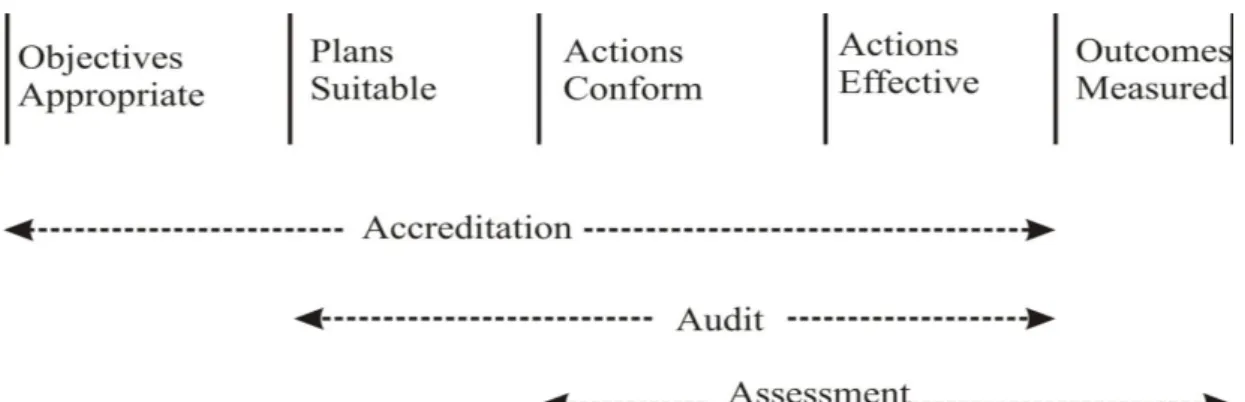
Figure 2-2: The difference between assessment, audit and accreditation ... 33
Figure 2-3: Dimensions of HE ... 41
Figure 2-4: Levels of knowledge transfer ... 48
Figure 2-5: A Policy transfer continum ... 49
Figure 2-6: The SECI model ... 56
Figure 2-7: The Szulaniski model ... 59
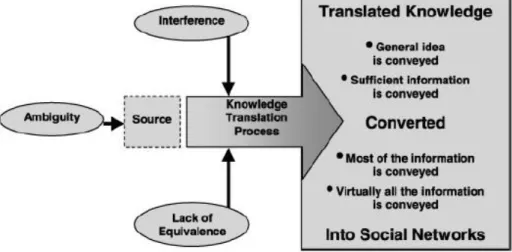
Figure 2-8: An extended model of knowledge transfer as translation ... 61
Figure 2-9: A multitheoretical approach ... 63
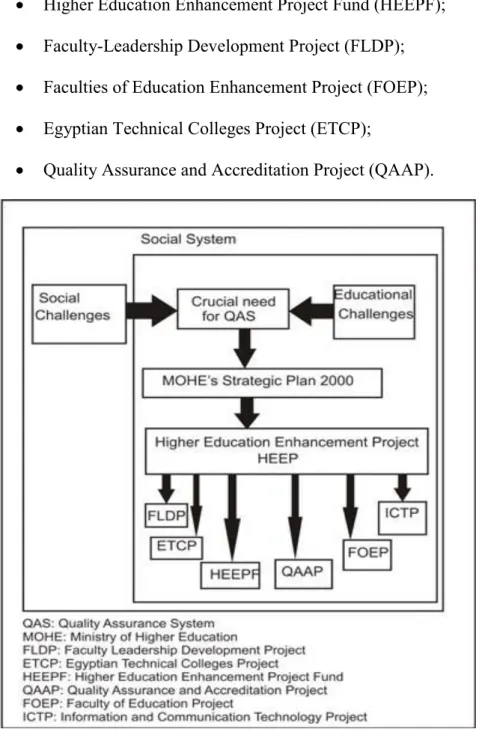
Figure 3-1: QAAP emergence as one of HEEPs ... 75
Figure 3-2: Accreditation process of NAQAAE ... 88
Figure 3-3: The three fields of AHELO ... 91
Figure 3-4: NAQAAE knowledge base ... 95
Figure 3-5: Factors affecting QA and accreditation P/KT in Egypt ... 96
Figure 4-1: Effects of NUCs ... 107
Figure 4-2: Evaluation of NUCs ... 110
Figure 4-3: Historical transition of student numbers by sectors ... 111
Figure 4-4: Coperation between PUs and MEXT ... 112
Figure 4-5: The structure of Chipa Principles ... 115
Figure 4-6: The Japanese IQAS ... 123
Figure 4-7: The PDCA cycle ... 124
Figure 4-8: JUAA accreditation process ... 130
Figure 4-9: Outlines of NIAD-UE accreditation process... 138
Figure 4-10: NIAD-UE accreditation process ... 139
Figure 4-11: Networking QAAs in the Asia-Pacific region ... 149
Figure 4-12: Accreditation QA and knowledge base in Japan ... 152
Figure 4-13: Factors affecting QA and accreditation P/KT in Japan ... 154
Figure 6-1: Factors affecting QA and accreditation P/KT ... 171
Figure 6-2: The EEII model of accreditation policy process ... 176
xiii
List of Tables
Table 1-1: Number of Japanese universities as of May 1, 2008 ... 9
Table 1-2: Number of Japanese HEIs as of May 1, 2008 ... 10
Table 2-1: Differences between assessment and audit ... 30
Table 2-2: Classification of basic options used in educational QA systems ... 32
Table 2-3: Global activities and impacts in HE ... 41
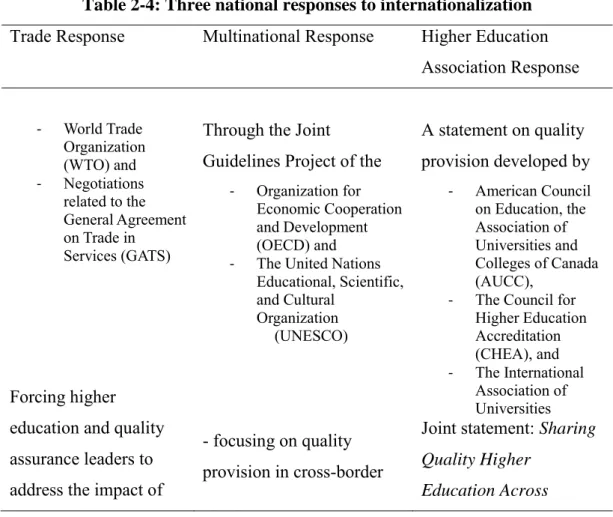
Table 2-4: Three national responses to internationalization ... 43
Table 2-5: Dolowitz & Marsh model ... 58
Table 3-1: Areas of cooperation in Egyptian professors program ... 92
Table 4-1: Number of Japanese HEIs as of May 2010 ... 105
Table 4-2: Change in subsidy for the operating costs od PUs ... 112
Table 4-3: Change in number of approvals of established HEIs ... 117
Table 4-4: Certified accreditation agencies in Japan ... 121
Table 4-5: JUAA members as of June, 2009 ... 126
Table 4-6: A Historical sketch of NIAD-UE ... 131
Table 4-7: Questionar results of institutions subjected to institutional certified evaluation and accreditation ... 146
xiv
List of Acronyms
Acronyms Full Name
AARU Association of Arab Universities
AAST The Arab Academy for Science and Technology ABET Accreditation Board for Engineering and Technology ABEST21 The Alliance on Business Education and Scholarship for
Tomorrow, a 21st century organization, Japan
AHELO Assessment of Higher Education Learning Outcomes project ALECSO Arab League Education, Cultural and Science Organization ANQAHE Arab Network for Quality Assurance in Higher Education APQN Asia-Pacific Quality Network
ARWU Academic Ranking of World Universities ASEAN Association of South East-Asian Nations AUC American University in Cairo
AUN Asian University Network
CHEA Council for Higher Education Accreditation , USA COE Centers of Excellence, Japan
EAPAA European Association for Public Administration Accreditation ECTS European Credit Transfer System
EFMD/EQUIS European Foundation for Management Development/European Quality Improvement System
EHEA European Higher Education Area
ENQA European Association for Quality Assurance in Higher Education
EQUIS European Quality Improvement System
ERASMUS European Action Scheme for the Mobility of University Students ETCP Egyptian Technical Colleges Project, Egypt
EUN Egyptian Universities Network
FLDP Faculty and Leadership Development Project, Egypt FOEP Faculties of Education Enhancement Project, Egypt GATS General Agreement on Trade in Services
GATT General Agreement on Trade and Tariffs
GOE Government of Egypt
HE Higher Education
HEEP Higher Education Enhancement Project, Egypt HEEPF Higher Education Enhancement Project Fund, Egypt HEIs Higher Education Institutions
IAU International Association of Universities
IBRD International Bank for Reconstruction and Development ICTP Information and Communication Technology Project, Egypt IDA International Development Association
IIEP International Institute for Educational Planning, UNESCO
xv
Education
IQAS Internal Quality Assurance System
ISESCO Islamic Educational, Scientific and Cultural Organization JABEE Japan Accreditation Board for Engineering Education JACA Japan Association for College Accreditation
JIAE Japanese Institute of International Accounting Education JIHEE Japanese Institution for Higher Education Evaluation, Japan JIME Japan Institute of Midwifery Evaluation
JSPS Japan Society for the Promotion of Science JUAA Japan University Accreditation Association, Japan LPUs Local Public Universities, Japan
MENA Middle East and North Africa
MEXT Ministry of Education, Culture, Sports, Science & Technology in Japan
MOHE Ministry of Higher Education, Egypt
NAQAAE National Authority for Quality Assurance and Accreditation of Education, Egypt
NCERD National Center for Educational Research and Development, Egypt
NIAD-UE National Institute for Academic Degrees and University Evaluation, Japan
NIER National Institute for Educational Policy Research, Japan
NPM New Public Management
NUCs National University Corporations, Japan
NUCEC National University Corporation Evaluation Committee, Japan NUFFIC Netherlands Organization for International Cooperation in
Higher Education
OECD Organization for Economic Co-operation and Development PCIQA Program of Continuous Improvement and Qualifying for
Accreditation, Egypt PDCA Plan-Do-Check-Act PIs Performance Indicators
PMU Projects Management Unit, Egypt PUs Private Universities, Japan
QA Quality Assurance
QAA Quality Assurance Agency for Higher Education, UK QAC Quality Assurance Center, Egypt
QAAP Quality Assurance and Accreditation Project, Egypt QAAs Quality Assurance Agencies
QAAS Quality Assurance and Accreditation System QAS Quality Assurance System
QAU Quality Assurance Unit, Egypt
xvi
SCPU Supreme Council of Private Universities, Egypt SCTI Supreme Council of Technical Institutes, Egypt SEEP Secondary Education Enhancement Project
SJTUIHE Shanghai Jiao Tong University Institute of Higher Education SPU Strategic Planning Unit, Egypt
SEU Standards for the Establishment of Universities, Japan THE Times Higher Education World University Ranking TEMPUS Trans-European Mobility Program for University Studies
UK United Kingdom
UN United Nations
UNESCO United Nations Educational, Scientific and Cultural Organization UNESCO/
IBE UNESCO/ International Bureau of Education
US United States
USDE United States Department of Education
WB World Bank
WTO World Trade Organization
1
Chapter 1: Introduction
Over the last three decades, most systems of higher education (HE) have been confronted with an overall trend of system expansion that is due in many instances to both growing social demand for HE and a government’s greater inclination to focus on investment in human resources. As systems of HE have expanded, diversification of HE systems has generated growing concern worldwide for the quality of HE processes and outputs in both developed and developing countries.
1.1 Backgrounds
1.1.1 The rise of QA policy in HE
In the knowledge-based society, all countries are facing big challenges in HE.
Moreover, accountability is an increasingly important element in the governance of HE systems. Within the context of publicly-funded HE systems, demonstration of value for money or of responsible and relevant activities undertaken with the taxpayers’ money is now widespread in many countries. This trend towards greater transparency and public accountability is developing in parallel with the move towards greater autonomy. The quality of a country’s HE sector and its definition, assessment and monitoring is a key not only to its social and economic wellbeing but is also a determining factor in the status of that HE system at the international level. In the early 19th century governments were interested in the quality of HEIs because of underwriting the finance of HE as well as defining the legal and administrative framework within which that institution evolved (Neave, 1988). By the end of 19th century, the transition from elite to mass HE (Trow, 1974) created many fundamental changes as well as challenges for decision makers in the field of HE where the real ‘pre-quality era’ started (Ewell, 2007).
Hence, QA was already a concern of nearly all nations, most of which have implemented schemes to evaluate the quality of institutions and programs in HE.
2
These systems vary enormously in focus, reach, objectives, and impact (Altbach, et al., 2009). Starting in the early 1980, quality has become a key topic in HE policy. However, different quality mechanisms in HE were present, for instance, the external examiner system in the United Kingdom (UK) and other Commonwealth countries, the accreditation system in America or the government ministerial control in many other countries1. In the 1990s, there was a significant change in the quality mechanisms of the HE field and this decade can be seen as the decade of quality in HE. From this time on, HEIs are required to demonstrate, through their institutional leaders and to express in comparable measures, the quality of its activities (Bernhard, 2012).
The need for QA has also become more pressing as the globalization of HE continues to grow. Quality and accountability have become key elements in the efforts of many countries to be internationally competitive in a world where interdependence in trade is rapidly growing. A part from this, the dramatic increase in international student mobility over the past three decades (OECD, 2007b), and the more recent surge in various forms of cross-border provision of HE have raised questions about quality standards and the reputation of cross-border institutions, and calls for a closer monitoring of cross-border education quality (van der Wende, 1999; El-Khawas et al., 1998). Craft (1994) points out:
Globalization and international migration mean that academic and professional qualifications need to be portable across national borders, and so both institutions and nation states are been to learn more about each other’s procedures for assuring the quality of tertiary education provision (p. viii).
Accreditation is one way for HEIs to prove its QA policy. As a result, countries have increasingly established national regulatory frameworks that evaluate and monitor quality in HE. The report of Organization for Economic Co-operation and Development (OECD) states that almost all OECD countries
1 Especially European countries.
3
have national systems of QA and accreditation, and a growing number of non-member countries are establishing similar system (OECD, 2004). In countries that lead in technology innovation, university management contributions to QA concentrate on accounting, administrative, and audit procedures. These procedures generate data and measures to evaluate teaching and research impacts on teaching, thus enhancing the global competitiveness of HE. In countries characterized as technology followers HE, however, management has been slow in aligning itself with the external requirements of QA (Gertel & Jacobo, 2007).
Recently, HE is being challenged to provide high quality education that is accessible and delivered in flexible ways, how to timely react to globalization, and how to accommodate themselves to massive demands while still assuring the delivery of quality teaching and research. Such challenges should be met in the face of increased global competition and the pressure of diminishing resources.
As a consequence, many countries have begun to implement innovative procedures for HE quality. Thus, QA has become a rapidly growing concern in a context of ongoing change in HE through the great attention that has been focused on convergence or transfer of QA knowledge or making different national QA schemes and frameworks more comparable to one another (Altach, et. al, 2009).
The globalization of HE systems increases the possibilities of improvement in the quality of national HE systems. Therefore, the establishment of QA systems has become a necessity, not only for monitoring quality in HE nationally but also for engaging in delivery of HE internationally. As a result, there has been an impressive rise in the number of national, regional and international or specialised QA and accreditation agencies in the past two decades.
QA agencies, responsible for monitoring institutional and program quality, are under globalization’s pressure of multiple constituencies to address evermore complicated expectations. These agencies throughout the world, while considering collaboration among them, are implementing measures for assuring the quality of globally deployed HE from the same global viewpoint.
4
1.1.2 QA and accreditation policy of Egyptian HE
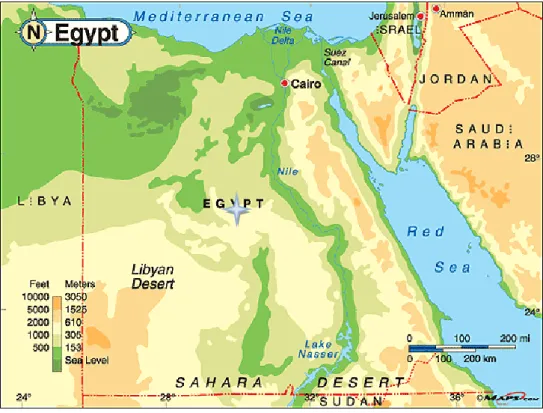
Egypt is one of developing countries in North Africa. It is located in the northeastern corner of Africa and is bordered by Libya, Palestine, Israel, Sudan, the Mediterranean, and the Red sea, and includes Asian Sinai Peninsula (Figure 1-1). Its location made it a transcontinental country and a major power in Africa, the Mediterranean Basin, the Middle East and the Muslim world2.
Egypt is the world’s 30th-largest country, at 1,001,450 square kilometers (386,660 sq mi)3. It lies between latitudes 22º and 32ºN, and longitudes 24º and 36ºE. During Egypt’s long history, the Nile River has played a dominant role in Egyptian life. It extends for some 1500 kilometers through the length of the country. Approximately 98% of the population lives along its banks, as they have for more than 6000 years. Egypt is the most populated country in the Middle East and the third most populous on the African continent at about 82,079,636 (July 2011 EST)4.
Egypt has the largest education system in the Middle East and North Africa (MENA). About 22% of Egypt’s population is in school age, which is between the age of six and seventeen, another 10.5% are in the age group 18-22 of whom fully one third are in HE. This age structure places enormous pressures on the HE system5.6 Between 1996 and 2006, the number of students enrolled in HE increased by 115%, and this trend is likely to continue (Fahim & Sami, 2009).
2 Retrieved on January 30, 2012 from: <http://en.wikipedia.org/wiki/Egypt>
3 World Factbook Area Rank Order. Retrieved 3 March, 2011, from
<https://www.cia.gov/library/publications/the-world-factbook/rankorder/2147rank.html>.
4 Retrieved on January 30, 2012 from:
<https://www.cia.gov/library/publications/the-world-factbook/geos/eg.html>.
5 Egypt Human Development Report (2010), Retrieved on Feb. 16, 2012 from
<http://hdr.undp.org/en/reports/national/arabstates/egypt/Egypt_2010_en.pdf>.
6 Egypt is one of the countries that are known in the literature as “Youth Bulge,” i.e., the increasing share of youth in the total population relative to other age groups.
5
Moreover, World Bank (2010) expects the rise in Egyptian HE student’s enrollment from 28 percent to 35 percent over 2006-2021.
Figure 1-1: Location of Egypt
Source: <http://www.maps.com/Search.aspx?q=Egypt>.
Accordingly, the accessibility to HE, and the policy of free public education were the main principles guiding the expansion of public universities in the post revolutionary era7. In 2000, Egypt has notably improved its HE enrolment rate and there were over a million students at 12 universities and 20 campuses, in line with government policy of admitting all secondary school graduates (AFDB/OECD, 2004, p. 131).
International development organizations, such as World Bank (WB), are increasingly embracing the view that significant reforms in tertiary education are necessary for African countries to become more economically productive.
7 After 1952 revolution.
6
Consequently, in 2001, the Country Assistance Strategy (CAS)8 report revealed that Egypt needs to accelerate its economic development and build its competitiveness in a global market. Accordingly, the CAS recommended WB Group support in four key areas: promotion of export-led development;
encouragement of private sector-led growth; development of the human resources base; and promotion of natural resource management. In the education sector, the CAS recommended expanding dialogue and support for basic and secondary education, and for increasing the market orientation of technical education and vocational training institutes. The CAS acknowledged that Egypt’s capacity to build human resources will be central to its long-term economic and social development. The CAS identified the development of the education sector, and specifically HE and skills development, as being critically important to ensuring adequate and balanced social development in Egypt that became a critical in ensuring competitiveness of the Egyptian labor force in the globalizing economy.
Consistent with the CAS recommendations, the WB expanded its dialogue with the Government of Egypt (GOE) on basic and secondary education and provided support under the Education Enhancement Program (EEP) and Secondary Education Enhancement Project (SEEP). These programs’ objectives directly supported the Government’s 20-year Education Sector Strategic Framework (1999-2019)9. The WB supported Egypt’s efforts to improve the market orientation of the HE sector by providing quality and relevance and enhancing sector efficiency.
QA efforts of HE in Egypt fall under the umbrella of the three-stage Higher Education Development project (2002-2017), which was launched in 2002, with the support of the WB. The accreditation policy in Egypt is implementing through the National Authority for Quality Assurance and Accreditation in Education
8 The WB prepares a CAS for active borrowers from the International Development Association (IDA) and the International Bank for Reconstruction and Development (IBRD) to identify the key areas where Bank Group’s assistance can have the biggest impact on poverty reduction.
9 This strategic framework developed with technical support from the WB
7
(NAQAAE), the only accrediting agency responsible for all educational institutions.
1.1.3 QA and accreditation policy of Japanese HE
Japan is an archipelago of 6,852 islands in East Asia, with a total area of 377,835 sq.km; including land and water about 11% smaller than California.
Located in the Pacific Ocean, it lies to the east of the Sea of Japan, China, North Korea, South Korea and Russia, stretching from the Sea of Okhotsk in the north to the East China Sea and Taiwan in the south10. It lies between latitudes 24º and 46ºN, and longitudes 122º and 146ºE. The characters that make up Japan’s name means “sun-origin”, which is why Japan is sometimes referred to as the “land of the rising sun”.
Japan proper has four main islands11, which are from north to south;
Hokkaido, Honshu (the largest island, where the capital and most major cities are located), Shikoku, and Kyushu, together accounting for 97% of Japan’s land area.
There are also many smaller islands stretched in an arc between the Sea of Japan and the East China Sea and the Pacific proper. About 73% of the country is mountainous, with a chain running through each of the main islands12. Japan consists of forty-seven prefectures, each overseen by an elected governor, legislature and administrative bureaucracy. Each prefecture is further divided into cities, towns and villages (McCargo, 2000, pp. 84-85).
Japan has the world’s tenth-largest population, with 127.3 million13, experienced a phenomenal growth rate for much of the 20th century as a result of
10 Retrieved April, 2012, from http://en.wikipedia.org/wiki/Japan
11 Retrieved April, 2012 from http://www.answer.com/topic/Japan
12 Retrieved May, 2012 from http://www.state.gov/r/pa/ei/bgn/4142.htm
13 World Factbook, Japan. Retrieved Jan. 2011, from
http://www.cia.gov/library/publications/the-world-factbook/geos/ja.html.
8
scientific, industrial, and sociological changes, but birth rates have fallen steadily since 1970s.
Figure 1-2: Location of Japan
Source: <http://www.worldatlas.com/webimage/countrys/asia/eastsea.htm>.
In 2005, Japan’s populations declined for the first time, 2 years earlier than predicted. In 2010, the population growth rate was -1.0%. However, high sanitary and health standards produce a life expectancy exceeding that of the US14. Population density is very high. Most residential and industrial areas tend to be located in lowland areas, along rivers (OECD, 2006a).
The schooling system in Japan, primary schools, secondary schools and universities, was introduced in 1872 as a result of the Meiji Restoration. Three
14 Retrieved May, 2012 from http://www.state.gov/r/pa/ei/bgn/4142.htm
9
fourth of high school students receive additional formal instruction of some kind after graduation (Nakayama, 2011, p. 2). According to the Ministry of Education, Culture, Sports, Science and Technology (MEXT), as of 2005 about 75.9 % of high school graduates attend a university, junior college, trade school, or other HEIs15.
Table 1-1: Number of Japanese universities as of May 1, 2008
Source: MEXT, 2010, p. 4.
By the early 1970, Japan achieved mass/higher tertiary education. The decrease in the number of secondary school graduates and the continued establishment of new higher/tertiary education institutions contributed to the present situation in which 49.4 percent of high school graduates continue to study in four-years universities and junior colleges and 70.5 percent in higher/tertiary education institutions as a whole.
More recently, a declining 18-years-old population has galvanized universities into taking the necessary actions into making reforms (Tables 1-1, 1-2 show the number of universities and HEIs as of May 2008). In comparisons, the 18 year old bracket population reached its peak of 2.05 million in FY1992, then entered a period of decline, and remained about 1.5 million from FY 1999 to FY 2003. In FY 2004 there were about 1.41 million, and in FY 2005 there was yet another
15 MEXT (2012), “Education”. Retrieved March, 2011 from www.mext.go.jp/english/introduction/1303952.htm
10
decrease. It is expected that after dropping to about 1.21 million in FY2009, the number will remain at about 1.2 million through to FY 2020 (OECD, 2006b).
Table 1-2: Number of Japanese HEIs as of May 1, 2008.
Source: MEXT, 2010.
Therefore, Doyon (2001) emphasis that at the time that many Japanese universities have been woken out of their slumber into the reform process as a result of the decreasing number of student enrolling into their programs, the Ministry of Education desires to raise the quality of education and research in Japan to be on par with its Western neighbors. As also Japan worked to catch up rapidly with western industrial countries, it placed great emphasis on systematic efforts to foster the development of educated human resources (Kimura, 2004).
Knipprath & Arimoto (2007) emphasizes that the concerns of the Ministry of Education, the public and educational advisory councils with the achievements of Japanese students throughout their educational career have had a major impact on education policy and the QA system in Japan.
Japanese HE has become more diverse in the past two decades, assuring the quality of academic degrees has become an issue, with the need for standardizing university quality including raising the bar for establishment with rigorous standards. In particular, as student mobility in HE increases, a QA system has become essential for Japanese universities to maintain international credibility (JUAA, university accreditation handbook, p.2).
11
However, the concepts of QA and accreditation are still new. Over time, there have been basically two ways to monitor QA of HE in Japan; on is provided as an ex-ante regulation under the law for Standards for the Establishment of Universities; the other is by regular evaluation after establishment as ex-post-facto checks (Maruyama, 2008). Moreover, in 2001, the Council for Regulatory Reform, which was established in the Cabinet office of the government, published the report on the regulatory reform of the government. In that report, matters related to HE system were include, such as development of free competitive environments for HE, minimization of common rules in regulating the establishment of universities and faculties, etc. In exchange for the de-regulation, the council proposed the introduction of a continuous accreditation system by third-party organizations (Yamamoto, 2006). This report stated that:
With a view to maintaining and improving the level of university education and research activities, a continuous accreditation system should be introduced by which all authorized universities are required to take accreditation by third-party organizations and report the results regularly. When any violation of laws and regulations is exposed in the evaluation results, the MEXT should be able to take corrective measures (Yamamoto, 2006, p.6).
Accordingly, and under the 2002 revision of the School Education Law16, universities in Japan are obligated to receive an evaluation conducted by a QA agency certified by the Minister of MEXT at least once every seven years.
1.2 Objectives and research questions 1.2.1 Objectives
The main objective of this research is to understand and explain the QA and accreditation policy process in both Egyptian and Japanese HE. Particularly, this study has three objectives:
16 Retrieved Feb. 2012, from http://www.juaa.or.jp/
12
1. To develop a theoretical model of the accreditation policy process of HE from the policy-as-knowledge perspective.
2. To investigate the factors affecting on QA and accreditation policies in both Egypt and Japan.
3. To make recommendations for HE’s policy-makers and accrediting agencies depending on our adopted comparative study.
1.2.2 Research questions
The research questions that guide our study are as follows:
Major research question (MRQ):
How has accreditation policy been made in Egypt and Japan?
Subsidiary research questions (SRQs):
SRQ 1: How have accrediting agencies in Egypt and Japan acquired, shared and transferred QA and accreditation knowledge?
SRQ 2: What factors have affected the QA and accreditation policy process in Egypt and Japan?
SRQ 3: What are the similarities and the differences in QA and accreditation policy processes in Egypt and Japan?
1.3 Originality and significance of the study
Numerous scholars from different disciplinary areas are undertaking research in HE, especially in terms of QA as a rather new field of interest (predominant in the past few decades). Many of them had an impact on the quality of teaching, learning research as well as management of HE in a certain way.
However, most comparative HE research foregrounds the national systems of HE. It offers cross-national comparisons of national patterns. The accreditation policy making process and accreditation policy/knowledge transfer mechanisms are not analyzed or theorized as they are identified. A review of literature revealed that little research has been conducted about accreditation policy making barriers.
13
Moreover, the current situation of how the accreditation policy in HE is being made from policy/knowledge transfer perspective in both Egypt and Japan have not yet been studied extensively in discursive research.
Thus, this study aims to fill that gap and gives the way for future studies in the field towards a deeper understanding of knowledge transfer phenomenon in QA of HE sector.
1.4 Methodology of the study
Qualitative methods were most appropriate for this research because of its exploratory nature. We adopt an in-depth qualitative case study approach combined with a comparative methodology. The procedures for the data collection and analysis are interwoven within an iterative cycle consisting of interview- analyze-refine-interview.
1.4.1 Data collection
The materials were systemically collected between the years 2009 and 2012 and analyzed afterwards. The main tool for retrieving relevant information was the Internet. The majority of study materials were found by using electronic search engines and intensive research of relevant websites. The primary on-line search method was complemented by selected newspaper articles, contributions from conferences and seminars. The analyzed materials have various forms such as;
official documents, press releases, and interviews. In addition to several websites (Appendix: P) were regularly searched to make sure of undated collected data.
The analysis of theoretical and the description of country reports do neither support the study with enough information nor do they provide a comprehensive picture of the research field. They are also not able to answer the main research question and the other sub-questions in detail. Therefore, the primary method of data collection was unstructured and semi-structured interviews. The perspectives of interviewees are unique because; they all have administrative experience in a college or university, the majorities have been faculty members, and the majorities have direct experience with the accreditation organizations. In the semi-structured
14
interviews, questions were asked about a small number of specified topics. This gave the interviewees ample time for elaboration on specific topics they considered relevant. A contact summary sheet was designed and used for every interview session to keep track of respondent information. The interviewers only intervened when further details were required or new topics needed to be addressed questions.
The experts are seen as a medium which provides information about professional values and attitudes, decision-structures and patterns of interpretation.
The interviews had two major objectives: to fill in the gaps in information from the documents analyzed and to explore how the QA policy of HE is made from knowledge transfer perspective in both Egypt and Japan.
The interviews for this study were conducted during the months December of 2011, and April, May, June, and July of 2012. The total number of interviews is 29 (13 with Japanese experts, Appendix N, and 16 with Egyptian experts, Appendix L.
Each interview session lasted approximately 60 to 90 minutes and was recorded and carefully transcribed. The interviews were guided by an interview protocol (Appendixes: M & O). Necessary clarifications with interviewees were made to ensure the reliability and validity of the collected data. We supplemented interview data with various written documents (i.e., annual reports, mission statements, meeting notes).
1.4.2 Data analysis
Data analysis is the process of bringing order, structure, and meaning to the mass of collected data (Marshall & Rossman, 1995, p.143). By using a case study approach, we can focus on both the phenomenon and the context in which it exists.
Case studies emphasize detailed contextual analysis of a limited number of events or conditions and their relationships. Yin (1984) defines a case study as:
An empirical enquiry that: investigates a contemporary phenomenon within its real life context; when the boundaries between the phenomenon and context are not clearly evident; and in which multiple sources of evidence are used (p. 23).
15
Through the use of case study, the subjects of the research are investigated within a real-life context (Yin, 1984). Case study research does not provide the means to prove ideas or test hypotheses so much as it allows for explorations of one or two issues or processes that are fundamental to understanding the system being studied (Feagin, 1991, p. 153). Therefore, case study approach enables us to capture reality in detailed manner.
When the purpose of comparison includes the identification of discrete phases of educational development, an assessment of the historical dimension is an integral part of the comparative process (Sweeting, 2005). Yariv-Mashal (2003) in his polemical essay emphasized the fundamental role of the historical approach in the comparative methodology17:
……we are facing an important role for historical research within the comparative discipline, one that would enable comparative work to trace the conceptualization of ideas and the formation of knowledge over time and space. One could picture such a theoretical framework for comparative studies as a multidimensional process in which research is grounded in ‘local histories’, but is based and embedded in different forces, connections, times and places. The reception of each of these histories in different ‘presents’ will produce an individually, historically contingent social, cultural and educational discourse (p. 435).
Four case studies in two countries, Egypt and Japan, were conducted; from Egypt only one case the NAQAAE, and from Japan JUAA, NIAD-UE and JIHEE.
The selection of these case studies was influenced mainly by two factors. The first reason for my country case selection, NAQAAE, was the accessibility of data, experts, legal material as well as sufficient information of this case. In this respect also the language issues was considered as well as existing materials that could have been used.
17 Cited by Sweeting (2005).
16
We select qualitative data analysis software (MAXQDA) as our data management and analysis tool to handle our textual collected data18. MAXQDA allows for automated searches of text for words, phrases, and co-occurring themes with more accuracy and time efficiency than hand sorting and counting (D’Andrea, et.al., 2011). Lewins & Silver (2008) state that this technology also allows researchers to interrogate the data set, look for co-occurrences of codes or themes, and to play with ideas in an exploratory fashion.
1.5 Definitions of terms
In this section, we will define the following keywords in this research:
Higher Education System: a set of autonomous post-secondary institutions, all of them have their specific natures but are still close enough to each other of offer teaching, learning and/or research to student.
Quality Assurance: refers to a set of approaches and procedures regarding the measurement, monitoring, guaranteeing, maintenance or enhancement of the quality of HEIs, providers and programmes, or the processes by which the achievement of education programme standards, as established by institutions, professional organizations, government and other standard-setting bodies, is measured.
Accreditation: refers to the formal approval of a HEI/provider or programme that has been found by a recognized accreditation body to meet predetermined and agreed standards, through a process of evaluation which eventually results in the granting of accredited status to that institution/provider or programme by the responsible authorities.
1.6 Organization of the study
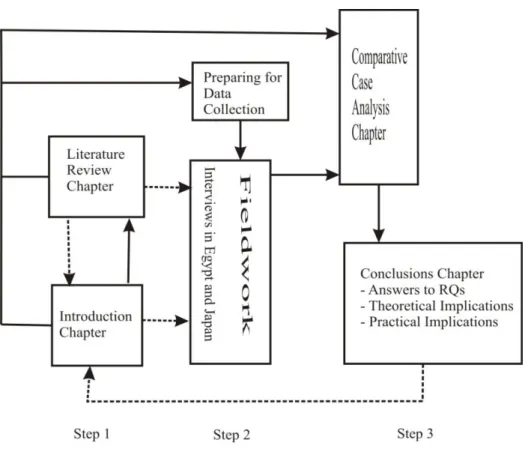
We organized this dissertation into six chapters. These six chapters have been organized according to the study’s three steps as shown below (Figure:1-3). The
18 www.maxqda.com
17
general outline of this study is presented in the first chapter. In the second chapter, we present our literature review which covers the quality definitions, QA in HE, QA different approaches; quality assessment, quality audit, accreditation and TQM. This chapter also presents different aspects of policy transfer. The last part of this chapter shows the different theories and models of policy/knowledge transfer.
Chapter three analyses the case of Egypt. It includes a brief of HE in Egypt with a historical backgrounds of QA and accreditation policy in Egypt, followed by a background of NAQAAE case. This chapter analyses the building of accreditation QA and accreditation knowledge base in Egypt. Moreover, it shows the different factors affecting QA and accreditation policy transfer in Egypt.
In chapter four, we analyses the case of Japan. This chapter starts with a brief of HE in Japan followed by a historical backgrounds of QA and accreditation policy in Japan. The middle part of this chapter presents backgrounds of our three cases of certified evaluation and accreditation in Japan, JUAA, NIAD-UE and JIHEE. In the last part of this chapter we analyses how each of these accrediting agencies acquires, share and transfer QA and accreditation knowledge. Moreover, we show the different factors affecting QA and accreditation policy transfer in Japan.
18
Figure 1- 3: Research steps and organizing
Chapter five shows a comparative analysis of QA and accreditation policy in Egypt and Japan. This chapter is organized in two main parts. In the first part, we present the similarities between Egypt and Japan in the QA and accreditation policy. The second part presents the differences between the two countries in this policy.
The final chapter presents the summary of the major findings of this study through answering three subsidiary questions, followed by answering of the major research question. Moreover, in this chapter we propose a theoretical model of accreditation policy making process based on P/KT perspective. Practical implications are also presented in this chapter with an outline of the direction for future research.
19
Chapter 2: Literature Review
“Every country has problems, and each thinks that its problems are unique…However, problems that are unique to one country…are abnormal…confronted with a common problem, policy makers in cities, regional governments and nations can learn from how their counterparts elsewhere responded” (Rose; 1991, p. 3).
2.1 Introduction
This review of literature is organized by three stands of literature. The first one is QA and accreditation movement in HE; the second is the ways in which QA movement has shaped HE policy and practice and impacted national, regional, and international priorities. The third is the theories and models of QA knowledge/policy transfer. The literature review is very significant for building up the next chapters. Thus, the analyzing of our cases will depend on theses literature guidelines, views, models and theories; to help us in proposing our theoretical implications.
2.2 QA & accreditation policy 2.2.1 Definitions of quality in HE
Quality has become one of the most popular words of the early twenty first century. Quality of life, total quality management, quality products, and quality service entered lexicon of daily life. “Quality” was created by the industry after World War Two, and transplanted to education19. The notions of quality as excellent, standards setting, QA and quality improvement are often conflated and
19 Cited by Hoffman & Julius (1995).
20
used in policy documents and literature rather loosely. A part of looseness arises because various interested parties bring different perspectives to bear.
Pirsig (1974) stated in his book, Zen and the Art of Motorcycle Maintenance, which has much of interest about quality and standards, expresses the problem if one cannot define quality or standards, and then one is in danger of spluttering into silence:
Quality…… you know what it is, yet you don’t know what it is.
But that’s self-contradictory. But some things are better than others, that is, they have more quality. But when you try to say what the quality is, apart from the things that have it, it all goes poof!
There’s nothing to talk about. But if you can’t say what Quality is, how do you know what it is, or how do you know that it even exists? If no one knows what it is, then for all practical purposes, it doesn’t exist at all. But for all practical purposes it really does exist.
What else are the grades based on? Why else would people pay fortunes for some things and throw others in the trash pile?
Obviously some things are better than others… but what’s the
‘betterness’? so round and round you go, spinning mental wheels, and nowhere finding any place to get traction. What the hell is quality? What is it?20
Garvin (1988) in his book, Managing Quality, describes the multiple dimensions of quality as follows:
Performance, the “fitness for use” test: Does the product do what the consumer wants?
Features, the “bells and whistles” that supplement the basic functions and add competitive edge.
Reliability: how long until first failure or service need?
Conformance, the extent to which the product meets established specification and manufacturer standards.
Durability, the length of product life.
Serviceability, speed, cost, ease of repair.
Esthetics, a highly subjective but measurable aspect of product appeal.
20 Cited by Williams (1992)
21
Perceived quality: is a Honda built in America perceived as a Japanese car? Of higher quality? (pp. 49-68).
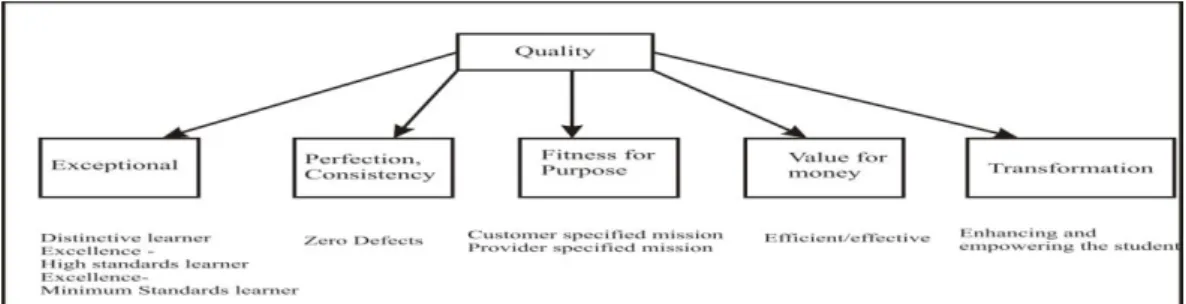
Moreover, Harvey & Green (1993)21 identifies five categories or ways of thinking about quality (Figure 2-1).
Exception: distinctive, embodies in excellence, passing a minimum set of standards.
Perfection: zero defects, getting things right the first time (focus on process as opposed to inputs and outputs).
Fitness for purpose22: relates quality to a purpose, defined by the provider.
Value for money: a focus on efficiency and effectiveness, measuring, outputs against inputs. A populist notion of quality (government).
Transformation: a qualitative change; education is about doing something to the student as opposed to something for the consumer, including concepts of enhancing and empowering: democratization of the process, not just outcomes.
Figure 2-1: Definitions for quality Source: Watty (2003), p. 215.
In HE, Astin, in his two books Achieving Educational Excellence (1985) &
Assessment for Excellence (1993), offers a definition of excellence in HE:
21 Cited in Watty (2003).
22 In a small-scale research with a sample of senior managers in HEIs, Lomas (2001) suggests that fitness for purpose and transformation seem to be the two most appropriate definitions of quality.
22
The most excellent institutions are, in this view, those that have the greatest impact-add the most value, as economists would say-on the student’s knowledge and personal development and on the faculty members’ scholarly and pedagogical ability and productivity (p. 61).
He also contends that there are four conventional views of excellence in collegiate quality: excellence as reputation, excellence as resources, excellence as outcomes, and excellence as content. While his definition focuses on results, a different definition is offered by Mayhew and his colleagues (1990). They argue for a more limited view on HE mission, suggesting that some of the effective hopes that are assumed in Astin’s definition are unlikely to be realized in colleges.
They anticipate a more limited definition:
Quality undergraduate education consists of preparing learners through the use of words, numbers, and abstract concepts to understand, cope with, and positively influence the environment in which they find themselves (p. 29).
The literature shows that the definition of quality varies greatly. In this study, however, quality will refer to fitness for purpose. This definition carries the assumption of sufficiency, efficiency, and effectiveness of the program or institution and of the learning-teaching process. For example, quality is defined in terms of the institution fulfilling its own stated objectives or missions.
2.2.2 Quality criteria in HE
Quality measurement in HE, as in business, has to include evaluation of its criteria. Bergquist (1995) describes quality criteria in education as follows:
Input criteria: the most common criteria for quality refer to the resources available to the institution including characteristics of incoming students.
For example, the size of the library, or size of institutional endowment, number of faculty holding doctoral degrees, and grade point averages on standardized test scores for new students. Astin (1985) stated that input criteria assist in establishing an institution reputation.
23
Output criteria: these criteria related to what the institution produces, including such outputs as alumni, research and scholarly publication, public services, graduation rate, and number of graduates being accepted in the best graduate schools.
Value-added criteria: these criteria emphasize the difference that institutions make in the growth of all members of the institution: for example, the student’s intellectual development value between the start and the end of an educational process.
Process-oriented criteria: these criteria focus on the process of achieving quality that involves academic and non-academic activities of the institution. The criteria take the form of continuous improvements and concern themselves with the conformance to standards. For example, the quality of instruction would be measured, not by a final grade, but by student involvement. The quality of registration service would be measured, not by the performance students receive, but by the participation of staff and students in problem solving (p.36-44).
Historically, quality assessments in HE relied on quantitative data such as full-time professors with advanced degrees, volumes in a university library, paper published by faculty, or student-professor ratios. Recently, there has been a growing emphasis on the outcomes23 of HE. OECD (2006) has launched The Assessment of Higher Education Learning Outcomes (AHELO)24 project as initiative to assess learning outcomes on an international scale. This project was
23 In other words, evaluators are looking for new data and indicators to demonstrate that students have mastered specific objectives as a result of their education.
24 OECD defines AHELO as “a test of university students comparable internationally,” available at <www.oecd.org/education/highereducationandadultlearning/45755875.pdf>.