Japan Advanced Institute of Science and Technology
JAIST Repository
https://dspace.jaist.ac.jp/
Title 静電インクジェットを用いたbias‑free定方向進化分子
のためのin‑vitro compartmentalization 法の開発
Author(s) BINEET Citation
Issue Date 2016‑06
Type Thesis or Dissertation Text version ETD
URL http://hdl.handle.net/10119/13721 Rights
Description Supervisor:高村 禅, マテリアルサイエンス研究科,
博士
Doctoral Dissertation
Development of a Novel In-Vitro Compartmentalization Method for Bias-Free Directed Evolution using Electrostatic Inkjet
Bineet
Supervisor: Prof. Dr. Yuzuru Takamura
School of Materials Science
Japan Advanced Institute of Science and Technology June 2016
Thesis Title DEVELOPMENT OF A NOVEL IN-VITRO
COMPARTMENTALIZATION METHOD FOR BIAS- FREE DIRECTED EVOLUTION USING
ELECTROSTATIC INKJET
Submitted by Bineet
Thesis Advisor Professor Yuzuru Takamura
Thesis Co-advisor Associate Professor Yuichi Hiratsuka
THESIS COMMITTEE
Chairman Professor Yuzuru Takamura Examiner Professor Tatsuya Shimoda Examiner Professor Takahiro Hohsaka
Examiner Associate Professor Tsutomu Hamada
External Examiner Professor Takanori Ichiki (University of Tokyo)
ACKNOWLEDGEMENTS
Numerous people over the years have helped me get here and made it happen. So I take immense pleasure to thank everyone who made this thesis possible.
First and foremost, I take this opportunity to convey my deepest gratitude and respect for my thesis advisor Professor Yuzuru TAKAMURA for his constant support, motivation and advice throughout this project. He has always encouraged me to develop as an independent researcher and helped me realize the power of critical reasoning.
It is hard to overstate my gratitude to Associate Professor Manish BIYANI. With his enthusiasm, his inspiration, and his great efforts to explain things clearly and simply, he helped to make research fun for me. Throughout my thesis-writing period, he provided encouragement, sound advice, critical comments and lots of good ideas.
My earnest thanks must also go to all the members of my thesis advisory and exam committee:
Professor Tatsuya SHIMODA, Professor Takahiro HOHSAKA, Associate Professor Tsutomu HAMADA and external referee Professor Takanori ICHIKI for their insightful comments and encouragement, but also for the questions which guided me to widen my research from various viewpoints. They generously gave their time to offer me valuable comments toward improving my work and provided me constructive criticism which helped me develop a broader perspective to my thesis.
My sincere thanks also goes to my minor research supervisor Professor Shinya OHKI, without his precious support it would not be possible to complete my doctoral thesis. I would also like to express deep gratitude towards Assistant Professor Pham TUE and my sub supervisor Associate Professor Yuichi HIRATSUKA for their kind support.
There is no way to express how much it meant to me to have such cooperative and supporting lab members. I would like to thank all members of TAKAMURA lab for their help and all the good times we had together. This would be incomplete without mentioning the indispensable support from Japan Advanced Institute of Science and Technology (JAIST) that bought this entire affair to a successful end.
On a personal note I would like to dedicate this thesis to my family. No word could thank them for always being the support system and standing with me no matter what the case is. I owe an earnest thanks to my parents, my brother and Monika for their unconditional love and endless
patience. It was their love that raised me up again when I got enervated. And finally I would thank all my friends in JAIST who helped me get through this agonizing period in the most positive way, and has been a family away from home.
Bineet
CONTENTS
ACKNOWLEDGEMENTS
GUIDE TO THE THESIS……… i
LIST OF PUBLICATIONS
..
………... ivLIST OF FIGURES AND TABLES ………... vi
CHAPTER 1: IMMERSED ELECTROSPRAYS FOR BULK GENERATION OF MONODISPERSE SUB-FEMTOLITER WATER-IN-OIL COMPARTMENTS 1.1 Introduction……….. 3
1.1.1 In vitro compartmentalization……….. 3
1.1.1.1 Methods of IVC generated system………... 3
1.2 Methods……… 8
1.2.1 Electrospray setup and procedure………... 8
1.2.2 Water-in-oil droplet generation………. 8
1.3 Results and discussion………. 9
1.3.1 Producing super-fine electrospray based sub-femtoliter in vitro compartmentalization………...……. 9
1.3.2 Optimizing parameters for monodisperse femtodroplet generation…….. 13
1.4 Conclusion and perspectives……….... 17
References……….. 18
CHAPTER 2: STUDY ON THE USE OF IMMERSED ELECTROSPRAY FOR CONTROLLED CELL-FREE GENE EXPRESSION IN MINIMAL IVC SYSTEM 2.1 Introduction………. 22
2.1.1 Cell-free protein synthesis……… 22
2.1.2 Droplet based immersed electrospray cell-free expression……….. 24
2.2 Methods……….. 27
2.2.1 Electrospray setup for GFP expression……… 27
2.2.2 In vitro protein expression in droplets……….. 27
2.3 Results and discussion………...… 28
2.3.1 Quantification of in vitro protein expression in sub-femtoliter droplets.. 28
2.3.2 Super-concentration effect……….... 33
2.4 Conclusion and perspectives………... 36
References………. 37
CHAPTER 3: DEVELOPMENT OF ‘SELECTION-IN-A-FL DROPLET’ SYSTEM FOR A RAPID AND BIAS-FREE DIRECTED MOLECULAR EVOLUTION
3.1 Introduction………... 40
3.1.1 Directed evolution………...………..…... 40
3.1.2 Selection-in-a-tube vs selection-in-a-droplet………... 41
3.2 Methods………... 44
3.2.1 Agarose-in-oil droplet using immersed electrospray setup and procedure………...…. 44
3.2.2 Transmission electron microscopy (TEM) observation………... 44
3.2.3 In vitro protein expression in agarose-in-oil gel beads……… 45
3.2.4 Design of microchip for washing of agarose gel beads………... 45
3.2.5 Encapsulation of fluorescent beads in agarose gel-in-oil……… 47
3.2.6 Washing for bias-free selection in agarose gel-in-oil……….…... 47
3.3 Results and discussion………... 48
3.3.1 Characterization of agarose-in-oil gel beads………...…… 48
3.3.2 GFP in vitro protein expression in agarose beads-in-oil………. 49
3.3.3 Development of a microchip for improved bias free washing of agarose gel beads……….. 50
3.3.4 Co-compartmentalization of fluorescent beads in agarose-in-oil gel beads……… 51
3.3.5 Demonstration of washing steps for bias-free selection……….. 52
3.4 Conclusion and perspectives……….. 54
References……… 55
GENERAL CONCLUSION……….. 58
i
GUIDE TO THE THESIS
Laboratory evolution mimics the natural evolution in the test tube and focused at molecular level for a particular property is termed as directed evolution. Basically the directed evolution experiment comprises of, gene encoding molecule viz. DNA/RNA aptamer which is randomized and expressed and linked as genotype-phenotype. A suitable screening or selection methods are used to distinguish the best variant amongst the millions of molecules for a desired trait. Selection method is the imitation of Darwin’s theory of survival of the fittest. Over the period of time, many researchers have demonstrated the significance of directed evolution via number of biomolecular display technologies like phage display, ribosomal display, mRNA display and so on. But all these technologies lacks the proper handling of millions of molecules, which give rise to the adulterated outcomes (biased). Still today, the current system lacks the detailed knowledge of selection method for evolution experiments because of the possibilities of mismatching genotype to phenotype due to linker molecules (ribosomal display). Since there are millions of molecules present with their expressed proteins that led to existence of the crowding effect and effect of target concentration on the screening steps. Moreover these display technologies does not provide high efficient genotype to phenotype linkage (g-p linkage) due to the batch mode treatment of the molecules.
Griffiths et al have shown in vitro compartmentalization (IVC) by encapsulating the biomolecules using water-in-oil emulsion. This technology provided efficient g-p linkage inside water droplets but selection of molecules still have problems discussed above.
A high throughput selection system is need of the hour with bias free screening steps of encapsulated variants. IVC by water-in-oil emulsions have limitations of polydispersity that creates the improper monitoring over evolution. Later droplet based microfluidics has overcome
ii
this problem by generating monodisperse droplets for precise volume, but this technique has limitation of small size droplets production with high throughput droplet generation speed.
Furthermore microarray technology provided a platform of small reaction chamber but fabrication of these chambers are limited to kilo-to-mega scale only. So considering the above challenges of directed evolution especially selection method, I planned to develop the bias-free high throughput selection system by IVC using immersed electrosprays.
Chapter first described about the high throughput generation of water-in-oil droplets using immersed electrosprays. The water droplets were generated by dipping the nozzle head of electrostatic inkjet while exploiting the principles of electrosprays. This water-in-oil emulsion system can generate ~1.3 µm size droplets with 105 droplets per second generation speed. Further parameters like nozzle size, oil viscosity and bias voltage affecting the droplets size were optimized. Nozzle size and viscosity of the oil directly proportional to the average droplet size while frequency of the inkjet machine inversely proportional to the droplet size.
Chapter second has shown the validity of high throughput water droplet systems for biochemical reactions. Immersed electrosprayed water-in-oil droplets demonstrated successful expression of GFP followed by the time course study in different size droplets. The small sized droplets showed the early saturation GFP expression in 15 minutes of incubation, this can be understood by the fact of miniaturization of compartments enhance the reaction kinetics of protein expression.
Furthermore I performed the co-expression of extreme diluted sample of GFP and mCherry and no droplets showed the single fluorescence. This may be explained on the concept of “super concentration effect” in which all the components concentrated in sub-femtoliter droplets and there exists rapid consumption of amino acids.
iii
After demonstration and validation immersed electrosprayed based water-in-oil droplets in previous chapters, I focused on development of “selection-in-a-fL droplet” system in chapter three which includes the generation of agarose-in-oil gel beads, followed by washing steps of unbounded DNA molecules. First of all, target immobilized beads were co-compartmentalized in ultralow agarose gel beads using high throughput immersed electrospray technology. Later, I demonstrated the bias-free washing system comprised of removal of encapsulated Cy-ssDNA (20mer) from the agarose gel beads by acetone and isopropanol wash. Since washing of agarose gel beads involve the centrifugation that can easily break/damage the gel beads, so I also fabricated the PDMS microchip of three inlets which serves the micro-mixer based on vortex technology for better solvent exchange during washing steps.
iv
LIST OF PUBLICATIONS
Patent
o Japan Patent Application number: 2015-115336
イ ン ク ジ ェ ッ ト を 用 い た I V C 用 液 滴 生 成 装 置 及 び 液 滴 生 成 方 法
Bineet Sharma, Manish Biyani, Yuzuru Takamura, Tatsuya Shimoda, (Droplet generation instrument and droplet generation method for IVC by inkjet) – Chapter 1.Scientific Journal
o Bineet Sharma, Yuzuru Takamura, Tatsuya Shimoda, Manish Biyani, A bulk sub-femtoliter in vitro compartmentalization system using super-fine electrosprays. (Sci. Rep. 6, 26257; doi:
10.1038/srep26257 (2016))
o Bineet Sharma, Yuzuru Takamura, Tatsuya Shimoda, Manish Biyani, Realization of “super- concentration” effect using cell-free system in sub-femtoliter droplets generated by immersed electrosprays (manuscript in preparation).
Conference proceeding
o Bineet Sharma, Manish Biyani, Yoshiaki Ukita, Yuzuru Takamura, Study on centrifugal force based particle trapping in micro chamber at lower Reynolds number, 19th International Conference on Miniaturized Systems for Chemistry and Life Sciences (MicroTAS), Texas, USA, October/November 2014 (conference proceeding).
Award
o Best Student Poster Award in International Joint Symposium on Single Cell Analysis, Kyoto, Japan – Chapter 3 (micro-mixer device).
Presentations
o Bineet Sharma, Yuzuru Takamura, Tatsuya Shimoda, Manish Biyani, Cell-free protein synthesis in sub-micrometer electrospray based water-in-oil droplets for in vitro compartmentalization, 8th International Symposium on Microchemistry and Microsystems, Hong Kong, May/June 2016. (oral)
v
o Bineet Sharma, Manish Biyani, Yoshiaki Ukita, Yuzuru Takamura, Effect of centrifugal force on vortex-based particle separation in micro chamber at lower Reynolds number, 8th International Symposium on Microchemistry and Microsystems, Hong Kong, May/June 2016. (poster)
o Bineet Sharma, Yuzuru Takamura, Tatsuya Shimoda, Manish Biyani, Super-fine electrostatic inkjetting of monodisperse sub-femtoliter droplets for ultra-rapid single-molecule in vitro compartmentalization, The International Chemical Congress of Pacific Basin Societies, Hawaii, USA, December 2015. (poster)
o Bineet Sharma, Yuzuru Takamura, Tatsuya Shimoda, Manish Biyani, High throughput monodisperse water-in-oil droplets formation for in vitro compartmentalization using electrostatic inkjet technology, 28th International Microprocesses and Nanotechnology Conference (MNC), Toyama, Japan, November 2015. (poster)
o Bineet Sharma, Yuzuru Takamura, Tatsuya Shimoda, Manish Biyani,High-speed generation of femtoliter water-in-oil droplets using electrostatic inkjet for in vitro compartmentalization, 7th International Symposium on Microchemsitry and Microsystems (ISMM), Kyoto, Japan, June 2015. (poster)
o Bineet Sharma, Manish Biyani, Yoshiaki Ukita, Yuzuru Takamura, Study on centrifugal force based particle trapping in micro chamber at lower Reynolds number, 19th International Conference on Miniaturized Systems for Chemistry and Life Sciences (MicroTAS), Texas, USA, October/November 2014. (poster)
o Bineet Sharma, Kiyotaka Sugiyama, Yoshiaki Ukita, Yuzuru Takamura, Study on particle trapping by microvortex chamber for single cell washing, 74th Japan Society of Applied Physics Autumn Meeting (JSAP), Kyoto, Japan, September 2013. (oral)
o Bineet Sharma, Yoshiaki Ukita, Yuzuru Takamura, Study on particle trapping by micro vortex chamber for single cell washing, International Joint Symposium on Single Cell Analysis, Kyoto, Japan, November 2012. (poster)
o Bineet Sharma, Yoshiaki Ukita, Yuzuru Takamura, Study on the vortex behaviour in micro scale chamber for the trapping of particles, 25th International Microprocesses and Nanotechnology Conference (MNC), Kobe, Japan, October/November 2012. (oral)
vi
LIST OF FIGURES AND TABLES
Figures
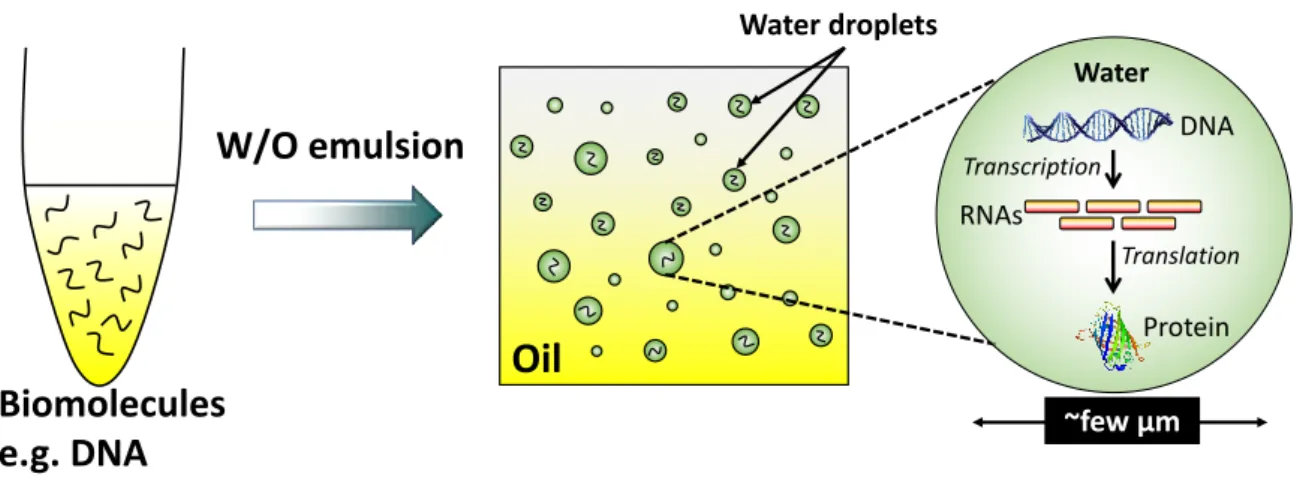
1.1 Schematic illustration of in vitro compartmentalization using water-in-oil emulsion.
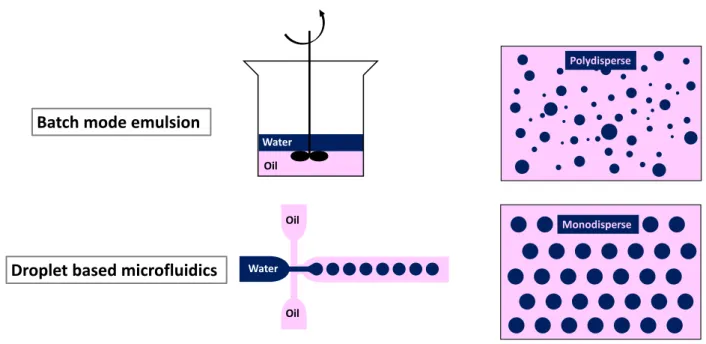
1.2 Methods of water-in-oil emulsion generation system.
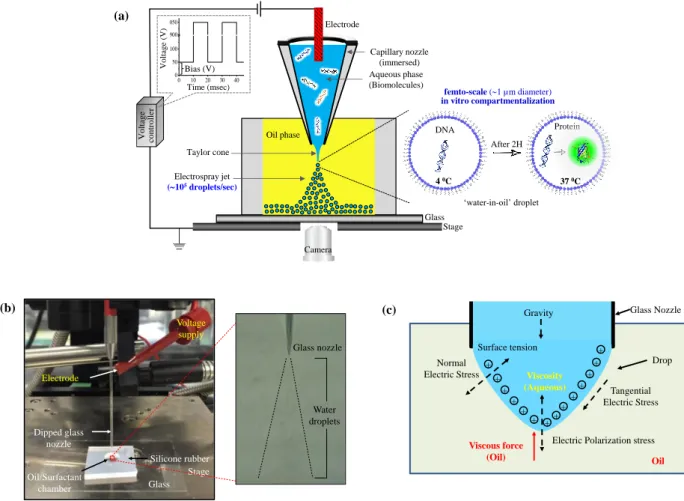
1.3 Immersed super-fine electrospray based miniaturized in vitro compartmentalization. (a) Schematic illustration of the experimental setup is shown. A head of inkjet nozzle (filled with nM solution of template DNA and gene expression system) immersed in an immiscible oil- phase can produce ultrarapid monodisperse water-in-oil femtoliter-scale droplets in bulk at mega-scale. (b) Photograph of electrostatic inkjet setup with image of water-in-oil droplet generation. (c) Forces acting on droplet interface under the influence of electric field.
1.4 Size measurement of femto-scale in vitro compartmentalization. (a) Confocal microscopic image of water-in-oil droplets. Droplet size distribution measured by dynamic light scattering.
(b) Histogram of the droplet size distribution obtained using 4 µm nozzle orifice diameter. The mean average shown is 1.3 µm with a volume of 1.2 femtoliter. Scale bar: 5 µm.
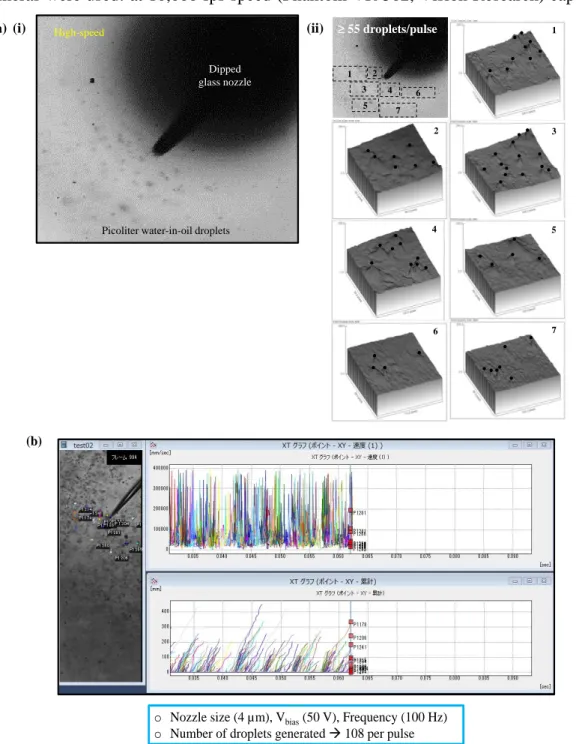
1.5 Number of droplet generation by high speed camera. (a-i) High-speed camera movie for water- in-oil droplet produced in very first pulse. (a-ii) Calculation of number of droplets from image (i) using ImageJ software. From 1-7 Surface plot of the different regions showing number of droplets generated by one pulse using high speed camera (Phantom VR 502). More than 55 droplets counted in 1 pulse at 50 V. Nozzle ~65 µm. (b) Another high speed camera at 16,000 fps speed (K5, Kato Koken) with fully automatic 2D motion analysis software (MotionV).
Using the experimental setup (Figure 1) ~108 droplets were produced in one pulse. At the maximum frequency in of 1 kHz, this system can produce aqueous droplets at the rate of 105 droplets per second. Nozzle ~4 µm.
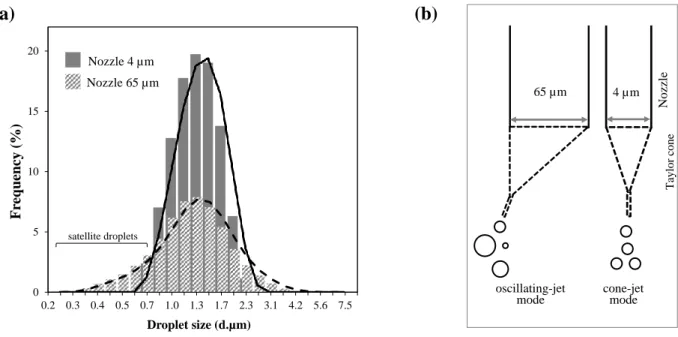
1.6 Influence of nozzle size on electrospray based water-in-oil droplet size distribution. (a) Comparison of nozzles with bigger (65 µm) and smaller (~4 µm) orifice diameter. The bigger results in polydisperse distribution with satellite droplets while small nozzle produces highly monodisperse droplet depending on types of jet mode. (b) Sketch of oscillating-jet mode and cone-jet mode.
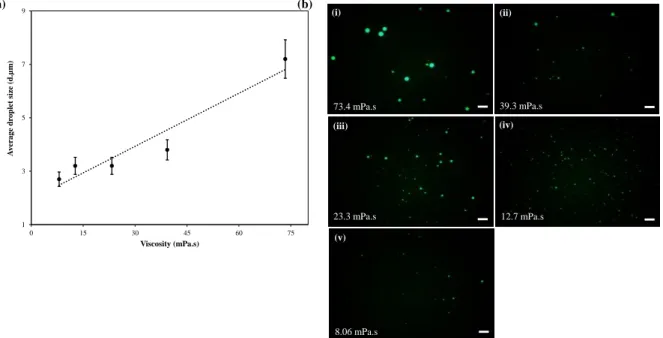
1.7 Effect of oil viscosity on the water-in-oil droplets size distribution (a) Comparison of the viscosity of the oil/surfactant mixtures, prepared by changing the tegosoft DEC while keeping ABIL EM 90 and mineral oil in fixed ratio. All observations were carried out at bias voltage 50 V and frequency 100 Hz. (b) Fluorescent images of water-in-oil droplets in different viscosity of the oil-phase. As viscosity decreases from 73.4, 39.3, 23.3, 12.7, 8.06 mPa.s droplets size also decreases as shown in figure (a) – (e), respectively. Scale bar 35 µm.
1.8 Droplet size distribution with change in applied bias voltage and frequency. High voltage refers to large amount of aqueous phase coming out from nozzle while frequency slightly varies the droplets size. (a) Droplet size increases with increase in voltage from 100 V to 1000 V at 100
vii
Hz frequency. (b) Higher frequency (1000 Hz) reinforce the small size at higher voltage (1000 V).
2.1 Comparison between electrostatic inkjet and immersed electrospray. (a) Inkjet printing of solutes on the substrates by the process of desolvation. (b) The encapsulation of molecules by the immersed electrospray based water-in-oil-droplets.
2.2 In vitro protein expression in sub-femtoliter water-in-oil droplets generated by electrospray.
(a) The figure shows a confocal fluorescence image (left) and the merge image with the corresponding bright field image for fluorescence of Green Fluorescent Protein (GFP) synthesized in femtoliter water-in-oil droplets. Green and grey encircled droplets represent GFP and empty, respectively. (b) Graph showing fluorescent intensity of with and without (negative control) template DNA for GFP synthesis. Scale bar: 15 µm.
2.3 Effect of voltage on DNA and GFP protein. (a) GFP was expressed in bulk using the PURE system before being electrosprayed via a glass nozzle at 50 V and 100 Hz (Off-droplet; top image). Later, GFP-encoding cDNA mixed with the PURE expression system was electrosprayed and incubated for 2 h at 37°C (On-droplet; bottom image). Confocal fluorescence microscopic images alone (left) and merged with the corresponding brightfield images (right) are shown. Scale bar: 15 μm. (b) A comparison of the time courses of GFP expression between off-droplet and on-droplet conditions.
2.4 Time course study of in vitro protein expression in sub-femtoliter water-in-oil droplets generated by electrospray. (Time courses for the synthesis of GFP in 5 differently sized droplets (1.8 fL, 5.5 fL, 13 fL, 25.5 fL, and 44.3 fL). The fluorescence of GFP reached a plateau at an earlier time (<15 min) in smaller droplets. The results represent the average data from 176 different droplets.
2.5 ‘Super-concentration’ effect in sub-femtoliter in vitro compartments. The extreme template dilution effect, from ~1,300 copies of the GFP encoding gene per droplet (35.75 nM) to 1 copy per 103 droplets (35.75 fM). The data were acquired for droplets ~5 μm in size (65 fL).
2.6 Co-expression of GFP and mCherry inside water-in-oil droplets at 2 different DNA template concentrations. Fluorescence confocal microscopic images were captured using an Alexa Fluor 488 filter for GFP (left) or an Alexa Fluor 594 filter for mCherry (center); the merged images with the corresponding bright field images are shown at the right. Encircled droplets represent the co-expression of both GFP and mCherry, which appeared as a yellow color in the merged image. Scale bar: 15 μm.
3.1 Comparison between conventional bulk selection method and selection-in-a-fL droplet.
Explaining the limitations of conventional method and advantage of selection in droplets.
3.2 (a-b) Photolithographic steps of fabrication of PDMS microchip showing the 3D circular chamber for micro mixing using vortex technique.
3.3 (a) TEM image of agarose gel beads-in-oil. (b) Droplet size distribution obtained using a 15- μm nozzle orifice diameter and calculated by ImageJ. The mean diameter is, with a volume of 2.8 fL. Scale bar: 1 μm.
viii
3.4 Successful expression of GFP in agarose-in-oil gel beads using immersed electrosprays.
Nozzle size (~65 μm), bias (500 V), frequency (100 Hz).
3.5 (a) A PDMS microchip showing the circular trajectory of the fluorescent beads in trapping chamber via vortex method. (b) Photograph of the fabricated microchip, this microchip can help in washing of agarose gel beads at low Reynolds number. Outlet at the center, circular chamber (~1 mm), and flow rate (800 μl/min).
3.6 Co-compartmentalization of target fluorescent beads in agarose gel beads-in-oil using immersed electrosprays at 500 V, 100 Hz using nozzle size of 15 μm. Inverted fluorescence microscope was used to capture the images.
3.7 Washing of encapsulated Cy5-ssDNA in agarose gel beads-in-oil using acetone and isopropanol. This washing step is to demonstrate the removal of unbounded molecules from agarose gel.
3.8 Removal of inhibitors from agarose gel beads-in-oil. Demonstration of this washing shown by entrapment of biotin-4-fluorescein in agarose gel beads and washed out using acetone and isopropanol using centrifugation.
Tables
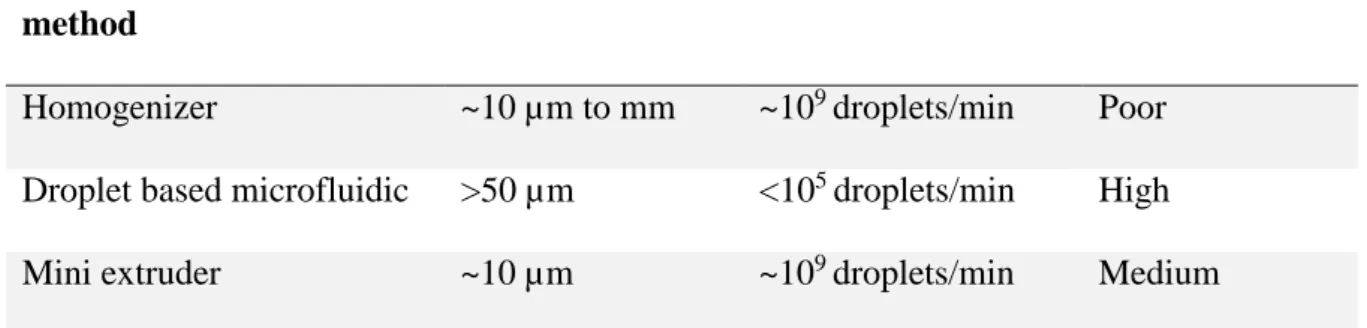
1.1 Comparison of three different droplets generation methods
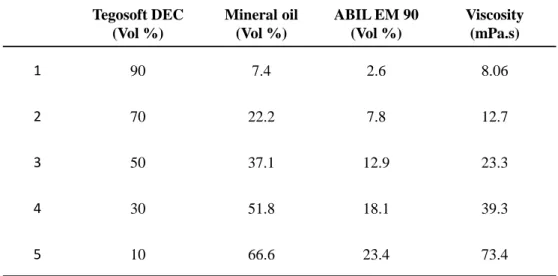
1.2 Preparation of different oil viscosities using tegosoft DEC, ABIL EM 90 and mineral oil.
9
1 Abstract
Directed evolution is laboratory evolution by imitating the natural evolution in the test tube and focused at molecular level for a particular property. It comprises of, a library of millions-of-millions molecules and selection method for desired function. Selection of variants has been performed by linking gene encoding molecule viz.
DNA/RNA and its expressed phenotype as genotype-phenotype (g-p) linkage. Over the period of time, many biomolecular display technologies like phage display, ribosomal display, mRNA display and so on has been discovered for directed evolution, but all these technologies lacks the proper handling of millions of molecules, which give rise to the adulterated outcomes (biased). The current scenario lacks the detailed knowledge of selection method for evolution experiments. Griffiths et al have shown in vitro compartmentalization (IVC) by encapsulating the biomolecules using water-in-oil emulsion. This technology provided efficient g-p linkage inside water droplets but selection of molecules still have problems discussed above. IVC by water-in-oil emulsions have limitations of polydispersity that creates the improper monitoring over evolution. Later droplet based microfluidics has overcome this problem by generating monodisperse droplets, but this technique has limitation of small size droplets production with high throughput droplet generation speed. So I planned to develop new method for monodisperse high throughput IVC droplets using electrostatic inkjet for the bias-free selection system in directed evolution.
The nozzle head of electrostatic inkjet was dipped in oil phase and on voltage application water-in-oil droplets generated termed as immersed electrosprays. A nozzle size of 4 µm was filled with aqueous phase and dipped in oil phase (mixture of ABIL EM 90 (50%), Tegosoft DEC (36%) and mineral oil (14%)) for generation of water- in-oil droplets at 50 V and 100 Hz. When voltage applied to the nozzle water surface started deformation and at threshold voltage it forms a Taylor cone followed by water jet stream which leads to generation of water droplets.
The average size of water droplets was found to be ~1.3 µm (CV = 12%) with generation speed of 105 droplets per second. By using high speed camera and it is found that ~108 droplets were generated in single pulse. Further parameters affecting the droplets size like nozzle size, oil viscosity and bias voltage were optimized. Increase in nozzle size, increases the droplet size with high degree of polydispersity due to different jet mode of droplet formation. Increase in viscosity also increases the average droplets size due to increase in hydrophobicity of oil phase. High voltage is analogous to the flow rate, so increase in voltage large droplets size were generated while higher frequency reinforced the smaller size. Green fluorescent protein (GFP) – cDNA along with PURE system was taken in inkjet nozzle and biomolecules were encapsulated in water droplets using immersed electrosprays.
Then all droplets were incubated for protein synthesis at 37ºC for 2 h. The successful expression of GFP in immersed electro sprayed water droplets was observed. Time course study of GFP expression revealed early saturation of GFP expression within 9 to 15 min for small droplet volume (1.8 fL). This can be understood by the fact of miniaturization of compartments enhance the reaction kinetics of protein expression with rapid consumption of key raw materials like amino acids. Conventional method of selection involves the bulk treatment of variants to the target molecule, this may leads to intermolecular and bias the outcome of selection.
Compartmentalized selection by femtoliter droplets provides platform for better understanding of selection system.
With the help of immersed electrosprays ultralow agarose droplets (melt over 60ºC and gelled below 10ºC) was generated in oil with average size of ~1.7 µm using 15 µm nozzle size at 500 V and 100 Hz. The successful encapsulation of target beads inside agarose gel-in-oil beads. Similarly encapsulation and washing of Cy5-ssDNA in agarose gel-in-oil beads and performed washing steps using acetone and isopropanol.
In conclusion, sub-femtoliter water-in-oil droplets were generated using immersed electrospray with the generation speed of 105 droplets per second. The parameters like nozzle size, oil viscosity and applied voltage were investigated for the droplets size manipulation. Successful GFP expression in water-in-oil droplets with the early saturation between 9 to 15 min. For the minimal volume selection-in-a-fL droplets, ultralow agarose-in-oil gel beads of ~1.7 μm size were generated using immersed electrospray. The washing of Cy5-ssDNA inside agarose gel beads were demonstrated by using acetone and isopropanol.
Keywords: In vitro compartmentalization (IVC), water-in-oil droplets, immersed electrosprays, cell-free protein expression, selection-in-a-fL droplet
2
Immersed electrosprays for bulk generation of
monodisperse sub-femtoliter water-in-oil compartments CHAPTER 1
~ Highlights ~
o High throughput water-in-oil droplets generation using immersed electrosprays.
o Average size of w/o droplets is found to be 1.3 µm with generation speed of 105 droplets per second.
o Increase in nozzle size and viscosity (oil) increase the average size of the
droplets.
3
1.1 Introduction
1.1.1 In vitro compartmentalization
The encapsulation of biochemical reactions in pico- to femtoliter-sized microreactors using water-in-oil emulsion technology which offers a means to parallelize biological and chemical assays, termed as in vitro compartmentalization (IVC)1-4. Initially, IVC (Griffiths et al.) was introduced to generate man-made cell-like compartments for the study of directed evolution.
These compartments were used for linkage of genotype (its encoding gene) to phenotype (protein) that is a principle requirement of conventional molecular evolution albeit often a limiting step for directed evolution5-7. Directed evolution is evolution at small and fast scale in the laboratory which focused at the molecular level for specific properties from the pool of millions-trillions molecule8.
1.1.1.1 Methods of IVC generated system
Water-in-oil (W/O) emulsion have been extensively exploited as micro-sized reactors which enhanced the reactivity and yield of the reactions. There are many different techniques have been used for generation of w/o droplets with different droplet size manipulation like
Oil
DNA Transcription
RNAs
Protein Water
Translation
Biomolecules e.g. DNA
W/O emulsion
Water droplets
~few µm
Figure 1.1: Schematic illustration of in vitro compartmentalization using water-in- oil emulsion.
4
homogenizers, extruder, and droplet based microfluidics by which small and stable aqueous compartments are generated in oil phase.
Homogenizer used to generate small size w/o droplets from large droplets by applying shear stress in narrow or physical barrier9. This leads to the production of polydisperse droplets with large size distributions and can also result in a loss of biological sample because of the high homogenization speed/pressure. Batch mode emulsion is generated by simple vortexing the water in oil phase which generates 1-100 µm droplets size, resulting in fL-to-nL differences in reaction volume10,11. Like homogenizer, vortex method of droplet generation produce polydisperse droplets which has also risk of damaging the sample. The above mentioned emulsion formation technology, w/o droplet shows wide or narrow size distribution. This leads to uneven distribution of reagents into droplets; sequentially causing loss in activity of translated proteins (Miller et al.) as a result not all the droplets become active for in vitro expression11. Although water-in-oil emulsion has been best suited for quantitative screening of molecules using FACS (fluorescence activated cell sorter). IVC using emulsion technology has been successful strategy for directed molecular evolution of enzymes but it also suffers some limitations. After in vitro gene-expression, for the purpose of screening molecules emulsion droplets are re-emulsified in aqueous phase. Due to technical problem, there are two kinds of micro-compartments exists as double emulsion droplets: compartments having gene-of-interest and unrelated gene. Furthermore if two different mutant genes are co-compartmentalized during re-emulsification their genotype-phenotype linkage would be affected during sorting process12. Also water-in-oil emulsion cannot applied for in vitro studies of various kind of proteins like membrane proteins.
To overcome these problems droplet based microfluidics was introduced13, which precisely generates highly monodisperse water-in-oil droplets by either T-junction or flow focusing method. The multiple compartments issue can be solved by high throughput droplet-based
5
microfluidics screening system embraces droplets for gene amplification, coalescence of droplet pairs12 (droplet with gene and droplet with PURE system) and finally separating the genes of interest. Droplet based microfluidics renovated the whole study of directed evolution by provided a platform to evaluate all micro-compartments for a specific study. But for the library size of million-quadrillion molecules and encapsulating the genes precisely in droplets can be challenging for droplet based microfluidic because of its limitations of droplet production14-17 (few thousands per minute). Pros and cons of the above discussed droplet generation method can be summarized in table 1.1, which depicts that microfluidics have an upper hand over mini extruder and homogenizer techniques for monodisperse droplets with reasonable high throughput generation speed.
To minimize the volume of the reaction, micro array technology have been used at femtoliter scale and proved to be efficient method for quantitative analysis (Yomo et al 2012) but it failed on the ground of IVC because of the non-uniform distribution of sample mixture, difficult to handle the >1015 compartments for directed evolution and well defined solid array cannot mimic the cellular compartments18-21.
Water Oil
Water
Oil Oil
Batch mode emulsion
Droplet based microfluidics
Polydisperse
Monodisperse
Figure 1.2: Methods of water-in-oil emulsion generation system.
6
Table 1.1: Comparison of three different droplets generation methods.
Droplet generation method
Droplet diameter Generation speed Uniformity
Homogenizer ~10 µm to mm ~109 droplets/min Poor Droplet based microfluidic >50 µm <105 droplets/min High
Mini extruder ~10 µm ~109 droplets/min Medium
Inkjet printing technology has also used for manipulating the droplet size with precise volume control which proved to be upper hand over microfluidics technology. Recently Yu et al (Lab chip 2015) reported droplet in oil for picoliter scale analysis but piezo electric inkjet used till now has limitation of low throughput generation of droplets22. Here I present a simple and new platform for ultra-rapid generation of water-in-oil droplets using electrostatic super fine inkjet technology (SIJ Technology, Inc.). The electrostatic based inkjet nozzle is submerged in oil phase and on the applied voltage, this system is capable of continuous droplet production with generation speed of ~3 million droplets/minute which is ideal platform to execute femtoliter- IVC.
7
~ Objective ~
To develop a new platform for ultra-rapid generation of water-in-oil femtodroplets using electrostatic super fine inkjet technology for the in vitro compartmentalization.
8 1.2 Methods
1.2.1 Electrospray setup and procedure
The water-in-oil droplet generation system was created by using a prototype head of super-fine inkjet technology [SIJ technology, Japan]. A small hole of ~6 mm was punched on commercial available silicone rubber (3 cm x 3 cm x 3 mm) and placed on glass slide (35 x 55 mm) which represents as chamber for droplet collection (Figure 1.3). Laboratory made glass nozzle (~ 65 µm orifice diameter) and commercially available glass nozzle (~4 µm orifice diameter) [SIJ technology, Japan] were used throughout the experiments. Glass capillary of 1x90 mm size was used to make ~65 µm nozzle by Puller machine PC-10 [Narishige, Japan] using two step mode, keeping heater level 60 and 50. Tungsten wire as an electrode was used in case of large nozzle.
Oil phase containing 50% ABIL EM 90 [Evonik Industries], 36% tegosoft DEC [Evonik Industries], and 14% mineral oil [Sigma Aldrich] was used. Different viscosity of oil mixtures was prepared by changing tegosoft DEC from 10% to 90% keeping ABIL EM90 and mineral oil as 3:1. Oil viscosities were measured by Viscomate [VM-10A, Sekonic CBC Co. Ltd]. All the oil mixtures used in the experiments were freshly prepared by vortexing at 2,500 rpm for 5 minutes and incubated at 30C for 30 minutes.
1.2.2 Water-in-oil droplet generation
The glass nozzle of ~4 µm was filled by 7 µl of nuclease free water and fixed to the inkjet machine. The oil phase (100 µl) was poured to the oil chamber and glass nozzle was immersed in oil, on voltage application through submerged glass nozzle containing aqueous solution was jet into cavity having oil phase succeeding large amount of water-in-oil droplets at the generation speed ~105 droplets per second. For droplet size calculation and distribution dynamic light scattering (DLS) [Malvern Zetasizer Nano ZS] machine was used. Droplet average size was also measured using laser scanning confocal microscope [Olympus FluoView
9
1000] with the help of ImageJ software. High-speed camera [Phantom VR 502 or Kato Koken K5] is used to estimate the water-in-oil droplets generation speed.
1.3 Results and discussion
1.3.1 Producing super-fine electrospray based sub-femtoliter in vitro compartmentalization
I report a technique that uses electrospray-based super-fine inkjet (SIJ Technology, Inc.) to generate monodispersed droplet jets with diameters in sub-micrometer range. The principle behind SIJ printing system is similar to electrospray techniques where a conducting liquid is slowly injected through an electrified capillary nozzle. The liquid inside the capillary nozzle attains hemispherical meniscus due to its surface tension. On applied pulsed DC voltage, a tangential electric stress is appeared due to accumulation of ions near the meniscus area. On a particular threshold voltage, Rayleigh instability phenomenon occurred which imbalance the
Tegosoft DEC (Vol %)
Mineral oil (Vol %)
ABIL EM 90 (Vol %)
Viscosity (mPa.s)
1 90 7.4 2.6 8.06
2 70 22.2 7.8 12.7
3 50 37.1 12.9 23.3
4 30 51.8 18.1 39.3
5 10 66.6 23.4 73.4
Table 1.2: Preparation of different oil viscosities* using tegosoft DEC, ABIL EM 90 and mineral oil.
10
two forces, electrostatic force and surface tension acting on water surface. This results into formation of a conical shape, commonly referred to as the Taylor cone, and a thin microthread of liquid is issued from the tip of the Taylor cone, which eventually fragments to form a spray of monodisperse droplets. Importantly, the size of generated droplets is independent of the diameter of the capillary tube and thus the droplet size can be obtained below the micrometer range. The electrospray of water-in-oil droplets for IVC can be generated by immersing the nozzle in an immiscible phase, i.e., oil. The basic experimental setup for the technique is
depicted in figure 1.3a. A capillary nozzle which is connected to a high voltage supply controller unit through a fine electrode wire is immersed in a reservoir filled with a mixture of
Dipped glass nozzle
Glass Stage Silicone rubber Voltage
supply
Electrode
Oil/Surfactant chamber
(b)
Surface tension Gravity
Viscosity (Aqueous) Normal
Electric Stress
Tangential Electric Stress
Electric Polarization stress Glass Nozzle
Drop
+ ++
+ +
+ + +
+ +
+ +
+
+
Viscous force
(Oil) Oil
(c) (a)
Voltage controller
Camera
Stage Glass Electrode
Aqueous phase (Biomolecules) Capillary nozzle
(immersed)
Oil phase
Electrospray jet (105droplets/sec)
DNA Taylor cone
Time (msec)
Voltage (V)
Bias (V)
femto-scale (1 µm diameter) in vitro compartmentalization
‘water-in-oil’ droplet
0 10 20 30 40
0 50 100 900 1050
Voltage (V)
Time (msec)
Protein
37 0C 4 0C
After 2H
Glass nozzle
Water droplets
Figure 1.3: Immersed super-fine electrospray based miniaturized in vitro compartmentalization. (a) Schematic illustration of the experimental setup is shown. A head of inkjet nozzle (filled with nM solution of template DNA and gene expression system) immersed in an immiscible oil-phase can produce ultrarapid monodisperse water-in-oil femtoliter-scale droplets in bulk at mega-scale. (b) Photograph of electrostatic inkjet setup with image of water-in-oil droplet generation. (c) Forces acting on droplet interface under the influence of electric field.
11
oil/surfactant with a clear bottom for visualization. The electrical field is generated by applying a high voltage drop from the capillary nozzle and a liquid consisting of biomolecules was extruded and sprayed through a nozzle. The forces acting on droplets are schematically illustrated in figure 1.3c, at the threshold voltage these forces get unbalanced at the minimum surface area and results in Taylor’s cone which further burst as jetstream. The water-in-oil femto-scale compartments were formed by the generation of monodisperse aqueous droplets followed by their mutual diffusion into a mixture of oil/surfactant.
A real time and high-speed camera was used to capture the release of a jet breaking into discrete
droplets. Laser scanning confocal microscopy was used to capture the water-in-oil droplet compartments. As shown in figure 1.4a, average size of the droplets was calculated by dynamic light scattering and found to be ~1.3 µm in size using a nozzle with 4 µm orifice diameter. For the calculation of number of droplets generated by electrospray system two types of high-speed
0.2 0.3 0.5 1.0 1.7 3.1 5.6 10.0
Frequency
Droplet size (d.µm)
(a) (b)
Figure 1.4: Size measurement of femto-scale in vitro compartmentalization. (a) Confocal microscopic image of water-in-oil droplets. Droplet size distribution measured by dynamic light scattering. (b) Histogram of the droplet size distribution obtained using 4 µm nozzle orifice diameter. The mean average shown is 1.3 µm with a volume of 1.2 femtoliter. Scale bar: 5 µm.
12
video cameras were used: at 10,000 fps speed (Phantom VR 502, Vision Research) captured
the droplets generated in one pulse followed by calculating the number of generated droplets using ImageJ software (see figure 1.5a) and at 16,000 fps speed (K5, Kato Koken) with fully
(b)
o Nozzle size (4 µm), Vbias(50 V), Frequency (100 Hz) o Number of droplets generated 108 per pulse
Figure 1.5: Number of droplet generation by high speed camera. (a-i) High-speed camera movie for water-in-oil droplet produced in very first pulse. (a-ii) Calculation of number of droplets from image (i) using ImageJ software. From 1-7 Surface plot of the different regions showing number of droplets generated by one pulse using high speed camera (Phantom VR 502). More than 55 droplets counted in 1 pulse at 50 V. Nozzle ~65 µm. (b) Another high speed camera at 16,000 fps speed (K5, Kato Koken) with fully automatic 2D motion analysis software (MotionV). Using the experimental setup (Figure 1) ~108 droplets were produced in one pulse.
At the maximum frequency in of 1 kHz, this system can produce aqueous droplets at the rate of 105 droplets per second. Nozzle ~4 µm.
Dipped glass nozzle
Picoliter water-in-oil droplets
High-speed 1
3
4 5
6 7
2
1 2
3 4
5 7
6
55 droplets/pulse
(a) (i) (ii)
13
automatic two dimensional motion analysis software, MotionV (see figure 1.5b). I calculated 55 to 108 droplets produced in one pulse using the experimental setup (as shown in figure 1.3a) and taking the maximum frequency of 1 kHz, in current setup lead to generate monodisperse aqueous droplets at rates near 105 droplets per second which can be further extendable to about 2 orders of magnitude faster using higher-frequency electrostatic waves.
1.3.2 Optimizing parameters for monodisperse femtodroplet generation
In a typical inkjet electric parameters like viscosity and surface tension are key factors which affects droplets size. Since we have used electrostatic inkjet with dipped nozzle which works on electrospray method so the disintegration of jet into different droplets size is predominantly affected by the size of the nozzle, surface tension of aqueous-phase, viscosity of the oil-phase, and various instrumental parameters, including the voltage supply, bias and frequency.
Therefore, the optimal conditions for these parameters to generate monodisperse and stable droplets were determined. Firstly, the size of nozzle determines the geometry of Taylor’s cone and different types of modes (e.g., cone-jet or oscillating-jet) can be generated in jet spray depending on the orifice diameter of nozzle. Therefore, the size of nozzle plays an important role in the jet spray-mode while optimizing the positioning and precisely controlling the volume of the droplets. Figure 1.6a shows the droplets size distribution of two different size nozzle, 4 µm and 65 µm, keeping other parameters constant. Large size nozzle provides large interface area, so under influence of external electric field liquid drop experienced imbalance stresses on interface and ended up with oscillating jet mode which leads to the wider size distribution of droplets. Whereas small size nozzle provides less interface area so it leads to cone jet-mode. Hence polydispersity is observed in case of bigger nozzle as compare to smaller
14
one (see figure 1.6b). Secondly, the area of plume is determined by the medium in which spray is occurred. Since air provides negligible friction force, so droplets generation in air by inkjet
for printing is more convenient than in case of oil where viscous force (or friction force) applies a shear stress at the interface. However, as compare to air, oil medium provides more stable water droplets with less possibilities of generating satellite droplets. Hence, we investigated the effect of viscosity of oil-phase on the average droplets size. The different viscosities of the oil-phase were prepared by mixing Tegosoft DEC, mineral oil and ABIL EM 90 in different ratio (see Table 1.2). I observed that average droplets size increased with increase in the viscosity as shown in figure 1.7.
0 5 10 15 20
0.2 0.3 0.4 0.5 0.7 1.0 1.3 1.7 2.3 3.1 4.2 5.6 7.5
Frequency (%)
Droplet size (d.µm) Nozzle 4 µm
Nozzle 65 µm
65 µm 4 µm
Nozzle Taylor cone
oscillating-jet mode
cone-jet mode
(a) (b)
satellite droplets
Figure 1.6: Influence of nozzle size on electrospray based water-in-oil droplet size distribution. (a) Comparison of nozzles with bigger (65 µm) and smaller (~4 µm) orifice diameter. The bigger results in polydisperse distribution with satellite droplets while small nozzle produces highly monodisperse droplet depending on types of jet mode. (b) Sketch of oscillating-jet mode and cone-jet mode.
15
Thirdly, it is very obvious to speculate the dependency of voltage and frequency on the droplet size distribution because of the fact that electrospray happens when voltage is applied to the liquid and frequency of the applied voltage can affects the forces acting at interfaces. Similar to flow rate factor in electrohydrodynamic-inkjet23, 24, voltage also plays the same role in electrostatic inkjet. An increase in applied bias voltage increases the amount of liquid at the interface which results in larger droplets size. Consistent to this, I observed a shift towards larger droplets size while increasing the bias voltage from 100 V to 1000 V at constant frequency of 100 Hz (see figure 1.8a). However, a higher frequency at higher voltage reinforce the smaller droplets size because of the more disturbance at the interface of the aqueous and oil phase which results in small droplets as compare to low frequency (see figure 1.8b). With these observations, the resulting optimal parameters for monodisperse and smaller droplets
(i) (ii)
(iii) (iv)
(v)
8.06 mPa.s 23.3 mPa.s
73.4 mPa.s 39.3 mPa.s
12.7 mPa.s
(b) (a)
1 3 5 7 9
0 15 30 45 60 75
Average droplet size (d.µm)
Viscosity (mPa.s)
Figure 1.7: Effect of oil viscosity on the water-in-oil droplets size distribution (a) Comparison of the viscosity of the oil/surfactant mixtures, prepared by changing the tegosoft DEC while keeping ABIL EM 90 and mineral oil in fixed ratio. All observations were carried out at bias voltage 50 V and frequency 100 Hz. (b) Fluorescent images of water-in-oil droplets in different viscosity of the oil-phase. As viscosity decreases from 73.4, 39.3, 23.3, 12.7, 8.06 mPa.s droplets size also decreases as shown in figure (a) – (e), respectively. Scale bar 35 µm.
16
were set as follows: nozzle with 4 µm of orifice diameter, a less-viscous (near 8 mPa.s) mixture of oil/surfactant mixture and electrostatic conditions using higher voltage (1000 Vbias) and frequency (1000 Hz).
0 5 10 15 20 25 30 35 40
0.0 - 0.5 0.5 - 1.0 1.0 - 1.5
Droplet count
Droplet size (d.µm) 0
5 10 15 20 25 30 35 40
0.0 - 0.5 0.5 - 1.0 1.0 - 1.5 1.5 - 2.0 2.0 - 2.5
Droplet count
Droplet size (d.µm)
Bias 100 V Bias 1000 V
(a)
(b)
Bias 100 V Bias 1000 V Frequency 100 Hz
Frequency 1000 Hz
Figure 1.8: Droplet size distribution with change in applied bias voltage and frequency. High voltage refers to large amount of aqueous phase coming out from nozzle while frequency slightly varies the droplets size. (a) Droplet size increases with increase in voltage from 100 V to 1000 V at 100 Hz frequency. (b) Higher frequency (1000 Hz) reinforce the small size at higher voltage (1000 V).
17 1.4 Conclusion and perspectives
I demonstrated the engineered sub-femtoliter-scale aqueous droplet or gel bead compartment with facile approach using electrospray for bulk production of robust artificial cell-like compartments. This electrospray system can generate nearly 105 droplets per second and this number can be increased by two order if the frequency of the applied voltage changes. Also the electrospray parameters like nozzle size and continuous phase (oil) viscosity played crucial role for monodisperse aqueous droplets generation.
In perspective, I am considering this high throughput sub-femtoliter droplet generation system for minimal biochemical reaction scale at maximum and accelerated reaction products. Such system are also expected to facilitate not only improvements in the sensitivity-issue in top- down artificial cellular system but also a colossal leap in directed molecular evolution methodologies.
18
References
1. Kelly, B. T., Baret, J. C., Taly, V. & Griffiths, A. D. Miniaturizing chemistry and biology in microdroplets. Chem Commun 18, 1773-1788 (2007).
2. de Souza, T. P., Stano, P. & Luisi, P. L. The minimal size of liposome-based model cells brings about a remarkably enhanced entrapment and protein synthesis. Chembiochem 10, 1056-1063 (2009).
3. Luisi, P. L. & Stano, P. Synthetic biology minimal cell mimicry. Nat Chem 3, 755-756 (2011).
4. Okano, T., Matsuura, T., Suzuki, H. & Yomo, T. Cell-free protein synthesis in a microchamber revealed the presence of an optimum compartment volume for high-order reactions. Acs Synth Biol 3, 347-352 (2014).
5. Lu, W. C. & Ellington, A. D. In vitro selection of proteins via emulsion compartments.
Methods 60, 75-80 (2013).
6. Tawfik, D. S. & Griffiths, A. D. Man-made cell-like compartments for molecular evolution.
Nat Biotechnol 16, 652-656 (1998).
7. Griffiths, A. D. & Tawfik, D. S. Miniaturising the laboratory in emulsion droplets. Trends Biotechnol 24, 395-402 (2006).
8. Packer, M. S. & Liu, D. R. Methods for the directed evolution of proteins. Nat Rev Genet 16, 379-394 (2015).
9. Aharoni, A., Amitai, G., Bernath, K., Magdassi, S. & Tawfik, D. S. High- throughput screening of enzyme libraries: thiolactonases evolved by fluorescence-activated sorting of single cells in emulsion compartments. Chem Biol. 12, 1281–1289 (2005).
10. Katepalli, H. & Bose, A. Response of surfactant stabilized oil-in-water emulsions to the addition of particles in an aqueous suspension. Langmuir 30, 12736-12742 (2014).
19
11. Miller, O. J. et al. Directed evolution by in vitro compartmentalization. Nat Methods 3, 561-570 (2006).
12. Fallah, A. A., Baret, J. C., Ryckelynck, M., & Griffiths, A. D. A completely in vitro ultrahigh-throughput droplet based microfluidic screening system for protein engineering and directed evolution. Lab on a Chip 12, 882–891 (2012).
13. Abate, A. R. , Thiele, J., Weitz, D. A One-step formation of multiple emulsions in microfluidics. Lab Chip 11, 253–258 (2011).
14. Ma, F., Xie, Y., Huang, C., Feng, Y. & Yang, G. An improved single cell ultrahigh throughput screening method based on in vitro compartmentalization. PLoS ONE 9, 2:e89785 (2014).
15. Guo, M. T., Rotem, A., Heyman, J. A. & Weitz, D. A. Droplet microfluidics for high- throughput biological assays. Lab Chip 12, 2146-2155 (2012).
16. Umbanhowar, P. B., Prasad, V. & Weitz, D. A. Monodisperse emulsion generation via drop break off in a coflowing stream. Langmuir 16, 347-351 (2000).
17. Shim, J. U. et al. Ultrarapid generation of femtoliter microfluidic droplets for single- molecule-counting immunoassays. Acs Nano 7, 5955-5964 (2013).
18. Biyani, M., Osawa, T., Nemoto, N. & Ichiki, T. Microintaglio printing of biomolecules and its application to in situ production of messenger ribonucleic acid display microarray. Appl Phys Express 4, 047001-047003 (2011).
19. Rondelez, Y. et al. Microfabricated arrays of femtoliter chambers allow single molecule enzymology. Nat Biotechnol 23, 361-365 (2005).
20. Kinpara, T. et al. A picoliter chamber array for cell-free protein synthesis. J Biochem 136, 149-154 (2004).
21. Okano, T., Matsuura, T., Kazuta, Y., Suzuki, H. & Yomo, T. Cell-free protein synthesis from a single copy of DNA in a glass microchamber. Lab Chip 12, 2704-2711 (2012).
20
22. Yingnan, S., Xiaodong, C., Xiaoguang, Z., Jinbiao, Z. & Yude, Y. Droplet-in-oil array for picoliter-scale analysis based on sequential inkjet printing. Lab Chip 15, 2429–2436 (2015).
23. Park, J.-U. et al. Nanoscale, Electrified Liquid Jets for High-Resolution Printing of Charge.
Nano Letters 10, 584-591 (2010).
24. Pratikkumar, V. R. & Naresh C. M. A review on electrohydrodynamic-inkjet printing technology. International Journal of Emerging Technology and Advanced Engineering 4, 174-183 (2014).
21
Study on the use of immersed electrospray for controlled cell-free gene expression in minimal IVC system
CHAPTER 2
~ Highlights ~
o Successful GFP expression in femtoliter water-in-oil droplets using immersed electrosprays.
o Time course study of GFP expression in smaller droplets (1.8 fL) revealed early GFP saturation (15 min).
o Co-expression of GFP and mCherry at extremely diluted concentration
explains “super-concentration effect” in minimal IVC.
22 2.1 Introduction
2.1.1 Cell-free protein synthesis
Cell-free protein synthesis (CFPS) exploits the translational machinery of cellular protein synthesis to produce protein of interest with the help of energy substrates, polymerases, amino acids, nucleoside triphosphate and salts1. CFPS drastically improves the development of engineered proteins2, 3 and has been used as research tool in applied biology as well as fundamental studies4-7. Based on CFPS several astonishing methods in directed evolution have been developed such as ribosome display8, 9, mRNA display10, and in vitro compartmentalization (IVC)11. These cell-free display systems have overcome the limitations associated with in vivo methods such as genotype-phenotype coupling efficiency, intermolecular interaction (noise) and precise high throughput screening methods having broader library size. Recently Swartz et al developed the micro bead display technology using IVC with fluorescence-activated cell sorting (FACS)12.
The minimal size encapsulation of molecules?
By above understanding it has been clearly depicted that CFPS system is not only for rapid production of desired proteins but also serves as epicenter of many methods in the field of directed evolution. Further advancement in this system was focused on miniaturization of the compartment, encapsulation and distribution of biomolecules/solutes inside cell free system.
Miniaturization of the compartment leads to the enhanced interaction between molecules which in turn increases the protein synthesis or enzymatic activity. Standard Poisson distribution method has been used for distribution of molecules inside compartment which is a relevant issue in understanding of the origin of life. First most to realize above query, it is very necessary to build a minimal size compartment to entrap the minimal number of biomolecules (proteins or nucleic acids) which can be helpful for understanding the cellular processes more accurately.
23
In the league of miniaturization, micro array technology have been used at femtoliter scale and proved to be efficient method for quantitative analysis13 but it failed on the ground of IVC because of the non-uniform distribution of sample mixture, difficult to handle the >1015 compartments for directed evolution and well defined solid array cannot mimic the cellular compartments. Furthermore piezoelectric inkjet printing technology has also used for manipulating the droplet size with precise volume control which proved to be upper hand over microfluidics technology. Recently reported14 droplet in oil for picoliter scale analysis but piezo electric inkjet used till now has limitation of low throughput generation of droplets.
Many small size compartments have demonstrated the green fluorescent protein (GFP) expression, an easy demonstrable protein using PURE system15. Ueda and colleagues has developed the commercially available Protein synthesis Using Recombinant Elements (PURE) system. There are about 80 different macromolecular species along with amino acids, nucleotides, etc. representing the minimal set of the translational machinery derived from E.
coli. So to characterize the minimal size of compartment volume Lazzerini-Ospri et al. (2011) designed an experimental simulation considering the stochastic factors which affect the reaction progression. The liposomal vesicles of nanometer size was used for investigating the stochastic effect as well as other parameters affecting the protein expression. Since translation process comprises reactions having higher than first order kinetics which likely depends on reaction volume, so it might be possible that encapsulation governed by power-law distribution instead of Poisson statistics. A translation yield was predicted from a pool of smaller liposomes (attoliter range) which states that; protein synthesis yields maximum at 10-16 L (840 nm diameter) and 10-17 L (275 nm diameter) with Poisson distribution and power-law statistics respectively. So a clear understanding can be acquired that effective protein synthesis cannot be measured at smaller volume than 10-17 L. This has been explained on the basis of “super-