Japan Advanced Institute of Science and Technology
JAIST Repository
https://dspace.jaist.ac.jp/
Title 種レベルのスマート分子診断用その場機器不要リコン
ビナーゼポリメラーゼ増幅法の開発
Author(s) Rathore, Himankshi Citation
Issue Date 2019‑12
Type Thesis or Dissertation Text version ETD
URL http://hdl.handle.net/10119/16756 Rights
Description Supervisor:高村 禅, 先端科学技術研究科, 博士
Development of onsite and instrument-free recombinase polymerase amplification for smart molecular diagnosis at species level
Doctor of philosophy in Material Science Yuzuru Takamura Laboratory, Bioscience and Biotechnology
1620436 Himankshi Rathore Research Content:
Nucleic acid identification tests based on conventional polymerase chain reaction (PCR) are often instrumental in choosing the correct treatment for the infection due to the rapidity, sensitivity and specificity of these tests and can be used for the detection of asymptomatic infections1, early stage diagnosis and disease relapse2. Very interestingly, recombinase polymerase amplification (RPA)-based molecular tools have attracted great interest since their initial publication in 20063 and are continually emerging as an elegant method of choice for performing amplification without the need for complex instrumentation. Additionally, sampling methods such as liquid biopsy are a burden to both patients and physicians, and the DNA extraction and purification steps involved in sampling in DNA-based methods increase the time to diagnosis. Direct sampling via an FTA card reduces the risk of contamination and facilitates the transport and long-term storage of the sample at room temperature. In this work, a way to discriminate true-positive results from false-positive and/or negative results generated during the RPA reaction is explored and an FTA card is used for direct sampling of RPA reactions to eliminate the concerns involved with sample contamination as well as the sample preparation steps and a method for species level analysis of RPA products obtained for leishmaniasis disease is also developed.
First, we devised an RPA protocol using Leishmania species, belonging to the subgenus Leishmania and Viannia to detect leishmaniasis infection. Next, we demonstrated a near-to-patient diagnostic tool utilizing an integrated approach of RPA, using Whatman FTA card as a direct sampling tool and body heat as the source of incubation temperature targeting a 360-bp gene segment of the 18S rRNA gene, and one-inch gel electrophoretic system. Next, Micro-Temperature Gradient Gel Electrophoresis (uTGGE)-type device is utilized, which has a power to distinguish, even a single nucleotide difference between two DNA molecules based on their thermal stabilities.
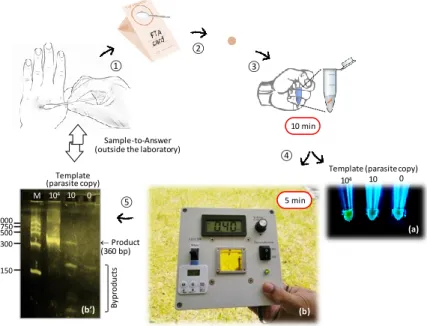
The schematic of the near-to-patient diagnosis is highlighted in Fig.1. First, the sample can be obtained from the patient and is then spotted onto the FTA card and dried. Next, a 2.0-mm-diameter disc is punched from the FTA card, washed and then subjected to liquid RPA reagents supplied with primers targeted to amplify the target gene fragment. This tube is then held in closed fist for 10 minutes to provide the incubation temperature for RPA using body heat. Although the process was simple, the weak true-positive signals amplified in the presence of a low template load (10 parasite copies) could not be distinguished from a negative reaction (no parasite copies) using fluorescent dye. Therefore, the
amplified products from RPA are subjected to rapid and portable gel-based detection using one-inch gel electrophoresis. The expected 360-bp band was clearly obtained with 104 copies. However, byproducts of smaller fragment sizes were also obtained in reactions containing 10 or no copies of template parasites, which could be clearly distinguished from weak true-positive signals using our handheld electrophoretic device. Next, 10 min- Micro-Temperature Gradient Gel Electrophoresis (uTGGE)-type device is utilized, which has a power to distinguish, even a single nucleotide difference between two DNA molecules based on their thermal stabilities and uses the same type of 1-inch gel electrophoretic system. The melting profiles are obtained and species identification dots are assigned.
Pattern similarity scores are then obtained using computer-aided normalization and used to plot a dendrogram. The results can then be submitted to a public database for treatment assessment programmes in epidemic conditions.
Figure 1: Schematic of near-to-patient nucleic acid-based molecular diagnostic tests.
Research Purpose:
Routine healthcare check-ups are important for early stage diagnosis of the disease. This needs the development of systems to monitor healthcare regularly. Thus, the development of simple, affordable and sensitive point of care testing has become the need of the hour to bridge the gap between diagnostics and treatment of deadly diseases prevailing in today’s world. The unavailability of health care resources mainly in the developing world leads to an ever increasing rate of spreading infection from one person to another. However, conventional diagnostic methods such as microscopy, culture-based methods, immunologic tests, non-nucleic acid-based methods and PCR cannot be used in the manufacturing of POCT devices.
In the last decade, a milestone in molecular biology research has been the development of isothermal amplification methods based on some new researches in the molecular biology of DNA/RNA synthesis and their interaction with some accessory proteins. One of the most widely used isothermal amplification methods is recombinase polymerase amplification (RPA) which amplifies the target at
10 min
5 min 104
Template (parasite copy)
10 0
750 (a)
150 300 500
Byproducts
1000
(b’) 104 10 0
Product (360 bp) Template (parasite copy) M
Sample-to-Answer (outside the laboratory)
(b)
37˚C for the detection of infection in just 10-20 minutes. There have been many publications in the last decade, but these developments have a long way to be available commercially mainly due to the lack of suitable sampling and detection methods as well as generation of non-specific amplification which leads to false-positive results for point-of-care purposes. Detection methods such as flocculation assay detection, electrochemical detection, chemiluminescent detection, silicon microring resonator based photonic detection, surface enhanced Raman scattering detection, etc. are either not suitable for point- of-care and low resource settings or are not able to differentiate between specific and non-specific amplification. Gel electrophoresis is the gold standard for the detection of DNA amplification products, although the tedious steps, time consuming protocol as well as the requirement of transilluminators to visualize the DNA bands renders it unsuitable for POC purposes. Moreover, considering the increasing number of cases of Leishmaniasis (Kala azar) in low resource countries, the current diagnostic methods such as microscopic and culture based detection or Leishmanianin skin test are time consuming and require expensive equipment which are generally available at community centres which are often responsible for 119 villages in India, for instance. Therefore, in this dissertation we engaged to develop a rapid and cost-effective method for the detection of leishmaniasis which can also be used for other diseases just by changing few reagents.
This is the first report of a rapid and portable miniaturized system known as one-inch gel electrophoresis based on the previously developed micro-electrophoretic design to perform onsite polyacrylamide gel electrophoresis in less than 10 minutes. Moreover, FTA card has been used for the first time as a direct sampling tool in RPA reaction to the best of our knowledge. We have used the combination of RPA and one-inch gel electrophoretic system for primary identification of leishmaniasis infection. However, further we have also engaged to develop a method for species level differentiation of Leishmania which is instrumental in diagnosing the different forms of leishmaniasis. The advanced detection utilises the formally developed micro-temperature gradient gel electrophoresis4 and RPA using 3-4 target gene sequences. In the future, the methods proposed in this research will be evaluated for clinical samples directly for near to patient diagnosis of leishmaniasis. Being a general method and just the need to change the primers for RPA are advantageous as this approach can easily be used for other targets. Our results demonstrate that the combination of robust RPA with FTA card-based direct sampling tools and portable electrophoretic devices can revolutionize nucleic acid-based molecular diagnostics for people in settings with poor healthcare infrastructure.
Research Accomplishment:
1. Himankshi Rathore, Radhika Biyani, Hirotomo Kato, Yuzuru Takamura and Manish Biyani. Palm-size and one-inch gel electrophoretic device for reliable and field-applicable analysis of recombinase polymerase amplification. Anal. Methods (2019). doi: 10.1039/C9AY01476D
2. Himankshi Rathore, Hirotomo Kato, Yuzuru Takamura and Manish Biyani. Rapid Electrophoretic Typing of Leishmania for Species-level Identification. In preparation.
3. Himankshi Rathore, M. Biyani, Y. Takamura. Development of ‘PCR-on-paper’ based diagnostics for
infectious diseases. 6th ISAJ symposium on Recent Advances in Science and Technology (ISAJ 2015), Tokyo, Japan, Dec 4, 2015 (Poster Presentation)
4. Himankshi Rathore, Yuzuru Takamura, Manish Biyani. ‘Smart pad diagnostics’, An automated Paper- based DNA test for Personal Health monitoring. 26th Anniversary World Congress on Biosensors 2016, Gothenburg, Sweden, May 25-27, 2016 (Poster Presentation)
5. Himankshi Rathore, Yuzuru Takamura, Manish Biyani. Development of Smart Wearable 'PCR-on- Paper' Device for Personal Health Monitoring. The 12th Biorelated Chemistry Symposium (CSJ 2016), Osaka, Japan, Sept 7, 2016 (Poster Presentation)
6. Himankshi Rathore, Yuzuru Takamura, Manish Biyani. PCR-on-paper for Wearable DNA Sensing Device using Recombinase Polymerase Amplification and Body Heat. Symposium, University of Toyama, Toyama, Japan, Sept 15, 2016 (Poster Presentation)
7. Himankshi Rathore, Yuzuru Takamura, Manish Biyani. PCR-on-paper for Wearable DNA Sensing Device using Recombinase Polymerase Amplification and Body Heat. Symposium, University of Toyama, Toyama, Japan, Sept 15, 2016 (Oral Presentation)
8. Himankshi Rathore, Yuzuru Takamura, Manish Biyani. PCR-on-Paper for Affordable Personal Health Monitoring using Recombinase Polymerase Amplification and Body Heat. Biyani International Conference 2016 (BICON 2016), Jaipur, India, Oct 20-22, 2016 (Poster Presentation)
9. Himankshi Rathore, Hirotomo Kato, Yuzuru Takamura, Manish Biyani. Field-applicable biosensing of cutaneous leishmaniasis species by rapid Recombinase Polymerase Amplification and Temperature Gradient Gel Electrophoresis. 9th International Conference on Molecular Electronics and Bioelectroics (M&BE9), Kanazawa, Japan, June 26-28, 2017 (Poster Presentation)
10. H. Rathore, S. Maki, E. Tamiya, Y. Takamura, M. Biyani. Rapid Detection of Leishmaniasis using Solid- phase Recombinase Polymerase Amplification and DEPSOR. JAIST Japan-India Symposium (JISMS2018), Nomi-shi, Ishikawa, Japan, March 5-6, 2018 (Poster Presentation)
11. Himankshi Rathore, Hirotomo Kato, Yuzuru Takamura, Manish Biyani. Biosensing of Leishmaniasis using FTA card as Direct Sampling Tool for Recombinase Polymerase Amplification. Indian Scientist Association in Japan, Symposium 2018 (ISAJ 2018), Tsukuba, Japan, Dec 7, 2018 (Poster Presentation) 12. Himankshi Rathore, Yuzuru Takamura, Manish Biyani. Versatile Electrochemical Sensor for RPA
analysis with Ease. National Institute of Advanced Industrial Science and Technology (AIST) DBT- AIST International Laboratory for Advanced Biomedicine (DAILAB) Workshop 2019, Tsukuba, Japan, Sept 3, 2019 (Oral Presentation)
References:
1 J. Martín-Sánchez, J. A. Pineda, F. Morillas-Márquez, J. A. García-García, C. Acedo and J. Macías, Am.
J. Trop. Med. Hyg., 2004, 70, 545–8.
2 C. N., L. V., G. Valiakos, V. Spyrou, K. Manolakou and C. Billinis, in Leishmaniasis - Trends in Epidemiology, Diagnosis and Treatment, InTech, 2014.
3 O. Piepenburg, C. H. Williams, D. L. Stemple and N. A. Armes, PLoS Biol., 2006, 4, 1115–1121.
4 M. Biyani and K. Nishigaki, Electrophoresis, 2001, 22, 23–28.