総 説
海底下の地下生物圏:過去と現世のリンクを担う 生物地球化学プロセス
高 野 淑 識
*・大河内 直 彦
*,**,***(2010年4月23日受付,2010年8月6日受理)
Deep biosphere and its biogeochemical processes:
a linkage between past and present microbes in sub-seafloor Yoshinori T
AKANO*and Naohiko O
HKOUCHI*,**,****
Institute of Biogeosciences,
Japan Agency for Marine-Earth Science and Technology (JAMSTEC), 2-15 Natsushima, Yokosuka, Kanagawa 237-0061, Japan
**
Department of Environmental Science and Technology, Tokyo Institute of Technology,
4259 Nagatsuda, Midori-ku, Yokohama, Kanagawa 226-8502, Japan
***
Department of Earth and Planetary Sciences, the University of Tokyo, 7-3-1 Hongo, Bunkyo-ku, Tokyo 113-0033, Japan
Deep-sea sediments harbor a novel biosphere with uncultured prokaryotic lineages and their global biogeochemical processes. Exploring these habitats poses interdisciplinary chal- lenges for the biogeochemical and geomicrobiological community. The limits of deep biosphere are on-going subject, which were not yet known in terms of environmental properties, including depth, temperature, energy availability, and geologic age; subseafloor microbes play a signifi- cant role in chemical reactions that were previously thought to have been abiotic processes.
These limits are set by a variety of physical and chemical properties such as temperature, avail- ability of energy and nutrients, pH, pressure, water availability, and salinity. In addition, mo- lecular analyses and cultivation experiments demonstrate a high diversity of microbial life in the sub-seafloor, although the relative abundances and roles of archaea, bacteria, eukarya, and viruses have been largely unknown. Recent intensive researches on deep biosphere revealed that carbon isotopic signatures of sedimentary archaeal membrane polar lipids indicate utiliza- tion of sedimentary organic carbon by the living archaeal community. Further deep drilling of marine sediments and igneous crust offers a unique opportunity to explore how life persists and evolves in the Earth’s deep sub-seafloor ecosystems. Here, we overviewed about historical back- ground of the deep biosphere and its latest progresses in terms of biogeochemical processes to- gether with prokaryotic ecology and limit of life on the Earth.
Key words: deep biosphere, geological setting, physico-chemical condition, prokaryotic ecology,
sub-seafloor biogeochemical processes
* 独立行政法人海洋研究開発機構海洋・極限環境生 物圏領域
〒237―0061 神奈川県横須賀市夏島町2―15
** 東京工業大学大学院総合理工学研究科
〒226―8502 神奈川県横浜市緑区長津田4259
***東京大学大学院理学系研究科
〒113―0033 東京都文京区本郷7―3―1 地 球 化 学 44,185―204(2010)
Chikyukagaku(Geochemistry)44,185―204(2010)
1.は じ め に
海底下の「地下生物圏」には,何が棲息していて,
どこまで広がり,どのような仕組みで成り立っている のか。この問いは,科学者だけではなく,人類共通の ものと捉えられる。1800年代後半には,HMSチャレ ンジャー号の海洋調査などにより,海洋の生態系の知 見が細々と蓄積されていた。1970年後半には,潜水 調査船アルビン号によるガラパゴス海嶺調査で海底熱 水系と周辺に広がる特異な生態系が初めて報告された
(Lonsdale, 1977; Corliss et al., 1979)。同じ頃,日 本周辺でも海底の生態系調査が積極的に行われるよう になり,熱水および冷湧水系の特異な化学合成生物群 集が報告された(e.g., Okutani and Egawa, 1985;藤 倉ら,2008)。1990年代に入り,海底下に広大な「地 下生物圏」が存在していることが徐々に認知されるよ うになり(Gold, 1992),分子レベルで海底下の生物 地 球 化 学 的 な 記 載 を 行 う 手 法 が 広 ま っ た(e.g.,
Parkes et al., 1994; Stevens and McKinley, 1995;
Whitman et al., 1998; Hinrichs et al., 1999)
。一方,陸上では,深部地中処理のアセスメントと併せて,陸 上地殻内の岩石・水文学的調査とともに「地下生物 圏」の研究も進められてきた(e.g., Pedersen and
Ekendahl, 1990; Pedersen, 1993, 1997;
村上・長沼,2000)
。2000年ごろから,分子生物学の本格的な参入が加わり,海底下から採取された試料に応用され,
様々な考え方が導入された(e.g., Parkes et al., 2000;
Boetius et al., 2000; Summit and Baross, 2001;
Orphan et al., 2001; D’Hondt et al., 2002; Kimura et
al., 2003; D’Hondt et al., 2004; Schippers et al.,2005)
。この頃から,日本国内においても海底下の地下生物圏に関する試みから,様々な熱水域・冷湧水 域・付加帯域等の科学提案が議論されるようになった
(加藤・高井,2000;高井・稲垣,2003;長沼,2003;
丸 山・浦 辺,2003;加 藤・永 翁,2005;平,2005;浦 辺ほか,2005)。
「Deep Biosphere」という言葉が徐々に浸透し,
2000年代後半に入ると,更に新しい分析手法の開発
と共に国際的な機運が高まってきた(e.g., Jorgensenand D’Hondt, 2006; D’Hondt et al., 2007; Jorgensen and Boetius, 2007; Pearson, 2008;
浦辺ら,2009;Schrenk et al., 2010)
。どこからが「地下生物圏」で はなく,化学(ガス・水および火成岩,堆積岩,変成 岩等)と物理(温度,圧力,pH等)のみが支配する「非生物圏」となるのか。地球深部での事象につい て,その根源的な問いに答えるための分野の一つが,
「生物地球化学」であり,サンプルへのアクセスの一 つ が,統 合 国 際 深 海 掘 削 計 画(IODP: Integrated
Ocean Drilling Program)や国際陸上科学掘削計画
(ICDP: International Continental Scientific Drill-
ing Program)といった「地球掘削科学」と位置付け
られる。では,具体的に地下生物圏の研究は,どこま で明らかになっているのか。次に新しい展開を図るに は,どのようなアプローチが求められているか。本総 説では特に,ごく最近になって明らかになってきた海 底下の「地下生物圏」について,生物地球化学的な視 点から概観した。2.
全球のエネルギー流量と海底下の 地質学的セッティング2.1 エネルギー流量,海底堆積物の厚さと年齢 まず,全球のエネルギー流量を概観する。太陽定数
(1.37 kW m−2)および地球の表面積から地球大気上 端に入射するエネルギー流量は,最大で350〜400 W
m
−2である(Bishop and Rossow, 1991; ISCCP)。そ の外因性エネルギーの大部分は,太陽での水素の核融 合反応に起因する。一方,地球内部のエネルギー流量 は,平 均 で60 mW m−2と 見 積 も ら れ て お り(e.g.,Hofmeister and Criss, 2005)
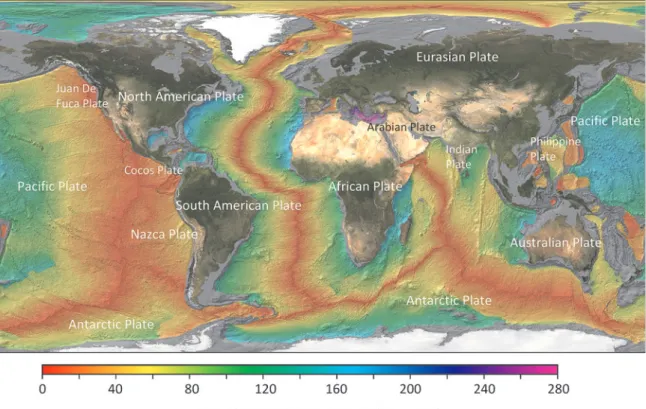
,外因性エネルギーに対 して3〜4桁小さい。地球の内因性エネルギーは,地 球内部での放射壊変に起因し,主にプレート境界で発 散されやすい。海洋底のプレートの拡大速度は,中央 海 嶺 で も っ と も 速 く,最 大15〜20 cm yr−1で あ る(Fig. 1)。拡大速度が速いほど,地球内部エネルギー の発散の場になりやすいことから,プルーム(周辺海 水と化学組成や濁度・温度などの物理的特徴が異なる 物質流)の頻度が高くなる。海水の硫酸は,リチャー ジされる駆動力があれば,ほぼ無限に供給されること から,熱水系周辺では,塊状硫化物の沈殿反応が進 み,熱水鉱床が形成される。また,熱水性の微生物群 集が着生し,それを利用する二次的な微生物・生物群 集が成育している。
プレート拡大軸や島弧火山列では,プレート拡大速 度や形成時期から時間軸が推定できるため,火成活動 に伴う熱水のディスチャージおよび熱水鉱床の分布等 を照合することによって,母岩中もしくは母岩上部に 捕獲された生物群集や地殻内・熱水孔下の地下生物圏 を 理 解 す る こ と が で き る(e.g., Stevens and
McKinley, 1995; Reysenbach and Cady, 2001; Takai
et al., 2004; Edwards et al., 2005;浦辺ら,2005;Fisher et al., 2007)
。スポット的あるいは線的に位置 するプルームは,現世の内部エネルギーを起点として いる。したがって,束縛条件は「化学フラックス」と「熱水循環系(Venting)の寿命」であり,過去から のある時間スケールの中で現世に生きる微生物が恩恵 を受けている(Brazelton et al., 2010)。
次に,海洋底の年齢を
Fig. 2に,海洋堆積物の厚さ
を
Fig. 3に示す。プレートが生まれる中央海嶺は,年
齢が若く,概して遠洋性であるため,堆積物による被 覆が少ない。逆に,プレートの沈み込み帯の付近や大 陸縁辺部の高一次生産海域は,分厚い堆積物に覆われ ている(Fig. 3)。一次生産された有機物のうち,約1
%程度がゆっくり海底にまで沈降し,無機的な生物遺 骸とともに海底に蓄積され,無機物・真核生物・原核 生物に由来する粒子などに過去の水柱記録が残されて いる。このため,大陸縁辺部や高一次生産海域は,堆 積学的な層序を高分解で読み解き,古海洋学的な記述 を行なうには相応しい環境となる。
全球的な外因性の熱流量を考慮すれば,面的な広が りを持つ,一次生産が集約された堆積相の厚い海底下 が,原核生物の生物相密度も比較的高く,現世に生き る微生物にとって過去の恩恵(特に,従属栄養プロセ
ス: Biddle et al., 2006; Lipp et al., 2008)を受けやす い地質学的セッティングと言える。したがって,「現 世」の微生物が,「過去」の層凖に「生きている」と いう構図が明確に見えてくる。どの程度まで深く,過 去の層凖に生きている微生物の活性があるか,という 問いは,これまでも注目されてきた(e.g., 海底下842
m depth,〜55° C,3.5 Ma; Wellsbury et al., 2002)
。 現在,ニューファンドランド沖の海底下1626 mから 生きている活性を示す微生物の報告(60〜100°C, 111 Ma; Roussel et al., 2008)があり,層序学的に「過去」
の時間軸上で「現世」の原核生物が棲息している最深 部の記録とされる。
2.2 海洋の水柱および海底下の微生物相
海洋の有光層では,真核・原核の光合成生物が,基 礎生産者となっている。その生産量は,一次捕食者,
二次捕食者およびウイルスまで含む微生物ループを包 括した水柱中のバイオマスを規定する一次因子になっ ている(ウイルスの役割は,後述)。有光層以深では,
海洋性アーキア(Archaea,古細菌ともいう)のうち クレンアーキオータ(Crenarchaeota)が卓越してお り(Fig. 4),有光層で卓越しているバクテリアとの 棲み分けが観測されている(Karner et al., 2001)。浮 遊性の海棲アーキアは,炭素源について独立栄養性 アーキア(Wuchter et al., 2003: Berg et al., 2010)と
Fig. 1 Comparison between solar energy flux (cf: Solar constant, 1.37 kW m
−2) and indigenous ther-
mal energy flux on the Earth surface (Pollack et al., 1993; Hofmeister and Cris, 2005). Correla- tion of crustal spreading rate and its frequency of hydrothermal plume were also noted (modi- fied from Baker and Urabe, 1996; Baker et al., 1998).
187 海底下の地下生物圏:過去と現世のリンクを担う生物地球化学プロセス
Fig. 2 Age of oceanic lithosphere and present distribution of plate (data from Muller et al., 2008: cour- tesy from E. Lim, NOAA National Geophysical Data Center).
Fig. 3 Marine sediment thickness of the world’s oceans and marginal seas compiled by the NOAA Na-
tional Geophysical Data Center. The data values are in meter and represent the depth to
acoustic basement (http://www.ngdc.noaa.gov).
従 属 栄 養 性 ア ー キ ア(Ouverney and Fuhrman,
2000)の双方が実験的に確認されている。近年,窒
素源については,独立栄養性アンモニア酸化アーキア の動態が,注目されている(e.g., Konneke et al.,2005; Coolen et al., 2007; Nicol and Schleper, 2006;
Francis et al., 2007)
。一方,海底下に生きている全原核生物バイオマスの うち,アーキアが優勢多数を占めているという報告が ある(e.g., Lipp et al., 2008; Biddle et al., 2006, 2008;
Pearson, 2008)
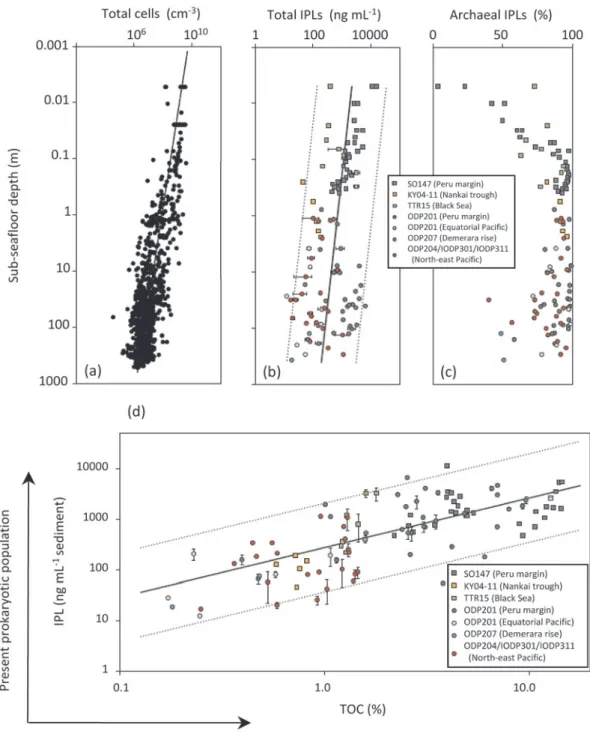
。海底堆積物中で深度とともに全菌数が徐々に減少していくことは,これまで知られていた
(Parkes et al., 2000)。Lipp et al.(2008)による
「アーキアワールド仮説」は,極性頭部に糖質等の官 能基に持つ易分解性の,「現在生きている」あるいは
「ごく最近まで生きていた」とされる原核生物の極性 脂質(Intact Polar Lipids, IPLs)の定量的評価と16S
rRNA
法を併せて検証している。海底堆積物中でのIPLs
の寿命時間に関する推定は,Lipp and Hinrichs(2009)に詳しい。アーキアに由来する
IPLs
の相対 量は,深くなるにつれて増大していることが分かる(Fig. 5-c)。また,堆積物に含まれる全有機炭素の割 合(TOC%)と
IPLs
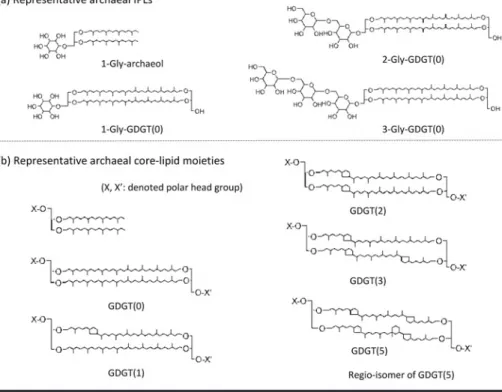
をプロットすると,明瞭な正の 相関が見られた(Fig. 5-d)。アーキア由来の代表的なIPLs
について言えば,コア脂質(Core lipid, CL)のGDGT(glycerol dialkyl glycerol tetraethers)に糖
質鎖であるモノグリコシル基(monoglycosyl-)が結 合していれば,1-gly-GDGTとなり,ジグリコシル基(diglycosyl-)が結合していれば,2-gly-GDGTにな る。こ の 他,糖 鎖 だ け で な く ホ ス ホ グ リ コ ー ル 基
(phosphoglyco-)などの様々な極性官能基を保有す るアーキアが知られている(Fig. 6)。極性頭部が付
いている
GDGTs
は,特にIPL-GDGTs
と呼ばれ,コア脂質だけからなるものを
CL-GDGTs
と呼ぶ。Lipp et al.
(2008)により,海底下で現世に生きてFig. 4 Contour plots of relative abundances with depth of bacteria and pelagic
crenarchaeota during one year sampling effort at the Hawaii Ocean Time- series station, ALOHA, in the North Pacific subtropical gyre. Contour lines are percentages of bacteria and pelagic crenarchaeota as compared with total microbial abundance at each depth. Total cell abundance was assessed using the DAPI nucleic acid stain. Bacteria and archaea were enumerated using whole-cell rRNA targeted fluorescent in situ hybridization with fluorescein- labelled polynucleotide probes (modified from Karner et al., 2001).
189 海底下の地下生物圏:過去と現世のリンクを担う生物地球化学プロセス
Fig. 5 Comparison of vertical distribution in marine sediment for (a) total microbial cells (bac- terial profile: Parkes et al., 2000) , (b) total intact polar lipids (IPLs). Error bars show the standard deviation of repeated injection of total lipid extracts. Regression lines show total microbial IPLs and 95% prediction interval (dotted lines, standard error of esti- mate, 0.60), both of which are generated using least-squares analysis (Lipp et al., 2008).
(c) Relative contribution of archaeal IPLs to total microbial IPLs. The limit of detection was assumed to be the bacterial proportion for samples without detectable bacterial IPLs (Lipp et al., 2008). (d) Correlation of concentrations of IPLs and TOC. Error bars show standard deviation of repeated injection of total lipid extracts. Regression lines show log[IPL]
totalversus log[TOC] (solid line; log[IPL]total=0.979 xlog[TOC]+2.436, N
=101, R2=0.56, P<0.0001, least squares analysis) and 95% prediction interval (Lipp et al., 2008).
Fig. 6 (a) Representative archaeal IPLs and (b) its core-lipid moieties are shown with its core-lipid moieties of di-ether and GDGT (glycerol dialkyl glycerol tetraethers), for example, 1-Gly-archaeol, 1-Gly-GDGT (0), 2-Gly-GDGT (0), 3-Gly-GDGT (0). See also, Sinninghe Damsté et al. (2002), Sturt et al. (2004), Koga and Morii (2007), Koga and Nakano (2008), Roussel et al. (2008), Lipp and Hinrichs (2009). (c) Repre- sentative total ion chromatogram of intact polar lipids (e.g., glyco- and phosphoglyco-GDGTs) from Thermoplasma acidphilus by high performance liquid chromatography combined with electron spray ionization mass spectrometry (HPLC/ESI-MS, Agilent 1100 series) on positive mode, showing IPL separation and its regio-isomers of GDGT moieties (Takano et al., 2010d). Three axis stands for re- tention time (min), m/z, intensity.
191 海底下の地下生物圏:過去と現世のリンクを担う生物地球化学プロセス
いる原核生物は,過去の基礎生産に依存していること が実証され,ペルー沖の既報で示唆されていたアーキ アの従属栄養性(Biddle et al., 2006)が改めて裏付 けられた。この発見は,Sturt et al.(2004)による液 体クロマトグラフ/電子スプレーイオン化/マルチス テージ質量分析法(HPLC/ESI-MSn)の改良や
DNA/
RNA
の新しい抽出・精製法の確立に支えられている(Morono et al., 2009; Lipp and Hinrichs, 2009)。
3.アーキアの多様性,過去の物質収支と
現世の原核生物のリンケージ自然界に分布するアーキアには,未知の部分が多数 残 さ れ て い る(e.g., 古 賀・亀 倉,1998;石 野,
2009)
。1990年前半に海洋性アーキアの存在が示された(DeLong, 1992; DeLong et al., 1994)。海底下の アーキアは,過去に堆積した有機物を起点にしたメタ ン生成,あるいは嫌気的メタン酸化に関わることはよ く知られてきた(e.g., Hinrichs et al., 1999; Boetius et al., 2000)。底質に棲むアーキア(benthic ar-
chaea)のユーリアーキオータ(Euryarchaeota
)の うち,嫌気的メタン酸化 を 担 うANME(Anaerobic Methanotroph) -1,ANME-2,ANME-3と 呼 ば れ る
系統分類群は,硫酸還元バクテリアとコンソーシアム を作ることによって,海底下でメタンを生化学的に分 解している。CH
4+SO42− →HCO
3−+H2O+HS
−すなわち,温室効果ガス「メタン」が海水中に湧き出 るのを面的に防いでいる。
海底下に棲むそれ以外のアーキアは,どうだろう か。コンタミネーションに十分に注意を払ったコア試 料採取を行い,その16S rRNAによる解析で明らかに なってきたように(Fig. 7),海底下のアーキアは,
ユーリアーキオータおよびクレンアーキオータともに 多様性に富んでいる(Fry et al., 2008 and literatures
within)
。この多様性を生み出す要因は,まだ明らかにされていない点が多いが,過去と現世のリンクを担 う存在としてアーキアが重要な役割を果たしているこ とは確実と言える。すなわち,海底下の原核生物は,
続成作用等の無機的なプロセスの進む中で,生化学的 なプロセスを保持している。言い換えれば,生細胞の 各 有 機 物 は,個 々 の 生 化 学 的 機 能 を 果 た し て い る
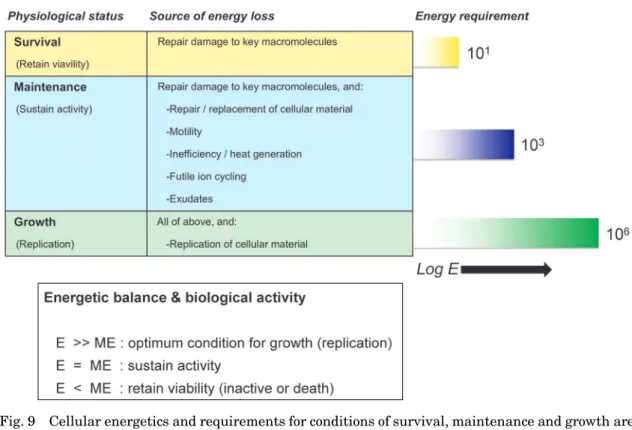
(Fig. 8)。それを細胞レベルの代謝でみた場合,生 き残るために最低限必要なエネルギー(survival en-
ergy)
,恒常性の維持に必要なエネルギー(mainte-nance energy)
,細胞の複製とその成育に必要なエネルギー(growth energy)があり,それらのエネルギー 的要求性は,比率にして1: 103
: 10
6と見積もられてい る(Price and Sowers, 2004; Valentine, 2007)。この エナジェティックスに従えば,供給されるエネルギー 量が,maintenance energyを下回る場合,将来的に 不活性化あるいは細胞死滅を意味する。maintenanceenergy
と 同 等 で あ る 場 合,代 謝 活 動 は 維 持 さ れ,maintenance energy
を大幅に上回る場合,細胞増殖 が可能になる(Fig. 9)。海底下に優勢なアーキアの 性状は,まだ断片的にしか記載されておらず,我々が 記述していない新しい生理機能・適応機能が備わって いる可能性がある(Takano et al., 2010c)。4.
「ウイルス」という存在と生物地球化学1946年に海洋性ウイルスが発見され,1970年代に
微生物ループの概念が提唱された。ウイルス(virus)は核酸と殻タンパク質で構成され,液体を保有する細 胞 構 造 は な く,大 き さ は お よ そ20〜200 nmの「粒 子」である。また宿主細胞の膜に由来する脂質二重膜 の外套に覆われた種類もある。分類体系は,粒子構造 と核酸成分(DNA,RNA,一本鎖,二本鎖など)を 基準としている。ウイルス粒子に代謝機能はないが,
宿主細胞に感染して増殖することができる。細胞を基 本とする生物(原核生物,真核生物)のすべてが宿主 であり,感染することでウイルス遺伝子を子孫に残す 偏性寄生性の生物と規定される(Madigan et al.,
2003)
。生物地球化学的な視点で見たウイルスの研究は,と くに海洋環境での宿主感染,微生物ループや溶存態有 機物(DOM)の動態 解 析 と 併 せ て 進 め ら れ て き た
(e.g., Rohwer and Thurber, 2009)。海洋性ウイルス 由来の脂質バイオマーカー探索もすでに行われている
(Vardi et al., 2009)。原(2006)によると,海洋に 浮遊しているウイルスの大部分は,原核生物(バクテ リア,アーキア)や原生生物(原生動物,微細藻類)
を宿主とするウイルスと考えられており,海水中に は,原核生物の少なくとも数倍から1桁多い程度のウ イルス様粒子が存在する。世界中の海洋のウイルス総 数は,平均で106
/mL
を越え,ウイルス総数は,概し て生物生産の高い海域で多い。ウイルスが感染してか ら増殖・分散するまでの増殖周期は,分単位のものか ら潜伏感染の年単位のものまで様々である。バクテリFig. 7 Community composition of archaeal 16S rRNA genes from various sites and depths in the deep subseafloor biosphere. The profiles were modified from Fry et al., 2008 and compilation from Reed et al., 2002; Inagaki et al., 2003; Kormas et al., 2003; Newberry et al., 2004; Sorensen et al., 2004;
Parkes et al., 2005; Webster et al., 2006; Biddle et al., 2006; Teske, 2006;
Inagaki et al., 2006; Sorensen & Teske, 2006; Roussel et al., 2008). As far as possible, the nomenclatures of subsurface unclassified archaeal groups are based on their first reported use and as reviewed by Teske & Sorensen (2008).
193 海底下の地下生物圏:過去と現世のリンクを担う生物地球化学プロセス
アの死滅要因の10〜40%がウイルスによるものと推 定されており,この細胞分解作用(e.g., Middelboe
and Jorgensen et al., 2006)が供給する溶存有機物の
供給は,海底下においても包括的に考慮していくべき 重要な生物地球化学的プロセスの1つと位置付けられ る(D’Hondt et al., 2007)。5.海底下を流れる「酸化的な水」と
原核生物の呼吸海 底 の 堆 積 物―水 境 界(sediment-water inter-
face)およびその深部では,生物が深く関与する酸化
還元反応が起きている。深度が増すにつれて酸化剤と して働く溶存酸素(O2),硝酸イオン(NO3−)が枯渇 し,や が て 硫 酸 イ オ ン(SO42−)が 徐 々 に 消 失 す る(e.g., Froelich et al., 1979; Fredrickson and
Fletcher, 2001)
。硫酸還元帯よりも深部,つまり更に嫌気的になると,メタン生成帯になる。この境界 は,硫酸イオン―メタン境界(Sulfate-methane in-
terface: SMI
も し く はsulfate-methane transition:
SMT, Fig. 10)と呼ばれ,海底下の一般的な酸化還元
状態を知る手掛かりとなる。SMI以深では,生物起 源のメタンの他,炭素同位体的に軽いエタンの存在も 知られている(e.g., Nakagawa et al., 2003; Hinrichs et al., 2006)。海底堆積物のSMI
は,場所によって100 m
以深になることもある(e.g., D’Hondt et al.,2002; Gay et al., 2010)
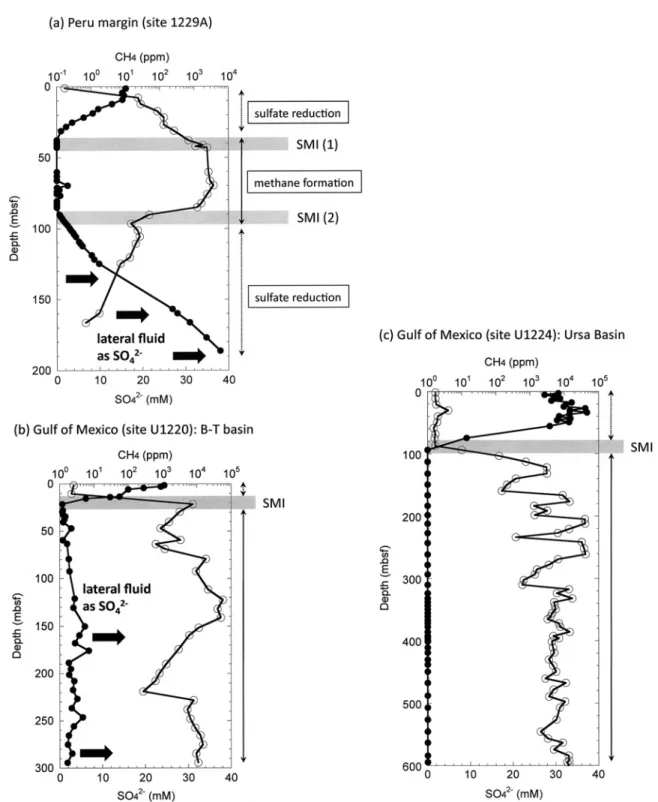
。しかし,SMIよりも深い層 凖の還元環境に酸化剤が再び出現することがある。Fig. 10に示すように,ペルー沖の海底下では,SMI
以深で硫酸イオンが再び出現する深度があり,SMI が2つ存在する(D’Hondt et al., 2004; Parkes et al.,2005; Shipboard Scientific Party of Leg 201, 2003)
。 さらに,理由は明らかにされていないが,同じくペFig. 8 Schematic view and biogeochemical processes in sub-seafloor under diagenesis, catagenesis,
and abiogenesis. Labile organic matter in biogenic and abiogenic pool mainly intermediate be-
tween past and present linkages biogeochemical processes. Compiled by prokaryotic labile or-
ganic component (Neidhardt, 1996; Pietzsch, 2004), abiogenic carbonaceous globule (Berndt et
al., 1996). Photo courtesy: Y. Morono, F. Inagaki, and CDEX, JAMSTEC.ルー沖の海底下の一部では,基盤岩付近で硝酸イオン の増大も確認されている(D’Hondt et al., 2004)。
SMI
以深での「酸化的な水」の存在は,ペルー沖特 有 の 現 象 で は 無 く,メ キ シ コ 湾 や フ ァ ン デ フ ー カ(Engelen et al., 2008)の掘削調査からも明らかに な っ て い る。メ キ シ コ 湾 海 底 渓 谷 に あ る 海 盆 の
Brazoz-Trinity
海盆では,1つのSMI
が存在するが,それ以深でも硫酸イオンが枯渇せず,何らかに起源を 持つ酸化的な間隙水の移動と微生物相の相関が分かっ ている(Shipboard Scientific Party of Exp 308, 2006;
Nunoura et al., 2009)
。Fig. 10の(a)〜(c)で示すSMI
と全く異なる深度プロフィールも一部の深層調 査で報告されている(D’Hondt et al., 2002)。このよ うな海底下を水平方向に移動する「酸化的な水」の存 在は,堆積物中に棲息する原核生物の呼吸とエネル ギー獲得に少なからず影響を与えていると推定されて いる(D’Hondt et al., 2002, 2009; DeLong, 2004)。6.海底下の難培養性微生物と原核生物の
生態解明に向けて:SIP法の可能性 海底下の微生物は,培養が難しい群集と比較的培養しやすい群集が知られる。前者は,とくにアーキアの 群集(e.g., Teske and Sorensen, 2008)が代表的で,
後 者 は 休 眠 胞 子 を 形 成 で き る バ ク テ リ ア(e.g.,
D’Hondt et al., 2004; Teske, 2006)が主体である。
Fig. 11にペルー沖のコア試料を用いて行われた培養
実験で成育したバクテリア群集を示す。全体の53%以上が,細胞壁に分厚いペプチドグリカン層を保有す る グ ラ ム 陽 性 バ ク テ リ ア(Actinobacteria, Fir- micutes)であった。この群集は,細胞壁の構成に必
須である
D―アミノ酸を比較的多く保有していること
が特徴である。すなわち,D―アミノ酸ラセマーゼや トランスフェラーゼは,酵素としての分子構造が維持 され,活性を保持していることが分かる。難培養性で あるアーキア群と培養しやすいバクテリア群は,海底 下で対極となる原核生物である。
海底下における原核生物の生態学を正確に記述して いくことは,前述のような原核生物の性質上,技術的 に難しい面がある。また,実験室において,海底と同 じ物理・化学条件および,それらの微妙な環境勾配を 忠実に再現するには,限界がある。このような問題解 決に向けて,我々は,潜水艇を用いた海底での現場培
Fig. 9 Cellular energetics and requirements for conditions of survival, maintenance and growth are
shown. The ratio of energy requirements (survival: maintenance: growth) has been esti- mated at 1: 10
3: 10
6(e.g., Price and Sower, 2004; Valentine, 2007). E, Energy supply; ME, Maintenance energy.
195 海底下の地下生物圏:過去と現世のリンクを担う生物地球化学プロセス
Fig. 10 Sulfate and methane interface (SMI) in (a) Peru margin at site 1229A (D’Hondt et al., 2004), (b) Gulf of Mexico at Brazos-Trinity basin (Shipboard Scientific Party of Exp 308, 2006;
Nunoura et al., 2009), and (c) Ursa basin (Shipboard Scientific Party of Exp 308, 2006; Gay et
al., 2010). Lateral fluids of SO42−ion beneath SMI were observed in (a) and (b).
養実験と13
C,
15N
標識を用いたStable-isotope prob- ing(SIP)により,堆積物―水境界の原生生物の挙
動理解(e.g., Nomaki et al., 2005, 2008, 2009;Takano et al., 2010d)
,そして堆積物中で起きている 原核生物の生物地球化学的動態を解読しようと試みて いる(Fig. 12)。13C―トレーサーを分子レベルおよび
分子内の部位的同位体組成で注意深く追跡すること で,海洋堆積物に棲息するアーキアの新しい代謝の仕 組みが見えつつある(Takano et al., 2010c)。7.
地下生物圏の限界と非生物圏での 物質進化の可能性原核生物が成育する温度や
pH
などの物理・化学条 件の研究(Rothschild and Mancinelli, 2001)とその 記録更新は,まさに日進月歩である。成育温度につい ていえば,1997年に113°C
(Blochel et al., 1997)へ,続いて121°
C
へ(Kashefi and Lovley, 2003),現在 は122°C(Takai et al., 2008)とされる。温度以外に
も地下の原核生物には,様々な制約がある。我々は,海底下の地下生物圏がどの深度まで広がっているか,
という根源的な問題には,まだ答えられないが,ある 境界を越えると,化学と物理のみが支配する無機的 な「非 生 物 圏」に な る こ と は,自 明 で あ る(e.g.,
Hoehler, 2007)
。岩石と水の存在下で,超高圧・超高温をかけると 様々な揮発性成分や難揮発性成分が非生物的に生成す ることは,以前から知られている(e.g., Berndt et al.,
1996;
鈴木ほか,2009)。大西洋中央海嶺のLost City hydrothermal field
か ら 採 取 さ れ た 炭 化 水 素 は,炭 素・水 素 の 同 位 体 比(δ
D・δ
13C)か ら Fischer-
Tropsch
反応(FT)に由来すると見積もられている(Proskurowski et al., 2008)。すなわち,現世の物質 進化(化学進化)の痕跡らしい兆候が見えている。同
じく
Lost City
の炭酸塩マウンドからは,蛇紋岩が育んでいる特異な生態系(Kelly et al., 2005)や生物起 源の脂質成分が 検 出 さ れ て い る(Bradley et al.,
2009)
。近年,様々な仮説に基づくモデル研究や,より厳密な条件下での実験による検証も進められてい る。初期生命の誕生とその揺らん期には,FT反応や
Strecker
反応に代表されるように,適切なエネルギー源と物質進化の反応場が,不可欠である(Martin et
al., 2008)。しかし,海底下深部の非生物圏で実際に
有機物としての物質進化が起きているかどうかは,観 測や検出の難しさもあり,厳密には不確かな点が多 い。例えば,「アミノ酸」という有機化合物は,生物 的なプロセスと非生物的なプロセス(化学的なプロセ ス)の両方で生成される。その両者をどう識別する か,というような新しい分析法(e.g., Takano et al.,
Fig. 11 Cultured bacterial isolates from Leg 201 sediments in open Pa-
cific site and Peru margin sites (compiled by Takano et al., 2010a from D’Hondt et al., 2004).
197 海底下の地下生物圏:過去と現世のリンクを担う生物地球化学プロセス
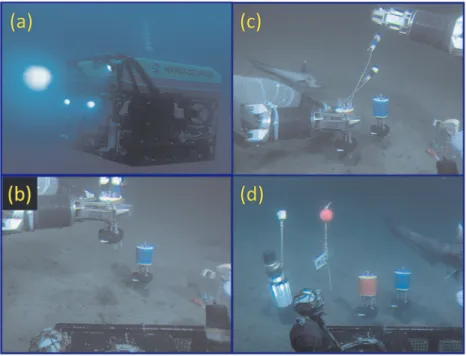
Fig. 12 Schematic apparatus of in situ incubation chamber and a photo-
graph of the experimental setup captured by (a) the remotely oper-
ated vehicle Hyper-Dolphin (photo courtesy: H. Nomaki, JAM-
STEC). (b) deployment of in situ incubation chamber in the deep
sea sediment at Sagami Bay (1453 m below sea-level), (c) injection
of stable isotope tracer (e.g.,
13C-,
15N-substrate), (d) in situ
13C-
incubation experiment for 405 days (Takano et al., 2010c).
2009, 2010a, b)が必要になる。次いで,実際の深層
掘削サンプル解析および物理化学モデルと統合した室 内実験的アプローチが求められていることはいうまで もない(e.g., Takai et al., 2006; McCollom andSeewald, 2007; Martin et al., 2008; McCollom and Bach, 2009)
。今後,海底下の掘削孔内(e.g., Shipboard scientific
party Leg 195, 2002)を用いて,例えば,蛇紋岩海
山の地殻内流体(Fryer et al., 1999; Hyndman andPeacock, 2003; Wheat et al., 2008)のような化学的
動態の把握と併せて,様々な実験的研究(Fig. 13)が行われていくと予想される。海底下での具体的な科 学的検証は,統合国際深海掘削計画(IODP, http://
www.iodp.org/)
,国際 陸 上 科 学 掘 削 計 画(ICDP),Inter-Ridge(http://www.interridge.org/)の よ う な
大型プログラム等との連携が推進力となる。8.お わ り に
本総説では,最近明らかになってきた科学的証拠に 基づいて,海底下の「地下生物圏」を概観した。ここ で述べた,過去と現世のリンクを担う「生物地球化学 プロセス(Biogeochemical process)」は,「原核生物 の 生 態 学(Prokaryotic ecology)」,「生 命 圏 の 限 界
(Limit of life)」と並び,今後の重要な研究課題とな ろう。いずれもチャレンジングな研究であり,それら の体系的な解明には,新しい分析法・解析法の確立お よび異分野と有機的・複合的なリンクが必要になる。
2009年にドイツ・ブレーメンで行われた IODP New
Ventures in Exploring Scientific Targets(IN-
VEST)や事前の国内会議では,Deep Biosphere
を含めた様々な分野横断課題(Interdisciplinary Sub-
ject)の目新しい議論が行われた(川幡ほか,2010)。
Fig. 13 (a) Geological setting of mud volcanoes in the Mariana fore-arc emit serpentine and blueschist that derive from the mantle wedge and subducting plate, respectively. Mineral equilibria in blueschist clasts recovered during Leg 125 constrain the slab to be 150° C to 250° C at 16 km to 20 km. A borehole observatory was installed in one of the serpentine mud volcanoes during ODP Leg 195 to provide fluid samples that derive from the sub- ducting slab (Fryer et al., 1999). (b) Casing configuration for the geochemical observatory installed in Hole 1200C on South Chamorro Seamount (Shipboard Scientific Party of Leg 195, 2002).
199 海底下の地下生物圏:過去と現世のリンクを担う生物地球化学プロセス
また,純然とした基礎科学が果たすべき社会への還元 と い う 視 点 や 具 体 的 な ア プ ロ ー チ も 議 論<http://
www.marum.de/iodp-invest.html>さ れ て い る の
で,そちらも併せて参照して頂きたい。謝 辞
本稿は,北海道大学創成科学機構の斎藤 裕之 博 士および1名の匿名研究者によって査読して頂き,有 用なコメントを頂いた。海洋研究開発機構の山本啓之 博士には,ウイルスに関して議論させて頂いた。本研 究の一部は,科学研究費補助金(Y. T., N. O., 19GS
0211)で行った。
引 用 文 献
Baker, E. T., Massoth, G. J., Feely, R. A., Cannon, G. A. and Thomson, R. E. (1998) The rise and fall of the CoAxial hy- drothermal site, 1993-1996. Journal of Geophysical Research-Solid Earth, 103, 9791―9806.
Baker, E. and Urabe, T. (1996) Extensive distribution of hy- drothermal plumes along the superfast spreading East Pacific Rise, 13°30’-18°40’S. Journal of Geophysical Research-Solid Earth, 101, 8685―8695.
Berndt, M. E., Allen, D. E. and Seyfried, W. E. (1996) Reduc- tion of CO2during serpentinization of olivine at 300 de- grees C and 500 bar. Geology, 24, 351―354.
Berg, I. A., Kockelkorn, D., Ramos-Vera, W. H., Say, R. F., Zarzycki, J., Hugler, M., Alber, B. E. and Fuchs, G.
(2010) Autotrophic carbon fixation in archaea. Nature Re- views Microbiology, 8, 447―460.
Biddle, J. F., Lipp, J. S., Lever, M. A., Lloyd, K. G., Sorensen, K. B., Anderson, R., Fredricks, H. F., Elvert, M., Kelly, T.
J., Schrag, D. P., Sogin, M. L., Brenchley, J. E., Teske, A., House, C. H. and Hinrichs, K. U. (2006) Heterotrophic Archaea dominate sedimentary subsurface ecosystems off Peru. Proceedings of the National Academy of Sciences of the United States of America, 103, 3846―3851.
Biddle, J., Fitz-Gibbon, S., Schuster, S., Brenchley, J. and House, C. (2008) Metagenomic signatures of the Peru Margin subseafloor biosphere show a genetically distinct environment. Proceedings of the National Academy of Sciences, 105, 10583―10588.
Bishop, J. K. B. and Rossow, W. B. (1991) Spatial and tempo- ral variability of global surface solar irradiance. Journal of Geophysical Research, 96, 16839―16858. Seealso, In- ternational Satellite Cloud Climatology Project (ISCCP) from http://isccp.giss.nasa.gov/
Blochl, E., Rachel, R., Burggraf, S., Hafenbradl, D., Jannasch, H. W. and Stetter, K. O. (1997) Pyrolobus fumarii, gen.
and sp. nov., represents a novel group of archaea, extend- ing the upper temperature limit for life to 113 degrees C.
Extremophiles, 1, 14―21.
Boetius, A., Ravenschlag, K., Schubert, C. J., Rickert, D., Widdel, F., Gieseke, A., Amann, R., Jorgensen, B. B., Witte, U. and Pfannkuche, O. (2000) A marine microbial consortium apparently mediating anaerobic oxidation of methane. Nature, 407, 623―626.
Bradley, A. S., Fredricks, H., Hinrichs, K. -U. and Summons, R. E. (2009) Structural diversity of diether lipids in car- bonate chimneys at the Lost City Hydrothermal Field.
Organic Geochemistry, 40, 1169―1178.
Brazelton, W. J., Ludwig, K. A., Sogin, M. L., Andreishcheva, E. N., Kelley, D. S., Shen, C. -C., Edwards, R. L. and Baross, J. A. (2010) Archaea and bacteria with surprising microdiversity show shifts in dominance over 1,000-year time scales in hydrothermal chimneys. Proceedings of the National Academy of Sciences of the United States of America, 107, 1612―1617.
Coolen, M. J. L., Abbas, B., van Bleijswijk, J., Hopmans, E.
C., Kuypers, M. M. M., Wakeham, S. G. and Sinninghe Damste, J. (2007) Putative ammonia-oxidizing Crenar- chaeota in suboxic waters of the Black Sea: a basin-wide ecological study using 16S ribosomal and functional genes and membrane lipids. Environmental Microbiol- ogy, 9, 1001―1016.
Corliss, J., Dymond, J., Gordon, L., Edmond, J., von Herzen, R., Ballard, R., Green, K., Williams, D., Bainbridge, A.
and Crane, K. (1979) Submarine thermal springs on the Galapagos Rift. Science, 203, 1073―1083.
DeLong, E. (1992) Archaea in Coastal Marine Environments.
Proceedings of the National Academy of Sciences of the United States of America, 89, 5685―5689.
DeLong, E., Wu, K., Prezelin, B. and Jovine, R. (1994) High abundance of Archaea in Antarctic marine picoplankton.
Nature, 371, 695―697.
DeLong, E. F. (2004) Microbial life breathes deep. Science, 306, 2198―2200.
D’Hondt, S., Inagaki, F., Ferdelman, T., Jorgensen, B., Kato, K., Kemp, P., Sobecky, P., Sogin, M. and Takai, K. (2007) Exploring Subseafloor Life with the Integrated Ocean Drilling Program. Scientific Drilling, 7, 26―38.
D’Hondt, S., Rutherford, S. and Spivack, A. (2002) Metabolic activity of subsurface life in deep-sea sediments. Science, 295, 2067―2070.
D’Hondt, S., Jorgensen, B. B., Miller, D. J., Batzke, A., Blake, R., Cragg, B. A., Cypionka, H., Dickens, G. R., Ferdelman, T., Hinrichs, K. U., Holm, N. G., Mitterer, R., Spivack, A., Wang, G. Z., Bekins, B., Engelen, B., Ford, K., Gettemy, G., Rutherford, S. D., Sass, H., Skilbeck, C.
G., Aiello, I. W., Guerin, G., House, C. H., Inagaki, F., Meister, P., Naehr, T., Niitsuma, S., Parkes, R. J., Schippers, A., Smith, D. C., Teske, A., Wiegel, J., Padilla, C. N. and Acosta, J. L. S. (2004) Distributions of micro- bial activities in deep subseafloor sediments. Science, 306, 2216―2221.
D’Hondt, S., Spivack, A., Pockalny, R., Ferdelman, T.,
Fischer, J., Kallmeyer, J., Abrams, L., Smith, D., Graham, D. and Hasiuk, F. (2009) Subseafloor sedimen- tary life in the South Pacific Gyre. Proceedings of the Na- tional Academy of Sciences of the United States of Amer- ica, 106, 11651―11656.
Edwards, K., Bach, W. and McCollom, T. (2005) Geomicrobi- ology in oceanography:microbe-mineral interactions at and below the seafloor. TRENDS in Microbiology, 13, 449―456.
Engelen, B., Ziegelmuller, K., Wolf, L., Kopke, B., Gittel, A., Cypionka, H., Treude, T., Nakagawa, S., Inagaki, F. and Lever, M. (2008) Fluids from the oceanic crust support microbial activities within the deep biosphere. Geomicro- biology Journal , 25, 56―66.
Fisher, R. C., Takai, K. and Le Bris, N. (2007) Hydrothermal vent ecosystems -special issue feature. In: Oceanography (edited by Devey, W. C., Fisher, R. C. and Musek, M. K.), 14―171.
Francis, C., Beman, J. and Kuypers, M. M. (2007) New proc- esses and players in the nitrogen cycle: the microbial ecology of anaerobic and archaeal ammonia oxidation.
ISME Journal , 1, 19―27.
Fredrickson, J. K. and Fletcher, M. (2001) Subsurface Micro- biology and Biogeochemistry. Wiley-Liss Inc., New York, p. 341.
Froelich, P., Klinkhammer, G., Bender, M., Luedtke, N., Heath, G., Cullen, D., Dauphin, P., Hammond, D., Hartman, B. and Maynard, V. (1979) Early oxidation of organic matter in pelagic sediments of the eastern equa- torial Atlantic: suboxic diagenesis. Geochimica et Cosmo- chimica Acta, 43, 1075―1090.
Fry, J., Parkes, R., Cragg, B., Weightman, A. and Webster, G.
(2008) Prokaryotic biodiversity and activity in the deep subseafloor biosphere. FEMS Microbiology Ecology, 66, 181―196.
Fryer, P., Wheat, C. and Mottl, M. (1999) Mariana blueschist mud volcanism: Implications for conditions within the subduction zone. Geology, 27, 103―106.
藤倉克則・丸山正・奥谷喬司(2008)潜水調査船がみた深海生 物―深海生物研究の現在.東海大学出版会,1―487.
Gay, A., Takano, Y., Gilhooly, III, W. P., Berndt, C., Heeschen, K., Suzuki, N., Saegusa, S., Nakagawa, F., Tsunogai, U., Jiang, S. Y. and Lopez, M. (2010) Geophysi- cal and geochemical evidence of large scale fluid flow within shallow sediments in the eastern Gulf of Mexico, offshore Louisiana. Geofluids, in press.
Gold, T. (1992) The Deep, Hot Biosphere. Proceedings of the National Academy of Sciences of the United States of America, 89, 6045―6049.
原成光(2006)単細胞生物の死滅要因としてのウイルス.海洋 生命系のダイナミクス3―海洋生物の連鎖(木暮一啓編). 東海大学出版会,pp. 145―161.
Hinrichs, K. U., Hayes, J. M., Sylva, S. P., Brewer, P. G. and DeLong, E. F. (1999) Methane-consuming archaebacteria
in marine sediments. Nature, 398, 802―805.
Hinrichs, K. U., Hayes, J. M., Bach, W., Spivack, A. J., Hmelo, L. R., Holm, N. G., Johnson, C. G. and Sylva, S.
P. (2006) Biological formation of ethane and propane in the deep marine subsurface. Proceedings of the National Academy of Sciences of the United States of America, 103, 14684―14689.
Hoehler, T. (2007) An energy balance concept for habitability.
Astrobiology, 7, 824―838.
Hofmeister, A. and Criss, R. (2005) Earth’s heat flux revised and linked to chemistry. Tectonophysics, 395, 159―177.
Hyndman, R. and Peacock, S. (2003) Serpentinization of the forearc mantle. Earth and Planetary Science Letters, 212, 417―432.
Inagaki, F., Suzuki, M., Takai, K., Oida, H., Sakamoto, T., Aoki, K., Nealson, K. and Horikoshi, K. (2003) Microbial communities associated with geological horizons in coastal subseafloor sediments from the Sea of Okhotsk.
Applied and Environmental Microbiology, 69, 7224―
7235.
Inagaki, F., Nunoura, T., Nakagawa, S., Teske, A., Lever, M., Lauer, A., Suzuki, M., Takai, K., Delwiche, M. and Colwell, F. (2006) Biogeographical distribution and diver- sity of microbes in methane hydrate-bearing deep marine sediments on the Pacific Ocean Margin. Proceedings of the National Academy of Sciences of the United States of America, 103, 2815―2820.
石野良純(2009)特集アーキア:第3の不思議な生物.蛋白質核 酸酵素,54,101―107.
Jorgensen, B. and D’Hondt, S. (2006) Ecology: A starving ma- jority deep beneath the seafloor. Science, 314, 932―934.
Jorgensen, B. and Boetius, A. (2007) Feast and famine- microbial life in the deep-sea bed. Nature Reviews Micro- biology, 5, 770―781.
Karner, M. B., DeLong, E. F. and Karl, D. M. (2001) Archaeal dominance in the mesopelagic zone of the Pacific Ocean.
Nature, 409, 507―510.
Kashefi, K. and Lovley, D. R. (2003) Extending the upper temperature limit for life. Science, 301, 934―934.
加藤千明・高井研(2000)深海極限世界の微生物.宇宙生物科 学,14,341―352.
加藤憲二・永翁一代(2005)地下生物圏.地学雑誌,114,434
―444.
川幡穂高・INVEST国内運営委員会(2010)IODP, INVEST 会議国内報告書.月刊地球,32,67―70.
Kelley, D. S., Karson, J. A., Fruh-Green, G. L., Yoerger, D. R., Shank, T. M., Butterfield, D. A., Hayes, J. M., Schrenk, M. O., Olson, E. J., Proskurowski, G., Jakuba, M., Bradley, A., Larson, B., Ludwig, K., Glickson, D., Buckman, K., Bradley, A. S., Brazelton, W. J., Roe, K., Elend, M. J., Delacour, A., Bernasconi, S. M., Lilley, M.
D., Baross, J. A., Summons, R. T. and Sylva, S. P. (2005) A serpentinite-hosted ecosystem: The lost city hydrother- mal field. Science, 307, 1428―1434.
201 海底下の地下生物圏:過去と現世のリンクを担う生物地球化学プロセス
Kimura, H., Asada, R., Masta, A. and Naganuma, T. (2003) Distribution of microorganisms in the subsurface of the manus basin hydrothermal vent field in Papua New Guinea: Applied and Environmental Microbiology, 69, 644―648.
古賀洋介・亀倉正博(1998)古細菌の生物学.東京大学出版,
1―301.
Koga, Y. and Morii, H. (2007) Biosynthesis of ether-type polar lipids in archaea and evolutionary considerations. Micro- biology and Molecular Biology Reviews, 71, 97―120.
Koga, Y. and Nakano, M. (2008) A dendrogram of archaea based on lipid component parts composition and its rela- tionship to rRNA phylogeny. Systematic and Applied Mi- crobiology, 31, 169―182.
Konneke, M., Bernhard, A., Jose, R., Walker, C., Waterbury, J. and Stahl, D. (2005) Isolation of an autotrophic ammonia-oxidizing marine archaeon. Nature, 437, 543―
546.
Kormas, K., Smith, D., Edgcomb, V. and Teske, A. (2003) Mo- lecular analysis of deep subsurface microbial communi- ties in Nankai Trough sediments (ODP Leg 190, Site 1176). FEMS microbiology ecology, 45, 115―125.
Lipp, J. S., Morono, Y., Inagaki, F. and Hinrichs, K. -U. (2008) Significant contribution of Archaea to extant biomass in marine subsurface sediments. Nature, 454, 991―994.
Lipp, J. and Hinrichs, K. (2009) Structural diversity and fate of intact polar lipids in marine sediments. Geochimica et Cosmochimica Acta, 73, 6816―6833.
Lonsdale, P. (1977) Clustering of suspension-feeding macro- benthos near abyssal hydrothermal vents at oceanic spreading centers. Deep Sea Research, 24, 857―858.
Madigan, M. T., Martinko, J. M. and Parler, J. (2003) Brock Biology of Microbiology, Pearson Education, Inc.
Martin, W., Baross, J., Kelley, D. and Russell, M., (2008) Hy- drothermal vents and the origin of life. Nature Reviews Microbiology, 6, 805―814.
丸山明彦・浦辺徹郎(2003)海底熱水系地下生物圏へのアプ ローチ.地学雑誌,112,309―322.
McCollom, T. and Bach, W. (2009) Thermodynamic con- straints on hydrogen generation during serpentinization of ultramafic rocks. Geochimica et Cosmochimica Acta, 73, 856―875.
McCollom, T. M. and Seewald, J. S. (2007) Abiotic synthesis of organic compounds in deep-sea hydrothermal environ- ments. Chemical Reviews, 107, 382―401.
Middelboe, M. and Jorgensen, N. (2006) Viral lysis of bacte- ria:an important source of dissolved amino acids and cell wall compounds. Journal of the Marine Biological Asso- ciation of the UK , 86, 605―612.
Muller, R., Sdrolias, M., Gaina, C. and Roest, W. (2008) Age, spreading rates, and spreading asymmetry of the world’s ocean crust. Geochemistry Geophysics Geosystems, 9.
Q04006, doi: 10.1029/2007 GC001743.
村上由紀・長沼毅(2000)地下深部に広がる微生物ハビタット
―深部地下生物圏―.Microbes and Environment,15,
125―131.
Morono, Y., Terada, T., Masui, N. and Inagaki, F. (2009) Dis- criminative detection and enumeration of microbial life in marine subsurface sediments. ISME Journal , 3, 503―
511.
長沼毅(2003)極限生物圏.地学雑誌,112,226―233.
Nakagawa, F., Tsunogai, U., Yoshida, N. and Adams, D. D.
(2003) Stable isotopic compositions of bacterial light hy- drocarbons in marginal marine sediments. Land and ma- rine hydrogeology (Eds., M. Taniguchi, K. Wang, and T.
Gamo). Elsevier Science, pp. 141―150.
Neidhardt, F. (1996) Escherichia coli and Salmonella: cellu- lar and molecular biology. Washington DC.
Newberry, C., Webster, G., Cragg, B., Parkes, R., Weightman, A. and Fry, J. (2004) Diversity of prokaryotes and metha- nogenesis in deep subsurface sediments from the Nankai Trough, Ocean Drilling Program Leg 190. Environmental Microbiology, 6, 274―287.
Nicol, G. and Schleper, C. (2006) Ammonia-oxidising Crenar- chaeota:important players in the nitrogen cycle?
TRENDS in Microbiology, 14, 207―212.
Nomaki, H., Heinz, P., Nakatsuka, T., Shimanaga, M. and Kitazato, H. (2005) Species-specific ingestion of organic carbon by deep-sea benthic foraminifera and meioben- thos:in situ tracer experiments. Limnology and Oceanog- raphy, 50, 134―146.
Nomaki, H., Ogawa, N. O., Ohkouchi, N., Suga, H., Toyofuku, T., Shimanaga, M., Nakatsuka, T. and Kitazato, H.
(2008) Benthic foraminifera as trophic links between phytodetritus and benthic metazoans:carbon and nitro- gen isotopic evidence. Marine Ecology-Progress Series, 357, 153―164.
Nomaki, H., Ohkouchi, N., Heinz, P., Suga, H., Chikaraishi, Y., Ogawa, N. O., Matsumoto, K. and Kitazato, H. (2009) Degradation of algal lipids by deep-sea benthic foraminif- era:an in situ tracer experiment. Deep Sea Research Part I , 56, 1488―1503.
Nunoura, T., Soffientino, B., Blazejak, A., Kakuta, J., Oida, H., Schippers, A. and Takai, K. (2009) Subseafloor micro- bial communities associated with rapid turbidite deposi- tion in the Gulf of Mexico continental slope (IODP Expe- dition 308). FEMS Microbiology Ecology, 69, 410―424.
Okutani, T. and Egawa, K. (1985) The first underwater obser- vation on living habitat and Thanatocoenoses of Calypto- gena soyoae in bathyal depth of Sagami Bay. Venus, 44, 285―289.
Ouverney, C. C. and Fuhrman, J. A. (2000) Marine plank- tonic Archaea take up amino acids. Applied and Environ- mental Microbiology, 66, 4829―4833.
Orphan, V., House, C., Hinrichs, K., McKeegan, K. and DeLong, E. (2001) Methane-Consuming Archaea Re- vealed by Directly Coupled Isotopic and Phylogenetic Analysis. Science, 293, 484―487.
Parkes, R., Cragg, B., Bale, S., Getlifff, J., Goodman, K., Rochelle, P., Fry, J., Weightman, A. and Harvey, S.
(1994) Deep bacterial biosphere in Pacific Ocean sedi- ments. Nature, 371, 410―413.
Parkes, R. J., Cragg, B. A. and Wellsbury, P. (2000) Recent studies on bacterial populations and processes in sub- seafloor sediments: A review. Hydrogeology Journal , 8, 11―28.
Parkes, R., Webster, G., Cragg, B., Weightman, A., Newberry, C., Ferdelman, T., Kallmeyer, J., J rgensen, B., Aiello, I.
and Fry, J. (2005) Deep sub-seafloor prokaryotes stimu- lated at interfaces over geological time. Nature, 436, 390
―394.
Pearson, A. (2008) Who lives in the sea floor? Nature, 454, 952―953.
Pedersen, K. and Ekendahl, S. (1990) Distribution and activ- ity of Bacteria in deep granitic groundwaters of south- eastern Sweden. Microbial Ecology, 20, 37―52.
Pedersen, K. (1993) The deep subterranean biosphere. Earth- Science Reviews, 34, 243―260.
Pedersen, K. (1997) Microbial life in deep granitic rock.
FEMS Microbiology Reviews, 20, 399―414.
Pietzsch, J. (2004) Mind the membrane. Nature.
<http: / / www . nature . com / horizon / livingfrontier / back- ground>
Pollack, H., Hurter, S. and Johnson, J. (1993) Heat flow from the Earth’s interior: analysis of the global data set. Re- views of Geophysics, 31, 267―280.
Price, P. B. and Sowers, T. (2004) Temperature dependence of metabolic rates for microbial growth, maintenance, and survival. Proceedings of the National Academy of Sciences of the United States of America, 101, 4631―4636.
Proskurowski, G., Lilley, M. D., Seewald, J. S., Fruh-Green, G. L., Olson, E. J., Lupton, J. E., Sylva, S. P. and Kelley, D. S. (2008) Abiogenic hydrocarbon production at Lost City hydrothermal field. Science, 319, 604―607.
Reed, D., Fujita, Y., Delwiche, M., Blackwelder, D., Sheridan, P., Uchida, T. and Colwell, F. (2002) Microbial communi- ties from methane hydrate-bearing deep marine sedi- ments in a forearc basin. Applied and Environmental Mi- crobiology, 68, 3759―3770.
Reysenbach, A. -L. and Cady, S. L. (2001) Microbiology of an- cient and modern hydrothermal systems. TRENDS in Microbiology, 9, 79―86.
Rohwer, F. and Thurber, R. V. (2009) Viruses manipulate the marine environment. Nature, 459, 207―212.
Roussel, P. E., Lipp, J. S., Fredricks, H. F., Arnds, J., Boetius, A., Elvert, M. and Hinrichs, K. -U. (2008) Intact polar lip- ids of anaerobic methanotrophic archaea and associated bacteria. Organic Geochemistry, 39, 992―999.
Rothschild, L. J. and Mancinelli, R. L. (2001) Life in extreme environments. Nature, 409, 1092―1101.
Roussel, E. G., Cambon-Bonavita, M. A., Querellou, J., Cragg, B. A., Webster, G., Prieur, D. and Parkes, R. J. (2008) Ex-
tending the sub-sea-floor biosphere. Science, 320, 1046―
1046.
Schippers, A., Neretin, L. N., Kallmeyer, J., Ferdelman, T. G., Cragg, B. A., Parkes, R. J. and Jorgensen, B. B. (2005) Prokaryotic cells of the deep sub-seafloor biosphere iden- tified as living bacteria. Nature, 433, 861―864.
Schrenk, M., Huber, J. and Edwards, K. (2010) Microbial Provinces in the Subseafloor. Annual Review of Marine Science, 2, 279―304.
Shipboard Scientific Party of IODP Exp 308 (2006) “Gulf of Mexico Hydrogeology: Overpressure and fluid flow proc- esses in the deepwater Gulf of Mexico: slope stability, seeps, and shallow-water flow, Proceedings of the Inte- grated Ocean Drilling Program (IODP ), Vol. 308, College Station TX (Integrated Ocean Drilling Program Manage- ment International , Inc . ) . doi : 10.2204 / iodp . proc.308.101.2006.
Shipboard Scientific Party of Leg 195 (2002) Leg 195 Sum- mary. Proceedings of the Ocean Drilling Program, Initial Reports, 195, 1―63.
Shipboard Scientific Party of Leg 201 (2003) Controls on mi- crobial communities in deeply buried sediments, eastern Equatorial Pacific and Peru Margin sites 1225-1231, Pro- ceedings of the Ocean Drilling Program, Initial Reports, 201, 1―81.
Sinninghe Damste, J. S. S., Schouten, S., Hopmans, E. C., van Duin, A. C. T. and Geenevasen, J. A. J. (2002) Crenarchaeol: the characteristic core glycerol dibiphy- tanyl glycerol tetraether membrane lipid of cosmopolitan pelagic crenarchaeota. Journal of Lipid Research, 43, 1641―1651.
Sorensen, K., Lauer, A. and Teske, A. (2004) Archaeal phylo- types in a metal-rich and low-activity deep subsurface sediment of the Peru Basin, ODP Leg 201, Site 1231.
Geobiology, 2, 151―161.
Sorensen, K. and Teske, A. (2006) Stratified communities of active archaea in deep marine subsurface sediments. Ap- plied and Environmental Microbiology, 72, 4596―4603.
Stevens, T. and McKinley, J. (1995) Lithoautotrophic micro- bial ecosystems in deep basalt aquifers. Science, 270, 450
―454.
Sturt, H. F., Summons, R. E., Smith, K., Elvert, M. and Hinrichs, K. U. (2004) Intact polar membrane lipids in prokaryotes and sediments deciphered by high- performance liquid chromatography/electrospray ioniza- tion multistage mass spectrometry - new biomarkers for biogeochemistry and microbial ecology. Rapid Communi- cations in Mass Spectrometry, 18, 617―628.
Summit, M. and Baross, J. (2001) A novel microbial habitat in the mid-ocean ridge subseafloor. Proceedings of the Na- tional Academy of Sciences of the United States of Amer- ica, 98, 2158―2163.
鈴木勝彦・中村謙太郎・加藤真吾・山岸明彦(2009)海底熱水 循環系の生物地球化学的理解に向けた実験的アプローチ.
203 海底下の地下生物圏:過去と現世のリンクを担う生物地球化学プロセス
地学雑誌,118,1131―1159.
Takai, K., Gamo, T., Tsunogai, U., Nakayama, N., Hirayama, H., Nealson, K. H. and Horikoshi, K. (2004) Geochemical and microbiological evidence for a hydrogen-based, hy- perthermophilic subsurface lithoautotrophic microbial ecosystem (HyperSLiME) beneath an active deep-sea hy- drothermal field. Extremophiles, 8, 269―282.
Takai, K., Nakamura, K., Toki, T., Tsunogai, U., Miyazaki, M., Miyazaki, J., Hirayama, H., Nakagawa, S., Nunoura, T. and Horikoshi, K. (2008) Cell proliferation at 122°C and isotopically heavy CH4production by a hyperthermo- philic methanogen under high-pressure cultivation. Pro- ceedings of the National Academy of Sciences of the United States of America, 105, 10949―10954.
Takai, K., Nakamura, K., Suzuki, K., Inagaki, F., Nealson, K.
H. and Kumagai, H. (2006) Ultramafics-Hydrother- malism-Hydrogenesis-HyperSLiME (UltraH3) linkage: a key insight into early microbial ecosystem in the Archean deep-sea hydrothermal systems. Paleontological re- search, 10, 269―282.
高井研・稲垣史生(2003)地殻内微生物圏と熱水活動.地学雑 誌,112,234―249.
Takano, Y., Chikaraishi, Y., Ogawa, O. N., Kitazato, H. and Ohkouchi, N. (2009) Compound-specific nitrogen isotope analysis of D-, L-alanine and valine: application of diastereomer separation toδ15N and microbial peptido- glycan studies. Analytical Chemistry, 81, 394―399.
Takano, Y., Chikaraishi, Y. and Ohkouchi, N. (2010a) Enantiomer-specific isotope analysis (ESIA) of D- and L-alanine: nitrogen isotopic hetero- and homogeneity by microbial process and chemical process. Earth, Life, and Isotopes (edited by N. Ohkouchi, I. Tayasu, and K. Koba).
Kyoto University Press, pp. 387―402.
Takano, Y., Kashiyama, Y., Ogawa, O. N., Chikaraishi, Y.
and Ohkouchi, N. (2010b) Isolation and desalting with cation-exchange chromatography for compound-specific nitrogen isotope analysis of amino acids. Rapid Commu- nication of Mass Spectrometry, 24, 2317―2323.
Takano, Y., Chikaraishi, Y., Ogawa, O. N., Nomaki, H., Morono, Y., Inagaki, F., Kitazato, H., Hinrichs, K. -U.
and Ohkouchi, N. (2010c) Sedimentary membrane lipids recycled by deep-sea benthic archaea. Nature Geoscience, 3, 858―861.
高野淑識・力石嘉人・大河内直彦(2010d)微量湿式分析によ る分子レベル同位体比の品質管理と確度向上:特に天然存 在比の正確な評価とStable Isotope Probing(SIP)法の応
用に向けて.Researches in Organic Geochemistry. In press.
平朝彦(2005)マントル生命を探せ―「ちきゅう」の挑戦―.
石油技術協会誌,70,305―314.
Teske, A. P. (2006) Microbial communities of deep marine subsurface sediments: Molecular and cultivation surveys.
Geomicrobiology Journal , 23, 357―368.
Teske, A. and Sorensen, K. B. (2008) Uncultured archaea in deep marine subsurface sediments:have we caught them all? ISME Journal , 2, 3―18.
浦辺徹郎・丸山明彦・丸茂克美・島伸和・石橋純一郎(2005)
アーキアン・パーク計画が明らかにしたもの.海の研究,
14,129―137.
浦辺徹郎・沖野郷子・砂村倫成・石橋純一郎・高井研・鈴木勝 彦(2009)海底下の大河―海洋地殻内熱水循環の多様性と 生物地球化学プロセス―.地学雑誌,118,1027―1036.
Valentine, D. L., (2007) Adaptations to energy stress dictate the ecology and evolution of the Archaea. Nature Reviews Microbiology, 5, 316―323.
Vardi, A., Van Moo-y, B. A. S., Fredricks, H. F., Popendorf, K.
J., Ossolinski, J. E., Haramaty, L. and Bidle, K. D. (2009) Viral glycosphingolipids induce lytic infection and cell death in marine phytoplankton. Science, 326, 861―865.
Wheat, C., Fryer, P., Fisher, A., Hulme, S., Jannasch, H., Mottl, M. and Becker, K. (2008) Borehole observations of fluid flow from South Chamorro Seamount, an active ser- pentinite mud volcano in the Mariana forearc. Earth and Planetary Science Letters, 267, 401―409.
Webster, G., Parkes, R., Cragg, B., Newberry, C., Weightman, A. and Fry, J. (2006) Prokaryotic community composition and biogeochemical processes in deep subseafloor sedi- ments from the Peru Margin. FEMS microbiology ecol- ogy, 58, 65―85.
Wellsbury, P., Mather, I. and Parkes, R. (2002) Geomicrobiol- ogy of deep, low organic carbon sediments in the Wood- lark Basin, Pacific Ocean. FEMS microbiology ecology, 42, 59―70.
Whitman, W. B., Coleman, D. C. and Wiebe, W. J. (1998) Pro- karyotes: The unseen majority. Proceedings of the Na- tional Academy of Sciences of the United States of Amer- ica, 95, 6578―6583.
Wuchter, C., Schouten, S., Boschker, H. T. S. and Sinninghe Damsté, J. S. S. (2003) Bicarbonate uptake by marine Crenarchaeota. FEMS Microbiology Letters, 219, 203―
207.