Ecological Research: Original Article
Larval nutritional environment determines adult size in Japanese horned beetles Allomyrina dichotoma
Kenji KARINO,* Natsuki SEKI and Mutsumi CHIBA
Department of Biology, Tokyo Gakugei University, Koganei, Tokyo 184-8501, Japan
Running head: Effect of larval nutrition in a beetle
*Corresponding author: Kenji Karino, Department of Biology, Tokyo Gakugei University, Nukui-kita 4-1-1, Koganei,
Tokyo 184-8501, Japan
Tel. +81-42-329-7520 Fax. +81-42-329-7737
E-mail address: [email protected]
The effects of larval nutrition and parental size on offspring horn (male) and body size (male and female) were examined in the Japanese horned beetle Allomyrina dichotoma L.
(Coleoptera: Scarabaeidae). Offspring-parent regressions for both horn size and body size of males show no heritable effect, and the magnitudes of these traits were primarily determined by the larval nutritional condition. Male A. dichotoma also displayed dimorphic horn size-body size allometry, i.e.,
larger males had longer horns relative to their body size and vice versa. Because it has been suggested that males of
different body sizes adopt different reproductive tactics, the dimorphic horn size-body size allometry and male reproductive tactics are also a result of the larval environment. Similarly, female body size was determined by larval nutrition, and, thus, larval condition may influence future female fecundity.
Females under low nutrition treatment spent longer duration of the third larval instar than females under high nutrition.
Probably females under poor nutrition attempted to be larger as much as possible by the extent of larval duration. Since horn and/or body sizes of males and females affect their fitness, this suggests the evolution of female choice for better oviposition site.
Key words: Horned beetles; trait size; nutritional
environment; heritability; larval duration.
Introduction
It is well known that some beetles exhibit remarkable sexual dimorphism, e.g., males possess longer horn(s) or larger mandibles but females have none or only smaller such traits (Darwin 1871; Andersson 1994). These male horns or mandibles are often used as weapons in male-male competition (Eberhard 1982; Andersson 1994). In general, males with larger horns are better competitors in intermale combat for access to females and/or other resources (Conner 1988, 1989; Emlen 1997b). Horn size often varies among individuals and it usually increases sigmoidally with male body size (Eberhard 1982; Eberhard &
Gutierrez 1991; Emlen 1994; Moczek 2002; Hongo 2003).
It has been shown in some horned beetles that male horn and body sizes are determined by larval nutritional condition (Emlen 1994, 1997a; Moczek 1998, 2002; Moczek & Emlen 1999).
For example, Emlen (1994) documented that horn length of the dung beetle Onthophagus acuminatus (Coleoptera: Scarabaeidae) was primarily determined by food quantity during the larval period, but not by paternal horn size. In these dung beetles, females dig vertical tunnels beneath dung and form ovally-
shaped ‘brood balls’ using dung pieces at the end of the
tunnels (Emlen 1994; Moczek 1998). Females spawn a single egg in a brood ball, which is subsequently consumed by the hatched larva. Therefore, the larval nutritional condition may be constrained by the size of the brood ball.
In contrast to dung beetles, in the Japanese horned beetle
Allomyrina dichotoma L. (Coleoptera, Scarabeidae, Dynastinae),
females lay their eggs in the soil in a scattered fashion, and
their larvae feed freely on the humus around them (Iguchi 1998). Hence, many factors, such as the quality and quantity of humus, number of food competitors, and the amount of litter supplement from trees, may affect the larval nutrition of A.
dichotoma. Iguchi (1998) examined the relationship between nutritional condition at larval period and male horn/body sizes, and found males with good larval nutrition had larger bodies and horns than those with poor nutrition. However, this experiment could not exclude genetic effects on male size,
because the specimens were randomly collected from the natural habitat (Iguchi 1998). Moreover, the two nutrition treatment groups were obtained and reared in different years, hence
involved different cohorts (Iguchi 1998). It is also possible that the difference in male size between the two groups
resulted from other factors, such as a difference in humus quantity and quality between the years.
In the present study, we examined the influence of both the genetic component and nutritional environment during larval period on adult male horn and body sizes in A.
dichotoma using parent-offspring regressions and nutritional manipulation experiments. Although female body size in insects usually influences their fitness component via fecundity
(Clutton-Brock 1988), very little information is available on the determinant factors of female body size in horned beetles (e.g., Hunt & Simmons 2000). In order to clarify the
importance of maternal body size and larval nutritional condition on female body size, we also performed a similar experiment for females. In addition, since Shafiei et al.
(2001) have demonstrated the effect of nutritional condition
on larval duration in the dung beetle Onthophagus taurus, we examine the influence of nutrition treatment on larval
duration also in A. dichotoma. Considering with the factors determining male and female trait sizes, we discuss the
importance of larval environment on sexual and natural selection and possible adaptive parental behavior.
Methods
Insects
Female A. dichotoma spawn their eggs into humus in the soil during July-September. Larvae feed on the surrounding humus, develop to the third instar and pupate in the soil during June-July of the next year (Iguchi 1998). Adults usually
emerge from late June until September. Thus, A. dichotoma has a 1-year life cycle.
Male A. dichotoma have horns protruding from both the head and prothorax, with the head horn being longer (Siva-Jothy 1987). In this experiment, we used head horn length as an indicator of horn size, and elytra length as an indicator of body size. Both characteristics were measured to the nearest 0.05 mm with a vernier caliper. Male horn length varied
sigmoidally with elytra length (Fig. 1; also see Hongo 2003 in detailed analysis of male dimorphism) as observed in other horned beetles having horn dimorphism (e.g., Eberhard 1982;
Emlen 1994; Moczek 2002). Since females of this species have
no horns, we measured only elytra length for females.
Experimental procedures
We collected third instar larvae from a forest in Ueda, Nagano, central part of Japan, in April 1998 and 1999. These larvae were reared individually to adulthood in the laboratory. After measuring horn and/or elytra lengths, 29 adult males (elytra length; 18.40-33.40 mm) and 29 adult females (elytra length;
23.50-25.55 mm) were chosen as parents for the experiment. We set a pair of a given male and female and placed them in
separate plastic aquaria (36 x 21 x 25 cm) filled to about 18 cm depth with humus. Adults were fed apples as food and
sprayed with water once per day. They were maintained in their aquaria at 26-28°C until natural death. By maintaining
isolated parental pairs, we could easily obtain offspring from the same parents. Individual offspring were reared separately from the first or second instar until the end of the
experiment in small cages (13 x 21 x 25 cm) in order to avoid cannibalism and competition for food.
Offspring were randomly divided into the two nutrition treatments: high nutrition (HN) condition and low nutrition (LN). Larvae from the HN group were reared in cages fully filled with humus, and those from the LN group were reared in cages containing humus and the soil consisted by red earth
(Green Tec Inc.) in a 1:1 ratio. We replaced the humus and red
earth with the new ones once a month for both groups. We used
humus (Japan Tobacco Inc.) which consisted of only Quercus
acutissima (Fagales: Fagaceae) litter to maintain constant
food quality. We measured the duration of the third larval instar in number of days from the moult to the third instar to pupation for each individual. After all individuals emerged as adults, male head horn length and elytra lengths of males and females were recorded.
Statistical analysis
From 17 parental pairs, we obtained 1-9 male siblings for each treatment group. Similarly, from 20 parental pairs, we
obtained 2-10 female siblings for each treatment group. We took the mean horn and/or elytra lengths from each treatment group within each parental pair brood for further analyses.
All data showed the normal distribution (Kolmogorov-Smirnov one-sample test, P > 0.2), so parametric statistics were used.
In order to clarify any heritable effect, father-son and
mother-daughter regressions were conducted for each treatment group separately. Significant regressions would suggest a heritable component for variation in offspring horn and body sizes, and the heritability (h
2) can be estimated by twice the regression slope when one parent is considered (Falconer &
Mackay 1996). In addition, we examined offspring-parent
regressions by using a mid-parent value; in this analysis, the heritability can be estimated as the slope of the regression (Falconer & Mackay 1996). To examine the effect of nutritional condition on offspring horn and body sizes, we conducted
paired t-test (two-tailed) between the mean values of for both
nutrition groups for siblings within both sexes.
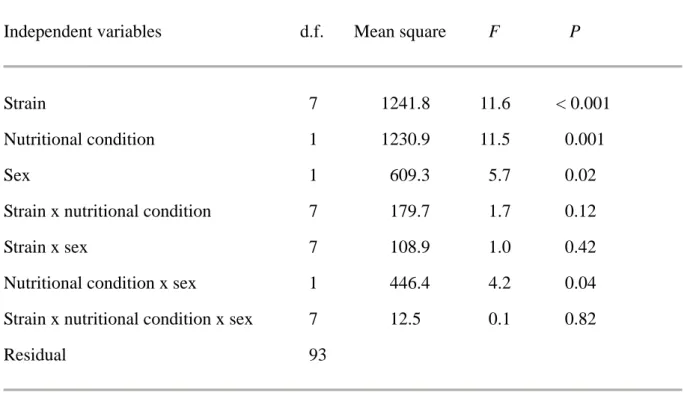
In order to examine the effect of nutritional condition on larval duration, we conducted ANOVA with the duration of the third larval instar as the dependent variable and with strain (parents), nutrition treatment and sex of offspring as
dependent variables. We conducted this analysis only for 8 broods in which both male and female offspring could survive until adulthood.
Results
Father-son regressions showed no significant relationships in either nutrition groups for both horn size and body size
(Table 1; Fig. 2). When mean values of all male siblings from each parental pair were examined regardless of nutrition
groups, heritable variation was also not detected for both horn length and body size (Table 1). We also performed a regression analysis using mid-parent body size, but the
regressions were not significantly different from 0 for HN or LN groups, or combined data (Table 1). Thus, no heritable contribution to male horn and body sizes could be detected in this experiment.
On the other hand, the larval nutrition treatment
remarkably affected male horn and body sizes (Fig. 2). Horn
length of the HN group (mean ± SD = 19.46 ± 3.80 mm, n = 17)
was significantly longer than that of the LN group (11.76 ±
2.98 mm, n = 17; paired t-test, t =5.88, P < 0.001). Male
elytra length of the HN treatment (25.96 ± 1.32 mm, n = 17)
was also much greater than that of the LN treatment (22.24 ±
1.72 mm, n = 17; paired t-test, t = 6.56, P < 0.001).
Similarly, a maternal heritable effect on female body size could not be detected. Mother-daughter regressions were not significant both in HN and LN treatments (Table 1; Fig. 3), or combined data (Table 1). Even using mid-parent value,
significant regressions were not found in either the HN, LN or combined data (Table 1).
Female body size was also primarily determined by larval nutrition treatment. Females reared under the HN treatment had longer elytra (mean ± SD = 24.53 ± 1.77 mm, n = 20) than those from the LN treatment (22.23 ± 2.07 mm, n = 20; paired-t test, t = -4.73, P < 0.001; Fig. 3).
These results indicate that the determinant factor of both male and female trait sizes is the nutritional condition of the larval environment rather than a genetic effect in A.
dichotoma.
ANOVA demonstrated the significant effect of strain on the duration of the third larval instar (Table 2). Therefore, larval duration may be determined by genetically to a certain degree. Effects of nutrition treatment, sex and the
interaction between nutritional condition and sex on larval duration were also significant (Table 2). Females spent longer larval duration as the third instar than males (Fig. 4).
Individuals under the LN treatment spent longer larval
duration than those of the HN treatment (Fig. 4). Nevertheless, the significant effect of nutritional condition disappeared
when ANOVA was conducted for data only from males (strain, F
7,40