Simulated Annealing Programming Using Effective Subtrees
Yuichiro UEDA* , Mitsunori MIKI** and Tomoyuki HIROYASU***
(Received October 20, 2008)
Simulated Annealing Programming (SAP), an automatic programming method, is an extension method of Simulated Annealing (SA) that allows SA to handle tree structures. In this method, the point to exchange is chosen randomly, and the subtree to insert is also generated randomly. In this paper, we propose the method that finds out effective subtrees in search and that uses them to generate subtree for inserting. The proposal method can perform search more efficiently than standard SAP in Santa Fe trail problem and Symbolic Regression problem.
Key words automatic programming, program search, genetic programming, simulated annealing, effective subtrees
!"$#%'&()*#,+
-./01
243457698 :7;9<9= >7?9@ ACB
D E7FHGJI9K L MON9P9I Q7R9SUT4V9S9W E7R9S
XHY[Z]\_^_`ba_c_d]e_`bf_g_h]i
1. jklm
no&oprqstuvwxyz{t}|~
t | wx } q
,$
x
z ¡¢£¤
x¥¦§qno&
p
¨©
ª wx«¬z}¦ z t¯® °
¡|wxy±
x²o
x}q«¬³z $
³q´µ,±¶r}o
·
Genetic Programming: GP¸ 1)¥ ³!o"$#%'&o(
* Graduate Student, Department of Knowledge Engineering and Computer Sciences, Doshisha University, Kyoto Telephone:+81-774-65-6921, Fax:+81-774-65-6716, E-mail:[email protected]
** Department of Knowledge Engineering and Computer Sciences, Doshisha University, Kyoto Telephone:+81-774-65-6930, Fax:+81-774-65-6716, E-mail:[email protected]
*** Faculty of Life and Medical Sciences, Doshisha University, Kyoto
Telephone:+81-774-65-6932, Fax:+81-774-65-6019, E-mail:[email protected]
)¹*¯#º+¯¯¯¯¯¹¯
·
Simulated Annealing Programming: SAP¸ 2) »¼½ x
GP¿¾yÀ z ry³¿´yµ xy GP
q¹¯
§¯ÁÂ
¯ÃÄ
ADF3)¥¯ÅÇÆ
/ 0¯1 È
É
´¯µ 4)ʹ#Ë(q¹Ì¯Å¯Í¡¹Î¯Ï½ÂÑÐÒ 5) zÇ{¡
«yÓ³q .ÔÕ
tÖ×,¶$xض¶
GP
}
ÙÚ
¡Û
yqÜÝÞ
³ß
¡
àá
wxãâåä#pçæ
è
xä#p
qé
ê
¥Ösëìq àá
¡Ûz
Ä GPqí
á
qîïð
±
x 6)
SAP ä# pq è xÐÒÇt
z´µ
Ä ,¡«yÓ³
»¼,$
² SAP
äy#p
è
³x±³zÂ
GP ±q
x 2)¶¶ q SAP¡Ãxq è
µ¡ ¶$
$
Ã, ¡
è
¶$² /01
ty y¡ ,¶$²yÐ !ðo¡" #wox
µ
±
xq²o
.Ô
¡ Ù%$
z&
x
'
(
¡
-.
z
/01 ·) *
-
.¯/¯0¯1
±,+.-
¸
t¯0/¯¡
É
Û0¯Æ¹w
µÇt2103¹
t è wx
/y01
¡³£,¶r 4ywxy±
SAP
qq .ÔÕ
t5x
2. 6789
:%;½=<>@?ABC DBE
7
AB
F
SAPG SAP
SAt
1 H I J
3x«¬¡K L,¶$²´µ
x
)M
¡ SAPq)NO+ÞtPwØ
STEP 1 QRS q
è
QRS
t¡
è
¶
'
qTUts½¬
STEP 2
è VW
× Xoq
S
¡³£,¶$
GPqY Z [ \,±]q^ªt³s
±
_
¶$
S ` a t è
¶$
'
tT Uwxcb
d
o¡
Fig. 1¡P'¶$²o«o¬³¡³× Xoq
S
¡³£,¶ro
¡Y Z [ \ð
·
Ð !ð
¸
t ,¶$
'
qðte
±$wx /01
tf gwx
'
qhØ ¡ /01
t è
¶f g½¶² /0
¡"#wx
mutation point ųᲢrandomlyᲣ
select delete a subtree insert new subtree generate randomly
Fig. 1. Generation Method in SAP.
STEP 3 i
Wj
kl
× Xq
S
qT U m
E ±
_
¶$
S ` a
qT U m
E0 ±
q2n
0
∆E(=E0−E)ÃÇ«2o.p¯Í T t¹ÎÇ¡
_ ¶
S ` a t i W
wxq
j ·i
W j ¸
ts,¬ i
W j ¡
q
(1)¡Pw MetropolisÎ r 7) tx
PAC=
1 if∆E≤0
exp(−∆ET ) otherwise (1)
STEP 4 s #½+
STEP2 Ão«to 3t
R
ìu Äwv'¶ ² hytpyÍ
T
tx
Â$wx
s
#,+hqpÍ
Tk+1
q ·
2¸
¡«Óy
wx
Tk+1=γTk (0.8≤γ <1) (2)
γ
z{
Ô
Ä
Tk
× XqpÍ
x
STEP 5 |}
j
STEP2~ 4t ²§s3t |} wx
3.
(
GPq
¾À
z #
s
îï
x Santa Fe trailîï 1)ëo Symbolic Regression
îï 1) t£ ½±¶$² Santa Fe trailîï
H
Ý
,p$
È è
wxîïwoz
S
tT Uwx
¡Ös
$
z³Ê#(
%$³
x& qyxîï
x Symbolic Regressionîï
H
ݺp¯
È è
¶zîïwz w qÊ#(
S q
TU¡twîï
x
3.1 Santa Fe trail
Santa Fe trailîï½± 1 q. Fig. 2(a)
¡Pw 32 32 q
t
¡
¿
² t
² %¡ N£¢y#£¤
o'
x ¥£Á ¦
w,xo
ooot è
w'xoîï
ox 1)zyÃow
q ,t ¦ w
o
%§
¶² ±w'x¨
| ©
ª¬«
{IF FOOD AHEAD, PROGN2, PROGN3}
|©
ª®«
{LEFT, RIGHT, MOVE} x IF FOOD AHEAD
¯
§ot 2Û °%³} oq
1
±
¡
² 1¯ §tz ² 2¯ §t
Ö¯s¯wx¯
PROGNn.¯ §Çt n³ °0¹.² 1 ¯ §¯
² 2
¯
§¯ · · ·² n
¯
§Çq´¡¹Öswx¯
(
îï
IF FOOD AHEADqµ ¶¡«Ä
H
Ý,p
¯
È è
wÇx
$
²T.U¹§
Eval
Çq·¯§
¦
¶$² q§
F t
¯
²¢q
Ä 0t³í ¸ S
±wxíx
Õ
îï
x
3.2 Symbolic Regression
Symbolic Regressionî¹ïº± n¹ q2#Æ2º.»¯#
¼
Ç,½.¾Çq.¹§
fobj t.
wÇx¯î¹ï
¯x 1) (
q
(3)¡Pw%§ fobj
t
wx
'
q
§ fobj
qt Fig. 2(b) ¡PwØ
fobj(x) =x4+x3+x2+x (3)
¨
|©
ª«
¿ sin cos exp rlog
|©
ª«Ç
x
x -1 1qìt 0.1 ¡
¶² 21³ q#.º¡£wÇxƺ.nq£.mq·
0.001
) M
z
§
¶²½±wxíx
Õ
îï
x
(
îï
H
Ý,p$
È è
¶z
(a)Santa Fe trail
(b)Symbolic Regression
Fig. 2. Test Problems.
4.
(
¯
SAPq¹¯¬.Çt x µ±
¶$
-./01
¡
¶$²o
) M
$
-./0
1
t $"!oÆwx
µ¡Ûy
ª
¶$ #yq -.
/01
t4,¶²
»¼
´µ¡Û
ª
wØ
4.1 "$%
SAPÇ . è q ¯¯.¯ ¡2".#
1 t è
¶Ñ¯.¯¯¡2Y.Z.[.\¯ð
·
Ð.!¯ð
¸
t2.¯wÇx¯
¶¶$
-./01
t4
o
.Ô
z
R"&
xض¶$}
{q«¬z /0
1 -.
xt j'
wx±
()
x
GP
Ç
ÅÆ
/¯0¯1¯È
É
´¯µ 4)¥Çʹ#Ë(Ñq̯
ůÍÇ¡¹Î¯ÏºÂÑÐ¯Ò 5) zÇ{ ¹»¯¼ºÑ ¯Çx ±.
GPqÁðt*½¶²´¯µ
x² SAP¡
¸
h
+", 0"- ¨
| © ª «
¡
%$
xî
î¹ïÇ¡ ¸¯ z¹Ç ¯
SAP ¡
Ã%x
-.y/01
q $"!oƵ,±¶$" #
1
¡
¶²
µt
»¼
wx
y
è
qT U m
.0/$
²21"3
" # 1
¡ -.
x&
4
 ' ¬ z
123
-y.
z¿ &
54
yo±r'¬w1 3y¡³ÎyÏ'Â
(
) M
q 36"7 q
/01
t
-./y01
q
8
±¶13²
9
type A: TUm .0/ ²¡"#,¶² /01
9
type B: T U m
.;/$
² ¡" #'¶$² /0y1
q
<
Ê# (te½±wx /01
9
type C: ª 267 q
/01
" #
1 ' q
$ $
T Uo¡
á
z t5=%3
x& y " # 1 t
Ú
«Ä á z
/01
T U¡
á
z ot=%3x&
?>
q /01
T U¡
á
z t=%3³x& t12@,¶$²
²
x
4.2 "
-./0y1
q4
µ,±¶$ A
Ô
¡" #
1
¡4
wx´µt
»¼
wx
¡«Ä
è
V W
t
¡sÓ³y² ´µo«Ä¢
.Ô
z
R"&
o
xyq
»y¼
´yµq2By³# DC #prt
Fig. 3¡P
¶$
) M
¡
»¼
´µqb
d
z)N%O+$Þt
ª
w
Yes
Yes
No
No
No start
set initial parameter delete a subtree criterion of using an effective subtree
use an effective subtree generate a subtree randomly generate
acceptance criterion transition
criterion of archiving an effective subtree Yes
archive an effective subtree
terminal criterion Yes
end No
Fig. 3. Algorithm of Proposal Method.
1 q!Æ
è V W
¡Ã
/01
t" #,¶$²yT U mq
n 0
∆E 0 «ÇÄ,x ¹zÓ²1 3¯
-¯.¯/ 0¯1
t
)#Ýä¡3x
2
-./01
q
_
)#ÝoäÜÝÞ
yt %3x1"3
yt %3
x§ ¥%)³#Ýä
/y01
tf gwxy f gwx
/01
)#Ýä /" #,¶$² T U m
.
/
¶$²"3
/01
´¡,Äg'Â
¡«
Ä«oÄ -y.
z
/y0y1
)³#yÝäy¡'Är¥yw'³zyxy
3
-./01
q"#
" #wx
/01
}Î
(
¡
,±]y
¡ è
¶A
Ô
¡
-./01
t"#
1
±wx
5.
5.1
»¼
´µo¡Ã%x
-y./01
t wx²³
»¼
´ µ± ¬ ´ µqts ¬ s §
100
x £ îï
3
ª
¶$²îï
Ä
100s%/í ¸ S t ²§ ·§
Ô ¸
±wx³
²#
¼
¡Û§
Santa Fe trailî
ï
40 Symbolic Regressionîï 20
±¶pÍ
Santa Fe trailîï 4 Symbolic Regressionîï 0.5"! ¶$² 2)zà »¼ ´
µo¡³Ãyy)³#Ýoä³ÜyÝÞot
10 è ¶r² -.y/
01
q"#A Ô t
20%±¶²
5.2 #$
Ö%,±¶
100s%/q § Ô q&'t Fig.
4¡2P¯wØz¹Ã¯
Fig. 4/¯q (a) Santa Fe trail î
ï¯ (b)
Symbolic Regressionî¹ïÇ¡Ã0¯x(
yxy
$ ²
Fig. 4)* ¡ § Ô (+ * ¡³ ³§t
PwØض$²
Ó³"B
/-,
{ /
t./w
x
Fig. 4«Ä>£Çîï¡£º¶
»¼
´µ
.
´µ«Ä¢
4
§ Ô t
xض$²
Ó³
»¼
´µ
´µo«Ä .yÔ
z³t³s,¬o±
x
±103x
¶¶$
-./01
q 8
¡«yÓ³
'
q
\z
Ä Santa Fe trailî³ï
"#
1 q t
-.y/0y1
±
¶r²y´yµ
¢}Ó±³¢
«o Symbolic Regression
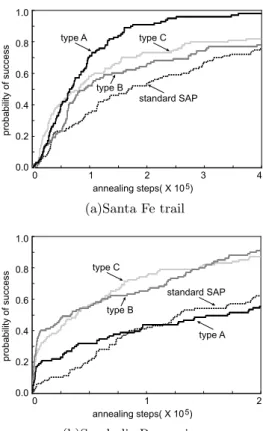
1.0
0.8
0.6
0.4
0.2
0.00 1 2 3 4 annealing steps( X 10 )5
probability of success
type A type C
standard SAP type B
(a)Santa Fe trail
1.0
0.8 0.6
0.4
0.2
0.00 1 2 annealing steps( X 10 )5
probability of success
type A type C
standard SAP type B
(b)Symbolic Regression
Fig. 4. Probability of Success.
îï
o
" # 1 q <
ʳ#($te,±$wox /0y1
t
-.y/
0¯1
± ¶Ñ²¯´ µ
íÇ¢ .
«¯Ó²Ç
¡¯«ÇÄ
-./01
q 8
£îï¡23wx±103x
6. 45
76
-./01
q 8
¡Ã xÊ#( §q&
'ot Fig. 5¡Pywz³Ã Fig. 5/q (a)
Santa Fe trailîï (b) Symbolic RegressionîÃx
yxy
$ ²
Fig. 58)* ¡yÊ# ( §(+ * ¡
§tPw
Fig. 5«Ä $ Santa Fe trailîï " # 1 q
t
-y./0y1
±¶$²21"3qyÊ#( §
yx
qm
¡9:,¶$yxq¡£,¶$
' );
q 8
Ê#(
§
(<"=
¡
àá
¶¯x¯
Ç
Santa Fe trail î
ï H
yÝ,p$
È è
wxîï
yx²
-
./0y1
t" # 1 t
yÚ
«Ä á z
/01
± 8 wox
±
H
yÝ,p$t
yÚ -./01
t è w
x2&..
4
¹z¯x²Ç2¥º±,103Ç
x¯¯q¹²Ç¹
Ê#( § àyá
¶?#%yz " #
1 q t
-y./01
±
8
¶$²´µ
Santa Fe trail îï¡Ã
-.
z
t
²½±=1%3
x
Ø¡ Symbolic Regressionîï
Ø
6´}µ ± ¢Ê #
(ç§
x
qm¡9:'¶
àá
¶?#%yz}
H
Ýo,p$
È è
¶zîï
yx²
±1%3
x
'
¶$q123 " # 1 q <
Ê#($t
e,±$wox /01
t
-.y/01
± 8
¶$²´yµ
í¢
-
.
zt
²±$" # 1 t
Ú
«Ä
á z /
01
¡ -.
¡
±=13
x
)
«oÄ SAPo " #
1 t
yÚ
«oÄ á z
/y0y1
¡ á
z t=%3x± 0%3x
'
¶$
H
Ý'p$
È è
woxîï
yq /0y1
¡
H
Ý,p$t
Ú
& ¢
à
3xcoÓ³
H
Ý
,p$y
È è
¶zoî£,¶$
" # 1 q <
ʳ#
($te,±$wox /01
t H
yÝ,p$
È è
wx
îï
" #
1
t
'
-y./01
± 8 wx
± -.
x±103x
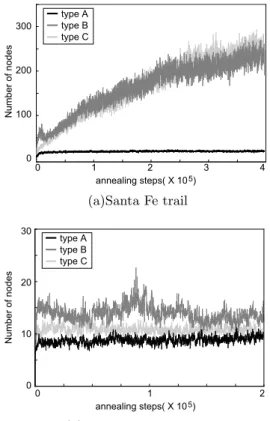
300
200
100
0
0 1 2 3 4 annealing steps( X 10 )5
Number of nodes
type A type B type C
(a)Santa Fe trail
30
20
10
00 1 2 annealing steps( X 10 )5
Number of nodes
type A type B type C
(b)Symbolic Regression
Fig. 5. History of Program Size.
7. l
(
SAPq è
µq .0/
±¶
-./01
t $"!ƶ4ywx´µt
»y¼
¶$² §
»¼ 4 t
²
$
² yÝo,pr
è
wx Santa Fe trailîï
"#
1 t
-.¯/01
± 8
¶Ñ²¢q
H
¯Ý½pÑ
È è
¶¹z Symbolic Regression
îï
o
" # 1 q <
ʳ#($te,±$wox /0y1
± 8 ¶
²¢q
'
í¢
.Ô
oztwxo±
²«yÓ³£ îïq ¡¤,$
-./01
q
8
tÌ
0
x±
»¼
´µ
«Ä .Ô
z
ts3x±tPw±
²
4
1) J. R Koza, Genetic Programming: On the Pro- gramming of Computers by Means of Natural Se- lection, MIT Press, 1992.
2) , 1 , ( , ¾ , ³!
" #y%& (r)¿*# +³t³²' y³
”, â
V W ! "
æ , Vol.48, pp. 88–102, 2007.
3) J. R Koza, Genetic Programming II: Automatic Discovery of Reusable Programs, MIT Press, 1994.
4) T. Asai, K. Abe, S. Kawasoe, H. Arimura, H.
Sakamoto, S. Akikawa, Efficient Substruc- ture Discovery from Large Semistructured Data”, Proc. of the 2nd SIAM Intl. Conf. on Data Min- ing, pp. 158–174, 2002.
5) D.Katagiri, S. Yamada, Speedup of Evolution- ary Behavior Learning with Crossover Depend- ing on the Usage Frequency of a Node”, IEEE International Conference on Systems, Man, and Cybernetics, 1999, No. 5, pp. 601–606, 1999.
6) #$%& , â#('æ , )*
á
Æ,+ , 2001.
7) N. Metropolis, A. Rosenbluth, M. Rosenbluth, A. Teller, E. Teller, Equation of State Calcu- lation by Fast Computing Machines”, Journ. of Chemical Physics, Vol. 21, pp. 1087–1092, 1953.