妊娠初期の血清葉酸値とBirth defectsリスクとの関連
研究代表者 岸 玲子 北海道大学環境健康科学研究教育センター 特別招へい教授 研究分担者 水上 尚典 北海道大学大学院医学研究科
生殖・発達医学講座産科・生殖医学分野 特任教授 研究分担者 馬場 剛 札幌医科大学医学部産科周産期科・生殖内分泌科 講師 研究分担者 千石 一雄 旭川医科大学医学部産婦人科学講座 教授
研究分担者 有賀 正 北海道大学大学院医学研究科・小児科学分野 特任教授 研究分担者 花岡 知之 北海道大学環境健康科学研究教育センター 客員教授
研究要旨
[Background] 妊娠初期の低赤血球葉酸濃度は神経管閉鎖不全を引き起こす可能性があ
る。しかし,神経管と発生器官が同じである先天性心疾患や口唇裂(口蓋裂併発含む)
と葉酸濃度との関連は不明のままである。そこで,妊娠初期の血清葉酸値とbirth defects リスクとの関連を検討した。[Methods] 北海道スタディ大規模コホートに 2002〜2012 年 に 参 加 登 録 し た 20,926 人 の 妊 娠 初 期 血 清 葉 酸 値 を chemiluminescent enzyme
immunoassay を使用して測定した。解析対象者は22週以降に出産した単胎児のうち,
適格基準を満たした母子14,763組である。血清葉酸濃度とbirth defectsリスクとの評価 はmultivariate logistic regression analysisによって解析した。[Results]妊娠初期血清 葉酸値の中央値 (四分位範囲) は16.5 (13.4–21.5) nmol/L,deficiency (<10.0 nmol/L), possible deficiency (10.0–13.4 nmol/L), optimal levels (≥13.5 nmol/L) はそれぞれ 6.6%,19.7%,73.7%であった。optimal levelsに対するdeficiency levelsのany birth defectsリスクは,交絡要因調整後1.23 (95% confidence interval [CI]: 0.81, 1.87) , circulatory system 1.23 (95% CI: 0.81, 1.87),genital organs 1.31 (95% CI: 0.68, 2.55), urinary system 2.36 (95% CI: 0.77, 7.24),そしてmusculoskeletal system 1.39 (95% CI:
0.49, 3.99) ,all CHDs 1.39 (95% CI: 0.72, 2.71), septal heart defects 1.30 (95% CI:
0.55, 3.06),ventricular septal defects 1.72 (95% CI: 0.72, 4.11)であったでリスク上昇傾 向がみられた。口唇裂の調整後ORは0.26 (95% CI: 0.03, 2.03)でリスク低下があった(口 唇裂casesは少数であった)。しかし,いずれも有意な差はみられなかった。 [Conclusions]
本研究では,妊娠初期の血清葉酸値濃度とbirth defectsリスクとの有意な関連はみられ なかった。しかし,本研究は妊娠初期の血清葉酸濃度とbirth defects との関連を説明す る基礎的研究になると考える。
A.研究目的
Birth defects は新生児死亡の主要死因 であり,birth defectsを持つ子どもだけで はなく,その家族の quality of life をも 脅かす公衆衛生上の重要な課題である。1,
2 Birth defects の病因は染色体異常や遺 伝子によるものよりも多因子遺伝による ものが多いが,その病因の多くは不明のま まである。
葉酸はメチオニンサイクルに不可欠な 一炭素単位転移,およびDNAメチル化に 必要なメチル基ドナーとしても必須の栄 養素である。3 葉酸は多因子遺伝によって 引き起こされる神経管閉鎖不全の原因と なる遺伝子発現を調節・阻止したり,ある
いは胚の生存を高め,正常な器官形成を維 持するための葉酸輸送障害による悪影響 を克服するのに役立つ。4 葉酸欠乏はホモ システイン増加を引き起こし,高ホモシス ティンレベルは葉酸の機能を妨げる。その 結果,DNAメチル化パターンの不規則な 発達が器官発生期における胚の致死およ び発達異常を導く。3
妊娠前の葉酸摂取は神経管閉鎖不全の 子どもを出産するリスクを減少させるこ とが 1980〜90 年代の世界各地での大規 模疫学研究によって報告された。5–7 その ためアメリカ,カナダ,コスタリカでは 1998 年から穀物への葉酸添加が義務付け られ,その後 3–6年でNTDs の子どもの 出生が19–46%減少した。8 しかし,神経 管 が発生す る神経 堤細胞 から発 生す る congenital heart defects (CHDs)9–12 や orofacial clefts13–16 と葉酸摂取との関連 はまだ明確ではない。17 つまり,器官形成 期の葉酸レベルと NTDs 以外の birth
defects との関連は不明のままである。
妊婦の葉酸摂取とbirth defects との関連 評 価 し た 研 究 の 殆 ど は case-control studies5–15,18,20–22であり,出産後に妊娠中 の 葉酸摂取 情報を 得てい る。こ れに は recall bias を含む可能性がある。また,
葉酸摂取の評価では体内葉酸量を正確に 反 映 し て い る と は 言 い 難 い 。 他 に も case-control studyにより出産後の血清あ るいは赤血球葉酸値を測定し CHDs や orofacial clefts21,23–30との関連を評価した 研究もある。しかし,出産後の葉酸濃度測 定では,器官形成期の葉酸濃度との関連を 評価できるものではない。2つの前向きコ ホート研究が妊娠期の血清葉酸値とbirth
defects との関連を評価している。一つは
妊娠中期 (妊娠第 15–18 週) の血清葉酸 値とCHDsや cleft lip with/without cleft 研究協力者
伊藤 久美子
(北海道大学大学院医学研究科 社会医学講座公衆衛生学分野)
宮下 ちひろ,小林 澄貴,田村 菜穂美
(北海道大学環境健康科学研究教育センター)
長 和俊,山田 俊
(北海道大学病院周産母子センター) 宮本 敏伸
(旭川医科大学産婦人科学講座) 研究協力機関
青葉産婦人科クリニック,秋山記念病院,
旭川医科大学病院,えんどう桔梗マタニテ ィクリニック,王子総合病院,帯広協会病 院,帯広厚生病院,北見赤十字病院,勤医 協札幌病院,釧路赤十字病院,慶愛病院,
五輪橋産科婦人科小児科病院,市立札幌病 院,札幌医科大学附属病院,札幌東豊病院,
札幌徳州会病院,白石産科婦人科病院,中 標津町立病院,名寄市立総合病院,函館五 稜郭病院,函館中央病院,はしもとクリニ ック,朋佑会札幌産科婦人科,北海道大学 病院,公立芽室病院,市立稚内病院
palate (CL ± P)14,24 との関連を評価し,
いずれも関連はみられないと報告してい る。もう一つの前向き研究では,妊娠初期 の血清葉酸値(中央値)は birth defects の ある子どもの母親は,birth defectsのない 子どもの母親よりも有意に低かったこと を報告している。25 妊娠期の葉酸値と birth defects との関連は議論の余地が大 いにある。日本においては,前向き研究に より葉酸濃度とbirth defects との関連を 評価した研究はない。そこで,我々は前向 きbirth cohort study により妊娠初期血 清葉酸値とbirth defectsとの関連を明ら かにすることを目的に研究を行った。
B.研究方法 1.対象
北海道スタディに 2002 年 2 月から 2012年5月までに北海道の大学病院から クリニックなどの37産科施設を受診して いる妊娠初期 (妊娠第13週未満)の参加登 録妊婦20,926名。
2.方法
(1) Data collection
ベースライン時に自記式質問紙調査に より年齢,出産回数,社会経済状況(教育 年数,世帯年収),既往歴,既往妊娠歴,
妊娠前の身長・体重,妊娠初期の喫煙習慣,
飲酒習慣,服薬およびビタミンサプリメン トの使用,生殖医療の経験,そしてbirth
defects 家族歴についての情報を得た。妊
娠前後のサプリメントに関する情報は,種 類,回数,期間を得た。本研究では葉酸サ プリメントを葉酸単独サプリメント(厚生 労働省の推奨量が 1 日で摂取できる葉酸 を主要成分としたサプリメント),マルチ ビタミン剤を含む何らかの葉酸を含有し
ているサプリメント(葉酸含有サプリメン ト),葉酸含有のマルチビタミン剤に分類 した。
妊娠初期の血清葉酸値を測定するため に空腹時静脈血を採取した。血清葉酸値は 外部委託(SRL, Inc. Tokyo, Japan) によ り the ADVIA Centaur techniqueを使用
し , chemiluminescent
enzyme immuno-assay (CLEIA) に よ って測定した。
出生児情報は出生7日以内に,出生結果 (miscarriage, stillbirth and live birth, singleton or multiple),性別,出生時体重,
在胎週数,birth defects有無を出産施設の 産婦人科医師から得た。さらに,生後 1 歳,
2 歳時の母親への調査票を使用して birth
defects 情報を得た。本研究では,多胎出
産および妊娠第22週未満の出産は解析か ら除外した。
(2) Definition and Classification of Birth Defects
Birth defects は the International Classification of Disease 10th revision (ICD 10)16 により分類した。また,CHD は 次 の 5 subgroups に 分 類 し た ;1) isolated septal defects (単独の心室中隔 欠 損 症 , 単 独 の 心 房 中 隔 欠 損 症 ),2) conotruncal heart defects (大血管転移 症,Fallot 四徴症, 総動脈幹症,両大血管 右室起始症),3) left-sided obstructive malformation( 大動脈弁狭窄症,左心室 低形成症,大動脈縮窄症,大動脈弓離断症,
4) right-sided obstructive malformations(肺動脈弁狭窄,肺動脈閉 鎖症,三尖弁閉鎖症,Ebstein 奇形,5)
other CHDs (重複心奇形,単心室,単独
の 動 脈 管 開 存 症 )。 7,8,10 さ ら に ,
folate-related birth defects として神経 堤細胞から発生する器官の birth defects である NTDs,5–7 CHDs, 9,8 orofacial clefts , 15,17 hypospadias , 26 limb reduction defects27 を設定した。
Birth defects 有無が不明瞭,染色体異 常,遺伝子病,副耳や鼠径ヘルニア等の微 細な形態異常だけの場合,birth defects の発生器官が 2 つ以上の場合は解析から 除外した。Birth defect選択・分類は新生 児医師の助言を受けて実施した。最終的な 解析対象者は14,763組の母子である。
(3) Statistical Analysis
血清葉酸値をdeficient (<10.0 nmol/L), possibly deficient (10.0–13.4 nmol/L), optimal (≥13.5 nmol/L)の3分類にした。
28 母親の出産時年齢は <20,20–24,25– 29, 30–34,≥35 歳に区分した。妊娠前 BMI(kg/m2) は , underweight (<18.5 kg/m2),normal weight (18.5–24.9 kg/m2), obese (≥25.0 kg/m2)に分類した。その他の 母親の背景因子は,教育年数(≤12 years,
>12 years),世帯年収(<5 million yen, ≥5 million yen),出産経験(0, ≥1),妊娠初期 の飲酒習慣 (yes, no),妊娠初期の喫煙習 慣の有無 (yes, no),生殖補助医療の使用 (yes, no),糖尿病既往 (yes, no),習慣性 流産既往(yes, no),birth defects 家族歴 (yes, no),妊娠初期の服薬の有無 (yes, no),妊娠初期の葉酸単独サプリメント使 用の有無(yes, no),葉酸含有サプリメント 使用の有無 (yes, no),マルチビタミン剤 使用の有無 (yes, no)である。
妊 娠 初 期 の 血 清 葉 酸 レ ベ ル と birth defects リスクとの関連では any birth defects ,ICD 10th に よ る 器 官 別 , folate-related birth defectsとその主要な phenotypeを解析した。
血清葉酸値レベルと母親属性との検討 で は ,Chi-squared ,Fisher s exact tests,one-way analysis of variance
(ANOVA)を使用した。血清葉酸レベルと
birth defects リ ス ク と の 評 価 で は , optimal level をリファレンスとして,
deficiency,possibly deficiency levelのリ スクを二項多重ロジスティック回帰分析 に よ り odds ratios (ORs) と 95%
confidence intervals (CIs) を算出した。
交 絡 因 子 は 出 産 時 年 齢 (continuous
variable),出産回数,教育年数,妊娠前
のBMI (continuous variable),妊娠初期 の喫煙習慣,飲酒習慣,服薬である。有意 水準は両側検定による P values <0.05 , 95% CIs は1.0 を含まないものとした。
統 計 解 析 に は SPSS for Windows (version 21.0; IBM Corp., Armonk, NY, USA)を使用した。
(倫理面への配慮)
本研究は,北海道大学環境健康科学研究 教育センターおよび北海道大学大学院医 学研究科・医の倫理委員会の承認を得た。
本研究によって得られた個人名及び個人 データの漏洩については,データの管理保 管に適切な保管場所を確保するなどの方 法により行うとともに,研究者の道義的責 任に基づいて個人データをいかなる形で も本研究の研究者以外の外部の者に触れ られないように厳重に保管し,取り扱った。
C.研究結果
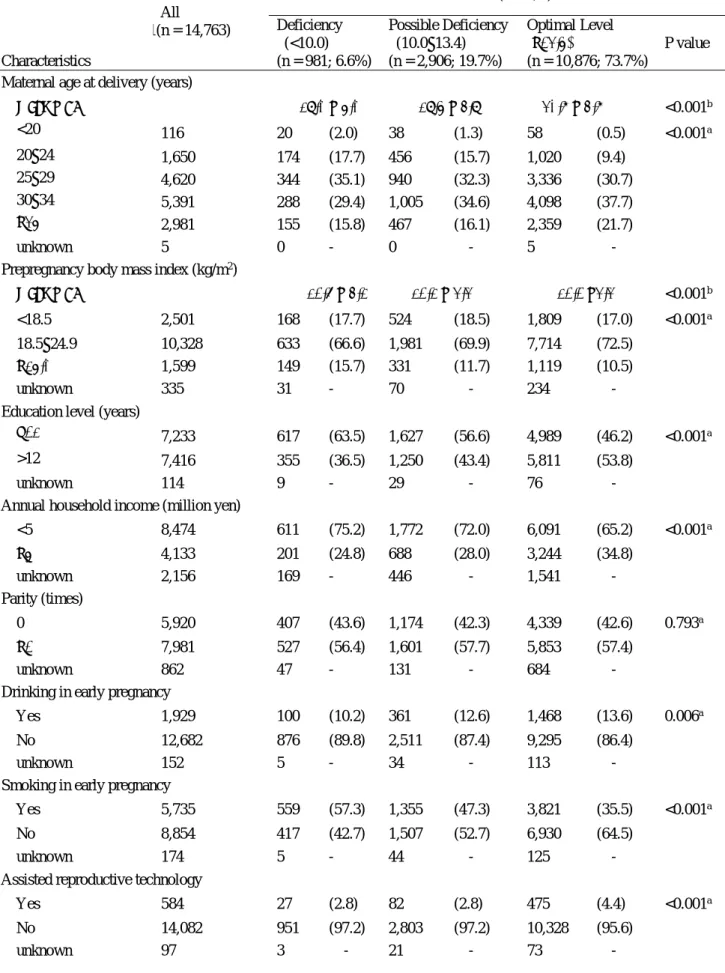
1. 母親の属性と妊娠初期血清葉酸レベル 血清葉酸値の中央値(四分位範囲) は 16.5 (13.4 – 21.5) nmol/L,血清葉酸レベ ル の deficient, possible deficient, optimal levelsの人数(%)はそれぞれ981
名(6.6%),2,906 名 (19.7%),10,876 名 (73.7%)であった (Table 1)。出産時年齢が 24 歳 未 満 は optimal levels よ り も deficiency levelsが多かった (P < 0.001)。
Deficient は有意に教育年数や世帯年収が
少なく(P < 0.001),生殖医療の使用者(P <
0.001)や習慣性流産の既往(P = 0.019) , 妊娠初期の喫煙者が多かった(P < 0.001)。
Obese mothers は underweight や normal weight mothers よ り も 有 意 に deficient が多かった(P < 0.001)。妊娠初 期 の 葉 酸 含 有 サ プ リ メ ン ト 使 用 者 は 22.7% で,deficient は葉酸含有サプリメ ントの不使用者に有意に多かった(P <
0.001)が,葉酸含有サプリメント使用者の
中でもdeficient が 67名 (2.0%) いた。
2. Birth defects と血清葉酸レベル
Birth defectsを持つ児は342名であっ た。ICD 10th 分類ではcirculatory system defects が最も多く130名,次にgenital organ defects 63名であった (Table 2)。 疾患ではventricular septal defects が61 名で最も多かった。birth defectsを持つ子 どもの母親とbirth defectsを持たない子 どもの母親の妊娠初期血清葉酸値の中央 値はそれぞれ16.6 nmol/L,16.5 nmol/L で有意な差はみられなかった (P = 0.691)。
Optimal levels に対する deficient と possible deficiency levels の調整前後の ORs ( 95% CI)を 示 し た 。Any birth defects の調整後 ORs は deficient 1.23 (95% CI: 0.81, 1.87)でリスク上昇傾向が あ っ た 。 ICD 10th 分 類 毎 の optimal levels に対する deficiency levels の調整 後ORs は,circulatory system 1.23 (95%
CI: 0.81, 1.87),genital organs 1.31 (95%
CI: 0.68, 2.55),urinary system 2.36
(95% CI: 0.77, 7.24) , そ し て musculoskeletal system 1.39 (95% CI:
0.49, 3.99)でリスク上昇傾向がみられた。
一方,nervous system,cleft lip and cleft palate,digestive system の possible deficiency levels(nervous system と digestive systemはdeficiency levelsは該 当者なしのためpossible deficiency levels の結果)の調整後ORs は,それぞれ0.76 (95% CI: 0.09, 6.70 ),0.44 (95% CI: 0.15, 1.68 ),0.48 (95% CI: 0.11, 2.13 )でリスク 低下傾向がみられた。しかし,いずれも有 意な差はみられなかった(Table 2)。
folate-related birth defectsと血清葉酸 レベルとの関連も評価した (Table 3)。 NTDs やlimb reduction defects を持つ 子どもは 2 名だけで,その母親は全員が optimal levelsであった。optimal levels に対する deficiency levelsの調整後ORs は all regarding folate-related birth defects 1.11 (95% CI: 0.59, 2.09),all CHDs 1.39 (95% CI: 0.72, 2.71),septal heart defects 1.30 (95% CI: 0.55, 3.06), ventricular septal defects 1.72 (95% CI:
0.72, 4.11)でリスクの上昇傾向がみられ た。一方,CL ± P(deficiency levelsは該 当者なしのためpossible deficiency levels の結果) と 単独 cleft palate の調整後 ORsはそれぞれ 0.26 (95% CI:0.03, 2.03), 2.25 (95% CI:0.25, 20.06)でリスク減少傾 向がみられた。しかし,いずれも有意な差 はみられなかった。
Birth defect リスクと妊娠初期の葉酸 サプリメント使用との関連も評価したが 有 意 な 関 連 性 は み ら れ な か っ た 。(not shown)。
D.考察
本研究では optimal levels に対する deficiency levels の調整後 ORs は,any birth defects,skin system defects,CHDs, septal heart defects,conotruncal heart defects , left ventricle outflow obstruction,ventricular septal defectで 上昇傾向が,oral cleft defectsでは減少傾 向がみられたが,いずれも有意な差ではな かった。
CHDsやCL±Pリスクと葉酸レベルと の関連 を 評 価し た前向き研 究 のうち , Saudi Arabiaでの研究では,妊娠初期の 血清葉酸値とbirth defectsとの関連を評 価した結果,congenital malformations の子どもを持つ母親48名の平均血清葉酸 値 は 40.85nmol/L , congenital
malformations のない子どもを持つ母親
961 名では 50.50 nmol/L で congenital
malformations の子どもを持つ母親の血
清葉酸値は有意に低かった(P < 0.001)。し かし,彼らの研究では交絡因子が調整され ていな か っ た。25 Shaw et al. 16,24 は California において,conotruncal heart defectsやCL±P と妊娠15–18週の血清 葉 酸 レ ベ ル と の 関 連 を 評 価 し た 。 conotruncal heart defects の子どもを持 つ母親140 名とbirth defectsのない子ど もの母親280名,CL±Pの子どもを持つ 母親89名とbirth defectsのない子どもの 母親 409 名との血清葉酸値の評価では,
いずれも血清葉酸値とそれぞれの birth
defects リスクとの関連はみられなかった
ことを報告している。本研究でも同様に conotruncal heart defectsやCL±P を含 め,それ以外のbirth defectsでも血清葉 酸値との関連はみられなかった。アメリカ では1998年から穀物への葉酸添加が義務
化され,その後の 1999–2006 年における 出産年齢にある女性の低血清葉酸値(<3 ng/mL or 6.8 nmol/L)割合は約 0.8% で あった。8 Shaw et al. の研究期間は,す でに葉酸添加が開始されているため,研究 対象者における低血清葉酸値割合は低か ったことが考えられる。
本 研 究 で は , 血 清 葉 酸 値 が optimal
levels が大多数であったことが,birth
defects と妊娠初期の血清葉酸値との関連
に有意な結果が得られなかった理由とし て考えられる。日本人の妊婦 118 名を対 象とした2008年報告の調査では,optimal levels (≥6.0 ng/mL; ≥13.5 nmol/L)29 は
33.0%で,本研究の半分程度であった。イ
ランでは小麦への葉酸添加後の出産年齢 に あ る 女 性 の 平 均 血 清 葉 酸 値 は 18.1
nmol/L 30 であり,本研究の結果とほぼ等
しかった。本研究期間のほぼ中間にあたる 2007年の国民健康・栄養調査では,20–39 歳の日本人女性の 1 日当たりの平均葉酸 摂取量は 236–253 µg/day (推奨量 240
µg/day)であり,ほぼ推奨量を満たしてい
る。31 本研究では葉酸サプリメント使用 者 は 23.2%と 少 な か っ た が ,optimal
levelsが大多数であることから,食事から
十分な葉酸摂取ができていることが考え られる。
葉酸はDNA合成のためのピリミジンお よびプリンおよび S-アデノシルメチオニ ンを生成する一炭素単位転移にとって必 要不可欠である。さらに,葉酸は発達の早 期段階で細胞増殖に影響を及ぼし,それに よって後方神経管発達を助長する。31,32 葉酸欠乏はDNAメチル化やヌクレオチド 合成のためのメチル基の生体利用効率に 影響を及ぼすことによって,congenital
malformations リスクを修飾するのかも
しれない。葉酸欠乏は神経堤細胞に影響を 及ぼすことで,この細胞から発生する神経 管,心臓,口唇,四肢の発達を妨げる可能 性があり,葉酸はこれらの領域から発生す る異常な発達を予防する役割があるかも しれない。4 これらの悪影響は低葉酸状態 で起こるが,本研究ではdeficiency levels の対象者が少なかったことが葉酸レベル とbirth defectsリスクとの関連評価に影 響を及ぼしたと考える。
本研究の強みは,妊娠初期から開始した 出生コホート研究であることである。殆ど の先行研究はcase control studyであるた め妊娠期の葉酸レベルの代用として葉酸 摂取を使用しているが,本研究では器官形 成期の葉酸レベルを測定した。また,妊娠 初期の喫煙,飲酒,服薬などの交絡因子情 報を妊娠初期に収集しているので recall bias を除外して解析することができた。
次に,研究対象者は,北海道の3大学病院 のような基幹病院だけではないクリニッ ク,産科病院などの産科施設の受診者も多 く含まれている。つまり,本研究のbirth
defects 割合は北海道の一般集団を反映し
て い る と 考 え る (Hanaoka T et al.
Prevalence and the risk of birth defects according to selected maternal factors observed in a prospective birth cohort study; the Hokkaido Study on Environment and Children's Health.
Submitted to the Journal of Epidemiology)。
しかし,本研究にはいくつかの弱みもあ る。第 1 に,birth defects 情報を出生時 の医療記録に加え,母親への1歳時,2歳 時調査票からも得ているが,birth defects 情報は医療記録ではないため cases や birth defect phenotypes に
misclassification が生じた可能性がある。
第2に,本研究では葉酸状態の指標として 血清葉酸値を測定したが,一般的に赤血球 葉酸値は血清葉酸値よりも長期間の葉酸 レベルを示す。しかし,赤血球葉酸測定は 複雑であり,本研究のような大規模疫学研 究では血清葉酸を測定している。2015 年 にNTD予防のための赤血球葉酸レベル閾 値が>906 nmol/L設定された。33 しかし,
血清葉酸値での閾値はまだ設定されてい ない。最後に,本コホートは比較的大規模 の研究であるが,birth defectsを持つ児の 出 生 は 多 く は な か っ た 。Birth defects
casesの少なさが,妊娠初期の血清葉酸値
とbirth defects との関連を評価する上で 影響した可能性がある。
E.結論
本研究は前向き研究によって妊娠初期 の血清葉酸レベルとbirth defects リスク との関連を評価した。deficiency levelsは 全体の6.6%であった。本研究では,妊娠 初期の血清葉酸の optimal levels に比較 して deficiency levels で有意なリスク上 昇はみられなかった。しかし,本研究は妊 娠早期の葉酸レベルとbirth defects リス クとの関連を説明する基礎的研究となる と考える。
F.研究発表 1.論文発表
Kumiko Ito et al. Association between maternal serum folate levels in the first trimester and the risk of birth defects: the Hokkaido study of Environment and Children’s Health.
(Submitted to Paediatric and Perinatal Epidemiology. 2017.01.06)
2.学会発表 該当なし
G.知的財産権の出願・登録状況 該当なし
参考文献
1. Bortolus R, Blom F, Filippini F, et al.
Prevention of congenital malformations and other adverse pregnancy outcomes with 4.0 mg of folic acid: community-based randomized clinical trial in Italy and the Netherlands. BMC Pregnancy Childbirth. 2014;14:166.
2. World Health Organization. World Health Organization Media centre Congenital anomalies Fact sheet Updated September 2016.
http://www.who.int/mediacentre/facts heets/fs370/en/. Accessed November 20, 2016.
3. McKay JA, Williams EA, Mathers JC.
Folate and DNA methylation during in utero development and aging.
Biochem Soc Trans.
2004;32:1006-1007.
4. Rosenquist TH. Folate, homocysteine and the cardiac neural crest. Dev Dyn.
2013;242:201-218.
5. Berry RJ, Li Z, Erickson JD, et al.
Prevention of neural-tube defects with folic acid in China. China-U.S.
Collaborative Project for Neural Tube Defect Prevention [corrected;
erratum to be published]. N Engl J Med. 1999;341:1485-1490.
6. MRC Vitamin Study Research Group.
Prevention of neural tube defects:
results of the Medical Research Council Vitamin Study. Lancet.
1991;338:131-138.
7. Czeizel AE, Dudás I. Prevention of the first occurrence of neural-tube defects by periconceptional vitamin supplementation. N Engl J Med.
1992;327:1832-1835.
8. Crider KS, Bailey LB, Berry RJ. Folic acid food fortification-its history, effect, concerns, and future directions.
Nutrients. 2011;3:370-384.
9. Smedts HP, Rakhshandehroo M, Verkleij-Hagoort AC, et al. Maternal intake of fat, riboflavin and nicotinamide and the risk of having offspring with congenital heart defects. Eur J Nutr. 2008;47:357-365.
10. van Beynum IM, Kapusta L, Bakker MK, den Heijer M, Blom HJ, de Walle HE. Protective effect of periconceptional folic acid supplements on the risk of congenital heart defects: a registry-based case-control study in the northern Netherlands. Eur Heart J. 2010;31:464-471.
11. Li X, Li S, Mu D, et al. The
association between
periconceptional folic acid supplementation and congenital heart defects: a case-control study in China. Prev Med. 2013;56:385-389.
12. Czeizel AE, Vereczkey A, Szabó I.
Folic acid in pregnant women associated with reduced prevalence of severe congenital heart defects in
their children: a national population-based case-control study.
Eur J Obstet Gynecol Reprod Biol.
2015;193:34-39.
13. George Wehby, Jeffrey CM. Folic Acid and Orofacial Clefts: A Review of the Evidence. Oral Diseases.
2010;16:11-19.
14. Shaw GM, Vollset SE, Carmichael SL, et al. Nested case-control study of one-carbon metabolites in mid-pregnancy and risks of cleft lip with and without cleft palate.
Pediatr Res. 2009;66:501-506.
15. Li S, Chao A, Li Z, et al. Folic acid use and nonsyndromic orofacial clefts in China: a prospective cohort
study. Epidemiology.
2012;23:423-432.
16. Rozendaal AM, van Essen AJ, te Meerman GJ, et al. Periconceptional folic acid associated with an increased risk of oral clefts relative to non-folate related malformations in the Northern Netherlands: a population based case-control study.
Eur J Epidemiol. 2013;28:875-887.
17. De-Regil LM, Peña-Rosas JP, Fernández-Gaxiola AC, Rayco-Solon P. Effects and safety of periconceptional oral folate supplementation for preventing birth defects. Cochrane Database Syst Rev. 2015;(12):CD007950.
18. Hobbs CA, Cleves MA, Melnyk S, Zhao W, James SJ. Congenital heart defects and abnormal maternal biomarkers of methionine and
homocysteine metabolism. Am J Clin Nutr. 2005;81:147-153.
19. Hobbs CA, Cleves MA, Zhao W, Melnyk S, James SJ. Congenital heart defects and maternal biomarkers of oxidative stress. Am J Clin Nutr. 2005;82:598-604.
20. Verkleij-Hagoort AC, Verlinde M, Ursem NT, et al. Maternal hyperhomocysteinaemia is a risk factor for congenital heart disease.
BJOG. 2006;113:1412-1418.
21. van Rooij IA, Swinkels DW, Blom HJ, Merkus HM, Steegers-Theunissen RP. Vitamin and homocysteine status of mothers and infants and the risk of nonsyndromic orofacial clefts. Am J Obstet Gynecol.
2003;189:1155-1160.
22. Little J, Gilmour M, Mossey PA, et al. Folate and clefts of the lip and palate—a U.K.-based case-control study: Part II: Biochemical and genetic analysis. Cleft Palate Craniofac J. 2008;45:428-438.
23. Munger RG, Tamura T, Johnston KE, et al. Oral clefts and maternal biomarkers of folate-dependent one-carbon metabolism in Utah.
Birth Defects Res Part A Clin Mol Teratol. 2011;91:153-161.
24. Shaw GM, Yang W, Carmichael SL, et al. One-carbon metabolite levels in mid-pregnancy and risks of conotruncal heart defects. Birth Defects Res A Clin Mol Teratol.
2014;100:107-115.
25. Sahar A, Ibrahim Hammouda, Om
Alsaad Farouk Abd Al-Halim, et al.
Serum levels of some
micronutrients and congenital malformations: prospective cohort study in healthy Saudi-Arabian first trimester pregnant women. Int J Vitam Nutr Res. 2013;83;346-354.
26. Ormond G, Nieuwenhuijsen MJ, Nelson P, et al. Endocrine disruptors in the workplace, hair spray, folate supplementation, and risk of hypospadias: case-control study.
Environ Health Perspect.
2009;117:303-307.
27. Yang Q, Khoury M, Olney RS, Mulinare J. Does periconceptional multivitamin use reduce the risk for limb deficiency in offspring?
Epidemiology. 1997;8:157-161
28. de Benoist B. Conclusions of a WHO Technical Consultation on folate and vitamin B12 deficiencies. Food Nutr Bull. 2008;29:S238-S244.
29. Matsuzaki M, Haruna M, Ota E, Sasaki S, Nagai Y, Murashima S.
Dietary folate intake, use of folate supplements, lifestyle factors, and serum folate levels among pregnant women in Tokyo, Japan. J Obstet Gynaecol Res. 2008;34:971-979.
30. Abdollahi Z, Elmadfa I, Djazayery A, et al. Efficacy of flour fortification with folic acid in women of childbearing age in Iran. Ann Nutr Metab. 2011;58:188-196.
31. Ministry of Health, Labor, and Welfare, Japan in 2010. The National Health and Nutrition
Survey, in 2007.
http://www.mhlw.go.jp/bunya/kenko u/eiyou09/01.html. Accessed September 15, 2016.
32. Ichi S, Costa FF, Bischof JM, et al.
Folic acid remodels chromatin on Hes1 and Neurog2 promoters during caudal neural tube development. J Biol Chem.
2010;285:36922-36932.
33. World Health Organization. Serum and Red Blood Cell Folate Concentrations for Assessing Folate Status in Populations. Vitam Miner Nutr Inf Syst. 2015:1-7.
Table 1. Baseline characteristics according to serum folate status
Characteristics
All 1(n = 14,763)
Serum Folate Status (nmol/L) Deficiency
(<10.0) (n = 981; 6.6%)
Possible Deficiency (10.0–13.4) (n = 2,906; 19.7%)
Optimal Level (≥ 13.5)
(n = 10,876; 73.7%)
P value Maternal age at delivery (years)
mean ± SD 29.0 ± 5.0 29.5 ± 4.9 30.7 ± 4.7 <0.001b
<20 116 20 (2.0) 38 (1.3) 58 (0.5) <0.001a
20–24 1,650 174 (17.7) 456 (15.7) 1,020 (9.4)
25–29 4,620 344 (35.1) 940 (32.3) 3,336 (30.7)
30–34 5,391 288 (29.4) 1,005 (34.6) 4,098 (37.7)
≥ 35 2,981 155 (15.8) 467 (16.1) 2,359 (21.7)
unknown 5 0 - 0 - 5 -
Prepregnancy body mass index (kg/m2)
mean ± SD 21.6 ± 4.2 21.2 ± 3.3 21.1 ±3.3 <0.001b
<18.5 2,501 168 (17.7) 524 (18.5) 1,809 (17.0) <0.001a
18.5–24.9 10,328 633 (66.6) 1,981 (69.9) 7,714 (72.5)
≥ 25.0 1,599 149 (15.7) 331 (11.7) 1,119 (10.5)
unknown 335 31 - 70 - 234 -
Education level (years)
≤12 7,233 617 (63.5) 1,627 (56.6) 4,989 (46.2) <0.001a
>12 7,416 355 (36.5) 1,250 (43.4) 5,811 (53.8)
unknown 114 9 - 29 - 76 -
Annual household income (million yen)
<5 8,474 611 (75.2) 1,772 (72.0) 6,091 (65.2) <0.001a
≥ 5 4,133 201 (24.8) 688 (28.0) 3,244 (34.8)
unknown 2,156 169 - 446 - 1,541 -
Parity (times)
0 5,920 407 (43.6) 1,174 (42.3) 4,339 (42.6) 0.793a
≥ 1 7,981 527 (56.4) 1,601 (57.7) 5,853 (57.4)
unknown 862 47 - 131 - 684 -
Drinking in early pregnancy
Yes 1,929 100 (10.2) 361 (12.6) 1,468 (13.6) 0.006a
No 12,682 876 (89.8) 2,511 (87.4) 9,295 (86.4)
unknown 152 5 - 34 - 113 -
Smoking in early pregnancy
Yes 5,735 559 (57.3) 1,355 (47.3) 3,821 (35.5) <0.001a
No 8,854 417 (42.7) 1,507 (52.7) 6,930 (64.5)
unknown 174 5 - 44 - 125 -
Assisted reproductive technology
Yes 584 27 (2.8) 82 (2.8) 475 (4.4) <0.001a
No 14,082 951 (97.2) 2,803 (97.2) 10,328 (95.6)
unknown 97 3 - 21 - 73 -
Diabetes mellitus
Yes 66 4 (0.4) 8 (0.3) 54 (0.5) 0.291a
No 13,909 916 (99.6) 2,725 (99.7) 10,268 (99.5)
unknown 788 61 - 173 - 554 -
Recurrent miscarriages
Yes 144 5 (0.5) 18 (0.7) 121 (1.2) 0.019a
No 13,831 915 (99.5) 2,715 (99.3) 10,201 (98.8)
unknown 788 61 - 173 - 554 -
Family history of birth defects
Yes 321 21 (2.2) 50 (1.7) 250 (2.3) 0.167a
No 14,327 952 (97.8) 2,831 (98.3) 10,544 (97.7)
unknown 115 8 - 25 - 82 -
Medication use during early pregnancy
Yes 5,517 381 (39.1) 1,078 (37.4) 4,058 (37.6) 0.607a
No 9,132 593 (60.9) 1,807 (62.6) 6,732 (62.4)
unknown 114 7 - 21 - 86 -
Only folic acid supplement use during early pregnancy
Yes 2,909 54 (5.6) 148 (5.2) 2,707 (25.4) <0.001a
No 11,592 907 (94.4) 2,716 (94.8) 7,969 (74.6)
unknown 262 20 - 42 - 200 -
Any folic acid supplement use during early pregnancy
Yes 3,357 67 (7.0) 208 (7.3) 3,082 (28.9) <0.001a
No 11,144 895 (93.0) 2,655 (92.7) 7,594 (71.1)
unknown 262 19 - 43 - 200 -
Multivitamin (containing folic acid) use during early pregnancy
Yes 729 14 (1.5) 68 (2.4) 647 (6.0) <0.001a
No 13,851 951 (98.5) 2,802 (97.6) 10,098 (94.0)
unknown 183 16 - 36 - 131 -
aχ2 tests and Fisher’s exact tests; bone-way analysis of variance
Table 2. Associations between all birth defects and ICD 10 birth defect codes and maternal serum folate status during the first trimester
Adjusted for maternal age (continuous variable), parity, educational level (years), smoking in early pregnancy, drinking in early pregnancy, body mass index (continuous variable), medication use in early pregnancy
CHD, congenital heart defect
Deficiency (n = 981)
Possible Deficiency (n = 2,906)
Optimal Levels (n = 10,876)
Crude Odds Ratios (95% Confidence Interval)
Adjusted Odds Ratios (95% Confidence Interval)
No.
No.
Deficiency Possible Deficiency
Optimal
Levels Deficiency Possible Deficiency
Optimal Levels
Any birth defect 26 65 251 1.15
(0.77, 1.74)
0.97 (0.74, 1.28)
Ref. 1.23
(0.81, 1.87)
1.03 (0.78, 1.36)
Ref.
ICD 10 Codes
Nervous system (Q00-07) 0
1 5 -
-
0.75 (0.09, 6.41)
Ref. -
-
0.76 (0.09, 6.70)
Ref.
Eye, ear, face, and neck (Q10-18) 1
1 8 1.39
(0.17, 11.13)
0.47 (0.06, 3.74)
Ref. 1.06
(0.13, 8.81)
0.39 (0.05, 3.19)
Ref.
Circulatory system (Q20-28) 10
23 97 1.15
(0.60, 2.21)
0.89 (0.56, 1.40)
Ref. 1.31
(0.68, 2.55)
0.96 (0.61, 1.53)
Ref.
Respiratory system (Q30-34) 0
1 0 -
-
- -
Ref. -
-
- -
Ref.
Cleft lip and cleft palate (Q35-37) 1 3 20 0.56
(0.08, 4.15)
0.56 (0.17, 1.89)
Ref. 0.44
(0.06, 3.39)
0.49 (0.15, 1.68)
Ref.
Digestive system (Q38-45) 0 2 16 -
-
0.47 (0.11, 2.03)
Ref. -
-
0.48 (0.11, 2.13)
Ref.
Genital organs (Q50-56) 5 16 42 1.32
(0.52, 3.36)
1.43 (0.80, 2.54)
Ref. 1.45
(0.56, 3.74)
1.59 (0.88, 2.86)
Ref.
Urinary system (Q60-64) 4 2 18 2.47
(0.84, 7.32)
0.42 (0.10, 1.79)
Ref. 2.36
(0.77, 7.24)
0.41 (0.10, 1.80)
Ref.
Musculoskeletal system (Q65-79) 4 14 39 1.14
(0.41, 3.20)
1.34 (0.73, 2.48)
Ref. 1.39
(0.49, 3.99)
1.57 (0.84, 2.94)
Ref.
Other (Q80-85)
(except for syndromes, not elsewhere classified)
1 2 4 2.78
(0.31, 24.91)
1.87 (0.34, 10.21)
Ref. 2.28
(0.24, 21.93)
1.89 (0.37, 10.60)
Ref.
Deficiency
(n = 981)
Possible Deficiency (n = 2,906)
Optimal (n = 10,876)
Crude Odds Ratios (95% Confidence
Interval) Adjusted Odds Ratios (95%
Confidence Interval) Groups of folate-related birth
defects No. No. No. Deficiency Possible
Deficiency
Optimal
Levels Deficiency Possible Deficiency
Optimal Levels All folate-related birth
defects 11 28 118 1.04
(0.56, 1.93)
0.89
(0.59, 1.93) Ref. 1.11 (0.59, 2.09)
0.92
(0.61, 1.41) Ref.
CHDs 10 23 92 1.21
(0.63, 2.33)
0.94
(0.59, 1.48) Ref. 1.39 (0.72, 271)
1.02
(0.64, 1.63) Ref.
CHD classification
Septal heart defects 6 15 59 1.13
(0.49, 2.63)
0.95
(0.54, 1.68) Ref. 1.3
(0.55, 3.06) 1.04
(0.58, 1.81) Ref.
Conotruncal heart defects 1 0 4 2.78
(0.31, 24.91) - Ref. 4.09
(0.41, 40.53) - Ref.
Left ventricle outflow
obstruction 1 2 6 1.85
(0.22, 15.42) 1.25
(0.25, 6.18) Ref. 1.61
(0.18, 14.50) 1.28
(0.25, 6.54) Ref.
Right ventricle
outflow obstruction 2 2 13 1.71
(0.39, 7.60)
0.58
(0.13, 2.55) Ref. 2.24
(0.49, 10.22) 0.66
(0.15, 2.94) Ref.
Other CHDs 0 4 10 - 1.50
(0.47, 4.77) Ref. - 1.64
(0.49, 5.44) Ref.
CHD phenotype
Ventricular septal defects 6 11 44 1.52
(0.65, 3.57)
0.94
(0.48, 1.81) Ref. 1.72 (0.72, 4.11)
1.01
(0.51, 1.97) Ref.
Atrial septal defects 0 3 9 - 1.25
(0.34, 4.61) Ref. - 1.56
(0.41, 5.87) Ref.
Pulmonary valve stenosis 2 2 13 1.71
(0.39, 7.60)
0.58
(0.13, 2.55) Ref. 2.31
(0.51, 10.52) 0.67
(0.15, 3.01) Ref.
Orofacial clefts 1 3 20 0.56
(0.08, 4.15)
0.56
(0.17, 1.89) Ref. 0.44 (0..06, 3.39)
0.49
(0.15, 1.68) Ref.
Orofacial cleft phenotype
Cleft lip with or
without cleft palate 0 1 12 - 0.31
(0.04, 2.40) Ref. - 0.26
(0.03, 2.03) Ref.
Cleft palate (alone) 1 1 6 1.85
(0.22, 15.42) 0.62
(0.08, 5.18) Ref. 2.25
(0.25, 20.06) 0.62
(0.07, 5.29) Ref.
Other 0 1 2 - 1.87
(0.17, 20.63) Ref. - 1.55
(0.14, 17.74) Ref.
Hypospadias 0 2 2 - 3.70
(0.52, 26.30) Ref. - 4.91
(0.66, 36.64) Ref.
Adjusted for maternal age (continuous variable), parity, educational level (years), smoking in early pregnancy, drinking in early pregnancy, body mass index (continuous variable), medication use in early pregnancy
CHD, congenital heart defect