早稲田大学比較法研究所
オンライン・ジャーナル・シリーズ
日本における公衆の正義感覚:公衆の意見は刑罰の基準と なりうるか?
The Public Sense of Justice in Japan: Can Public Opinion Define Sentencing Standards?
松澤 伸
MATSUZAWA, Shin
早稲田大学比較法研究所 兼任研究員 松原 英世
MATSUBARA, Hideyo
愛媛大学法文学部 教授No.2021-1 2021 年 5 月
※この論文は、早稲田大学比較法研究所出版・編集委員会の査読を経たものである。
〒169-8050
東京都新宿区西早稲田 1-6-1
早稲田 早稲田大学比較法研究所
The Public Sense of Justice in Japan:
Can Public Opinion Define Sentencing Standards?
1Shin Matsuzawa* & Hideyo Matsubara**
1. Introduction
1.1 Theoretical Background
In any country, criminal policy is and must be supported by the public opinion2. Criminal policy, in this instance, can mean anything from penal law, criminal litigation, to the execution of punishment.
Public opinion here is sometimes referred to as the “public sense of justice”. Prior research has been dedicated to measuring it through various methods such as testing, giving questionnaires, and interviewing.
However, what can be achieved from this prior research is the public’s direct, reflexive reaction or popular sentiment on punishment. In reality, we need to look beyond this direct, reflexive reaction – there may be a more well thought opinion derived from sufficient knowledge and analysis. There may also be rational opinions based on more universal ideas. The purpose of this research is to conduct a comparative analysis of the “deliberative” popular sentiment on punishment vs. the “reflexive” public opinion on punishment.
1.2 Idea
This research is based upon the research of the Danish criminologist Flemming Balvig (Balvig et al. 2015). Balvig’s research was conducted through (1) Short telephone interviews regarding
punishment, (2) Questionnaires that had subjects come up with a sentence regarding a particular crime, and (3) Showing the actual court footage of the same crime in litigation and providing sufficient
knowledge of criminal punishment and again, having the same subjects come up with a sentence.
The objective of Balvig’s research was to determine whether it is true that the public really wants a more punitive criminal policy, and to see the change in what kind of criminal punishment they seek after sufficient “deliberation” (knowledge and understanding) of the current criminal policy.
Balvig has already conducted his research in Denmark, and his research is still on-going in Sweden, Finland, and Iceland.
*Professor, Waseda University, School of Law, Tokyo. (e-mail: [email protected])
**Professor, Ehime University, Faculty of Law and Letters, Matsuyama. (e-mail: hideyoma@ehime- u.ac.jp)
1 This work is supported by JSPS KAKENHI Grant No.19H01425.
2 This idea is increasingly being shared by other countries besides Japan, especially in the developed Western countries. For example, for the United States, the United Kingdom, Canada, and New Zealand, see, Roberts et al. (2003). For the Nordic countries, see, Balvig et al. (2015).
1.3 General Structure and Hypothesis
The general structure of this research has been influenced by the Danish criminal system with certain changes to accommodate the cultural difference between Denmark and Japan. The differences are namely:
- Difference in criminal systems (Denmark has diverse penalties, sanctions, and punishments.
Community service orders, monitoring by wearing anklets, etc. Most notably, they have short-term imprisonment3)
- Difference in sentencing principles (Denmark has a more lenient sentencing policy than Japan)
This research has also employed four different types of hypothetical crimes: financial crime, drug-related crime, sex-related crime, and robbery. These crimes have been chosen because they are relatively common, but also significant and relevant.
Additionally, we have limited sentencing to a suspended sentence or a jail sentence since Japan does not have many options of punishment and we have concluded that the difference between these two sentences is sufficient to measure the change in Japanese public opinion.
Lastly, these are our hypotheses:
- The public tends to give lenient sentences the more they are educated with accurate information about punishment; and,
- In a court setting, the public tends to give lenient sentences the more they are physically close to the defendant and the more they get information about him.
2. Methodology
2.1 Types
In order to test our hypotheses, we have chosen to implement three different types of testing methods.
In the first test, we gave a simple questionnaire using keywords such as “criminal” and “penalty”
(“first test”). In the second test, we had subjects read a detailed report on a hypothetical criminal incident and had them decide what the appropriate sentence to the defendant is (“second test”). Both of these tests were administered via Internet.
For the third test, we used the focus group research method where we had subjects view a video adaptation of the court proceedings for the same hypothetical criminal incident we used for the second test and had them decide what the appropriate sentence would be on three different occasions during the viewing (“third test”). The subjects were asked to sentence the defendant after they had (1) read the report, (2) viewed the video, and (3) discussed appropriate sentencing for this case. In other words, we engineered the research so we will have more data regarding the appropriate sentencing for
the crime and criminal in question as time progresses and subjects will have a closer relationship with the criminal. The same pattern should be anticipated for the somewhat less detailed first and second tests, meaning the second test should yield more data than the first and the third test should yield more data than the second.
2.2 Subjects
Subjects were randomly selected through a database of research-specific monitors from a subsidiary of the Japan Management Association Research Institute (“JMAR”). For the first and second tests, a total of 3000 people, comprised of 1500 men and 1500 women aged 20 to 69 (300 men and 300 women each from age groups of 20’s, 30’s, 40’s, 50’s, and 60’s), hailing from all over Japan were
selected. For the third test, 24 men and 24 women ranging from age 20 to 69 from the Tokyo area were selected (groups of 6 men and 6 women were allocated to one of four cases).
In the third test, we collected a group of people with a distribution that reflected that (opinions regarding stronger penalties) of the group from the first test. For example, question one from the first test answered with 44.4% “Agree,” 31.1% “Somewhat Agree,” 20.5% “Neither,” 2.7% “Somewhat Disagree,” and 1.3% “Disagree,” so the distribution for the third test had 5 of those who “Agree,” 4 who
“Somewhat Agree,” 2 who chose “Neither,” and 1 was chosen for both “Somewhat Disagree” and
“Disagree.” Additionally, those who were affiliated with legal professions (including theorists and researchers) were excluded from the third test.
2.3 Time frame
The first and second test was be held from October 2, 2017 to October 5, 2017. The third test was held on March 3, 7, 8, 9 in 2018, one focus group per day. Each focus group participated in research for about 2.5 hours.
3. Results
3.1 First Test
Easy questions, not unlike ones used in public-opinion polls, were used for this test. We asked these three questions:
- Q1: Do you agree that criminals should be incarcerated for extended periods of time?
- Q2: Do you agree that violent crimes should have heavier penalties?
- Q3: In general, do you think penalties under the Japanese law is appropriate, too heavy, or too lenient?
The answer choices for Q1 and Q2 were “Agree,” “Somewhat Agree,” “Neither,” “Somewhat Disagree,” and “Disagree.” The answer choices for Q3 were “Appropriate,” “Too Heavy,” and “Too Lenient.”
The results are shown in Figure 1. In broad terms, 75.5% agreed with Q1, 87.2% agreed with Q2, and 76.4% answered “Too Lenient” for Q3.
Fig.1: Results of 1st Test
3.2 Second Test
In the second test, we asked subjects to read four hypothetical criminal cases and asked what the appropriate sentencing would be. The four cases were embezzlement, sexual assault, illegal drug use, and burglary. These four types of crime typically result in imprisonment under Japanese law. For the purposes of research (to observe the subjects’ responses to criminals and punishment), however, we crafted these hypothetical cases so that these may result in either a suspended sentence or
imprisonment. Additionally, it was assumed that the offender has pleaded guilty to all charges, did not have any prior criminal records, and was a 30 years-old male. When 10 professional and former
professional judges were asked about the sentences for these cases, 62.5% of them answered that
1331
934
615
80 40
2000 400600 1000800 12001400 1600
Agree
Somewhat Agree
Neither
Somewhat Disagree
Disagree
Q1
1576
1040
353
24 7
2000 400600 1000800 12001400 1600
Agree
Somewhat Agree
Neither
Somewhat Disagree
Disagree
Q2
663
46
2291
0 500 1000 1500 2000 2500
Appropriate Too Heavy Too Lenient
Q3
Fig.2: Results of 2nd Test
imprisonment was appropriate for case of embezzlement, 43.8% for case of sexual assault, 0% for case of illegal drug use, and 100% for case of burglary4.
The answer choices given to subjects were (1) Impunity, (2) Fine, (3) Suspended Sentence (4) Suspended Sentence with Probation, (5) Imprisonment (less than one year), (6) Imprisonment (more than one year, less than two years) (7) Imprisonment (more than two years, less than three years), (8) Imprisonment (more than three years, less than four years), (9) Imprisonment (more than four years, less than five years), and (10) Imprisonment (more than five years).
The results are shown in Figure 2. Items ① through ⑩ in the figure correspond to questions (1) through (10) above. In broad terms, the percentage of subjects who chose imprisonment was 58.1% for embezzlement, 76.3% for sexual assault, 53.8% for drug use, and 87.2% for burglary.
3.3 Third Test
In the third test we showed video adaptations of the criminal cases to groups of 12 subjects, constituted of six men and six women, and asked each subject what they think is the appropriate sentence. As mentioned before, the criminal cases are the same as those used in the second test.
4 Although it seems unusual the judges answered that 0 percent for case for illegal drug use and 100 percent for case for burglary, it was difficult to craft hypothetical cases about one page long of A4 paper to show the nuances of these crime types. In Japan, sentencing tends to be based on a very detailed assessment of criminal and general circumstances.
20 366
625
246 271 396 364
221 153 338
0 200 400 600 800
① ② ③ ④ ⑤ ⑥ ⑦ ⑧ ⑨ ⑩
Embezzlement
17 103
258 334 327 411 415
248 212 675
0 200 400 600 800
① ② ③ ④ ⑤ ⑥ ⑦ ⑧ ⑨ ⑩
Sexual Assault
22 51 354
756
215 342 350
233144 533
0 200 400 600 800
① ② ③ ④ ⑤ ⑥ ⑦ ⑧ ⑨ ⑩
Illegal Drug Use
5 42 109 229 287
455 531
385271 686
0 200 400 600 800
① ② ③ ④ ⑤ ⑥ ⑦ ⑧ ⑨ ⑩
Burglary
Fig.3 Results of 3rd Test
0 1 2 3 4 5
① ② ③ ④ ⑤ ⑥ ⑦ ⑧ ⑨ ⑩ Embezzlement(After
Reading)
0 1 2 3 4 5
① ② ③ ④ ⑤ ⑥ ⑦ ⑧ ⑨ ⑩ Embezzlement(After
Viewing Video)
0 1 2 3 4 5
① ② ③ ④ ⑤ ⑥ ⑦ ⑧ ⑨ ⑩ Embezzlement(After
Discussion)
0 1 2 3 4 5
① ② ③ ④ ⑤ ⑥ ⑦ ⑧ ⑨ ⑩ Sexual Assault(After
Reading)
0 1 2 3 4 5
① ② ③ ④ ⑤ ⑥ ⑦ ⑧ ⑨ ⑩ Sexual Asault(After
Viewing Video)
0 1 2 3 4 5
① ② ③ ④ ⑤ ⑥ ⑦ ⑧ ⑨ ⑩ Sexual Assault(After
Discussiion)
0 1 2 3 4 5
① ② ③ ④ ⑤ ⑥ ⑦ ⑧ ⑨ ⑩ Illegal Drug Use (After
Reading)
0 1 2 3 4 5
① ② ③ ④ ⑤ ⑥ ⑦ ⑧ ⑨ ⑩ Illegal Drug Use(After
Viewing Video)
0 1 2 3 4 5
① ② ③ ④ ⑤ ⑥ ⑦ ⑧ ⑨ ⑩ Illegal Drug Use(After
Discussion)
We asked the subjects about appropriate sentencing on three different occasions: (1) after reading about the criminal cases, (2) after watching the video adaptation, and (3) after discussing possible penalties.
The discussions were held in this method: imprisonment, suspended sentence, suspended sentence with probation, and fines were introduced to the discussion in this order through videos by specialists in each field. Following the video viewing, subjects discussed (1) the general merits of imposing these sentences, (2) the general demerits of imposing these sentences, (3) the merits of imposing these sentences to the specific offender in each hypothetical situation, and (4) the demerits of imposing these sentences to the specific offender in each hypothetical situation. A moderator was also present to add in necessary information at any and all appropriate times.
Since the objective of these discussions was to analyze penalties from multiple perspectives and deepen subjects’ general understanding of penalties, the discussions were held in a manner where subjects would each express their own opinion and simply listening to that of others instead of having subjects hold dialogue amongst themselves. In other words, the subjects were different from a jury, where members must converse amongst each other to a certain extent to reach a conclusion or an agreement.
This focus group research was led by a moderator for various reasons, including general organization of discussions. We gave the moderator a handout with instructions on how to lead the research, meaning all focus groups were handled in the same manner. We decided that we should use moderator to lead instead of ourselves to eliminate any possibility of bias, e.g. asking questions in a way to yield an answer that we want to hear. The same moderator was used for all focus groups.
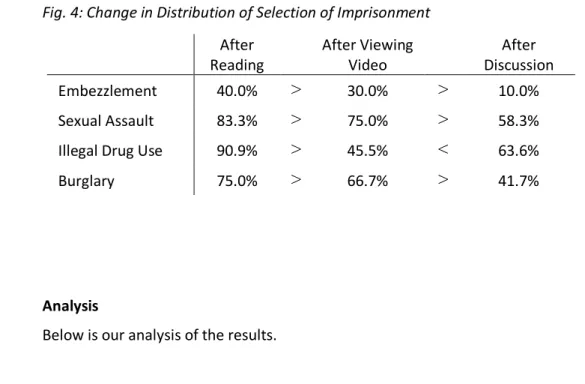
The results are shown in Figure 3. The chart below (Figure 4) shows the change in distribution of those who chose imprisonment.
0 1 2 3 4 5
① ② ③ ④ ⑤ ⑥ ⑦ ⑧ ⑨ ⑩ Burglary(After
Reading)
0 1 2 3 4 5
① ② ③ ④ ⑤ ⑥ ⑦ ⑧ ⑨ ⑩ Burglary(After Viewing Video)
0 1 2 3 4 5
① ② ③ ④ ⑤ ⑥ ⑦ ⑧ ⑨ ⑩ Burglary(After
Discussion)
Fig. 4: Change in Distribution of Selection of Imprisonment
4. Analysis
Below is our analysis of the results.
4.1 Hypothesis
The first question is whether our hypothesis was proven true. Our research method was crafted in a way that information about each subjects’ views on crime and criminals increases and their
relationship with the criminal becomes closer with every question.
We will first take a look at the relationship between the first and second tests. In Q1 of the first test, of the subjects who agreed, the percentage of those who did not choose imprisonment were as follows: embezzlement (39%), sexual assault (22.2%), drug use (36.8%), and burglary (12.0%). These numbers indicate that even for those who agree with imprisonment (long term) in general, there is a significant percentage of people who do not choose so when they are presented with a specific situation. For the first two tests, we could say that our hypothesis was somewhat supported.
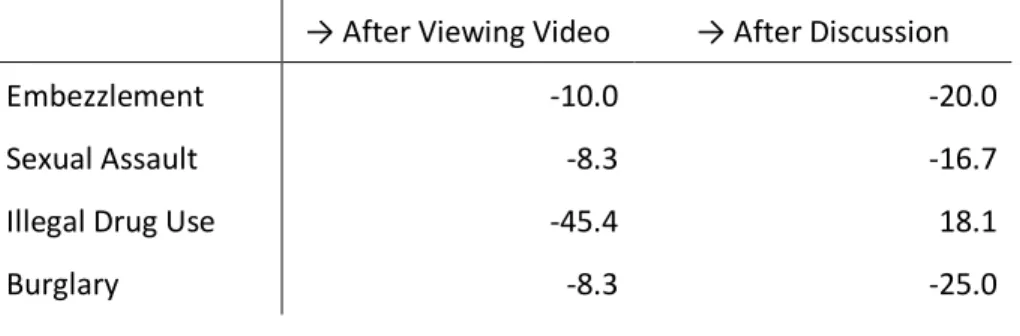
We will now review the third test. As shown in Fig. 2, as the test progresses from “After Viewing Courtroom Video” to “After Discussion,” there is a significant decrease in the percentage of those who chose imprisonment. It is worth pointing out, however, that the percentage increased for illegal drug use – we will discuss in later sections.
In other words, the human tendency to decrease the degree of penalty with the increase in knowledge of the crime became clearer through the third test. Drawing from the results of this test, we can conclude that our hypothesis was strongly supported.
As shown in Figure 5, the degree of decrease in the percentage of those who selected
imprisonment was greater after the discussion than after viewing the video, so it can be assumed that these changes are largely due to the increased knowledge about punishment.
After
Reading After Viewing Video After Discussion
Embezzlement 40.0% > 30.0% > 10.0%
Sexual Assault 83.3% > 75.0% > 58.3%
Illegal Drug Use 90.9% > 45.5% < 63.6%
Burglary 75.0% > 66.7% > 41.7%
Fig. 5: Decrease (%) in Selection of Imprisonment
From the first test, it is possible to draw a conclusion that the public hopes for more stringent penal policies and feels that the present sentencing policies are too lenient. It is indeed a reality that various public-opinion polls point toward this conclusion. However, it is said these are polls that are conducted by media outlets and use very simple language that does not capture the true opinion of the public (Roberts, et al. 2003:21-34). It was also pointed out that opinions change with the amount of prior knowledge on rehabilitation and protection, which may include knowing about what policies are already in place, what procedures follow a certain situation, whether reported recidivism rates are inflated, etc. (Roberts, et al. 2005:24-28). With these criticisms in mind, the second and third tests were created. What we were able to reap from these two tests was that different research methods yield different results or a different “public opinion.” Needless to say, we will discuss the matter of whether public opinion should be referenced in sentencing in later sections.
4.2 Explanation
This leads us to the next question: what is the explanation behind the human tendency to decrease the degree of punishment with the increase in knowledge of the crime?
According to Balvig, one of the causes is the gap between the general image of the criminal and the actual criminal. We, as people heavily influenced by the media, visualize criminals as violent and almost savage. However, when we come in contact with a specific case, we must face a different image of the criminal – we will see a non-violent, even remorseful person as opposed to the violent and savage image that we attribute to crime and criminals. People find an exception to the usual frightening
imagery of the criminal and, with context of the actual crime, end up reacting in a milder way.
Another cause is the emotional response that is triggered by seeing a criminal in person – that a criminal is another human being. In a courtroom setting, subjects end up thinking about the appropriate sentence for the criminal who is standing next to them. Criminal punishment is both painful and
harmful – it is surely difficult to inflict pain on somebody you have held eye contact with.
Below are several testimonies from research subjects that support Balvig’s statements:
“I initially chose ‘Imprisonment’ but I ended up changing to ‘Suspended Sentence with Probation.’ I chose ‘Imprisonment’ out of sympathy for the victim, but imprisonment is a very harsh sentence that entails a life that is very difficult and different from ours. I simply thought that imprisonment was too far for embezzlement.” (Embezzlement)
→ After Viewing Video → After Discussion
Embezzlement -10.0 -20.0
Sexual Assault -8.3 -16.7
Illegal Drug Use -45.4 18.1
Burglary -8.3 -25.0
“I ended up changing my mind and choosing with a lighter sentence of ‘Imprisonment (less than one year).’ After watching the video, I thought that the assailant should never be forgiven, but I
collected myself and thought about the other much more heinous crimes that are committed. I also thought that the assailant still has a chance to grow from his mistakes and that it would be very difficult for him to readjust to normal life if it he had been in prison for two years.” (Sexual Assault)
“I chose ‘Imprisonment (more than four years, less than five years),’ but I changed my answer to
‘Suspended Sentence’ because, despite the fact that the convenience store staff member may have experienced emotional distress, the amount that was stolen was very little. Also considering the fact that it costs the government 300,000 yen per year for a single prisoner, I thought imprisonment is not cost-effective, and the defendant showed remorse.” (Burglary)
This interpretation of criminals apparently directs people to a more productive use of penalties, as opposed to pure and simple “punishment.” In the following testimonies of research subjects, it seems as if the subjects held discussions out of instrumental interest (to prevent recidivism, rehabilitation of defendants, etc.):
“I switched from ‘Imprisonment’ to ‘Suspended Sentence with Probation.’ The victim was already repaid and the company lost social trust and is still repaying what was lost. Rather than isolating the defendant in a prison, I think he needs to get a job and repay the company as soon as possible. I chose the option with probation so it will give the defendant the impression that he does not have a second chance.” (Embezzlement)
“Releasing the defendant back to society without any education or rehabilitation is a loss for both the defendant himself and for society, so I think there should be a chance for education or mentoring. There should at least be an option that is above probation and involves society intervening and encouraging the defendant’s rehabilitation to prevent recidivism.” (Sexual Assault)
“I did consider the gravity of the crime. But when I thought about what the fastest way to reintegrate to society, I thought that the root of the problem was in the fact that the defendant was uninformed about money, and combined with the fact that he promised to communicate more with his father, I thought suspending the sentence with probation was the best option.” (Burglary)
In prior research held in Japan (Karasawa 2013:9), it has been shown that either utilitarian or retributionist theories could become the bases for penalty. It was further shown that retributionist theories tended to have more support and the key cause for this tendency was the existence of moral anger.
However, the above testimony shows research subjects using penalty and sentencing as a tool or an instrument. It may be that subjects’ center of thought shifted from moralism to instrumentalism sometime during the discussions.
This is where we address the one crime we have not yet: illegal drug use. As mentioned before, we saw an increase in those who selected imprisonment from “After Viewing Courtroom Video” and
“After Discussion.” It could be said that this was caused by utilitarian thinking, as opposed to pure and simple “punishment.” In other words, the research subjects thought that imprisoning the defendant is
“I first thought ‘Suspended Sentence’ was appropriate but after hearing the defendant’s story, I thought it would be better to isolate the defendant so I chose ‘Imprisonment.”
“I changed from ‘Suspended Sentence with Probation’ to ‘Imprisonment.’ This was because I thought the defendant should isolate him or herself and become sober.”
“Watching the video, the defendant did not come across as antisocial and this was his first offense, so I chose ‘Imprisonment (less than one year)’ but after considering how hard it is to recover from drug addiction and the possibility that the defendant will not participate in rehabilitation programs, I thought imprisonment for two to three years will be sufficient to force the defendant to participate in a rehabilitation program.”
“I chose ‘Imprisonment (more than two years, less than three years’ at first, but I thought that was too easy on the defendant, so I changed my answer to the heaviest sentence available. Drug addiction is not something that can be cured with probation.”
These responses were caused by the moderator’s insufficient explanation of the realities of drug addiction. He did not adequately explain that treatment is more effective in preventing recidivism than custodial sentence. The explanations of penalties and other treatments given during focus group discussions still have room for improvement. However, we were able to reaffirm that this knowledge has a substantial affect on the research subjects’ decision making.
4.3 Implications to Penal Policy
We mentioned “instrumental interest” before, but what relationship does it have with penal policy? It is, most likely, not necessarily same as using penalty as crime prevention (or for the pursuit of general and special prevention). In the focus group research, subjects responded more to the demerits of imposing penalties (with regard to the function of penalty) rather than the merits. We can deduce that it was common knowledge among the subjects that they had to be cautious when imposing penalties and that the preventative quality of punishment was effectively unproven to them. If this were really the case, “instrumental interest” cannot exclusively mean prevention by punishment. If anything, the center of thought seems to be in conveying a message by punishment – the subjects sought to explain to the defendant the gravity of their crime, or to encourage repentance by wishing the defendant to be remorseful. The question of, “How do people want to use punishment?” which is the central topic of this research, can be answered with “People want to use punishment as a tool or instrument to communicate with criminals.” This coincides with the communication theory in punishment.
The communication theory is a relatively new and growing theory in Anglo-American penal theory. For example, Av Hirsch interprets punishment as something that communicates to the criminal the censure as a result of their crime, or in other words, as having a special quality in that it is a means of communication from the government to criminals (von Hirsch 2017). Since this interpretation holds that punishment accurately communicates to criminals the gravity of their crime, it provides the rationale for the desert model or the principle of proportionality, which calls for punishment that is equal in gravity to the crime committed. Alternatively, RA Duff views punishment as a tool to convey a message from the community at large for the criminal to repent (Duff 2001). The perspective of
“community” is a unique feature of Duff’s interpretation, which leads to the conception of a punishment theory that includes the possibility of reconciliation with the criminal. The significance of these theories
lie in the fact that, given that retribution does not consider prevention (which is considered pointless), it not only does it give retributive sentencing a functional purpose but it also seeks to justify it.
Within the research subjects, there may have been a certain level of consciousness in conveying the gravity of the crime to the criminal or encouraging contrition, but what was clear and common among the subjects was both were most appropriately realized through the use of punishment. The subjects are essentially hopeful in “instrumental” punishment to realize those goals, and it may have been shared between the subjects that viewing punishment as painful is the best way to justify
“instrumental” punishment.
There is another very interesting element to this thought process. This fact provides key
implications (i.e. if causing pain conveys the message, or if causing pain promotes remorse) to answering the question of why punishment must be regarded as painful (must be hard treatment), or in other words, evokes an analysis of the “phenomenon of pain” from the perspective of functionality. There is research that proves that thinking about the cause of the pain and accepting the reason(s) is the best method to easing pain (Lewin 1948). If this were indeed true, the function of pain (conveying a message of censure) is largely significant. For this reason, viewing punishment as painful is an indispensable part of punishment as a means of communicating censure.
Of course, these analyses are hypotheses. We are expected to empirically clarify whether these various theories derived from interpretation of this research are appropriate and we plan to keep these things in mind as we design more research projects.
5. Conclusion
Our answer to this paper’s title (Can Public Opinion Define Sentencing Standards?) is, “public- opinion polls” that utilize general, easy questions that lead to a reflexive “public opinion” is not appropriate to justify sentencing standards.
The results of this study were in general agreement with the results of the previous study by Balvig et al. In this respect, the findings of this study can be said to be highly reliable.
We do, however, need to conduct more studies and research to strengthen our argument. We only used four cases, and there can be innumerable variations to these. With regard to the focus group research, we only held them once per case. We need more data to make our argument stronger and persuasive.
On another note, the moderator in the focus group research informed the subjects of general information regarding penalties/punishment, and it is possible that the moderator’s explanation was insufficient. At the same token, in a real-life setting, it is possible that the judge’s explanation of the cases is insufficient for jury members to make an appropriate decision. In Japan, the lay judge system was introduced in 2009, and what kind of information the judges give them during the deliberations is still an important issue. In future studies, it may be necessary to further verify what type of information is to be provided.
Appendix:
(1) Provided cases
[Embezzlement]
A is a banker working at X bank. A has a good work record and is not badly regarded by his superiors and colleagues. Several years have passed since he started working and he has become accustomed to his job, so he decided to become more familiar with asset management and started investing in stocks and financial products for his own personal use.
One day, B, one of A's clients, asked him to withdraw 4 million yen from a bank account in B's name at X Bank and deposit it into B's grandchild's bank account (B had been saving up the money to pay for his grandchild's tuition fees for college).
A thought it would be a good idea to secretly return the money to B after making a profit from the stock trading. A thought that he could return the 4 million yen to B secretly after making a profit from this stock transaction, but the profit did not come out well.
The bank repaid the 4 million yen and returned it to B. However, B suffered a lot of mental anguish because A, whom he trusted, betrayed him.
As a result of A's act, the bank where A worked suffered a damage of 4 million yen. At the trial, A stated that he wanted to be reimbursed for the entire amount of damage. A is 30 years old. He has no criminal record.
[Sexual Assault]
C was reprimanded by his boss for a mistake he made at work. After work, he went out for a drink with a younger colleague who worked at the same company to relieve his grievances.
When he came back to his apartment, he was so drunk that he got off the elevator on the wrong floor and ended up in a room one floor below his own (he thought it was his room). When he turned the doorknob, the door was unlocked, and although he thought it was strange, he walked straight into the room and saw a woman sleeping on the bed. C had passed this woman a few times in the apartment and had a faint liking for her because of her appearance and atmosphere. As she was sleeping with her skin exposed, C became horny and tried to have sexual intercourse with her, covering her.
When he did so, the woman woke up and resisted violently. C held both of the woman's arms and tried to have intercourse with her, but she screamed so loudly that he hurriedly left the scene.
Although intercourse did not take place, the woman suffered injuries to her arms that required five days of treatment.
After the incident, C paid the woman 2 million yen as compensation through her lawyer, but a settlement has not been reached. His supervisor at work has written a letter of petition to the effect that he will properly supervise C in the future.
C is 30 years old. He is an ordinary salaryman who works at the company he started working at when he graduated from college. He has no criminal record.
[Illegal Drug Use]
D, who works as a doctor at a general hospital, had been chronically tired from the intense workload of night shifts. When a colleague of his left the hospital, his workload increased even more, and it became difficult for him to take time off.
As I was thinking that my body could not continue like this, I remembered an article I had read in a magazine or something about the experiences of a methamphetamine user who said, "If you use methamphetamine, you will feel refreshed" and "If you use methamphetamine, you will not be tired even if you work all night.
Somehow, D managed to get hold of some stimulants and immediately tried them out. Just as the article said, his head felt crisp and his fatigue seemed to be gone. From then on, D began to use stimulants whenever he felt tired and became a regular user.
One day, D fainted at work and had to go to the hospital for a checkup, where it was discovered that he had been using methamphetamine.
As a result, it was discovered that D was addicted to methamphetamine. He was dismissed from the hospital where he worked and his medical license was expected to be revoked.
At the trial, the mother stated that she would supervise D closely from now on.
D is 30 years old. He has no criminal record.
[Burglary]
A few minutes past 6:00am, E walked into a convenience store wearing a balaclava. There was only one young male employee in the store at the time. E approached the cash register and pulled out a knife toward the employee in a threatening manner, yelling at the employee to hand him the contents of the cash register. The employee could not respond immediately, causing E to go behind the counter to point the knife at the employee. He yelled at the employee to open the cash register and to hand him the money, whilst pushing the employee toward the counter. The employee opened the cash register, where it had 30,000yen worth of paper bills and 5,000yen worth of coins. E took the paper bills in one hand and continued to point the knife at the employee with his other hand, yelling at the employee to give him more money.
E saw that there was another customer approaching the convenience store (he was parking his bicycle), so he kept 30,000 yen and fled the store. The employee was not injured.
During trial, E’s father, who owns a shipping company, said that he would look after E more closely.
E is 30 years old. After graduating high school, he worked at various restaurants. He would lavishly spend money, and had a significant amount of credit card loans to pay back at the time. He has no criminal record.
(2) Explanation of Answer Choices (Penalties)
The questionnaire used in the second test has the following explanation attached:
- A fine is a sum of money exacted as a penalty, paid to the government.
- A suspended sentence is when the Court suspends it intended sentence, provided that the offender does not repeat the offense. When time of suspension passes without withdrawal, the sentence will not be executed.
- A suspended sentence with probation is where a probation officer supervises an offender whose sentence was suspended. The probation officer will supervise an offender by setting up
appointments with the offender to grasp what the offender’s daily life is like, instruct the offender to prevent repeat offenses, support the offender, provide treatment to the offender, etc.
- Imprisonment is where the offender’s freedom is taken away by placing the offender in jail and having the offender participate in prison labor.
References:
- Balvig, Flemming, Helgi Gunnaugsson, Kristina Jerre & Aarne Kinnunen (2015) “The Public Sense of Justice in Scandinavia: A study of Attitudes towards Punishments”, European Journal of Criminology Vol.12 (3) pp.342-362
- Duff, Antony (2001), Punishment, Communication and Community, OUP.
- Karasawa, Minoru (2013), Shakaishinrigaku ni okeru Doutokuhandan no Genjou (Current status of moral judgment in social psychology) (in Japanese), Shakai to Rinri No.28 pp.85-99.
- Lewin, Kurt (1948), Resolving Social Conflicts: selected papers on group dynamics, Gertrud Weiss Lewin ed., Harper.
- Roberts, Julian V., Loretta J. Stalans, David Indermaur & Mike Hough (2003), Penal Populism and Public Opinion: Lessons from Five Countries, OUP.
- von Hirsch, Andreas (2017) Deserved Criminal Sentences, Hart.