192
IEICE TRANS. ELECTRON., VOL.E104–C, NO.6 JUNE 2021
BRIEF PAPER
Special Section on Recent Progress in Organic Molecular ElectronicsE ff ect of Temperature on Electrical Resistance–Length
Characteristic of Electroactive Supercoiled Polymer Artificial Muscle
Kazuya TADA†a),Member andTakashi YOSHIDA†,Nonmember
SUMMARY It is found that the electrical resistance–length character- istic in an electroactive supercoiled polymer artificial muscle strongly de- pends on the temperature. This may come from the thermal expansion of coils in the artificial muscle, which increases the contact area of neighbor- ing coils and results in a lower electrical resistance at a higher temperature.
On the other hand, the electrical resistance–length characteristic collected during electrical driving seriously deviates from those collected at constant temperatures. Inhomogeneous heating during electrical driving seems to be a key for the deviation.
key words: actuator, supercoiled polymer artificial muscle, twisted and coiled polymer actuator, electrical resistance, mathematical model
1. Introduction
Since the discovery of the supercoiled polymer artificial muscle, which is also known as the twisted and coiled poly- mer actuator or the nylon muscle, by Haines et al.,[1]lots of research efforts have been devoted to the applications of the device such as humanoid hand[2]and power-assist sys- tem[3]. The actuation principle of the device is the con- traction upon heating, and the device made from conductive sewing thread can be directly driven by electrical power.
The electroactive supercoiled artificial muscle seems to be highly attractive compared to other electrically driven artifi- cial muscles in numerous factors such as durability and cost.
The modeling of an artificial muscle is indispensable for the precise control of it. Most researchers tackling the problem have paid little attention to the electrical resis- tance of electroactive supercoiled artificial muscle in oper- ation[4],[5]. The electrical resistance is still important be- cause the input power is in inverse (direct) proportion to it under constant voltage (current) application. We have re- cently pointed out that the electrical resistance of the super- coiled polymer actuator shows considerable reduction upon contraction due to Joule heating[6],[7]. Here, the effect of temperature on the electrical resistance–length characteris- tic of the electroactive supercoiled artificial muscle is stud- ied.
Manuscript received June 1, 2020.
Manuscript revised September 23, 2020.
Manuscript publicized October 6, 2020.
†The authors are with Department of Electrical Materials and Engineering, University of Hyogo, Himeji-shi, 671–2280 Japan.
a) E-mail: [email protected] DOI: 10.1587/transele.2020OMS0002
2. Experimental
The supercoiled artificial muscle used in this study was pre- pared from a nylon monofilament fishing line of 0.81 mm in diameter manufactured by TOA-Strings. The insertion of a twist to a thread 16 cm in length with a suspended weight of 500 g at room temperature resulted in a supercoiled artificial muscle approximately 4 cm in length with approximately 30 coils. After annealing at 140◦C for 0.5h in an oven to fix the shape, the artificial muscle was coated with Du Pont PE872 silver paste.
The length of the artificial muscle was changed by changing the suspended weight to collect length–electrical resistance characteristics. The temperature of the sample was changed by a Yamato Scientific IN804 incubator.
The change in the length of the artificial muscle with a suspended weight of 500 g at room temperature driven by a 1/180 Hz square current wave of 0.8 A with 1/3 duty cycle, which made the temperature of the artificial muscle 20/40 ◦C at the end of off /on state, was measured by an Optex FA CD22-100 laser displacement sensor. The tem- perature of the artificial muscle is measured by a type-K thermocouple attached to the center of the sample. The data including the voltage applied to the artificial muscle were collected by a Graphtec GL240 data logger. The thermo- graph of the artificial muscle is collected by a FLIR ETS320 thermal camera.
3. Results and Discussion
Both length and electrical resistance monotonically in- creased by increasing the suspended weight. The electri- cal resistance–length characteristic is shown in Fig. 1 (a).
An electroactive supercoiled artificial muscle has the low- est electrical resistance in its shortest form since the neigh- boring coils are fully contacted and the artificial muscle is considered as a cylindrical resistor. The contact area be- tween the neighboring coils in the artificial muscle reduces by elongation, giving increased electrical resistance. At a certain degree of elongation, the neighboring coils are sepa- rated and the artificial muscle becomes a spiral line resis- tor. Further elongation virtually retains the electrical re- sistance. Thus, the conductive supercoiled artificial mus- cle shows S–shaped electrical resistance–length characteris- Copyright c2021 The Institute of Electronics, Information and Communication Engineers
BRIEF PAPER
193
Fig. 1 (a) Electrical resistance–length characteristics of the electroactive supercoiled polymer actuator at various temperatures. Lines show fitting curves using Eq. (1). (b) Dependence of fitting parameters on temperature.
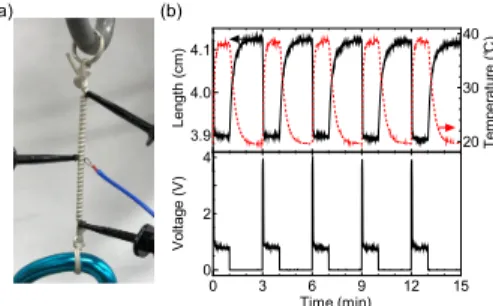
Fig. 2 (a) Photograph of the electroactive supercoiled artificial muscle under electrical driving. (b) Temporal change of the length, the tempera- ture, and the voltage of the electroactive supercoiled artificial muscle during 5 cycles of the electrical driving.
tics[7]. Interestingly, the electrical resistance at a constant length, say 3.7 cm, strongly depends on the temperature.
This may come from the thermal expansion of coils in the artificial muscle, which increases the contact area of neigh- boring coils and results in a lower electrical resistance at a higher temperature.
As mentioned in the previous report[7], a simple ex- pression for electrical resistanceRas a function of lengthL using a logistic function
R(L)=R0+ ΔR
1+exp (−α(L−L0)) (1) can reproduce the experimental data. As shown as curves in Fig. 1 (a), Eq. (1) successfully reproduces the experimental data. The temperature dependences of fitting parameters are shown in Fig. 1 (b). It is found that all parameters, sayΔR, L0andαincrease as increasing the temperature.
Figure 2 (a) shows a photograph of the experimental setup for the electrical driving of the electroactive super- coiled artificial muscle. Figure 2 (b) shows 5 cycles of the temporal change of the length, the temperature, and the volt- age under the electrical driving. The sample used for this experiment is the same one used for the results mentioned above. Similar to our previous reports[6],[7], the voltage and thus the electrical resistance seriously drop upon the Joule heating.
The electrical resistance of the artificial muscle as a function of length during electrical driving is plotted in Fig. 3 (a). Because the temperature range during the exper- iment is between 10 and 50◦C, the data for the electrical driving are expected to be mapped into the area bounded by the electrical resistance–length curves for 10 and 50◦C.
However, the data for the electrical driving deviate from the
Fig. 3 (a) Electrical resistance–length characteristics of the electroactive supercoiled artificial muscle from Fig. 2 (b). Lines show the fitting curves that appeared in Fig. 1 (a) at 10 and 50◦C. (b) Thermograph of an electroac- tive supercoiled artificial muscle under the constant current application.
area. Inhomogeneous heating during electrical driving, a typical case is shown in Fig. 3 (b), seems to be a key for the deviation.
In conclusion, the electrical resistance–length char- acteristic in an electroactive supercoiled polymer artificial muscle strongly depends on the temperature. The thermal expansion of coils in the artificial muscle, which may in- crease the contact area of neighboring coils and results in a lower electrical resistance at a higher temperature. The elec- trical resistance–length characteristic collected during elec- trical driving seriously deviates from those collected at con- stant temperatures, which may come from inhomogeneous heating during electrical driving.
Acknowledgments
This work was partially supported by the Hyogo Science and Technology Association.
References
[1] C.S. Haines, M.D. Lima, N. Li, G.M. Spinks, J. Foroughi, J.D.W.
Madden, S.H. Kim, S. Fang, M. Jung de Andrade, F. G¨oktepe, ¨O.
G¨oktepe, S.M. Mirvakili, S. Nacy, X. Lepr´o, J. Oh, M.E. Kozlov, S.J. Kim, X. Xu, B.J. Swedlove, G.G. Wallace, and R.H. Baughman,
“Artificial Muscles from Fishing Line and Sewing Thread,” Science, vol.343, no.6173, pp.868–872, 2014. DOI: 10.1126/science.1246906 [2] L. Wu, M. Jung de Andrade, L.K. Saharan, R.S. Rome, R.H.
Baughman, and Y. Tadesse, “Compact and low-cost humanoid hand powered by nylon artificial muscles,” Bioinspir. Biomim., vol.12, no.2, 026004, 2017. DOI: 10.1088/1748-3190/aa52f8
[3] M. Hiraoka, K. Nakamura, H. Arase, K. Asai, Y. Kaneko, S.W. John, K. Tagashira, and A. Omote, “Power-efficient low-temperature wo- ven coiled fibre actuator for wearable applications,” Sci. Rep., vol.6, 36358, 2016. DOI: 10.1038/srep36358
[4] F. Karami and Y. Tadesse, “Modeling of twisted and coiled polymer (TCP) muscle based on phenomenological approach,” Smart Mater.
Struct., vol.26, no.12, 125010, 2017. DOI: 10.1088/1361-665X/ aa8d7d
[5] M.C. Yip and G. Niemeyer, “On the Control and Properties of Su- percoiled Polymer Artificial Muscles,” IEEE Trans. Robotics, vol.33, no.3, pp.689–699, 2017. DOI: 10.1109/TRO.2017.2664885 [6] K. Tada and M. Kaku, “Contribution of deformation for electri-
cal resistance of conductive thread artificial muscle,” IEICE Trans.
Electron. (Japanese Edition), vol.J102-C, pp.271–272, 2019. (in Japanese).
[7] K. Tada and M. Kaku, “S-shaped nonlinearity in electrical re- sistance of electroactive supercoiled polymer artificial muscle,”
IEICE Trans. Electron., vol.E103-C, no.2, pp.59–61, 2020. DOI:
10.1587/transele.2019ECS6013