Environmental Education in Japan: A Survey of Nature Schools
FU Rui, Graduate, Graduate School of International Studies, J. F. Oberlin University FUJIKURA Manami, Professor, J. F. Oberlin University
Keywords: Environmental Education, Outdoor Education, Nature School, International Cooperation, Elderly people
1. Introduction
Japan has been emphasizing the importance of environmental education for a long time.
Environmental education in Japan started with two activities: (1) nature conservation education, which started in the 1950s and (2) education for pollution understanding, which started in the late 1960s. The former activity aim to raise environmental consciousness and educate people about the crisis that the damage to the environment was creating. The latter activity taught the importance of human rights and human life and of protecting children’s health from environmental pollution. In 1972, Japan proposed Declaration 19, which pertained to environmental education, at the United Nations Conference on the Human Environment1. In 2002, Japan supported the ‘UN Decade of Education for Sustainable Development (ESD)’
initiative at the World Summit on Sustainable Development2. Nowadays, Japan is taking all kinds of measures aimed at promoting ESD.
One of the leading institutions in environmental education in Japan is the nature school.
Nature schools are a part of outdoor education. They conduct nature activities and teach students the importance of a sustainable society where humans and nature can coexist harmoniously. In Japan, youth education camps organized by the YMCA and the Boys Scouts in the early 20th century started the trend of nature education. After the war, nature experience activities came to be widely used in the cultivation of human resources. In the 1960s and 1970s, nature observation programs were often organized, which gave an impetus to the nature conservation movement. In 1987, a meeting of environmental educators called the
‘Kiyosato Meeting’ was held in Yamanashi Prefecture, and a network was formed among people engaging in environmental education, especially nature experiences. Following this, the Japan Environmental Education Forum (JEEF) was established in 1992. Today, nature schools with various managers and management styles exist, such as public, non-profitable, or self- employed.
To explore the on-going situation regarding nature schools in Japan, JEEF conducts a 国際学研究 第7号(2016年度)
(hereafter called ‘2010 Survey by JEEF’), there are 3,696 nature schools in Japan. The most common subjects of activity are environmental education, sound upbringing of youth, regional development, and nature conservation and research.
Regional development is one of the features of nature schools in Japan. Since Japanese nature schools take few donations, unlike Europe and America, partnership with regions becomes very important. Nature schools not only contribute to nature and cultural conservation but also provide economic stimuli for the region through the use local products, services, planning, and arrangements for eco-tours or other activities conducted by them. The reason that such economic stimuli are necessary is that populations are aging and decreasing, especially in rural areas, where nature schools exist. Therefore, nature schools should involve elderly people and make them an important part of their activities. Moreover, Japan, which has paved the way for ESD on the global stage, should also assist in the global transmission knowledge from Japanese nature schools. However, there are no studies on programs for elderly people and international cooperation among nature schools in Japan.
2. Objectives
The purpose of this study is to explore the current situation and challenges with regard to programs for elderly people and international cooperation among nature schools in Japan. The findings of this study will contribute to the further development of ESD in developing countries that have problems of low birth rates and aging.
3. Methodology
We conducted a questionnaire survey with the cooperation of JEEF. An electronic questionnaire was prepared on a website, and we emailed it to 1,781 nature schools. The period for response was from November 5, 2013, to December 10, 2013. The total number of valid responses was 109, and the response rate was 6 per cent.
We also interviewed some participants at the ‘Kiyosato Meeting’ held in November 2013.
4. Results
4.1 Main subjects of nature schools
We asked about the main subjects in nature schools, offering multiple choices similar to those in the ‘2010 Survey by JEEF’ so that respondents could select more than one activity. As shown in Fig. 1, ‘Environmental education’ was provided by 86% of nature schools. The second most offered subject was ‘Nature conservation and research’ (59%), and the third was ‘Sound upbringing of youth’ (58%). The overall rank order trend was approximately the same as in the
‘2010 Survey by JEEF’; therefore, this survey was thought to have representativeness.
In addition to the above, it was found that nature schools address a broad range of social challenges, such as ‘Regional development’ or ‘Realization of a sustainable society’.
Satoyama (‘community-based forest’) is comprised of human-influenced natural environments such as farmlands and secondary forests, which people have developed and sustained over a long time. In Japan, interest in conservation of Satoyama increased from about 2004.
4.2 Current users and users expected to increase in the future
As shown in Fig. 2, the majority of current users are in the categories of ‘Primary school child’, ‘Adult under 60 years old’ and ‘Middle and high school student’. ‘College student’ has the least number of users. The users expected to increase the most in number in the future are in the categories ‘Adult under 60 years old’, ‘Middle and high school student’, and ‘College student’. In the category of ‘60 years old or older’, only 25% responded as current users, but 36% responded as users expected to increase in the future. It may be said that nature schools are taking a growing interest in elderly users.
国際学研究 第7号(2016年度)
Fig. 1 Main subjects of nature schools (multiple answers)
Fig. 2 Current users and users expected to increase (multiple answers up to three)
4.3.1 Implementation of programs for elderly people by school size
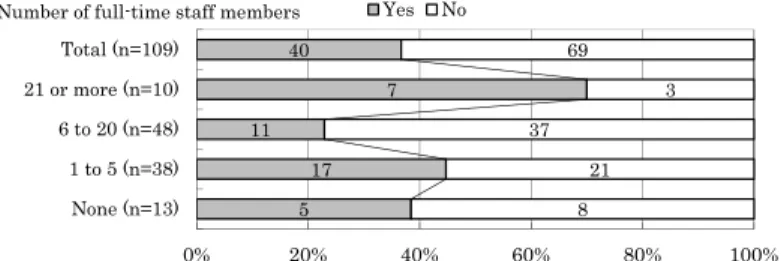
As shown in Fig. 3, 40 (37%) out of 109 implemented programs are aimed at elderly people.
Breaking down the responses by school size reveals that the schools with more than 21 full- time staff members have a higher percentage of implementation, while schools with 20 or fewer full-time staff members do not show a definite relationship between implementation of programs for elderly people and school size.
4.3.2 Implementation of programs for elderly people by main subject
The implementation of programs for elderly people by main subject is depicted in Fig. 4. A total of 34 (36%) out of 94 schools that chose ‘Environmental education’ as their main subject implemented programs for elderly people. The subject of ‘International cooperation’ had the highest implementation rate, with more than 10 schools implementing it.
4.3.3 Contents of programs for elderly people
We asked 40 nature schools which implemented programs for elderly people about the contents of the programs, offering multiple choices. As shown in Fig. 5, 22 (55%) out of 40 conducted an eco-tour.
Fig. 3 Implementation of programs for elderly people by the number of full-time staff members
Fig. 4 Implementation of programs for elderly people by main subject
4.3.4 Problems in the implementation of programs for elderly people
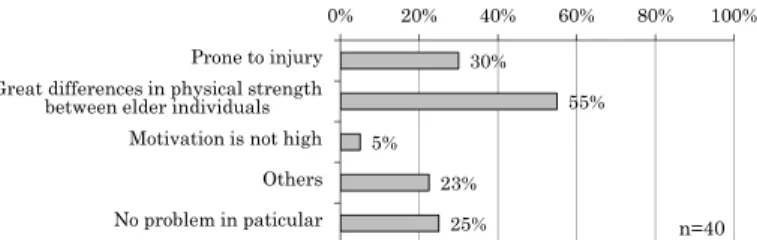
As shown in Fig. 6, the top answer was ‘Great differences in physical strength between elder individuals’. The option ‘Others’ included ‘Elder people are not only weaker but also slower to catch up to younger people’; ‘Elder people do not pay attention to safety precautions. ‘They act as they want’; and ‘There are health risks such as myocardial infarctions’.
4.3.5 Reasons not to implement programs for elderly people
We asked 69 nature schools which did not implement programs for elderly people the reason for this, offering multiple choices. As shown in Fig. 7, the top answer was ‘Elderly people participate in other programs’. More than one school answered ‘Elderly people participate in normal programs’. One school responded ‘Cross-age interaction is important. It is preferable not to focus on elderly people only’. The option ‘Others’ included ‘short on staff’
or ‘We have not established a system for elderly people’.
国際学研究 第7号(2016年度)
Fig. 5 Contents of programs (multiple answers)
Fig. 6 Problems in the implementation of programs for elderly people (multiple answers)
Fig. 7 Reasons not to implement programs for elderly people (multiple answers)
4.4.1 Implementation of international cooperation by school size
As shown in Fig. 8, 42 (39%) out of 109 schools implemented international cooperation.
Breaking down the responses by school size reveals that nature schools with more full-time staff had a higher percentage of implementation.
4.4.2 Implementation of international cooperation by main subject
Implementation of international cooperation by main subject is shown in Fig. 9. A total of 39 (41%) out of 94 schools which chose ‘Environmental education’ as their main subject implemented programs for elderly people. ‘Conservation of Satoyama’ had the lowest implementation among main subjects, with more than 10 schools implementing it. As the conservation of Satoyama depends on history, climate, and the natural features of the local region, schools focusing on ‘Conservation of Satoyama’ are expected to receive less international cooperation. However, the International Partnership for the Satoyama Initiative, started in 2010,4 may increase international cooperation on this subject.
4.4.3 Contents of the topic of international cooperation
We asked 42 nature schools which implemented international cooperation as a topic about Fig. 8 Implementation of international cooperation by number of full-time staff members
Fig. 9 Implementation of international cooperation by the main subject
the contents of the topic, offering multiple choices. As shown in Fig. 10, 29 (69%) out of 42 accepted trainees from foreign countries. Additionally, several nature schools claimed to
‘Support the establishment of nature schools abroad’, ‘dispatch experts to foreign countries’, and ‘train nature school leaders abroad’.
4.4.4 Reasons not to implement international cooperation
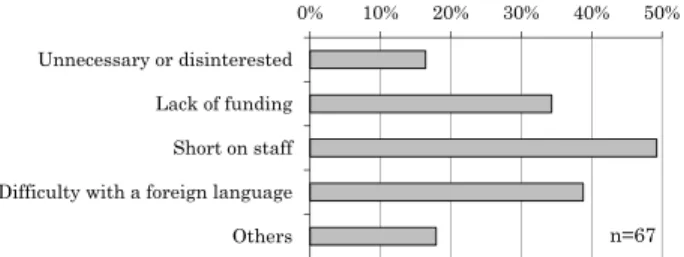
We asked 67 nature schools which did not implement international cooperation the reason for this, offering multiple choices. As shown in Fig. 11, 33 (49%) out of 69 answered that they were ‘Short on staff’. ‘Difficulty with a foreign language’ and ‘Lack of funding’ were the other reasons.
5. Discussion and conclusion
We conducted a questionnaire survey of nature schools in Japan and received 109 valid responses. The responses showed the same tendencies found in the nationwide survey by JEEF.
The percentage of nature schools which answered that users who were ‘60 years old or older’ were the majority of their current users was not high, but the number of elderly people was expected to increase in the future. A total of 37 per cent of nature schools implemented programs for elderly people. Meanwhile, the main reason given for not implementing
国際学研究 第7号(2016年度)
Fig. 10 Contents of international cooperation (multiple answers)
Fig. 11 Reasons not to implement international cooperation (multiple answers)
that are safe for all ages.
With regard to problems with the implementation of programs for elderly people, the most commonly stated problem was that there were great differences in physical strength between elder individuals, and elderly people were prone to injury. Since elderly people tend to have declining vision, hearing, and sense of smell and tend not to listen to others, it is necessary to pay more attention to safety measures for them. This kind of attention is also important when elderly people participate in common programs.
We interviewed some organizers of nature schools about the significance of elderly people’s participation. Regarding the reason for targeting elderly people, Mr. Yabuki from Nasu Heisei no Mori (‘Forest in Nasu’) said that ‘Since elderly people have interfaced with nature since their childhood, they can easily recall their experiences. Furthermore, once they attend a program, they can often attend again with their grandchildren’. Therefore, elderly people play a role in imparting knowledge or experience to future generations. Elderly people are not just participants. Leaders or other participants can learn from elderly participants. This is why it is important to target elderly people.
Mr. Hayashida from Tokyo Senior Shizen Daigaku (‘nature college’) pointed out that elderly people are a market; in other words, they have a lot of time and money. They are players in regional development. Mr. Hayashida also stated that the college was considering giving qualification certificates to graduates of Tokyo Senior Shizen Daigaku, in order to ensure that they continued attending college activities after a program was over. It is important that nature schools become a place of lifelong learning in the future. With social maturation, the demand for lifelong learning increases. Involving elderly people in nature schools will contribute to nature conservation and sustainable development.
A total of 39 per cent of nature schools implemented international cooperation, and 69 per cent accepted trainees from foreign countries. Several nature schools implemented international cooperation activities such as supporting the establishment of nature schools abroad, dispatching experts to foreign countries, and training nature school leaders abroad.
Nature schools with more full-time staff showed a higher percentage of implementation. The reasons for not implementing international cooperation were shortage of staff, difficulty with a foreign language, and lack of funding. These difficulties are common to international cooperation of nonprofit organizations. For such problems, the Japanese government offers various forms of support, such as Japan International Cooperation Agency (JICA) Partnership Program. If implementation is difficult for one nature school, others schools can form a network to offer support. Now that Japan has paved the way for ESD on the world stage, international cooperation among its nature schools should be prioritised.
Acknowledgment
We would like to express our sincere appreciation for JEEF, which accepted Rui FU as an internship student and helped us with our survey. We are also grateful to the 109 nature schools that responded to our survey.
References
1 Ministry of Environment Japan, White Paper on the Environment 1973, 1973 2 http://www.mofa.go.jp/policy/environment/wssd/2002/kinitiative2.html
3 JEEF: “Dai 5 kai Sizen Gakkou Zenkoku Chousa Houkokusho” (“The Fifth Nationwide Survey of Nature Schools”), 2010
4 SATOYAMA Initiative, http://satoyama-initiative.org/
国際学研究 第7号(2016年度)