Formation of Periodical Structure Formed on Diamond‑like Carbon Film with a Femtosecond Laser : The formation on sliding surface of machine part
著者 Tao Masanori, Iwai Yoshiro, Sentoku Eisuke
雑誌名 福井大学大学院工学研究科研究報告
巻 64
ページ 79‑82
発行年 2016‑03
URL http://hdl.handle.net/10098/9898
Formation of Periodical Structure Formed on Diamond-like Carbon Film with a Femtosecond Laser
—The formation on sliding surface of machine part —
Masanori TAO* Yoshiro IWAI** and Eisuke SENTOKU***
(Received February 5, 2016)
Recently, it was reported that nano scale structure are formed on the metal surfaces by irradiating femtosecond laser pulses at an energy power density (fluence) slightly above the ablation threshold [1]. These structures have lately attracted considerable attention as a method to give a high function to the surface. This was verified experimentally by the authors in a recent paper [21. In this paper, we report the formation of the structure to the cylindrical surface of the piston ring as a proper example of sliding surface of machine parts (piston ring). As a result, the processing system combined the femtosecond laser and NC rotation stage was developed and formed the nano scale structure (pitch A = 311 nm) on the piston ring at F = 0.13 J/cm2, v = 24 mm/s, is = 60 gm.
Key Words : Femtosecond laser, Laser processing, Periodical structure, Piston ring
1. Introduction
Recently, a reduction of CO2 emissions from various industrial machines, environmental improvement by regulations of discharge of polluting material,
energy-saving by an improvement of fuel consumptions are strongly required. In particular, a reduction of a friction on a sliding surface in various industrial machines is important to improve the fuel consumptions.
Coating of hard thin films [3] and formation of structures [4] on a sliding surface of parts such as engines are studied as an effective method for the reduction of the friction on that surface.
On the other hand, it was reported nano scale structures were formed on surfaces of metals such as Cu and so on by irradiating femtosecond laser pulses at fluence slightly above the ablation threshold W. The effect of these structures on friction reduction is reported [5] [6].
In our previous reports, we established the technique to form the structure widely on a DLC (Diamond-like carbon) film by the processing system that combined the femtosecond laser and NC stages [2].
In this study, we developed a piston ring processing system that combined the femtosecond laser and a NC rotation stage, and clarified relations between processing conditions and formed structures.
* Technical Di vision
** Dept
. of Mechanical Engineering
***
Dept. of Mechanical Engineering, Fukui national college of technology
2. Specimen and Experimental method 2.1 Specimen
The specimens were commercially available piston rings. They were coated by DLC films on the substrate of SUS420J2. Photograph of the piston ring before laser irradiation is shown in Fig. 1. The diameter of the rings were 86 mm, the thickness were 1.2 mm. The thickness of DLC films were approximately 6 gm, the indentation hardness were approximately 20 GPa.
The piston rings fixed end gap and sandwiched by the holders were installed in the NC rotation stage (Newport Corporation; RGV100BL).
80
Be Material SUS420.12 Film : DLC
Al 0 86 ram
( )
End gap
Fig. 1 Photograph of piston ring specimen.
2.2 Processing system and experimental method Experimental set-up and a procedure are almost the same as them described in our recent paper [2].
Photograph of femtosecond laser system is shown in Fig.
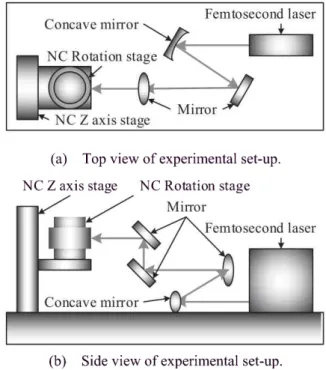
2. A schematic drawing of the experimental apparatus is shown in Fig. 3. The femtosecond laser (Cyber Laser Inc.; IFRIT) was operated at 1 kHz repetition frequency, 800 nm wavelength, 180 fs pulse width. The polarization of the light of the laser was liner and its direction of the electric field E was constant.
It was reported that nano scale structure was formed on the surfaces by irradiating femtosecond laser pulses at fluence slightly above the ablation threshold [71.
Therefore, we designed the optical system to get enough fluence by processing at a focus position of a concave lens.
The side surface of the piston ring fixed on the NC rotation stage was irradiated perpendicularly by the laser at a constant fluence. The piston ring was rotated at feed rate v during the laser irradiation and moved by shift distance h to Z-axis direction after each a rotation as shown in Fig. 4.
The controllable parameter were fluence F, feed rate v and shift distance L.
(a) Top view of experimental set-up.
NC Z axis stage NC Rotation stage
Fig. 3
(b) Side view of experimental set-up.
Schematic drawing of experimental set-up.
•
rea
C
• r•
411[.
_./
Laser F JIcm2 Rotati • - ction
0 1-
._0111P
. ,,-:. •,....,.
.
---...
..
V =BIS Pistonring--. ...SC:4,-
«...
..111..
Rotative direction_JA
Fig. 4 Method for the processing piston ring.
3. Results
3.1 Formation of nano scale structures
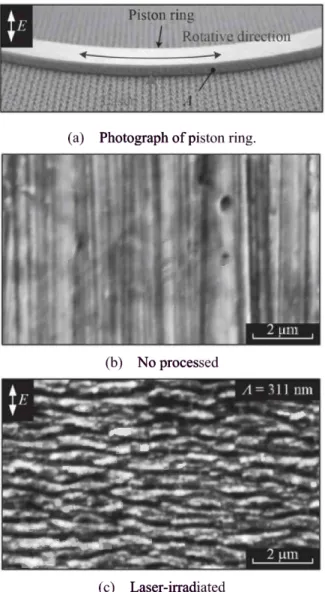
Fig. 5 (a) shows the photograph of piston ring formed nano scale structures by the laser at F = 0.13 Rem', v = 24 mm/s and Is = 60 jam. Fig. 5 (b) shows the SEM (Scanning Electron Microscope) images around the center of the side surfaces of no processed piston ring.
Fig. 5 (c) shows the SEM images at point A in Fig. 5(a).
In Fig. 5 (b), periodic traces in the width direction on no processed surface is shown. It was considered that the traces were formed in production processes of the piston ring such as grinding.
In Fig. 5 (c), the nano scale structures were formed periodically on the laser irradiated surface. The direction of the structures was a right angle of the polarization direction E.
(a) Photograph of pi
:ft I
tit
I
(b) No proces
OW"
...grill's.... _gm •
• "nes... gi p
• 0410.--.01.-
...
fry 4111^1. • .^rh 111,111.4gaggral• "1"91rna.
-ow
(c) Laser-irrad
Photograph of piston ring.
.. - ..
...p., ...
.
.011.
f :up ..s..-.•
.. +gr.. . IV" - • •
• so-- ' -406 .
illorm' .4111MP . - 'al "6.
. .0111.6mahl•vpac 10 ..4.010 .400:2 '-
4
ri
1
t
^
1.1111
No processed
1 — iI I in 0•16.
"MO
yr.
r 'a •
.101
--.1;rae o
• a
•
g. 4=1. 1111
Laser-irradiated
(F = 0.13 J/cm2, v = 24 mm/s, IS = 60 tim) Fig. 5 SEM images of piston ring.
3.2 Relationship of fluence and periodic structure Fig. 6 shows the cross-sectional profile by AFM (Atomic Force Microscope) in the center of the cylindrical surface of the piston ring processed at F = 0.13 J/cm2, v = 24 mm/s and Is = 60 [mi. In Fig.6, the cross-sectional profile is also shown periodic peaks and valleys.
In this paper, the size of the structure was evaluated by a pitch A which was the mean value of the distance between a valley and adjacent one at 50 points in the cross-sectional profile. The A was measured 311 nm, standard deviation o-was ±77nm from Fig. 6.
The measured value A is plotted as a function of fluence F and a is indicated by the error bars in Fig. 7.
As shown in this figure, the structures were formed at fluence higher than 0.10 J/cm2. In the region I, Pitch A increases rapidly with increasing F near the ablation threshold fluence F = 0.10 J/cm2. In the region II, A increases slowly and becomes saturated.
82
No structure Periodic structure
600
500
400
300
U -,>
4
200
100
0
Fig. 7
0 0.05 0.1 0.15 0.2 0.25 Fluence F, J/cm2
Fig. 7 Relationship between fluence and pitch.
(v = 24 mm/s, Is = 60 i_tm)
4. Conclusion
1) The periodical structure was formed over the piston ring by the developed processing system, which was
constructed by femtosecond laser and NC rotation
stage.
2) The periodical structure was formed at fluence higher than F = 0.10 J/cm2, the pitch A increases
rapidly with increasing near the F = 0.10 J/cm2.
References
[1] M. Hashida: New Applications of Femtosecond
Laser in Industry, The journal of the Institute of Electrical Engineers of Japan, 122-11, 749 (2002).
[2] M. Tao, E. Sentoku, T. Miyajima, T. Honda, J.
Kiuchi, F. Matsui, R. Tanaka and Y. Iwai:
Formation of Periodical Structure Formed on
Diamond-like Carbon Film with a Femtosecond
Laser (Large Area Forming and Its Processing
Condition), Journal of the Japan Society of Advanced Production Technology, 29-1, 88 (2011).
[3] H. Tachikawa: Tribological Issue in Automobile
Industry and DLC Coating, Journal of the Surface Finishing Society of Japan, 59-7, 437 (2008).
[4] H. Ogihara: Technology For Reducing Rubbing Resistance of Engine By Means Of Surface
Improvement, The Japan Society of Mechanical
Engineers, IV, 357 (2000).
[5] A. Mizuno, T. Honda, J. Kikuchi, Y. Iwai, N.
Yasumaru and K. Miyazaki: Friction Properties of
the DLC Film with Periodic Structures in
Nano-scale, Tribology Online, 1-2, 44 (2006).
[6] H. Sawada, K. Kawahara, T. Ninomiya, A. Mori and K. Kurosawa: Effect of Precise Periodic
Structures with Femtosecond-laser on Tribological
Characteristics under Sliding Tests, The Japan Society for Precision Engineering, 70-1, 133
(2004).
[7] N. Yasumaru, K. Miyazaki and J. Kiuchi: Fluence dependence of femtosecond—laser-induced
nanostructure formed on TiN and CrN, Applied Physics A, 81-5, 933 (2005).