The Benefits of Doing the Practice Half-test for Students
Taking the full TOEIC
学生が TOEIC 模擬テストを受ける利点について
Diarmuid MacAnthony
(大学教育開発センター特命講師)Gerardine McCrohan
(大学教育開発センター講師)Background
The purpose of this paper is to determine whether the half TOEIC test can be an effective and useful tool in preparing students for the real or actual full test. In addition, the question as to whether the test can be used as a reliable indicator of future scores in the full test will be discussed along with possible reasons why it does or does not reflect the full test scores. We will begin with a brief history of the TOEIC test and how it is used in Kagawa University followed by an analysis of the data and finally our resulting conclusions.
The TOEIC Test
1.1 History of the LR TOEIC
The TOEIC LR test was both conceived and created in Japan by the educational Testing service (ETS), an institution which develops, administers, and scores tests to measure the proficiency of English as a foreign language. ETS set out to create a “test system which accurately measures communications skills in English, gives standards as to where the skills are in terms of expertise and occupation and where they are in relation to objectives and goals.” Additionally, the purpose of the test was to be “able to measure a wide range from beginner to advanced level” and serve as a “yardstick for measuring the skills of English as a common international language without bias for any country or countries”, and the results were to “allow the test taker to measure his or her own skills, while at the same time allowing companies or schools to utilize the scores for making many important decisions. ETS was also asked to design a test that would be “capable of permitting test taking by large numbers of people at once” and to be “capable of being given relatively affordable and conveniently” (Mitsuhashi, 2010).
The resulting test consists of two separate sections, listening and reading. The 2-hour test’s two sections each contain 100 questions for a total of 200 questions. The score for each section ranges from 4 to 495, with totals ranging from 10 to 990. Its long history has meant it has become a well-known and respected test, used throughout the ESL environment in an attempt to measure or quantify proficiency levels for both individuals and groups worldwide. The type of questions, the scoring system and proficiency levels are widely known and a vast assortment of literature is now available giving advice on how to both study for the test, and to improve personal scores.
1.2 - The Half-test?
The assigned text used in the first year English program at Kagawa University comes with what is termed a Half-test. This test is, as one would expect from its name, approximately half the length of the full test. It consists of 100 questions—50 listening and 50 reading. There is no written component to the test. Its duration is approximately 1 hour. The students score is out of 100 and the publisher Seibido provided a conversion table which gives a range of possible scores for the real test (See appendix I). The shortened nature of the test renders it a useful tool in the classroom as Kagawa University classes are 90 minutes long, and a one hour test can fit neatly into one class allowing for administration, correction, and discussion all with the allotted class time. As it is a useful tool, it is frequently used by many of the teachers and as such its relevance as an indicator or full scores may be useful.
1.3 - The TOEIC at Kagawa University
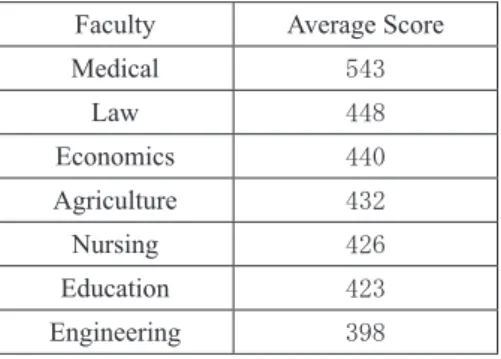
All first year students are required to take the TOEIC in both semesters of their first year. Students have explicit in class practice and in addition they are required to self-study for the TOEIC using an e-learning program which is part of their assigned TOEIC textbook. Failure to take the test will result in a failing grade. These tests are usually administered near the end of each of their two semesters, and the results become part of the students’ final grades. In fact, the students’ TOEIC scores account for 20 percent of their grade. In general one finds that the students of the medical faculty tend to score the highest of all the faculties. The Law, Education, and Economic faculties tend towards the middle level, while the nursing and agriculture students score slightly lower on average than the above three, and finally the Faculty of Engineering students tend to score the lowest on average. While there are variations within the faculties these levels are most useful for our purposes. Table 1 shows the average scores for the full test for the classes the authors taught and their corresponding faculties.
Table 1 Average Score for the Full TOEIC Test (all Faculties) December 2013
Faculty Average Score Medical 543 Law 448 Economics 440 Agriculture 432 Nursing 426 Education 423 Engineering 398 2.0 Research question:
What is the correlation between the real TOEIC test and Half-test and possible reasons for this? Is there value in students sitting the Half-test?
After evaluating the test results of Kagawa University students who have taken both the half-test and the full test, results appear to be inconclusive. For the most part the actual scores tended to lower that of the
half-test. In fact the half-test scores were on average 55 points lower than the full half-test.
2.1 The results and what they mean
The following is an overview of the results broken down by faculty for the authors’ students:
These results are the average differences between the full test results and the half-test. The difference is calculated by subtracting the lowest value in the corresponding range for each level from the corresponding full TOEIC test scores. The actual half-test scores out of 100 are in brackets.
Table 2 Difference between the half-test and the full TOEIC Test
Faculty Average Full Test Scores Average Half-test Scores Difference Medical 612 625-655 (59) -13
Law 547 595-620 (58) -48 Economics 537 595-620 (58) -58 Engineering 426 505-530 (47) -79
This variation may be explained by a number of factors. To begin with, as any teacher knows, standardized tests such as the TOEIC or TOEFL can create a lot of test anxiety for students. This high-stress testing environment is certainly not ideal for students trying their utmost to succeed in any educational environment. Conversely, the half-test was taken in the students’ classroom with both familiar classmates and teacher. In addition, the students were aware that results would have no bearing on their final grades. The whole testing environment was casual and in a familiar setting and this in itself may have contributed to the higher scores. Indeed if this is the case then it is a good argument for the negative effect that stress may have on the overall test scores in this and any other test, and may hint at formal test scores being a less than a realistic reflection of the true language ability of some of the students. In addition, the test itself was half the length of the full test and this in itself may have meant a less stressful situation and a more energetic and thus more motivated student.
In any diverse learning environment one finds that the reaction of certain students to such a challenge that testing may present may result in a tendency to freeze on test day, while others, may carelessly rush through the whole test taking process frequently making careless and numerous errors in their haste to finish. In an effort to avoid these pitfalls studies have shown how important it is for students not only to take practice exams, but also to take them under realistic testing conditions—conditions comparable to the conditions they will face when taking the actual test.
Another area of note is that it would appear the higher the level of the students, the closer the two test scores become. Perhaps the explanation for this would also confirm a stress factor or test anxiety issue. Higher level students are simply under less stress when confronted with the English language and the testing process. Higher level students by definition have a broader knowledge base of the language and would be under less pressure when being tested in a subject they are more comfortable in using. One would therefore expect a more knowledgeable student to be under less stress and be able to perform closer to his or her actual ability. This stress
factor or test anxiety may have a significant role to play in the results. Test anxiety is a type of performance anxiety, that is, apprehension over academic evaluation. Test anxiety (TA) causes poor performance. It relates inversely to students’ self-esteem and directly to their fears of negative evaluation, defensiveness, and other forms of anxiety. A growing number of research has been devoted to investigating the correlation between language anxiety and achievement, usually finding negative results (e.g., Horwitz, 1988; MacIntyre & Gardner, 1994).
Many researchers have found that learning a foreign language has anxiety-provoking potential and that language learning difficulties could predict anxiety in foreign language learning settings (Chan & Wu, 2004). Second language researchers are aware that anxiety is often associated with the success of target language learning, and have verified the effects of anxiety on foreign language learning. Bailey, Onwuegbuzie, and Daley (1999) found that students who have low expectations of their foreign language ability tend to have low levels of foreign language achievement.
Literature on test anxiety in L2 learning indicates that there are some factors that have an influence on students' reactions to language tests. These are perceptions of test validity, time limit, test techniques, test format, length, testing environment and clarity of test instructions (Young, 1999). Young (1991) found that students experience anxiety if the test involves content that was not taught in class. As Young (1991) reported, students felt anxious when they had studied hours for a test and then they found that question types with which they had no experience. Therefore, to reduce anxiety, it is vital to "test what is taught"; teachers should be aware of test validity and the course content should reflect what students are tested on. The TOEIC test being a proficiency test means that the students will not be directly answering questions that they have studied before. This in itself can lead to a level of anxiety that practice through the half-test may help to minimize.
Time limit is another factor that increases test anxiety and decreases performance. Ohata (2005), found that learners sometimes felt pressure when they had to organize their ideas in a short period of time. Using inappropriate test techniques, especially inappropriate time management, is one of the causes of test anxiety. Alcala (2002) found that teachers should familiarize students with the exam format and the type of rating system to reduce test anxiety. Teachers should provide students with clear explanations on the aims of the tests, content, test techniques, number of the questions before the administration.
3.1 – Why?
While the actual correlation was not high, this means the half-test could not and should not be reliably used as an initial placement test reducing both the cost and need for the full test . There are however other benefits that the Half-test offers. The benefits of practice tests are particularly important for students taking standardized tests. The following are some of those advantages.
While there are many strategies for increasing scores, taking realistic practice tests is perhaps the most important element of test preparation. Studies have shown how important it is for students not only to take
practice exams, but also to take them under realistic testing conditions. The TOEIC half-test provides a realistic environment with typical TOEIC questions (Karpicke & Blunt, 2011) .
At present our students take the Half-test twice a year: once before they take the TOEIC test in the spring semester and again before the take the TOEIC test in the autumn semester. The initial Half-test in the spring semester familiarizes students with the test format, directions, and questions style. This practice should give students more confidence on the actual test day. There are a number of advantages to taking TOEIC practice tests at regular intervals during their TOEIC preparation. The main advantage is that students gain expertise in managing typical questions asked in the TOEIC. Practice tests along with regular practice of test type questions allows students to become thoroughly familiar with the format by the time they take the real test. This will make students more confident, composed and relaxed on the day of the actual TOEIC test because they will be aware of the type of questions that will be asked. Inadequate practice of either question types or test format could result in students becoming increasingly confused and nervous on the TOEIC test date leading to poor performance on the TOEIC test.
An additional advantage to doing TOEIC practice tests and test style questions as often as possible is that students can acquire techniques to answer all the questions correctly within the stipulated time frame at a comfortable pace. Students can use TOEIC practice tests to test the techniques that they have acquired from their TOEIC classes and e-learning materials. Adequate practice on the answering strategies outlined in their TOEIC prep textbook and e-learning materials will help them utilize them to their fullest potential. The TOEIC practice half-tests can be used to effectively practice and perfect students’ time management skills.
Students should intersperse their study schedule with practice tests at regular intervals. Each practice test they take will help them evaluate the improvements they have made since the last time they took the test and will allow them to focus on specific areas where they have not been able to make progress. This should encourage students to work towards improving their knowledge and skills in these areas. Making this routine of test style question practice and of regular TOEIC practice tests a part of their TOEIC study schedule, will help them immensely in developing their study and exam taking skills.
4. Conclusion
The TOEIC test was initially designed to give a reliable measure of an English learner’s proficiency and over the years has become a well-known and respected test. Students at Kagawa University are required to sit the TOEIC twice and their results are used to place them in class best suited to their proficiency level. As a result the TOEIC test is an important element in the English curriculum at Kagawa University.
In order to reduce test anxiety students practice test-type questions in class and outside class time using the e-learning system. Furthermore, many students in class do a half-test usually in the week preceding the actual TOEIC to give addition practice and to further reduce test anxiety.
This study has shown that the half-test scores are a more reliable indicator of the actual scores for higher level students. While the Half-test may not be a great predictor of the full test scores for lower level students, this is by no means a reason to ignore it as a useful instrument in the teacher’s repertoire. It can be another useful tool for the English teacher in helping students develop strategies to improve their scores in the TOEIC test. The process of doing the practice test can increase a student’s confidence and experience and reduce the stress when actually taking the full test, and this in itself should help students to achieve better more realistic scores in the future.
References
Alcala, F. R. (2002). Making oral tests more human and less anxiety generating. Humanising Language Teaching, 4 (4), 1 - 3.
Bailey, P., Onwuegbuzie, A.J., & Daley, C.E. (1999). Foreign language anxiety and learning style. Foreign Language Annals, 32(1), 63-76.
Chan, D.Y., & Wu, G.C. (2004). A study of foreign language anxiety of EFL elementary school students in Taipei County. Journal of National Taipei Teachers College, 17(2), 287-320.
Horwitz, E. (2001). Language anxiety and achievement. Annual Review of Applied Linguistics, 21, 112-126. Karpicke J.D., & Blunt, J.R. (2011). Retrieval Practice Produces More Learning than Elaborative Studying with
Concept Mapping, Science 11 February 2011: Vol. 331 no. 6018 pp. 772-775
MacIntyre, P.D., & Gardner, R.C. (1991). Methods and results in the study of anxiety and language learning: A review of the literature. Language Learning, 41, 85-117.
Mitsuhashi, M. (2010). Using the TOEIC Test for College English Education: Review of the Characteristics of the TOEIC Test. Presentation given at University-level English language education and the TOEIC test” at Campus Plaza Kyoto, March 21, 2010
Ohata, K. (2005). Potential Sources of Anxiety for Japanese Learners of English: Preliminary Case Interviews with Five JapanFalese College Students in the U.S. TESL-EJ, Vol. 9, No. 3, 1 - 21.
Young, D.J. (1991). Creating a low-anxiety classroom environment: what does the language anxiety research suggest? Modern Language Journal, 75/4, 426-437.)