[Mem Fac Agr Kagawa Univ No 20 (1965)l
STUDIES
ON
THE
MEIIIA FOR ORCHID
SEED
GERMINATION
Kunio KANO
(Labor ator y of Floriculture) With 19 Tables, 23 Textfigures and 6 Plates
Contents
Page
1. Introduction 3
11. Materials and Methods 3
111. Results 5
1. Preliminary experiments 5
i) Effect of plant saps on the germination and growth of Bletilla, Dendrobium, Brar rolaeliocattleya and Laeliocattleya seeds 5 ii) Effect of adenine, IAA, kinetin and fresh yeast on the germination and
growth of Dendrobium and Laelzocattleya seeds 6
iii) The applicability of "Hyponex" as a base of culture solution 7
iv) Discussion 9
2. Effect of types of containers on germination of orchid seeds and
growth of seedlings 10
i) Effects of various kinds of stoppers on germination of orchid seeds and
growth of seedlings 10
ii) Effect of size of culture vessels on the growth of Brarrauola nodora seed-
Iings 13
iii) Discussion 14
3. Effects of pH and solidity of agar bed on the germination of orchid
seeds 14
i) Effect of p H on germination of Brarrolaeliocattleya seeds 14 ii) Effect of p H on germination of Dendrobium seeds 15 iii) Effect of solidity of agar bed on germination of Laeliocattleya seeds 16
iv) Discussion 1 7
4. Effect of sugar concentration in sowing bed on germination of
Dendrobium and Brassolaelioca~~leya seeds 18
i) On Dendrobium seeds 18
ii) On Brar rolaelzocattleya seeds 19
iii) Discussion 19
5. Effect of gibberellin added to the sowing and transplanting beds on
germination of orchid seeds and growth of seedlings 20
i) On the seed germination and seedling growth of Blettlla striata 20 ii) On the germination of Dendrobium seeds and growth of Brasro:'aeliocattleya
seedlings 2 1
iii) Discussion 22
6. Effects of concentration of Hyponex and IBA in sowing and trans-
planting beds on the germination and growth of Dendrobium and
Kunio KANO
i) Effect of Hyponex concentration on the seed germination and seedling
growth in Dendrobium and Brarrolaelzocaltleya 22
ii) Effects of IBA concentration on the seed germination and seedling growth in Dendrobium and Brar rolaeliocattleya 23
iii) Discussion 24
7. Effects of vitamins, plant saps and organic acids on the germination
and growth of' some kinds of the orchid seeds 26
i) Effect of vitamins 26
ii) Comparison of effectiveness of fresh strained tomato and apple juices on germination of Brar rocattleya, Dendrobzum and Cyprtpedzum regznae seeds 27 iii) Effect of dried apple fruits on seed germination in Dendrobium 29 iv) Effects of organic acids and plant saps on the germination and growth of
Dendrobium grantzz seeds 30
v) Discussion 30
8. Eff zcts of peptone, tryptone and other additions on the germination
and growth of several kinds of' orchids 33
i) O n Cymbzdium seeds 33
ii) O n Oriental Cymbzdtum seeds 34
iii) O n Paphtopedzlum seeds 3 5
iv) O n Cyprzpedtum reginae seeds 36
v) O n Calanthe dzrrolor seeds 36
vi) O n Dendrobzum seeds 3 7
vii) O n Brar ravola nodora seeds 38
viii) Discussion 38
9. Effects of various amino acids and organic substances from natural
sources on the gwmination and growth of Dendrobium and Bras-
solaeliocattleya seeds 42
i) Effects of amino acids and organic substances on the germination and growth of Dendrobtum and Brarrolaeliocattleya seeds 42 ii) Effects of concentrations of tryptophan and glutamic acid on the germi-
nation and growth of Dendrobium and Bras rolaeliocatlleya seeds 44
iii) Discussion 4 5
10. Effects of sugar concentrations in transplanting bed on the growth of Dendrobium, BrassocatLle,ya, Brassavola, Paphiopedilum and
Cymbidium seedlings 46
i) O n Dendrobzum seedlings 46
ii) O n Bras rocattleya seediings 47
iii) O n Brarravola nodora seedlings 4 7
iv) O n Paphiopedzlum callorum seedlings 4 7
v) O n Cymbrdzum seedlings 48
vi) Discussion 49
11. Effacts of' the concentration of tryptone added to the transplanting
bed on the growth of Paphiopedilum callosum and Cymbidium
seedlings 49
i) O n Paphzopedzlum callosum seedlings 50
ii) O n Cymbtdium seedlings 50
iii) Discussion 50
12 Germination of the so-called "hard to germinate" species 50
i) Ovule culture of Oriental Cymbidzum (Cymbzdzum uzrescence) and Paphiopedi- a) Determination of the germinative age in Cymbzdium uirercence 51 b) Eff'ect of peptone and tryptone on the germination of the immature
seed of Cymbidium uirescence 51
Studies on the Media for Orchid Seed Germination
ii) Acceleration of germination in ripe Oriental Cymbidium seeds (Cymbidium
uzrercence) 52
a) Effect of duration of sterilization on accelerating the germination of
ripe Cymbidium uzrercence seeds 53
b) Effect of soaking in KC1 solution prior to sterilization 53 c) Effect of soaking in KC1 solution after sterilization 54 iii) Effect of gibberellin on the germination of ripe Oriental Cymbidium seeds54
iv) Effect of light during germination 55
v) Discussion 55
13. Effect of the storage conditions of Dendrobium and Brassolaeliocat- tleya seeds on thier longevity 57
i) On Dendrobzum seeds 57
ii) O n Brarrolaelzocattleya seeds 58
iii) Discussion 58
14. Effect of X-ray irradiations on the germination and growth of
Dendrobium seeds 58
IV. General Discussion 59
V. Conclusion 61 VI. Summary 6 1 Acknowledgements 63 Literature Cited 63 Plates 68 I. Introduction
Since Knudson succeeded in the asymbiotic germination of orchid seeds with a culture medium which contained inorganic salts, sugar, agar and water in 1922, many new facts have been discovered in the field of the artificial germination of orchid seeds and a number of recipes have been proposed by many workers. Among the fact reported to date, the following two are very important from the practical point of view, especially for the breeders. First, orchids hold different nutrient requirements for their germination depending upon the genera or species, and second, some orchids, like some of the terrestrials, are still difficult to germinate on the culture media artificially prepared. The reasons have not been clarified, but as to the commercially cultivated orchids, the seeds can germinate satisfactorily on culture media which are specifically recommended for that particular genus or species, or with a special cultural method. However, many of the recipes recommended to date are, except a few, somewhat troublesome to follow.
The prsent work was undertaken in order to establish the formulae which are easy to prepare and effective in germination and growth of the orchid seeds, and to find how to germinate the seeds whose germination seemed to be difficult on artificial media.
The recipes devised in this work were reported in Amer. Orch. Soc. Bull. 32: 354-355, 1963.
11. Materials and Methods
4 Kunio KANO
Brassavola, Dendrobium, Cymbidium, Paphiopedilum, Cypripedium and Bletilla were used a s materials. In some cases, however, immature seeds were also used in the test.
In general, four t o five Ehrlenmeyer-flasks (50 m1:-200 ml. capacity) or test tubes (190 mm.
x
21 mm.) were used for each trial a s the culture vessels. These vessels were tightly stoppered with cotton plugs and sterilized in dry heat. After the dry heat sterilization, culture solutions which contained minerals, sugars, agar and various additions were poured into the vessels. All the media were autoclaved a t 15 lbs.. pressure for 20 min. T h e media were generally solidified with 1.5 per cent agar.The pH value of the culture solution was adjusted, in most cases, with Na2C03 and HCl and was checked with a glass electrode pH meter, Initial pH values presented in this paper show the pH values measured after autoclaving the media.
Throughout the work, filtered Wilson's calcium hypochlorite solution (Wilson, 1915) was used a s the disinfectant.. For the sterilization of the seeds, a desired quantity of the seeds was placed in a small glass tube or a small Ehrlenmeyer.flask and the disinfectant added. The tube or flask was then shaken vigorously for three t o five min.. and stored still for another five to seven min. It generally took 10 min. from the beginning of the seed sterilization to the start of planting.
The sowing method was altered depending upon the state of seeds a t the end of the sterilizing procedure.. When the seeds were suspended in the disinfectant solution, it was diluted with three-fold quantity of sterile water upon completion of the sterilization. A small aliquot of the diluted solution with the seeds, varied depending on the size of culture vessels used, was dropped onto the sterile agar surface in the culture vessels with a n ordinary medicine pipette previously sterilized. On the other hand, when the seeds floated on the surface of the disinfectant solution, a small aliquot of sterile water was poured onto the agar bed with the above-mentioned pipette and then the seeds were placed on it with a sterile loop needle.
The procedures described above made the seeds spread on agar surface easily when the flask was gently rotated a t the completion of the sowing process. In some cases, however, the seeds were transferred directly from the disinfectant onto the agar bed with a sterile loop needle..
The immature pods were also sterilized, in the same method. Their sowing method will be stated later.
Soon after the seeds were inoculated in the flasks, in most cases, cotton plugs were replaced with rubber stoppers through each of which a fishhook-shaped glass tubing was inserted.. The tubing was stuffed with a smaI1 wad of cotton a t the outer end, and the whole stoppers had been sterilized previously in dry heat.
Aseptic precautions were taken throughout the work.
After inoculation the cultures were generally placed in a greenhouse. No attempt was made to control the temperature which fluctuated a s the season advanced and the heat within greenhouse.. Readings varied anywhere from 15°C up to approximately 30°C..
Studies on the Media for Orchid Seed Germination 5
The largest 10 to 20 seedlings from one or two culture vessels were used for measurement. The seeds were counted for germination under binocular microscope and small protocorm-like materials were measured using an ordinary microscope.
111. Results 1. Preliminary experiments.
At the beginning of this study, as already tried by many workers in this field, effects of some plant saps and some chemicals which are considered a t present to play important roles in the metabolism of plant development, on the germination and growth of orchid seeds were examined. And then, a simplification of the formulae was tried.
i) Effect of plant saps on the germination and growth of Bletilla, Dendrobium, Brassolaeliocattleya and Laeliocattleya seeds.
Knudson's solution C (Knudson, 1946) was used as the base, to which fresh strained juice of tomato, apple or pseudo bulb of Cymbidium was added a t the rate of 30 per cent. Saps of Cymbidium pseudo bulb showed a mucilage nature. Although these saps contain a certain amount of sugars, the sugar concentration in apple juice is high enough to meet the requirement of orchid seeds even after dilution in preparing culture media. Hence, only the minerals in Knudson's formula were used in the apple juice medium.
For the checks, Knudson's medium and that in which sucrose was replaced by crude sugar were prepared.
Sugar concentration in each medium containing any plant sap was calculated from the reading of a hand sugar refractometer on the fresh strained juice. Sugar concentration in these media varied depending upon the saps added.
The pH value after autoclaving and the sugar concentration in each medium were as follows:
Medium Sugar conc, pH value
Knudson's soln.. C (Basic soln.) 2.0 % 5.2
Basic
+
tomato juice 2.3 % 4.7Basic -I- apple juice 3.6% 5.0
Basic
+
Cymbi. juice 4.0 % 5.0Knudson's mineral soln. +crude sugar 2.0% 5.3
Ehrlenmeyer-flasks of pyre^'^ glass of 100 ml. in capacity with their necks plugged with cotton were used as culture vessels.
Seeds of orchids, Bletilla strzata, Dendrobium, Brassolaeliocattleya were planted in May, 1960, using the method described in Chapter 11.
Results are shown in fig. 1-1 and Plate I. fig. 1 (A-C). As seen in Plate I. fig. 1, 60 days after seed inoculation (Plate I, fig. 1-A), Bletilla striata showed less growth
6 Kunio KANO
on the media containing apple and Cymbi. juices than on other media. Two months later, this tendency of growth was also observed apparently, though on apple juice medium, some plantlets showed normal growth (Plate I, fig. 1-B). On the 140th day of the seed planting, growth was generally better on Knudson's soln. C, basic plus tomato juice and Knudson's minerals plus crude sugar (Plate I, fig. 1-C).. On the apple juice medium some plantlets developed normally a s mentioned above, while others were inhibited in their growth a s compared with those on Knudson's medium. On the Cymbidium juice medium, growth of the seedlings was completeIy inhibited. It seemed that there was no difference in the percentage of seed germi- nation among the media.
On the contrary, a s for Dendrobium, growth of the seedlings was generally better on the media containing plant saps.. The best growth was recorded on the medium with apple juice.. Top growth of the seedlings of Brassolaeliocattle,ya and Laeliocattleya on the apple juice medium was worse than that on Knudson's, while in both genera the root growth was better on the former than on the latter (fig.. 1-I)..
i i ) Effect of adenine, IAA, kinetin and fresh yeast on the germina- tion and growth of Dendrobium and Laeliocattleya seeds.
It was reported recently that such substances as adenine, IAA, and kinetin play important roles in the growth and differentiation of plants. The effect of these substances, added to the media individually or. in combinations, on the germination and growth of orchid seeds was examined in this experiment. A t the
Studies on the Media f b r Orchid Seed Germination 7
same time, the media containing fresh yeast, tomato or apple juice were prepared. Knudson's soln. C was used as a base.
The following doses were added to the Knudson's base: 10% of tomato juice 10% of apple juice 0.5% fresh yeast 40 ppm adenine sulfate 1 ppm IAA 0.5 ppm kinetin
Concentration of sugar in all the media was adjusted to two per cent adding a necessary amount of sucrose. The pH values of these media after autoclaving were between 4.5 and 4.8.
The results obtained with Den. and LC. seeds are shown in fig. 1-2.
O:au height of plant
8:av no of leaf per plant
0 20,
ae
-
40 0, C605
8011: DoFig 1-2 Effect of various additions to the media on the growth of orchid seeds Basal medium: Knudson's soln C Cultured in test tube with cotton plug
The best growth was recorded on the medium containing apple juice in both genera.. Those genera responded differently to the fresh yeast, adenine and IAA.
Fresh yeast was effective on the growth of Den., while it was ineffective on the growth of
LC.
The response of either genera to the latter two substances was quite reverse to the former. No favourable effect of other additions was observed in the present experiment.iii) The applicability of 'cHyponexyy as a base of culture solution. In order to simplify the recipe of culture solution, Hyponex, a plant food containing nitrogen (total nitrogen not less than 7%' nitrate nitrogen not less than
8 Kunio KANO
5.8 %, ammoniacal nitrogen not less than 1.2 %), phosphoric acid (available phos- phoric acid not less than 6%), potash (water soluble potash not less than 19%) and other essential elements for plant growth, and commonly used by horticulturists throughout the world, was examined for its applicability as a mineral nutrient base.
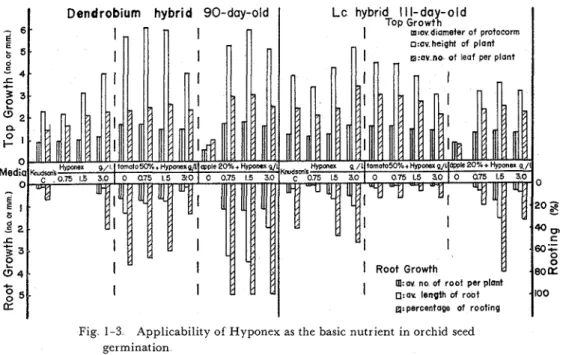
The concentration of Hyponex solution was 0.75, 1.5 or 3.0g per liter in each medium. The applicability of Hyponex solution alone and that containing 50 per cent tomato juice solution (Meyer's tomato juice medium) or 20 per cent apple juice solution was tested. With the latter two, plots containing no Hyponex were also used. Plain Knudson's soln. C was employed as a control.
Sucrose was added a t the rate of two per cent to both plain Knudson's C and Hyponex solutions, and neither sucrose nor any other type of sugar was added to those plots containing tomato or apple juice. The sugar concentrations in these two solutions were determined by hand sugar refractometer readings as already mentioned. They were approximately 2.0 per cent in the tomato juice medium and 2.4 per cent in apple juice medium. pH of these media was between 5.4 and 4.6.
As the seed material, seeds of Dendrobzum hybrid and Laelzocattleya hybrid were used.
Fig 1-3 Applicability of Hyponex as the basic nutrient in orchid seed germination
Results are shown in fig. 1.-3
With Dendrobium, the best growth of whole plants was recorded on the medium with apple juice and 1.5g Hyponex, and the seeds did not grow well on the medium with apple juice alone. In general, the root growth on the media with apple juice and Hyponex was superior to the root growth on any other media. Comparing the
Studies on the Media for Orchid Seed Germination 9
growth on plain Knudson's soln. C and on plain Hyponex of 3.0g, the better growth was observed on the latter.
With Laelzocattleya, the best growth of root portion was recorded on the medium with apple juice and 1 5 g Hyponex, a s in the case of Dendrobzum. Considering the growth of both top and root portions together, however, it may be concluded that growth is better on the medium with 3.0g Hyponex. On the media containing tomato juice, the growth was successively decreased according a s the dosage of Hyponex increased
iv) Discussion.
Through the experiments presented above, it was shown that the preferable formulae for culture solution differ depending upon the orchids used. Among the plant saps used a s the supplement, apple juice was by far the most effective on the growth of both top and root in Dendrobium, and in other orchids on the growth of root. Hyponex is applicable a s the mineral nutrient base of culture solution to asymbiotic germination of orchid seeds.
T h e fact that the formulae preferable for asymbiotic germination of orchid seeds are different depending upon what orchid one deals with, is clearly demonstra- ted in the present experiment a s already shown by great many investigators (Ballion and Ballion, 1924; Breddy, 1953; Burgeff, 1936; Clement, 1924a, b ; Curtis, 1947; Curtis and Spoerl, 1948; Griffith and Link, 1957; Hegarty, 1955; Spoerl, 1948; Spoerl and Curtis, 1948; Withner, 1959; etc.). This fact may be interpreted that different genera or species of orchids hold different nutrient requirements for their germination, but the exact reason for it has not yet been clarified as emphasized before One of the ways to attack such a problem is to find first a favorable recipe for each genus from the practical point of view, setting the reason aside.. Some of the experiments which will be shown in the later sections of this paper were carried out from this point of view.
T h e simplification of the formulae of the culture solution in asymbiotic germi- nation of orchid seeds from the practical standpoint was reported already by several workers with success (Chang, 1953, 1955 ; Graeflinger, 1950 ; Ito, 1955 ;
Karasawa, 1964; Meyer, 1945a and Yamada, 1952; etc.). Most of the recipes presented to date are empirically derived from Knop or Pfeffer solution, and there has been no research, except that of Wynd (1933a), with respect to a systematic determination of the optimum mineral requirements of any particular species or genus (Withner, 1959). This means there is no scientific standpoint of the recipes.. Since good germination and seedling growth are aimed from the practical point of view, media should be the ones that can be prepared without difficulty. A s was mentioned in the introduction, almost all the recipes now used a r e too troublesome to follow, for practical uses, Preparation of media, therefore, should be simplified for practical uses. These considerations must be taken into account in practically attacking the problem of asymbiotic germination of orchid seeds of unknown nature.
10 Kunio KANO
solution as compared with the plain Knudson's soln. C for the growth of both Dendrobium and Laeliocattleya seeds.. The fact indicates obviously that this plant food is applicable as a mineral nutrient base in culture solution. Based on this fact and the considerations mentioned above, the following trials were made in order to establish recipes which are easy to follow and effective in germination and growth of the orchid seeds, using Hyponex as a mineral base..
2. Effect of types of containers on germination of orchid seeds and growth of seedlings.
Some of the results of the observation on the effect of containers on germina- tion and growth of orchid seeds are as follows.
i)
EfTect of various kinds of stoppers om the of orchid seeds axad the growth of seedlings.Plate I. fig. 2-A shows the effect of stoppers on the growth of Laeliocattleya seeds 188 days after sowing. The growth was better in the flask which was completely sealed with a rubber stopper (A-b) than in the others, though the roots in that flask elongated upward with numerous hairy roots. On the 268th day after seed sowing died all of the seedlings whose roots elongated upward and top growth was depressed seriously in the sealed flask (Plate I. fig. 2-B-b). At that time,
Studies on the Media for Orchid Seed Germination 11
temperature in the greenhouse rose drastically. This may be one of the reasons causing the death of the seedlings. The growth recorded 285 days after seed sowing is shown in fig. 2-1. The best growth of seedlings was recorded in the flask sealed with the rubber stopper with' a glass tubing. In this case also, growth of the seedlings on the plain Hyponex solution exceeded the growth on the plain Knudson's solution C..
Effect of type of stoppers on the growth of orchid seeds in an early period of sowing culture was repeatedly examined. Results obtained with Dendrobium and
Brassolaeliocattleya seeds are shown in tables 1 and 2. Although there are some variations depending upon the orchids used, the growth of the seedlings in com- pletely sealed flasks is generally best as in the result shown in the Plate I. fig. 2,-A.
Table 1 Effect of various kinds of stoppers on the growth of Dendrobrum seeds
*
Age: 156 days- -
- - - -- - A - - -- - - - -- -- A - -
Stoppers Av. height of plant per plant Av width of leaf o plant ~ ~ o Av length ~of root ~ e r percentage Roofing
mm mm mm
Cotton plugs 7 1 2 0 1 9 2 0 10 5 100
Rubber with glass tubing
Scaled completely 10. 1 3 1 1 2 2 9 14 2 100
*
Medium: Hyponex plus apple juiceTable 2 Effect of various kinds of stoppers on the growth of Blc seeds
*
Age: 156 days- ---- . . -- -- . - - -- -
-Av no Av dia Av. no
Stoppers iA:
:t;ht
of leaf per of proto- of ;:;perAtf
$zth
p2z::::e
plant COI mmm mm mm
Cotton plugs 3 9 2 7 1 4 1 6 3 3 100
Rubber with glass
tubing 4 5 2 6 1 6 1 3 1 7 100
Sealed completely 5 3 2 9 2 0 1 2 1 7 80
*
Medium : Plain Hyponex.Plate I. fig.. 3 shows the results obtained in another trial in which the effect of complete sealing on the growth of developing Dendrobium seedlings was examined. In this figure it is apparent that roots with numerous root hairs elongated upward and the top growth of these seedlings was depressed seriously. The results coincide with some of the results in the trials described above. Also in this figure, the excellence of the medium containing apple juice for the growth of Dendrobium
seedlings is proved.
In Plate I. fig. 4 (A and B) is shown the result obtained in the trials in which the effect of cotton wad stuffed a t the outer end of glass tubing was examined. Namely, a series of culture vessels was plugged with ordinary rubber stoppers, and another series was plugged with zigzag-shaped glass tubings instead of glass tubings with cotton wads a t the outer ends. There was no appreciable difference in the
12 Kunio KANO
growth of the seedlings between these two series, except some contamination in the latter series.
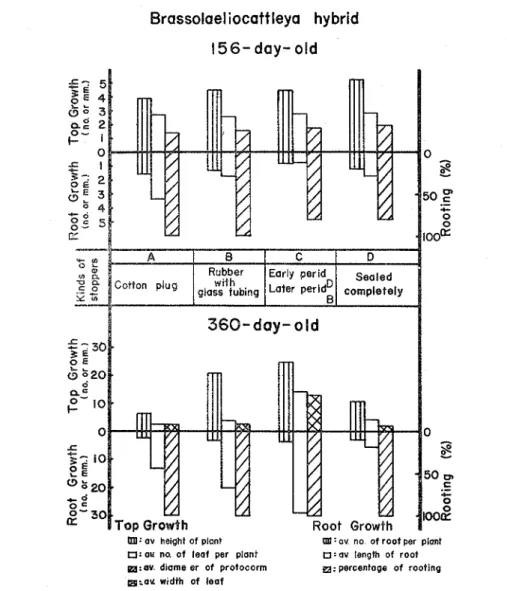
Brassolaeliocattleya hybrid
Rubber Early perid seeled
1
glez%bing1
La" Per$1
cempbts~yI l l : av height of plant m : a v no of root per plant
a: ou no. of leaf per plant tl: av length of root p;d:av diome er of protocorm a: percentage of rooting ep:au width of l e a f
Fig 2-2 Effect of various kinds of stoppers on the seed germination in Blc In plot
C the stoppers were changed on 156 days after sowing
These facts give rise to an idea that better growth of seedlings may be ex- pected when the culture is completely sealed in the early period of the cultures and plugged with ordinary rubber stoppers with glass tubings in the later period.. This possibility was examined setting the plots as follows:
a : cotton plugs
b: rubber stoppers with glass tubings
c: completely sealed in the earlier period of culture and plugged with ordinary rubber stoppers with glass tubings in the later period
Studies on the Media for Orchid Seed Germination
d : completely sealed throughout the culture
Actually, for the completely sealed plots, ordinary rubber stoppers with glass tubings whose outer ends were tightly plugged with small rubber cylinders were used. In plot C, the small rubber cylinder was removed 206 days after seed sowing. Dendrobium grantii was used a s the seed material.
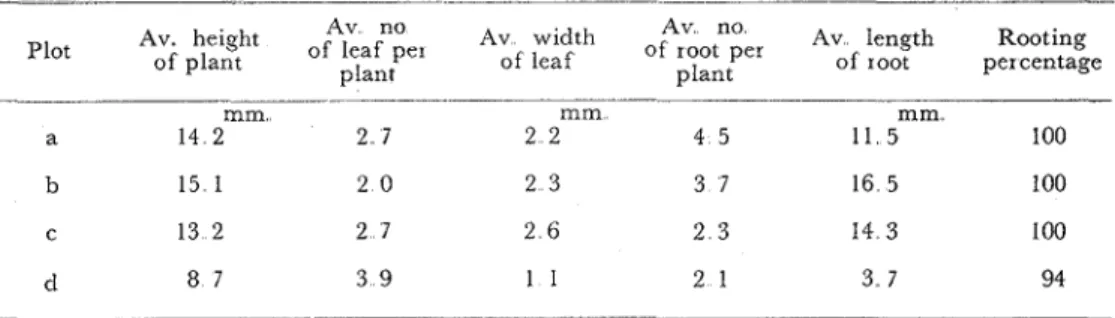
As shown in tables 3 and 4 and Plate I. fig. 5 (A-C), no favorable result was obtained in this attempt. It may be considered, however, that the timing of the removal of the rubber cylinder played an important role in the failure of this trial.
Table 3 Effect of stoppers on the growth of Den grantzz
*
Age: 206 days, henceforth the rubber cylinder in plot C was removedAv no Av no
Av. height of leaf per AV dia of of root per A;f t ~ ~ ; t h Rooting
'lot of plant plant protocorm plant percentage
*
Medium: Hyponex plus apple juiceTable 4 Effect of stoppets on the growth of Den grantzz, at the end of experiment
*
Age: 365 days-- ---- -
--
-- - - -Av no Av Av length Rooting
plot
$,":
of leaf pelzi:th
of root per of root percentageplant plant
*
Medium : same as above.On this problem the author obtained successful result in another experiment with Blc. seeds a s shown in fig. 2-2.
ii) Effect of size of culture vessels on the growth of Brassavola nodosa seedlings.
Hundred and forty-eight-day-old seedlings of Bra.s.ravola nodosa were transplanted into the culture flasks of various sizes, and the effect of the size of culture vessels on the growth of orchid seedlings was observed. In this experiment, the number of plants in each flask was limited to a plant per 5 ml. of nutrient solution..
Results are shown in table 5 and Plate I. fig. 6.. These results show that growth of the seedlings is generally better in large culture vessels than in smaller ones..
14 Kunio K A N O
iii) Discussion.
The results of the above experiments clearly show that the growth of the seedlings is better when culture vessels are sealed completely in the early period of culture, and is better in large culture vessels than in smaller ones in later period.
From the early period of asymbiotic culture of orchid seeds much attention has been paid by many investigators to the stopper of containers in order to minimize the desiccation of agar plate and exclude the fungal contamination which
Table 5 Effect of the size of culture vessels on the growth of Brarravola nodora seedlings Age: 177 days after transplanting
- - -
-Size of Amount of No of Av no
culture plant per Av. height of leaf Av Width oi%o?ier Av length
flasks solution flask per plant leaf plant root
occurs often when a cotton plug is used as a stopper.. The rubber stoppers with glass tubing eliminate these cares and assure a good growth of the seedlings as shown in the present experiment. Meyer (1948) has shown that growth of seedlings sealed in culture flasks was better than that in cotton-stoppered containers. His result coinsides with the result shown in the present experiment so far as the early period of seedling growth is concerned. Practically speaking, rubber stoppers with glass tubing may be recommended. This recommendation is supported also by Breddy's result (Breddy, 1953) When experiments are limited to germinating seeds, e.g. Oriental Cymbidium seed germination, however, sealed test tubes were used as containers in most cases..
As to the size of containers, Knudson (1922) observed that a better growth can be obtained in larger containers than in smaller ones. A similar result was obtained in the present experiment with Brassavola nodosa seedlings. From the practical standpoint containers of large size are recommended a t least as trans- planting vessels..
3. Effects of pH and solidity of agar bed on the germination of orchid seeds.
Effect of pH in the sowing bed was examined on Brassolaeliocattleya and Dendro- bium hybrid seeds. The effect of the solidity of agar plate on the germinating orchid seeds was also examined, since it changes depending upon the pH value of nutrient solution.
i) Effect of pH on the germination of Brassolaeliocattleya seeds.
Studies on the Media for Orchid Seed Germination 15
regulated with KOH and HCI. In order to obtain a proper solidity of agar plate and hence, make planting operations easy, the following agar concentrations were employed in correspondence to different pH values.
Initial pH 4.55 5.25 5.65 6.72 8.38 Agar concentration (%) 2.0 1.5 1.0 1.0 1.0
In this experiment, the flasks were stoppered with cotton plugs.
The result is shown in fig. 3-1. The growth of the seedlings became better with the increased acidity. The best growth was recorded on the medium with pH a t 4.55.
The acidity in each medium increased a t the end of the experiment.
Blc.
hybrid
120-
day-old
:ax diameter of protocorm
0: av height of plant
0
20
8
Root Growth
: 0" n* Of root per plant 40 a E
.-
0: ov length of root 60; ed : percentage of roeting 0 e o a tooFig. 3-1. Effect of' pH concentrations in the sowing bed on the development of Blc.. hybrid seeds. Basal medium: Knudson's soln. C.
ii)
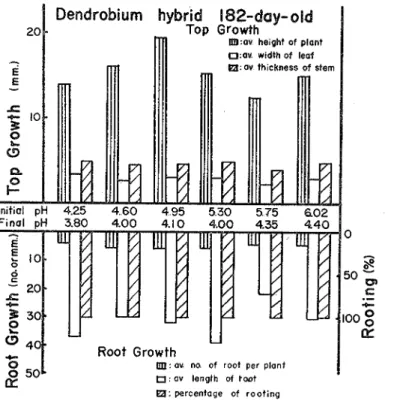
Effect of pH on the germination of Dendrobium s e d s .Knudson's solution C containing apple juice a t 15 per cent was used as a basic culture solution. This solution is especially favorable for germinating Dendrobiurn
seeds and has a strong buffer action.
16 Kunio KANO
addition of sucrose. pH was regulated with Na2C03 and HC1 in this experiment. Agar concentration in each medium was adjusted also.
Initial pH (1 week after seed sowing) Agar concentration (%)
4.25 2.5 4.60 1.7 4.95 1.3 5.30 1.0 5.75 0.7 6.02 0.7
As described above, initial pH values were determined one week after seed inocu- lation.
Fig. 3-2 shows the result. Generally speaking, there is no apparent difference among the plots. Observation record, however, shows that a t first seed germina- tion and growth of the seedlings were appreciably retarded on the media of high pH values. As shown in the figure, only small differences are seen among the final pH values which were determined after culture of six months.
O ; a v width of leaf
0 : au no of root per plant O : av length of root
El: percentage of rooting
Fig 3-2 Effect of p H concentrations in the sowing bed on the development of Dendrobzum hybrid seeds Basal medium : Knudson's soln C plus 15% apple juice
i i i ) Effect of solidity of agar bed on the g e r m i n a t i o n sf Laeliocat-
tleya seeds.
Studies on the Media for Orchid Seed Germination 17
varies depending on changes of pH value of the solutions, especially after autoclav- ing Therefore, the effect of solidity of agar bed on the growth of orchid seeds was investigated.
Knudson's mineral solution containing apple juice a t 10 per cent was used as a basic solution. Total sugar concentration was adjusted to 2.4 per cent adding sucrose. pH of this solution was adjusted to 4.5. Agar concentrations a t 0.8, 1.6 and 2.4 per cent were prepared. LC. hybrid was used as seed material and the culture flasks were stoppered with cotton plugs. It was found after autoclaving that 0.8 per cent of agar is too soft.
The result is shown in fig. 3-3. As shown in the figure, the growth is better in the softish side.
-
6 a : a v diameter of protocormf
height ofim+
0 L: m : a v no of l e a f p e r p l a n t-
4 0 8 16 2 4 %A ~ a r
Concentraf
ions
Fig 3-3 Effect of solidity of agar plate on the development of LC hybrid seeds Basal medium : Knudson's soln C plus 10% apple juice Initial p H 4 5
i v ) Discussion.
Some workers have attempted to study pH stabilization in culture media (Burgeff, 1936: Vacin and Went, 1949a, b; etc.) and others referred to the pH concentration of germinating media (Burgeff, 1936; Breddy, 1953; Curtis and Spoerl, 1948; Downie, 1940, 1941 ; Hegarty, 1955; Knudson, 1925; La Garde, 1929; Lugo, 1955; Smith, 1932; etc.). However, these are of little importance as stated by Knudson (1951 and 1952) Namely, at the lower side of pH values, death of the embryo is a problem. The critical point of death in the range of pH values differs among the orchid genera or the species. The death is probably due to the increased availability of minor elements such as iron or manganese and in part due to the failure of absorption of calcium. On the other hand, when the solution is less acid, viz., pH 5.5 or above, these substances precipitate and are not utilized by the embryo. This brings no chlorophyll development in the embryo. That is, pH of the culture solution affects indirectly to the germinating orchid seeds through
18 Kunio KANO
the availability of iron, manganese and other substances in the solution, and if these substances could be kept available, growth of orchid seedlings would be a s good a t pH 6 a s a t pH 5.0 (Knudson, 1952).
Withner (1959) stated on the pH problem of culture solution of orchid that "except for effect of pH on availability of iron, calcium, phosphate, or other inorganic nutrients which tend to precipitate a s insoluble complexes above approxi- mately pH 5.3, pH does not seem to have a well-defined effect on growth". In studying the pH problems of nutrient solution, he suggested the applicability of complexed or chelated forms of the metal ions a s an available nutrient source not so readily influenced by the pH of the solution.
In the present experiment, another indirect effect of pH, through the solidity of agar bed on the germination of orchid seeds was demonstrated. Good growth on softish agar bed is probably due to the good moisture maintenance. Thus the effect of pH of culture solution on the germination of orchid seeds is indirect and complicated matter.
In order to ascertain the direct effect of pH on the germination of orchid seeds, another type of solidifying material and of minor elements not so readily influenced by the pH variation of the solution must be employed..
With Dendrobium, appreciable amount of seedling growth was obtained on the medium a t pH 6..02 a t the end of experiment. This is probably due to the fact that in such complex nutrient solution the minor elements which readily precipitate in less acid solution would be contained in available complexed forms..
Many investigators observed that the culture medium becomes more acid during the growth period (Bahme, 1949; Burgeff, 1936; Curtis and Spoerl, 1948; Knudson, 1951; Spoerl, 1948; Vacin and Went, 1949b; Wynd, 1933b, c ; etc..). T h e similar results were also obtained in the experiment. This may be due to the utilization of chemicals in the medium by the germinating embryos and the products of growth a s suggested by Vacin and Went (1949b). T h e pH stabilization of culture medium is of little importance a s pointed out by Knudson (1951). It seems, however, that the acidity of culture solution is only increased in every experiment in which the well developed orchid seedlings were obtained including the present author's.. While in the experiment of Muir, Hildebrandt and Riker (1958) during incubation of marigold crown gall tissue the original pH levels of the liquid medium drifted toward 6.. 1.
As a conclusion pH about 5.0 and agar concentration about 1.5 per cent may be recommended for germinating orchid seeds from the practical point of view.. Under these conditions the agar bed is hard enough for the planting procedure, and a good germination and growth of the seedlings of many orchid genera are secured.
4. Effect of sugar concentration in sowing bed on germination of
Dendrobium and Brassolaeliocattleya seeds.
i)
On Dendrobium seeds.Studies on the Media for Orchid Seed Germination 19
were prepared. For a basic medium Knudson's solution C was employed. pH value of these media was about 5.1.
The results a r e shown in fig. 4.
The best growth of the seedlings was recorded on the medium containing 4.0 per cent sucrose. The rooting became better with the increase in sucrose concen- tration. At 8.0 per cent growth in both top and root was suppressed a s compared with the growth a t 4.0 per cent.
i i ) On Brassolaeliocattleya seeds.
The sucrose concentrations prepared and the basal medium employed were same a s in the experiment on Dendrobium.
The results are also presented in fig. 4.
Dendrobium hybrid 120-day-old l Blc. hybrid 120-day-old
2 6 Ei O 5 C
-
1 13 av he~ght of plant 4 f 3 2 O 2 n. $ 1-
E 0 t l 0 E-
2I
riQ av no of root per plantf av length of root 3 3 2 1 percentage of rootong (3 4 C 0 0 5 Ix
Fig 4 Effect of sucrose concentrations in sowing bed on the development of Den and B16 hybrid seeds Basal medium: Knudson's soln C
In general, results are the same a s those obtained with Dendrobium seeds, though in this genus somewhat better growth in top was seen on the medium with 2.0 per cent sucrose than with 4.0 per cent medium.
i i i ) D i s c u s d o n .
Researches in connection with the types of sugars in germinating bed have been presented by many workers on various kinds of orchids (Bouriquet and Boiteau, 1937; Bultel, 1925; Cappelletti, 1933; Knudson, 1924, 1952; a s to others see Withner's chronology concerning the research on carbohydrate sources for orchids, Withner, 1959), but very few experiments can be found concerning the sugar concentrations in sowing bed.. Except those of Burgeff (1936), Ito (1961) and Yates and Curtis (1949), most of the experiments were carried out making the concentrations of sugars to the extent of 2..0 per cent (Knudson, 1922; Withner, 1959).. Yates and Curtis presented the results that the optimum concentrations of
20 Kunio KANO
sucrose for the development of shoots and roots were found to be distinct, higher concentrations favoring root growth. And concentrations which favor root growth and do not suppress top growth too much are between 0.10 and 0.15 molar, each species showing individual characteristics. This almost accords with the present results.
From the practical standpoint, sucrose concentration of about four per cent may be recommended for the germinating bed.
5.
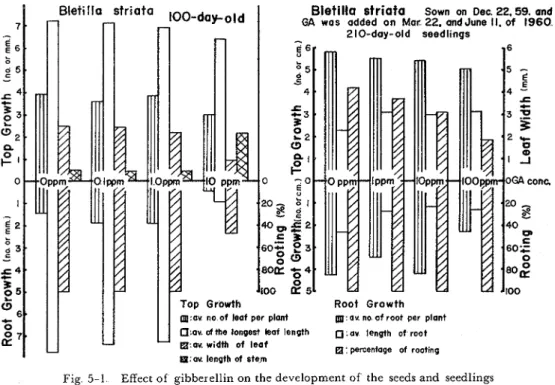
Effect of gibberellin added to the sowing and transplanting beds on the germination of orchid seeds anad growth of seedlings.i) On the seed germination and seedling growth of Bletilla striata.
Knudson's solution C containing 0.1, 1.0 and 10 ppm of GA were prepared. Plain Knudson's solution C was used as a control. Seeds of Bletilla striata were inoculated onto these media. The growth of the seedlings recorded 100 days after seed sowing is presented in fig.. 5-1.
Bietilla striata Sown on Dec 22.59. and
7 GA was added on Mar 22. cmd June II. of I960
-
-
21 0-day-old seedl~ngs 6 1 6 0z
;
5-
-
-
4E
,
4-
+ C 3 f 3B
3 3s
2 2 2 2'5
.,
n w 0 $ 1 $ 1 If
F 0 0 - 0 OGA conc I I 20- 8 1 2 0 , 2 $-
-
8E
4 0 m = 2 4 0 W b 6'05 $ 3 E 8 6 0 . Z-
g w
0 f 4 eocr%
4 eo 3e 5
I00:
5 100 6 Root Growth+ av no of leaf per plant IN au no of root per plant
U av of the longest Lsaf length 0 av length of root av width of leaf a percentage of rootmg BP m. length of stem
Fig 5-1 Effect of gibberellin on the development of the seeds and seedlings of Bletilla rtrzata Basal medium: Knudson's soln C Flasks were stopped with cotton plugs
The stem elongated exceedingly on the medium with 10 ppm of GA, while the number of leaves, leaf length and leaf width were reduced. Root growth was seriously suppressed on this medium.
As presented in fig. 5-1, the effect of GA on the developing seedlings of
Studies on the Media for Orchid Seed Germination 21
aseptically into the culture flask (300 ml. capacity) which contained about 100 ml. of culture solution. The concentrations of GA were 1, 10 and 100 ppm. The pouring treatment was made 90 and 172 days after seed planting. The recording was made 210 days after seed sowing.
Generally speaking, in top growth, the number of leaves per plant and the width of leaf were reduced by the GA treatment, while the length of the longest leaf was somewhat increased. GA generally suppressed the root growth except the percentage of rooting which seemed established before GA treatment.
ii)
On the germination of Dendrobium seeds and growth of Bras- solaeliocattleya seedlings.Knudson's solution C plus 10 per cent apple juice was used as a basic culture solution. The concentrations of GA added to the media were 0, 0.5, 5.0 and 50 PPm.
Eighty-day-old seedlings of Blc. and seeds of Dendrobium were planted on these media.
The results are shown in fig. 5-2.
Blc. hybrid 100 days after trans- Dendrobium hybrid 100-day-old
Root Growth
m:ov diameter of protocorm ov n o of r o o t p e r plant
[7 ov helght of plont ov length of root
ov no of leof per plant percentage of r o o t ~ n g
Fig 5-2 Effects of gibberellin on the development of the Blc seedlings and the Dendrobtum seeds Basal medium: Knudson's soln C plus 10 percent apple juice
In both genera, average diameter of protocorms decreased by degrees as the concentration of GA increased. The similar tendency was seen in root growth. The growth of plant in height was somewhat better on the media with 50 ppm of GA in both genera..
22 Kunio K A N O
From the practical standpoint no favorable effect of GA on the germination of orchid seeds or on the growth of their seedlings was observed in these experiments. This accords with the result of other investigators (Sisa and Sawa, 1963). Appli- cabiIity of GA to orchid plants may be limited to grown up plants for such purposes as acceleration of flowering, shortening of juvenile phase, and controlling flowering time, as proved with other plants.
6. Effects of concentrations of Hyponex and IlBA
ha
sowing and trans-plamting beds on the
and
growth of Dendrobium axadBrassolaeliocattleya seeds and thdr seedling growth.
The applicability of Hyponex as a mineral nutrient base in asymbiotic germi- nation of orchid seeds was already proved in section 1. In this experiment, suitable amount of Hyponex in sowing and transplanting beds was determined using the seeds and seedlings of Den.. and Blc. The effects of IBA on the germination of these orchid seeds and their seedling growth were also examined for its practical applicability.
Based on the results obtained in the experiments of section 1, 10 per cent apple juice solution was used as basic solution for Dendrobium, and plain Hyponex solution was employed for Brassolaeliocattle,ya.
i) Effect of Hypormex concentration on the seed germination and seedling growth in Lledrobium and Brassolaeliocattleya.
As described above, with Dendrobium 10 per cent solution of fresh strained apple juice was prepared. Then 2, 3, 4 or 5 grams of Hyponex was added per liter of the solution. Total sugar concentration of each solution was adjusted to 3.5 per cent adding sucrose. pH of these media ranged between 4.80 and 4.95 after autoclaving. With Blc.. 2, 3, 4 or 5 grams of Hyponex was added per liter of water. Sucrose was added a t the rate of 35 grams per liter of each solution.. pH of these culture solutions ranged between 4.95 and 5.1 after autoclaving.
Seeds or seventy-nine-day-old seedlings of Dendrobium were inoculated or transplanted respectively onto apple juice media containing various amounts of H y ponex.
Similarly, seeds and ninety-one-day-old seedlings of Blc.. were planted onto a series of plain Hyponex media.
The results are presented in fig. 6-1 and Plate I. figs. 7 and 8.
As can be seen in the figures and plate, with Dendrobium seeds, plant height increased by degrees according as the amount of Hyponex increased. The growth response of roots was quite reverse to that of plant height. As. a whole, the same results are seen in the transplanting experiment of this genus except that the best elongation of root was recorded on the medium with three grams of Hyponex. Seedlings showed a pale green color on the sowing bed with low concentrations of
Studies on the Media for Orchid Seed Germination Brassoloeliocatt leya av width of loat ym ax no of root per 0 av length of root rn percsntage ot
Basol solution : IO%opple jutce
Fig 6-1 Effect of concentration of Hyponex in the sowing and transplanting beds on the growth of seeds and seedlings of Den and B1c hybrids
Hyponex as observed in the Plate. I. fig. 7.
On the other hand, with Blc. the best growth in plant height was recorded on the medium with three grams of EIyponex in both sowing and transplanting beds. In the sowing experiment, the root length decreased by degrees as the amount of Hyponex increased as in Dendrobkm. In this genus, however, growth in both top and root was apparently suppressed on the medium with five grams of Hyponex. This dose of Hyponex also suppressed the growth of transplanted seedlings. The best growth in both top and root of transplanted seedlings was recorded on the medium with three grams of Hyponex.
ii)
Effects of IBA concentration on the seed germination and seedling growth in Dendrobium and Brassolaeliocattleya.As in the former experiments, solutions of various constitutions were employed as base depending upon orchids used as foIIows:
Sugar
Orchid Basic solution concentration
(%I
Dendrobium Hyponex 3 g./liter of
10 per cent apple juice soln. 3.5
Brassolaeliocattleya Hyponex 3 g../liter of water 3.5
24 Kunio KANO
culture solution. pH values in apple juice media ranged between 4.8 and 4.95, and those of plain Hyponex were between 4.95 and 5.1. The same seeds and seedlings of the orchids used in the former experiment were inoculated or transplanted onto the media of each group.
T h e results are presented in fig. 6-2 and Plate 11. figs. 1 and 2.
r Dendrobium hybrid B;zo\sowing bed I - d a y o d
I
rt; E I B A concentrations1-1
4 0 Transplanting bed1
117 days after transpl[m
I
t
Brassolaeliacattleya20 Sowing bed 178-day-old
I
Root Growth
Fig 6-2 Effect of IBA in the sowing and transplanting beds on the growth of seeds and seedlings of Den and Blc hybrids
With Dendrobium, the seed germination and the growth of germinated seedlings were extremely inhibited by 10 ppm of IBA. On the contrary, the growth of the transplanted seedlings was apparently promoted by this concentration of IBA in both top and root, especially in plant height and number of roots per plant. Observation record shows that on this medium, however, transplanted seedlings become abnormal in forms immediately after transplanting and their roots were separated easily from the plant body a t the time of sampling.
With the seeds and seedlings of Brassolaeliocattleya, no excellent effects were observed except that the seed germination and the growth of germinated seeds were inhibited by 10 ppm IBA as in the case of Dendrobium.
iii)
Discussion.Growth response of both seeds and seedlings to the concentration of Hyponex differed between Dendrobium and Brassolaeliocattleya. The former developed well on all the media examined, while in the latter the best growth of transplanted seedlings and the best top growth of the germinated seedlings were recorded on the medium with 3.0 grams of Hyponex, and the highest concentration of Hyponex apparently
Studies on the Media for Orchid Seed Germination 25
suppressed the growth in both germinated seeds and transplanted seedlings. These facts suggest that the tolerance to high salt concentration, and the optimum salt concentration for best growth differ between these two orchids.
As the concentration of Hyponex in sowing beds increased, the growth in root length of germinated seedlings was inverse proportionally decreased in both
Dendrobium and Brassolaeliocattleya. The similar tendency was also seen with the transplanting media of Dendrobium. This phenomenon is quite interesting when compared with the effect of sugar concentration on the root growth (section 4 of the present work, and Yates and Curtis, 1949)) i.e. the growth in root length generally increased according as the concentration of sucrose increased. Thus, with Dendrobium, the effect of fertilizer and that of sucrose on the shoobto-root ratio of the seedlings are in reverse.
The other results of Yates and Curtis (1949) concerning the effect of salt concentration on the shoot growth of other orchids, generally accord with the present results. So far as root growth is concerned, however, they conflict especial- ly with the results obtained with Dendrobium in the present experiment.
Generally speaking, the present results concerning the Hyponex concentration show that optimal concentrations for root growth are lower than for top growth, although each orchid showing individual characteristics.
It is well known that many kinds of orchids grow so well on a wide variety of combinations and concentrations of inorganic substances in culture. However, very little is known about the actual mineral requirements, the optimal mineral combina- tion or the optimal mineral concentration for the germination and growth of different orchid groups. There are many problems to be solved scientifically as to the mineral nutrition for asymbiotic germination of orchid seeds. The present work was carried out in order to determine the favorable amount of Hyponex as a mineral base of culture solution from the practical standpoint.
Concerning the concentration of Hyponex for practical use, the concentration of three grams per liter with 3.5-4.0 per cent of sugar may be recommended for the sowing and transplanting beds for Dendrobium and Brassobaeliocattleya, although for the former genus it is better to combine with apple juice solution (see also sections 1, 4, 9 and 10).
The results concerning the effect of IBA on the germination and growth of seedlings in the present work show that 10 ppm of IBA in transplanting bed is usable for Dendrobium in practice. This concentration of IBA inhibited the germina- tion and growth of germinated seedlings in both Dendrobium and Eras.solaelioca~tleya
on sowing bed and scarcely any effect was observed on the growth of transplanted seedlings of the latter orchid.
As to the work with auxins, Withner's review (1951) and his chronology (1959) are valuable. The present results generally accord with the results shown by Meyer (1945b)) Meyer and Pelloux (1948)) Sisa and Sawa (1963) and Withner (1951, 1955). Some of the discrepancy with their results are probably due to the differences in basal media employed.
26 Kuuio KANO
7. Effects of vitamins, plant saps and organic acids on the !germina- tion and growth of some kinds of the orchid seeds.
i) Effect of vitamins.
Effect of thiamine and "vitamin complex" ("Panvitan solution": each cubic centimeter containing Vitamin A, 5,000 I.U.; Vitamin D2, 500 I.U.; Vitamin B1, 2 mg.; Riboflavin, 3 mg ; Nicotinamide, 20 mg ; Pyridoxine HCl, 2 mg.; Na- pantothenate, 5 mg. ; Vitamin BIZ, 2 mg. ; Ascorbic acid, 75 mg.; and L-Lysine monohydr ochlor ide, 25 mg.) on germinating Dendrobzum seeds was examined using Knudson's minerals a s base. A medium with 15 per cent apple juice was also prepared. Sugar concentration in all the media used was regulated to 3.5 per cent adding sucrose
The media employed were a s follows:
(a) Knudson's solution C (sucrose : 3.5 per cent) (b) (a) plus thiamine 1 mg./l.
(c) (a) plus "Panvitan solution" 0.5 ml./l. (d) (a) plus "Panvitan solution" 1.0 ml./l.
(e) Knudson's mineral solution 850 ml. plus fresh strained apple juice 150 ml.
Studies on the Media for Orchid Seed Germination 27
pH of these media after autoclaving was between 4.9 and 5.2. Measurements were recorded after six months of culture..
The result of this experiment shown in fig. 7-1 proves that all the additions examined give a good effect in germinating the seeds. The best growth, however, was obtained on the medium containing apple juice, followed by one with "Panvitan solution" 0.5 ml./l.., thiamine 1 mg./l. and "Panvitan solution" 1 ml./l. The best germination was also obtained on the medium with apple juice.
A similar experiment was carried out with glutathion (10 mg./l.), DL-malic acid (8 mg./l.), glutathion (10 mg./l.) plus DL-malic acid (8 mg./l.) and apple juice (15 per cent v/v). In this experiment too, the best germination and growth were recorded on the medium with apple juice.. Other additions showed little or no favorable effect on germination or seedling growth.
ii) Comparison of effectiveness of fresh stratimed tomato aand apple juices om germination of Brassocattleya, Dsndrobium arad Cypripe-
dium reginae seeds.
The effectiveness of apple and tomato juices for germinating orchid seeds was repeatedly examined in preliminary experiment. The results are somewhat in conflict among the experiments.. Therefore, effectiveness of these juices was examined repeatedly using Brassocattleya, Dendrobium and Cypripedium reginae seeds.
Knudson's C minerals and Hyponex (3 g./l.) were used as bases. T o each of them, 5 or 15 per cent of apple juice or 15 per cent of tomato juice was added. Meyer's tomato juice solution was also prepared. Sugar concentration in each medium was adjusted to 3.5 per cent adding sucrose, except in Meyer's solution in which the sugar concentration was 2.3 per cent..
The results are shown graphically in fig. 7-2 with the pH values determined prior and after the culture in each medium. Some of the results are also shown in Plate 11. fig. 3 (A-D).
With Brassocattleya, the best growth was recorded on plain Hyponex, and the growth was poorer on the media containing 15 per cent tomato juice in both bases. Addition of apple juice to Knudson's minerals, suppressed the top growth while it somewhat increased the growth in root length. In the Hyponex series of experi- ment, however, the growth in both top and root was suppressed by addition of apple juice. The superiority of Hyponex in germinating the seeds of Cattleya group was confirmed again (see figs. 1-3 and 2-I).. However, the effectiveness of apple and tomato juices in both basal solutions conflicted again with the results obtained in the experiments of section 1. This conflict may be probably derived from the differences in the kinds of orchids used, the differences in the concentra- tion of the juices or the minerals used, differences in the pH values among the media, the type of sugars and its concentrations employed, etc. Another important factor was found, which will be described later and will be discussed in Chapter IV.
Kunio KANO
D.0. helpht of plont OY 00 of leaf per plant
.OY dlsmeter d stem
Fig. 7-2 Comparative growth of Bc hybrid and Den hybrid seeds on the different basal media and additions
media to which the juices had been added.. Again the growth of the seedlings on plain Hyponex exceeded that of Knudson's (see fig.. 1-3). T h e best growth of the seedlings was recorded on the Knudson's medium with 15 per cent tomato juice. As shown in Plate 11.. fig.. 3 (A-D), however, the germination and the growth of seedlings on the media containing tomato juice were erratic among the flasks in the same plot, while on the media containing apple juice, uniform germination and growth of seedlings were observed in all the cultures employed. This seems to be one of the reasons why the effect of tomato juice differed among the experiments.
T h e growth of seedlings increased by degrees especially in root length, according a s the concentration of apple juice increased on both bases.
T h e final pH value in each medium is shown in fig.. 7-2. As a whole, acidity increased during the culture period with Dendrobium, while with Bras.socattle,ya, it generally decreased in the media with juices, especially with tomato juice, and on which the growth of seedlings was very poor. This fact probably consists in other reasons for the conflicted results on the media with apple and tomato juices among the experiments. Detailed discussions of these phenomena will be presented later.. With Cyprzpedium regznae seeds, no seedling has been obtained during about two years of culture period on any of the media examined, although on some media a few seeds have swollen and protocorm-like masses of the embryo have developed.
Studies on the Media for Orchid Seed Germination 29
Rest of the embryos swelled to a certain degree on all media examined, but they became brown in color and stopped swelling.
i i i ) Effect of dried apple fruits on seed germination in Dendrobium.
The pronounced favorable effect of apple juice on germinating Dendrobium seeds was already shown repeatedly. The effect of dried apple fruits on germinating Dendrobrum seeds was also examined.
Two basic solutions, Knudson's C minerals and Hyponex (3 g./l.), were used as in the previous experiment. The design of the experiment was almost the same as the experiment described above, i.e., to each group of basal solution, fresh strained apple juice (15 per cent v/v) and powder of dried apple fruit (10 or 20 g./l.) were added respectively. Sugar concentration in all the media was adjusted to 3.5 per cent adding sucrose. pH of these media after autoclaving was between 4.7 and 5.2.
The results are shown in fig. 7-3 graphically and in Plate 11. fig. 4.
Fig 7-3 Effect of dl ied apple added to the media on the germination of Dendrobium seeds
Generally speaking, the good germination and growth of the seedlings were obtained on the media in which both fresh and dried apples were supplemented. In both Knudson's and Hyponex bases, the best growth was recorded on the media containing 15 per cent fresh apple juice.. Growth of the seedlings was somewhat better on the Knudson's minerals plus apple series than that on the Hyponex series