Abbreviations: ACEI, angiotensin-converting enzyme inhibitor; ARB, angiotensin II receptor blocker; ELISA, enzyme-linked immunosorbent assay; IGF1, insulin-like growth factor 1; 5/6-Nx, 5/6-nephrectomized; 8-OHdG, 8-hydroxy-2'
-Combination Therapy with Olmesartan and Temocapril
Ameliorates Renal Damage and Upregulates the klotho Gene
in 5/6 Nephrectomized Spontaneously Hypertensive Rats
Satoko Maeta, Chishio Munemura, Takeaki Fukui, Chihiro Ishida and Yoshikazu Murawaki
Division of Medicine and Clinical Science, Department of Multidisciplinary Internal Medicine, School of Medicine, Tottori University Faculty of Medicine, Yonago 683-8504 Japan
Recent studies suggest that chronic kidney disease may induce cardiovascular disease through oxidative stress, and that the aging suppressor gene klotho reduces oxidative stress in the kidney. In this study, we examined the changes in klotho gene expression, and the renoprotective effects of olmesartan (OLM), angiotensin II receptor blocker (ARB) alone or in combination with temocapril (TEM), angiotensin-converting enzyme inhibitor (ACEI) in 5/6-nephrectomized (5/6-Nx) spontaneously hypertensive rats. Male 5/6-Nx spontane-ously hypertensive rats were randomly assigned to 5 groups as follows: control group; 5/6-Nx group, 5/6-Nx rats; low OLM group, 5/6-Nx rats administered low-dose OLM (3 mg/kg/day); high OLM group, 5/6-Nx rats administered high-dose OLM (10 mg/kg/day); OLM+TEM group, 5/6-Nx rats administered high-dose OLM and TEM (10 mg/kg/day each). These drugs were administered for 12 weeks. Systolic blood pressure, glomerular sclerosis and transforming growth factor beta 1 mRNA in high OLM and OLM+TEM groups were significantly lower than that in the 5/6-Nx group. Only the OLM+TEM group showed improvement of serum creatinine and urinary 8-hydroxy-2'-deoxyguanosine. Ex-pression of klotho mRNA, which was downregulated in the 5/6-Nx group, was upregu-lated in the high OLM and OLM+TEM groups. OLM dose-dependently prevented klotho mRNA downregulation in 5/6-Nx rats, thus confirming a renoprotective effect. In ad-dition, combination therapy of OLM and TEM was more effective than OLM alone. In conclusion, the combination of OLM and TEM inhibits the progression of renal damage in 5/6-Nx rats through the upregulation of klotho gene.
Key words: angiotensin II receptor blocker; angiotensin-converting enzyme; cardiovascular
dis-ease; chronic kidney disdis-ease; inhibitor; klotho gene
In chronic kidney disease, in addition to end-stage renal disease, mild renal failure can cause cardio-vascular disease as a result of oxidative stress (Des-camps-Latscha et al., 2005). Angiotensin II, through the angiotensin II type 1 receptor, increases the expression of p47phox, which is a component pro-tein of NADPH oxidase, and leads to
overproduc-tion of free radicals (Tojo et al., 2002). Angiotensin receptor blocker (ARB) and angiotensin-converting enzyme inhibitor (ACEI) inhibit the action of angio-tensin II, which results in the reduction of oxidative stress (Dohi et al., 2003; Fliser et al., 2005).
The aging suppressor gene klotho, which is predominantly expressed in the kidney, prevents
insulin and insulin-like growth factor 1 (IGF1) signals to reduce oxidative stress (Kurosu et al., 2005). It has been reported that angiotensin II, through the activation of angiotensin II type 1 re-ceptor, downregulates the expression of the klotho gene in the kidney, and the introduction of exog-enous klotho ameliorates renal injury (Mitani et al., 2002). In addition, another study showed that the renal expression of klotho gene was downregulated in patients with chronic renal failure (Koh et al., 2001). Furthermore, in chronic kidney disease, it has been suggested that the downregulation of renal klotho expression is involved in the onset of cardiovascular disease. Taken together, it appears that angiotensin II, oxidative stress and the klotho gene are closely related to one another, and contrib-ute to the progression of renal failure and onset of cardiovascular disease.
In this study, we examined the therapeutic ef-fects of ARB and ACEI on renal damage in 5/6-ne-phrectomized (5/6-Nx) spontaneously hypertensive rats. In addition, we determined the changes in uri-nary 8-hydroxy-2'-deoxyguanosine (8-OHdG) and
klotho mRNA.
Materials and Methods
Animals
Male spontaneously hypertensive rats of the Izumo strain were purchased from Japan SLC (Shizuoka, Japan), and were maintained at a temperature of 24 ± 2°C with a 12-h light-dark cycle. Animals were given standard pellet chow and tap water. Anes-thesia was performed by intraperitoneally injecting pentobarbital (Dainippon Pharmaceutical, Osaka, Japan) at dose of 50 mg/kg. All experiments were carried out in accordance with the Animal Experi-mentation Guidelines of Tottori University.
Establishment of model
Male 6-week-old spontaneously hypertensive rats underwent a 5/6-nephrectomy. First, the surgical
excision of approximately 2/3 of the renal cortex of the left kidney was performed. One week later, the right kidney was removed. At 1 week after surgery, baseline measurement of body weight, blood pressure, urine volume and urinary protein was performed. Blood pressure was measured in conscious rats using the tail-cuff method with a sphygmomanometer (Softron, Tokyo, Japan). Urine was collected from individual rats housed in metabolic cages for 24 h. Administered drugs were olmesartan (OLM) as ARB and temocapril (TEM) as ACEI. Rats were divided into 5 experi-mental groups: control group, non-nephrectomized rats (n = 8); 5/6-Nx group, 5/6-Nx rats (n = 8); low OLM group, 5/6-Nx rats administered low-dose OLM (3 mg/kg/day); high OLM group, 5/6-Nx rats administered high-dose OLM (10 mg/kg/day); and OLM+TEM group, 5/6-Nx rats administered high-dose OLM and high-dose TEM (10 mg/kg/ day each). Dosage of each drug was selected based on earlier reports so that they would exhibit com-parable antihypertensive effects (Kanazawa et al., 2002; Fan et al., 2006). Drugs were administered once a day for 12 weeks beginning 1 week after nephrectomy. Every 4 weeks, we measured body weight, blood pressure, urine volume and urinary protein in each group.
After 12 weeks of administration, rats were killed under pentobarbital anesthesia. Blood was collected from the heart. Serum samples were fro-zen and stored at –80°C, and serum creatinine was measured. Remnant kidneys were removed and fixed in 10% buffered formalin and embedded in paraffin for histological analysis.
RNA extraction and reverse transcription PCR analysis
Tissue samples were homogenized and total RNA was extracted using the RNeasy Mini Kit (Qiagen, Hilden, Germany). RNA concentration was de-termined by measuring absorbance at 260 nm and the RNA quality was verified by electrophoresis on an ethidium-bromide-stained 1% agarose gel. About 2 μg of total RNA was reverse transcribed
in a final volume of 11.5 μL containing 4 μL of 5× standard buffer, 2 μL of 0.1 M dTT, 1 μL of Super-Script II RNase H-reverse transcriptase (Invitrogen, Carlsbad, CA), 2 μL of 10 mM dNTPs (Promega, Madison, WI), 1 μL of 50 pmol/μL Random Prim-er (Promega), 0.5 μL of 100 pmol/μL Oligo (dt) 15 Primer (Promega) and 1 μL of 40 units/μL Ribonu-clease Inhibitor (Wako Pure Chemical Industries, Osaka). Samples were incubated at 37°C for 60 min, followed by 95°C for 5 min and cooling to 4°C for 5 min.
Real-time PCR
For quantitative real-time PCR, we used 10 µL of reverse transcribed samples: PCR grade water, 4.1 μL; Universal ProbeLibrary probe, 1 μL (Roche, Tokyo); Forward primer (10 μM), 0.2 μL; Reverse primer (10 μM), 0.2 μL; LightCycler TaqMan Master, 2 μL (Roche); and cDNA sample, 2.5 μL. mRNA levels of transforming growth factor beta 1 (TGF- 1) and klotho were assessed by real-time
PCR assays using -actin as a housekeeping gene. The forward and reverse primer sequences used for this study are shown in Table 1. The thermal cy-cler conditions were as follows: hold at 95°C for 10 min, repeat 45 cycles of 95°C for 30 s and 60°C for 1 min.
Histological analysis
Three-micrometer sections of formalin-fixed, paraffin-embedded kidneys were stained with pe-riodic acid-Schiff and pepe-riodic acid-methenamine silver. To calculate focal glomerular sclerosis, 100 to 150 glomeruli from each stained specimen were examined. The degree of sclerosis in each glom-erulus was subjectively graded on a scale of 0 to 4
Table 1. Primer sequences
Forward primer Reverse primer
TGF- 1 5'-CCTgCCCCTaCaTTTgga-3' 5'-TggTTgTagagggCaaggaC-3'
klotho 5'-CaagaagTTCaTaaTggaaagCTTaaa-3' 5'-aTgCggTgTaCCCaaTgaC-3'
-actin 5'-CTggCTCCTagCaCCaTga-3' 5'-TagagCCaCCaaTCCaCaCa-3'
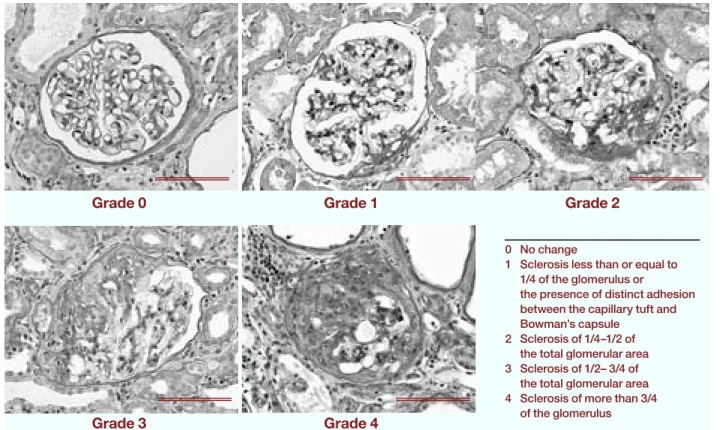
as follows (Fig. 1): Grade 0, no change; Grade 1, sclerotic area less than or equal to 1/4 of the glom-erulus or the presence of distinct adhesion between the capillary tuft and Bowman’s capsule; Grade 2, sclerosis of 1/4 to 1/2 of the total glomerular area; Grade 3, sclerosis of 1/2 to 3/4 of the total glom-erular area; Grade 4, sclerosis of more than 3/4 of the glomerulus. The index of glomerular sclerosis was calculated using the following formula (Saito et al., 1987): index of glomerular sclerosis = (1 N1 + 2 N2 + 3 N3 + 4 N4)/(N0 + N1 + N2 + N3 + N4), where N is the number of glomeruli at each grade of sclerosis.
Urinary 8-OHdG measurement
Urinary 8-OHdG concentrations were measured by enzyme-linked immunosorbent assay (ELISA) us-ing a commercially available competitive 8-OHdG ELISA kit (Japan Institute for Control of Aging, Shizuoka). The kit can measure 8-OHdG values ranging from 0.5 to 200 ng/mL using a specific monoclonal antibody, N45.1.
Statistical analysis
Statistical significance of intergroup differences in quantitative data was assessed by Student’s t-test (Stat View for Windows; SAS Institute, Cary, NC).
P < 0.05 was considered significant.
Results
Blood pressure
Mean systolic blood pressure in the rats dur-ing the 12-week experimental period is shown
in Fig. 2. Systolic blood pressure after nephre-ctomy increased progressively throughout the experimental period in the 5/6-Nx group. Drug administration induced a significant decrease in the treated groups (low OLM, high OLM and OLM+TEM groups) when compared with in the
Fig. 2. Course of mean systolic blood pressure in the 5 groups. The systolic blood pressure of rats is significantly
de-creased at 12 weeks of administration in groups of low OLM ( ), high OLM ( ) and OLM+TEM ( ) when compared with in the 5/6-Nx group ( ). , control group. HighOLM, high-dose olmesartan; 5/6-Nx, 5/6-nephrectomized; low OLM, low-dose OLM; OLM+TEM, high-dose OLM combined with high-dose temocapril.
Fig. 1. Classification of glomerular sclerosis by periodic acid-Schiff stain. Bar = 100 μm.
0 No change
1 Sclerosis less than or equal to 1/4 of the glomerulus or the presence of distinct adhesion between the capillary tuft and Bowman’s capsule
2 Sclerosis of 1/4–1/2 of the total glomerular area 3 Sclerosis of 1/2– 3/4 of
the total glomerular area 4 Sclerosis of more than 3/4
of the glomerulus
5/6-Nx group. At the end of the 12-week admin-istration period, the level was significantly lower in the treated groups than in the 5/6-Nx group: 228 ± 22 for the 5/6-Nx group, 191 ± 15 for the low OLM group, 178 ± 27 for the high OLM group, 153 ± 16 mmHg for the OLM+TEM group. The OLM+TEM group showed significantly lower levels than the low OLM group (P < 0.001).
Proteinuria
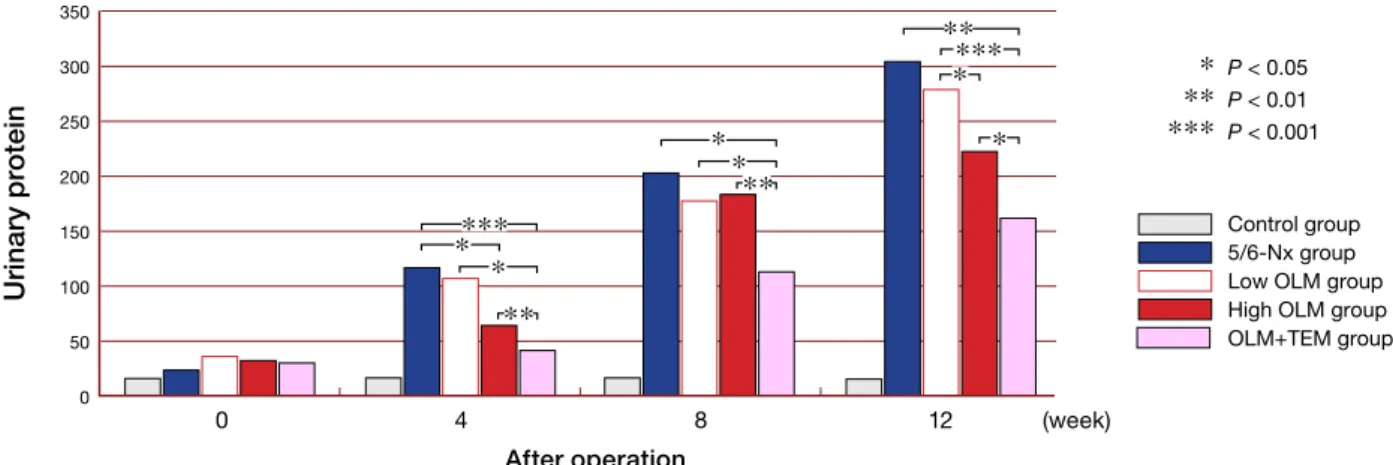
Figure 3 shows total urinary protein excretion in each group during the 12 weeks. The control group showed no change, while the 5/6-Nx group exhibited progressive increase throughout the ex-perimental period. During the period, urinary pro-tein levels were lower in the treated groups than
Grade 0 Grade 1 Grade 2
Grade 3 Grade 4 S ys to lic b lo o d p re ss u re After operation 0 4 8 12 (week) 250 200 150 100 50 0 (mmHg)
Fig. 3. Effects of treatments on urinary protein in the 5 groups. HighOLM, high-dose olmesartan; 5/6-Nx, 5/6-ne-phrectomized; lowOLM, low-dose OLM; OLM+TEM, high-dose OLM combined with high-dose temocapril.
Fig. 4. Serum creatinine concentrations in the 5 groups at
12 weeks. Values are expressed as mean ± SD. *P < 0.05. HighOLM, high-dose olmesartan; 5/6-Nx, 5/6-nephrecto-mized; lowOLM, low-dose OLM; OLM+TEM, high-dose OLM combined with high-dose temocapril.
in the 5/6-Nx group: especially in the OLM+TEM group, the level was significantly lower at 4, 8 and 12 weeks after the operation.
Serum creatinine
Figure 4 shows serum creatinine in the 5 groups of rats at 12 weeks. The serum creatinine level was significantly higher in the 5/6-Nx group than in the control group (P < 0.01). The treated groups (low OLM, high OLM and OLM+TEM groups) showed lower levels than the 5/6-Nx group; especially, the difference between the OLM+TEM and 5/6-Nx groups was significant (P < 0.05).
Histological findings in the kidney
In the control group, only a few sclerotic changes of glomeruli and interstitial fibrosis were ob-served. The values of the index of glomerular sclerosis in the treated groups were significantly lower than in the 5/6-Nx group: P < 0.05 between the low OLM and 5/6-Nx groups; P < 0.05 be-tween the high OLM and 5/6-Nx groups; P < 0.01 between the OLM+TEM and 5/6-Nx groups. In comparison among the treated groups, the index was significantly lower in the OLM+TEM group than in the low OLM group (P < 0.05) (Fig. 5).
Fig. 5. Index of glomerular sclerosis in the 5 groups at 12
weeks. Values are expressed as mean ± SD. *P < 0.05, **P < 0.01. HighOLM, high-dose olmesartan; 5/6-Nx, 5/6-nephrectomized; lowOLM, low-dose OLM; OLM+TEM, high-dose OLM combined with high-dose temocapril. S er u m c re at inin e In d ex o f g lo m e ru la r s c le ro si s
Control 5/6-Nx Low OLM High OLM OLM+TEM
Control 5/6-Nx Low OLM High OLM OLM+TEM (mg/dL) 3 2 1 0 2.0 1.5 1.0 0.5 0.0 Urinary protei n (mg/day) 350 300 250 200 150 100 50 0 Control group 5/6-Nx group Low OLM group High OLM group OLM+TEM group P < 0.05 P < 0.01 P < 0.001 After operation 0 4 8 12 (week) * ** *** *** *** * ** ** * * * * ** * * ** * * *
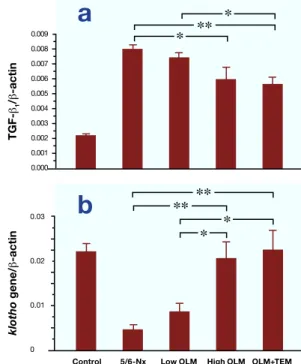
Fig. 7. Levels of mRNA for transforming growth
fac-tor- 1 (TGF- 1) and klotho gene in renal tissue.
(a) Expression of TGF- 1 mRNA.
(b) Expression of klotho mRNA.
Values are expressed as mean ± SEM. *P < 0.05, **P < 0.01. HighOLM, high-dose olmesartan; 5/6-Nx, 5/6-ne-phrectomized; lowOLM, low-dose OLM; OLM+TEM, high-dose OLM combined with high-dose temocapril.
Fig. 6. Urinary 8-hydroxy-2'-deoxyguanosine (8-OHdG)/
urinary creatinine ratio in the 5 groups at 12 weeks. Val-ues are expressed as mean ± SD. *P < 0.05. HighOLM, high-dose olmesartan; 5/6-Nx, 5/6-nephrectomized; low OLM, low-dose OLM; OLM+TEM, high-dose OLM combined with high-dose temocapril.
Urinary 8-OHdG/urinary creatinine ratio
Levels of urinary 8-OHdG/creatinine in the 5/6-Nx group at 12 weeks were slightly higher than in the control group: the difference was not sig-nificant. Levels of urinary 8-OHdG/creatinine in the treated groups were lower than in the 5/6-Nx group: the difference between the OLM+TEM and 5/6-Nx groups was significant (P < 0.05) (Fig. 6).
mRNA quantification of TGF- 1 and klotho
The TGF- 1 mRNA level in the 5/6-Nx group was
markedly increased when compared with in the control group (Fig. 7a). This increase was signifi-cantly alleviated in the high OLM and OLM+TEM groups, but not in the low OLM group. The level in the OLM+TEM group was significantly lower than that in the low OLM group (P < 0.05).
The klotho mRNA level was significantly lower in the 5/6-Nx group than in the control group (Fig. 7b). The klotho mRNA levels in the treated groups were higher in the 5/6-Nx group: the high OLM and OLM+TEM groups showed significant difference to the 5/6-Nx group (P < 0.01). Among the treated groups, levels were significantly higher in the high OLM and OLM+TEM groups than in the low OLM group (P < 0.05).
Discussion
The rennin-angiotensin system plays an important role in the development of hypertension and the progression of renal failure. Numerous studies have shown that ARB or ACEI is able to prevent the progression of renal failure (Parving et al., 2001; Nakao et al., 2003; Schmieder et al., 2007). ARB or ACEI alleviates glomerular hypertention by reducing the constructive effects of angiotensin II on the efferent arterioles, which leads to inhibi-tion of glomerular sclerosis. Angiotensin II also activates the production of free radicals, promotes cell growth, and increases the synthesis of inflam-matory and profibrotic cytokines (Wolf et al., 2000; Brewster and Perazella., 2004; Long et al., 2004). Furthermore, there is increasing evidence
U ri na ry 8 -O H d G 80 70 60 50 40 30 20 10 0 (ng/mg creatinine)
Control 5/6-Nx Low OLM High OLM OLM+TEM
Control 5/6-Nx Low OLM High OLM OLM+TEM 0.009 0.008 0.007 0.006 0.005 0.004 0.003 0.002 0.001 0.000 0.03 0.02 0.01 0.00 *
b
a
** ** ** * * * *supporting a potential role for aldosterone, which is stimulated by angiotensin II, in the pathophysi-ology of renal injury (Hollenberg, 2004; Remuzzi et al., 2008).
Spontaneously hypertensive rats have been used as a model for essential hypertension in hu-mans, and 5/6-Nx rats have commonly been used as an experimental model for chronic renal failure in humans. In the present study, we combined the 2 rat models, and prepared 5/6-Nx spontaneously hypertensive rats. Systolic blood pressure, urinary protein and glomerular sclerosis in 5/6-Nx sponta-neously hypertensive rats increased progressively throughout the experimental period. After 12 weeks, each of the ARB-treated groups (low and high OLM groups) showed a significant decrease in systolic blood pressure and index of glomerular sclerosis when compared with the 5/6-Nx group. These data indicate that OLM ameliorates renal injury in a dose-dependent manner. Indeed, Fan et al. also reported that ultrahigh doses of OLM showed greater renoprotective effects than typical doses of OLM, and that efficacy was independent of blood pressure (Fan et al., 2006).
In our study, the OLM- and TEM-adminis-tered rats showed greater renoprotective effects than only the high OLM-administered rats did, in-dicating that combination therapy with ARB and ACEI has a beneficial effect on renoprotection as compared with ARB alone. It is known that ACE inhibition results in reduced degradation of bra-dykinin (Gavras, 1992), and that brabra-dykinin may cause selective efferent arteriolar dilatation and stimulate endothelial NO formation. Jacobsen et al. showed that dual blockade of the rennin-angio-tensin system offers additional renal protection in type 1 diabetic patients with diabetic nephropathy (Jacobsen et al., 2003).
TGF- 1 has been shown to play a
predomi-nant role in mediating angiotensin II-induced extracellular matrix production and promotes the fibrosis of cardiovascular and renal tissues (Saito et al., 2004; Dabek et al., 2006). In the present study, renal TGF- 1 mRNA levels were markedly
lower in the high OLM group and OLM+TEM
groups. This suggests that the reduction in TGF- 1
is closely correlated with the prevention of pro-gressive renal damage by inhibition of the rennin-angiotensin system.
Defects in klotho gene expression in mice have been reported to lead to a syndrome closely resembling human aging, including shortened life span, infertility, arteriosclerosis, osteoporosis and pulmonary emphysema (Kuro-o et al., 1997). The
klotho gene is expressed in limited tissues, nota-bly the distal convoluted tubules in the kidney and the choroid plexus in the brain.
klotho protein functions as a circulating hormone that binds to a cell-surface receptor and represses the intracellular signals of insulin and IGF1. It appears that the anti-aging effects of
klotho-induced inhibition of insulin/IGF1 signal-ing are associated with increased resistance to oxidative stress (Kurosu et al., 2005). It has been shown that klotho protein inhibits the phospho-rylation of FoxO forkhead transcription factors, which induce expression of manganese superoxide dismutase, thereby facilitating removal of reac-tive oxygen species and conferring resistance to oxidative stress (Yamamoto et al., 2005). Mitani et al. have demonstrated in experimental models that continuous administration of angiotensin II reduces renal klotho gene expression (Mitani et al., 2002).
Downregulation of klotho mRNA in the kidney has been reported in animal hyperten-tion models, such as spontaneously hypertensive rats and deoxycorticosterone acetate-salt hyper-tensive rats (Aizawa et al., 1998). In the present study, expression of klotho mRNA in the 5/6-Nx group was markedly downregulated when com-pared with the control group. This reduction of
klotho mRNA was ameliorated in the high OLM and OLM+TEM groups, but not in the low OLM group. Losartan completely blocked angiotensin II-induced klotho mRNA downregulation, which is independent of its blood pressure-lowering ef-fects (Mitani et al., 2002). This is the 1st report showing that OLM dose-dependently prevents
sponta-neously hypertensive rats.
Urinary 8-OHdG is a biological marker of in vivo oxidative DNA damage (Shigenaga et al., 1989), and the average urinary 8-OHdG excretion in the OLM+TEM group was significantly lower than in the 5/6-Nx group: this fact indicates that OLM- and TEM-induced klotho overexpression reduces oxidative DNA damage. In addition to ACEI (de Cavanagh et al., 2000, 2001), OLM (Yao et al., 2004) has been reported to improve endothelin-induced hypertension and oxidative stress in rats. Fujimoto et al. also reported that OLM inhibits superoxide production and oxida-tive stress, independent of its blood pressure-lowering effects (Fujimoto et al., 2008).
A recent study reported that chronic kidney disease is an independent risk factor for cardio-vascular disease, which involves excessive oxida-tive stress (Descamps-Latscha et al., 2005). Fur-thermore, it has been reported that expression of the klotho gene in the kidney is downregulated in chronic renal failure in vivo (Aizawa et al., 1998) and in vitro (Koh et al., 2001). Saito et al. demon-strated that klotho gene transfer in an experimen-tal rat model of atherosclerotic disease improved endothelial dysfunction (Saito et al., 2000), and that klotho protein protects the cardiovascular sys-tem through endothelium-derived NO production by humoral pathways (Saito et al., 1998). These data suggest that the downregulation of renal
klotho expression in patients with chronic kidney disease is involved in the onset of cardiovascular disease. ARB reduced the incidence of cardiovas-cular disease (Yusuf et al., 2000; de Zeeuw et al., 2004), which raises the relationship between ARB and inhibition of klotho gene downregulation. In the present study, the combination of OLM and TEM significantly decreased urinary 8-OHdG, and showed renoprotective effects. These data suggest that the combination therapy is more ef-fective for cardiovascular protection.
In conclusion, the present study demon-strated that OLM ameliorates klotho gene down-regulation in 5/6-Nx rats in a dose-dependent manner, and this has a renoprotective effect. In
addition, combination therapy of OLM and TEM was more effective than OLM alone. This sug-gests that klotho gene upregulation by the rennin-angiotensin system inhibitor leads to a reduction in cardiovascular disease.
acknowledgments: We are grateful to Sankyo Co., Ltd. (Tokyo, Japan) for supplying olmesartan and temocapril.
References
1 Aizawa H, Saito Y, Nakamura T, Inoue M, Imanari T, Ohyama Y, et al. Downregulation of the Klotho gene in the kidney under sustained circulatory stress in rats. Biochem Biophys Res Commun 1998;249:865– 871.
2 Brewster UC, Perazella MA. The renin-angiotensin-aldosterone system and the kidney: effects on kid-ney disease. Am J Med 2004;116:263–272.
3 Dabek J, Kułach A, Monastyrska-Cup B, Gasior Z. Transforming growth factor beta and cardiovascular diseases: the other facet of the ‘protective cytokine’. Pharmacol Rep 2006;58:799–805.
4 de Cavanagh EM, Inserra F, Ferder L, Fraga CG. Enalapril and captopril enhance glutathione-depen-dent antioxidant defenses in mouse tissues. Am J Physiol Regul Integr Comp Physiol 2000;278:R572– R577.
5 de Cavanagh EM, Inserra F, Toblli J, Stella I, Fraga CG, Ferder L. Enalapril attenuates oxidative stress in diabetic rats. Hypertension 2001;38:1130–1136. 6 Descamps-Latscha B, Witko-Sarsat V, Nguyen-Khoa
T, Nguyen AT, Gausson V, Mothu N, et al. Ad-vanced oxidation protein products as risk factors for atherosclerotic cardiovascular events in nondiabetic predialysis patients. Am J Kidney Dis 2005;45:39– 47.
7 de Zeeuw D, Remuzzi G, Parving, HH, Keane WF, Zhang Z, Shahinfar S, et al. Albuminuria, a thera-peutic target for cardiovascular protection in type 2 diabetic patients with nephropathy. Circulation 2004;110:921–927.
8 Dohi Y, Ohashi M, Sugiyama M, Takase H, Sato K, Ueda R. Candesartan reduces oxidative stress and inflammation in patients with essential hypertension. Hypertens Res 2003;26:691–697.
9 Fan YY, Baba R, Nagai Y, Miyatake A, Hosomi N, Kimura S, et al. Augmentation of intrarenal angio-tensin II levels in uninephrectomized aldosterone/ salt-treated hypertensive rats; renoprotective effects of an ultrahigh dose of olmesartan. Hypertens Res 2006;29:169–178.
10 Fliser D, Wagner KK, Loos A, Tsikas D, Haller H. Chronic angiotensin II receptor blockade reduces (intra)renal vascular resistance in patients with type 2 diabetes. J Am Soc Nephrol 2005;16:1135–1140 11 Fujimoto S, Satoh M, Horike H, Hatta H, Haruna Y,
Kobayashi S, et al. Olmesartan ameliorates progres-sive glomerular injury in subtotal nephrectomized rats through suppression of superoxide production. Hypertens Res 2008;31:305–313.
12 Gavras I. Bradykinin-mediated effects of ACE inhi-bition. Kidney Int 1992;42:1020–1029.
13 Hollenberg NK. Aldosterone in the development and progression of renal injury. Kidney Int 2004;66:1–9. 14 Jacobsen P, Andersen S, Jensen BR, Parving HH.
Additive effect of ACE inhibition and angiotensin II receptor blockade in type I diabetic patients with diabetic nephropathy. J Am Soc Nephrol 2003;14: 992–999.
15 Kanazawa M, Kohzuki M, Yoshida K, Kurosawa H, Minami N, Saito T, et al. Combination therapy with an angiotensin-converting enzyme (ACE) inhibitor and a calcium antagonist: beyond the renoprotective effect of ACE inhibitor monotherapy in a spontane-ous hypertensive rat with renal ablation. Hypertens Res 2002;25:447–453.
16 Koh N, Fujimori T, Nishiguchi S, Tamori A, Shiomi S, Nakatani T, et al. Severely reduced production of klotho in human chronic renal failure kidney. Bio-chem Biophys Res Commun 2001;280:1015–1020. 17 Kuro-o M, Matsumura Y, Aizawa H, Kawaguchi H,
Suga T, Utsugi T, et al. Mutation of the mouse klotho gene leads to a syndrome resembling ageing. Nature 1997;390:45–51.
18 Kurosu H, Yamamoto M, Clark JD, Pastor JV, Nandi A, Gurnani P, et al. Suppression of aging in mice by the hormone Klotho. Science 2005;309:1829–1833. 19 Long DA, Price KL, Herrera-Acosta J, Johnson RJ.
How does angiotensin II cause renal injury? Hyper-tension 2004;43:722–723.
20 Mitani H, Ishizaka N, Aizawa T, Ohno M, Usui S, Suzuki T, et al. In vivo klotho gene transfer amelio-rates angiotensin II-induced renal damage. Hyper-tension 2002; 39:838–843.
21 Nakao N, Yoshimura A, Morita H, Takada M, Kayano T, Ideura T. Combination treatment of angiotensin-II receptor blocker and angiotensin-converting-enzyme inhibitor in non-diabetic renal disease (CO-OPERATE): a randomised controlled trial. Lancet 2003;361:117–124.
22 Parving HH, Lehnert H, Brochner-Mortensen J, Gomis R, Andersen S, Arner P, et al. The effect of irbesartan on the development of diabetic nephropa-thy in patients with type 2 diabetes. N Engl J Med 2001;345:870–878.
23 Remuzzi G, Cattaneo D, Perico N. The aggravating mechanisms of aldosterone on kidney fibrosis. J Am Soc Nephrol 2008;19:1459–1462.
24 Saito K, Ishizaka N, Aizawa T, Sata M, Iso-O N, Noiri E, et al. Role of aberrant iron homeostasis in the upregulation of transforming growth factor-beta1 in the kidney of angiotensin II-induced hypertensive rats. Hypertens Res 2004;27:599–607.
25 Saito T, Sumithran E, Glasgow EF, Atkins RC. The enhancement of aminonucleoside nephrosis by the co-administration of protamine. Kidney Int 1987; 32:691–699.
26 Saito Y, Nakamura T, Ohyama Y, Suzuki T, Iida A, Shiraki-Iida T, et al. In vivo klotho gene delivery protects against endothelial dysfunction in multiple risk factor syndrome. Biochem Biophys Res Com-mun 2000;276:767–772.
27 Saito Y, Yamagishi T, Nakamura T, Ohyama Y, Aizawa H, Suga T, et al. Klotho protein protects against endothelial dysfunction. Biochem Biophys Res Commun 1998;248:324–329.
28 Schmieder RE, Delles C, Mimran A, Fauvel JP, Ruilope LM. Impact of telmisartan versus ramipril on renal endothelial function in patients with hyper-tension and type 2 diabetes. Diabetes Care 2007;30: 1351–1356.
29 Shigenaga MK, Gimeno CJ, Ames BN. Urinary 8-hydroxy-2'-deoxyguanosine as a biological marker of in vivo oxidative DNA damage. Proc Natl Acad Sci U S A 1989;86:9697–9701.
30 Tojo A, Onozato ML, Kobayashi N, Goto A, Matsuoka H, Fujita T. Angiotensin II and oxidative stress in Dahl Salt-sensitive rat with heart failure. Hypertension 2002;40:834–839.
31 Wolf G. Angiotensin II as a mediator of tubuloint-erstitial injury. Nephrol Dial Transplant 2000;15 Suppl 6:61–63.
32 Yamamoto M, Clark JD, Pastor JV, Gurnani P, Nandi A, Kurosu H, et al. Regulation of oxidative stress by the anti-aging hormone klotho. J Biol Chem 2005;280:38029–38034.
33 Yao L, Kobori H, Rahman M, Seth DM, Shokoji T, Fan Y, et al. Olmesartan improves endothelin-induced hypertension and oxidative stress in rats. Hypertens Res 2004;27:493–500.
34 Yusuf S, Sleight P, Pogue J, Bosch J, Davies R, Dagenais G. Effects of angiotensin-converting-en-zyme inhibitor, ramipril, on cardiovascular events in high-risk patients. N Engl J Med 2000;342:145–153.
Received December 19, 2008; accepted January 6, 2009 Corresponding author: Satoko Maeta