Podcasting an English for Professional Purposes Course
Steve McCarty
教室への窓:ポッドキャスティングにした専門展開群の講義
マッカーティ
スティーブ
Abstract
This paper investigates possible ways that coursecasting ― podcasting the lecture parts of a class ― may be pedagogically useful. Particularly at a college where all students have iPods, the infrastructure becomes mobile and the learning institution naturally looks for ways to make more extensive use of iPods and related Web-based technologies. Literature on these new practices will be reviewed, including iTunesU, arguably a next-generation learning management system. This paper also reports on an experiment in coursecasting a Bilingual Education class, part of an upper division curriculum in English for Professional Purposes. The conclusion will address the hypothesis of the usefulness of coursecasting and podcasting special events for the learner and other stakeholders, also suggesting some ways to use new Web-based technologies for research and publications.
Key words : podcasting, coursecasting, iTunesU, bilingual education
(Received August 23, 2006)
抄
録
この論文は「コースキャスティング」(学期の授業のレクチャーの部分をデジタルに録 音し、インターネット上のポッドキャスティング・ブログにアップし、学生・その他の関 係者に、復習などのためにコンピュータや iPod で聞くように提供するような情報技術)を 研究し、実際のバイリンガル教育という専門展開群の科目をコースキャスティングにする 試みとその学生よりのフィードバックを報告する。教育的ポッドキャスティング全般の役 立つところについての著述を調べる。iTunesU という新世代の LMS も調べる。分析した 証拠に基づき、コースキャスティングがいろいろなふうに役立つという仮説を考察し、積 極的に結論する。 キーワード:ポッドキャスティング、コースキャスティング、 iTunes 大学、 バイリンガル教育 (2006年8月23日 受理) ― 1 ―Introduction
This paper investigates possible ways that coursecasting ― podcasting the lecture parts of a class ― may be pedagogically useful. Particularly at a college where all students have iPods, the infrastructure becomes mobile and the learning institution naturally looks for ways to make more extensive use of iPods and related Web-based technologies. Literature on these new practices will be reviewed, and there will be suggestions for leveraging the technologies to contribute to goals of the college.
Furthermore, this paper analyzes iTunesU, arguably the first of a next generation of learning management systems to support audio and video as well as written course files. iTunesU will facilitate coursecasting along with supplementary course materials and podcasting projects by students. This paper also reports on an experiment in coursecasting a Bilingual Education class, part of an upper division curriculum in English for Professional Purposes (EPP).
The conclusion will address the hypothesis of the usefulness of coursecasting and podcasting special events for the learner and other stakeholders of the learning institution, also suggesting some ways to use new Web-based technologies for research and publications.
New Directions for Research
Podcasting itself is part of a new generation of Internet-based technologies often called Web 2.0 for imprecise convenience. The point is that new research techniques are also afforded and called for. Podcasting as a neologism or practice has only arisen in the past two years, while coursecasting is less than a year old. Given the timetables of print publications, there can only be a limited number of books and refereed journal articles on podcasting, but hardly any yet on coursecasting or iTunesU. To substantiate this point,
Chart 1 : Keyword searches on 10 August 2006 Keyword or metadata tag searched!
Web search engine and number of hits on the keywords podcasting coursecasting iTunesU Google (searches whole texts of HTML, etc. Websites) 117 million 9,800 30,900 Technorati blog search (27 + million registered blogs) 235,000 111 104 Technorati tags (metadata identifiers bloggers write) 37,000 3 23 del. icio. us tags (social bookmarking encourages tags) uncountable 34 87 Google Scholar (searches limited to academic works) 437 1 0 Amazon : books, magazines, newspapers & newsletters 57 1 0
consider the above chart of keyword searches, with large numbers rounded off to approximations.
These radically different results show, for one thing, that podcasting can be taken as a given to Internet and iPod users, although vetted academic sources are relatively few or forthcoming. The newer applications of podcasting ― coursecasting and iTunesU ― have received much less attention, almost non-existent in scholarly and print publications thus far. The one hit from Amazon is actually an article of first impressions about coursecasting. Nevertheless, Web mentions are rapidly increasing and both the analytical as well as the how-to genre can be predicted to increasingly find their way onto paper.
Links to add an online dimension to this paper
The so-called Web 2.0 technologies have afforded another new mode of research besides Web keyword searches. While this paper cites representative sources and has space for few illustrations, the reader can be referred to a new generation of Websites to view the sources online by clicking, or for further sources. The author created a coursecasting and iTunesU research social bookmarking site at http://del.icio.us/ coursecasting with about 80 links initially, each with one or more tags to identify the type of content. By clicking on the tags at the right, one can have only the links to articles on a certain topic display, which helps to focus and share research sources. For the reader to just click to read the references in this paper, there is a tag paper1 added to each link cited in this paper. Thus the reader may click on paper1 on the right side of the above Website to display only the online references for this paper. They include PowerPoint presentations, PDF and MSWord files to download as well as Web pages.
Furthermore, using another Web 2.0 technology, for the reader to actually view more examples of Websites than would fit in this paper, such as an administrative interface for iTunesU, a Flickr photo sharing site http://www.flickr.com/photos/steve-illustrated was established, with a Research set subdirectory apart from personal photos to show various screen shots of Web-based technologies. There also with the same paper1 tag as the del. icio.us site, only the illustrations relevant to this paper are displayed as a set, and can be viewed as a slide show.
Through the above links, this paper becomes a hybrid publication, both on paper and online.
Review of Pedagogical Literature on Podcasting, Coursecasting and iTunes
Coursecasting and iTunesU both rely on podcasting, which has been defined as follows :[A]podcast is content such as a radio show that is recorded in the ubiquitous MP 3 format and broadcast (or more accurately, published) on a web site for download by anyone who cares to listen to it on a mobile device or a computer. Through the use of RSS (Really Simple Syndication), information about the web site and the podcasts (or other content) that is available on the web site is provided in a lightweight XML format. The RSS files, or “feeds,” can be harvested by content aggregators designed for podcasts, such as iPodder or iPodderX, or by other aggregators, such as iTunes, all of which can download “subscriptions” either on demand or at predetermined intervals. (Rogers, 2005)
For a white paper on what podcasting is, including video, with a glossary of technical terms, see Meng (2005). For more information on podcasting for English language teaching in Japan, the pioneering implementation of iPods with listening materials at Osaka Jogakuin College, publicizing podcasts, and configuring a podcasting blog for iTunes, see McCarty (2005). Within the scope of this paper, the following discusses podcasting in a pedagogical context :
Digital audio and mobile audio players such as the iPod are being adopted by young people on a massive scale. The new technology of Podcasting is allowing audio content creators to make and distribute content easily to those mobile audio users. To leverage this interest and technology, teacher preparation programs are beginning to use Podcasting to disseminate information such as university information, sound seeing tours of campus, advising and orientation information, and lectures. (Pownell, 2006)
Incorporating podcasting into teacher education shows how rapidly and deeply the uptake of this technology has been in universities. The context could as well be faculty and staff development, since teachers are enjoined to develop and produce imaginative applications of podcasting and MP3 players such as the iPod. Just as some museums such as the Queen’s Gallery in Buckingham Palace pass out head sets for visitors to listen to a guided tour, iPods could be lent to campus visitors or used for English treasure hunts at college festivals, while podcasts of concerts, lectures or other events could attract interest in the college.
The “lectures” alluded to in the Pownell (2006) citation above could be publicly ― 4 ―
offered presentations, interviews and so forth. A prominent example is Stanford-on-iTunes http://itunes.stanford.edu, which is a pilot project of Apple’s iTunesU, showing what can be offered on the open Web in addition to password-protected course sites restricted to registrants. Whether through Apple or independently through podcasting blogs, the bulk of “lectures” will be coursecasts, recording the sounds of the classroom for asynchronous on-demand listening and, increasingly, viewing.
Sloan finds podcasting a useful educational tool ! for distance learning
! to facilitate self-paced learning ! for remediation of slower learners
! to allow faculty to offer advanced and or highly motivated learners extra content ! for helping students with reading and/or other learning disabilities
! for multi-lingual education
! to provide the ability for educators to feature guest speakers from remote locations ! to allow guest speakers the ability to present once to many sections and classes... ! to offer a richer learning environment (2006)
Sloan also suggests
two things that make podcasting such important technology. First is the value add. The richer learning experience it allows students to bring to the classroom. Second, and this could be the most disruptive to the existing paradigm, is that RSS based instruction may allow for new learning methods to emerge that enable learning and higher education to reach learners and potential students for whom the traditional higher education paradigm may simply not be an option. (2006)
RSS pushes content to subscribers such as when the iPod is synched to iTunes to automatically download the latest podcasts. Because of the vast literature on podcasting, the focus here is on aspects of podcasting that are involved in or informative about the pedagogical potential particularly of coursecasting and iTunesU, more specifically for EFL in higher education.
First consider the learning implications for blind or visually impaired students and the fact that there are various individual learning styles. How could podcasting serve learners with various and special needs ?
Kaplan-Leiserson outlines a number of pedagogical uses of podcasting, writing that “the medium is perfect for learners who prefer to take in information aurally” (2005). “Even
though critics initially said students would stop attending classes, Maag found that attendance did not in fact decline, because students ‘didn’t want to miss what was going on’” (Kaplan-Leiserson, 2005). Margaret Maag’s cited experience at the University of San Francisco also shows that the difference between one-off podcasts of course lectures or related events and coursecasting much or all of the lectures of a class is a matter of degree. Similarly, an iTunesU site would compile coursecasts and other podcasts of a higher educational institution along with text files and learning management system functions. Podcasts and coursecasts
[p]rovide another channel for material review . . . podcasting can ease learner worries that they missed key information in their note-taking. The audio files can be reviewed at their leisure for understanding or before testing. In Maag’s end-of-course survey, this was a main reason students rated the recorded lectures as a strength of the course. (Kaplan-Leiserson, 2005)
Podcasting can also
[a]ssist non-native speakers. Learners who aren’t yet proficient in the language may struggle to keep up with lectures or presentations. Being able to review recordings of those events as many times as necessary for understanding can be of great benefit. Podcasting can also be an excellent technology for learning a language, not only for listening to speech and pronunciation but also, in combination with a recording device, for capturing a learner’s own speech for review by themselves or a teacher. (Kaplan-Leiserson, 2005)
The above considerations apply to EFL situations such as Japan at least as much as to ESL and studying abroad.
Podcasting can also be used to provide feedback from the instructor to learners or vice versa in lieu of writing. It can enable instructors to review their own lectures, or for others on campus to subscribe to the lectures (Kaplan-Leiserson, 2005). This provides a window into the classroom while, particularly in the case of foreign language teaching, the instructor can listen to his or her own speaking with a view to making various adjustments for more comprehensible input.
Podcasts can furthermore
[r]eplace full classroom or online sessions when content simply requires delivery. In many cases, learning requires interaction, questioning, practice, and so forth. But when what’s required is simple delivery of information, a full-fledged in-person or online course may not be necessary. (Kaplan-Leiserson, 2005)
The above alludes to courses that are face-to-face, wholly online, or blended mixtures of the two. Online courses will increasingly be enlivened by audio and video lectures. In another variation of the above, instructors can have students access lectures asynchronously at their own convenience along with questions or other prompts, then design the in-class time to be more interactive.
Finally, podcasting or coursecasting can
[p]rovide supplementary content or be part of a blended solution. When a full course is necessary, there may be occasions when supplementary material would be helpful to learners. Subject-matter-expert interviews are just one example of this type of content. The material could be available for access on a voluntary basis, or it could be a required component of a classroom or online course in a blended solution. In any case, the RSS technology allows instructors to make the material easily accessible to learners and to alert them when new content is in the pipeline. (Kaplan-Leiserson, 2005)
While such lectures and interviews could be planned in advanced and linked from an online syllabus, unanticipated opportunities also arise to interview a subject matter expert or to record a public lecture related to a given course with permission. Thus, during the Bilingual Education course described in this paper, two lectures by a bilingualism expert visiting Japan from Canada were recorded with a digital voice recorder and turned into podcasts.
Thomas summarizes the taxonomy of Graham Stanley which categorizes ESL podcasts into three types :
1. authentic podcasts that are not aimed at ESL students and can often be a rich source of listening [;]2. podcasts produced by teachers, often for their own classes, and usually aimed at helping students learn by producing listening content that is not available elsewhere ; and 3. student podcasts produced by students, but often with teacher help . . . (Thomas, 2006, p. 6)
This author has produced the above three kinds of podcasts, and Thomas introduces Japancasting http://stevemc.blogmatrix.com among 11 iPodder ESL podcasting directory entries, concluding that “[e]ducationally oriented broadcasts on such themes as Japanese culture, history and society are interspersed with interviews from students and professors. . . . Links are also provided to additional resources [related Websites], audio scripts [transcripts, summaries or PowerPoint presentations to download] and photos related to
the podcast resources” (Thomas, 2006, p. 8). Podcasts with or by the Osaka Jogakuin College students, moreover, go beyond Stanley’s envisaged student podcasts that “tell about their lives and interests” (Thomas, 2006, p. 6). Selected student presentations and interviews by or of students can be considered publishable if they would be of general interest, and the Japancasting site statistics on the hundreds of downloads serve to support their inclusion.
Coursecasting would seem to apply mainly to number 2 of Stanley’s three types of ESL podcasts. Coursecasting Bilingual Education, a podcasting blog introduced in the next section, is in that category and has deliberately not been publicized, since it is for use internal to the institution, whereas the public site Japancasting is widely publicized, in the Apple iTunes Music Store and many podcasting directories both abroad and in Japan. Thus the two sites also encompass the two types of podcasts, private and public, that will appear in iTunesU sites of universities in the near future. After the first group of eight pilot iTunes universities, half of which made public sites like Stanford’s, over a hundred universities are working with Apple to roll out their iTunesU for the school year starting in fall 2006, so the amount of attention, represented by hits in keyword searches on iTunesU, coursecasting and the like, is about to grow exponentially. Colleges outside of the U. S. are not among the selected institutions at this stage, but the technologies can be cobbled together with similar results through podcasting blogs for coursecasting and other forms of podcasting.
Turning to coursecasting, there are few academically vetted sources published yet beyond those cited above which allude to coursecasting in the context of, or as a subset of, podcasting. However, a recent faculty development seminar presentation available online with many illustrations is suggestive of the pedagogical potential of coursecasting. Blezard (2006) outlines “Educational Possibilities” first in terms of “Content to Coursecast,” namely “Lectures ; Guest presenters ; Foreign Language, Linguistics, Communication Disorders (Listen and record) ; Music in History, Humanities, Art, Literature ; Virtual or real tours ; Remedial or supplementary materials ; [and] Existing podcasts” (Blezard, 2006) [reformatted with punctuation added].
“Listen and record” in the above could be on the part of students, by adding a microphone such as iTalk to their iPods in lieu of note-taking. At a certain moment, particularly in lecture halls, students could either speak their notes into the microphone or record the professor’s lecture with permission. This is another major use of iPods for education after listening to podcasts and coursecasts. Students could record all kinds of out-of-class assignments, voluntary projects, and oral messages for professors as well. Also
in the above outline, “virtual” tours are viewed on the computer screen whereas “real tours” refer to using audio podcasts for guided tours of actual places like a campus.
Blezard (2006) further outlines “Learning Styles” in terms of “Supporting Diversity,” through “Repetition ; Non-traditional students (Missed classes) ; Visual learners ; Audio with images ; Lyric Tracks (Transcription) ; [and] Source text material” (Blezard, 2006) [punctuation added].
“Non-traditional students” are adults, often working full-time jobs, such as distance learners taking online courses. “Source text material” refers to the capacity of iTunes to display PDF format texts for learners to view while listening to related audio files, as is useful with transcripts for foreign language learners.
At this stage the sources on coursecasting tend to be journalistic articles and blog entries by educators, and the same is true of iPods, iTunes and iTunesU, so this paper is exploring a new area for research. The following anecdotal article is suggestive of current trends and pedagogical possibilities.
College students are increasingly turning to their MP3 players to complete their assignments as academic podcasting continues to expand its scope. Now professors aren’t just uploading lectures-to-go, they are seeking out new ways to use the technology to connect with students and share their work with other educators. . . . Schools such as the University of Florida and Vanderbilt University have adopted news -based podcasts so that students can remain informed despite their hectic schedules. (Leonard, 2006)
At Duke University
[m]ultimedia, radio and foreign-language teachers have seamlessly integrated podcasting into their curriculums, and now science and math teachers are quickly embracing the technology as well. “It takes the pressure off of students with respect to note taking, so they can feel like they can actually listen and not always be worrying about writing everything you say down,” said Lori Leachman, a professor of economics at Duke. (Leonard, 2006)
many professors record lectures and post the podcasts for students to download as study aids or to use in order to catch up on missed classes. However, . . . Michael Cheney . . . at the University of Illinois . . . is able to supplement assigned reading with
comments, clips and video for his online course. He notes that accessibility and variation of content are key issues for online courses. Furthermore, he feels that podcasts featuring his voice give students across the country a sense of who he is, personalizing the online experience. (Leonard, 2006)
It is clear that podcasting provides a breakthrough technology for what online courses may lack in comparison to face-to-face classes, while podcasting and coursecasting provide further learning opportunities outside of class for traditional students who are usually able to attend face-to-face classes. For another article on how American universities such as Purdue are implementing coursecasting, see Read (2005).
the University of Illinois at Springfield has also established the Higher Educational Podcast Repository, a virtual centralized location housing academic podcasts. The expectation is that the online searchable database will enable instructors to upload and download educational podcasts. Theoretically, teachers could share lectures, media and exercises with other faculty across disciplines. (Leonard, 2006)
The above concept alludes to the possibility of podcasts becoming reuseable, sharable learning objects, where instructors would not have to create new content for each element of each lesson but could search learning object repositories for a one-off lecture or other recorded event related to a syllabus item or learning goal. At the same time, students could search for lectures by professors at other universities to understand their own course of studies more deeply.
The above-cited repository http://ed-cast.org/default.aspx, which also includes a rubric to assess the quality of podcasts, contains 23 vetted podcasts from Japancasting, including student podcasts based on presentations that excelled in campus contests. The students consented to record their presentations again, but anonymously. Further with regard to academic repositories of reuseable, sharable podcasts, it would be very laborious to listen to innumerable podcasts and coursecasts, assess them, and categorize them into disciplines for directory style searches. Thus such repositories are in the early stages and await a large team effort, but their pedagogical potential is already understood.
Turning to iTunesU, Apple captured the imagination of universities with its initial announcement in early 2006 at http://www.apple.com/education/solutions/itunes_u/. From the viewpoint of the University of Illinois at Springfield (UIS), one of the universities selected by Apple to implement it :
iTunesU is a free, cross-platform multimedia distribution and learning environment system wherein educational content―course audio/video lectures and supplemental course-related material―is hosted online and made available to students. In addition to course-related material, lectures and presentations from UIS public events, sports, news broadcasts, and concerts can be delivered through iTunes U. Students can download course-related content from iTunes U using a Windows PC or a Mac, or take it with them using an MP3 player. Students can access iTunes U content from Blackboard with one click. With secure authentication, content within iTunes U can be restricted to registered students, faculty, or staff, or it can be made available to all, depending on an instructor’s request. (University of Illinois at Springfield, 2006)
“Blackboard” mentioned above is a company that provides LMS hosting and services, and which recently acquired WebCT. Blackboard has also been strongly criticized for getting a U. S. patent on basic LMS elements having much prior art from earlier innovators, arguably deserving only copyright protection, then suing the Canadian LMS company Desire2Learn. Blackboard was originally free, then started charging fees, which raises questions about Apple’s business model for iTunesU with this partnership.
Another point about this whole phenomenon of podcasting with iPods and iTunesU is that, unlike nearly all other Web-based technologies that are accessible through Web browsers such as Internet Explorer or Firefox, iPods and iTunesU only work fully through Apple’s iTunes program, which is a media player and browser that accesses only Apple’s iTunes Music Store. There is a category of podcasting sites that are mostly free in iTunes, but one needs a credit card account with the Music Store in order to nominate a podcasting site to iTunes. In other words, iTunes is free and cross-platform, but it is proprietary. This gives pause to many educators who favor open source solutions and the openness of Web interoperability generally.
Michael Feldstein of the State University of New York Learning Network, however, has been briefed by Apple that iTunesU standards are mostly open, and he was assured that their business model is mainly to sell more Macintosh computers through the halo effect of iPods and iTunesU. Whereas individual universities would find it prohibitive to distribute multimedia files similarly themselves, Apple can leverage its huge investment in its online Music Store to provide this service at low cost to itself, and promises that it will be free until 2007 and that they do not intend to charge for the service after 2007. And yet, Apple has accepted non-disclosure agreements requested by its partners, among which Blackboard is prominent, so there are aspects of Apple’s briefings that iTunes universities
cannot disclose, while it is a normal business practice to reveal few details about future plans. Feldstein concludes his series of reports by believing that Apple would like to “keep iTunes U free and free from lock-in for the long-term” (2006).
If you think about how the majority of classes in the majority of colleges use an LMS, it’s primarily as a file sharing utility. Share the syllabus, share the handouts, share the assignments. iTunes U can serve this same purpose better than the typical LMS. You don’t have to go through logins and click through multiple screens to find what you want. The content is organized in an easy-to-use, hierarchical offline tool. And if you use RSS feeds, students don’t even have to explicitly log in to check for new documents ; content is pushed right to their desktops whenever they are online and iTunes is open. . . .iTunes U supports PDFs, so teachers can send text documents as well as sound and video files. iTunes U even has a drop box and a sharing folder, so students can submit content to the teacher or to the class. (Currently upload is a browser-based interface, not built into iTunes itself.) If you supplement this capability with a discussion board and maybe a shared calendar, then you’ve provided pretty much everything that the majority of web-enhanced classes use today. You’ve also greatly diminished the value of licensing a traditional LMS to cover the entire campus. This is precisely why Apple draws the distinction between a learning management system (which is narrow) and a learning environment (which is broad). (Feldstein, 2006)
Considering that Apple is working with Blackboard, which has patented traditional LMS functions, Apple could be keeping its options open by calling it a learning environment. In the view of this researcher, the above functionalities point to iTunesU as a next-generation LMS. Blackboard can see the threat to its LMS licensing business in the above, although this is of course speculation based on their actions. They appear to be moving quickly to join or merge with that which they cannot competitively defeat or financially acquire.
A theorist of digital democracy substantiates the above points and puts the issue in larger perspective :
What we believe about information, such as ‘information wants to be free’, structures our worldview. Our knowledge about information may be true or not, but in either case it structures our relationship to information. If we believe the learning environment to be a marketable good in all cases, then institutions and tools will reflect that belief, and with that you have changed the premises of education and
educational institutions toward a market mentality and in that transformed the future. (Hunsinger, 2006, p. 193)
We can see the transformation of knowledge production and provision toward a commodification model in current events. Systems and forms of knowledge are rapidly changing, as knowledge becomes more business centered than science centered. With businesses such as Blackboard moving into teaching . . . the traditional forms of knowledge that science and human development require are moving from the public to the private sphere. . . .We have a choice between the open models of shared knowledge versus a closed model of owned, proprietary knowledge. (Hunsinger, 2006, p. 198)
Returning to Feldstein, he concludes his series on iTunesU as follows :
if Apple is successful with iTunes U then we should see a proliferation of student- and faculty-created multimedia in the classroom. Apple’s iLife software suite really does drastically lower the barrier to producing audio, video, and digital images. iTunes, iPods, and video iPods make it easy for users to organize and use those newly created multimedia assets. iTunes U completes the ecosystem by making it easy to share the files. (Feldstein, 2006)
There is little doubt that iTunesU will be successful as over 100 universities implement it imminently and many more queue to be selected by Apple in the future. Like any previous LMS the functions will grow and mature, assisted by user community recommendations and innovations. The significance for this paper is the disclosure of current and future technological trends and circumstances contextualizing coursecasting, the podcasting of a class.
An Experiment in Podcasting an English for Professional Purposes Class
Turning to empirical research and the importance of experimentation, the implementation of educational technologies must build on previous experience. For example, first one is a consumer of Web-based content, then a producer of HTML pages and more dynamic content such as online multimedia. One starts using an iPod with the iTunes program, experiencing a prototype of iTunesU such as Stanford on iTunes, listening to lectures while commuting as a student would do. Then various experiences of producing podcasts prepare one technically for coursecasting. Building on previous experiences with the related technologies involved, it is then that one experiments with podcasting the lecture parts of a class and related events. Through that experience, issues particular to coursecasting become evident, and adjustments can be made in futuresemesters to improve the pedagogical usefulness and all-around quality. Therefore, since each accomplishment builds on the previous, it is important at any stage not to shy away from new technologies but to keep experimenting and aiming for further new accomplishments.
In teaching EFL according to methodologies accepted in the profession, actually a lecture course tends to be a rarity, or students do not reach a level of learning through lectures until they make a leap to studying abroad at an English-medium university. If there is a laxity at most colleges in Japan regarding homework and expectations of achievement, Osaka Jogakuin College (OJC) by comparison sets ambitious goals and achieves, for example, relatively high average student scores on TOEIC-IP tests.
Focusing on content-based EFL, the first three weeks of OJC core courses could be characterized in bilingualism terminology as BICS or basic interpersonal communication skills (Baker, 2006, pp. 174― 175). The relative ease of BICS (Baker, 2006, pp. 178 ― 179) is evidenced by the rest of the first two years of the English curriculum at OJC being devoted to EAP or English for Academic Purposes (Jordan, 1997, pp. 3― 5), which involves CALP or cognitive/academic language proficiency (Baker, 2006, pp. 174― 178). Then from the third year of the OJC 4-year college the curriculum features concentrations of courses in EPP or English for Professional Purposes (Jordan, 1997, pp. 3― 4). This can also be expressed as moving from EGAP to ESAP, that is, from English for General Academic Purposes to English for Specific Academic Purposes (Jordan, 1997, pp. 249― 250). CALP in the L2 takes much longer to acquire than BICS (Baker, 2006, pp. 178― 179), and EPP or ESAP represents a step beyond EAP or a “pinnacle” of EGAP (Jordan, 1997, p. 249) with the specialized vocabulary and so forth of a field along with the research methods of a specific discipline to learn.
OJC guidelines specify that EPP courses, which are 52 classes of 50 minutes in one semester for four credits, consist of three-quarters lecture time and one quarter discussion by the students. For the many hours of lecture obviously an enormous amount of content is to be presented to teach students about a professional discipline previously unfamiliar to them. This raises issues such as retention and review where coursecasting is hypothesized to be pedagogically useful.
A leading bilingualism researcher stated in a presentation that, relevant to the OJC curriculum, “[c]ontent-based approaches to second language instruction were first introduced in immersion programs but have now been adopted as the preferred approach
in foreign language education” (Genesee, 2006). Another point he made was that content-based L2 instruction can be either language-driven or content-driven. It could be inferred from his distinction that EAP is generally language-driven but that EPP could equally well be content-driven. Again regarding the medium of instruction, bilingualism research on L2 acquisition after adolescence is insufficient, and Genesee has defined immersion programs as having instruction at least 50% in the target language medium. Thus Genesee, asked if the upper division EPP curriculum at OJC, where instruction is over 50% in English, represents a case of immersion education, answered that such programs have been termed “immersion-like” (Genesee, 2006).
The first EPP course in Bilingual Education at OJC was in the spring semester from April through July of 2006. Students were to learn about bilingualism, bilingual education and its types. Major related issues were biliteracy, biculturalism, and creating a good school. Cases were examined of bilingual education in Europe and North America as well as in Japan. Many readings in both Japanese and English were assigned to balance content-driven with language-content-driven curricular goals. To access the detailed syllabus online, see the directions below.
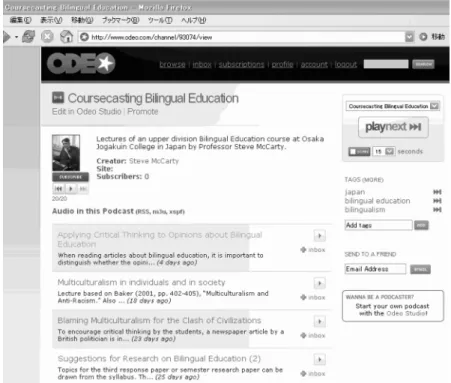
This paper focuses particularly on the experiment of coursecasting the lecture parts of a class. An MP3 format voice recorder was held while lecturing, then files were uploaded after class to the podcasting blog “Coursecasting Bilingual Education” http://www.odeo. com/channel/93074. In addition, annotations describing the main points of the lecture were added to each entry for extra assistance to students in reviewing the lectures. The APA format for citing such online sources in a research paper was also provided. When there were handouts made by the instructor, the files such as MSWord documents were made available to download by linking to them from a lecture entry for that day.
While the site was introduced early in the course, at a rather late stage it was evident that a computer lab hands-on session with earphones was necessary to orient students to use the podcasting blog. Thus an opportunity, albeit with few informants and no possibility of control groups, was missed to gather empirical evidence on the how students’ use of coursecasting might have made a difference in this first offering of Bilingual Education at the OJC 4-year college. In this pilot experiment it was just observed that a how-to computer orientation would be needed at the beginning of the class, plus follow-up training.
Moreover, coursecasting is too new for comparative empirical studies to be available as to possible drawbacks as well as benefits. Coursecasting is not suggested as a substitute
for attendance except in distance education. OJC students know well the strict attendance policy, and a necessary part of coursecasting orientation would be to emphasize that attendance is essential and that coursecasting is a supplementary enhancement of the course in online media. All the students were able to accomplish the written coursework culminating in a research paper, and there is no reason to assume that drawbacks will outweigh benefits when coursecasting is fully implemented with appropriate orientation.
Notwithstanding the above considerations, students were asked to write in Japanese or English an anonymous kansoubun ― a feedback mechanism for frank reflections familiar to students in Japan ― on their impressions of the Coursecasting Bilingual Education site. There happened to be rare absences during the computer lab orientation session toward the end of the course, so the students’ comments are just impressions but nonetheless informative. Their English comments are slightly edited for grammatical clarity and the mostly Japanese comments are translated by the author as follows, with the five students in random order :
Student A wrote that “If I’m absent from the Bilingual Education class, I can listen to the lectures ? ! I think that it’s very good. I can improve hearing English ; also I can feel like I’m attending class. I will go to the Website tomorrow. Thank you for a half year.” This student and all the others had very good attendance, but a possible drawback of coursecasting is the temptation to skip a class if they overlook the participatory aspects of the class that are not recorded. In any event, is not likely that sociable Japanese students regard the class as a mere transfer of information. If they must be absent for some reason, however, coursecasting provides some recourse.
Student B wrote that “To review I could go over it again and, for example, realize, oh, that was what was said. Parts of what the teacher said in class that I didn’t understand ; I could also read the annotations and understand. It’s a good Website, I think. By the way, I like the photo.”
Student C wrote that “I think it’s good that I could listen again to information that I didn’t catch in class. Not only that but the class contents are also written a little, so it’s very good for listening and easy to understand. But some of the files are very long, so if they were broken into shorter segments, I could listen to a lot of them.” The student provides useful feedback while pointing out how written summaries aid listening comprehension.
Student D wrote that “I think it’s very convenient to be able to listen to course contents by PC. Even if I attend class properly there are things I don’t catch, and if I miss class and go to this site, I can know what kind of class it was, which is good.”
Student E wrote that “It was so good ! ! Before my own final paper I can learn from some classes again and again, then I can cite the teacher’s sentences. It was a useful system. It was easy to navigate the lectures arranged by titles. I think it’s very convenient if I’m absent or for writing a paper. At first I didn’t know what was going on, but it turned out to be a unique class with a good feeling.” Besides the extra review and documentation, this student points out the aid for understanding as well as navigation of having titles for class lectures. Ordinarily class lectures are not given an explicit title, but in documenting the coursecasting, this further benefit for students was revealed.
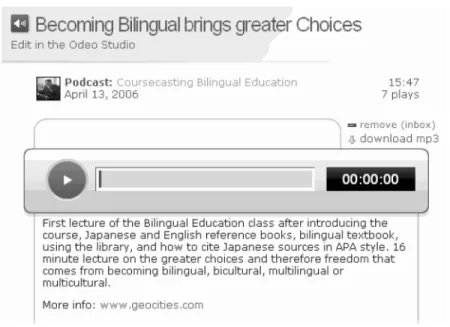
The podcasting blog “Coursecasting Bilingual Education” ended up having 20 entries, and the main page is illustrated below (Figure 1), then an example of what appears after clicking on a lecture title, another Web page with an embedded media player, an annotation describing the lecture, and a link to download a course document. Whereas the homepage can be accessed at the URL http://www.odeo.com/channel/93074/view, the example lecture “Becoming Bilingual brings greater Choices” is located at URL http://www.
Figure 1. Coursecasting Bilingual Education homepage ― 17 ―
odeo.com/audio/1001936/view, with its MP3 format audio file located at URL http://media. odeo.com/9/9/6/B_Ed_4_12_a_15min.MP3, and the link to : http://www.geocities.com/steve_ mccarty/bilingual_education/syllabus.doc.
Conclusion
Coursecasting was hypothesized to be pedagogically useful, and the body of the paper provided a large number of citations and suggestions in support of the conclusion that coursecasting and other podcasts of related educational events are useful for learners and learning institutions. As also reported by the students in the Bilingual Education class investigated, in various ways podcasting supports review, comprehension and retention of lectures, plus providing additional sources for research papers.
It could be added that the students also acquire a Web-based technological skill that provides another avenue to use their iPods for education, not least by opening up the vast listening resources available through the iTunes program and at free podcasting sites. By the same token, because the technology is new, a hands-on orientation near the beginning of the semester is needed for students to be able to take advantage of coursecasting through a podcasting blog or, in the future, a next-generation LMS like iTunesU. The only potential drawback of coursecasting, the temptation to skip a class because part of it is available online, can be addressed in the orientation to the coursecasting site by making clear that it is not a substitute for class attendance, participation and interactions that are not recorded but are evaluated.
Figure 2. Web page of the first lecture with a link to download the syllabus
In conclusion, based on the research findings and pilot class experiment, in reference to the initial hypothesis, the usefulness of coursecasting and educational podcasting accrues to all stakeholders who take advantage of the available technologies :
! For EFL students, coursecasting provides review, target language listening practice, alternative access to class lectures in the case of unavoidable absence, written reinforcement of lectures through podcasting blog entry titles and annotated descriptions, downloading of course documents, citations for their written course work, and a base for online research.
Moreover, insofar as the voices of students are recorded in podcasts, whether as course work or public performances as in the case of the Japancasting site, the students can check their own pronunciation and other speaking skills. This alerts students that the Internet is increasingly becoming an oral as well as aural medium, with wireless extensions to iPods and mobile phones. Perhaps most significantly, the students become not just consumers but producers of online English content, which places them more fully in the target language community with benefits for developing intrinsic motivation and a bilingual identity.
! For teachers, coursecasting and podcasting can provide various forms of professional development such as checking the comprehensibility of lectures, offering more supplementary materials, and making various online connections to and from the classroom. The teacher is empowered with technologies while the class is enhanced. ! For the learning institution, more documentation of course content is provided, and
various imaginative uses of iPods and podcasting have been suggested, such as for campus tours in Japanese or school festival activities using English. As in the case of Stanford, if iTunesU is acquired, a portion of faculty lectures or special events can be offered as public podcasts to the credit of the institution. The college is seen as one that embraces new technologies that are empowering for students and other stakeholders involved.
! For the general public, the proceedings of the college, special events including concerts, and the fruits of its research become more visible and audible as educational benefits to the community. As one example, parents and high school students can make better informed decisions in comparing colleges.
In sum, coursecasting and podcasting generally provide all stakeholders of the college with more of a window into the classroom and other sites of educational activity.
For further research, using so-called Web 2.0 technologies, the iTunes News and Coursecasting Research site at the social bookmarking site Del.icio.us http://del.icio.us/
coursecasting/ was mentioned in the introduction. More specifically, to just click to read the online references for this paper, see the items at the above site sorted by the tag “paper 1” at http://del.icio.us/coursecasting/paper1. Furthermore, at the photo sharing site Flickr, computer screen shots related to this paper similarly tagged with “paper 1” can be viewed as a batch or slide show at http://www.flickr.com/photos/steve-illustrated/tags/paper 1. There are screen shots that show, by comparison with the regular user interface of iTunes, how the iTunesU administrative interface turns the iTunes program into a new kind of LMS through links to designer functions. To view the Research set of all screen shots on e-learning and online education, see URL http://www.flickr.com/photos/steve-illustrated/sets /72157594230044274/.
References
Baker, C. (2006). Foundations of bilingual education and bilingualism (4th ed.). Clevedon, UK : Multilingual Matters.
Blezard, D. J. (2006). Faculty Instructional Technology Summer Institute : Coursecasting. [University of New Hampshire faculty training document]. Retrieved August 12, 2006,
from http://at.unh.edu/fitsi/2006/docs/Coursecasting.pdf
Feldstein, M. (2006, February 15). Why iTunes University is a Game Changer. E-Literate [blog]. Retrieved August 14, 2006,
from http://mfeldstein.com/index.php/weblog/permalink/why_itunes_ university _ is_ a_ game_ changer/
Genesee, F. (2006, June 12). Content-based foreign language instruction : Models and methods. Lecture presented at Kansai University, Osaka, Japan.
Hunsinger, J. (2006). The political economy of the Internet : Contesting capitalism, the spirit of informationalism, and virtual learning environments. In J. Weiss, J. Nolan, J. Hunsinger, & P. Trifonas (Eds.), The international handbook of virtual learning environments, Volume I (pp. 189― 206). Dordrecht, The Netherlands : Springer.
Jordan, R. R. (1997). English for academic purposes : A guide and resource book for teachers. Cambridge, UK : Cambridge University Press.
Kaplan-Leiserson, E. (2005, June). Trend : Podcasting in academic and corporate learning. Learning Circuits. Retrieved August 12, 2006, from http://www.learningcircuits.org/2005/jun2005/0506_trends Leonard, S. (2006, June 16). Your Teachers May Be Conspiring Via Podcast : Technology allows
professors to trade lectures, assignments. MTV Think News. Retrieved August 13, 2006 from http://www.mtv.com/news/articles/1534503/20060616/index.jhtml
McCarty, S. (2005, August). Spoken Internet to go : Popularization through podcasting. The JALT CALL Journal, 1(2), pp. 67― 74.
Meng, P. (2005). Podcasting and Vodcasting : A White Paper [University of Missouri]. Retrieved August 13, 2006
from http://edmarketing.apple.com/adcinstitute/wp-content/Missouri_Podcasting_White_Paper.pdf Pownell, D. (2006). The What, How, and Why of Podcasting in Teacher Education. In C. Crawford et
al. (Eds.), Proceedings of Society for Information Technology and Teacher Education International Conference 2006 (pp. 2378― 2379). Chesapeake, VA : AACE. [Abstract] retrieved August 11, 2006, from http://www.editlib.org/index.cfm?fuseaction=Reader.ViewAbstract & paper_id=22429 & CFID= 28203369&CFTOKEN=87264635
Read, B. (2005, October 28). Lectures on the Go. The Chronicle of Higher Education : Information Technology. Retrieved August 13, 2006, from http://chronicle.com/free/v52/i10/10a03901.htm Rogers, G. P. (2005). Podcasting and Its Role in Semantic Social Networks, the Web 2.0, and the
Semantic Web [MSWord download from the School of Library and Information Science, The University of North Carolina, Chapel Hill]. Retrieved August 11, 2006, from http://www.ils.unc.edu/ ∼gerogers/papers/rogers_sigsemis_paper.doc
Sloan, S. (2006, March 15) .Edupodder Weblog: Richer learning through podcasting. Retrieved August 13, 2006,
from http://weblog.edupodder.com/2006/03/richer-learning-through-podcasting.html
Thomas, M. (2006, July). iPods in education : Innovations in the implementation of mobile learning. The Learning Tree, Edition 10. Retrieved August 12, 2006,
from http://kt.flexiblelearning.net.au/wp-content/uploads/2006/08/thomas.pdf
University of Illinois at Springfield (2006). Podcasting Resource : iTunes U at UIS. Retrieved August 13, 2006, from http://www.uis.edu/podcasting/resources/itunesu.html