1. Introduction
Auxis is a commercially important fish with widespread distribution in tropical to temperate waters(COLLETE and NAUEN, 1983). It is repre-sented by four species, A. brachydorax, A. eudor-ax, A. rochei and A. thazard(FRICKEet al., 2018). The latter two species are cosmopolitan in distri-bution, while the former two species have been recorded only in the eastern Pacific and are pre-viously considered as subspecies of A. thazard and A. rochei, respectively (COLLETTE and AADLAND, 1996). Around Japanese waters, both A. rochei and A. thazard are widely distributed, with the former dominating fisheries catches
throughout the year(HOTTA, 1955; OKACHI, 1958; MOHRIet al., 2016),half of which are landed from Tosa Bay(OCHIAIand TANAKA, 1998; NIIYA, 2001). This demonstrates the importance of Tosa Bay in the reproduction of pelagic fishes in south-western Japan(KINOSHITA, 2006).
Global capture production of Auxis from 2010Ȃ 2015 showed a general increasing trend, with an annual average of ca. 457 kt(FAO, 2018a). However, in Japan Auxis capture production con-tinue to decline from ca. 29 kt in 2010 to ca. 16 kt in 2015(FAO, 2018b). To manage fisheries resources sustainably, precise identification (FISCHER, 2013)and information on the early life histories that has considerable influence on pop-ulation dynamics(SPONAUGLE and COWEN, 1997) should be acquired. Currently, identification of Société franco-japonaise dʼocéanographie, Tokyo
Taxonomical review of Auxis(Scombridae, Pisces)larvae using
collections around Tosa Bay, Japan
Donna M. GUARTE, Liezel C. PARABOLESand Izumi KINOSHITA
Abstract: Larvae of Auxis collected around Tosa Bay from May 2002 to May 2018 could be
dis-tinguished into two types primarily by the pigmentation patterns on the caudal peduncle. Type-A Type-Auxis larvae possess a row of pigmentation along the midlateral line in all larval stages, while type-B does not. Little morphometric differentiation was found until the flexion stage in both types, but at the postflexion type-A showed significantly larger head[36.8% BL(mean)],larger mouth(24.1%),shorter vent to anal-fin length(17.7%)and deeper body(27.8%)than type-B (34.8, 21.5, 19.0, 25.9%, respectively).These observed differences indicate the validity of the pig-mentation row in distinguishing Auxis larvae. Between the two types, type-B larvae(n = 795) were more abundant than type-A(n = 21)in Tosa Bay. Based on this distribution pattern and shallower body depth, type-B larvae could be considered as A. rochei and type-A with a deeper body as A. thazard.
Keywords : Auxis larvae, pigmentation and morphometry, Tosa Bay
Usa Institute of Marine Biology, Kochi University 194 Inoshiri, Usa, Tosa, Kochi 781Ȃ1164, Japan
1)Institute of Marine Science, Burapha University, Bangsaen, Chon Buri 20131, Thailand
2)Department of Aquatic Science, Faculty of Sci-ence, Burapha University, Bangsaen, Chon Buri 20131, Thailand
3)Atmosphere and Ocean Research Institute, The
University of Tokyo, 5Ȃ1Ȃ5, Kashiwanoha, Kashi-wa, Chiba 277Ȃ8564, Japan
*Corresponding author: Thidarat Noiraksar Tel: + 66(0)38 391671
Fax: + 66(0)38 391674
the larvae of the two cosmopolitan Auxis species is still problematic. MATSUMOTO(1959)classified Auxis larvae into two types using pigmentation patterns of the caudal peduncle region, and JONES (1963)speculated that these types I and II may be A. thazard and A. rochei, respectively. How-ever, because of the lack of detailed morphomet-ric examinations, both works are inconclusive.
There is little available information on the ear-ly life history of Auxis in Japan. Most of the infor-mation are limited to collection records based on ichthyoplankton studies(YOKOTA et al., 1961; YABE and UEYANAGI, 1962; HATTORI, 1964; MATSUDA, 1969; FUKUDA, 1984; FUNAKOSHI, 1993; ZHONG, 2002).Artificially reared larvae and juve-niles of both Auxis species were reported in HARADAet al.(1973a, b),but their papers never describe their ontogeny. To date, only NISHIKAWA (2014)described an uncertain species of Auxis, which may probably be any of the two types ob-served by MATSUMOTO(1959). This study aims to differentiate the early developmental stages of Auxis larvae collected around Tosa Bay, Japan based on pigmentation patterns and morphomet-ric trends. Detailed descriptions of pigmentation and morphometric patterns are also provided to determine which characters are most useful in separating Auxis even at early developmental stages.
2. Materials and methods
Fish larvae were collected in waters of Tosa Bay(32°42″-33°25″ N, 132°52″-133°38″ E)from May 2002 to May 2018, primarily by towing obli-quely from near the bottom to the surface with a larva net(1.3 m mouth diameter with 0.5 mm mesh aperture)and a modified IKMT(1.5 m2
mouth opening with 2 mm and 0. 5 mm mesh apertures in the anterior part and cod end, re-spectively). All samples collected were pre-served in 10% formalin solution. Fishes were
immediately sorted and transferred to 80% ethanol. Auxis larvae were identified following MATSUMOTO(1959),NISHIKAWAand RIMMER(1987) and NISHIKAWA(2014). Larvae of Auxis can be distinguished from other scombrids containing the same number of myomeres(39)such as Thunnus, Euthynnus and Gymnosarda based on the pigmentation patterns on the caudal pedun-cle, chleithral symphysis, front of the anus and tip of the lower jaw.
After identification, the body lengths(BL: no-tochord length in preflexion and flexion larvae, and standard length in postflexion larvae)and other various measurements such as eye diame-ter, body depth, snout, upper jaw, pre-anal, head and vent to anal-fin(VAFL)lengths were made following LEISand CARSON-EWART(2000)by de-velopmental stages(KENDALL et al., 1984).A to-tal of 642 preflexion(2.3Ȃ4.6 mm BL),140 flex-ion(4.7Ȃ7.1 mm)and 34 postflexion(5.5Ȃ7.9 mm) larvae of Auxis were collected and representa-tive samples were used to describe the different developmental stages.
Morphometric data were evaluated for hetero-geneity of variances using ANCOVA. A repre-sentative series of specimens used in this study were deposited in the Usa Institute of Marine Bi-ology, Kochi University(UKU-449000Ȃ449005). 3. Results
Types of larvae
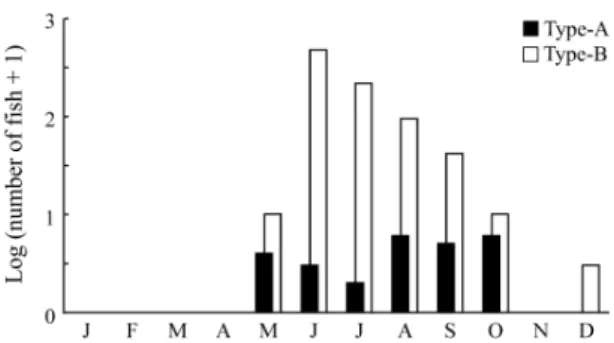
Specimens were classified into two types pri-marily using pigmentation patterns. Type-A specimens possessed a distinct row of melano-phores along the midlateral line of the caudal pe-duncle, while type-B did not. Both types occur-red almost simultaneously in spring to autumn, with type-B larvae outnumbering type-A on all occasions(Fig. 1). A total of three preflexion (4.1Ȃ4.3 mm BL),three flexion(4.8Ȃ5.5 mm)and 15 postflexion larvae(5. 5Ȃ7. 9 mm)of type-A,
while 639 preflexion(2. 3Ȃ4. 6 mm), 137 flexion (4.7Ȃ7.1 mm)and 19 postflexion larvae(5.6Ȃ7.6 mm)of type-B were collected(Fig. 2).
General morphology
Both types containing 39 myomeres are later-ally compressed with an elongate body tapering gradually towards the caudal end. The abdomi-nal sac is triangular and protrudes ventrally
be-low the body outline. In both types, the pre-anal (ca. 40Ȃ48% BL),head(ca. 26Ȃ37%),upper jaw (ca. 16Ȃ24%)and snout(ca. 7Ȃ14%)lengths and body depth(ca. 24Ȃ28%)increase with body length(Fig. 3a, b, d). Eye diameter hardly changes with BL(ca. 11Ȃ12%)(Fig. 3e),while the VAFL becomes shorter(ca. 22Ȃ17%)(Fig. 3c)from preflexion to postflexion. However, at the postflexion stage, significant differences be-tween the two types were observed, with type-A having a larger head[36. 8% BL vs 34. 8% (means)in type-B, p < 0.05],longer upper jaw (24.1% vs 21.5%, p < 0.05),shorter VAFL(17.7% vs 19.0%, p < 0.01)and deeper body(27.8% vs 25.9%, p < 0.01)than type-B(Fig. 3f, g, h).Cor-respondingly, the snout and pre-anal body length in type-A(14% and 48%)are also longer than type-B(13% and 47%, respectively), but these were not significant.
Fin formation
Notochord flexion begins at 4. 8 mm BL in
Fig. 1 Seasonal abundance of types -A and -B Auxis
larvae collected in Tosa Bay from May 2002 to May 2018.
Fig. 2 Developmental stages of types -A(a-c)and -B(d-f)Auxis larvae from Tosa Bay.(a)4.3 mm BL
preflexion larva(UKU-449000);(b)5.4 mm BL flexion larva(UKU-449001);(c)6.8 mm BL postflexion 449002);(d)5.0 mm BL preflexion 449003);e 6.9 mm BL flexion larva(UKU-449004);(f)7.5 mm BL postflexion larva(UKU-449005).Note: Fig. 2a was derived from the right side body of the larva due to damage on the left side.
type-A and at 4.7Ȃ5.2 mm in type-B, and is com-pleted at 5.5 and 6.9 mm, respectively(Fig. 2e). The hypurals start to appear in late preflexion larvae measuring 4.3 mm in type-A(Fig. 2a)and in 4. 6Ȃ5. 2 mm in type-B, with incipient rays formed subsequently. The pelvic bud occurs in 4.8 mm flexion larva in type-A and in 5. 1 mm flexion larvae in type-B, with rays starting to de-velop at 6.5 and 7 mm postflexion larvae, respec-tively. The second dorsal- and anal-fin anlagen first appear in 4.8 mm flexion larvae of type-A and in 5.2 mm flexion larvae of type-B, and their incipient fin rays begin to differentiate in 5.5 and 6 mm flexion larvae, respectively. The first dorsal-fin anlagen are found in late flexion larvae measuring 5.5 mm in A and 7 mm in type-B, with incipient spines starting to form in 6. 6 and 7.3 mm postflexion larvae, respectively. The 7.9 mm postflexion larva of type-A was the larg-est in both types, and showed full complements of first dorsal(XI),second dorsal(11 + 7 finlets), anal(11 + 7 finlets),pelvic(I + 5)and caudal(9 + 8)fins(pectoral fin, unkown due to damage). Head spination and dentition
In both types, two and three spines are initial-ly present on the inner and outer preopercle, with the outer spine at the angle being the lon-gest(Fig 2a, d).The number of inner and outer spines increase gradually to three and seven, re-spectively, by postflexion stage in both types (Fig. 2c, f).One small spine starts to form on the posttemporal in 5.4 mm BL flexion larvae(Fig. 2b),increasing to two in ca. 6 mm flexion larvae in both types(Fig. 2c, 2e).The small and coni-cal teeth are already present in both jaws in the smallest larvae at 4.1 mm in type-A and 2.3 mm in type-B, gradually increasing their number with development thereafter(Fig. 2).
Pigmentation
Three distinct rows of melanophores(middor-sal, midlateral and midventral)are present on the caudal peduncle in type-A(Fig. 2a-c),while one or two rows only in type-B, along the mid-ventral and or middorsal(Fig. 2d-f), which is sometimes absent in preflexion and flexion lar-vae. The rows on the caudal peduncle become denser with growth in both types, and the three rows of type-A form a transverse band(Fig. 2a-c). The internal melanophores arranged along the anal-fin anlagen are more numerous in pre-flexion type-B larvae(6Ȃ13)than in type-A(5Ȃ8) (Fig. 2a, c), and their number decreased,
al-though variable, to 1Ȃ5 in type-A(Fig. 2c)and 3Ȃ6 in type-B at postflexion(Fig. 2f).Small mel-anophores at the tip of the lower jaw and large branched melanophores over the head are pres-ent in all stages in both types, becoming more obvious with growth(Fig. 2).Melanophores on the triangular abdominal sac are internally de-veloped, being heavier along the anterior and dorsal surfaces from flexion larvae(Fig. 2). A conspicuous melanophore at the cleithral symph-ysis(Fig. 2b-f)is present in most specimens, but sometimes absent in type-A preflexion larvae (Fig. 2a)and in any stage of type-B larvae. A single melanophore just in front the tip of the anus and/or the anterior finfold(Fig. 2a, b, d, e, f)irregularly appears in any stage in both types. 4. Discussion
The midlateral row of melanophores on the caudal peduncle is the most consistent feature distinguishing all larval stages of type-A from type-B. Both types closely resemble MATSUMOTOʼS (1959)types I and II larvae, respectively from unspecified waters of the Pacific, Atlantic and In-dian Oceans, based on pigmentation patterns. Al-though MATSUMOTO(1959)mentioned the ex-treme inconsistency of the midlateral pigments
Fig. 3 Changes in the ratio of the different morphometrics measured to body length of Auxis types -A
and -B larvae covering all larval stages(left: a-e),and upon attaining postflexion stage(right: f-h).** and * indicate significant differences between the two types with p value < 0.01 and < 0.05, respective-ly.
in type I larvae(a row of 1Ȃ5 melonophores on one side of the body but absent on the other side on the same larvae),our type-A specimens have the pigments on both sides, except for the 4. 3 mm BL preflexion larva(Fig. 2a). This speci-men had a damaged caudal peduncle on the oth-er side, hence, the presence or absence of the pigment row is uncertain. Nevertheless, we are convinced that this specimen possessed the pig-ment because the other two preflexion type-A larvae(4.1 and 4.3 mm BL, with deformed bod-ies)have the pigment row on both sides.
The morphological features of both types -A and -B are very similar in the early larval stages. Differences are recognizable only at the postflex-ion stage, with type-A larvae showing a larger head, larger mouth, shorter VAFL and deeper body than type-B(Fig. 3). These results indi-cate the validity of the pigmentation row on the midlateral line in typing the entire larval stages of Auxis, probably until the juvenile stage.
The body depths of juvenile and adult A. ro-chei are shallower than in A. thazard(COLLETTE and AADLAND, 1996; NAKABO and DOIUCHI, 2013). In Tosa Bay, A. rochei are captured more abun-dantly than A. thazard(OCHIAIand TANAKA, 1998; NIIYA, 2011).In this study, the shallower-bodied type-B larvae predominated the deeper-bodied type-A larvae. Based on these facts, type-B lar-vae can be considered as A. rochei and type-A larvae as A. thazard. Our opinion corroborates with JONEʼS(1963)speculations based on a limit-ed morphometric examination(eight specimens) that the stouter type of Auxis larvae from Indian waters may be a A. thazard[= type I of MATSUMOTO(1959)]and the less stout or elon-gate type may be A. rochei[= type II of MATSUMOTO(1959)]. Furthermore, the photo-graphs, although unclear, of the artificially reared preflexion larvae of A. thazard and A. ro-chei have three and two rows of pigmentation on
the caudal peduncle, respectively(HARADAet al., 1973b, a). Accordingly, based on the results of this study, the three postflexion Auxis larvae ob-served in NISHIKAWA(2014)can be identified as A. thazard, but the smallest preflexion larva is not Auxis because of the absence of pigmenta-tion rows on the midventral, middorsal and/or midlateral lines of the caudal peduncle which are distinguishing characteristics of Auxis even in early preflexion larvae. This preflexion specimen is probably Euthynnus(NISHIKAWA, 2014),which has 1Ȃ3 pigment spots on the ventral edge of the tail and shares the same characters with Auxis; such as 39 myomeres, strong preopercular spines and pigmentations at the tip of the lower jaw, cleithral symphysis and tip of anus. In the near future, molecular studies examining the two types of Auxis larvae should be conducted to clarify their identifications.
Acknowledgements
We are thankful to S. OKA, S. TOJIMA, T. T. TRAN, K. TANAKA, I. IMOTO, G. NIGIand H. HIRAGA for their assistance with this study. We are grateful to W. L. CAMPOS(marine biologist)for correcting the English manuscript.
References
COLLETTE, B.B. and C.E. NAUEN,(1983):FAO species
catalogue. Vol. 2 Scombrid of the world. An an-notated and illustrated catalogue of tunas, mack-erels, bonitos and related species known to date. FAO, Rome, 137 pp.
COLLETTE, B.B. and C.R. AADLAND(1996):Revision of
the frigate tunas(Scombridae, Auxis),with de-scription of two new subspecies from the east-ern Pacific. Fish. Bull., 94, 423Ȃ441.
FAO(Food and Agriculture Organization of the United Nations)(2018a)Fishery statistical col-lections: Global capture production (online query)http://www.fao.org/figis/servlet/SQSer vlet?file=/usr/local/tomcat/8.5.16/figis/webapps
/figis/temp/hqp_3195203086751253756. xml&out type=html. Accessed 20 July 2018.
FAO(2018b): Fishery statistical collections: Global capture production(online query).http://www. fao. org/figis/servlet/SQServlet? file=/usr/local/ tomcat/8.5.16/figis/webapps/figis/temp/hqp_71 52296182342659440.xml&outtype=html. Accessed 20 July 2018.
FISCHER, J.(ed.)(2013):Fish identification tools for
biodiversity and fisheries assessments: review and guidance for decision-makers. FAO Fisher-ies and Aquaculture Technical Paper No. 585. FAO, Rome, 107 pp.
FRICKE, R., W. N. ESCHMEYER and R. VAN DER LAAN
(eds.)(2018):Catalog of fishes: genera, species, references; updated 5 November 2018. http://res earcharchive. calacademy. org/research/ichthyol ogy/catalog/fishcatmain. asp. Electronic version accessed 27 November 2018.
FUKUDA, Y.(1984):Fish larvae from the surface
lay-ers in the southern part of Bungo Channel. Bull. Oita. Pref. Fish. Exper. Stat., 11, 9Ȃ33.
FUNAKOSHI, S.(1993): Occurrence of fish eggs and
larvae in Mikawa Bay and Enshu-nada. Bull. Ai-chi. Fish. Res. Inst. 1, 19Ȃ39.
HARADA, T., O. MURATAand H. FURUTANI(1973a):On
the artificial fertilization and rearing of larvae in marusōda, Auxis tapeinosoma. Mem. Fac. Agri. Kinki Univ. 6, 113Ȃ116.
HARADA, T., O. MURATAand S. MIYASHITA(1973b):On
the artificial fertilization and rearing of larvae in hirasôda, Auxis thazard. Mem. Fac. Agri. Kinki Univ. 6, 109Ȃ112.
HATTORI, S.(1964):Studies on fish larvae in the
Kur-oshio and adjacent waters. Bull. Tokai. Reg. Fish. Res. Lab., 40, 1Ȃ158.
HOTTA, H.(1955):Seasonal distribution and growth
of the frigate mackerel Auxis tapeinosoma Bleek-er along the Pacific coast of Japan. Bull. Tohoku. Reg. Fish. Res. Lab., 46, 120Ȃ26.
JONES, S.(1963):Notes on eggs, larvae and juveniles
of fishes form Indian waters. XI. Further obser-vations on the genus Auxis Cuvier. Indian J. Fish., 8, 413Ȃ421.
KINOSHITA I.(2006): Significance of the research of
shirasu fishery grounds for resource and ecolog-ical study of pelagic fishes. Fish. Biol. Oceanog. Kuroshio, 7, 3Ȃ12.
KENDALL, A. W. Jr, E. H. AHLSTROM and H. G. MOSER
(1984): Early life history stages of fishes and their characters. In: MOSER, H.G., W.J. RICHARDS,
D.M. COHEN, M.P. FAHAY, A.W. KENDALLJr and S.
L. RICHARDSON(eds.)Ontogeny and systematics
of fishes. Am. Soc. Ichthyol. Herpetol., Spec. Publ. 1, Lawrence, p. 11Ȃ12.
LEIS, J.M. and B.M. CARSON-EWART(2000):The larvae
of Indo-Pacific coastal fishes: an identification guide to marine fish larvae. Brill, Leiden, 850 pp. MATSUDA. S.(1969):The studies on fish eggs and
lar-vae occurred in the Nansei regional waters of Ja-pan I: Species occurred and their seasonal varia-tion. Bull. Nansei. Reg. Fish. Res. Lab., 2, 49Ȃ83. MATSUMOTO, W.M.(1959):Description of Euthynnus
and Auxis larvae from the Pacific and Atlantic Oceans and adjacent seas. Dana Report, 50, 1Ȃ34. MOHRI, M., H. TANOUE, T ENOSHIMA, T. KAMANO, K.
HATA, H. GOTOH, M. KOKATSU, T. ITOH and N.
HAMAZAKI(2016).: Distribution of catches of
bul-let tuna by surface water trawl in the Japan Sea. Math. Phys. Fish. Sci., 13, 10Ȃ21.
NAKABO, T. and R. DOIUCHI(2013): Scombridae. In:
NAKABO, T.(ed.)Fishes of Japan with pictorial
keys to the species, 3rd edition. Tokai Universi-ty Press, Hadano, p. 1648Ȃ1654.
NIIYA, Y.(2001):Age, growth, maturation and life of
the bullet tuna Auxis rochei in the Pacific waters off Kochi Prefecture. Nippon Suisan Gakkaishi,
67, 429Ȃ437.
NISHIKAWA, Y.(2014):Auxis sp., Euthynnus affinis. In:
OKIYAMA, M.(ed.)An atlas of early stage fishes
in Japan, 2nd edition. Tokai University Press, Hadano, p. 1397Ȃ1400.
NISHIKAWA, Y. and D.W. RIMMER(1987):Identification
of larval tunas, billfishes and other scombrid fishes(Suborder Scombroidei): an illustrated guide. CSIRO Mar. Lab. Rep., 186, 1Ȃ20.
OCHIAI, A and M. TANAKA(1998): Ichthyology.
Koseisha-Koseikaku, Tokyo,1139 pp.
OKACHI. I.(1958): Studies on the distribution and
catch statistics I. Seasonal distribution and fish-ing condition of the fishes in the Tsushima warm current system. Ann. Rep. Jpn. Sea. Reg. Fish. Res. Lab., 4, 1Ȃ13.
SPONAUGLE, S. and C.K. COWEN(1997):Early life
histo-ry traits and recruitment patterns of Caribbean wrasses(Labridae).Ecol. Monogr., 67, 177Ȃ202. YABE, H. and S. UEYANAGI(1962):Contribution to the
study of the early life history of the tunas. Oc-cas. Rep. Nankai Reg. Fish. Res. Lab., 1, 57Ȃ72.
YOKOTA, T., M. TORIYAMA, F. KANAI and S. NOMURA
(1961): Studies on the feeding habit of fishes. Rep. Nankai Reg. Fish. Lab. Res., 14, 1Ȃ234. ZHONG, J.(2006):Study on the migration mechanism
of fish larvae into the inlet as their nurseries. Bull. Mar. Sci. Fish. Kochi. Univ., 24, 71Ȃ137.
Received: January 29, 2019 Accepted: March 26, 2019