著者
Sang Kyung An
journal or
publication title
Journal of regional development studies
number
11
page range
1-20
year
2008-03
URL
http://id.nii.ac.jp/1060/00003701/
Creative Commons : 表示 - 非営利 - 改変禁止 http://creativecommons.org/licenses/by-nc-nd/3.0/deed.jaRecentralization of Central Tokyo
and Planning Responses
Sang Kyung An
Introduction
Since the late 1990s, there have been several spatial transformations in Tokyo metropolitan region and in the lives of its inhabitants. Central to the transforma-tions has been a rapid population influx into inner-city areas whose populatransforma-tions have steadily declined over the last three decades,and high-rise construction boom in central Tokyo.
The Japanese bubble economy collapsed in the early 1990s and long economic recession followed. The period from then to early 2000s has been labeled the lost decade. In the midst of the extended stagnation,it is ironic that all around the city, but principally in inner-city areas, skyscrapers and population recovery have been occurring. In recent years, the population increase in inner-city areas has been growing at a greater pace than suburban ones. At first glance, the phenomenon surely seems like gentrification process that has mainly been experienced in other advanced capitalist cities, the process of physical renovation and neighborhood change accompanying the influx of affluent people into deteriorating areas that may displace poorer residents. Researchers argue that the nature of the process identified in central Tokyo differs from that of western countries including racial and class components (Waley 1997; Yabe 2003).
However, gentrification is no longer isolated or restricted to a few advanced cities. Today, it has gradually evolved into a crucial urban regeneration strategy for global interurban competition in cities around the world (Smith 2002). Currently,central to the urban restructuring in Tokyo is urban regeneration strategy to enhance its global economic competitiveness through state interventions. There-fore, it is difficult to say that recentralization phenomenon and new developments in Tokyo in recent years have no relationship with the wave of gentrification as a
global urban strategy. It is also interesting that the phenomenon is occurring in large cities across the country, not only in Tokyo.
First, this paper examines the changing pattern and its nature of population trends in Tokyo at regional and local scale,focusing on population recovery in city center. Then it seeks the causes of recentralization of central Tokyo,in the respect of both market forces and public interventions and its consequences. Second,the planning responses to socio-economic changes in 1990s are reviewed and their impacts on urban structure and built environment are explored. Third,this paper also examines the process of urban generation strategy in Japan through private sector property development and its relationship with spatial planning since 2000. The implications of these findings are then explored.
The Changing Faces of Tokyo since the Late 1990: Population Recentralization Geographical Context
The name Tokyo refers variously to Tokyo Metropolis (Tokyo-to) as a whole, the area governed by the Tokyo Metropolitan Government (TMG) that contain the 23 Special Municipal Wards or Ku and 39 other municipalities,or only to the 23 Ku that is known as formerly the City of Tokyo, or the Tokyo Region (Tokyo-ken) that includes Tokyo Metropolis and its three surrounding prefectures, Kanagawa,Saitama and Chiba,depending on the context. Besides,as a frequently
being used term, there is the National Capital Region (Shuto-ken) which includes the Tokyo Region plus Ibaraki, Tochigi, Gunma and Yamanashi prefectures (Fig-ure 1).
The term Central Tokyo in this paper is referred to as the 23 Ku of Tokyo Metropolis. The area has 8.66 million residents in October 2007 that accounts for 67.8% of total population (12,790,000) of Tokyo Metropolis. The Tokyo Region has 36.47 million populations at 2005 Census,the world s most populous metropoli-tan area and the National Capital Region has 44.37 million people that represent 28. 5% and 34.7% of the national total population, respectively(Table 1).
Figure 2 Tokyo Metropolis and Central Tokyo (23 Ku)
Table 1 Population of Tokyo Region and National Capital Region (figures in millions) 1980 1985 1990 1995 2000 2005 National Capital Region 35.70 37.62 39.40 40.40 41.32 42.38 growth rate 6.2% 5.3% 4.7% 2.6% 2.3% 2. 6% Tokyo Region 28.70 30.27 31.80 32.57 33.42 34. 48 growth rate 6.2% 5.5% 5.1% 2.4% 2.6% 3.22% Saitama prefecture 5.42 5.86 6.40 6.76 6.94 7. 05 Chiba prefecture 4.73 5.15 5.55 5.80 5.93 6.06 Kanagawa Prefecture 6.92 7.43 7.98 8.25 8.49 8. 79 Tokyo M etropolis 11.62 11.83 11.85 11.77 12.06 12.58 Central Tokyo 8.35 8.35 8.16 7.97 8.14 8.49 Source: Ministry of Internal Affairs and Communications, Bureau of Statistics, Population Census of Japan, Each year.
101: Chiyoda 102: Chuo 103: Minato 104: Shinjuku 105: Bunkyo 106: Taito
107: Sumida 108: Koto 109 : Shinagawa 110: Meguro 111: Ota 112: Setagaya 113: Shibuya 114: Nakano 115: Suginami
116: Toshima 117: Kita 118: Arakawa 119 : Itabashi 120: Nerima 121: Adachi 122: Katsushika 123: Edogawa
Nature of Changes in Population and Residential Trends
This section examines the nature of changing patterns in population in Tokyo at two scales,Regional and local scale. To begin with,lets look at the changes in the National Capital Region (NCR) and Tokyo region as a regional and sub-regional scale. In the NCR, population
in-creased in the period from 1995 to 2000 in all prefectures(Figure 3). However,for the period from 2000 to 2005,while only Tokyo metropolis (4.2%)and Kanagawa prefecture(3.5%)experi-enced higher growth rate than the previous five year, Gunma, Ibaraki, Yamanashi prefectures that are far away from Tokyo lost the residents. Similar patterns were also shown in Tokyo region, although population has increased in the entire region (Table 1 and Figure 4). Population has been decreasing at suburban areas of three prefectures,principally of Saitama prefecture while it has been on a strong increas-ing trend in inner-city areas of Tokyo. Compared with the changes between 1990 and 1995 when there has been a hollowing out at the
Figure 3 Population Changes in NCR, 1995-2005 Source: Ibid, 2005
Figure 4 Population Changes in Tokyo Region
Source: Ministry of Infrastructure, Land and Transport (MILT), White Paper on National Capital Region 2006, 2006. 6
center and growth in the suburban areas, the trends have been completely reverse since the late 1990. It reveals that the roles of suburban areas which has played to accommodate the population flowing in the capital region and contribute to restraining a rapid population increase in central Tokyo has gradually been weakening (MLIT 2006).
Next, looking at changes in population in central Tokyo (23 Ku),population level has been rapidly rising after many years of decline. In three core areas, particularly,the population growth rate was so high.The proportional population growth and decline occurred much faster and higher,the closer to downtown (Table 2). For example, while three core areas where once the growth rate declined by -18. 16% grew by 21.67% between 2000 and 2005, those of the 5 inner Ku and 15
Table 2 Change in Population in Tokyo Metropolis (in percentages)
1975-1980 1980-1985 1985-1990 1990-1995 1995-2000 2000-2005 3 core Ku −6.22 −4.04 −18.16 −8.43 10.01 21.67 5 inner Ku −7.85 −3.29 −9.60 −6.17 2.37 4.67 15 outer Ku −2.37 0.86 −0.21 −1.55 −1.77 3.63 Central Tokyo −3.40 0.03 −2.29 −2.40 2.10 4.36 Tokyo Metropolis −0.43 1.81 0.17 −0.68 2.46 4.31 Source: Ministry of Internal Affairs and Communications,Bureau of Statistics,Population Census of Japan,Each year,
Chiyoda, Chuo, and Minato Ku Shibuya, Shinjuku, Toshima, Bunkyo, and Taito Ku
Figure 5 Population Gain and Loss in Central Tokyo (23 Ku) 1988-2007
Source: Tokyo Metropolitan Government, Population and Household by Basic Resident Registers, Each year
outer Ku increased to 4.67% and 3.63% from -9.60% and -0.21% during the same period, respectively.
Figure 5 shows a comparison of real numeric population change in central Tokyo during the two periods, 1988-1997 and 1998-2007, which has completely different features. Between 1988 and 1997, while only three Ku-Katsushika, Nerima, and Edogawa Ku-experienced population growth, 20 of 23 Ku suffered population declines and 11 Ku lost more than 20,000 residents.
However, between 1998 and 2007, all of Ku except only Kita-ku experienced population increase and eight Ku among them gained more than 20,000 residents. The common element among almost all of eight Ku was not their income level but their location. Six of eight Ku-Edogawa, Koto, Chuo, Minato, Shinagawa, and Ota Ku-were located along Tokyo Bay.
The six waterfront Ku experienced a combined increase in population of 217,669 that accounts for less than 50% of total growth of central Tokyo (23 Ku)for last decade. Koto-ku in the waterfront areas gained the largest population (59,481) for the last ten years in central Tokyo,where it lost 27,1472 residents between 1988 and 1997. According to Jacobs (2005), the growth in these areas came from immigration from other Ku, suburban parts of Tokyo metropolis and Kanagawa prefecture.
Meanwhile,these in-migrants were largely consisted of young and middle-aged households. According to a survey result by MILT (2006), 65.1% of net-inflow households into 3 core areas for the 5 years up to 2003 were households with head aged less than 44. On the other hand,regarding the households with a head aged 65 and over, number of out-migrants exceeded in-migrants by 834. Yabe (2003) also observed that single and multi-income households accounted for a high proportion of the movers.
However,such a process has occurred different ways from that of gentrification that has experienced in other advanced capitalist cities since 1950s. Generally, gentrification defines as the process by which higher income households displace lower income residents of neighborhood,changing the essential character and flavor of that neighborhood (Kennedy and Leonard 2001, Smith 2002). Thus, displace-ment of low income residents is one of the defining components of gentrification. The problem is that the displacement is taking place involuntarily, that is, the replacement of those original residents who would prefer to stay there,but because of rapidly increasing rents rather than forced evictions,cannot afford to do so. In
Tokyo,However,recent researches indicate that the influx of new comers has taken place without displacing existing renters and home owners (Takagi 2002, Sonobe 2001). Also,Table 3 shows that there were few changes in rank of 3 core Ku and waterfront Ku in 23 Ku in terms of household income between 1990 and 2003 where their growth rate was relatively much higher than others since 1995. Waley(1997) concluded that what Tokyo has experienced is not gentrification but the construc-tion of limited number of new high-rise prestige complexes in relatively central parts of the city. Actually, much urban and housing development has occurred on a landfill in the bay or, using the large plots of land once occupied by storage and distribution facilities and industrial facilities.
Factors Contributing to Recentralization and Its Consequences Causes
First of all, falling land prices by collapse of bubble economy was a key ingredient for recentralization of population into inner areas. During the bubble economy,and especially at its peak in 1990,property prices in Japan likely deviated from their true values due to temporary demand and speculation. The commercial and residential prices rose to above three times the price of its pre-bubble time prices. As the result, population level in 23 Ku which has consecutively maintained the excess of net inflow of migrants from areas within Tokyo metropolis and other prefectures since 1950 changed to the excess of net-outflow to other areas since 1987.
Since 1991 and the end of bubble economy, however, the prices had fallen
Table 3 Household Income of 3 Core Ku and Waterfront Ku, and Their Ranks 1990-2003 (100 yen)
1990 Rank 2000 Rank 2003 Rank 23 Ku 47,500 43,460 41,780 Chiyoda 106,430 1 75,290 1 73,660 2 Chuo 69,560 3 50,790 7 51,370 6 Minato 80,310 2 72,980 2 76,750 1 Koto 41,280 17 38,830 15 37,160 13 Edogawa 41,300 16 39,750 13 37,160 14 Shinagawa 45,420 13 43,350 11 41,470 12 Ota 47,470 11 44,270 8 41,910 9 Source: Nihon Marketing Kyoiku Center, 2004
continuously(Figure 6). As seen in Figure 6, the prices of land since 1997 have fallen to pre-bubble levels. Housing prices and office rents also declined sharply after peaking out in 1990. The average price of new condominium cost 1.6 million yen per square meter in central Tokyo in 1991 fell by 638 thousands yen in 2002 and the average price/average annual salary ratio also declined from 12 times in 1990 to 6 times in 2000 (Table 4).
Such a sharp decrease in land and housing prices has led to massive construc-tion of condominium, bringing about a rapid populaconstruc-tion increase in inner city areas. In the five years between 1996 and 2002, net inflow of 160,000 migrants occurred in the 23 Ku,which is approximately half of the lost population during the bubble period. The number of new condominium supplied in the five years between 1988 and 1992 was no more than 42,000 units,but the number of between 1998 and 2002 increased by 1999,000 units. In particular,in 3 core Ku,it increased over 10 times from 1,701 in the former period and 16,776 units in the later. In 2004,
Figure 6 Changes in Price of Commercial and Residential Land in Central Tokyo, 1984-2005 Source: TMG, Land of Tokyo 2005, (tokyo no tochi), 2006
Note: 1983=100 8 inner Ku include 3 core Ku and 5 inner Ku.
Table 4 Construction of New Condominium in Central Tokyo, 1986-2004 (unit, 10,000 yen, times)
1986 1988 1990 1992 1994 1996 1998 2000 2002 2004 No. of new units 10,021 5,824 7,225 5,657 20,304 25,902 22,035 35,318 31,574 39,117 Price per ㎡ 55.8 125.6 152.7 124.2 85.8 74.5 72.3 66.0 63.8 67.0 Price/annual salary 5.3 10.8 11.6 9.0 6.5 6.5 6.1 6.0 6.1 6.5
Source: TMG, Land of Tokyo 2005
it reached more than 39,000 units at its peak (Table 4).
It is notable that so called one room mansion supplied explosively during the 1980s and showed declining tendency after the bubble burst is booming again since 1997. The major differences from the boom in the late 1980s are their size and location of their construction. Less than 20 square-meters accounted for 71.3% of total one room mansion in 1990. But, while 20 square-meters over and 25 less accounted for 78%, 20 square-meters less accounted for only 10.6% in 2002. Looking at their location,52.3% of them were built in 12 inner Ku in 1990. But, 22.1% were built there in 2002. Meanwhile,42.7% of total were built in 3 core Ku in 2002, as compared to the only 0.7% in 1990. As mentioned above, growth in single family in these areas brought about rise in demand for one room mansion. Along with such a one room mansion boom, the rapidly growing supply for high-rise condominium more than 20 storey also contributed to the recentralization of population in the region (Table 5).
While economic forces like changing land and housing market seem to drive the population influx into downtown, government policies of the past and present facilitated the process.
At the end of bubble economy between the late 1980s and early 1990, many residential areas in inner city areas including three core Ku have faced serious problems such as closure of shops and collapse of communities by their rapid replacement of low-rise housing and small commerce to office building and high-rise developments. Central and local governments attempted a variety of policy measures to preserve communities and to curb the falling population level. Government adopted a policy of comprehensive redevelopment that involved the purchase of land and the construction of unifunctional high-rise housing estates,and some incentive and subsidy measures to promote housing construction in inner-city areas. Several core Ku pursued measures to subsidize rents and extend credits for
Table 5 New High-rise Condominium Units of 20 Storey or Over
1999 2000 2001 2002 2003 Chiyoda 500 Minato 244 257 330 15 211 Chuo 1,078 925 288 608 3 core Ku 244 1,335 1,755 303 819 23 Ku 1,590 2,990 4,130 4,419 2,132 Source: Hirose, M. (2005), Impacts of Recentralization of Tokyo on Urban Structure and Travel Demand, Transportation and Economy 65(8), p.18. (Japanese)
young people moving in or wishing to remain, including direct intervention like supply of social housing. Besides,it was required in some central areas that when new commercial developments were undertaken, a certain proportion of building had to be occupied by housing for the purpose of protecting concentration of special land uses in neighborhood (RICE, 2000). However, in the respect of that the growth of population began in the late 1990s,there remain some questions that how effective these measures were on population recovery in inner-city areas.
Furthermore,Hatta(2006)argues that a major factor behind this new phenome-non is a series of statutory changes implemented in the early 2000s to promote urban regeneration with the relaxation of FAR control in the late 1990s,and government s abandonment of the ideology of balanced development , long-held philosophy that served as the backbone of various policies, and the abolishment of Factory Restriction Law. Basically,decentralization policies were main direction for all of spatial policies and plans,because heavy concentration of population and economic function has been considered major problems to be solved. Factory Restriction Law was a measure introduced in 1959 designed to remove from the 23 Ku large factories,university campus,and other such inefficient users of land. These policy measures were partly successful in the respect of industrial development of suburban and local areas. But,pace and intensity of concentration of the function in central Tokyo has not been easily slowed and weakened.
The roles of government involved in these changes are discussed further in next sections.
Consequences
Recentralization of Tokyo is double-edged sword. It has caused both positive and negative impacts. It has led to revitalization of city neighborhoods on the one hand,and it has imposed on costs on certain groups or geographical spaces,on the other hand.
First, commuting times (hour away from home) for salary men and students into 3 core Ku that has consistently lengthened by 1995 began to decrease from 2000 for the fist time. Average commuting times into the region dropped from approxi-mately 71 minutes in 1995 to 69 minutes in 2000. The proportion of commuting time less than one hour has gradually decreased from 40.1% in 1980 to 33.1% in 1995. However,it reversed to 35.0% in 2000,representing increasing proximity to workplace. The reduction of commuting time is attributable to the growth of
residing population in city center.
Second, the number of children with population recovery in inner Tokyo has continued to grow. In Japan,since the basic unit of territory based community is mainly consisted by primary school district,the increase of children means growth in opportunity to interact with residents in community through nurturing children and their education, consequently, helping revitalization of community.
Third,growth of residing population in city center,particularly in Minaoto-ku and Chuo-ku where rapid population recovery is occurring has brought many retail shops for local residents to the areas which are necessary for a stable and vigorous community.
Fourth, the high-rise condominium boom created severe conflicts, in part because they brought with them deterioration of landscape,but even more because they blocked direct sunlight to neighboring houses.
Fifth, conflicts between older and new residents are appearing. A growing number of new residents moving into high-rise housing is not likely to lead to well-balanced local communities. Disparities in lifestyle between those living in high-rise blocks or one room mansion and the old residents of two storey houses are great.
Sixth, lack of public service provision such as primary school and nursery school capacity has occurred in some neighborhoods due to rapid growth in number of children.
Urban Restructuring in Tokyo in 1990s and Planning Responses
When examining the policies for urban growth and management in Tokyo in 1990s, it is impossible to ignore the urban structuring that occurred in the 1980s, particularly the second half of the decade,which was at a turning point in its urban development.
The bubble economy began in the mid 1980s impacted on the built environment and urban structure in Tokyo in various ways. They can be summarized as follows: a rapid growth in office space, skyrocketing land price, displacement of housing and evictions of communities,deregulation of urban planning and construc-tion, and active redevelopment projects. (Hayakawa and Hirayama 1991; Ma-chimura 1992)
adopted new roles in the global control of capital and the global businesses were heavily concentrated in central Tokyo. Land for office building increased to 30% in the five years from 1986 to 1991. Even so,the office vacancy rate dropped to low rate of around 0.3% in central Tokyo. This promptly led to abnormal rise in land price in the center of Tokyo first and then spread to Tokyo region and to all of Japan s major cities. As seen in Figure 6,the average price of commercial land in 8 inner Ku increased nearly four times between 1983 and 1991.
Relaxation of city planning was carried out throughout the 1980s. Inspired by the neo-liberal policies of Reagan and Thatcher, Japanese government led by then Prime Minister Nakasone promoted policies of deregulation, the use of private enterprise and privatization,the expansion of domestic demand,and fiscal retrench-ment (Sorensen 2003) These were essential eleretrench-ments of minkatsu policy, meaning something like the active use of the dynamism of private enterprise. Hayakawa and Hirayama (1991) call minkatsu a mechanism for reorganizing urban space in pursuit of economic growth . The major measures adopted by minkatsu policy were relaxation of zoning regulation and disposal of public land. The deregulation that this entailed focused on encouraging redevelopment in central Tokyo. Specifi-cally, they were to increase floor area ratio in inner city areas, rezone residential zone to commercial, and relax the regulation on development in urbanization control area where urbanization should be basically restricted and was designated in urban fringe area. The disposal of public land to private sectors in pursuit of urban redevelopment was largely connected with the privatization of Japan National Railways.
In addition to these measures, the 4 Capital Regional Development Plan proposed the restructuring of mono-centric regional structure to poly-centric one,by construction of 11 existing urban centers (later 4 centers were added) as satellite business sub-centers in 1986. Its purposes were to discourage the over-concent-ration of business function and reduce negative externalities in Central Tokyo. However, these subsidiary centers created new and supplementary functions and helped expand and reinforce the role of Tokyo, rather than absorbing excess capacity from Tokyo.
The policy of reinforcing Tokyo was also implemented at Tokyo Metropolitan Government level. Six sub-centers (Shinjuku, Shibuya, Ikebukuro,Ueno,Kinshi-cho, and Osaki) were designated to form poly-centric urban structure within the inner area in 1983(Sorensen 2001). While,the CBD area(3 core Ku)was
designat-ed as the global finance and information center, these sub-centers were proposed to pre-vent the further expansion of the CBD. To these centers was added a seventh on reclaimed land on Tokyo bay in 1988, called the waterfront sub-center (Figure 7). The waterfront sub-center was chosen as a pri-mary area to enhance Tokyo s global communication and
exchange function (Saito 2003). Thus,in the 1980s,spatial plans made by national and local governments were to facilitate redevelopment and intensification of central Tokyo and hence further accelerated a huge property development boom.
The bubble economy burst in the early 1990s. Following the burst,the nation s financial system almost collapsed under bad real estate loans,and the country has suffered economic stagnation since 1991 and to 2005. The average real GDP annual growth between 1991 and 2003 did not exceed 1%. Japanese government attempted various measures for economy recovery such as expansion of public expenditure by issuance of government bonds,adoption of low interest rate close to zero percent,tax reduction policy,and expansion of money supply. In particular, huge public spending was injected on infrastructure development in an attempt to restart economic growth. The public investment in the form of supplementary budgets amounting to approximately 66 trillion yen propped up the economy. Notwithstanding,the spending on major public works has not been to link autono-mous recovery of economy. As a result, decrease in domestic demand resulting from the extended recession led to the excessive of supply, and in turn deflation spiral effect accompanying decline in consumer price and real GDP coincidentally since 1998 was continued.
Japanese economy and the system of Japan Inc.that once was area of study as a successful model of economic development from all countries in the world changed to that of criticism,expressing it as sinking sun from the rising sun. The public mood in Japan also changed from one of great confidence to one of uncertainty and pessimism. The 1990s has, thus, been labeled the lost decade.
Figure 7 Third Long-term Plan for the Tokyo Metropolis, 1991
Meanwhile,by the late 1980s,there was increasing public pressure to address the land inflation crisis. A number of government related measures related began to move from deregulation to strong planning and the tighter regulation of property development. The emphasis in planning and development field was also shifted on quality of life. There was a significant strengthening of City Planning Law includ-ing provision of Master Planninclud-ing and improved zoninclud-ing regulations in 1992. Eight zoning categories were subdivided into twelve,allowing for more detailed control of land uses. Policies designed to attract younger residents and tempt existing resi-dents to stay in inner city areas was also introduced in this period.
However, the persistence of the economic crisis led to moves to deregulate the property development industry to make land development profitable once again to compensate for bubble-related losses. In the late 1990s, significant increases in allowable building heights and volumes in order to make urban redevelopment more profitable were made in Building Standards Law.
Urban Regeneration Strategy and Spatial Planning in Tokyo
At several times during the 1990s,there were signs of turn-around to economy recovery. But, the economy couldn t enter upon upward phase of economic cycle in spite of various recovery measures. By the end of 1990s, a new approach to economy recovery was emerging. Japanese government began to seek the cause of long-term depression from Japanese system and standard in which the state always safeguarded national industry, lifetime employment system, equalitarian approach, and main bank system under which business corporations and their main bankers are closely and effectively connected. It was recognized that these traditional Japanese system could not provide the answers and that, rather than a new set of polices,a shift in the framework of economics,social and education itself in the light of the global standard is needed.
The government announced an Emergency Economic Package that sought to approach the problem from a fundamental perspective. As part of this package,the government set up the Headquarters for Urban Regeneration within the cabinet in 2001. The headquarter states the significance of urban regeneration as follows:
The basic significance of revitalizing the urban areas,which are the source of vitality in Japan in the 21st century, is to heighten their attractiveness and
international competitivenesse...Moreover, such revitalization of urban areas would draw forth the capital and know-how that exist in the private sectors, direct them toward the urban areas, which in turn would arouse new demand and lead to the realization of economic revitalization. Additionally, the revitalization of urban areas would contribute to the disposal of the non-performing loans issue through the liquidity of land assets (MLIT 2002) As shown in the statement,the focus of the act was placed on the strengthening international competitiveness of Japanese cities, promotion of private involvement in urban development,economy recovery,and disposal of bad loans. Basically,the urban regeneration strategy consists of three main programs: urban regeneration project by state initiative, urban development by private investment, and urban regeneration project in nationwide to be carried out by local government and NPO or voluntary sector. The centerpiece of these urban regeneration strategies is second program,full support including deregulation and financial and taxation incentives for private urban development projects. To promote actively the project, the government enacted the Special Urban Regeneration (Urban Renaissance) Act in June of 2002. Looking at the ideological agenda,it is similar again to the one of minkatsu that prevailed under the Nakasone government in the early 1980s. Controls and restrictions have been further loosened,with a series of measures that have significantly relaxed Floor Area Ratios (FARs) (waley 2007).
Headquarter for urban regeneration has authority to designate Urban Regenera-tion Area in which greatly weakened development regulaRegenera-tion will apply and relaxed FAR bonus system can be permitted directly by central government instead of requiring local government consultation (Sorensen 2003). Thus,by giving cabinet authority to designate regeneration areas,the central government has made it much easier and faster to grant approval for huge FAR bonus for redevelopment of inner city sites into high-rise global space. Large-scale redevelopment projects sites carried out since 2002 in Tokyo and other large metropolitan areas are mostly urban regeneration areas designated by this act.
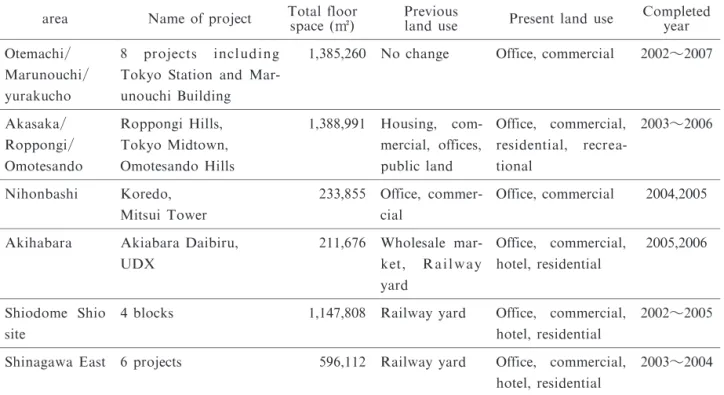
Figure 8 represents eight areas designated by this act in Central Tokyo,which consists of total 2,514 ha. All of sites in Tokyo are in central areas. The size of projects in terms of floor space and height of buildings has been successively increased,as new rules have allowed for ever-great relaxation of existing regulation (table 6 and 7). After a 15 years period of decline,land prices started rising again
in Tokyo in the latter part of 2005.
Spatial Planning and Policies in Tokyo
Since the late 1990s when Ishihara was elected new Governor of Tokyo, planning thinking and planning strategies of Tokyo have been changed dramati-cally. He proposed to revitalize Tokyo again as Japan s leading city and an important world player. His idea was reflected in the planning documents for-mulated successively by Tokyo Metropolitan Government (TMG) in the years following the election. The words increasing attractiveness,competition,world or global city appear frequently in these documents. The Tokyo Plan 2000 iden-tifies the Tokyo s task as being necessary for it to become a global city. Urban White Paper of Tokyo 2000 also refers to the competitive aspect of the global
Figure 8 Urban Regeneration Areas in Tokyo
Source: Prime Minister and His Cabinet, Headquarter for Urban Regeneration, 2007
Table 6 Number of Buildings with a Height 100m or Over (Including Residential Building) 1,000㎡
00 01 02 03 04 05 06 Total No of Buildings 14 9 23 19 20 21 22 128 Total Floor Area 838.2 858.5 2,701.4 1,752.9 1,235.8 1,834.0 1,455.0 10,675.8 Source: Hirose, M. (2005), Impacts of Recentralization of Tokyo on Urban Structure and Travel Demand, Transportation and Economy 65(8), p.19. (Japanese)
world. The priorities of urban policy in Tokyo were mainly placed on attracting inward investment and increasing economic competitiveness.
These ideas have been reflected in the strategic planning. First of all,regard-ing the role of CBD, the new strategy, with its emphasis on competitiveness, has focused on the importance of the agglomeration of business functions in central core. Thus,TMG proposed to revitalize the central core areas and develop it as a location to boost Japanese economy(Saito and Thornley 2003).
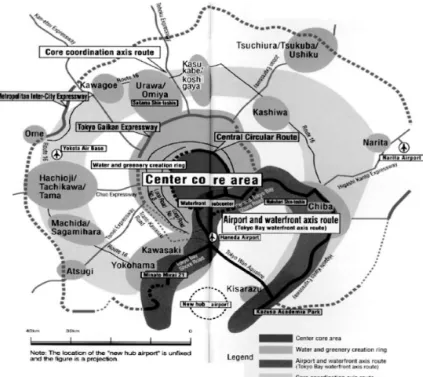
The second debate point in the strategic planning was the location of new capital. Although the consensus on the over-concentration in Tokyo and the resulting problems has diminished after the bubble collapse, relocation of capital function is still a live issue. TMG has consistently opposed to such a move and are challenging central government on this issue. The Tokyo Megalopolis Concept (TMG 2001) formulated in 2001 proposes the inclusion of central government functions in the region by constructing the circular megalopolis structure . The plan takes a regional approach,linking Tokyo metropolis,Saitama,Chiba,Kanag-awa prefectures and Yokohama,Kmetropolis,Saitama,Chiba,Kanag-awasaki and Chiba cities,which would allocate various functions including central administrative functions to the above said zones, and allow for dynamic exchange among zones and the development of attractive city life (Figure 9)
Table 7 Large-scale Urban Development Projects Completed between 2002 and 2007 area Name of project Total floorspace (㎡) Previousland use Present land use Completedyear Otemachi/
Marunouchi/ yurakucho
8 projects including Tokyo Station and Mar unouchi Building
1,385,260 No change Office, commercial 2002∼2007 -Akasaka/ Roppongi/ Omotesando Roppongi Hills, Tokyo Midtown, Omotesando Hills 1,388,991 Housing, com mercial, offices, public land Office, commercial, residential, recrea tional 2003∼2006 -Nihonbashi Koredo, Mitsui Tower 233,855 Office, commer cial Office, commercial 2004,2005
-Akihabara Akiabara Daibiru, UDX 211,676 Wholesale mar ket, Railway yard Office, commercial, hotel, residential 2005,2006 -Shiodome Shio site
4 blocks 1,147,808 Railway yard Office, commercial, hotel, residential
2002∼2005
Shinagawa East 6 projects 596,112 Railway yard Office, commercial, hotel, residential
2003∼2004
Concluding Remarks
It seems fair to conclude that the recentralization process of central Tokyo differs more or less from that of gentrification which has largely been experienced in western cities. Although limited number of new high-rise prestige complexes were supplied in relatively central parts of the city, much urban and housing development has occurred on landfill in the bay or, using large plots of land once occupied by industrial facilities and company housing and Japan Railway.
It is interesting finding that young and middle-aged households accounted for a high proportion of the movers. Increased in smaller household and multiple-income households are another characteristic. Because of need less space,they buy one room mansion nearby center. In the case of multiple income households,they tend to locate more centrally in order to minimize transportation costs. Increase in these households has given both positive and negative impacts on neighborhood changes. Positive impacts have been decreased traffic congestion and swindling commutes by proximity to workplace and revitalizing neighborhoods. Negative impacts have been conflicts between old and new residents,landscape and sunlight right conflicts, rising crime rate, and lack of public service provision.
It is clear that wide range of different types of public intervention involved in the late 1990s,particularly urban regeneration strategy and policies,have facilitated
the recentralization process of central Tokyo. The urban generation process has several interrelated characteristics. First,the role of state in the urban development projects has changed. Government has withdrawn almost entirely from the projects and the partnership between private capital and public sectors in the name of PFI and PPP in the reconstruction of government building and public facilities was intensified. Second, Japanese capital has played a more important role in the development process than global capital,unlike other global cities where new influx of global capital into large mega-development in urban center has been remarkable. In the Japanese case, most of projects have been led almost entirely by Japanese private sector consortia. The third characteristic is outward expansion of urban generation projects from the urban center,attracting people and capital into the city and reinforcing the city function more and more.
It is also worth noting that the policies and spatial planning at national and local level since 1990s have focused on further reinforcing Tokyo in the name of building a competitive global city. A growing gap between larger metropolitan areas and local areas in recent years is no doubt attributable to these policies and ideological shift from equity to efficiency in the development field.
References
Hatta,T (2006),Economics of Urban Recentralization,Tokyo : Nihonkeizai Shinbunsha.(Japanese) Hayakawa,K.and Hirayama,Y.(1991), The Impact of the Minkatsu Policy on Japanese Housing
and Land Use, Environment and Planning D : Society and Space, 9 : 151-164.
Hirose,M.(2005), Impacts of Recentralization of Tokyo on Urban Structure and Travel Demand, Transportation and Economy 65(8): p.14-22. (Japanese)
Jacobs, A.J. (2005), Has Central Tokyo Experienced Uneven Development? An Examination of Tokyo s 23 Ku relative to America largest Urban Centers, Journal of Urban Affairs, 27(5): 521-555.
Kennedy,M.and Leonard,P (2001), Dealing with Neighborhood change: A Primer on Gentrifica-tion and policy Choices, A Discussion Paper Prepared for The Brookings InstituGentrifica-tion Center on Urban and Metropolitan Policy. The Brookings Institution.
Machimura, T. (1992), The Urban Restructuring process in Tokyo in the 1980s: Transforming Tokyo into World City, International Journal of Urban and Regional Research, 16(1): 114-128.
Ministry of Internal Affairs and Communications,Bureau of Statistics,Population Census of Japan, Each Year
Ministry of Infrastructure, Land and Transport (MILT) (2006), White Paper on National Capital Region 2006.
Nihon Marketing Kyoiku Center (2004), Individual Income Indicators, Kyoiku Center.
Research Institute of Construction and Economy(RICE) (2000),Construction Economy Report,35 Saito, A. (2003), Global City Formation in Capitalist Development State: Tokyo and the
Waterfront Sub-center Project, Urban Studies, 40(2): 283-308
Saito, A. and Thornley, A. (2003), Shifts in Tokyo s World City Status and the Urban Planning response, Urban Studies, 40(4): 665-683.
Smith, N. (2002), New Globalism, New Urbanism: Gentrification as a global Urban Strategy, Antipode, 34(3): 427-449.
Sonobe, A. (2001), Contemporary Urban Sociology, Tokyo : Dosinto
Sorensen,A.(2001), Subcentres and Satellites Cities: Tokyo s 20th Century Experience of Planned Polycentrism, International Planning Studies, 681): 9-32.
Soresen, A. (2003), Building World City Tokyo : Globalization and Conflict over Urban Space, Annals of Regional Science, 37: 519-531.
Takagi (2002), City center and Inner Area, Urban Sociology toward 21 Century, Kikuchi and Egami (eds.), Tokyo : Gakumonsha (Japanese)
Tokyo Metropolitan Government,Population and Household by Basic Resident Registers,Each year Tokyo Metropolitan Government (2003), White Paper on Housing in Tokyo (Tokyo Jutaku
Hakusho)
Tokyo Metropolitan Government (2006), Land of Tokyo 2005, (tokyo no tochi)
Waley, P. (1997), Tokyo : Patterns of Familiarity and partitions of difference, The American behavioral Scientist, 41(3): 396-428.
Waley, P. (2007), Tokyo-as-World-City: Reassessing the Role of Capital and The State in Urban Restructuring, 44 (8): 1465-1490.
Yabe, Naoto (2003), Population Recovery in Inner Tokyo in the Late 1990s: A Questionnaire Survey in Minato Ward, Jinbunchiri, 55(3): 79-94. (Japanese)