論 文
Exchange Rate Management in Selected East Asian
Countries After the Financial Crisis
Hiroyuki Taguchi†
1。 Intmduction
Exchange rate management is one of the central issues of macroeconomic policies. Since the postwar period, there has been a long−term debate over the merits of fixed versus floating exchange rates. The debate, which is typically framed in terms of the trade−off between credibility and flexibnity, has gone through several swings of the pendulum. Recently, the debate on exchange rate regimes has become focused on whether or not the intermediate regimes.such as target zones, crawling and basket pegs are vanishlng, in other wQrds, wh6ther or not exchange rate regimes are moving to a corner solution with the hard peg or the凸 free float . So far, no clear consensus has been reached,
The 1997−98 Asian crisis has refocused attention on exchange rate management of East Asian countries. Most views expressed criticize the pre−crisis US dollar−pegged−rate regime as one of the causes of the crisis. It is said that this regime induced short−term external over−borrowing and caused the appreciation of real exchange rates with the loss of competitiveness. Then, the question arises as to whether, after the crisis, the East ASian countries are simply returning to the pre−crisis US dollar standard, or whether they have learned a lesson from the crisis and are finding another path to follow.
This article examines post−crisis exchange rate management in.selected East Asian countries in terms of exchange rate regimes and targeting. The main findings from our empirical studies are as follows:As far as can be seen from the recent developments of exchange⑫te arrangements ln countrles analyzed according to the. hMF.classification, it appears that the hypothesis of the corner solution with a
hard peg or free float has taken hold in the post−cr.isis period. However, when we analyze the de facto regimes by examining the volatilities of foreign exchange reserves, we can speculate that the countries analyzed, except for Malaysia, are in fact holding to the. soft peg even in the post−crisis period, regardiess of their announcement in favor of the free float . The next issue to consider is what kind of factors determine the targeted reference rate. Post−crisis exchange rate targeting appears to be somewhat diff6rent from the simple US dollar standard in the pre−crisis period. Empirical evidence shows that some countries have come to value inflation adjustment ip exchange rate targeting in addition to the US dollar linkage during the post−crisis period.
The rest of the paper is organized as follows:Section II reviews the preヤious studies on exchange rate regimes. In this section, first we present an outline of the long−term debate over fixed versus
†早稲田大学社会科学研究科 博士課程.3年
floating exchange rates since the postwar period. Secohd, we focus on recent studies:the debate over the corners hypothesis versus the Fear of Floating hypothesis;.and the reviews on assessments of exchange rate management of East Asian countries in pre−and post−crisis. Section III condu6ts empirical studies. In this section, we firSt rev孟ew recent devdopments of exchange rate regimes in the sample countries according to IMF clas6ification. Second, we analyze the de facto exchange rate regimes by examining the volatilities of foreign exchange reserves in the sample countries. Third, we analyze the factors determining the targeted referehce rates in managing exchange rates, both by investigating the real effective exchange rate movements and by conducting regression analysis. Section IV presents concluding remarks. In this section, we also indicate宙hat issμe串remain tQ be analyzed,
皿.Previous Studies
In this section, we review the previous studies on exchange rate regimes. Fiゴst, we show a bird eyes view of the long−term debate over fixed versus floating exchange rates since theやoStwar period.
Second, we focus on recent studies:the debate over the corners hypothesis versus the Fear of Floating hypothesis, and the reviews of the ass6ssments of exchange rate management of East Asian countries in pre−and post−Asian crisis.
A.Lρng幽teml Debates;Fixed versus Fioa髄ng Exchange Rates
We first present the long−term debate over the merits of.fixed versus floating exchange rates since the postwar period田. The debate is typically framed in terms of the trade−off between credibility and flexibility. With the adoption of a fixed regime, domestic monetary po!icy is dictated by the central bank of the country whose currency provides the external anChor, and the fixed rate automatically acquires all the credibility accumulated by the issuer of the anchor currency. Floating rates, in contrast, maximize the flexibility with which the authorities can.use monetary policy for economic stabilization. They leave the central bank free to intervene as a lender 6f last r6sort to financial markets,
The debate has gone through several swings. of the pendulum. At the time of Bretton Woods, the architects of the postwar system favored fixed exchange rates, attributing the economic instability of the interwar period, in part, to flexible rates. During the 1960s, a growing number of ecohomists came to favor floating rates, responding to the widening US balance−of−payments disequilibrium that led to the breakdown of the Bretton Woods system. During the 1980s, the accumulating experience with high inflation in many parts of the world brought the pendulum back. Setting a target for the exchange rate came to be viewed as one way for central banks to realize monetary stabilization. New theories of rational expectation and dynamic consistency concluded that a commitment to such a nominal anchor, if credible, would even allow disinflation without the usual costs of lost output and employment。 In the late 1990s we faced the second complete swing of the pendulum out and back, as conventional wisdom blamed exchange rate targets for crises in Mexico(1994−95), East Asia(1997−98), Russia(1998), and Brazi1(ユ999). In this context, has come the new proposition that countries are−or should be−moving to the corner solutions〔2).
B.Recent Studies
We here focus on recent studies ob exchange rate regimes:First, we review the recent debate over the corners hypothesis versus the Fear of Floating hypothesis. Second, we concentrate on reviews of assessments of the exchange rate management of East Asian countries in pre−and post−Asian crisis.
8−1.Comers Hypothesis Versns Fear of Floating Hypothesis
The hypothesis of corner solutions involves opting either, on the one hand, for full flexibility, or,
on the other, for rigid institutional commitments to fixed exchanges in the form of currency boards or full monetary union with the dollar or euro. It is said that the intermediate exchange rate regimes such as the target zones, crawling and basket pegs, are no longer feasible and are going to disappear.
ADB(2001)identified the reasons for this as follows:Large and liquid international capital markets make it more diffiωlt for national authorities to support a shaky currency peg, since the
resources of the markets far outstrip the reserves of even the best−armed central banks and
g6vernments. Effective defense of exchange rates requires raising interest rates and restricting domestic credit, something that will have significant costs especially in emerging market economies with their fragile financial and political systems. Frankel et al.(2000)offered a theoretical rationale for the corners hypothesis by introducing the notion of Verifiability and suggested that a simple peg or a simple float may be more verifiable by market participants than a more complicated intermediate regime. They also offered some empirical evidence that intermediate regimes do in fact inspire less.credibility than institutional arrangements such as dollarization〔3[.
Calvo and Reinhart(2000), on the contrary, insisted that a careful reading of the evidence on exchange rate policy presents a strikingly different picttlre:countries that say they allow their exchange rate to float mostly do not−there seems to be an epidemic case of the fear of floating , particularly among emerging market economies. They presented an analytical model that suggests that,
even in the best of times, when countries retain voluntary access to international capital markets, lack of credibility will lead to the fear of floating . They also found, in their empirical analyses across 154 exchange rate arrangements, a low variability of exchange rates and a high volatility of central bank reserves that suggest significant central ban≧intervention・
B−2.As8essments of R㏄ent East Asian Ex¢㎞ge Rate Management
We next focus on assessments of exchange rate management of East Asian countries in pre−and post−Asian crlsis. We first summarize the views of international organizations on the pre−crisis US dollar−pegged−rate regimes, most of which blame the regime as one of the causes of the crisis,
The World Bahk(1998)stated that in most of the ASEAN countries, informal pegging to the US dollar that makes nominal rate predicable, encouraged unhedged short−term external borrowing due to large interest rate differentials. They also added that to furt}1er complicate matters, the yen depreciated against the US dollar throughout much of 1996, so the pegged currencies lost competitiveness against the important yen market..@Along this line, the World Bank(2000)suggested that a flexible exchange rate absorbs shocks from capital inflows and outflows.
One of the factors of the Asian crisis, identified by the IMF(1998), was the excessively long maintenance of pegged exchange rate regime.s, which complicated the response of monetary policy to
overheating pressures, and which came to be.viewed as implicit guarantees 6f exとhange value,
encouraging short−term external borrowing and leading to excesslve exposure to foreign exchange r董sk.
They suggested that adjustable pegs have become increasingly difficult to maintain in the face of large−scale financial flows, and that for some economies, the balance of cos㌻s and benefits may be shifting in favor of greater exchange rate flexib藍lity, partly because of the advantages of avoiding th〔ミ risk that a fixed rate may encourage exc6ssive foreign currency exposure.
ADB(1998)explained that the pegged exchange rate contributed to the current account deficits and rislng real exchange rates, the combination of which provided a vital ingredient for the financial crisis.
They attributed the rising real rate to a combination of factors that included higher domestic inflation in relation to the world average:appreciation of the US dollar, to which these currencies were pegged;
depreciation of the Japanese yen;and devaluation of the PRC currency in 1994, They also pointed out that the high interest rates of the affected countries, along with pegged exchange rates, created a false sense of secμrity among many investors that they could earn relatively high rates of return without any exchange rate risk.
Most of the views criticize the pre−crisis US dollar−pegged−rate regime because of its moral hazard in inducing short−term external borrowing and its tendency to cause the appreciation of real exchange rates with the loss of competitiveness. They also favor greater exchange rate flexibility(4㌧ The next question is how posレcrisis exchange rate management is evaluated. In spite of the suggestion of greater flexibility,.not all East Asian countries seem to prefer the same exchange rate arrangement and assessment does not always seem to reach clear−cut consensus. Calvo and Reinh.art(2000), again, shows that many countries that are categorized as having floating currencies since the Asian crisis are, in effect, holding loose pegs. Mckinnon(2001)analyzed how the post−crisis gxchange rate regime has evolved since l998. According to his analyses, dollar exchange rates;particularly when obser>ed on a high−frequency(daily)basis, have become as stable as they were before the crisis. Therefore, he stated that the East Asian dollar standard, except for Indonesia, seems to be resurrecting itself, and that the
fear of floating identified by Calvo and Reinhart(2000)is shown at higher frequencies to be a rational response to capital market conditions in emerging markets,
皿.Empirical Studies on Selected East Asian Countrie6
We conducted an empirical analysis of the selected East Asian countries. We here focus, as sample countries, on the hardest−hit crisis couhtries among the East Asian countries:Indonesia, the Republic of Korea, the Philippines, Malaysia, and Thailand. First, we briefly review recen止developments of exchange rate regimes in the sample countrieS according to the IMF classification・$ecQnd, we analyze the de facto exchange rate regimes by examining the volatilities of foreign exchange reserves in the sample countries. Third, we analyze the factors determining the targeted reference rates in managing exchange rates both by investigating the real effective exchangg rate moveinents and by conducting regreSSiOn analySiS.
A.Developments of Exchange Rate Regimes in IMF CIassi6cation
We first analyze the developments of exchange rate arrangements in the sample countries from the
pre−crisis period to the post−crisis period from information obtained from the IMF(International Monetary Fund).
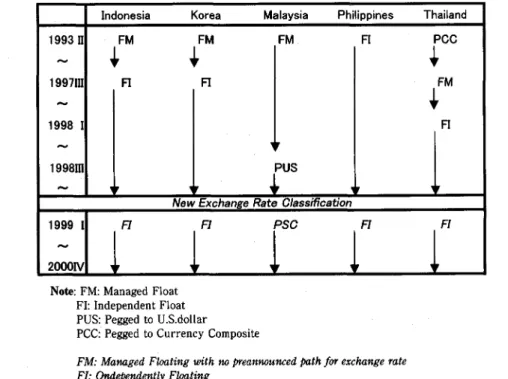
According to Table 1, we observed the following:First, Indonesia and Korea moved from Managed
Float to Independent Float. Thailand moved.from Pegged to Currency Composite through Managed
Float to Independent Float. Second, Malaysia, on the contrary, shifted from Managed Float to Pegged to US dollar in 1998. Third, the Philippines showed no change, staying at Independent Float. Fourth,although the IMF has adopted the new exchange rate classification system since 1999〔51, any significant changes in clas〜ification have.not occurred in the sample countries.
From the observation above and considering that Hong Kong and China have adopted pegs, the East Asian arrangements seem apparently to go along with the hypothesis of corner solutions, hard peg or free float (6). As we stated before in II−B, however, some economists argue that some countries that announced free float seem to be returning to soft peg , from their empirical studies. We will verify this point in the following section.
B.1)eFa¢to Exchange Rate Regimes:Retuming to soft peg
Calvo and Reinhart(2000)showed, as key evidence of the fear of floating , that in the countries that say they al塾ow their exchange rate to float, the foreign exchange reserve volatility is very high,
contrary to what would be expected in a floating exchange rate regime, which suggests significant
Table l Developments of Exchange Rate Arrangements
Indonesia
Korea
Mabysia Philippin6s Thailand199311 FM FM FM. 阿 PCC
〜
← ← ←
1997111 Fl Fl
FM
〜
←
19981
F1〜
1998瑚
PUS
〜
〜ew
εxcわaη9εRatθ 0伯3s所oa亡 oη19991
月. 月PSO
月 π〜
20001V
Note:FM:Managed Float FI:Independent Float PUS:Pegged to U.S。donar
PCC:. Pegged to Currency Composite
FM 1閃影初F∫oα 伽8嘘ん㎜ρ惣α川止膨4舛ゐルrθκ6んα㎎θπ吻 Flf oπ4脚翻砂FZoα 囎
PSCJ・Cbπひθπ 勿麗α ∫喧メθd P㎏A77α㎎㎜飴α8α πs αsづ㎎ θα陽7猶2循σ=y
Source:IFS(IMF)
central bank intervention. Their analysis included the cases of Indonesia, Korea and Thailand in the post−crisis period, and the Philippines in the recent decade, where their fqreign exchange reserve volatilities are higher than those of the United States a皿d Japan, and surprisingly, even those of the countries that are classified i羅 limited Flexibility according to the IMF system.
We here verify the volatili止ips of foreign exchange reserves ln the sample countries by examining the trends of their coefficients of variation from the pre−crisis period to the post−crisis period. We use the monthly data of the foreign exchange reserves in US.Dollar base from January 1994 to Deごember 2000,taken from the International Financial Statistics of the International Monetary Fund. Then we calculate the coefficients of variation year by year. If a country adopts the regime of pure float , the coefficients of variation should, in principl〔…, be zero.
Table 2 reports the results of the calculations. The main observations are as follows. .First,
Indonesia, Korea and Thailand, which announced lndependent Float after the crisis, showed no
sign三ficant changes in the coefficients of variation of their foreign exchange reserves regardless of their changes of the announced regime。 Second, Malaysia, which shifted formally to Pegged to US dollar , similarly showed no noteworthy change in its coefficients. Third,.the. Philippines, which kept to山e formally Independent Float during the period, has lnostly the same degree of coefficients as those of the other sample countries.From the observation above, we speculate that the sample countries, except for Malaysia, are holding to the soft peg even in the post−crisis period regardless of their announcement of the free
float ,
C.Exchange Rate Targeting
If we follow the hypothesis that the sample countries, except for Malaysia,
peg , the next step is to examine what factors determine targeted reference whether or not the sample countries are simply returning to the pre−crisis
are holding to the Soft rates;in other words,
US dollar−pegged−rate
Tab且e 2 Coefficient of Variation in Foreign Exchange Reserves
lndonesia Korea
Malaysia
PhilipPinesThailand
C.V. Regimes C.V. Regimes C.V. Regimes C.V. Regimes C.V.. Regimes
1994
0.05 0.07 0.09. 0」1 0.061995
0.05FM
0.09FM
0.03 0.08 0.08PCC
1996
0.07 0.04 α06 .FM 0」5 0.021997
0.06 FM→F1 0.13 FM→Fl 0.11 0.10 FI 0.15PCC→FM
1998
0.12 0.24 0.09FM→PUS
0.08 0.04 FM→F11999
0.04 Fl 0.09 FI 0.06PUS
0.08 0.06 FI2000 0.07 0.07 0.05 0.04 0.01
Notes:
1)C.V.:Coefficient of Variation in;Foreign Exchange Reserves 2)The meanings of the simbols in Regimes are shown in Table 1,
Source:IFS(IMF)
regime as Mckinnon(2001)suggested. We here present the hypothesis that the sample countries, not simply relying on the US dollar standard, have come to pay more attention to inflation rates in their exchange rate management during the post−crisis period. We speculate that they may have learned the lessons that the Asian crisis was partly caused by the simple US dollar−pegged−rate regime accompa−
nied by a rising real exchange rate and the moral hazard in inducing external borrowing. We first examine the actual movements of the real effective exchange rates to see whether the exchange rates have been qdjusted by inflation rates. We next conduct a regresslon.analysis to identify the factor of inflation adjustment in managing.exchange ratesl
C−1.Real Elf艶¢樋ve Ex¢hange Rate
We first examine the actual movements of the real effective exchange rates(REER)in the sample countries. The REER is an.indicator for a・country s international phce competitiveness. This indicator is obtained by unifying a bilateral real exchange rate that shows the prices of one country s outpht baskets relative to the others . Theref6re, when an exchange rate is fully adjusted according to a country s pri6es relative to the others (the country follows the purchasing power parity), the country s REER levels off because the country s prices relative to the others remains unchanged.
We here show two kinds 6f REER:One is the Morgan Guaranty indexes(REERMGI), which are weighted averages of each real exchange rate of its trading partners wherein the weights are the share of the trading partner in the country s total exports and imports GP Morgan(2001)). The other is the pri6es of one country relative to those of the competitors in the world export market(REEREup), which are obtained by dividing the US dollar value of the price level of a country in question by the US dollar value of the world export unit price index. The REERMGI clearly reflect the relative importance of a country s trading partners, While REEREup value the role of competitors in third markets. It would be better, therefore, to evaluate the REER through both indices(7}.
1The following are the main findings. from Figure 1. First, during the pre−crisis period of 1990−96,
the REEREup show a clear trend of appreciation by more than 20%except that the trend for Korea
shows only slight appreciation, while the REERMGI do not necessarily show the same trend of
appreciation{8}. Second, during the post−crisis period of 1998−2001, the REERMGI do not show any clear trends except that the one.for Malaysia indicates the recent trend of appreciation. As for the REEREup,we cannot identify any trends because of lack of data after 2000.
We interpret the observation above in the following way. During the pre−crisis period, we cannot deny the possibility of the rising trend of the REER under the US dollar−pegged−rate regime from the movements of the REEREup. The REERMGI may not fully renect the role of competitors in export 耳narkets, with tbe drastic devaluation of the Chinese Yuan in 1994 being the typical example..In the post−crisis period, we cannot present a clear−cut implication only from the movements of the REERMGI.
At least, we do not observe any evidence of appreciation except for Malaysia. We speculate that Malaysia, who shifted.from Managed Float to Pegged to US dollar in 1998, may have recently had appreciation of the REER,
Figure Movements of Real Effective Exchange Rates
a)Morgan Guaranty Index(REER−MGI)(1990=100)
b)Price relative to World Export Unit Price(REER−EUP)(1990=100)
140 120 100 80 60 40 20
0
90 91 92 93 94 95
−o−lndonesia一白一Korea一ひ一Malaysia
97 .98 99 00
Philippines 一一〇一ThailandNotes:
1)All the indexes on exchange rates are expressed as the foreign currency price of a unit oゴdomestic currency. Thus, an increase in the index means apPreciation of.the currency.
2)REER−EUP is caluculated.ih case oHndonesia as follows,
Exchange Rate(U.S, dollar/Rupiah)*Indonesian WPI(Rupiah base)/World Export Price Index(US. dollar base)
Source:JP Morgan(2001), IFS(IMF)
C−2Regression An』ysis
We next turn to a regression analysis.to identify the factors determining the targeted reference rates including innation rate in managing exchange rates. We follow the work of Frankel and Wei
(1994)〔9)and specify the regression model in the following way.
』og(Local Currency/SWF)=α1∠log(USD/SWF>十α2∠log(JPY/SWF))
十α3∠10g(DEM/SWF)十α4∠log((CPI十CPI−1)/2)十ε
Where SWF is the Swiss franc, USD is the US dollar, JPY is the Japanese yen, DEM is the German mark andεis assumed to be a well−behaved error term, following N(0,σ2). CPI is the Consumer Price Index of the local country with a time lag to take the causality relationship between CPI and the value of local currency into account. The.Swiss franc is chosen as an arbitrary鋤吻6η吻for measuring variations in the exchange rate because it is an independently floating currency of an advanced country which nonetheless carries little weight in Asia s trade. Based on the first difference of logarithms
(percentage changes), the simple regression model is multivariate ordinary least squares for each country and time period. All the.sample data are monthly ones taken from the International Financial Statistics of the Inter耳ational Monetary Fund, for the sample countries−Indonesia, Korea, Malaysia, the Philippines and Thailand. The data are broken up into two periods−pre−crisis from January l994 to December 1996, and post−crisis from January 1999 to December 2000. According to Frankel Wei(1994),
if the local currency is tightly fixed to some particular value of the US dollar, then the regression coefficientαl should be discernible and approximately unity, while the others are close to O. Another crucial variable is the local CPI. If the coefficient of the loc合l CPI is significantly positive, we assume that the domestic inflation rate can be one of the factors determining the targeted reference rates in managing exchange rat6s.
T・bl・3rep・・捻th・・,sult・・f th・r・gressi・n・・Th・m・i・gbserv・ti・ns and th・i・i・terpret・ti・n・are as follows. First, the coefficients of the US dollar in all local currencies are significantly positive throughout the pre− and post− periods, In particular, the PhilipPine Pεso of both periods and the pre−crisis Indonesian Rupiah have an approximate unity as a coefficient of the US dollar and the post−crisis Malaysian Ringgit. has a rigid unity. The sample countries, except for Malaysia, therefore,
seem to be holding the soft peg to the US dollar, during not ohly the.pre−crisis period but also the post−crisis period, regardless of its assigned weights. Malaysia, who has announced Pegged to US dollar. since 1998 is econometrically verified to fix its currency to the US dollar in the post−crisis period. Second, the coefficients of the loca韮CPI are significantly positive in the post−crisis of the Thai Baht, the Philippine Peso and the Korean Won. Korea, the Philippines and Thailand, therefore, may have come to take the domestic inflation rates into account as one of the factors determining the targeted reference rates during the post−crisis period. Third, most of the coefficients of the Japanese yen 3nd the German mark are insignificant and do not have a noteworthy characteristic in the process from the pre−crisis to the post crisis. Thus, there seem to be no significant changes in the weights assigned to the Japanese yen and German mark.. Lastly, the post−crisis Indonesia Rupiah shows a relatively worse performance in the adjus≒ed R−squared・ POst−crisis Indonesia may have had its currency influenced by other factors such as political instability.
Tab且e 3 Results of Regressions on Functions Determining Changes in Value of Curencies
Period
USD JPY DEM
(CPI+CP夏(一1))/2 R**2 D.W.・ ,
o「e−C「151S ***O.85 ***O.10 0.04 0.0唱 0,998 t275
Baht
, .
垂盾唐煤│crlSls 0.66*** 0.23 一〇.02 綿S.17 0,481 1,488
..■
垂窒?−crlSlS **宰P.05 0.05 037 一〇.22 0,843 0,805
Pes◎
} ,
垂盾唐爆浮モ窒撃rIS ***
P.15 一〇.18 ***O.08 2.78糊 0,825 1,820
・ ・
o「e層CnSlS **宰O.82 **串O.20 一〇.14 0.18 0,908 t472
Won
■・
垂盾唐煤│crlSls **ホP.06 ***O.44 0.01 林Q.15 0,750 1.,731
..
o「e−CnSIS ***O.97 0.01 0.06 ***O.20 0,986 t459
Rupiah
・ .
垂盾唐煤│crlslS **Q.13 一〇.85 一〇.04
t31
0,273 2,034, .
垂窒?−crlSlS 0.7ε*** 0.10 ホ*O.64 0.23 0,780 1,367
Ringgit
■■
垂盾唐煤│crlSls ***P.00 0.00 一〇.00 0.00 1,000 2,829
Notes:
1) All currencies are in terms of units of Swiss francs.
2) The pre−crisis period is from January 1994 to December l996, and the post−criSis period is from January 1999 to December 2000, except for the Baht(from June 1998 to.December 2000)and the Won(from June.1998 to April 2001).
3) *, **, *** indicate that the coefficient is significant at the 90,95, and 99 percent levels, respectively.
Source:IFS(IMF)
W.Concluding Remarks
After the Asian crisis, Indonesia, Korea and Thailand officially announced the transition of their exchange rate regimes towards free float while Malaysia annou.nced the transition towards the solid peg to the US dollar. It apparently looks as though the hypothesis of corner solution has taken hold in these post−crisis developments for the official regimes. When it comes to the de facto exchange rate regimes, however, Indonesia, Korea and Thailand as well as the Philippines, seem to be still holding to the soft peg regimes even in the post−crisis period. The post−crisis exchange rate targeting, however,
appears to be somewhat different fr6m the simple US口ollar standard in.the pre−crisis period, Our empirical evidence shows that Korea, the Philippines孕nd Thailand have come to care about the factor of the inflation rate in addition to the US dollar linkage in their post−cfisis exchange rate management。
The following issues still need analysis:First, the posレcrisis period is a little too short to provide sufficient monthly data for analySes of the foreign exchange reserves, the REER, and the factors for exchange rate targeting. We will, therefore, need the re−analyses to get more consolidated outcomes by keeping tねck of the upcoming data. Second, it may be useful for our analysis to examine the exch耳nge rate management of non−crisis countries and to compare them with the management of hardest−hit crisis countries. Third, we have to analyze more deeply the merits and demerits of inflation−adjusted management on exchange rates, Inflation adjustment under the soft peg , with an exchange rate less
>olatile than free float , may alleviate such risks as the rising real exchange rates(the loss of competitiveness)and the moral hazard inducing external borrowing. However, whether the soft peg , even though inflation−adjusted, would still be the best regime consistent with growing international
financial integration(whether soft peg would help alleviate pressures associated with large capital
flows), is the question. 〔投稿受理日2001.10.31/掲載決定日2002.1.19〕
NOES
(1) The descriptions in this section, mostly refer to ADB(2001)and Frankel et al.(2000).
(2) As for the actual trends of the role of exchange rate in a macroeconomic framework and the factors underlying the shift of weight assigned to the role, see IMF(1999)and Taguchi(1998)。 Conc白rning the latest study on the choice of e箪change rate regime including the theory of optimum currency area, see Poirson(2001),
(3) Frankel et a1.(2000)also reviews the literature on the hypothesis of corner solutions, As the latest study,
Fischer(2001)discusses this hypothesis.
(4) Fischer(1999)also suggests that greater exchange rate flexibility would be desirable in the future.
(5)IMF classification system has grouped IMF members exchange rate arrangements according to the degree of flexibility, The previous system, though it had been unchanged for over 14 years, has a number of shortcomings,
In particular, there were sometimes important differences between the official dassification, based on members formally announced regimes, and the actual, de facto, exchange rate arrangements. IMF(1999)describes that the new system is based on the members actual, de facto,.regimes and it also presents members exchange rate regimes against alternative monetary policy fra血eworks. The new system, however, does not necessarily seem to reflect de facto regimes such as informal exchange rate targeting because it stm depends on the information provided by country authorities, .
(6) The exchange rate arrangements can be classified into three categories in general:the hard peg where a currency is fixed using a currency board or where the currency of another country has been adopted, the soft peg where廿1e currency is tied to another currency or a basket of currencies either through a peg, a crawling peg, or bands around a refεrence rate, and free noat where the value of the currency is either allowed to fluctuate freely or where there is a managed float. For details see ADB(2001),
(7)The IMF weighting scheme is based on trade data for manufactured goods and primary goods, with weights reflecting both tねe relative importance of a country s trading Partners in jts direct bilateral trade relation, and that resulting from competition in a third market. However, the REER compiled by the IMF based on this weighting scheme is not available for the sa皿ple countries. The weights, which are derived from MERM (Multilateral Exchange Rate Model), each represent the moders estimate of the effect on the trade balance of the country in question of a l percent change in the domestic currency price of each of the other currencies. A detail description of the IMF weighting scheme is contaihed in the IFS oHMF Supplement on Exchange Rates,
No9(1985) .
(8) Ohno(1999)argued that measured by real effective exc血ange rates(inflation−adjusted and trade−weighted exchange rates), no serious overvaluation is detected in the worsレhit economies durlng the pre−crisis period,
However, this argument does not・necessarily hoid in case of counting the effects from competition in a third market. .
(9) Some of the且oca且currencies are de facto linked to a basket of major currencies and the weights assigned to various currencies are not announced. Frankel and Wei(1994)argue that it is important to infer policies. by observing actual behavior, rather than relying on officia且pronouncements, and estimate the implicit weights eCOnometriCally.
REFERENCES
ADB(Asian Development Bank).1998..4s伽πDωθめ卿侃 0%伽。々1998,23−37。 Manila.
一.2001.Asia s Globalization Challenge...43毎%D卯8 ψ〃励 0漉口説2001.ユ61−201. Manila.
Calvo, Guille}mo A., and Carmen M. Reinhart.2000. Fear of Floating..亙BER堀(銅牌㎎P砂θγNo.7993. Cambridge,
Massachusetts:National Burea血of Economic Research,
Fischer, Stanley.200L Exchange Rate Regimes:Is the Bipolar View Correct?This paper was prepared for the 2001 American Economic Association meetings, Washington, D. C:International Monetary Fund,
一.1999.On the Need for a Lender of Last Resort Address to the American Economic A§忘。¢iation. New York.
January 3.
Frankel, Jeffrey A., and SJ. Wei.1994. Yen Bloc or Dollar Bloc?Exchange Rate Policies in the East Asian Economies. In Takatoshi Ito and Anne Krueger, eds.,1協聯ogω㎜づ。 L伽ゐ㎎θ ε卿づ㎎13, E暫。肋㎎召Rσ陀3,απ4 αψf α F伽〃.NBER−East Asia Seminar o皿Eco箪omics 3, Chicago:University of Chicago Press.
Frankel, Jeffrey A., Sergio Schmukler, and Luis Serven.200G. Verifiability and the Vanishing Exchange Rate Regime. This paper was prepared for the Brookings Trade Forum 2000:Policy Challenges in the Next Millenium, April 27−28,2000, Washington, D.C,
IMF(lnternational Monetary Fund).1998.防吻Eα㎜必0媚oo々 ハ血夕1998.3−7. Washington, D.C.
一.1999.Exchange Rate Arrangements and Currency Convertibility:Developments and Issues.伽∂露6 Eω㎜飴α嘱 F伽酒αε∫卿のs.23−46..Washington, D.C.
一.2001.1漉㎜飯㎜1窺%α剛α∫S鰯誌 os. June 2001, and previous issues..Washington, D.C.
JP Morgan.2001. JP Morgan. Real Broad. Effective Exchange Rate Indices, July 2001,【http:〃www.jp−
morgan.com/MarketDatalnd/Forek/currlndex.html}
Mckinnon, Ronald.2000. The East Asian Dollar Standard, Life after Death?Eoo㎜覚1>b θ829(1, February).31−82.
一.2001.After the Crisis, the East Asian Donar Stapdard Resurrected:an Interpretation of High−frequency Exchange Rate Pegging. In Joseph E Stiglitz and Shahid Yusuf, eds., Rθ地伽観㎎ ん8 Eα3」ノ1s歪α 伍7α6彦θ (Chapter 5).197−246. Washington, D.C:World Bank.
Ohno, Kenichi.1999. Exchange Rate Management in Developing Asia:Reassessment of the Precrisis Soft Dollar Zone..4DB∬Wb漉f㎎・Pα釦γ1σanuary). Tbkyo=Asian Develop皿ent Bank Institute.
Poirson, Helene.2001. How Do Countries Choose Their Exchange Rate Regime?1MF陥襯囎P吻γWP/01/46.
Washington, D.C:internationa且Monetary Fund,
Taguchi, Hiroyuki.1998. Exchange Rate Movements and Trade Balances in Selected ASEAN Countries.∫o o一∫漉駕θ 4:187−207.Tokyo:Waseda University.
World Bank.1998, Eα3 且sづα=丁肋R〔u4 o Rθ60肥りP.1−18. Washington, D℃,
一2000.Eαs朗5砿Rθoo 6η㈱4 Bの伽d,19−43. Washington, D.C,