九州大学学術情報リポジトリ
Kyushu University Institutional Repository
絶滅危惧植物ジンリョウユリの繁殖生態学
横田, 静香
九州大学大学院理学府
https://doi.org/10.15017/21707
出版情報:Kyushu University, 2011, 博士(理学), 課程博士 バージョン:
権利関係:
Reproductive biology of a threatened plant, Lilium japonicum var. abeanum
Shizuka Yokota
Ecological Science Laboratory, Department of Biology, Graduate School of Sciences, Kyushu University
Contents
Chapter 1 Pollination biology of
Lilium japonicum
var. abeanum
and var. japonicum
: evidence of adaptation to the different availability of diurnal and nocturnal pollinatorsAbstract 4
Introduction 6
Materials and methods 10
Result 15
Discussion 19
Figure legends 25
Tables 26
Figures 29
Chapter 2 High selfing rate and strong inbreeding depression in
Lilium japonicum
var.abeanum
Abstract 35
Introduction 36
Materials and methods 39
Result 46
Discussion 49
Figure legends 55
Tables 57
Figures 60
References 65
Acknowledgments 76
Chapter 1
Pollination biology of Lilium japonicum var . abeanum
and var . japonicum : evidence of adaptation to the
different availability of diurnal and nocturnal
pollinators.
Abstract
Floral traits such as color and size are highly diversified in lilies, but their adaptive significance remains uncertain. Here, we compared pollination processes between Lilium japonicum var.
abeanum and var. japonicum, to clarify how the two varieties are adapted to different pollinators. Var. japonicum is known to be moth pollinated, and we hypothesized from its flower traits that var.
abeanum is pollinated by diurnal insects. Using water-proof digital cameras set to a recording interval of 10-30 seconds, we recorded flower visitors for 7-9 flowers of var. japonicum and 4-6 flowers of var.
abeanum over 24 hour periods. We also recorded the number of versatile (T-shaped) and rigid (I-shaped) anthers per flower. For var.
abeanum, we observed flowers at 5:00 and 17:00 to determine flower opening time and measured the intensity of floral scent with a metal-oxide semiconductor odor sensor. Both diurnal and nocturnal insects visited flowers of the two varieties, but visitation of diurnal insects was more frequent in var. abeanum. Anthers of var. abeanum are usually rigid, as in many bee flowers, whilst those of var. japonicum are mostly versatile. While flowers of var. japonicum are known to open in the evening, 32% flowers of var. abeanum started to flower during the day. Var. abeanum emitted scent at night, with a maximum
intensity at 20:00 just as in var. japonicum. These findings suggest that floral traits of the two varieties are adapted to different relative availabilities of nocturnal versus diurnal pollinators. The flower of var.
abeanum is relatively more adapted to diurnal pollinators, and yet retains adaptation to nocturnal pollinators, particularly as regards its scent.
Keywords: anther shape, bimodal pollination, floral scent intensity, flowering time, pollination ecotype
Introduction
Lilium has been cultivated for ornamental purposes since ancient Egyptian times (Mcrae 1998). Wild species of Lilium are distributed widely in the northern hemisphere, and since the first monograph of the Genus Lilium was published by Elwes (1880), approximately 115 species have been recognized (Shimizu 1987, Mcrae 1998). Many of these wild species have large trumpet-shaped corollas of various appealing colors such as white, red, and yellow, also having long stamens and pistils. These floral traits appear to be adaptive to pollination by animals. Beyond Brantjes & Bos’s (1980) report that both diurnal and nocturnal hawkmoths visit L. martogon, many other efforts have been made to describe pollinators of wild lilies in various contexts.
The most intensive study was made by Skinner (1988) who observed pollinators of 13 west American species of Lilium, and recognized five types of pollination: butterfly pollination (L. humbolodtii, L.
kelleyanum and L. kelloggii), butterfly and hummingbird pollination (L.
wigginsii, L. pardalinum and L. pardalinum ssp. vollmeri), hummingbird pollination (L. columbianum, L. occidentale and L.
bolanderi), hummingbird and bumblebee pollination (L. parvum and L.maritimum), and hawkmoth pollination (L. washingtonianum and L.
parryi). Additional studies reported various flower visitors including fritillaries to L. concolor var. pulchellum (Hayashi 2007), swallowtails
to L. dauricum (Hayashi 2007), nocturnal hawkmoths to L.
formosanum (Rodger et al. 2010) and L. japonicum (Chiba & Shimizu, 2004), and hawkmoths and swallowtails to L. auratum (Hayashi &
Kawano 2007, Morinaga et al. 2009). These studies showed that flowers of Lilium are mostly pollinated by diurnal and nocturnal Lepidoptera, and less frequently by hummingbirds and bumblebees. However, how floral traits of lilies are adapted to various pollinators including diurnal and nocturnal Lepidoptera, remains uncertain. To clarify the adaptive significance of floral traits in lilies, further comparative studies are required, especially among related taxa pollinated by different groups of pollinators.
Three approaches have been taken in the study of floral adaptation to animal pollinators. First, congeneric plant species having contrasting floral traits have been compared. These studies have shown that related species are often diversified in flower color as a result of adaptation to different pollinators. Examples include Aquilegia (Grant
& Temeles 1992; Whittall & Hodges 2007), Hemerocallis (Hasegawa et al. 2006; Nitta et al. 2010), Ipomopsis (Melendez & Campbell 1998;
Caruso 2001) and Petunia (Hoballah et al. 2007; Stuurman at al. 2004).
Second, populations polymorphic in floral traits have been effectively utilized to quantify pollinator-mediated selection of floral traits (Galen 1989; Jones & Reithel 2001; Alexandersson & Johnson 2002; Irwin &
Strauss 2005). Third, the relationship between floral traits and
pollinators has been compared between intraspecific lineages known as pollination ecotypes (Robertson & Wyatt 1990; Johnson 1997). While the first approach can examine contrasting floral traits adapted to different pollinators that are usually not maintained within a population, the second approach is advantageous to detect natural selection upon floral traits mediated by pollinators. The third approach is similar to the first one but it enables us to study an incipient stage of differentiation. Here, we employ this third approach to elucidate the adaptive significance of floral traits in two varieties of L. japonicum; var.
abeanum and var. japonicum.
L. japonicum var. abeanum and var. japonicum are distinguished by their floral traits. First, var. abeanum has smaller pink flowers while var. japonicum has larger flowers, usually white, or a paler pink color (Shimizu 1987; Mcrae 1998; Yokota, 2006a). Nocturnal hawkmoth pollination of flowers from var. japonicum has been previously reported (Chiba & Shimizu 2004). However, no observation has been made of pollinators of var. abeanum. The pink flower color of var. abeanum suggests that this variety would be pollinated by diurnal insects, because it lacks white color characteristic of moth-pollinated flowers (van der Pijl 1961, Miyake and Yahara 1998). Second, many lilies including var. japonicum have versatile anther that is an adaptation to insects hovering to forage on nectar (D’Arcy 2005), but anthers of var. abeanum are often rigid. Third, var. japonicum starts
flowering at 16:00 to 22:00 in the evening (Chiba & Shimizu 2004) and emits a sweet scent after flowering. However, there are no such corresponding observations for var. abeanum. In this study, we test hypotheses that (1) var. abeanum would be pollinated mostly by diurnal insects while var. japonicum is pollinated mostly by nocturnal moths and (2) two varieties would show differentiation in the following traits that typically show a contrast between diurnally and nocturnally pollinated flowers; flower opening time (van Doorn & van Meeteren 2003, Nitta et al. 2010) and floral scent intensity (Miyake et al. 1998, Hoballah et al. 2005), anther morphology (D’Arcy 2005).
Materials and methods
Study species and study site
Lilium japonicum Houtt. var. japonicum (Liliaceae) is a diploid perennial herb that is endemic to Japan, growing in grasslands and secondary forests of central and western Honshu, Shikoku and Kyushu (Fig. 1). It blooms from middle to late June, and the longevity of a flower is 6-10 days (Nishimura & Atsumi 2000). Individual plants have 2 to 3 flowers that bloom acropetally (Nishimura & Atsumi 2000).
Flowers are 12-13 cm in diameter (Shimizu 1987; Yokota et al. 2006b), white or light pink with an internal base of light green, and are self-compatible (Inagaki 2003), although average seed sets (the proportion of flowers that produced a fruit having more than 20 seeds) by hand self- and cross-pollination were 12.7% and 90.9% of flowers (Nishimura & Atsumi 2007). The major flower visitors are hawkmoths;
but noctuid moths and flies often also visit flowers (Chiba & Shimizu 2004). The population under study in this paper grew along a path in an evergreen forest on the sea-facing slope of Ishima, a small island of Tokushima Prefecture, Shikoku, Japan.
L. japonicum var. abeanum (Honda) Kitam. is also a diploid perennial (Fig. 2), endemic to a narrow serpentine outcrop in the western part of Tokushima Prefecture, Shikoku, growing in open or half-shaded forests on the serpentine outcrop (Honda 1949; Kitamura
1952). It blooms from mid May to early June, and the flower longevity is 6-11 days. Individual plants usually have a single flower. Flowers are 6-7 cm in diameter (Shimizu 1987; Yokota 2006a), pink in color with the internal base of a darker pink. By hand self- and cross-pollination, 26.1% and 62.3% of flowers set fruits, respectively (Yokota, unpublished data). Because it is qualified as EN in the Red Data Book of Japanese vascular plants (Agency of Environment 2000), the location of the study population is not specified here.
Camera-tracking of flower visitors
We recorded flower visitors with waterproof digital cameras (Optio W30, Pentax), using eight cameras for var. japonicum and two cameras for var. abeanum. We took pictures of flowers automatically by setting the cameras with an interval of 10-30 seconds. By this method, the relative frequencies of insects visiting flowers less than 10-30 seconds are underestimated. By exchanging batteries and SD card memories at an interval of 2-7 hours, we continued to take pictures of the same flower for 24 hours, using electronic flash at night. In addition to the waterproof digital cameras, we used two infrared ray video cameras (CCD-TR96, Sony, not water-proof) to record diurnal and nocturnal flower visitors of var. abeanum. By exchanging batteries and video tapes every 2 hours, we continued to record the same flower for 24 hours. We did not use video cameras in rainy conditions. Using the
records of video cameras, we checked any effect of digital camera’s electronic flash upon pollinator visitation. By comparing records of digital and video cameras, we also examined how an interval of 10-30 seconds may underestimate visitations of diurnal and nocturnal insects.
Each day, we photographed 7-9 flowers of var. japonicum and 4-6 flowers of var. abeanum. We selected fresh flowers which were less than three days old for observation. Using recorded images, we scored the number of insect visitors that touched anthers and/or a stigma. The pictures taken by digital cameras were fine enough to confirm whether small insects such as Lasioglossum touched anthers and/or a stigma (see Fig. 3b). If an insect was recorded in a series of successively taken pictures, we recorded it as one visit. We observed var. japonicum from June 15-17, 2008 and from June 14-21, 2009, and var. abeanum from May 29 to June 14, 2009. The identification of pollinators used in the manuscript was based on a database Dictionary of Japanese Insect Names (http://konchudb.agr.agr.kyushu-u.ac.jp/dji/).
Measurement of floral scent intensity
We measured the intensity of floral scent with a metal-oxide semiconductor odor sensor (OMX-GR, Shinyei). This odor sensor enables us to record the intensity of any scent as a compound vector of two different sensitivities measured with semiconductor sensors. In the
field, we selected four flowers of each variety that had just started flowering at around 4:00 pm and inserted the odor sensor into these flowers for 2 minutes, recording the intensity of floral scent. We repeated this measurement at 2 hour intervals, overnight and during daytime, until 4:00 pm of the next day. We made measurements for var.
abeanum from June 11-12, 2008 and for var. japonicum from June 17-18, 2009.
Anther morphology
Anthers of L. japonicum are introrse morphologically. When anthers are dehisced, those of var. japonicum are versatile, swinging on the top of a filament, while those of var. abeanum remain rigid on the top of a filament. Below, we describe the former state as T-shaped, and the latter as I-shaped. To describe the difference between two varieties quantitatively, we recorded the number of the T-shaped and I-shaped anthers among 6 stamens of a fresh flower. We observed 53 and 77 flowers of var. japonicum from June 15-17, 2008 and from June 14-21, 2009, respectively, and 268 flowers of var. abeanum from May 29 to June 14, 2009 for this measurement.
Timing of flower opening and pollination
We observed flowers of var. abeanum twice a day by eye, at 5:00 and 17:00 as diurnal visitors were not yet active at 5:00, and
nocturnal visitors not yet active at 17:00. We recorded whether each flower was open or not and whether it was pollinated or not at these times. A flower was recorded as ‘open’ when it opened to 45 degrees, because our preliminary observation showed that this is the angle at which insects will start to visit a flower. Any flower in which the tepals were wilted or fallen was excluded from observation. A flower was recorded as ‘pollinated’ when 2/3 of the stigmatic area was covered with pollen grains. The criterion of 2/3 is applied because it was difficult to distinguish accidental self-pollination by wind or other physical force from small amount of cross-pollination by insects. The pollination rate was calculated for each observation time (at 5:00 or 17:00) as the number of pollinated flowers at that time / (the number of open flowers at that time – the number of flowers recorded as ‘pollinated’ in a previous observation). The 95% confidence interval of pollination rate was calculated by the F-distribution function of Excel 2008 assuming binomial distribution.
Result
Floral visitors and visit frequency
We observed 56 occasions (5.1 times per day) on flowers of var.
japonicum with digital cameras (Table 1) and 81 occasions of insect visits (4.6 times per day per flower) on flowers of var. abeanum with digital cameras (56 occasions) and video cameras (25 occasions) (Table 2). For var. abeanum, 71 (90%) visits were during daytime and only 8 (10%) were at night. For var. japonicum, 22 visits (39%) were during daytime and 34 (61%) were at night. Frequencies of diurnal vs nocturnal pollinators significantly differed between the two varieties (χ2 = 36.81, p < 0.001). In daytime, bees visited flowers of var. abeanum 49 times (62% of the total visits), and those of var. japonicum 16 times, (29% of the total visits). Among bees, bumblebees visited flowers of var.
abeanum 20 times (25%) but did not visit flowers of var. japonicum.
Lasioglossum bees visited flowers of var. japonicum 16 times (28%) and visited flowers of var. abeanum only 6 times (8%). At night, hawkmoths visited 2 times (4%) in var. japonicum (Theretra nessus at 0:28 and Rhagastis mongoliana at 4:27), and 2 times (3%) in var. abeanum (Agrius convolvuli at 19:37 and Deilephila elpenor at 19:48). In addition, flowers of var. japonicum were visited by a geometrid moth Ourapteryx japonica at 21:10 and a nolid moth Risoba prominens at 19:32, 20:02,
20:56, and 21:17, and flowers of var. abeanum were visited by geometrid moths at 19:56 and 20:29, a noctuid moth at 19:56, and pyralid moths at 19:31 and 19:56. In the observation by video cameras, 8 species among the 12 total (Table 2) stayed on a flower less than 30 seconds, including 7 species of diurnal bees (Andrena sp., Bombus ardens, Bombus diversus, Bombus hypocrita, Lasioglossum occidens, Lasioglossum sp., Megachile sp.)and a nocturnal moth (Sp. of Noctuidae). Therefore diurnal bees could be more underestimated than other insects. However, the ratio of observations with digital and video cameras is 33:18 for bees, or 12:7 for other insects and the difference was not significant (χ
2=0.0257, p = 0.873). In addition to bees and moths, syrphid flies visited flowers of two varieties in daytime and beetles visited flowers of two varieties both in daytime and at night.
Using pictures taken automatically in the field, we could examine whether each pollinator touched a stigma and/or anthers and was an effective pollinator or not (Table 1, 2). All flower visitors of var.
japonicum and var. abeanum touched anthers, but only a proportion touched stigmas. Beetles and larger moths touched a stigma in var.
japonicum, whilst bees, syrphid flies, some nocturnal moths and a nocturnal beetle touched stigmas in var. abeanum. In var. japonicum, nocturnal insects touched stigmas in 9/34 (26%) visits and diurnal insects did so in 3/22 (14%) visits. In var. abeanum, diurnal insects touched stigmas in 57/71 (80%) visits and nocturnal insects did so in 3/8
(38%) visits. Frequencies of diurnal vs nocturnal pollinators that touched stigmas significantly differed between the two varieties (χ2 = 30.42, p < 0.001). Among these insects, hawkmoths (Rhagastis mongoliana, Theretra nessus, Deilephila elpenor) carried pollen grains on their legs and deposited them on stigmas in both varieties (Fig. 3a, c).
Bumblebees also carried many pollen grains on their urosome and legs and deposited them on stigmas in var. abeanum (Fig. 3d). Lasioglossum bees (Fig. 3b) and syrphid flies didn't touch stigmas of var. japonicum but touched stigmas of var. abeanum. In addition to these digital camera observations, we directly observed visits of bumblebees and megachilid bees on flowers of var. abeanum. While bumblebees foraged on both nectar and pollen, megachilid bees foraged only on pollen. Both touched stigma and anthers.
Flower opening time
Among 239 flowers of var. abeanum observed, 162 (68%) started to flower at night (between 17:00 to 5:00), and the remaining 77 (32%) started to flower during daytime (between 5:00 to 17:00).
Temporal change in floral scent intensity
In both varieties, floral scent intensity increased from 16:00 to 18:00 in the evening, and attained to the highest at 20:00; 55.2 in var.
japonicum and 63.3 in var. abeanum (Fig. 4). At 2:00, flowers of var.
japonicum maintained scent intensity as high as 71 % of the maximum, but those of var. abeanum dropped to 21% of the maximum. In both varieties, floral scent intensity was low during daytime; it attained to the lowest at 14:00 in var. japonicum and at 08:00 in var. abeanum.
Frequency of T-shaped anthers in a flower
While all six stamens were T-shaped in 98/130 (78%) flowers of var. japonicum, all six stamens were I-shaped in 155/269 (58%) flowers of var. abeanum (Table 3). Four or more stamens were T-shaped in 120 (92%) flowers of var. japonicum, and four or more stamens were I-shaped in 251 (94%) flowers var. abeanum.
Rate of pollination between day and night
In var. abeanum, pollination rate varied during 18 days of observation from 0 to 0.4 (on June 4). It was higher in daytime in 4 days of the 16 total (June 3, 6, 7 and 9), higher in night time in one day (June 1) and non significant in 11 days.
Discussion
As far as we know, this is the first study of pollination processes using an interval-programming function of a digital camera.
Using this method, we could reveal that both diurnal and nocturnal insects visit flowers of both var. abeanum and var. japonicum, but visitation frequencies and pollination effectiveness of diurnal and nocturnal pollinators were different between two varieties. Visitation of diurnal insects was more frequent in var. abeanum than in var.
japonicum. This is a conservative conclusion because diurnal bees tended to be more underestimated than nocturnal moths. While diurnal bees, diurnal syrphid flies, a nocturnal beetle and nocturnal moths were effective pollinators of var. abeanum, in that they touched anthers and stigmas, diurnal and nocturnal beetles and nocturnal moths were effective in var. japonicum. Considering visitation frequencies and pollination effectiveness together, the most effective pollinators of var.
abeanum are diurnal bees, and those of var. japonicum may be nocturnal moths. Chiba & Shimizu (2004) reported that hawkmoths touched stigma and anthers but geometrid and noctuid moths were unlikely to pollinate flowers of var. japonicum. However, not only hawkmoths but also geometrid and noctuid moths touched both stigma and anthers and were effective pollinators.
In a previous study on pollination in North American lilies,
Skinner (1988) classified 5 pollination types; butterfly, butterfly and hummingbird, hummingbird, hummingbird and bumblebee, and hawkmoth. In Asia, there is no hummingbird, and effective pollination by butterflies and hawkmoths have been reported (see Introduction).
Our observations included some notable findings that advance our understanding of pollination in the genus Lilium. First, not only hawkmoths but also some other groups of nocturnal moths were effective pollinators in two varieties of L. japonicum. Second, not only bumblebees but also other bees were effective pollinators of var.
abeanum. Third, beetles were effective pollinators of two varieties and syrphids were effective pollinators of var. abeanum, although their visits were less frequent than other effective insects. In summary, more groups of insects than previously reported in other lilies are effective pollinators of L. japonicum. It is likely that digital camera observation with an interval-programming function enabled us to record effective pollinators more accurately. Further studies using this technique would elucidate diversity of pollinators in lilies and also in many other plants.
Var. abeanum and var. japonicum have remarkable differences in flower traits related to pollination. While var. japonicum starts to flower in the evening (Chiba & Shimizu 2004), 31% of var. abeanum flowers we observed started to flower during the daytime. In our field survey, we have never seen any flower of var. japonicum starting to bloom during the daytime, although our observation was only
qualitative and a small proportion of var. japonicum flowers may start to bloom during the daytime. In addition, the corolla of var. abeanum is smaller, narrower and more deeply colored than that of var. japonicum, probably improving efficiency of pollination by bees and attraction to bees. Likewise, anthers of var. abeanum are usually I-shaped (rigid) and those of var. japonicum are mostly T-shaped (versatile). While rigid anthers are suitable for bees to take pollen from longitudinal slits, versatile anthers are regarded as an adaptation for insects hovering to forage on nectar (D’Arcy 2005). A series of differences summarized above can be explained as adaptations to different effective pollinators;
namely, diurnal bees for var. abeanum and nocturnal moths for var.
japonicum. However, it is notable that var. abeanum emitted scent at night, with a maximum intensity at 20:00 just as in var. japonicum.
This trait of var. abeanum is likely to be an adaptation to attract nocturnal moths, and nocturnal moths did visit and pollinate flowers of var. abeanum five times from 19:32-21:17, and also at 0:28 and 4:27. In conclusion, the flower traits of var. abeanum are probably adapted to maximize the fitness when using both diurnal and nocturnal pollinators at the same time.
The variability of flower opening time in var. abeanum is notable because a theoretical model predicts that nocturnal flower opening is advantageous for flowers pollinated by both diurnal bees and nocturnal moths (Miyake & Yahara 1998). This model assumes diurnal
bees remove more pollen grains per visit than nocturnal moths. In this way, nocturnal flower opening is advantageous because flowers would be pollinated first by nocturnal moths, which consume less pollen grains, and then the higher consumption of diurnal bees will carry out the remaining pollen. This assumption was supported by an empirical observation study for Lonicera japonica (Miyake & Yahara 1998). This may be also the case in var. japonicum in which a diurnal beetle, Cetonia pilifera, was observed to visit flowers and stay for a long period to eat pollen grains. In var. abeanum, however, 68% of flowers opened at night. Thus, whilst the majority trend is consistent with the theoretical prediction, some flowers deviated from the prediction. This is probably because selection for nocturnal flower opening is relatively weak due to the lower availability of nocturnal moths than diurnal bees, and the longer longevity of flowers in Lilium japonicum (6-10 days) than in Lonicera japonica (2 days).
Since Stebbins (1970) proposed the most effective pollinator principle, it had been believed that flower traits are adapted to the most effective pollinators. On the other hand, more recent studies in some plants have suggested that flower traits are adapted for multiple pollinators (Waser et al. 1996; Aigner 2001; Ollerton et al. 2009), and often for two sets of pollinators associated with different specialized pollination syndromes (bimodal pollination system; Manning and Goldblatt 2005, Montly et al. 2006, Johnson et al. 2007, Shuttleworth
and Johnson 2008). Our finding supports these views. In L. japonicum, the visitation frequency of diurnal and nocturnal pollinators varied between two habitats of the same prefecture. Although we did not examine pollinator abundance, we observed very few bees in the habitat of var. japonicum that is located on a small island. Thus, it is likely that floral traits of the two varieties are adapted to difference in relative availability of multiple pollinators. In other words, the two varieties are differentiated to pollination ecotypes in habitats differing in relative availability of diurnal and nocturnal pollinators. Although such evidence of pollination ecotype remains limited at this time (Robertson
& Wyatt 1990; Johnson 1997; Suzuki 2005), it could come to be a more recognized general phenomenon. Further studies are needed to test generality of pollination ecotypes by using quantitative methods such as the utilization of interval-programming function of digital cameras employed in this study.
In this study, we observed the process of pollen deposition on stigmas, but we did not observe pollen removal that has been examined as a measure related to male reproductive success (Fishbein & Venable 1996; Aigner 2001; Muchhala 2007; Reynold & Fenster 2008). Although the rate of pollination during daytime was not generally higher than at night in var. abeanum, the rate of pollen removal and/or pollen donation might be higher at night. This study could be refined by measuring pollen carried and deposited by different pollinator groups to
estimate effectiveness of different pollinators (Ne'eman et al. 2010). In future, we need to quantify relative contributions of diurnal and nocturnal pollinators to paternal pollination success.
In conclusion, various groups of diurnal and nocturnal insects are effective pollinators of L. japonicum, and floral traits of the two varieties are differentiated under different proportions of diurnal and nocturnal pollinator visits, providing evidence of pollination ecotypes.
However, our observation was made only in two habitats and there remains uncertain how variable L. japonicum is in effective pollinator fauna over its range and how significantly its variability is associated with variation in floral traits. Further comparative studies are needed to answer these questions.
Figure legends
Fig. 1.1 Lilium japonicum var. japonicum.
Fig. 1.2 Lilium japonicum var. abeanum.
Fig. 1.3 (a) A hawkmoth Rhagastis mongoliana visiting a L. japonicum var. japonicum flower. (b) A halictid bee Lasioglossum occidens visiting a L. japonicum var. japonicum flower. (c) A hawkmoth Deilephila elpenor visiting a L. japonicum var. abeanum flower. (d) A Bombus ardens worker visiting a L. japonicum var. abeanum flower.
Fig. 1.4 Diel changes in scent emission of L. japonicum var. japonicum and L. japonicum var. abeanum (mean, ±SE). The metal-oxide
semiconductor odor sensor analyzed the total amount of scent in the air in the field. These measurements were performed on the fifth day from anthesis. We measured 4 flowers from different individuals for each variety (L. japonicum var. japonicum and L. japonicum var. abeanum).
Fig. 1.5 Rate of pollination (±95 % confidence interval) between day and night on L. japonicum var. abeanum. White circles represent day
samples and black circles indicate night samples.
Table 1.1 Insects that visited the flowers of L. japonicum var.
japonicum.
Order Family Species Number of
individuals day/night Anther Pistil Year Coleoptera Scarabaeidae Cetonia pilifera 1 day 1 1 2008
Maladera spp. 2 night 2 2 2009
Diptera Syrphidae Syrphinae spp. 3 day 3 2009
Hymenoptera Halictidae Lasioglossum occidens 16 day 16 2009 Lepidoptera Sphingidae Macroglossum pyrrhosticta 2 day 2 2 2009 Geometridae Ourapteryx japonica 1 night 1 1 2009 Sphingidae Rhagastis mongoliana 1 night 1 1 2008
Noctuidae Risoba prominens 4 night 4 4 2009
Sphingidae Theretra nessus 1 night 1 1 2008
- Lepidoptera spp. 6 night 6 2008
Pyralidae Pyralidae spp. 19 night 19 2008
Table 1.2 Insect that visited the flowers of L. japonicum var. abeanum.
Order Family Species Number of individuals
day/night Anther Pistil Year Digital
cameras
Video cameras
Coleoptera Nitidulidae Carpophilus chalybeus 1 day 1 2009
Elateridae Dolerosomus gracilis 1 day 1 2009
Scarabaeidae Ectinohoplia obducta 1 day 1 2009
Cerambycidae Leptura dimorpha 1 day 1 2009
Elateridae Parasilesis musculus 1 day 1 2009
Scarabaeidae Sericania sp. 1 night 1 1 2009
Chrysomelidae Alticinae sp. 1 day 1 2009
Dermaptera - Dermaptera sp. 4 day 4 2009
Diptera Syrphidae Episyrphus balteatus 1 day 1 2009
Syrphidae Volucella nigricans 1 1 day 2 2 2009
Syrphidae Syrphidae spp. 6 day 6 6 2009
Tachinidae Tachinidae spp. 2 day 2 2009
Hymenoptera Andrenidae Andrena sp. 9 3 day 12 12 2009
Apidae Bombus ardens 5 3 day 8 8 2009
Apidae Bombus ardens (Queen) 1 day 1 1 2009
Apidae Bombus diversus 4 1 day 5 5 2009
Apidae Bombus hypocrita 2 2 day 4 4 2009
Apidae Bombus sp. 2 day 2 2 2009
Halictidae Lasioglossum occidens 2 day 2 2 2009
Halictidae Lasioglossum sp. 5 1 day 6 4 2009
Megachilidae Megachile sp. 5 6 day 11 11 2009
Lepidoptera Sphingidae Agrius convolvuli 1 night 1 2009
Sphingidae Deilephila elpenor 1 night 1 1 2009
Geometridae Geometridae spp. 2 night 2 2009
Noctuidae Noctuidae sp. 1 night 1 1 2009
Pyralidae Pyralidae spp. 2 night 2 2009
Orthoptera Tettigoniidae Tettigonia orientalis 1 day 1 2009
Table 1.3 Distribution of the number of T-shaped anthers in a flower for the two varieties of L. japonicum.
Number of T-shaped anthers per flower 6/6 5/6 4/6 3/6 2/6 1/6 0/6 L. japonicum var. japonicum 98 11 11 3 5 2 0 L.japonicum var. abeanum 1 4 5 7 33 63 155
Fig. 1. 1
Fig. 1. 2
Fig. 1. 3
Fig. 1. 4
Fig. 1. 5
Chapter 2
High selfing rate and strong inbreeding depression in
Lilium japonicum var. abeanum
Abstract
If large population experiences rapid decrease or sudden increase of selfing, it's expected that strong inbreeding depression occur in population by process of screening deleterious genes. We estimated strength of inbreeding depression and selfing rate in L. japonicum var. abeanum and inspected possibility that it experienced high inbreeding depression. We also studied the relation of stigma-anther distance and selfing rate because there was polymorphism in stigma-anther distance. We measured stigma-anther distance after flowering and estimated inbreeding depression and outcrossing rate in parental individuals and seeds by microsatellite markers. As a result, stigma-anther distance is binomial distribution, selfing rate decreased so that stigma-anther distance was large. The average selfing rate of population reached 0.60. However, for strong inbreeding depression such as 0.52, the inbreeding coefficient of parental generation was small as 0.17. The seeds derived from selfing were hard to be produced by inbreeding depression. In L. japonicum var. abeanum, the reserves of deleterious genes are still in high state. It's suggested that result in L. japonicum var. abeanum are exposed to strong inbreeding depression.
Keywords: mixed mating, inbreeding depression, decrease of rapid population size, polymorphism of the stigma-anther distance, Lilium japonicum var. abeanum.
Introduction
Plants growing in small populations are expected to suffer increased inbreeding (both selfing and bi-parental inbreeding) and inbreeding depression (Frankham & Ralls 1998, Kramer & Havens 2009). The increased selfing in small populations has been documented in many studies (e. g., Sampson et al. 1994, He et al. 1998, Hirayama et al. 2007) and the increased bi-parental inbreeding in a small population was documented by Collevatti et al. (2001). On the other hand, a recent meta-analysis showed that inbreeding depression is usually smaller in smaller populations (Angeloni et al. 2011). This relationship can be expected in the equilibrium population because smaller populations can maintain fewer deleterious genes (Hedrick 1994). If, however, a large population has suffered rapid population decline and rapid increase of selfing, strong inbreeding depression would be expected in the process that deleterious genes are selected out from the population.
Under land use changes and other human activities, many plant species are suffering rapid population decline (Environmental Agency Japan 2000, Matsuda et al. 2003). However, inbreeding depression in rapidly declining plant populations has been studied only for two species (He et al. 1998, Chen et al. 2009). In Ophiopogon xylorrhizus (Liliaceae), eight populations decreased to only two populations during two years by destruction and degradation of its
habitat (He et al. 1998). Then, the survived populations showed high selfing rates and high inbreeding depression. In Ammopiptanthus nanus (Leguminosae), population size rapidly decreased due to the increased infection of insect pests such as Bracon sp. and Nephopteryx sp. for about 30 years (Chen et al. 2009). Then, the declined population showed high selfing and high inbreeding depression. However, two studies are too few to derive a general conclusion. Further studies are needed to test the generality of the effects of inbreeding depression in rapidly declining species.
Lilium japonicum var. abeanum provides a good opportunity to test inbreeding depression in a rapidly declining population. This lily is endemic to a serpentine area of Tokushima Prefecture, Shikoku, Japan, and preferring half-open habitats in edge of secondary forest. As many as five localities were known in 1950s (Honda 1949, Sendo 1971), but rapid population loss by collection and habitat deterioration resulted in extinction of local populations in all localities except for a population still remaining only in a small area. Even in the last locality, the number of flowering individuals is decreasing under the deterioration of light environment (Kamada 2008). Because L. japonicum var. abeanum is self-compatible (Yokota et al. 2006), this decline of reproductive population size would cause increased selfing.
The purpose of this paper is to estimate the selfing rate and the strength of inbreeding depression using microsatellite markers and test
the hypothesis that L. japonicum var. abeanum is suffering high inbreeding depression even though current population size is relatively small. In the process of our field works, we found that the last population of L. japonicum var. abeanum is polymorphic in anther-stigma distance, containing some plants in which anthers are located closely with stigma. We suspect that these plants with shorter anther-stigma distance would be more selfing. Thus, we examined the relationship of anther-stigma distance and selfing rate in our analysis.
Materials and methods
Study species & study site
Lilium japonicum Thunb. var. abeanum (Honda) Kitamura is a diploid perennial, endemic to a narrow serpentine outcrop in the western part of Tokushima Prefecture, Shikoku, growing in open or half-shaded places along forest or in forest understory (Honda 1949, Kitamura 1952). It blooms from mid May to early June, and the flower longevity is 6-11 days. Individual plants usually have a single flower, but rarely have two or three flowers. Flowers are 6-7 cm in diameter (Shimizu 1987; Yokota 2006a), pink in color with the internal base of darker pink. L. japonicum var. abeanum has variation in the distance between stigma and anthers. While stigma and anthers are long separated in some individuals, those are almost in the same position in some others. By hand self- and cross-pollination, 26.1% and 62.3% of flowers set fruits, respectively (Yokota, unpublished data), indicating that self-pollination does result in the production of selfed seeds, even though at a lower frequency than out-crossed seeds.
The study site is located at 600 meters above the sea level and in secondary forest dominated by Pinus densiflora and Spiraea blumei or in Cryptomeria japonica plantation. Because L. japonicum var.
abeanum is qualified as EN in the Red Data Book of Japanese vascular plants (Environment Agency of Japan 2000), the location of the study
population is not specified here. Flowering individuals of L. japonicum var. abeanum were seen only in open or half-open places in the edge of forest or plantation along the roadside.
Approximately 50 years ago when L. japonicum var. abeanum was distributed in five localities, this lily was found in half-open understory of sparse, deciduous, broad-leaved forest maintained by local people for harvesting fuel wood or in grassland neighboring to secondary forest maintained for harvesting fodder. However, those secondary forests were mostly converted to plantation of Japanese cedar (Cryptomeria japonica) over the past 50 years, and the habitat of L. japonicum var. abeanum was much fragmented.Furthermore, grassland and remnant broad-leaved forest became much less used and less managed under the decreased economic values of fodder and fuel wood. Then, grassland was changed to forest and half-open sparse forest was changed to more dense forest with shaded understory. These changes under the succession resulted in extinction of four local populations and the decrease of population size in the last population.
In the remaining population, the number of flowering individuals of L.
japonicum var. abeanum decreases with the decrease of light availability in the habitat (Kamada, 2008).
Measurements of the distance between stigma and anthers
We measured the distance from the edge of a stigma to the top
of the closest anther on the first day of flowering for 264 flowers in 2008 and 236 flowers in 2010. To examine how the stigma-anther distance changes from opening to closing of a flower, we took pictures of individual flowers with a scale every day from flower opening to closing, at a constant angle by which the stigma-anther distance can be measured. As a result, the stigma-anther distance did not change significantly over flowering time of individual flowers except just before flower closing when anther sacs were shrinked and then the stigma-anther distance was shortened.
Timing of flower opening and pollination
We observed flowers of var. abeanum once a day by eye, at 5:00 when flower visitors were not yet active. We recorded whether each flower was open or not and whether it was pollinated or not. A flower was recorded as ‘open' when it opened to 45 degrees, because our preliminary observation showed that this is the angle at which insects will start to visit a flower. Any flower in which the tepals were wilted or fallen was excluded from observation.
A flower was recorded as ‘partially pollinated’ when less than 2/3 of the stigma area was covered with pollen grains and as ‘fully pollinated’ when 2/3 or larger of the stigmatic area was covered with pollen grains. The criterion of 2/3 is applied because it was difficult to distinguish accidental self-pollination by wind or other physical force
from small amount of cross-pollination by insects. The anther sac of L.
japonicum var. abeanum dehisced after flower opening. Therefore, pollen grains are never placed on the stigma before flower opening.
Statistical analysis
The statistical analyses were conducted using the computer software R (version 2.8.1 for Macintosh). The effect of the distance between the stigma and the anther on pollination was tested by logistic regression (function glm in R). We observed 264 flowers of L. japonicum var. abeanum from May 29 to June 14, 2008 for this measurement.
Populations, sampling and DNA extraction
Expanded leaves of 40 mother plants were collected and stored in silica gel. In addition, 40 fruits were collected and stored in silica gel.
Genomic DNA was extracted from silica gel dried leaves using a CTAB method (Milligan1992). For the progeny arrays, DNA was extracted directly from the embryo, because of the very low germination potential of dormant seeds. The embryos were placed in a PCR tube that contained 10 μl of reaction buffer (1 M Tris-HCl, pH 8.0; 0.5 M EDTA;
10% SDS; 0.02% Proteinase K), incubated for 90 min at 65C and heated for 10 min at 95C. The extract was used as a PCR template after it was diluted 10 times with reaction buffer.
Microsatellite marker analysis
PCR was performed in an Applied Biosystems 3130xl Genetic Analyzer (Applied Biosystems). Three microsatellite loci previously developed by Kawase et al. (2010) and optimized for all varieties of L.
japonicum were used to genotype the mother plant and an open-pollinated progeny array of 246 individuals. The forward primers (Table 2.1) were labeled with 6-FAM or NED (Applied Biosystems). Multiplex PCR amplification were performed using the Multiplex PCR Kit (Qiagen) in a final volume of 2μl, which contained each primer (0.02μl of Lja01T and 6-FAM, or 0.02μl of Lja10A and Lja13A and 0.04μl of NED) (Applied Biosystems) and 0.7μl of template from leaves or seeds.Thermal profiles were as follows: 95C for 5 min, then 35 cycles of 96C for 5s, 56C for 5s, 68C for 10s, and finally 72C for 1 min. Products were resolved using an Applied Biosystems 3130xl Genetic Analyzer (Applied Biosystems) along with a fluorescently labeled internal size standard (Gene Scan 500 LIZ Size Standard;
Applied Biosystems); allele sizes were assigned manually with Gene Mapper version 3.7 software (Applied Biosystems).
Statistical analysis under the mixed mating model
Single- and multi locus outcrossing rates (probability that each offspring of a maternal plant is an outcross), under the mixed mating model of Ritland & Jain (1981) and Ritland (1989), were estimated by
the software MLTR (Ritland, 1996). In MLTR, single- and multilocus outcrossing rates are estimated by the maximum likelihood method, by fitting the observed proportions of genotypes descended from a known maternal genotype to the proportions expected under the mixed mating model. The mixed mating model assumes that each mating represents a random event of an outcross or a self-fertilization, with probabilities equal to t and (1 - t), respectively; there is no assortative mating (the probability of an outcross is independent of the maternal or paternal genotypes) (Ritland & Jain, 1981). As the maternal genotypes were known, the following parameters were estimated: single locus (ts) and multilocus (tm) outcrossing rates; average single locus inbreeding coefficient of maternal parents (f); the difference between the estimates (tm-ts) which represents the probability of biparental inbreeding. The expectation-maximization method was used for maximizing the likelihood equation to estimate all parameters and correlations, and 100 bootstraps were performed and standard errors were obtained for each parameter.
Observed inbreeding coefficient was estimated following the method of the Wright’s fixation index: where Heis expected
heterozygosity and Hois observed heterozygosity. Expected inbreeding depression was estimated following the equation of Ritland (1990)
assuming the equilibrium: where F is inbreeding
coefficient and t is the outcrossing rate.
Result
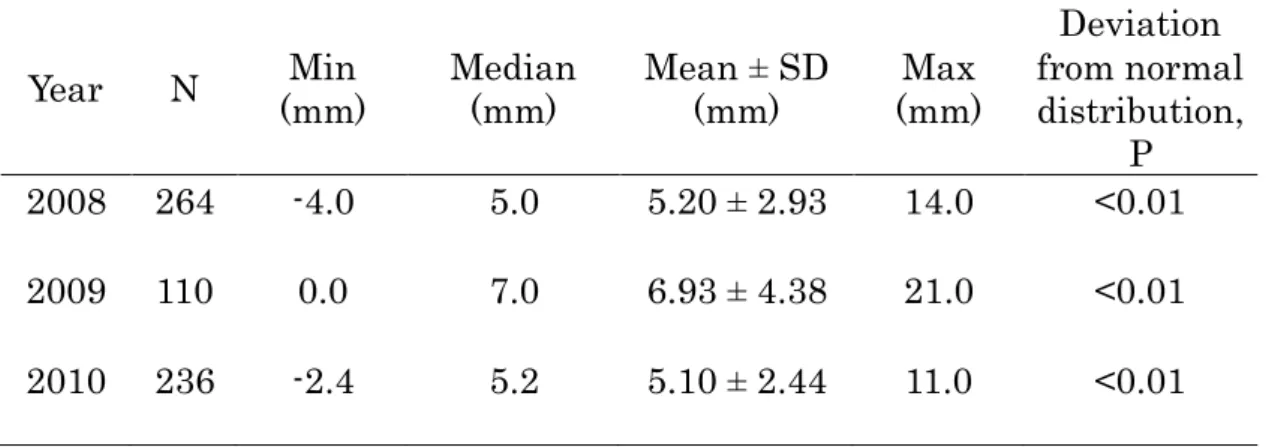
Frequency distribution of the distance between stigma and anthers The distance between stigma and anthers varied from -4 to 14mm; negative values indicate that stigma position is lower than the position of anthers (Fig.2.1). The distribution of the distance between stigma and anthers was significantly deviated from normal distribution in three years (Shappiro-wilks test, P<0.01; Fig. 2.1, Table 2.2), showing apparent bimodal distributions with median of 5.0mm in 2008, 7.0mm in 2009 and 5.2mm in 2010, respectively.
Relationship of the stigma-anther distance with seed fertility and outcrossing rate
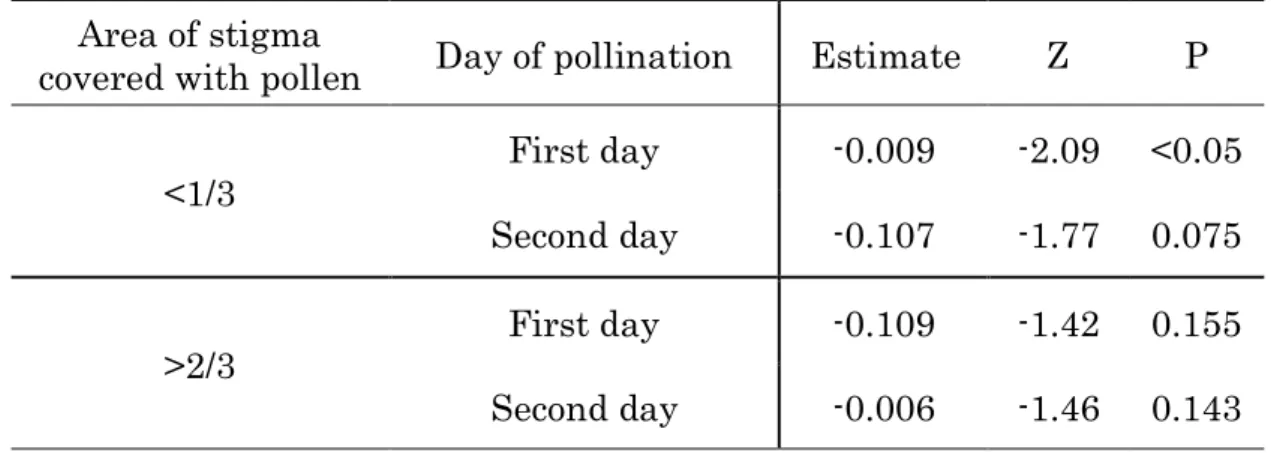
The distance between stigma and anthers showed significantly negative relationship with presence or absence of smaller quantity pollination on the first flowering day (Fig.2.2, Table 2.3), indicating the shorter the distance is, the more likely occurs smaller quantity pollination on the first flowering day.However, the relationship was not significant for larger quantity pollination on the first flowering day (Table 2.3). On the second flowering day, the relationship was significant for neither smaller nor larger quantity pollination. While all of 264 observed flowers were pollinated with smaller quantity pollen until the end of flowering, only 34 individuals (12.8%) were pollinated
with larger quantity pollen until the end of flowering. On the other hand, the distance between stigma and anthers showed no significant relationship with seed fertility (GLMM, n=40, β+SD=-0.006+0.005, z=-1.212, P=0.225; Fig. 2.3).
The single-locus and the multi-locus estimates of outcrossing rate were ts=0.503+0.065, and tm=0.396+0.046, respectively. The distance between stigma and anthers had positive significant correlation with both the single-locus and the multi-locus estimates of outcrossing rate (Fig. 2.4, Spearman rank correlation test, ts; r=0.327, P<0.05, tm; r=0.438, P>0.01), indicating that the flowers with longer stigma-anther distance produced relatively more outcrossed seeds. To compare the outcrossing rate between flowers with shorter and longer stigma-anther distance, we divided observed flowers to two classes with the same size using the median of the distribution (5.2 mm, Fig. 2.1):
flowers with more than 5.2mm distance and flowers less than 5.1 mm distance. The outcrossing rate estimates of the latter group (< 5.1 mm) were ts=0.31, tm=0.37), and those of the former group (5.2 mm<) were ts=0.55, tm=0.76); the estimates were significantly different between two classes (Wilcoxon rank sum test, P<0.01; Fig. 2.5).
Estimate of inbreeding depression
Using the estimate of inbreeding coefficient F =0.168±0.065 and the outcrossing rate ts=0.396, the strength of inbreeding
depression was estimated to be 0.735, indicating that average relative fitness of selfed seeds was as low as 0.265 when average fitness of outcrossed seeds was standardized to unity.
Discussion
This study showed that L. japonicum var. abeanum is highly selfing in spite of that flowers show remarkable display of pink-colored perianths. Selfing rate is particularly higher in flowers having shorter stigma-anther distance: outcrossing rate estimate for the class with shorter stigma-anther distance was as low as 0.31. This result is consistent with the finding that only 34 individuals (12.8%) were pollinated with larger quantity pollen until the end of flowering. Other flowers were pollinated only with smaller amount of pollen (covering less than 1/3 of the stigma), probably derived from spontaneous self-pollination. Thus, it is likely that L. japonicum var. abeanum is under strong pollinator limitation to acquire outcross pollen.
It is notable that the distance between stigma and anthers showed binomial distribution. In particular, some flowers showed negative stigma-anther distance indicating that the stigma position is lower than the position of anthers. This morphology seems to be adapted to self-pollination. In fact, there was significant negative correlation between the stigma-anther distance and the presence of small-quantity pollination, suggesting that flowers with shorter stigma-anther distance is more likely to be self-pollinated. The estimates of outcrossing rate demonstrated this expectation was true:
flowers with shorter stigma-anther distance showed higher selfing rate.
This correlation may be resulted because the shorter distance between stigma and anthers could make it more frequent for self pollen to be placed on the stigma by physical force such as wind and rain. On the other hand, there was significant positive correlation between the outcrossing rate and the distance between stigma and anthers, indicating that the longer distance between stigma and anthers could make it more frequent for outcross seeds to be produced. However, there was an opposed tendency that the longer the distance between stigma and anthers is, the pollination with larger amount of pollen less frequent. Although this tendency was not statistically significant, it is likely that the shorter distance between stigma and anthers could make it more frequent for both self and outcross pollen to be placed on the stigma by insects. Thus, under high availability of insect pollinators, the shorter distance between stigma and anthers might be advantageous to get more outcross pollen. However, under low availability, the shorter distance between stigma and anthers may be disadvantageous because it makes self-fertilization more frequent.
The polymorphism of the stigma-anther distance might be maintained under the fluctuation of pollinator availability.
Another important finding is that L. japonicum var. abeanum has strong inbreeding depression; average relative fitness of selfed seeds was as low as 0.265. Inbreeding depression is also expected to occur during the process of seed maturation because there was no
significant correlation between the distance between stigma and anthers and seed set in spite of that there is negative correlation between the distance between stigma and anthers and the presence of smaller quantity pollination. However, this process is not included in our estimation of inbreeding depression with genetic markers.
In conclusion, L. japonicum var. abeanum has the average selfing rate as high as 0.604 and suffer inbreeding depression as large as 0.735. This situation seems to be critical for the conservation of this endangered lily from the viewpoint of conservation genetics. In particular, high frequency of the morph having shorter stigma-anther distance may promote more frequent selfing under stronger pollinator limitation and could cause further decline of the remaining population of L. japonicum var. abeanum.
We suggest that the high selfing rate and large inbreeding depression in L. japonicum var. abeanum is resulted because the population size reduced rapidly, by the loss of four populations since 1950s, and the time since 1950s may be too short for the population to reach equilibrium. In highly selfing population in equilibrium, inbreeding depression is expected to be small, because deleterious genes are mostly purged through inbreeding (Lande and Schemske 1985, Husband & Schemske 1996, Fu et al.1998). This expectation is supported by a recent meta-analysis between the relationship of selfing
rate and inbreeding depression (Angeloni et al. 2011). Thus, if population size decreased slowly, we expect that weak inbreeding depression occur by a gradual purge of deleterious genes from all over the population. On the other hand, if population size rapidly decreased, we expect that strong inbreeding depression occur in a non-equilibrium state during the process for deleterious genes to be purged from the population. To test these expectations, we reviewed previous studies on species comparable to L. japonicum var. abeanum; i. e. rare, self-compatible, partial inbreeding, and perennial species. As is expected, selfing rate s was high and inbreeding depression δ was weak in the cases of slow population decrease (Pico et al. 2004, δ=0.25, s=1;
Weller et al. 2005, δ=0.16, s=0.63). On the other hand, in the cases of rapid population decrease, there was a tendency that selfing rate is high and inbreeding depression is strong (Chen et al.2009, δ=0.88, s=0.55; Hirayama et al. 2007, δ=0.65, s=0.73). Our estimates for L.
japonicum var. abeanum, δ=0.735, s=0.604, corresponds to the latter cases.
Under the environment before the loss of four populations of L.
japonicum var. abeanum, pollinator availability might be higher that ensured high frequency outcrossing. Since 1950s, however, this environment might have been deteriorated; both bees and moths, the pollinators of L. japonicum var. abeanum (Yokota & Yahara, 2012),
might be decreased under the loss of deciduous broad-leaved forest and the increase of conifer plantation since 1950s. Now, deciduous broad-leaved forest that provided habitats of many nector-secreting plant species is fragmented among large areas of Cryptomeria japonica plantations. It has been reported that, frequency of pollinator visits was decreased in fragmented and isolated polulatoins (Collevatti et al. 2001, Pinto-Torres & Kaptur 2009), and the mixed mating species produced fruit only by selfing under the absence of pollinators (Nassar et al.
2007).
The most important thing for conservation of L. japonicum var.
abeanum is to maintain population size at least in the level of current size, and to increase it if possible. To achieve this goal, this study demonstrated the importance to ensure the condition in which
pollinators frequently visit flowers of L. japonicum var. abeanum and promote outcrossing, preventing the expression of inbreeding
depression. This condition may be prepared by thinning conifer trees that improves the light environment of forest understory that is critically important both for increasing pollinator availability and for improving the growth of L. japonicum var. abeanum. Further efforts to restore deciduous broad-leaved forest from conifer plantation would be effective to increase the number of pollinators, because deciduous broad-leaved forest maintains many species with nectar-secreting flowers blooming in different seasons that provide continuously
available food resource for many pollinator insects. By such efforts of restoring the environment where pollinators more frequently visit the flowers of L. japonicum var. abeanum, we can also restore habitats suitable for vegetative growth of L. japonicum var. abeanum.
Figure legends
Fig. 2.1. Frequency distribution of the distance between stigma and anthers in 2008 (n=264), 2009 (n=110) and 2010 (n=236).
Fig. 2.2. Presence/absence of pollination on the stigma as a function of the distance between stigma and anthers on pollination in 2008 (n=264).
(A) Presence/absence of smaller amount pollination that is defined as a state in which less than 1/3 of the stigmatic area was covered with pollen within one day after flowering. (B) Presence/absence of larger amount pollination that is defined as a state in which larger than 2/3 of the stigmatic area was covered with pollen within two days after
flowering. Open circles indicate presence or absence of two classes of pollination.
Fig. 2.3. Seed set as a function of the distance between stigma and anthers in 2010 (n=40).
Fig. 2.4. Relationship between the distance between stigma and anthers and the estimates of out-crossing rates, examined using a Spearman rank correlation in 2010 (n=40).
Fig. 2.5. Boxplots of the estimates of out-crossing rates ts and tm in two classes of flowers; flowers with the distance between stigma and
anthers shorter than 5.2mm (n=18) and 52mm or longer (n=22) in 2010.
**Wilcoxon rank sum tests at P < 0.01..
Table 2.1. Characteristics of the microsatellite loci.
Locus Primer sequence (5'-3') Reference
Lja01T F: ACAGTAATAAGAGAAAGTTCGAGA Kawase et al. (2009) R: TCTCTCTCTCTCACACACACAC
Lja10A F: ATGTACCACATGCATGGCTTA Kawase et al. (2009)
R: ACACACACACACAGAGAGAGAG
a13a(rsa) F: AATACAAAAATTTGACGTTCTTA Kawase, pres. comm.
R: ACACACACACACAGAGAGAGAG
Table 2.2. Statistics of the distance between stigma and anthers in 2008, 2009 and 2010.
.
Year N Min
(mm) Median
(mm) Mean ± SD
(mm) Max
(mm)
Deviation from normal distribution, 2008 264 -4.0 5.0 5.20 ± 2.93 14.0 <0.01 P
2009 110 0.0 7.0 6.93 ± 4.38 21.0 <0.01 2010 236 -2.4 5.2 5.10 ± 2.44 11.0 <0.01
Table 2.3. Relationship of the distance between stigma and anther with presence/absence of pollination in 2008 (n=264).
Area of stigma
covered with pollen Day of pollination Estimate Z P
<1/3 First day -0.009 -2.09 <0.05 Second day -0.107 -1.77 0.075
>2/3 First day -0.109 -1.42 0.155 Second day -0.006 -1.46 0.143
Fig. 2.1
Fig. 2.2
Fig. 2.3
Fig. 2.4
Fig. 2.5
References
1. Aigner P. A. (2001) Optimality modeling and fitness tradeoffs: when should plants become pollinator specialists? Oikos 95: 177–184.
2. Alexandersson R. & Johnson S.D. (2002) Pollinator–mediated selection on flower–tube length in a hawkmoth–pollinated Gladiolus (Iridaceae). Proceedings of the Royal Society B 269:
631-636.
3. Angeloni F. F. (2011) Meta-analysis on the association of population size and life history with inbreeding depression in plants.
Biological Conservation 144: 35-43.
4. Brantjes N. B. M. & Bos J. J. (1980) Hawkmoth behaviour and flower adaptation reducing self pollination in two Liliflorae. New Phytolorogist 84: 139-143.
5. Caruso C. M. (2001) Differential selection on floral traits of
Ipomopsis aggregata growing in contrasting environments. Oikos 94: 295-302.
6. Charlesworth B. B. (1999) The genetic basis of inbreeding depression. Genetical Research 74: 329-340.
7. Chen G. Q. (2009) Mating system and genetic diversity of a rare desert legume (Leguminosae). Journal of Systematics and
Evolution 47: 57-66.
8. Chiba S. & Shimizu T. (2004) Life history of the near threatened Lilium japonicum Thunb. in Nagano and pollinators. Bulletin of the Botanical Society of Nagano 37: 1-8. (In Japanese)
9. Collevatti R. R. G. (2001) High resolution microsatellite based analysis of the mating system allows the detection of significant biparental inbreeding in Caryocar brasiliense, an endangered tropical tree species. Heredity 86: 60-67.
10. Culley T. M. (1999) Inbreeding depression and selfing rates in a self-compatible, hermaphroditic species, Schiedea membranacea (Caryophyllaceae). American Journal of Botany 86: 980.
11. D'Arcy, W. G. & R. C. Keating. (1996) The Anther: Form, Function and Phylogeny. Cambridge University Press, Cambridge, pp 15-18.
12. Dole J. (1993) Inbreeding depression in two Mimulus taxa measured by multigenerational changes in the inbreeding coefficient. Evolution 47: 361.
13. Eckert C. G. (1994) Inbreeding depression in partially self-fertilizing Decodon verticillatus (Lythraceae):
population-genetic and experimental analyses. Evolution: 952.
14. Elwes H. J., Fitch W. H. & Bourne S. (1880) A Monograph of the Genus Lilium. Taylor and Francis, London.
15. Fishbein M. & Venable D. L. (1996) Diversity and temporal change in the effective pollinators of Asclepias tuberosa. Ecology 77:
1061-1073.
16. Frankham R. R. (1995) Conservation genetics. Annual Review of Genetics 29: 305-327.
17. Frankham R. R. (1998) Conservation biology: inbreeding leads to extinction. Nature (London) 392: 441-442.
18. Frankham, R., Ballou, J.D., Briscoe, D.A. (2002) Introduction to Conservation Genetics. Cambridge University Press, Cambridge, UK.
19. Fu Y. Y. B. (1998) Comparison of Breeding Strategies for Purging Inbreeding Depression via Simulation. Conservation Biology 12:
856-864.
20. Galen C. (1989) Measuring pollinator-mediated selection on morphometric floral traits: bumble bees and the alpine skypilot, Polemonium viscosum. Evolution 43: 882-890.
21. Grant V. & Temeles E. J. (1992) Foraging ability of rufous
hummingbirds on hummingbird flowers and hawkmoth flowers.
Proceedings of the National Academy of Sciences of the USA 89:
9400-9404.
22. Hasegawa M., Yahara T., Yasumoto A. & Hotta M. (2006) Bimodal distribution of flowering time in a natural hybrid population of daylily (Hemerocallis fulva) and nightlily (Hemerocallis citrina).
Journal of Plant Research 119: 63-68.
23. Hayashi K & Kawano S. (2007) Lilium dauricum Ker-Gawler. In:
Kawano S. (ed) Life-History Monographs of Japanese Plants III.