INTRODUCTION
The establishment of the English Education Center in marked an important step in Ehime Universityʼs general education English curriculum. The university recognized that providing first-year students with an organized curriculum would best help them further develop the English they had acquired in junior and senior high school. Like many reforms, the establish- ment of a new program has been an on-going process, and subsequent changes have made todayʼs EEC curriculum more attuned to studentsʼ needs than it was in the early years of its existence. One of these changes involved the establishment of a higher-level set of English classes called The Professional Course. This report initially outlines the general development of the EEC, and proceeds to report on the development and performance of the English Professional Course
(hereafter referred to as the Professional Course) , with particular focus on the academic years(AYs) −
.
EEC BACKGROUND AND ORIGINS OF PROFESSIONAL COURSE
In the first few years after its establishment in , the EEC focused on courses designed to activate studentsʼ latent English communicative potential.
English A and English B were communicative courses in studentsʼ first year, with English C a four-skills integrated course completed in the first semester of studentsʼ second year. After a few years it was determined that, in order to better prepare students for their academic and professional lives(as it related to their English skills) , further reform was necessary. In , a new EEC curriculum was established, one with common textbooks, common learning aims, and common
tests and assessment guidelines. The new curriculum focused not only on communicative competence, but also on developing first-year studentsʼ writing, listening, and reading abilities.
While the establishment of the new four-skills curriculum was seen to address an important need for all first-year Ehime University students, a realization had already surfaced among university management that an English course serving the needs of higher-level students was necessary. In , a planning committee was created consisting of the EEC director and EEC faculty members to study options and develop a proposal for such a course. Special intensive courses (S )had been part of the EEC curriculum since its inception, and most had proven to be popular (and remain so) with students.
When consideration arose of adding a higher-level multi- class English course, the S classes proved to be useful starting point. A careful study was conducted of what worked in these courses, and these findings served as a basis for the recommendations the committee eventually produced in AY . The planning committee produced a list of classes then asked EEC full-time faculty members to select one class and create a course.
The committee also created the position of Course Coordinator an EEC permanent faculty member whose responsibility it became to administer aspects of the program, communicate with other EEC faculty about program matters, and to coordinate with EEC office staff on other administrative matters regarding the course.
THE ENGLISH PROFESSIONAL COURSE(AYs - )
In AY - , with a view towards developing an organized set of courses for higher-level students, the EEC coordinated and revised appropriate S intensive courses towards this end. After evaluating the
The EECʼs English Professional Course : History, Structure, and Results
Ronald Paul M URPHY
Institute for Education and Student Support Ehime University
performance of this unofficial trial, the EEC organizing committee finalized its selection of required and elective classes a selection that focused on communicative competence and also on practical skills that will likely be necessary for students in their future academic and professional work. It was then proposed to the Kyoiku Gakkusei Shien Kaigi (教育学生支援会議) that the Professional Course officially be made part of Ehime Universityʼs curriculum. In AY - the proposed course was conducted as an official trial. Upon completion of the trial, the course was judged to be successful, and was then authorized by the Kyoiku Gakkusei Shien Kaigi to be officially included in Ehime Universityʼs curriculum from AY - .
The remainder of this report details the Professional Course curriculum, assessment mechanisms, student sur- vey results, admission policy, and added features of the course.
Required and Elective Courses
The summaries below represent the most-recent list of Professional Course courses, some of which were added or revised after the period that this report covers
(AYs - ) .
Required Courses(AYs - )
Oral Communication aims to improve overall fluency, with a focus on travelling abroad, and office/
workplace situations. Students also learn common aspects of western societies and cultures and how to deal with social issues in communication.
Writing Workshop focuses on writing for professional and academic purposes. Students learn different styles of writing, common forms and expressions, common research conventions, and independent study techniques.
Speaking and Reading Strategies focuses on reading strategies and skills to help students be more resourceful and time-efficient when using the Internet in English to accomplish work-related tasks.
Effective Presentations teaches students the process of creating good presentations from generating ideas and organizing ideas to then researching and presenting them in a professional manner.
Elective Courses(AYs - )
TOEIC Experience familiarizes students with the TOEIC format and vocabulary particular to the test.
Students also extensively practice the questions in the reading and listening sections.
TOEIC Intensive gives students extensive listening and reading practice directly related to TOEIC, as well as grammar and vocabulary practice. Under- standing test strategies is also stressed.
Business English focuses on the four skills and language common to many business situations.
Students learn various methods of written communi- cation, various cultural aspects of international business, and dealing with non-Japanese employees.
Writing Strategies provides students the basics of academic writing, the underlying structures of academic papers, and the skills and strategies for writing them.
Academic Reading teaches students the style of academic publications in English, and the impor- tance of why-questions in English grammar.
Students learn how form, meaning, and use are interconnected.
Introductory Interpretation teaches students how to express themselves, in both Japanese and English, about familiar topics (i.e. college life, business, families, life and culture in foreign countries, and current issues) . Students practice note taking about what is spoken in simple terms, and express themselves based on the notes both in Japanese and English.
English for Tourism helps students learn what needs to be explained about Japanese culture and society while guiding. Students also learn how to plan tours, manage time, and gather information for guiding purposes.
Discussion Skills develops studentsʼ discussion skills in English, focusing on agreement and disagreement strategies, supporting oneʼs arguments, and overall oral fluency. (Note : This course was added in AY 2013-2014 ) .
International English Experience aims to make students more proficient in authentic, daily communication in a foreign country, and to help them understand American and Hawaiian culture.
During the three-weeks that the course moves to
the University of Hawaii, students use English to
accomplish everyday tasks (i.e., public transporta- tion, banking, shopping) , experience a homestay, and attend daily communicative classes with students from various countries. (Note : In AY 2013- 2014 this course was expanded to include study abroad programs at schools in various countries. Students are able to choose among them.)
Study Abroad Course(AY - )
In the continuing effort to improve the Professional Course, a study abroad elective course was developed and proposed in AY - . Named International English Experience (IEE) , the course is centered around the three-week New Intensive Course of English (NICE) program at the University of Hawaii at Manoa in August. The NICE course offers various oral communication classes half-days Monday to Friday, voluntary cultural activities both on-campus and off- campus, and a homestay that allows for language development in an intensive and authentic environment.
The IEE course includes preparatory lessons in the weeks prior to departure to Hawaii, then concludes with follow-up interviews and essays after students return to Ehime University.
Three Professional Course students participated in the trial of the IEE course in AY - . In AY - , the IEE was officially approved as part of the Professional Course. Two students participated and passed the course that year. No students applied the following year.
As noted above, the IEE was expanded in AY - to include various study abroad programs in the U.
S.A. Programs in other countries will likely be added in the future.
RESEARCHING THE PROFESSIONAL COURSE
When the Professional Course began in AY - , there was recognition that the first years of the course would establish certain aspects and precedents that would give the course its personality and direction. At the same time, it was also clear that it would likely grow and change over time. There also was the recognition that formal research of studentsʼ opinions regarding the course should be gathered. In consideration of these recognitions, two strands of
research were undertaken interviews, and formal student surveys.
Interviews
In order to better understand how the Professional Course could benefit both the students individually and the university overall, the Professional Course coordina- tor conducted internal interviews with EEC faculty and students, interviews with various faculty members in the Law & Letters faculty and Education faculty(since students from these faculties provided over half of the applicants and a large majority of admissions to the course) , and interviews with teachers within Japan.
Internal EEC Research
By the end of AY - , the coordinator began one-to-one discussions with other EEC faculty members to determine their views on one basic issue : Should the Professional Course include career-focused professional training with its central language-learning component, or should the course be only a skills-focused language course designed to help students prepare for their future academic and professional working lives ? Teachers unanimously thought the latter -- that the Professional Course should teach practical language and skills students will need in future academic and professional situations.
Interviews and surveys with students confirmed this, revealing that studentsʼ most-common preference was the opportunity to speak more English. A distant second was an interest to work on specific skills or areas of interest, such as writing a thesis, ESP, or studying about foreign cultures.
Internal Ehime University Research
Interviews with faculty outside of the EEC began in
, with follow-ups in . These interviews were
mostly with Law and Letters faculty members, and also
some Education faculty. Interviews were also
conducted with staff and teachers of Ehime Leaders
School. The purpose of these interviews was to
determine the fit that the Professional Course achieved
within the overall Ehime University language-learning
curriculum. There were three core questions- )Is
the Professional Course content, level, and time de-
mands appropriate in regards to their students ? )
Are there suggestions for changes ? )Is the course
Are there suggestions for changes ? )Is the course
complementary or redundant to their facultyʼs curriculum ?
The second purpose of interviews with faculty outside of the EEC was for the coordinator to familiarize himself with the types of courses that the majority of the Professional Course students themselves were either enrolled in presently or would be enrolled in eventually in their faculty coursework. This would help inform the EEC about the levels, abilities and coursework of many of the Professional Course students.
The response from all the interviewees was very positive towards the Professional Course. All respon- dents considered the course content, level, and time demands to be appropriate, and considered the course overall to be beneficial to their students English language development.
External Ehime University Research
The course coordinator also sought out other universities in Japan with programs comparable to the Professional Course. The most helpful sources included on-line list-serv communities, and various groups and contacts within a nationwide Japan teacherʼs organiza- tion. As was the response of the Ehime University faculty members, the feedback the coordinator received from interviewees outside this university (after a thorough explanation of the program)was unanimously positive.
Formal Student Surveys
In order to quantify the effectiveness of the various aspects of the Professional Course, the course supervisor developed on instructions from the center director a series of student surveys.
Overall Survey
This survey, begun in AY - , is conducted annually among third and fourth-year Professional Course students near the end of the second semester.
It asks for studentsʼ satisfaction level and opinions on how the course overall can be improved.
Individual Class Survey
This survey is conducted by each EEC faculty member who teaches a Professional Course class. It is designed to determine the extent to which the learning aims of a particular class were achieved. In the first week of the class, a pre-survey is conducted, asking students their perceived abilities in certain skill areas, i.e.
organizing an academic paper, searching the Internet in English, the elements of a presentation, etc. Responses are taken on a Likert scale. At the end of the semester, students are again asked to assess their perceived abilities in these specific skill areas. The results help the teacher determine if he/she successfully taught the learning aims of the course to the students.
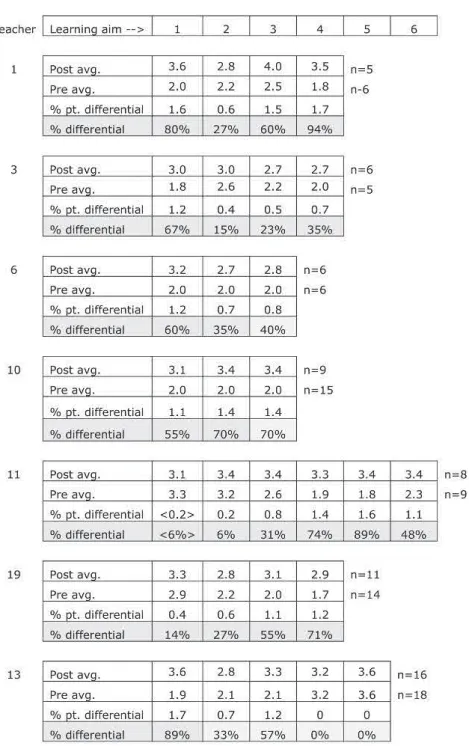
How to interpret Table 2 below
This survey produces group data, not individual data. The intent of this survey was to help the teacher determine if the class, collectively, made progress.
Table : below are the results for seven teachers
.
Academic year
nd
year
%rd
year
th
year
.
Faculty
Law & Letters
%Education Science Engineering Agriculture
.
Reasons for joining course
Wanted more English practice
%Interested in class offerings
Wanted Pro Course certificate
.
Satisfaction with course classes
Very satisfied
%Somewhat satisfied Somewhat unsatisfied Not at all satisfied
.
Suggestions to improve course ?
No. Good as it is
%Yes
.The course taught me skills for my future academic and
professional life.
Agree strongly
%Agree somewhat Disagree somewhat Disagree strongly
Table : Overall Student Survey Findings
(combined AY and AY .n= )
who taught the Professional Course in the second semester of AY - .
− Each teacher has learning aims specific to his/her course. The number of learning aims differ among teachers.
− Post avg. is the class average score for each learning aim by the end of the semester.
− Pre avg. is the class average score for each learning aim at start of the semester.
− Students rate their ability according to this survey prompt :
I am not at all capable, not very capable, somewhat capable, very capable, at doing the fol- lowing in English (Teachers then insert each learning aim of the class) .
The Likert Scale :
. Not at all capable . Not very capable . Somewhat capable . Very capable
− The yellow row in the tables below is the percentage gain or loss, post-survey compared to pre-survey.
Table : Pre & Post Individual Class Survey Results, AY - Semester
Example : For teacher , the students(collectively) rated their capability for learning aim number as a score of
. -- not very capable . By the end of the course, the students (collectively) rated their capability for learning aim number as a score of . − approaching very capable .
Finding : Students(collectively) of Teacher learned learning aim number very well.
The data in the table below shows that nearly all of the learning aims in each Professional Course class were successfully taught to the students, as a whole.
Space limitations do not allow for the reporting of each semesterʼs Overall Survey results. Likewise, because each teacherʼs learning aims are unique and sometimes vary, overall composite data is not possible.
However, results of each semesterʼs Individual Class Survey consistently resemble the table below, in that nearly every learning aim in every teacherʼs class shows significant gains. This clearly shows that students are achieving the learning aims of their Professional Course classes.
Mentor Program Survey
This survey is administered annually via e-mail from the EEC office because, unlike the other Professional Course surveys, the respondents of this survey are not physically present in a classroom when it is administered. As is common with voluntary-response surveys of all types, the response rate for this survey has been near percent, but it nonetheless provides useful feedback for evaluating the effectiveness of the Mentor Program.(The Mentor Program itself is explained near the end of this report.)
ADMISSION POLICY
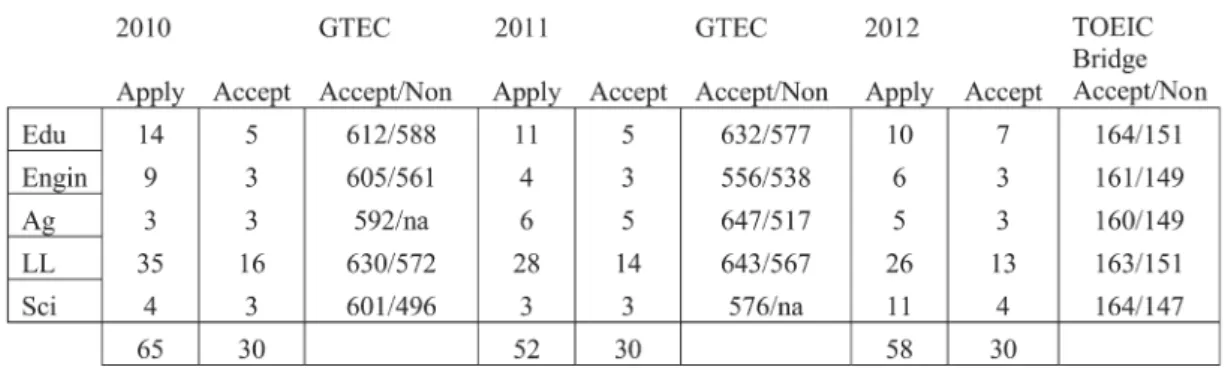
Among the important initial decisions to be made regarding the Professional Course was the admission policy who to admit, how many students to admit, and on what criteria should applicants be admitted. The planning committee considered what resources the EEC had to support the addition of this type of course, and decided that students would be admitted annually based on their GTEC scores in their first year. It was also decided that each faculty(the Faculty of Medicine does not participate in the Professional Course) be allowed three automatic admissions. The remaining would be evaluated according to their GTEC scores.
Admission policy(AYs and ) Qualified applicants : nd-year students.
Total admitted annually : . Application period : February.
Selection period : March.
Application requirement : Application document only.
Admittance criteria : st-year GTEC.
admitted : Each faculty, three spots.
Remaining admitted : st-year GTEC.
.
Academic Year(n= )
nd
%rd th
.
Faculty
Education
%Law & Letters Science Engineering Agriculture
.
Reasons for joining Mentor Program Specific goal I want advice on
%I like the teacher
Occasionally want advice Other
a.Chances to get advice from mentor ? More than enough chances
%Enough chances
Not enough chances Far from enough chances
.
Enough contacts with mentor ?
Too often
%About right Too little
.
Reasons for contacting mentor(multiple answers)
Current classes advice
%Study tips advice
Study/travel abroad advice Questions about mentor General problem
Mentor requested meeting
.