Taxonomic Notes and New Distribution and Host Plant Records for Sawflies and Woodwasps (Hymenoptera, Symphyta) of Japan V
Akihiko Shinohara
1and Hideho Hara
21
National Museum of Nature and Science, 4–1–1 Amakubo, Tsukuba, Ibaraki 305–0005, Japan
E-mail: [email protected]
2
Nishi 4 Kita 3–4–29, Bibai, Hokkaido 072–0033, Japan E-mail: [email protected]
(Received 24 August 2020; accepted 23 September 2020)
Abstract Aglaostigma kawazoei Togashi, 2007 (Tenthredinidae) is a new synonym of Aglaostigma amoorense (Cameron, 1876). Euura damnacanti (Takeuchi, 1922) (Tenthredinidae) is redescribed and a lectotype is designated. Euura longa (Takeuchi, 1952) is redescribed and divided into two subspecies, E. longa longa (Takeuchi, 1952) from Honshu and E. longa shiretoko Hara and Shinohara, subsp. nov. from Hokkaido. New host records are: Betula platyphylla Sukaczev var. japonica (Miq.) H. Hara (Betulaceae) and Lithocarpus edulis (Makino) Nakai (Fagaceae) for Tremex apicalis Matsumura, 1912 (Siricidae), Quercus crispula Blume (Fagaceae) for Periclista erythrogramma Togashi, 1999 (Tenthredinidae) and Leucaena leucocephala (Lam.) de Wit. (Faba- ceae) for Lataxiphyda nodai (Togashi, 1982) and Kalopanax septemlobus (Thunb.) Koidz. (Aralia- ceae) for Xiphydria ogasawarai Matsumura, 1927 (Xiphydriidae). New distribution records are:
Aglaostigma naitoi Togashi, 1972 (Tenthredinidae) from Kyushu and Aglaostigma yasumatsui Togashi, 1970, Euura tibialis (Newman, 1837) and Periclista erythrogramma Togashi, 1999 (Ten- thredinidae) from Hokkaido. New collection records are given for two rare species, Xiphydria kanba Shinohara, Hara & Smith, 2020 (Xiphydriidae) and Xyela kamtshatica Gussakovskij, 1935 (Xyelidae), and a “drumming” behavior of the male is newly recorded for Xiphydria ogasawarai (Xiphydriidae).
Key words : Siricidae, Tenthredinidae, Xiphydriidae, Xyelidae, new synonym, lectotype designa- tion, new subspecies, new distribution records, new host plant records, “drumming” behavior.
Introduction
This is a fifth of a series of papers, where vari- ous notes are given about the taxonomy, distribu- tion and biology of sawflies and woodwasps occurring in Japan. Recent knowledge of the diversity of these insects was summarized in a Catalog (Hara et al., 2019) and a Zukan, or an illustrated reference book (Naito et al., 2020), but the information included in those publica- tions was that published elsewhere before early autumn of 2019. Since that period, several papers treating Japanese Symphyta have been published
(Park et al., 2019; Hara and Ibuki, 2020; Hara et al., 2020; Shinohara, 2020a; Shinohara and Smith, 2020; Shinohara and Yamasako, 2020;
Shinohara et al., 2020a, b) including descriptions of ten new species.
Here we treat 13 species of the families Siric- idae, Tenthredinidae, Xiphydriidae and Xyelidae.
We propose a new synonym, describe a new sub- species, designate a lectotype and redescribe two little-known species based on the type material in the Tenthredinidae. Other new findings include new host records for four species of Siricidae, Tenthredinidae and Xiphydriidae and new distri- bution records for four species of Tenthredinidae from Kyushu and Hokkaido. We also give new
© 2020 National Museum of Nature and Science
collection records for two rare species of Xiphy- driidae and Xyelidae and report on a peculiar
“drumming” behavior of the male of Xiphydria ogasawarai Matsumura, 1927 (Xiphydriidae).
Material and methods
The material used in this study is kept in the National Museum of Nature and Science, Tsu- kuba, unless otherwise indicated. Morphological examination was undertaken with a Leica MS5 and an Olympus SZ60 stereo binocular micro- scopes and Olympus BH-2 light microscope.
Photographs were taken with an Olympus TG-4 digital camera (Fig. 1A–B) and an Olympus TG-5 digital camera (Figs. 1C–D, F–M, 3G–N) and a Sony DSC-RX100 digital camera with a Leica MS5 and an Olympus BH-2 light micro- scope (Figs. 1E, 2, 3A–F, 4–6). The digital images were processed and arranged with GIMP 2.10 and Adobe Photoshop Elements 8 and 15®
software. For the morphological terminology, we generally follow Viitasaari (2002).
Results and discussion Siricidae
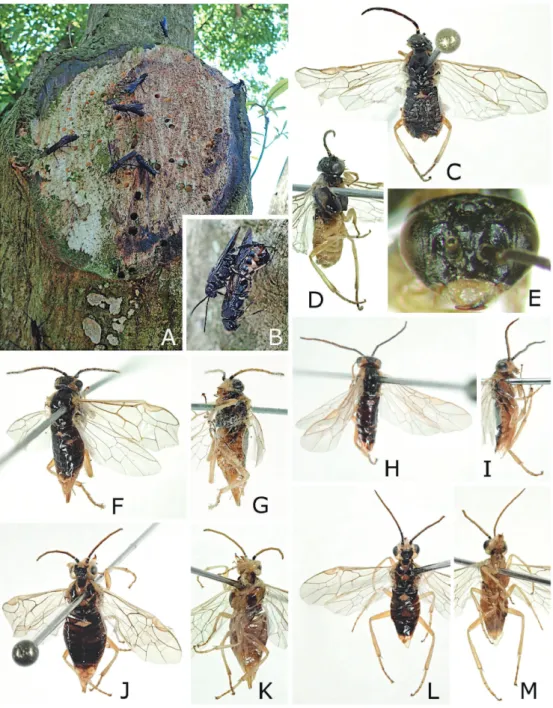
Tremex apicalis Matsumura, 1912 (Fig. 1A–B)
Tremex apicalis Matsumura, 1912: 23; Maa, 1949: 140;
Okutani, 1967a: 44; Smith, 1978: 93; Abe and Togashi, 1989: 558; Naito et al., 2004: 68; Taeger et al., 2010:
107; Kuramitsu et al., 2019: 37; Naito, 2019a: 19;
Naito, 2020b: 181, 467.
Material examined. HOKKAIDO: 2 ♀2 ♂, Minamichitose, 42°48′47″N 141°40′11″E, ca.
16 m alt., Chitose, on Betula platyphylla var.
japonica, 12. VI. 2019, A. Shinohara; 1 ♀1 ♂, same locality, on Betula platyphylla var. japon- ica, 25. VI. 2020, H. Hara. HONSHU: Ibaraki Pref.: 2 ♀10 ♂, Sengen, 36°4′10″N 140° 7′17″E, 23 m, Tsukuba, on Lithocarpus edulis, 10. V.
2020, A. Shinohara; 4 ♀16 ♂, same data, 11. V.
2020; 4 ♀2 ♂, same data, 12. V. 2020; 3 ♀1 ♂, same data, 14. V. 2020.
Distribution. Japan: Hokkaido, Honshu, Shi-
koku, Kyushu. Korea. China. Russia: Sakhalin, Siberia.
Host plants. Cornaceae: Swida macrophylla (Wall.). Eupteleaceae: Euptelea polyandra Sieb.
et Zucc. Fagaceae: Quercus myrsinifolia Blume.
Magnoliaceae: Magnolia liliiflora Desr. Ole- aceae: Fraxinus spaethiana Lingelsh. Rosaceae:
Cerasus × yedoensis (Matsum.) Masam. et S.
Suzuki. Salicaceae: Populus sp. Sapindaceae:
Acer spp. (Maa, 1949; Okutani, 1967a; Kuramitsu et al., 2019). Betulaceae: Betula platyphylla Sukaczev var. japonica (Miq.) H. Hara (new record). Fagaceae: Lithocarpus edulis (Makino) Nakai (new record).
Remarks. The specimens listed above were found on the trunk of a dead standing tree of Bet- ula platyphylla var. japonica in Chitose and on the trunk of a half dead tree of Lithocarpus edu- lis in Tsukuba (Fig. 1A–B). Some of the females were ovipositing on the trees and dead and bro- ken bodies of some females were also found on the same trees. This is the first record of Betula (Betulaceae) and Lithocarpus (Fagaceae) as host plants of this species. Tremex apicalis is quite polyphagous, but Matsumuraʼs (1912) record of Abies (“the larvae bore in the stem of Abies sachalinensis”, p. 24) is doubtful.
Tenthredinidae
Aglaostigma amoorense (Cameron, 1876)
Tenthredo amoorensis Cameron, 1876: 466.
Aglaostigma amoorensis: Takeuchi, 1952: 21; Togashi, 1961: 33; Okutani, 1967b: 97; Abe and Togashi, 1989:
545; Naito et al., 2004: 42.
Aglaostigma kawazoei Togashi, 2007: 657; Taeger et al., 2010: 545; Shinohara, 2019e: 98; Shinohara, 2020c:
407. New synonym.
Aglaostigma (Aglaostigma) amoorense: Taeger et al., 2010: 542; Sundukov, 2017: 83.
Aglaostigma amoorense: Shinohara, 2019e: 97; Shino- hara, 2020c: 129, 409.
Material examined. HONSHU: Mie Pref.: ♀
(holotype of Aglaostigma kawazoei), “Fit [trap],
Kameyama-shi, Asakayama-cho, Nonobari-
yama, 21-IV-2005, coll. M. Inagaki” “Holotype,
Aglaostigma kawazoei n. sp.” “NSMT-HYM
62204”; 1 ♂ (paratype of Aglaostigma kawa- zoei), same data, “Paratype, Aglaostigma kawa- zoei n. sp.” “NSMT-HYM 62206”; 1 ♀ (paratype
of Aglaostigma kawazoei), same data except coll.
A. Kawazoe, “Paratype, Aglaostigma kawazoei n.
sp.” “NSMT-HYM 62205”.
Fig. 1. A–B, Tremex apicalis: A, several male adults on the trunk of Lithocarpus edulis; B, a male adult on the same tree trying to copulate with an already dead and half broken body of a female adult. Photographed in Tsukuba on May 10 and 11, 2020, by A. Shinohara. C–E, Euura damnacanti, female, lectotype: C–D, dorsal, ventrolateral view; E, head, frontal view. F–I, Euura longa longa: F–G, female, dorsolateral, ventrolateral view, holotype;
H–I, male, dorsolateral, lateral view, paratype, Mt. Hakuba. J–M, Euura longa shiretoko: J–K, female, dorsal,
ventrolateral view, holotype; L–M, male, dorsal, ventrolateral view, paratype. Photographed by H. Hara.
Distribution. Japan: Honshu. Korea. China.
Russia: Far East, Siberia (Shinohara, 2019e).
Remarks. Togashi (2007) distinguished A.
kawazoei from A. amoorense by the venational characters of the fore and hind wings, the shape of the tarsal claws and the inner tibial spur, and the color of the mesepisternum. By examining the type series of A. kawazoei and over 50 speci- mens of A. amoorense, we confirmed that the given differences were within the range of intra- specific individual variations and we here pro- pose to treat them as synonyms.
Aglaostigma naitoi Togashi, 1972
Aglaostigma naitoi Togashi, 1972: 81; Abe and Togashi, 1989: 546; Shinohara, 2019e: 98; Shinohara, 2020c:
407.
Material examined. HONSHU: Gunma Pref.:
1 ♀, Nidoage, 1200 m, 5. VII. 1967, M. Nishikawa (Y. Kato collection). Nagano Pref.: 1 ♀, “Shi- mashima-dani, 4. VI. 1933, Y. Nakajima”. Hiro- shima Pref.: 1 ♀, “12. VI. 1937, Mt. Kanmuri, Hirosima, Takeuchi/coll. T. Nakanishi”
“Aglaostigma nakanishii n. sp.” “Aglaostigma naitoi Togashi, Paratype”. SHIKOKU: Tokushima Pref.: ♀ (holotype), “1. VI. 1950, Mt. Tsurugi, Awa, Takeuchi/S. Isshiki, S. Ito” “Aglaostigma naitoi Togashi, Holotype”. KYUSHU: Oita Pref.:
1 ♀, Mt. Kurodake, 900–1100 m, Kujusan Mts., 18–19. V. 1997, A Shinohara.
Distribution. Japan: Honshu, Shikoku (Togashi, 1972), Kyushu (new record).
Remarks. Aglaostigma naitoi was described from three females collected in Shikoku (Tokushima Prefecture) and western Honshu (Hiroshima Prefecture) (Togashi, 1972) and no additional collection records have been published thereafter. This is the first record from central Honshu (Gunma and Nagano Prefectures) and Kyushu (Oita Prefecture). The five specimens available show small variation. The pale mark on the mesoscutellum is large and covers most of the mesoscutellum in the Kyushu specimen, whereas it is missing in the Gunma specimen and it is small and near its posterior margin in the remain-
ing three specimens. The Gunma specimen is not in good condition, very dark and possibly discol- ored, with no distinct pale marks on the head.
Aglaostigma yasumatsui Togashi, 1970
Aglaostigma yasumatsui Togashi, 1970: 2; Abe and Togashi, 1989: 546; Shinohara, 2019e: 98; Shinohara, 2020c: 130, 409.
Material examined. HOKKAIDO: 1 ♀1 ♂, Hobetsu-cho, Iburi, 16. VI. 1997, H. Hara. HON- SHU: Tokyo Met.: 1 ♀, Kamiange, Mt. Jin- bayama, 6. V. 1991, A. Shinohara; 1 ♀, same data except 17. V. 1992; 1 ♂, Nippara, Okutama, 26. V. 1974, A. Shinohara. Niigata Pref.: 1 ♀, Renge-onsen, Itoigawa, 24. VII. 1984, A. Shino- hara. Yamanashi Pref.: 1 ♂, Koganezawa, 26. V.
1974, K. Kimura. Ishikawa Pref: 1 ♀ (paratype), Mt. Haku, 4. VII. 1966, I. Togashi. Nagano Pref.:
1 ♀, Shimashima, 23. V. 1985, A. Shinohara;
4 ♀5 ♂, Tobira-onsen, 24−31. V. 1985, A. Shi- nohara; 1 ♂, Misayama-toge, nr. Kakeyu, 29. V.
1981, A. Shinohara; 1 ♀1 ♂, Oshirakawa-rindo, Azumi-mura, 4. VI. 1990, A. Shinohara; 1 ♀, Maekawado, Azumi-mura, Nagano, 5. VI. 1990, A. Shinohara. Gifu Pref.: 1 ♂, Hikagedaira, Takayama, 11. VI. 1980, E. Nishida.
Distribution. Japan: Hokkaido (new record), Honshu (Togashi, 1970).
Remarks. This species has been recorded from Ishikawa and Nagano Prefectures, Honshu (Togashi, 1970; Shinohara, 2020c) and this is the first record from Hokkaido and Tokyo Metropolis and Niigata and Yamanashi Prefectures, Honshu.
The Hokkaido specimens show no conspicuous differences from the Honshu specimens examined.
Euura damnacanti (Takeuchi, 1922) (Figs. 1C–E, 2)
Pteronidea damnacanti Takeuchi, 1922: 77, 80; Wata- nabe, 1937: 7; Shiraki, 1952, Vol. 5: 96; Takeuchi, 1952: 69; Shiraki, 1954: 558.
Nematus damnacanti: Okutani, 1967b: 93; Abe and Togashi, 1989: 552; Taeger et al., 2010: 429.
Euura damnacanti: Shinohara and Hara, 2015: 173; Hara,
2019: 72.
Redescription, female (Fig. 1C–E). Length 6–7 mm. Black. Head yellow on clypeus except for dorsolateral area, labrum, mandible except for reddish brown apical half, and maxillary and labial palpi. Thorax brown yellow on narrow lat- eral area of median mesoscutal lobe and large dorsal area of mesepisternum, yellow on prono- tum except for narrow medial and ventral areas, tegula and postspiracular sclerite. Legs brown yellow; narrow bases of coxae black; apices of fore and middle tarsi, apex of hind tibia and hind tarsus brown. Wings slightly yellowish; stigma
brown yellow, marginally dark brown; veins mostly dark brown. Abdomen yellow laterally, ventrally and on tenth tergum, cercus and ovipos- itor sheath.
Head in dorsal view slightly dilated behind eye, with length behind eye 0.4–0.5×eye length (Fig. 2A); length behind lateral ocellus 1.7–2.2
×length of lateral ocellus. Postocellar area mod- erately or markedly convex, with anterior margin dull and lateral furrow short. OOL:POL:OCL 0.9–1.1:1.0:0.8–0.9. Frontal area widest at some- what posterior to middle between frontal pit and
Fig. 2. Euura damnacanti, female: A–C, head, dorsal, frontodorsal, lateral view; D, right mandible, outer view; E,
left mandible, outer view; F, posterior part of thorax, dorsal view; G–H, claw; I, antero-middle part of fore
wing; J–K, apex of abdomen, lateral view (ov=ovipositor protruding from ovipositor sheath); L, apex of
abdomen, dorsal view (ov, same as above); M, lance; N–P, lancet (1, 5, 10=first, fifth, tenth annulus). A–G, I,
J, M–O, Lectotype; H, paralectotype, Gifu; K–L, Gifu; P, paralectotype, “Minomo”. Photographed by H. Hara.
median ocellus in frontodorsal view (Fig. 2B), with very shallow concavity before median ocel- lus; lateral ridge weak; anterior ridge medially shallowly concave or not. Distinct transverse ridge present above dorsal tentorial macula (Fig.
2B). Frontal pit long oval, large and deep. Dis- tance between eyes at torulus 1.2–1.3×eye height (Fig. 1E). Torulus wholly surrounded by narrow ridge. Paraantennal field setose except for glabrous medial third, with longitudinal ridge along inner margin of eye (Fig. 1E). Supr- aclypeal area distinctly swollen. Clypeus with width 2.5–2.7×maximum height, deeply emar- ginate ventrally; maximum height 1.0–1.2×toru- lus height; depth of ventral emargination 0.6–1.0×median height of clypeus. Malar space 0.6–0.7×as long as median ocellus width. Dis- tinct furrow present along outer margin of eye (Fig. 2C). Antenna 2.3–2.4×as long as head width; flagellum very slightly tapering (Fig. 1C);
first flagellomere 0.6–0.7×as long as eye height;
second flagellomere 1.1–1.2×as long as first.
Mandibles almost equal in length, each in outer view sharply tapering basally, with same or simi- lar thickness on wide middle part and gradually tapering apically (Fig. 2D–E); basal outer surface slightly rounded or nearly flat. Maxillary palpus long, with second maxillary palpomere about 0.7×as long as third and apical palpomere length 1.2–1.6×torulus height.
Mesoscutellum gently roundly convex (Fig.
2F) or widely flattened centrally. Mesoscutellar appendage length 1.2–1.6×short diameter of cenchrus. Metascutellum length 1.1–1.4×short diameter of cenchrus. Mesepisternum with groove along anterior edge; this groove dorsally shortly extending into epicnemium. Ventral edge of epicnemium grooved. Katepimeron glabrous, with several setae along posterior edge and ven- tral area. Anterior fore tibial spur with velum.
Hind tibia usual, in lateral view 0.7×as broad as femur; posterior tibial spur 1.1–1.2×as long as apical breadth of tibia, 0.4×as long as first tarso- mere. Hind tarsus 0.8–0.9×as long as hind tibia.
Claws with inner tooth hardly curved, rather long or short (Fig. 2G–H); depth of concavity between
teeth 0.5–0.7×distance between teeth. Fore wing with vein C swollen apically (Fig. 2I) and cell Sc 0.2–0.3×as wide as vein C at level of base of vein Rs +M. Hind wing with section of vein 1A between cell 1A and crossvein cu-a 1.7–1.9×as long as crossvein cu-a (Fig. 1C).
Abdomen with ninth tergum 0.3–0.5×as long as eighth tergum at level of base of cercus, 0.6–
1.5×as long as eighth tergum at level of eighth spiracle (Fig. 2J–K). Cercus about 2–3×as long as wide, posteriorly not extending beyond ovi- positor sheath. Ovipositor sheath about 0.2–
0.3×as long as abdomen, 0.4×as long as hind tibia; each apical sheath in lateral view with apex sharply rounded or nearly pointed, dorsal margin short and almost straight and ventral margin rounded, sometimes slightly concave near apex (Fig. 2J–K), in dorsal view tapering apically, with basal width about as long as or slightly lon- ger than cercus width (Fig. 2 L). Lance annulated on apical two thirds (Fig. 2M); annuli distinctly oblique. Lancet with radix about 1.4×as long as lamnium (Fig. 2N, P); lamnium with about 10 annuli; annuli except for most basal and apical ones each with row of minute ctenidial teeth along anterior margin (Fig. 2O); rows of ctenid- ial teeth oblique with ventral ends located poste- rior to dorsal ends; serrulae flat, with minute den- ticles; tangium without sensilla.
Punctures inconspicuous or fine. Head capsule finely rough, dorsally rather smooth. Thorax mostly smooth; pronotum rough; scutum slightly rough; posterolateral sunken area of mesoscutum entirely smooth; mesopostnotum microsculp- tured; metapostnotum smooth; mesepisternum mostly glabrous on ventral half. Abdomen microsculptured.
Male. Unknown.
Material examined. Lectotype (here desig- nated) (Fig. 1C–E): ♀, “30, IV, 1921 Katayama Takeuchi”, “Pteronidea damnacanti Takeu Type”.
Paralectotypes: 1 ♀, “17, IV, 1920 Minomo Takeuchi”; 1 ♀, “19, IV, 1920 Gifu Takeuchi”;
1 ♀, “30, IV, 1921 Katayama Takeuchi”, “[Ari-
toshi-habachi (in Japanese)]”. Other material
examined: 1 ♀, “5, V, 1921 Gifu Takeuchi”,
“Pteronidea damnacanti”.
Distribution. Japan: Honshu (Takeuchi, 1922).
Host plants. Rubiaceae: Damnacanthus indi- cus C. F. Gaertn. var. indicus (Takeuchi, 1922).
Life history. This species has one generation a year, and the adult appears in spring (Takeuchi, 1922).
Remarks. The original description of Pteroni- dea damnacanti Takeuchi, 1922 is too simple, and we here redescribe the sawfly in detail. The female ovipositor is described and figured for the first time.
Shinohara and Hara (2015) erroneously stated that this species went to the second half of the couplet 17 in the key by Prous et al. (2014). This species only goes to the couplet 6 in the key and does not agree with both halves of the couplet;
the first half reads “Left mandible markedly con- stricted near middle and right mandible tapered regularly towards apex” and the second half “Left and right mandible both tapered regularly towards apex”. This species has the left and right mandibles both swollen and sharply tapering on the base, thin from the middle to the apex, and with almost the same thickness on the wide mid- dle part (Fig. 2D–E). Although we placed this species in Euura Newman, 1837 (Shinohara and Hara, 2015), the generic position needs revision.
In the keys by Zhelochovtsev and Zinovjev (1988), P. damnacanti goes to their “Nematus”
but does not fit any of the subgenera, because this sawfly has the combination of a ventrally deeply emarginate clypeus (Fig. 1E), a relatively small inner tooth of the claws (Fig. 2G–H) and an apically broadened vein C in a forewing (Fig.
2I). “Nematus” of Zhelochovtsev and Zinovjev (1988) consists of the currently recognized gen- era Euura, Nematus Panzer, 1801, Pristiphora Latreille, 1810 and Stauronematus Benson, 1953.
Pteronidea damnacanti is distinguished from Pristiphora by the tangium of the lancet without sensilla and from Stauronematus by the claws without a basal lobe (for the generic characters, see Prous et al., 2014). This species probably belongs to Euura or Nematus, but we are not aware of any species of these genera closely sim-
ilar to E. damnacanti. We retain this species in Euura until more information is available.
Euura damnacanti is rather unique in having a longitudinal ridge along the inner orbit (Fig. 1E), a bulging supraclypeal area (Fig. 1E), a distinct furrow along the outer orbit (Fig. 2C), the mandi- bles almost equal in length and both with the basal part sharply tapering and the wide middle part with almost the same thickness in the outer view (Fig. 2D–E), and a ventrally very widely glabrous mesepisternum. These features will dis- tinguish this species from other species of Euura and its related genera.
In Takeuchiʼs collection now kept in the National Museum of Nature and Science, Tsu- kuba, there are four females under the card
“Pteronidea damnacanti Tak.” probably written by Takeuchi. One of them has the type label. We designate it as the lectotype. The type localities mentioned by Takeuchi (1922) are “[Honshu (Gifu-ken Yawata-mura, Settsu Minoo-koen) (in Japanese)]”. “Katayama” and “Minomo” on the labels of the type specimens are within “[Yawata- mura]” and “[Minoo]”, respectively. “[Ari-toshi- habachi]” means a sawfly of Damnacanthus indi- cus var. indicus.
We have also found one female with the data label agreeing with the original description and a label “Pteronidea damnacanti” probably written by Takeuchi in another place of Takeuchiʼs col- lection. It is not regarded as the type because Takeuchi (1922) wrote “Described from four females”.
As the host plant of this sawfly, Shiraki (1954) gave D. macrophyllus Siebold ex Miq., but not D.
indicus var. indicus, without any comment. This inexplicable treatment is probably a mistake.
Euura longa (Takeuchi, 1952) (Figs. 1F–M, 3A–F, 4–5)
Decanematus longus Takeuchi, 1952: 67 [part]; Wong, 1968: 85, 86; Abe and Togashi, 1989: 548.
Amauronematus (Brachycoluma) longus: Taeger et al., 2010: 388.
Euura longa: Shinohara and Hara, 2015: 174 [part]; Hara,
2019: 73.
Redescription, female (Fig. 1F–G, J–K). Length 6–6.5 mm including ovipositor sheath. Head in dorsal view slightly dilated behind eye, with
length behind eye 0.7–0.8×eye length (Fig. 3A);
length behind lateral ocellus 2.8–3.3×length of lateral ocellus. Postocellar area with anterior
Fig. 3. A, Euura longa longa, female, head, dorsal view, holotype. B–F, E. longa shiretoko, female: B–C, head,
frontodorsal, lateral view; D, left mandible outer view; E, head, anterior view; F, maxillary palpus; B–E, holo-
type; F, paratype. G–J, Euura tibialis, female, Hokkaido: G, frontal view; H, dorsal view; I, lateral view; J,
ventral view. K–N, Xyela kamtshatica, female, Hidaka: K, frontal view; L, dorsal view; M, lateral view; N,
ventral view. Photographed by H. Hara.
margin dull and lateral furrow deep.
OOL:POL:OCL 1.2–1.3:1.0:1.0–1.2. Frontal area widest at middle between frontal pit and median ocellus in frontodorsal view, with small concav- ity before median ocellus (Fig. 3B); lateral ridge weak; anterior ridge with or without median fur- row. Distance between eyes at torulus 1.8–
1.9×eye height (Fig. 3E). Torulus wholly sur- rounded by narrow ridge. Paraantennal field mostly setose. Clypeus with width 3.3–3.5×
maximum height, deeply emarginate ventrally (Fig. 3E); maximum height 0.9–1.0×torulus height; depth of ventral emargination 0.6–0.8×
median height of clypeus. Malar space 1.4–
1.7×as long as median ocellus width. Antenna 2.4–2.6×as long as head width; flagellum very slightly tapering; first flagellomere 0.9–1.1×as long as eye height; second flagellomere 1.1–
1.2×as long as first. Each mandible with one inner tooth, rounded on basal outer surface; right mandible 0.9×as long as left one, in outer view rather regularly tapering (Fig. 3C); left mandible in outer view sharply tapering on basal half, slightly constricted at middle or with same thick- ness from middle to near apex, and thin on apical half (Fig. 3D). Maxillary palpus long, with sec- ond maxillary palpomere 0.5–0.7×as long as third (Fig. 3F) and apical palpomere length 0.9–
1.2×torulus height.
Mesoscutellum slightly roundly convex (Fig.
4A). Mesoscutellar appendage length 0.6–
0.9×short diameter of cenchrus. Metascutellum length 1.2–1.4×short diameter of cenchrus.
Mesepisternum with groove along anterior edge;
this groove dorsally extending into epicnemium.
Ventral edge of epicnemium grooved. Katepim- eron glabrous, at most with several setae along posterior edge and narrow ventral area. Anterior fore tibial spur with velum narrow or indistinct.
Hind tibia usual, in lateral view 0.7–0.8×as broad as femur; posterior tibial spur 1.3–1.6×as long as apical breadth of tibia, 0.4–0.5×as long as first tarsomere. Hind tarsus 0.8–0.9×as long as hind tibia. Claws with large inner tooth hardly curved (Fig. 4B–C); depth of concavity between teeth 0.6–1.0×distance between teeth. Fore wing
with vein C moderately swollen apically (Fig.
1F) and cell Sc 0.8–1.0×as wide as vein C at level of base of vein Rs + M. Hind wing with section of vein 1A between cell 1A and crossvein cu-a 1.6–2.0×as long as crossvein cu-a.
Abdomen with ninth tergum 1.5–2.0×as long as eighth tergum at level of base of cercus, 2.1–
2.7×as long as eighth tergum at level of eighth spiracle (Fig. 4E). Cercus about 10–12×as long as wide, posteriorly not reaching apex of oviposi- tor sheath (Fig. 4D–E). Ovipositor sheath about 0.7×as long as abdomen, 1.3–1.4×as long as hind tibia; apical sheath long, in dorsal view with basal width about 1.5–2×cercus width, in lateral view sharply rounded apically. Lance annulated almost throughout (Fig. 4F); annuli oblique. Lan- cet with radix short and about 0.3×as long as lamnium, with 18–21 annuli (Fig. 4G, I); each annulus with row of ctenidial teeth along anterior margin (Fig. 4H, J–K); ctenidial teeth short and thick; rows of ctenidial teeth of middle and api- cal annuli nearly erect; serrulae with minute den- ticles, sometime without denticles (probably because of severe wear).
Punctures inconspicuous or fine. Head mostly slightly irregularly microsculptured. Thorax mostly smooth; pronotum slightly rough; pos- terolateral sunken area of mesoscutum widely microsculptured; mesopostnotum mostly micros- culptured; metapostnotum smooth, partly or widely irregularly microsculptured. Abdomen slightly microsculptured.
Male (Fig. 1H–I, L–M). Length 5 mm. Differ- ing from female as follows. Head in dorsal view with length behind eye 0.5–0.6×eye length;
length behind lateral ocellus 2.1–2.6×
length of lateral ocellus. OOL:POL:OCL 1.1–
1.2:1.0:0.9. Distance between eyes at torulus
1.6–1.7×eye height. Antenna 2.5–2.7×as long
as head width. Procidentia distinctly protruding
posteriorly, narrowing toward apex and rounded
apically, about third as wide as eighth tergum
(Fig. 5A–B). Subgenital plate about 0.6×as long
as abdomen, 0.8–0.9×as long as hind tibia,
gradually narrowing towards apex, with apex
narrowly rounded. Male genitalia Fig. 5B–F,
H–K; harpe in ventral view slightly longer than wide, with lateral margin slightly concave, medial margin gentry rounded and apex rounded;
parapennis narrow, acute; valvispina acute; para- valva not protruding apically.
Material examined. See the material examined in E. longa longa and E. longa shiretoko.
Distribution. Japan: Hokkaido, Honshu (Takeuchi, 1952).
Remarks. Euura longa is a little known species
Fig. 4. A–B, D–H, Euura longa longa, female; C, I–K, E. longa shiretoko, female. A, Posterior part of thorax,
dorsal view; B–C, claw; D–E, apex of abdomen, dorsal, lateral view (tg 8, tg 9=eighth, ninth tergum; long
arrows indicate edges of terga at level of cercus base, short arrows at level of eighth spiracle; E, reversed); F,
lance; G–K, lancet (1, 5, 6, 10=first, second, fifth, sixth, tenth annulus). A–B, D–E, holotype; F–H, paratype,
Mt. Hakuba; C, I–J, holotype; K, paratype. Photographed by H. Hara.
with peculiar morphological features. Here we give a detailed redescription. The female oviposi- tor and male genitalia are described and figured for the first time.
Euura longa has the exceptionally long female ovipositor sheath and male subgenital plate, each of which is longer than half of the abdomen.
These features are useful to distinguish this spe- cies from other species of Euura and its related genera. In the keys by Zhelochovtsev and Zinovjev (1988), the female of Euura longa may go to couplets 64 and 97 of the key to species of
“Pteronidea” but disagrees with both lines because the ovipositor sheath is longer than two
basal tarsomeres of the hind tarsus and the three basal abdominal terga combined, and the male may go to couplets 145 and 146 but differs from both lines in having the widely or mostly black occiput and the dorsally black and ventrally and apically brown yellow abdomen.
The female of E. longa has a very large ninth abdominal tergum as that of Nematinus Rohwer, 1911. This species is easily distinguished from Nematinus by the left mandible with a sharply tapering basal half and a thin apical half in the outer view (Fig. 3D), the mandibles with basally rounded outer surfaces and the relatively short clypeus (Fig. 3E).
Fig. 5. A–F, Euura longa longa, male; G–K, E. longa shiretoko, male. A, G, Apex of abdomen, dorsal view (tg 7, tg 8=seventh, eighth tergum); B, H, genital capsule, dorsal view; C, I, genital capsule, ventral view (I, penis valves removed); D–E, J, penis valve, lateral view (left dorsal); F, K, apical part of penis valve, lateral view (left dorsal). A–D, F, paratype, Mt. Hakuba; E, paratype, Mt. Hakuba; G–K, paratype. Photographed by H.
Hara.
Takeuchi (1952) placed this species in Decane- matus Malaise, 1931. The genus is now treated as the species group of Euura viduata (Zetterstedt, 1838) (see Zhelochovtsev and Zinovjev, 1988, Lacourt, 1999, Prous et al., 2014). The members of Decanematus were placed in Amauronematus Konow, 1890 (a synonym of Euura) by Lindqvist (1945), Benson (1958), Zhelochovtsev and Zinovjev (1988) and Taeger et al. (2010), or Dec- anematus was regarded as a subgenus of Amauro- nematus by Hellén (1970) and Goulet (1992).
According to Benson (1958), Zhelochovtsev and Zinovjev (1988) and Goulet (1992), Amaurone- matus was mainly characterized by the slightly projecting face and the short maxillary palpus with all palpomeres almost of equal length. How- ever, Euura longa does not have those features:
face normally projecting (Fig. 3B–C); maxillary palpus long with first and second palpomeres dis- tinctly shorter than other palpomeres (Fig. 3F).
This species is not considered a member of the E.
viduata species group.
The Hokkaido specimens of E. longa have more pale areas than the Honshu specimens. We treat them as different subspecies as stated below.
Euura longa longa (Takeuchi, 1952) (Figs. 1F–I, 3A, 4A–B, D–H, 5A–F) Description, female (Fig. 1F–G). Length 6 mm including ovipositor sheath (6.3 mm in holotype).
Head yellow; ocellar area, frontal area and its surroundings, dorsal tentorial macula and its sur- roundings and occiput black; postocellar area black (Fig. 3A), posterolaterally with or without brown to dark brown spot; temple dark brown on narrow margin behind eye, sometimes mostly dark brown (Fig. 1G). Antenna with scape and pedicel black; flagellum with dorsum black, gradually becoming paler toward apex and api- cally brown to dark brown, and venter brown yellow to brown. Mandible yellow, apically red- dish brown. Maxilla, labium and their palpi brown yellow to brown. Thorax black (Fig. 1F);
pronotum except for medial area and tegula yel- low; postspiracular sclerite mostly or entirely
pale yellow; sometimes anterolateral corner of median mesoscutal lobe, posterolateral ridge of lateral mesoscutal lobe and lateral area of mesos- cutellum brown yellow respectively; sometimes middle or posterior middle area of mesepister- num and posterior area of katepimeron brown yellow to dark brown; rarely pectus yellow brown (lateral area of mesoscutellum brown yel- low, wide middle area of mesepisternum and posterior area of katepimeron dark brown in holotype). Legs yellow; coxae narrowly dark- ened basally; femora except for trochantelli usu- ally slightly darkened dorsobasally; tarsi slightly darkened apically. Abdomen black dorsally, brown yellow apically and ventrally.
Male (Fig. 1H–I). Length 5 mm. Coloration differing from female as follows: propleuron widely brown yellow; mesopleuron brown yel- low except for anepimeron; metepisternum brown yellow.
Material examined. Holotype (Fig. 1F–G): ♀,
“1, VIII, 1932 Mt. Hakuba Takeuchi” “Decane- matus longus” (upper side) / “[Shirinaga-hime- habachi (in Japanese)]” (under side). Paratypes:
1 ♀ with same data label as holotype and “Dec- anematus Malaise [ni zokusu (in Japanese)]”;
1 ♀2 ♂ with same data label as holotype; 2 ♀,
“17, VIII, 1936 Mt. Yari Takeuchi”; 1 ♀, 28, VIII, 1940, Kumonotaira, [Kurobe-genryu (in Japanese)], Takeuchi”.
Distribution. Japan: Honshu (Takeuchi, 1952).
Remarks. Takeuchi (1952) described Decane-
matus longus based on five females and ten
males from Honshu and one female from Hok-
kaido. He wrote “Holotype: ♀, Mt. Shirouma,
Shinano, 1, VIII, 1932, K. Takeuchi leg.” In
Takeuchiʼs collection now kept in the National
Museum of Nature and Science, Tsukuba, there
are six females and four males with the labels
agreeing with the original description under the
card Decanematus probably written by Takeuchi
himself. They do not have the type label, but one
female has the label “Decanematus longus” prob-
ably written by Takeuchi. The collection data of
this female, “1, VIII, 1932 Mt. Hakuba [another
name of Mt. Shirouma] Takeuchi”, agrees with
the holotype data stated in the original descrip- tion. We regard the female as the holotype and the other five females and four males as the para- types. The paratopotypes mentioned by Takeuchi (1952) were one female and three males, but actually they are two females and two males.
Takeuchi (1952) referred to seven male paratypes from Kumonotaira. We have located only two males from this series. They are not Euura longa but belong to an unknown Euura species, and therefore we excluded them from the list above.
Euura longa shiretoko Hara and Shinohara, subsp. nov.
(Figs. 1J–M, 3B–F, 4C, I–K, 5G–K) Description, female and male (Fig. 1J–M).
Length 6–6.5 mm including ovipositor sheath (6.5 mm in holotype) in female, 5 mm in male.
Differing from the nominotypical subspecies as follows: postocellar area yellow with anterior and lateral margins and narrow median line black or only narrow anterior margin black (Fig. 3B);
temple dark brown only on narrow hind margin of eye (Fig. 3C); occiput widely brown yellow marginally; propleuron mostly brown yellow;
mesoscutum widely brown yellow along notau- lus and on posterolateral ridge; mesoscutellum brown yellow except for apex; in female, meso- pleuron brown yellow except for most of epicne- mium, large middle spot, anepimeron and ante- rior part of katepimeron, and metapleuron widely brown yellow (Fig. 1K); in male, thorax as in Honshu male, but propleuron mostly brown yel- low and metepimeron widely brown yellow.
Material examined. Holotype (Fig. 1J–K): ♀,
“[JAPAN] Hokkaido” “Mt. Rausu-dake 23. vi.
1967 T. Naito leg.” Paratypes: 4 ♀3 ♂, same data as holotype.
Distribution. Japan: Hokkaido.
Etymology. The subspecific name is derived from Shiretoko Peninsula that includes the type locality. It is a noun in apposition.
Remarks. Although we here treat the Hokkaido specimens as a distinct subspecies, Takeuchi (1952) did not mention the difference between
his Hokkaido specimen (one female from Shari) and Honshu specimens. Unfortunately, we have not located his Hokkaido specimen.
Euura tibialis (Newman, 1837) (Figs. 3G–J, 6)
Nematus tibialis Newman, 1837: 260; Benson, 1958: 223;
Smith, 1979: 69; Darling and Smith, 1985: 225; Lis- ton, 2011: 190; Ichikawa, 2015: 22.
Nematus hortensis Hartig, 1837: 195.
Nematus trilineatus Norton, 1867: 215.
Nematus similaris Norton, 1880: 224; Comstock, 1880:
222; Dyar, 1895: 301.
Pteronidea tibialis: Enslin, 1916: 432.
Nematus (Pteronidea) tibialis: Raizenne, 1957: 36; Zhelo- chovtsev and Zinovjev, 1988: 90; Taeger et al., 2006:
436; Taeger et al., 2010: 427.
Pteronidea trilineata: Lorenz and Kraus, 1957: 231.
Hypolaepus (Pteronidea) tibialis: Lacourt, 1999: 143.
Euura tibialis: Hara, 2019: 75; Hara, 2020: 88, 348.
Only the references cited in the text are shown. For more synonyms, see Smith (1979), Lacourt (1999) and Taeger et al. (2010, 2018).
Material examined. JAPAN, HOKKAIDO:
1 ♀, Mikasa, Kayano, 43°12′N 141°51′E, 23. V.
2019, H. Hara (Figs. 3G–J, 6A). HONSHU:
Tochigi Pref.: 1 ♀, Tochigi, Watarase Retarding Basin, coll. larva on Robinia pseudoacacia 14.
VI. 2008, em. 29. VI. 2008, T. Saito (Fig. 6B);
1 ♀, same data but em. 3. VII. 2008. USA: 1 ♀,
“Princeton, N. J., 50 g 9” (Fig. 6C); 1 ♀, “Pough- keepsie, VIII 25 1936 NY, H. K. Townes”.
Distribution. Japan (introduced): Hokkaido (new record), Honshu (Ichikawa, 2015). Europe (introduced) (Newman, 1837; Taeger et al., 2006, details), North America (native) (Norton, 1867; Smith, 1979, details).
Host plants. Fabaceae: Gleditsia triacanthos L. (Raizenne, 1957), Robinia hispida L. (Darling and Smith, 1985), R. pseudoacacia L. (Com- stock, 1880), R. viscosa Vent. (Liston, 2011).
Remarks. Although this sawfly was described
from Europe in the early 19th century (Newman,
1837, from the isle of Wight; Hartig, 1837, from
Germany), it was introduced from North America
into Europe (Enslin, 1916). This sawfly was
recently recorded from Japan by Ichikawa (2015),
who found the adults and larvae in Kansai Region, western Honshu in 2015. He also mentioned about the specimen collected in Tokyo Metropolis, Kanto Region, eastern Honshu in 2006. We exam- ined two females obtained in Tochigi Prefecture, Kanto Region in 2008 and one female collected in Hokkaido in 2019. This sawfly is recorded from Hokkaido for the first time.
The identification of the specimens examined is based on Newman (1837), Benson (1958) and Darling and Smith (1985). This sawfly will be distinguished from other Japanese species of Euura and its related genera by the predomi- nantly yellow body and legs with black on the vertex, mesoscutum, hind tibia and tarsus, abdominal terga and ovipositor sheath (Fig.
1A–D) and the malar space 0.8–1.0×as long as a median ocellus width. For the larval characters and life history, see Comstock (1880), Dyar (1895), Enslin (1916), Lorenz and Kraus (1957) and Darling and Smith (1985). All the recorded hosts are native to North America. The host rec-
ognized in Japan is R. pseudoacacia (Ichikawa, 2015; present study).
In the keys by Zhelochovtsev and Zinovjev (1988), our specimens may not run to E. tibialis.
In the five specimens examined, the ovipositor sheath is about as long as (0.9–1.1 ×) the two basal tarsomeres of a hind tarsus (Fig. 3I), while, according to Zhelochovtsev and Zinovjev (1988), the ovipositor sheath (“яйцк.” = “яйцеклад”) of E. tibialis is longer than the two basal tarsomeres of a hind tarsus. Also, two Japanese specimens dissected (Fig. 6A–B) have the ctenidial setae longer than those in one American specimen dis- sected (Fig. 6C) and those in figure 718 in Ben- son (1958) and in figure 6 in Darling and Smith (1985). We regard these differences as intraspe- cific variations.
Periclista erythrogramma Togashi, 1999
Periclista erythrogramma Togashi, 1999: 40; Naito et al., 2004: 31; Yoshida, 2014: 41; Naito, 2019b: 62; Naito, Fig. 6. Lancets of Euura tibialis: A, Hokkaido; B, Honshu, Tochigi, reversed; C, Princeton. Photographed by H.
Hara.
2020a: 98, 366.
Material examined. HOKKAIDO: 1 ♀, Toka- chi, Shintoku, on Quercus crispula, 24. V. 1993, H. Hara; 1 ♀, same data but ovipositing in emerging leaf of Quercus crispula; 1 ♀, Mikasa, Kayano, 7. V. 2016, H. Hara; 2 ♀, Mikasa, Kay- ano, 43°12′N 141°51′E, 11. V. 2018, H. Hara;
3 ♀, same data but 12. V. 2018; 1 ♀, same data but 5. V. 2019; 1 ♂, same data but 6. V. 2019;
3 ♀, Abira, Hayakita, 42°45′N 141°50′E, 20. V.
2017, H. Hara. HONSHU: Ishikawa Pref.: ♀ (holotype), Mt. Shiritaka, 28. IV. 1991, I.
Togashi. Tottori Pref.: 1 ♀ (paratype), Sanno- sawa, Mt. Daisen, 22. V. 1981, A. Shinohara.
Distribution. Japan: Hokkaido (new record), Honshu (Togashi, 1999).
Host plants. Fagaceae: Quercus aliena Blume (Yoshida, 2014), Q. crispula Blume (new record).
Remarks. This sawfly is recorded from Hok- kaido for the first time. Quercus crispula is newly recorded as the host plant.
Xiphydriidae
Lataxiphyda nodai (Togashi, 1982)
Hyperxiphia nodai Togashi, in Togashi and Hirashima, 1982: 186; Abe and Togashi, 1989: 559.
Lataxiphyda nodai: Shinohara, 2019a: 103 Shinohara, 2019d: 22; Shinohara, 2020d: 183, 471; Smith, 2020:
144.
See Shinohara (2019a) for more synonyms.
Material examined. OKINAWA-JIMA IS.:
1 ♂, Kushi, 26°30′29″N 128°00′07″E, ca. 15 m alt., Nago, emerged 2. VII. 2020 (indoors in Tsu- kuba) from dead branch of Leucaena leucoceph- ala (about 35–50 mm in diameter) collected 14.
XII. 2019, A. Shinohara.
Distribution. Japan: Amami-oshima Is., Oki- nawa-jima Is. (Shinohara, 2019a). Laos (Smith, 2020).
Host plants. Lauraceae: Machilus thunbergii Siebold et Zucc. Primulaceae: Ardisia sieboldii Miq. (Shinohara, 2019a). Fabaceae: Leucaena leucocephala (Lam.) de Wit. (new record).
Remarks. The adults of this species have been reared from Machilus thunbergii (Lauraceae) and
Ardisia sieboldii (Primulaceae) (Shinohara, 2019a) and this time from Leucaena leucoceph- ala (Fabaceae). The three plant families are not closely related, all belonging to different orders (APG, 2009). Lataxiphyda nodai is clearly polyphagous.
The male listed above, which emerged on July 2, 2020, from a dead piece of branch collected in Kushi, Nago, near the seacoast, in December, 2019, is the second specimen to be recorded from Okinawa-jima Island. Shinohara (2019a) recorded a male specimen collected on Mt.
Nishimedake (360 m alt.), Kunigami, on October 19, 1987. This species occurs from the seacoast to mountains and is on flight in July and October in the island. The adult may also occur there in May and June because the species has been found in that season in Amami-oshima Island (Shinohara, 2019a). The newly acquired male is a large specimen, 15.5 mm long, and both the antennae have 19 antennomeres; otherwise, it is quite similar to the previously known specimens (Shinohara, 2019a).
Xiphydria kanba Shinohara, Hara and Smith, 2020
Xiphydria kanba Shinohara et al., 2020a: 382.
Material examined. HOKKAIDO: 1 ♀1 ♂, Horobinai, 42°48′01″N 141°19′20″E, ca. 280 m alt., near Shikotsu-ko, Chitose, Hokkaido, emerged 20–29. IV. 2020 (indoors in Tsukuba) from dead branch of Betula ermanii collected 20.
VII. 2019, A. Shinohara. HONSHU: Gunma Pref.: 1 ♀, Marunuma, 10. VIII. 1980, K. Koni- shi (Kyushu University, Fukuoka). Tochigi Pref.:
1 ♀, Chûgûshi, 36°44′46″N 139°28′23″E, ca.
1300 m alt., near Chûzenji-ko, Nikko, emerged 2.
VII. 2020 (indoors in Tsukuba) from dead branch of Betula platyphylla var. japonica collected 10.
VI. 2020, A. Shinohara; 1 ♀, same data except emerged 20. VII. 2020.
Distribution. Japan: Hokkaido, Honshu (Shi- nohara et al., 2020a).
Host plants. Betulaceae: Betula platyphylla
Sukaczev var. japonica (Miq.) H. Hara, Betula
ermanii Cham. (Shinohara et al., 2020a).
Remarks. This species was recently described from a long series of specimens from Hokkaido and one specimen from Honshu. The two speci- mens from Shikotsu-ko listed above emerged from the very piece of dead branch of Betula ermanii from which most of the type specimens emerged in 2019. This piece of branch was kept in a plastic container since July 2019. Some of the individuals of Xiphydria kanba certainly stay in the branch, probably in larval stage, for two or more years before emergence, as is known for X.
ogasawarai (Kajimura, 2000).
The only paratype from Honshu is the female that emerged on August 10, 2019, from a dead branch of Betula platyphylla var. japonica col- lected in Chûgûshi, Nikko, on August 7, 2019.
The two specimens from Chûgûshi listed above emerged also from a dead branch collected at the same locality as the paratype but the collection date of the branch was June 10 and the emer- gence dates were July 2 and 20, 2020, the earlier date being more than a month earlier, though in different years, than the paratype. We still have little information but the adult emergence period of this species in Chûgûshi seems to be long, at least over a month in July to August.
The female from Marunuma collected in 1980 is the fourth specimen available from Honshu and Marunuma is the second locality of this spe- cies to be recorded in Honshu. It is interesting that all the four specimens collected in 1980 and 2019/2020 were from the two localities in the same area, only 16 km apart, considering that we have examined hundreds of xiphydriid speci- mens randomly sampled in all areas in Honshu (e.g., Shinohara, 2019b; Shinohara and Kameda, 2019; Shinohara et al., 2020a). The two locali- ties, about 1300–1400 meters high, are on the western and eastern slopes of a high mountain range, the highest peak being Mt. Shiranesan (2577 m alt.). More material is needed to ascer- tain the actual distribution range of X. kanba in Honshu.
Xiphydria ogasawarai Matsumura, 1927
Xiphydria ogasawarai Matsumura, 1927: 205; Naito et al., 2004: 69; Shinohara, 2019b: 533; Shinohara, 2019d: 24; Shinohara, 2020d: 183, 472.
See Shinohara (2019b) for more synonyms and refer- ences.
Material examined. HOKKAIDO: 5 ♀1 ♂, Chisaka, 42°56′05″N 142°35′52″E, ca. 450 m, Hidaka, 22–24. VI. 2020, H. Hara; 5 ♀6 ♂, same locality, 23–24. VI. 2020, A. Shinohara.
HONSHU: Nagano Pref.: 1 ♀, Iizuna-kogen, Ageya, 20. VI. 2019, H. Kojima; 1 ♀, Biwaike, 1400 m, Yamanouchi, 22. VI. 2019, H. Kojima;
1 ♀, Kisawa, 875 m, Minamishinano, Iida, 3.
VII. 1973, H. Kojima.
Distribution. Japan: Hokkaido, Honshu, Shi- koku (Shinohara, 2019b).
Host plants. Juglandaceae: Juglans mandsh- urica Maxim. var. sachalinensis (Komatsu) Kitam., Pterocarya rhoifolia Siebold et Zucc.
Sapindaceae: Acer sieboldianum Miq., Acer pal- matum Thunb., Aesculus turbinata Blume (Shi- nohara, 2019b). Araliaceae: Kalopanax septemlo- bus (Thunb.) Koidz. (new record).
Remarks. The female specimen from Iizuna- kogen listed above was ovipositing on a dead branch of Kalopanax septemlobus (Araliaceae) (H. Kojima, personal communication). This is the first record of this plant as a host of Xiphy- dria ogasawarai.
On July 23, 2020, Hara observed a “drum- ming” behavior of the male of this species in Chisaka, Hidaka, Hokkaido. While watching at a dead standing tree of Acer (6–7 m high), which had already lost much of bark, at around 11:00 AM, one male of this species was found walking downwards on a smooth surface of trunk without bark about 2 m high and about 6–7 cm in diame- ter. The male tapped his abdomen on the trunk a few times quickly and rhythmically and repeated this behavior twice. The male was captured just after this observation.
Shinohara et al. (2020a) reported on the simi- lar behavior of the males for X. kanba Shinohara, Hara & Smith, 2020, and called it a “drumming”
behavior. They suggested that the “drumming”
might be part of the courtship behavior and might have some connection with the presence of hair tufts on the abdominal sterna of the male.
This latter view was supported by the present discovery of the “drumming” behavior for the male of X. ogasawarai, which also has hair tufts on the abdominal sterna (Shinohara, 2019b).
Xyelidae
Xyela kamtshatica Gussakovskij, 1935 (Fig. 3K–N)
Xyela kamtshatica Gussakovskij, 1935: 133; Takeuchi, 1938: 203; Togashi, 1954: 12; Togashi, 1961: 29;
Smith, 1978: 13; Abe and Togashi, 1989: 541; Blank et al., 2013: 21; Blank et al., 2017: 112; Shinohara, 2019c: 1; Shinohara, 2020b: 2, 220.
Material examined. HOKKAIDO: 1 ♀, Nis- sho-toge, 42°58′16″N 142°45′08″E, 1100 m, Shi- mizu, Tokachi, 21. VI. 2020, A. Shinohara; 1 ♀, same locality, 22. VI. 2020, H. Hara.
Distribution. Japan: Hokkaido, Honshu (Takeuchi, 1938; Togashi, 1954). Russia: Kam- chatka (Gussakovskij, 1935).
Remarks. This species was described from Kamchatka, Russia (Gussakovskij, 1935) and later recorded from Hokkaido and Honshu, Japan (Takeuchi, 1938; Togashi, 1954). From Hok- kaido, one female collected on “Mt. Daisetsu” in 1930 was recorded by Takeuchi (1938) and three females collected on Mt. Upepesanke-yama in 1995 by Blank et al. (2013). One of the two specimens listed above was collected by random sweeping on the grass and another was found on the clothes of the collector. There were a few small bushes of the probable host, Pinus pumila (Pall.) Regel, nearby, but extensive searches and sweeping on the plant did not yield any addi- tional specimens.
Acknowledgements
We thank Tatsuya Ide (National Museum of Nature and Science, Tsukuba), Yu Kato (Kawa- saki), Haruyoshi Kojima (Nagano), Toshiharu Mita (Kyushu University, Fukuoka) and Takeshi
Saito (Kanuma) for the loan or gift of the speci- mens and Shinobu Akiyama (National Museum of Nature and Science, Tsukuba) for determining Lithocarpus edulis. Special thanks are due to Haruyoshi Kojima for the information about the oviposition of Xiphydria ogasawarai. We also thank David R. Smith (United States Department of Agriculture, Washington, D.C.) for his careful review of the manuscript and Andreas Taeger (Senckenberg Deutsches Entomologisches Insti- tut, Müncheberg) for providing literature.
References
Abe, M. and I. Togashi 1989. Symphyta. In Hirashima, Y.
(ed.): A Check List of Japanese Insects, pp. 541–560.
Entomological Laboratory Faculty of Agriculture, Kyushu University, Fukuoka. (In Japanese.)
APG III 2009. An update of the Angiosperm Phylogeny Group classification for the orders and families of flow- ering plants: APG III. Botanical Journal of the Linnean Society, 161: 105–121.
Benson, R. B. 1958. Hymenoptera, Symphyta. Hand- books for the Identification of British Insects, 6(2c):
139–258.
Blank, S. M., K. Kramp and A. Shinohara 2017. Xyela fusca spec. nov. from Japan elucidates East Asian- North American relationships of Xyela (Hymenoptera, Xyelidae). Zootaxa, 4303: 103–121.
Blank, S. M., A. Shinohara and E. Altenhofer 2013. The Eurasian species of Xyela (Hymenoptera, Xyelidae):
taxonomy, host plants and distribution. Zootaxa, 3629:
1–106.
Cameron, P. 1876. Descriptions of new genera and spe- cies of Tenthredinidae and Siricidae, chiefly from the East Indies, in the Collection of the British Museum.
Transactions of the Entomological Society of London, [1876] (3): 459–471.
Comstock, J. H. 1880. The locust saw fly. In Comstock, J.
H.: Report of the Entomologist of the Department of Agriculture. Annual Report of the U.S. Department of Agriculture for the year 1878: 222–224, pl. IV.
Darling, D. C. and D. R. Smith 1985. Description and life history of a new species of Nematus (Hymenoptera:
Tenthredinidae) on Robinia hispida (Fabaceae) in New York. Proceedings of the entomological Society of Washington, 87(1): 225–230.
Dyar, H. G. 1895. On the larvae of some nematoid and other saw-flies from the northern Atlantic States. Trans- actions of the American Entomological Society, 22:
301–312.
Enslin, E. 1916. Die Tenthredinoidea Mitteleuropas V.
Deutsche Entomologische Zeitschrift, [1916] (Beiheft 5): 413–538.
Goulet, H. 1992. The Genera and Subgenera of the Saw- flies of Canada and Alaska, Hymenoptera: Symphyta.
The Insects and Arachnids of Canada, Part 20. 235 pp.
Research Branch Agriculture Canada, Publication 1876.
Gussakovskij, V. V. 1935. Chalastogastra (pt. 1). Faune de lʼURSS (n. s. 1), Insectes Hyménoptères, II (1). XVIII+
453 pp. Édition de lʼAcademie des Sciences de lʼURSS, Moscou, Leningrad. (In Russian with German sum- mary.)
Hara, H. 2019. Subfamily Nematinae. In Editorial Com- mittee of Catalogue of the Insects of Japan (ed.): Cata- logue of the Insects of Japan, Volume 9 Hymenoptera (Part 1 Symphyta), pp. 69–87. Entomological Society of Japan, Kyoto. (In Japanese.)
Hara, H. 2020. Subfamily Nematinae. In Naito, T., A. Shi- nohara, H. Hara and F. Ito, Sawflies and Woodwasps of Japan, pp. 75–89, 323–350. Hokkaido University Press, Sapporo. (In Japanese.)
Hara, H. and S. Ibuki 2020. Caliroa slug sawflies of Japan (Hymenoptera, Tenthredinidae). Zootaxa, 4768 (3): 301–333.
Hara, A., I. Ibuki and A. Shinohara 2020. Arge ibukii sp.
nov. (Hymenoptera, Argidae) feeding on Ulmus davidi- ana var. japonica from Japan. Bulletin of the National Museum of Nature and Science, Series A, 46: 25–33.
Hara, H., T. Naito and A. Shinohara 2019. Hymenoptera (Part 1 Symphyta). In Editorial Committee of Cata- logue of the Insects of Japan (ed.): Catalogue of the Insects of Japan, Volume 9, Part 1. xxi+158 pp. Ento- mological Society of Japan, Kyoto. (In Japanese.) Hartig, T. 1837. Die Aderflügler Deutschlands mit beson-
derer Berücksichtigung ihres Larvenzustandes und ihres Wirkens in Wäldern und Gärten für Entomologen, Wald- und Gartenbesitzer. Die Familien der Blattwespen und Holzwespen nebst einer allgemeinen Einleitung zur Naturgeschichte der Hymenopteren.
xiv+416 pp. Erster Band. Haude und Spener, Berlin.
Hellén, W. 1970. Die Nematinen Finnlands II (Hymenop- tera, Tenthredinidae). Tribus Nematini: Gattung Amau- ronematus Konow. Notulae Entomologicae, 50: 1–37.
Ichikawa, A. 2015. [Nematus tibialis collected in Osaka, Nara, Hyogo and Shiga Prefectures.] Gekkan Mushi, (538): 22–23. (In Japanese.)
Kajimura, H. 2000. Discovery of mycangia and mucus in adult female xiphydriid woodwasps (Hymenoptera:
Xiphydriidae) in Japan. Annals of the Entomological Society of America, 93: 312–317.
Kuramitsu, K., T. Ishihara, A. Sugita, T. Yooboon, B.
Lustig, Y. Matsumori, H. Yamada and N. Kinoshita 2019. The attraction of Tremex apicalis (Hymenoptera, Siricidae, Tremecinae) and its parasitoid Ibalia japon- ica (Hymenoptera, Ibaliidae) to the fungus Cerrena
unicolor. Journal of Hymenoptera Research, 68: 37–48.
Lacourt, J. 1999. Répertoire des Tenthredinidae ouest- paléarctiques (Hymenoptera, Symphyta). Mémoires de la Société Entomologique de France, 3: 1–432.
Lindqvist, E. 1945. Über Blattwespen der Amauronema- tus-Gruppe[sic] [Amauronematus viduatus-Gruppe].
Notulae Entomologicae, 25: 102–108.
Liston, A. D. 2011. New hostplant records for European sawflies (Hymenoptera, Tenthredinidae). The Entomol- ogistʼs Monthly Magazine, 146(3): 189–193.
Lorenz, H. and M. Kraus 1957. Die Larvalsystematik der Blattwespen (Tenthredinoidea und Megalodontoidea).
Abhandlungen zur Larvalsystematik der Insekten, 1:
1–389.
Maa, T. 1949. A synopsis of Asiatic Siricoidea with notes on certain exotic and fossil forms (Hym. Sym.). Notes DʼEntomologie Chinoise, 13: 11–189.
Matsumura, S. 1912. Thousand Insects of Japan. Supple- ment IV. 247 pp., 55 pls. Keiseisha-shoten, Tokyo. (In Japanese and English.)
Matsumura, S. 1927. Summary of the Japanese Xiphy- dria-species. Insecta Matsumurana, 1: 202–206.
Naito, T. 2019a. Family Siricidae. In Editorial Committee of Catalogue of the Insects of Japan (ed.): Catalogue of the Insects of Japan, Volume 9 Hymenoptera (Part 1 Symphyta). Entomological Society of Japan, Kyoto, pp. 18–20. (In Japanese.)
Naito, T. 2019b. Subfamily Blennocampinae. In Editorial Committee of Catalogue of the Insects of Japan (ed.):
Catalogue of the Insects of Japan, Volume 9 Hymenop- tera (Part 1 Symphyta). Entomological Society of Japan, Kyoto, pp. 57–63. (In Japanese.)
Naito, T. 2020a. Subfamily Blennocampinae. In Naito, T., A. Shinohara, H. Hara and F. Ito, Sawflies and Wood- wasps of Japan, pp. 94–103, 359–375. Hokkaido Uni- versity Press, Sapporo. (In Japanese.)
Naito, T. 2020b. Family Siricidae. In Naito, T., A. Shino- hara, H. Hara and F. Ito, Sawflies and Woodwasps of Japan, pp. 179–182, 462–468. Hokkaido University Press, Sapporo. (In Japanese.)
Naito, T., A. Shinohara, H. Hara and F. Ito 2020. Sawflies and Woodwasps of Japan. xvi+530 pp. Hokkaido Uni- versity Press, Sapporo. (In Japanese.)
Naito, T., H. Yoshida, H. Nakamine, T. Morita, T. Ikeda, H. Suzuki and A. Nakanishi 2004. Species diversity of sawflies in Hyogo Prefecture, central Japan. Museum of Nature and Human Activities, Hyogo, Monograph of Natural History and Environmental Science, (1): 1–2
+pls. 1–10+1–85. (In Japanese.)