The Effects of Desflurane Versus Conventional Maintenance Anesthetics on the Incidence of Post-Operative Nausea and Vomiting
in Patients Undergoing Laparoscopic Surgery
―A Network Meta-Analysis of 4 Randomized Controlled Trials―
Koichi ANDO*1,2), Akane ANDO3,4), Ayako AKIZUKI5), Takaaki KAMATANI5), Kinuko GOTO3), Tatsuo SHIROTA5),
Takehiko IIJIMA3) and Shin INOUE2)
Abstract : It is not fully known if there are significant differences in the incidence of post-operative nausea and vomiting(PONV)in patients undergoing laparoscopic surgery under general anesthesia following administration of desflurane compared to other conventional maintenance anesthetics, such as sevoflurane and propofol.
This study was aimed to address this issue using network meta-analysis of relevant randomized controlled trials. Summary effect sizes were calculated as odds ratios
(ORs)with 95% confidence intervals(CIs). The incidence of PONV after admin- istration of different anesthetics was compared by surface under the cumulative ranking curve(SUCRA)analysis. The odds of desflurane vs sevoflurane, desflurane vs propofol, and sevoflurane vs propofol contributing to the incidence of PONV were 0.44(95% CI, 0.12-1.61), 2.43(95% CI, 0.72-8.26), and 5.50(95% CI, 1.78- 16.93), respectively. The SUCRA scores for desflurane, sevoflurane, and propofol were 48.3, 5.6, and 96.1, respectively. The incidence of PONV after desflurane administration did not differ significantly from that after sevoflurane and propofol administration. However, the odds of PONV occurring after sevoflurane adminis- tration were significantly higher than those after propofol administration. Moreover, the SUCRA score after desflurane administration was greater than that after sevoflurane administration. These results confirm the safety of desflurane regarding PONV in patients undergoing laparoscopic surgery under general anesthesia.
Key words : desflurane, maintenance anesthetics, post-operative nausea and vomiting, laparoscopic surgery
Introduction
Laparoscopic surgery is frequently jeopardized by post-operative nausea and vomiting(PONV), which contributes to dehydration, anxiety, wound disruption, metabolic abnormalities, prolonged Original
1)Division of Respiratory Medicine and Allergology, Department of Internal Medicine, Showa University School of Medicine, 1-5-8 Hatanodai, Shinagawa-ku, Tokyo 142-8666, Japan.
2)Showa university Dental hospital Medical Clinic.
3)The Division of Anesthesiology, Department of Perioperative Medicine, Showa University School of Dentistry.
4)Department of Anesthesiology, Showa University Northern Yokohama Hospital.
5)Department of Oral and Maxillofacial Surgery, Showa University School of Dentistry.
* To whom corresponding should be addressed.
recovery, and other issues1-3). Recently, the maintenance anesthetic desflurane(2-[difluorometh- oxy]-1, 1, 1, 2-tetrafluoroethane)became available in Western countries and Japan, and is now widely used in part because patient recovery is relatively rapid4). Due to its strong resistance to biodegradation and relatively low metabolism rate5), desflurane should be able to minimize the incidence of PONV.
Previous meta-analyses failed to demonstrate a significant difference in the incidence of PONV between patients anesthetized with desflurane and those anesthetized with sevoflurane6). It is also highly controversial whether desflurane or other conventional maintenance anesthetics such as sevoflurane contribute to significant differences in the incidence of PONV in patients under- going laparoscopic surgery7,8). Few studies have evaluated the difference in the incidence of PONV following the administration of desflurane and total intravenous anesthesia(TIVA)using propofol7,9).
The lack of consistent information in the literature indicates an unmet medical need for accurate data on the effects of maintenance anesthetics on the incidence of PONV. This study used network meta-analysis of randomized controlled trials(RCTs)to compare the incidence of PONV after administration of desflurane and other conventional maintenance anesthetics, such as sevoflurane and propofol, in patients undergoing laparoscopic surgery under general anesthesia.
Methods
Publication retrieval and inclusion criteria
The MEDLINE(PubMed), Scopus, and Cochrane library databases were searched for publica- tions up to December 2016 using the following queries : postoperative nausea [Title / Abstract]
AND desflurane [Title] OR sevoflurane [Title] OR propofol [Title] OR TIVA [Title] AND laparoscopy [Title] OR laparoscopic [Title]. The PubMed database was the preferred option for retrieving publications as it has an open access database and is suitable for comprehensive literature searches. The Scopus database was searched to ensure that all eligible articles had been detected in PubMed. The Cochrane library database was also searched to identify addi- tional references. Studies were considered eligible if they met the following criteria : 1)the study was an RCT that assessed the clinical efficacy or safety of desflurane, sevoflurane, or propofol, and 2)data on the incidence of PONV were an outcome measure. No restrictions were placed on the search language. The electronic databases were independently searched by 2 investigators
(KA and AA). When discrepancies occurred between the 2 investigators, a third investigator
(SI)conducted an additional evaluation or our research team resolved the discrepancy through discussion.
Data retrieval and quality assessment
Case reports and single-arm studies were excluded. Studies involving children under 18 years of age were also excluded because the present analysis focused on adult patients only. The Jadad scale was used to evaluate the methodological quality of the included trials based on randomization, blinding, and dropout10).
Assessment of risk of bias
Each included study was examined for random sequence generation, allocation concealment, participant and personnel blinding, blinding of outcome assessments, incomplete outcome data, selective reporting, and other forms of potential bias according to the Cochrane methodology11).
Data analysis
Network meta-analysis was performed to compare the incidence of PONV following the administration of desflurane and other conventional anesthetics, including sevoflurane and pro- pofol, using previously described statistical methods12,13). Summary effect sizes were determined as odds ratios(OR)with 95% confidence intervals(CIs). Data analysis was performed using Revman 5.3 for Windows(Cochrane Corp., Oxford, UK)and STATA version 14.0(Stata Corp., College Station, TX).
Ranking investigation
The surface under the cumulative ranking curve(SUCRA), defined as the ratio of the area under the cumulative ranking curve to the entire area of the plot, was calculated to compare each treatment to an ideal treatment that was consistently found to be the best without any uncertainty. In the present analysis, greater SUCRA scores indicated that the treatment was more effective12,13).
Evaluation of inconsistency
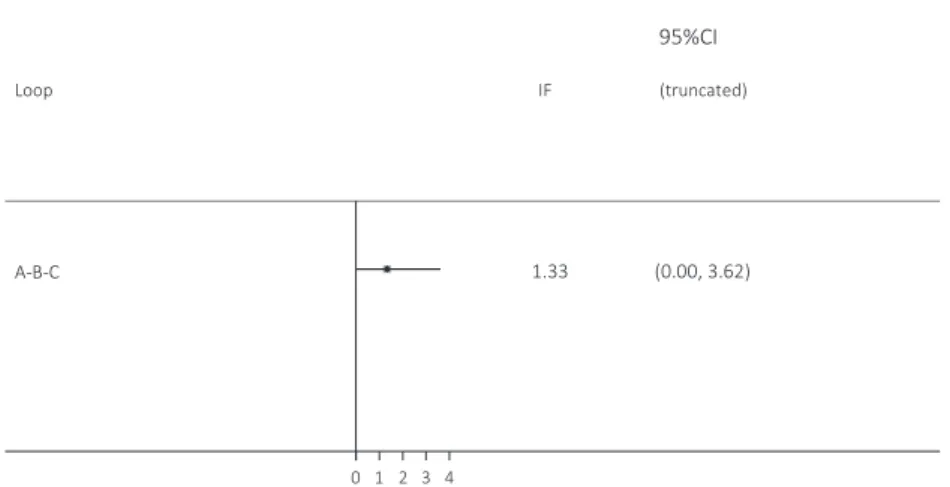
Network meta-analysis is performed based on the assumption of consistency, which should be confirmed in a closed loop of evidence. Here, the ifferences between direct and indirect evidence, expressed as inconsistency factors with 95% CIs and P values, were calculated by ana- lyzing the equivalence of the 2 types of evidence. Loops in which the lower CI limit did not reach the zero line were considered to exhibit significant inconsistency12,13).
Results
Search results and characteristics of the included studies
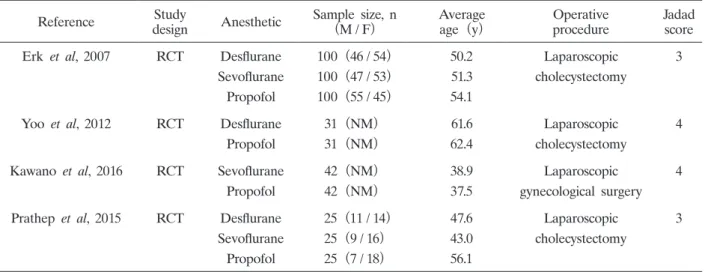
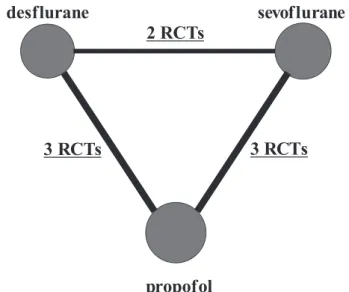
The study selection process is presented in Fig. 1. Of 39 studies retrieved from the databases, 35 were excluded as they did not compare the incidence of PONV after administration of maintenance anesthetics. The remaining 4 RCTs(n = 521 subjects)met the inclusion criteria and were included in the network meta-analysis presented here7-9,15). The characteristics of the 4 RCTs are shown in Table 1, and the anesthetics employed in these trials are described in Table 2. The mean age of patients in the 4 RCTs was 37.5-56.1 years. Two of the studies had Jadad scores of 4 and 2 had scores of 3, indicating that these were high quality studies. Fig. 2 presents all comparisons performed in the network meta-analysis. Desflurane was comparatively evaluated with sevoflurane and propofol in 2 and 3 RCTs, respectively, and sevoflurane was compared with propofol in 3 RCTs.
Risks of bias
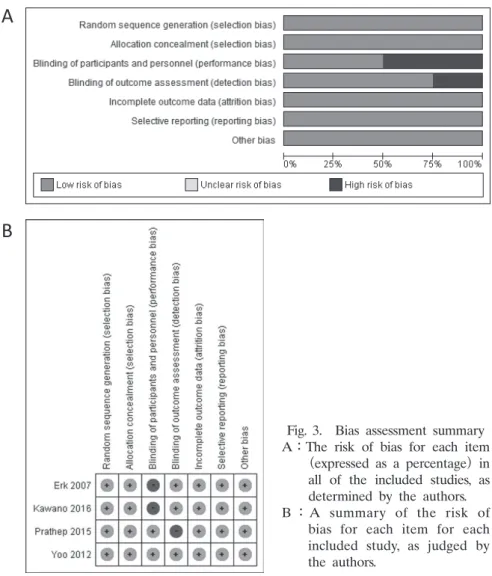
Apart from detection bias in 1 RCT and performance bias in 2 RCTs, all 4 RCTs were found to exhibit a low risk of bias for all evaluated factors. The risk of bias assessments, as deter- mined by the authors, is presented in Fig. 3.
Mixed comparison for incidence of PONV
The results of the present network meta-analysis are shown in Table 3. The odds of desflu- rane vs sevoflurane, desflurane vs propofol, and sevoflurane vs propofol influencing the incidence of PONV were 0.44(95% CI, 0.12-1.61), 2.43(95% CI, 0.72-8.26), and 5.50(95% CI, 1.78- 16.93), respectively.
Fig. 1. Flow diagram of the study selection process. RCT, randomized clinical trial.
Table 1. Summary of the 4 RCTs included in the network meta-analysis
Reference Study
design Anesthetic Sample size, n
(M / F) Average
age(y) Operative
procedure Jadad
score
Erk et al, 2007 RCT Desflurane 100(46 / 54) 50.2 Laparoscopic 3
Sevoflurane 100(47 / 53) 51.3 cholecystectomy
Propofol 100(55 / 45) 54.1
Yoo et al, 2012 RCT Desflurane 31(NM) 61.6 Laparoscopic 4
Propofol 31(NM) 62.4 cholecystectomy
Kawano et al, 2016 RCT Sevoflurane 42(NM) 38.9 Laparoscopic 4
Propofol 42(NM) 37.5 gynecological surgery
Prathep et al, 2015 RCT Desflurane 25(11 / 14) 47.6 Laparoscopic 3
Sevoflurane 25(9 / 16) 43.0 cholecystectomy
Propofol 25(7 / 18) 56.1
RCT, randomized controlled trial NM, not mentioned
Fig. 2. Network of studies eligible for comparison of treatment efficacy
The line width represents the number of studies compared for each pair of treatments, and the balloon size represents the total sample size of each treatment.
Table 2. Anesthetics evaluated in the randomized controlled trials included in the network meta-analysis Reference Details of evaluated anesthetics
Erk et al, 2007
• Anesthesia : maintained by propofol infusion(6 mg/kg/h), 50% N2O / O2 ventila- tion.
• Anesthesia : maintained with desflurane(average MAC=1.3), 50% N2O / O2
ventilation.
• Anesthesia : maintained with sevoflurane(average MAC=1.3), 50% N2O / O2
ventilation.
Yoo et al,
2012 • Anesthesia : maintained by propofol(2-5 mcg/ml)and remifentanil(2-5 ng/ml)
infusion.
• Anesthesia : maintained by desflurane(end-tidal concentration : 4%-7%)and remifentanil(effect site concentration : 2-5 ng/ml)infusion.
Kawano et al,
2016 • Anesthesia : maintained with sevoflurane(end-tidal concentration : approximately 1 MAC).
• Anesthesia : maintained by propofol infusion(4-8 mg/kg/h).
Prathep et al,
2015 • Anesthesia : maintained by desflurane infusion(end-tidal concentration : 2%-6%).
• Anesthesia : maintained by sevoflurane infusion(end-tidal concentration : 0.5%-3%).
• Anesthesia : maintained by propofol infusion(effect site concentration : 2-5 mcg/ml). MAC, minimum alveolar concentration
Analysis of ranking probability
The ranking of each anesthetic is presented in Table 4. The probabilities of desflurane, sevo- flurane, and propofol being the best treatment were 7.6%, 0.1%, and 92.3%, respectively. The corresponding probabilities for being the second-best treatment were 81.4%, 11.0%, and 0.1%,
Fig. 3. Bias assessment summary A:The risk of bias for each item
(expressed as a percentage)in all of the included studies, as determined by the authors.
B:A summary of the risk of bias for each item for each included study, as judged by the authors.
Table 3. Mixed comparison results of the network meta-analysis
Comparison of anesthetics OR(95% CI)
Desflurane vs sevoflurane 0.44(0.12, 1.61)
Desflurane vs propofol 2.43(0.72, 8.26)
Sevoflurane vs propofol 5.50(1.78, 16.93)
Results are expressed as odds ratio(OR)with a 95% confidence interval(CI)for the incidence of PONV with the first treatment relative to that with the second treatment.
respectively. Similarly, the probabilities for being the third-best treatment were 11.0%, 88.9%, and 0.1%, respectively. The incidence of PONV following administration of desflurane, sevoflu- rane, and propofol showed SUCRA scores of 48.3, 5.6, and 96.1, respectively(Fig. 4 ; Table 4).
Inconsistency test
The lower CI limit of IF reached the zero line, and we considered that there was no signifi- cant inconsistency(Fig. 5).
Discussion
In the present network meta-analysis, we assessed the differences in the incidence of PONV
Table 4. Ranking probabilities and SUCRA values
Treatment Best(%)a 2nd(%)a 3rd(%)a Mean rank SUCRAb
Desflurane 7.6 81.4 11.0 2.0 48.3
Sevoflurane 0.1 11.0 88.9 2.9 5.6
Propofol 92.3 7.6 0.1 1.1 96.1
SUCRA, surface under the cumulative ranking curve.
a. Probability(expressed as a percentage)of being the best, second-best, or third- best treatment.
b. SUCRA values for the incidence of PONV calculated from the network meta- analysis.
Fig. 4. Surface under the cumulative ranking curve for the incidence of post-operative nausea and vomiting for the 3 anesthetics.
after administration of desflurane and the conventional maintenance anesthetics sevoflurane and propofol in patients undergoing laparoscopic surgery. The results demonstrated that there were no significant differences in the incidence of PONV when comparing desflurane and sevoflurane or desflurane and propofol. These results are consistent with a previous meta-analysis, which also demonstrated no significant difference between desflurane and sevoflurane in influencing the incidence of PONV in patients undergoing surgery under general anesthesia16). In contrast, this study showed that the odds of PONV occurring after propofol administration were significantly lower than after sevoflurane administration, which was expected.
Of the 3 anesthetics, propofol exhibited the highest SUCRA score and the highest probability of being the best treatment. Of the remaining 2 anesthetics, desflurane had a higher SUCRA score and a higher probability of being the best treatment than sevoflurane. These results might be biologically plausible given that the pharmacokinetic properties of desflurane allow fast anesthesia induction and recovery, high molecular stability, and minimal metabolic degradation.
Desflurane also has the lowest organic toxicity of all halogenated anesthetics and is well-tolerated by the human body4,5). Our results suggest that desflurane is a safe anesthetic in terms of the incidence of PONV, and could be an alternative to guideline-recommended conventional anes- thetics in patients undergoing laparoscopic surgery under general anesthesia.
The present study is the first network meta-analysis to compare the incidence of PONV between desflurane and the conventional maintenance anesthetics sevoflurane and propofol with a focus on patients undergoing laparoscopy under general anesthesia. Although previous stud- ies directly compared the effects of these 3 anesthetics in all combinations on the incidence of PONV, our study statistically integrates direct and indirect comparisons and also allows simulta- neous comparison of multiple treatments17-19).
However, the present study has several limitations. First, we considered published studies only.
Fig. 5. Inconsistency plot of the network meta-analysis. IF, inconsistency factor ; CI, confidence interval.
Therefore it is possible that the present results might suffer from publication bias. Second, meta- analysis is a form of retrospective research ; therefore, it is subject to the same methodological limitations as all retrospective studies, including the possibility of outcome selection bias. In particular, we considered that further analysis was required because the results published by Erk and colleagues7)might have been obtained by using a statistical method with insufficient accuracy, even though this study had a high Jadad score. Third, the sample size in the present study was small : only 4 RCTs were analyzed. Meta-analysis of 4 or fewer studies is not uncommon, as seen in studies on orphan disease. Nevertheless, issues addressed by these meta-analyses might be considered unresolved in the presence of heterogeneity. Fortunately, the present data did not exhibit any heterogeneity. Finally, there is still no consensus whether the results of network- meta-analysis or pairwise meta-analysis provide more reliable and useful information about clinical practice. Further analysis including direct comparisons are essential to understanding the clinical efficacy and safety of these agents.
In summary, the results of this network meta-analysis suggest that desflurane is a safe anesthetic in terms of the incidence of PONV. Desflurane could be used as an alternative to guideline-recommended conventional anesthetics in patients undergoing laparoscopic surgery under general anesthesia. However, considering the limitations of this meta-analysis, further research is required to confirm the safety and efficacy of anesthesia with desflurane in patients undergoing laparoscopic surgery.
Acknowledgements
We are indebted to the authors of the primary studies included in this study.
Conflict of interest disclosure
The authors have no conflicts of interest to declare.
References
1)Wang X, Wang K, Wang B, et al. Effect of oxycodone combined with dexmedetomidine for intravenous patient- controlled analgesia after video-assisted thoracoscopic lobectomy. J Cardiothorac Vasc Anesth. 2016;30:1015-1021.
2) Mraovic B, Simurina T, Sonicki Z, et al. The dose-response of nitrous oxide in postoperative nausea in patients undergoing gynecologic laparoscopic surgery: a preliminary study. Anesth Analg. 2008;107:818-823.
3) Candiotti KA, Kovac AL, Melson TI, et al. A randomized, double-blind study to evaluate the efficacy and safety of three different doses of palonosetron versus placebo for preventing postoperative nausea and vomiting. Anesth Analg. 2008;107:445-451.
4) Eger EI, Eisenkraft JB, Weiskopf RB, eds. The pharmacology of inhaled anesthetics. 2nd ed. Chicago: HealthCare Press; 2002.
5) Sutton TS, Koblin DD, Gruenke LD, et al. Fluoride metabolites after prolonged exposure of volunteers and patients to desflurane. Anesth Analg. 1991;73:180-185.
6) Macario A, Dexter F, Lubarsky D. Meta-analysis of trials comparing postoperative recovery after anesthesia with sevoflurane or desflurane. Am J Health Syst Pharm. 2005;62:63-68.
7) Erk G, Erdogan G, Sahin F, et al. Anesthesia for laparoscopic cholecystectomy: comparative evaluation--desflurane/
sevoflurane vs. propofol. Middle East J Anaesthesiol. 2007;19:553-562.
8) Yoo YC, Bai SJ, Lee KY, et al. Total intravenous anesthesia with propofol reduces postoperative nausea and vom- iting in patients undergoing robot-assisted laparoscopic radical prostatectomy: a prospective randomized trial. Yonsei Med J. 2012;53:1197-1202.
9) Kawano H, Ohshita N, Katome K, et al. Effects of a novel method of anesthesia combining propofol and volatile anesthesia on the incidence of postoperative nausea and vomiting in patients undergoing laparoscopic gynecologi- cal surgery. Braz J Anesthesiol. 2016;66:12-18.
10) Jadad AR, Moore RA, Carroll D, et al. Assessing the quality of reports of randomized clinical trials: is blinding necessary? Control Clin Trials. 1996;17:1-12.
11) Higgins JPT, Green S, eds. Cochrane handbook for systematic reviews of interventions. Chichester, UK: John Wiley
& Sons; 2008. (Cochrane book series).
12) Higgins JP, Thompson SG, Deeks JJ, et al. Measuring inconsistency in meta-analyses. BMJ. 2003;327:557-560.
13) DerSimonian R, Laird N. Meta-analysis in clinical trials. Control Clin Trials. 1986;7:177-188.
14) Mantel N, Haenszel W. Statistical aspects of the analysis of data from retrospective studies of disease. J Natl Cancer Inst. 1959;22:719-748.
15) Prathep S, Mahattanaporn S, Wasinwong W. Target controlled infusion versus sevoflurane/desflurane anesthesia for laparoscopic cholecystectomy: comparison postoperative nausea/vomiting and extubation time. J Med Assoc Thai.
2015;98:1187-1192.
[Received January 4, 2017 : Accepted January 31, 2017]